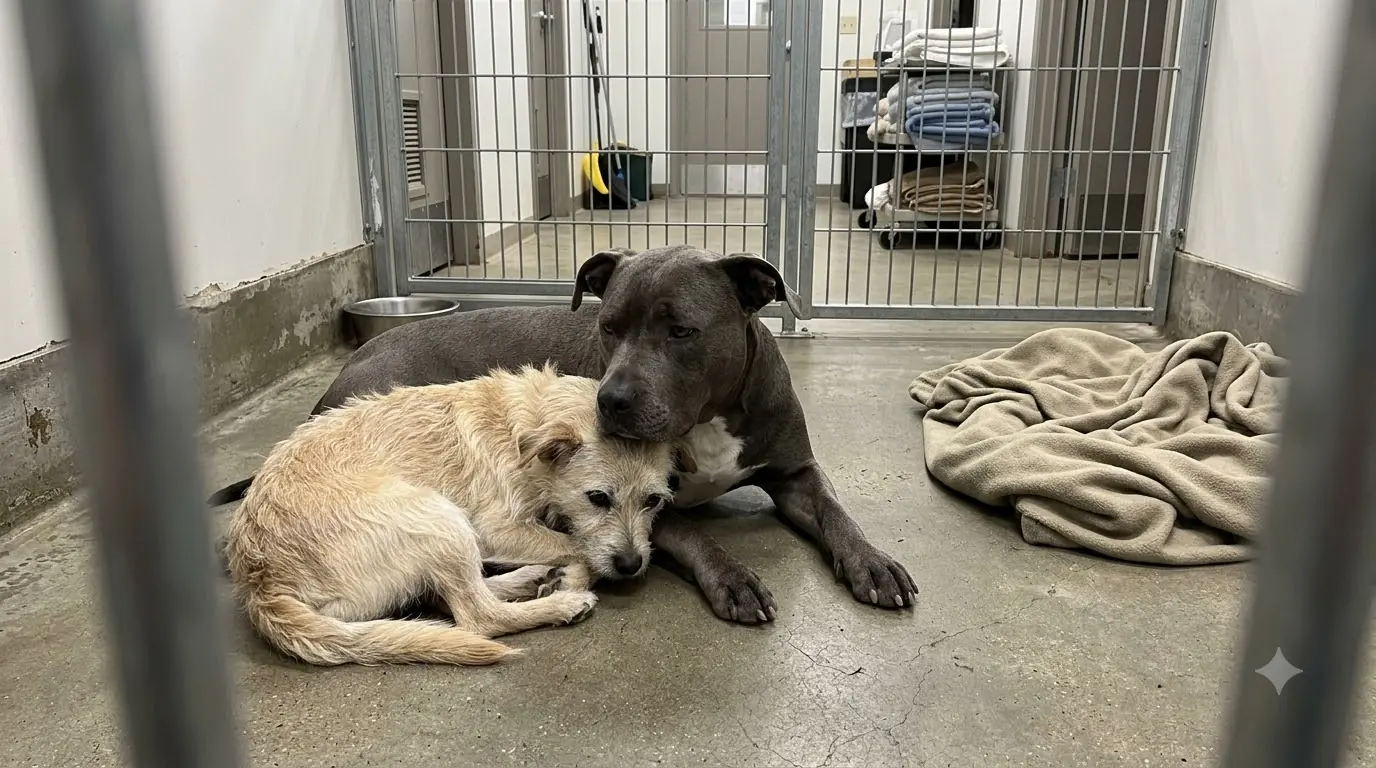
The thick blanket was usually Rocky’s.
Not because anyone assigned it to him.
Not because Milo was prevented from using it.
Rocky simply tended to get there first.
The 7-year-old Pit Bull mix would circle the blanket several times on colder evenings, push part of it beneath his chest with his paws, and curl tightly into the warmest section.
Milo, a much smaller 10-year-old Terrier mix, usually chose another part of their shared kennel.
There were additional thinner blankets and a raised bed available, and staff regularly checked that both dogs had appropriate places to rest.
The two dogs got along comfortably.
They ate separately.
They could move around one another without tension.
They sometimes rested close together, but they did not spend every moment touching.
Then one cold evening, something changed.
Milo began to tremble.
At first, staff thought he might simply be cold.
He was small.
He was older.
And despite the shelter’s indoor heating, temperatures near exterior kennel areas could feel cooler overnight.
Milo stood near the opposite side of the enclosure with his body slightly hunched.
His legs trembled.
Rocky was already beneath the thick blanket.
Then he lifted his head.
He watched Milo.
A few moments later, Rocky stood.
He stepped off the blanket and walked across the kennel.
He lowered himself beside the smaller dog.
Milo immediately moved closer.
His little body pressed against Rocky’s chest.
Rocky remained still.
The blanket stayed empty.
By the time staff checked again, both dogs were asleep together.
It was an unusually tender moment.
But for our medical team, one part of it needed a closer look.
Milo was still trembling more often than we expected.
Rocky and Milo Had Very Different Physical Needs
Sharing a kennel did not mean sharing the same medical picture.
Rocky was seven years old and substantially larger.
He had the broad chest and muscular frame common in many Pit Bull-type mixes, although his body condition was slightly lean.
He moved comfortably during routine walks.
He had a few areas of mild skin irritation and moderate dental tartar but no major problem requiring emergency treatment.
Milo was different.
At 10 years old, the Terrier mix was a senior dog.
His small frame made subtle changes in weight easier to see.
He had lost some muscle over his hindquarters.
His coat was thinner along portions of his back.
He moved with mild stiffness after long periods of rest.
And staff noticed that the trembling did not occur only when temperatures dropped.
Sometimes Milo trembled while standing indoors during the day.
That observation mattered.
A small older dog may shiver when cold, anxious, excited, or stressed.
But trembling can also occur with pain, weakness, metabolic problems, neurological disease, nausea, or other medical conditions.
We did not want to assume warmth was the only answer.
What We Knew About Their History
Rocky and Milo had entered our care with limited background information.
We could not verify exactly how long they had known each other before shelter intake.
Their ease around one another suggested familiarity, but behavior alone could not establish whether they had lived together for years or met more recently.
We also did not know Milo’s complete medical history.
There were no reliable records documenting previous treatment for arthritis, endocrine disease, neurological problems, or chronic pain.
Rocky’s history was similarly incomplete.
Nothing about their condition allowed us to conclude that they had been deliberately neglected, abused, or subjected to a particular hardship.
When an animal’s past is unknown, we say so.
Our responsibility is to evaluate what is happening now.
Milo’s Veterinary Examination
Milo received a complete senior examination.
His temperature was within a normal range.
He was not hypothermic at the time of evaluation.
That made environmental cold less likely to be the only explanation for his recurrent trembling.
His heart and lungs were carefully assessed.
A soft heart murmur was detected.
Murmurs are not uncommon in older small dogs, but they deserve appropriate evaluation rather than dismissal.
Milo was not coughing persistently.
He was not struggling to breathe.
There was no history of collapse during his shelter stay.
His abdomen was soft.
His eyes showed mild age-related lens changes without evidence of an acute eye emergency.
His ears had moderate debris and mild chronic inflammation.
His mouth showed significant dental disease.
Several teeth had heavy tartar, and there was gum recession around some areas.
His joints and spine were then examined carefully.
That produced another clue.
Milo Was Uncomfortable Through His Lower Back
When the veterinarian palpated Milo’s lower spine and hips, his muscles tightened.
He turned his head toward the examiner.
He did not snap.
He did not cry out dramatically.
But he clearly became less comfortable.
His hind legs also had reduced muscle mass.
His knees remained stable on examination, and there was no obvious acute fracture.
Milo could walk independently.
However, his stride was short, especially when he first stood after resting.
The veterinary team suspected chronic musculoskeletal pain.
Radiographs were recommended.
Rocky Was Examined Too
Because Rocky and Milo shared space and because Rocky was also entering his later adult years, he received his own thorough assessment.
Rocky’s heart and lungs sounded normal.
His abdomen was unremarkable.
His joints had good functional movement, though mild stiffness was noted in one hip.
Nothing suggested an acute orthopedic emergency.
His weight was slightly below ideal but not severely low.
Routine bloodwork and parasite screening were planned.
Rocky’s mild skin irritation appeared consistent with dermatitis rather than a major infectious process.
Treatment was straightforward.
Compared with Milo, Rocky’s medical needs were less complicated.
That allowed us to focus more attention on understanding why the smaller dog was trembling.
Baseline Bloodwork for Milo
A complete blood count and serum chemistry panel were performed.
Milo had mild age-related changes but no severe anemia.
His kidney values were slightly above the range expected in a young dog, though hydration status and age had to be considered.
The changes were not severe enough to diagnose advanced kidney failure based on one test.
His liver values did not suggest an acute hepatic crisis.
His blood glucose was normal.
That made severe hypoglycemia an unlikely explanation for the trembling episodes.
Electrolytes were also reviewed.
There was no dramatic abnormality that could account for his symptoms.
A urinalysis was performed to provide more information about kidney function.
Milo’s urine was adequately concentrated for his circumstances, though the results supported continued senior monitoring.
Nothing in the initial laboratory testing explained the trembling completely.
That made pain increasingly important.
Imaging Confirmed Chronic Degenerative Changes
Radiographs of Milo’s spine and hips revealed degenerative changes consistent with osteoarthritis and spondylosis.
Spondylosis refers to bony changes that develop along portions of the spine and are commonly seen in older dogs.
Not every radiographic change causes severe pain.
That distinction is important.
Imaging has to be interpreted alongside clinical signs.
In Milo’s case, the location of the changes matched areas where he showed discomfort during examination.
His reduced hind-limb muscle and stiffness after rest also supported chronic musculoskeletal pain as an important contributor.
The team could not say that every trembling episode was definitely caused by pain.
Anxiety and temperature could still influence him.
But chronic discomfort was confirmed.
A Pain-Management Trial
Milo began veterinary-prescribed pain management appropriate for his age and laboratory results.
Because older animals can be more vulnerable to medication-related effects, the team established a monitoring plan.
His appetite.
Drinking.
Urination.
Stool quality.
Energy.
Any vomiting or diarrhea.
All of those would matter.
Medication was only part of his treatment.
Milo received a thicker padded bed.
Non-slip surfaces were added where practical.
His walks were shortened but kept regular.
Complete inactivity can worsen muscle loss in older dogs.
The goal was gentle, consistent movement.
The Trembling Began to Change
Within the first week, staff noticed a difference.
Milo still trembled occasionally.
Cold mornings brought it out.
Loud barking sometimes did too.
But the prolonged episodes after standing became less frequent.
He seemed more comfortable rising from bed.
His first steps were less guarded.
That response supported the idea that pain had been contributing to his behavior.
It did not prove pain was the only factor.
So staff continued documenting when trembling occurred.
Patterns mattered.
Rocky Remained Close
Rocky seemed largely unconcerned with Milo’s medical examinations.
When Milo left the kennel for appointments, Rocky usually watched through the gate.
He did not panic.
He did not bark continuously.
But when Milo returned, Rocky almost always approached to sniff him.
Sometimes he sniffed Milo’s face.
Sometimes his shoulders.
Then the dogs went back to their routine.
That was encouraging.
Their relationship appeared strong without becoming completely dysfunctional during temporary separation.
The Blanket Moment Was Not a One-Time Event
After the first cold evening, staff began watching their sleeping choices more closely.
The thick blanket remained available.
Rocky still used it sometimes.
But on nights when Milo appeared especially stiff or sought contact, Rocky often slept closer to him.
Occasionally Milo climbed partly onto the blanket with Rocky.
Other nights, both ignored it and slept pressed together on the padded bed.
We did not describe Rocky as intentionally “sacrificing” warmth.
Dogs’ motivations cannot be known with that level of certainty.
What we could observe was that Rocky voluntarily left his preferred resting place and chose proximity to Milo.
Milo then settled against him.
That was enough to make the behavior meaningful without inventing an explanation.
Milo’s Dental Disease Needed Treatment Too
As his pain management stabilized and his laboratory results were reviewed, the veterinary team addressed another source of possible discomfort.
Milo’s mouth.
Senior dogs can live with substantial dental pain while continuing to eat.
The ability to finish a meal does not prove the mouth is comfortable.
Dental radiographs revealed disease below the gumline.
Several teeth required extraction.
Because Milo also had a heart murmur, anesthesia needed careful planning.
Evaluating the Heart Murmur
Chest radiographs did not show evidence of congestive heart failure.
An echocardiogram was recommended to characterize the murmur more precisely.
The findings were consistent with early degenerative mitral valve disease, a common condition in older small-breed dogs.
Milo did not have fluid accumulation in the lungs.
He was not in heart failure.
Depending on the exact cardiac measurements, immediate heart medication was not necessarily required.
What he did need was ongoing monitoring.
His foster or future adopter would need to watch for persistent coughing, increased sleeping respiratory rate, exercise intolerance, fainting, or breathing difficulty.
The diagnosis was added to his long-term care plan.
Dental Treatment Was Completed Safely
Once Milo’s cardiac status was understood, the anesthesia protocol was tailored to his needs.
His dental procedure proceeded with careful monitoring.
Diseased teeth were removed.
The remaining teeth were cleaned.
Pain management was continued afterward.
Milo ate soft food during recovery.
His first meal was small.
By the second day, his appetite improved.
Within a week, he appeared more comfortable chewing.
Addressing dental pain did not eliminate his spinal arthritis.
But reducing one source of discomfort made a meaningful difference to his overall quality of life.
Rocky’s Role Stayed Simple
People naturally wanted to assign Rocky a job.
Protector.
Caretaker.
Guardian.
We avoided those labels.
Rocky was a dog.
He did not replace veterinary treatment.
He did not understand Milo’s radiographs.
He was not responsible for monitoring medication.
His role was simpler.
He liked being near Milo.
And Milo appeared to find that proximity comforting.
That mattered.
But it remained one part of a much larger care plan.
Feeding Them Safely
Rocky and Milo were fed separately.
Their size difference alone made that important.
Rocky ate more quickly.
Milo took longer.
Allowing Rocky to finish Milo’s food would have made nutritional monitoring impossible and could create conflict even between dogs who otherwise shared space peacefully.
Their bowls were removed after each meal.
High-value chews were also managed carefully.
The dogs could be emotionally bonded and still need individual resources.
Responsible shared housing required both.
Milo’s Weight Needed Attention
Milo was slightly underweight.
Part of that may have been related to dental discomfort and chronic pain.
His previous feeding history was unknown.
He was transitioned onto a complete, balanced diet with measured portions appropriate for his size and medical status.
After dental recovery, his appetite became more consistent.
Weight gain was gradual.
We did not want rapid increases, especially because excess weight would worsen pressure on his arthritic spine and joints.
The target was healthy condition, not maximum weight.
Rocky’s Weight Was Managed Differently
Rocky needed a little more body condition but had a larger frame and greater calorie requirement.
His meals were calculated separately.
The shelter did not simply feed “two scoops each.”
Individual animals require individual plans.
Rocky maintained good muscle through his shoulders and front limbs.
His hindquarters were also in reasonable condition.
He enjoyed walks more than Milo and could tolerate longer distances.
That meant staff sometimes walked them separately.
Milo Did Not Like Being Left Behind at First
When Rocky went for his longer walk, Milo initially stood near the kennel gate.
He listened.
Sometimes he whined softly.
Staff used those periods to give Milo individual enrichment.
A food puzzle.
A calm grooming session.
A short sniff walk at his own pace.
Over time, Milo became better at resting while Rocky was away.
That was important.
A healthy bond should not require constant access to the other dog.
Rocky Also Benefited From Individual Time
Rocky enjoyed Milo’s company, but he clearly appreciated one-on-one attention too.
During solo walks, he became more playful.
He liked sniffing along fence lines.
He occasionally carried a soft toy.
He leaned against familiar staff for chest scratches.
When he returned to the kennel, Milo usually greeted him with a quick sniff.
Then both settled.
Those routines showed that the relationship allowed independence.
Bathroom Habits
Both dogs urinated normally.
Milo needed more frequent bathroom opportunities because older dogs can become uncomfortable when asked to hold urine for long periods.
There were no persistent accidents suggesting urinary disease.
His stool remained generally formed.
Rocky’s bathroom habits were also normal.
Staff documented any changes because appetite, stool, urination, and mobility are particularly useful indicators when monitoring older animals on medication.
Milo Had a Difficult Morning
Several weeks into treatment, Milo experienced a temporary increase in stiffness.
He remained on his bed longer than usual.
When he stood, his hind legs trembled noticeably.
Because he had known arthritis, it would have been easy to assume the cause.
We did not.
The veterinary team reexamined him.
There was no new neurological deficit.
He could still bear weight.
His temperature was normal.
He had not experienced an obvious injury.
The episode was considered consistent with a flare of his chronic musculoskeletal pain.
His treatment plan was reviewed.
Activity was reduced temporarily.
Within several days, he returned closer to baseline.
Rocky Changed His Sleeping Spot Again
During Milo’s flare, staff found Rocky sleeping beside him more frequently.
One evening, the thick blanket was positioned on the raised bed.
Rocky walked toward it.
He sniffed.
Then he looked across the kennel.
Milo was already lying on the floor bed.
Rocky walked over.
He turned once.
Then he lay down with his chest near Milo’s back.
Milo shifted until his body touched Rocky.
Again, we cannot say Rocky understood that Milo was having a painful day.
What we can say is that when given multiple resting choices, he chose to lie beside him.
A Quieter Kennel Helped Both Dogs
Because Milo’s trembling sometimes worsened during intense barking, we moved the pair to a quieter section when space became available.
The difference was noticeable.
Milo slept more deeply.
Rocky also rested more.
Neither dog needed constant entertainment.
Older animals often benefit from predictable periods of uninterrupted sleep.
Their enclosure continued to include multiple beds and blankets.
The thick blanket was no longer the only warm option.
And interestingly, that did not stop the dogs from sleeping together.
Foster Care Became the Next Step
Once Milo’s pain treatment, cardiac monitoring, and dental recovery were stable, a foster placement was considered.
The team strongly preferred to place the dogs together.
Their relationship was consistent.
They were compatible around shared space.
Temporary separations did not cause extreme panic.
And both repeatedly chose proximity when reunited.
An experienced foster caregiver agreed to take them as a pair.
Preparing the Foster Home
Milo’s age and mobility shaped the setup.
Rugs were placed on slippery floors.
Beds had low edges so he could step onto them easily.
A warm sleeping area was arranged away from drafts.
Rocky received his own large bed.
Milo received a smaller supportive bed.
A third shared resting area was added.
They had options.
The foster caregiver received written instructions for each dog separately.
Milo’s medications.
Milo’s cardiac monitoring.
Milo’s diet.
Rocky’s diet.
Exercise plans.
Follow-up appointments.
Everything was individualized.
Their First Evening in Foster Care
Rocky explored first.
He walked around the living room sniffing furniture.
Milo stayed closer to the entrance.
After several minutes, Rocky returned to him.
That appeared to encourage Milo to move forward.
The dogs found the beds.
Rocky tested the large one.
Milo investigated the small one.
For a while, they remained separate.
At bedtime, the foster caregiver expected them to stay that way.
They did not.
Milo got up.
He walked across the room.
Rocky was already lying down.
Milo lowered himself against Rocky’s chest.
Rocky barely moved.
By morning, both were still there.
The House Was Warmer, but They Kept Sleeping Together
The foster home maintained a comfortable indoor temperature.
Milo had multiple thick blankets.
There was no shortage of warm bedding.
Yet the pair frequently slept in contact.
That was useful information.
It suggested their proximity was not simply a response to inadequate shelter warmth.
Milo seemed to prefer the physical contact.
Rocky appeared comfortable providing it.
Some nights Milo used his own bed.
That was equally important.
He could rest independently.
Milo Became More Active at Home
With pain better controlled and his dental disease treated, Milo began moving more.
He followed the foster caregiver between rooms.
He became enthusiastic about meals.
He enjoyed short outdoor sniffing sessions.
His walks remained modest.
The goal was not to turn a 10-year-old Terrier mix with spinal degeneration into an athlete.
The goal was comfortable function.
He needed enough activity to maintain muscle without provoking pain.
Rocky Enjoyed Longer Walks
Rocky continued receiving separate longer outings.
He had more stamina.
His gait was comfortable.
He became interested in neighborhood scents and sometimes tried to extend the walk toward unfamiliar streets.
His foster caregiver kept the exercise consistent rather than dramatically increasing distance.
At seven, Rocky was not yet a senior in the same way Milo was, but long-term joint health still mattered.
Milo’s Trembling Became Less Frequent
Several weeks into foster care, the caregiver noticed that Milo could go entire days without obvious trembling.
Cold mornings still occasionally triggered a brief episode.
Unexpected noises could make him shake temporarily.
Stiffness after sleep remained.
But the persistent trembling seen at the shelter had decreased.
That was consistent with improved pain control, better rest, warmth, nutrition, and reduced environmental stress.
We could not identify one single intervention as responsible.
Recovery often works that way.
Several reasonable changes add up.
Follow-Up Bloodwork
Because Milo was receiving ongoing medication and had mild age-related kidney changes, follow-up laboratory testing was performed.
His kidney values remained stable.
His liver values were acceptable.
His hydration was good.
There was no significant anemia.
That allowed the current pain-management strategy to continue with ongoing veterinary oversight.
Periodic testing would remain important.
Older dogs change over time.
A medication that is appropriate now may need adjustment later.
Cardiac Monitoring
Milo’s heart murmur remained stable on examination.
His foster caregiver learned to count his sleeping respiratory rate.
There was no persistent increase.
He did not develop chronic coughing.
He did not faint.
His exercise tolerance was appropriate for his age and musculoskeletal condition.
Follow-up cardiac evaluation would be recommended according to his veterinary team’s schedule.
The heart disease had not disappeared.
It simply remained in an early, monitored stage.
Rocky Developed a Protective Habit Around Beds
One concern we watched for was resource guarding.
Because Rocky and Milo slept together so often, it was important to ensure Rocky was not becoming possessive of beds or blankets.
He did not.
Milo could approach.
Rocky could leave.
Both dogs could access separate beds.
There was no consistent growling, blocking, freezing, or guarding behavior observed around bedding.
That made shared resting safer.
Still, multiple beds remained available.
We never wanted affection to become obligation.
Adoption Planning Required Two Different Conversations
Keeping Rocky and Milo together was our preferred placement plan.
But potential adopters needed to understand what adopting the pair actually meant.
Rocky was seven and relatively healthy, though he would still need routine veterinary care, weight monitoring, dental follow-up, and appropriate exercise.
Milo was 10 with chronic osteoarthritis and spinal degeneration, a history of dental disease, and early degenerative heart disease.
His long-term costs and medical needs would likely be greater.
That reality needed to be discussed openly.
Emotion alone is not enough for a successful adoption.
Preparation matters.
Milo May Need More Help as He Ages
His mobility could decline.
His arthritis treatment may require adjustment.
He may eventually need ramps or additional traction.
His heart disease could progress.
Dental follow-up will remain important.
Senior bloodwork should continue.
None of those possibilities mean Milo cannot have an excellent quality of life.
They mean his family needs to understand that older-dog care evolves.
Rocky may also become more medically complex as he ages.
Adopting them together means preparing for two dogs moving through different stages of adulthood.
The Pair Could Still Function Separately
Before finalizing placement recommendations, the foster continued short separations.
Rocky could go for a walk while Milo remained home.
Milo could attend a veterinary appointment while Rocky rested.
Both noticed the other’s absence.
Neither became dangerously distressed.
That was reassuring.
They were strongly bonded, but their welfare did not appear to depend on never spending a minute apart.
One Cold Night in Foster Care
Several months after their shelter intake, temperatures dropped sharply overnight.
The foster caregiver placed extra blankets on every bed.
Rocky selected one near the couch.
Milo initially curled beneath a blanket in his own bed.
Later that night, the caregiver walked through the room.
Milo had moved.
The little Terrier was now beside Rocky.
His back was pressed against Rocky’s chest.
Rocky’s front leg rested loosely near Milo’s shoulder.
Two warm beds sat empty nearby.
This time, there was no medical concern behind the scene.
Milo was stable.
His pain was managed.
The house was warm.
They had simply chosen each other again.
What We Can Say About Their Bond
We cannot say Rocky understands Milo’s diagnoses.
We cannot say he consciously gives up blankets because he knows Milo is older.
We cannot call him Milo’s nurse.
Those are human interpretations.
What we can document is still remarkable.
When Milo trembled, Rocky frequently moved closer.
Milo sought physical contact with him.
Rocky tolerated and often appeared to choose that contact.
They slept together even when alternative warm beds were available.
They remained calm during temporary separation.
Their relationship appeared voluntary and mutually comfortable.
That is enough.
Rocky and Milo Today
Rocky remains the larger, younger, more physically capable member of the pair.
He enjoys walks.
He has a healthy appetite.
He likes soft bedding.
He frequently seeks attention from familiar people.
Milo remains slower.
He takes more time getting up.
His walks are shorter.
His chronic arthritis and spinal degeneration require ongoing management.
His early heart disease requires monitoring.
His dental treatment has improved his comfort.
His weight has moved into a healthier range.
And the trembling that first concerned us has become much less frequent.
There are still difficult mornings.
Milo sometimes wakes stiff.
On cooler days, he may briefly shiver until he warms up and starts moving.
Those moments are monitored rather than ignored.
Rocky is often nearby.
Sometimes he stays on his own bed.
Sometimes he walks over.
Milo is given the same choice.
No one places them together for photographs.
No one tucks Milo beneath Rocky’s leg.
No one asks Rocky to surrender his resting space.
They decide.
Most nights, three comfortable sleeping areas are available.
Sometimes Rocky chooses one and Milo another.
But surprisingly often, when the lights go down, Milo gets up.
He crosses the room.
Rocky shifts.
Milo presses his small body against the larger dog’s chest.
Then both settle.
Their first memorable cold night in the shelter ended with the thick blanket lying untouched while the two dogs slept together.
Today, they no longer have to choose between warmth and space.
They have both.
And yet, more often than not, they still choose the same place.