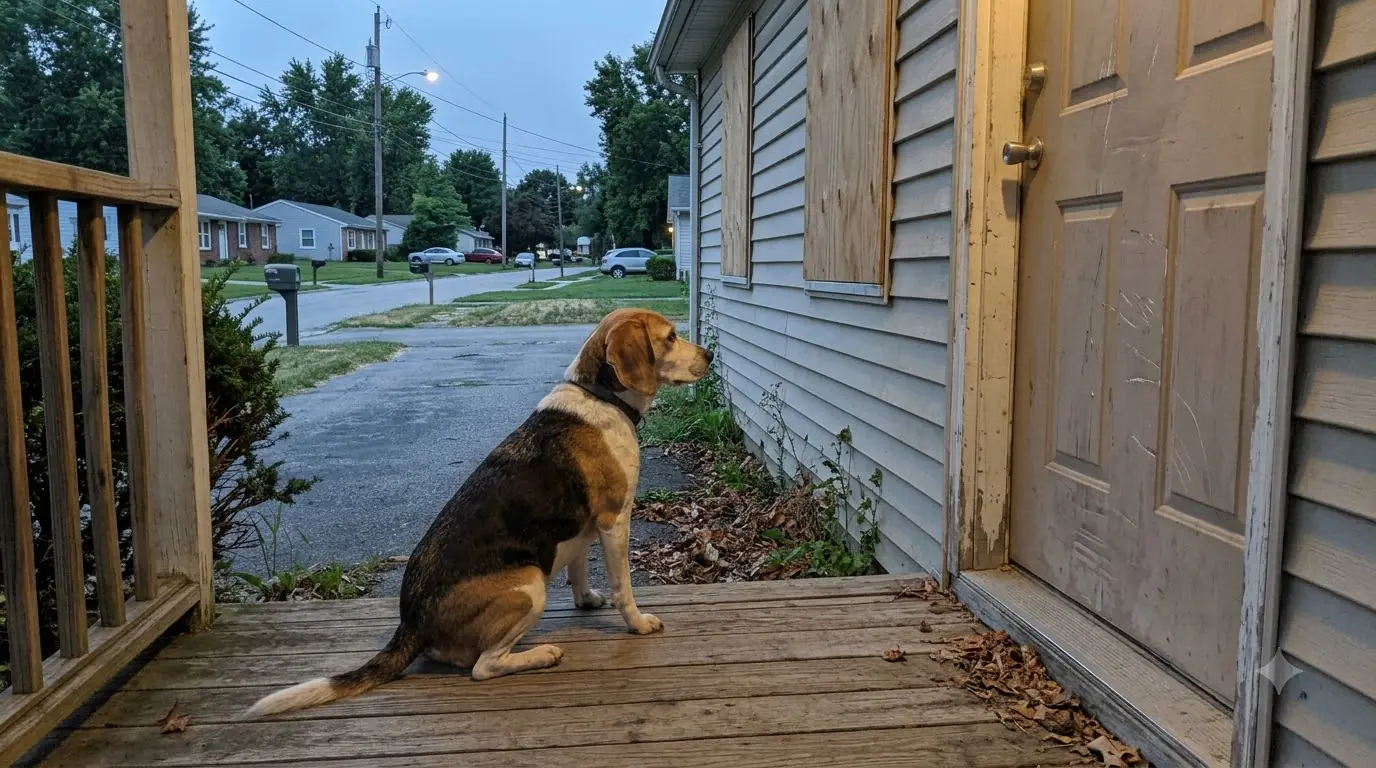
For several days, neighbors noticed the same dog returning to the same porch.
The house had been vacant for some time.
Its windows were boarded.
No lights came on at night.
No one entered through the front door.
Still, every evening, a 9-year-old Beagle mix climbed the porch steps as though he expected the house to open for him.
He sniffed along the bottom edge of the door.
Then he lifted one front paw and scratched gently.
Not frantically.
Not hard enough to damage the wood.
Just a few quiet movements.
After that, Toby turned around and sat facing the driveway.
He watched passing cars.
He watched people walking farther down the street.
He listened whenever a vehicle slowed.
As darkness settled over the neighborhood, Toby eventually gave up his watch.
He curled his body against the front door and slept.
By morning, he was usually still there.
We cannot confirm exactly why Toby kept returning to that house.
We do not know whether he had once lived there.
We do not know whether someone connected to the property had fed him.
We do not know whether the porch had simply become the place he considered safest.
The house was empty, and no reliable history was available.
What neighbors could verify was that Toby returned repeatedly.
And over time, they became increasingly worried about his condition.
A Dog Who Kept Coming Back
At first, people left food and water near the porch.
Toby accepted both.
He was cautious when strangers approached directly, but he did not immediately run.
If someone remained several feet away, he often stayed near the steps and watched.
His nose was constantly working.
He sniffed the bowls.
The porch railing.
The grass near the driveway.
The cracks along the front door.
Typical Beagle curiosity was still there.
But so was fatigue.
Neighbors noticed that Toby was getting slower.
He sometimes paused before climbing the porch steps.
His ribs appeared more visible than they had at first.
When he lay down, he stayed down for long periods.
After several nights of cold weather, a local rescue contact was called.
A volunteer arrived during the afternoon, before Toby returned for his usual evening routine.
She waited nearby.
Just before sunset, Toby appeared from the side of the property.
He walked toward the porch.
He climbed the steps.
He sniffed beneath the door.
Then he scratched once with his paw.
The volunteer watched him sit facing the driveway.
That was when she approached.
Bringing Toby to Safety
Toby noticed her immediately.
His body became still.
His ears shifted slightly backward.
The volunteer stopped several feet away and turned her body sideways.
She tossed a few small treats onto the porch.
Toby sniffed.
He ate the closest one.
Then he looked toward the driveway again.
More treats were offered.
Gradually, Toby moved closer.
He did not show overt aggression.
He also did not appear comfortable enough for someone to reach suddenly over his head.
The volunteer gave him time.
Eventually, a slip lead was placed gently around his neck.
Toby froze for several seconds.
Then he followed.
As they descended the porch steps, Toby turned his head back toward the front door.
The volunteer paused.
Toby looked at it.
Then, after a moment, he continued toward the vehicle.
He climbed inside with assistance.
The vacant house disappeared behind them.
His First Hours at the Shelter
Toby arrived quiet and tired.
He was thin enough that staff could feel his ribs and spine more easily than expected.
His coat was dull.
There was mild dirt staining around his legs and underside.
His nails were moderately overgrown, suggesting that he had not been walking consistently on surfaces that naturally wore them down.
He drank water after settling into the medical intake area.
Because he appeared mildly dehydrated, staff monitored how much he drank and began supportive care.
Food was offered in a measured amount.
Toby approached it immediately.
He sniffed the bowl for several seconds before eating.
He ate slowly.
Not because he lacked interest.
He seemed interested in every smell.
But chewing appeared uncomfortable.
He dropped a few pieces.
Then he picked them up again.
That detail was documented for the veterinarian.
Toby’s First Veterinary Examination
A full examination began once Toby had time to settle.
His temperature was within an expected range.
His respiratory rate was not dangerously elevated.
His lungs sounded clear.
His abdomen was soft, and no obvious large mass was felt during palpation.
His eyes showed age-related changes but no immediate emergency.
His ears contained wax and mild inflammation.
His skin was dry in places, but there were no severe open wounds.
His joints were another area of concern.
Toby was stiff when he first stood.
His hind legs moved with a shortened stride, especially after resting.
He did not have an obvious acute fracture or severe lameness.
However, reduced muscle condition and age-related joint discomfort were suspected.
Then the veterinarian examined his mouth.
That was one of the clearest problems.
Toby had substantial tartar accumulation, inflamed gums, and several teeth that appeared badly diseased.
Dental pain could easily explain why chewing had become slow and awkward.
But there was another finding.
While listening to Toby’s chest, the veterinarian detected a heart murmur.
The Heart Murmur Changed the Plan
A heart murmur is not a diagnosis by itself.
It is a sound produced by turbulent blood flow.
Some murmurs are relatively mild.
Others may indicate structural heart disease.
Because Toby was nine years old and had no known medical history, the finding required further evaluation.
Before scheduling dental treatment under anesthesia, the veterinary team wanted to understand his cardiac status.
Baseline bloodwork was collected.
A complete blood count showed mild anemia, though not severe enough to require emergency treatment.
His serum chemistry panel did not reveal acute kidney or liver failure.
Protein levels were slightly low, which could have been related to nutritional status, inflammation, chronic disease, or another cause.
Urinalysis was performed as well.
Nothing in the urine suggested a major urinary emergency.
Heartworm testing was negative.
That was reassuring.
Still, the murmur remained unexplained.
Cardiac Imaging
Chest radiographs were obtained.
They did not show severe fluid accumulation in the lungs.
There was no evidence of congestive heart failure at that time.
The heart silhouette was mildly enlarged.
Because that finding could have several explanations, Toby was referred for an echocardiogram.
An echocardiogram uses ultrasound to evaluate the heart’s chambers, valves, and function in real time.
The study showed degenerative changes of the mitral valve consistent with early-stage myxomatous mitral valve disease.
This condition is common in older small and medium-sized dogs.
Toby’s disease had not progressed to congestive heart failure.
That distinction was important.
He did not need emergency hospitalization for fluid around his lungs.
He did need monitoring.
His veterinary team documented the stage of disease and discussed how often he should be rechecked.
At this stage, treatment decisions would depend on measurements, progression, and clinical signs.
What the Diagnosis Meant
Toby’s heart disease was real.
But it did not explain everything.
His thin body condition.
His dental pain.
His stiffness.
His fatigue.
His outdoor living situation.
All of those needed to be addressed individually.
The heart murmur became part of his long-term medical picture, not a reason to stop planning for recovery.
Staff were instructed to watch for coughing, increased resting respiratory rate, exercise intolerance, fainting, rapid breathing, or other changes that could suggest progression.
His foster or future adopter would need to understand those signs too.
But for now, Toby was stable.
Dental Disease Was Still a Major Problem
With his cardiac status better understood, the team revisited Toby’s mouth.
Dental radiographs were recommended because much of dental disease exists below the gumline.
Toby had several teeth with significant periodontal disease.
Some were loose.
Others had evidence of infection around their roots.
The veterinary team decided that a dental procedure was necessary.
Because anesthesia carries risk in every patient and requires extra planning in dogs with heart disease, Toby’s protocol was tailored carefully.
His cardiac findings were reviewed.
Pre-anesthetic bloodwork was assessed.
Monitoring equipment was prepared.
The goal was not zero risk.
No anesthesia can offer that.
The goal was informed, appropriate risk management.
Stabilizing Him Before the Procedure
Before dental treatment, Toby received several days of supportive care.
His hydration improved.
His meals were softened.
That immediately helped.
He still ate slowly, but chewing required less effort.
He also received pain management selected by his veterinarian.
Within days, staff noticed that Toby approached meals more confidently.
His appetite had always been present.
Pain had been interfering with how comfortably he could act on it.
His weight was checked regularly.
The goal was gradual improvement.
We did not dramatically increase his calories all at once.
Instead, he received measured meals with complete and balanced nutrition.
Parasite Screening
Because Toby had been living outdoors and his preventive history was unknown, parasite testing was part of the intake workup.
A fecal examination identified whipworm infection.
Whipworms can contribute to gastrointestinal irritation, weight loss, and intermittent loose stool.
Toby did not have severe diarrhea at intake, but his stool quality had varied.
He began an appropriate deworming protocol.
Because whipworms can be challenging due to their life cycle and environmental persistence, follow-up treatment and repeat testing were included in his plan.
The shelter environment was cleaned carefully according to standard infection-control procedures.
The Dental Procedure
Once Toby was considered medically stable enough, he underwent dental treatment.
Dental radiographs confirmed advanced disease in several teeth.
Multiple extractions were necessary.
The veterinarian removed teeth that were painful, unstable, or infected.
Other teeth were cleaned thoroughly.
Toby received appropriate anesthetic monitoring throughout the procedure.
His heart rhythm, blood pressure, oxygenation, ventilation, and other important parameters were watched closely.
The procedure was completed without a major complication.
Afterward, Toby was moved into recovery.
He was drowsy.
His mouth was sore.
Pain medication was continued.
Soft food would be required while the extraction sites healed.
Eating Became Easier
The first evening after the procedure, Toby ate only a small portion.
That was not unexpected.
By the next day, his interest improved.
Several days later, staff noticed something different.
Toby no longer dropped pieces of food.
He ate steadily.
He still sniffed every meal as though conducting a full inspection.
That behavior was simply Toby.
But once he started eating, the process looked easier.
His mouth was healing.
The chronic pain from diseased teeth was no longer dominating every bite.
The Porch Behavior Followed Him
Toby did not have a porch inside the shelter.
But he had doors.
And he watched them.
Whenever someone entered the medical ward, Toby lifted his head.
If the footsteps approached his kennel, he stood.
If they passed, he sometimes remained standing for several seconds.
Then he returned to his bed.
At night, Toby often slept near the front portion of his kennel rather than in the farthest corner.
He seemed to prefer keeping the door within view.
We could not know whether that behavior had anything to do with the vacant house.
It could simply have been a habit developed during his time outdoors.
We did not assign meaning beyond what we could observe.
His Stiffness Needed Attention Too
Once Toby’s more urgent medical concerns were under control, his movement was evaluated more closely.
Orthopedic examination suggested chronic discomfort in his hips and lower back.
Radiographs showed degenerative changes consistent with osteoarthritis.
There was no acute fracture.
His muscle mass was reduced, particularly in the hind limbs.
At nine years old, chronic joint disease was not surprising.
But it still deserved treatment.
A pain-management plan was developed based on his overall health.
Controlled exercise was introduced gradually.
Supportive bedding was provided.
Slippery surfaces were minimized.
Toby did not need intense exercise.
He needed regular, comfortable movement.
Short Walks Became His Favorite Part of the Day
Toby loved using his nose.
His first shelter walks were slow.
He stopped constantly.
Grass.
Fence posts.
Leaves.
Tree roots.
Every scent seemed important.
That made controlled walking surprisingly easy.
Toby was not interested in racing ahead.
He wanted time to investigate.
Staff allowed him to sniff as long as his stamina remained appropriate.
At first, outings were brief.
As his nutrition improved and his joints became more comfortable, the walks grew gradually longer.
His stride remained somewhat stiff after rest, but he warmed up quickly.
His Weight Began to Improve
Toby gained weight slowly over the following weeks.
His ribs became less prominent.
His coat improved.
The muscles around his shoulders and hindquarters began filling in.
His appetite remained strong after dental treatment.
Because older Beagle-type dogs can gain excess weight easily once food becomes abundant, staff monitored his condition carefully.
The goal was not simply to make him heavier.
Extra weight would place unnecessary stress on his joints and potentially complicate his heart disease.
We aimed for a lean, healthy body condition.
Bathroom Habits
Toby urinated normally during outdoor breaks.
He did not show persistent straining or unusual frequency.
His bowel movements improved after deworming and dietary stabilization.
Occasional softer stool occurred during the transition period, but no sustained severe diarrhea developed.
Follow-up fecal testing was scheduled.
Staff continued observing appetite, water intake, stool quality, urine output, and weight because small changes can provide early clues in older dogs with multiple medical issues.
Emotional Recovery Was Quieter
Toby did not become dramatically playful overnight.
His personality emerged in smaller ways.
He began approaching familiar staff before they entered his kennel fully.
He leaned into slow chest scratches.
He sometimes rested his chin on a person’s knee.
He developed a habit of sniffing pockets where treats were usually stored.
He also began wagging his tail more frequently.
Not wildly.
Usually just a few slow movements.
His affection was understated.
That made it easy to miss unless someone spent time with him.
One Behavior Became Familiar
Whenever someone walked away, Toby often watched.
He did not cry.
He did not bark continuously.
He simply followed the person with his eyes.
Sometimes he stood at the kennel door.
Then, after several seconds, he turned around.
During his early shelter days, that pattern happened almost every time.
Later, it became less frequent.
Toby started returning to his bed before the person had completely disappeared down the hallway.
That small shift suggested that the environment was becoming more predictable.
A Foster Home Offered Something the Shelter Could Not
Once Toby was medically stable, we began looking for foster placement.
He had several reasons to benefit from a home environment.
His heart disease needed monitoring.
His arthritis required controlled activity.
His dental recovery needed observation.
And emotionally, a quieter routine might help him settle.
An experienced foster caregiver agreed to take him.
Before discharge, the foster received detailed instructions.
Medication schedule.
Diet.
Activity recommendations.
Signs of cardiac progression.
Dental aftercare.
Parasite follow-up.
Weight targets.
Nothing was left vague.
Toby’s First Evening in Foster Care
Toby entered the home slowly.
He sniffed the doorway.
Then he sniffed the floor.
Then he walked toward the living room.
A bed had been placed near a wall, with a clear view of the front door.
Toby found it almost immediately.
He stood beside it.
Then he walked toward the door.
He sniffed along the bottom edge.
His foster caregiver watched quietly.
Toby lifted one paw.
For a second, it looked as though he might scratch.
Instead, he lowered the paw.
Then he turned around and sat.
He faced the door.
After several minutes, he lay down.
The First Night
Toby slept lightly.
When a car passed outside, his head came up.
When headlights briefly moved across the wall, he watched.
The foster caregiver did not force him away from the door.
He had access to a comfortable bed.
He had water.
He was warm.
He could choose where to rest.
Sometime after midnight, Toby moved away from the entrance.
He walked to the prepared bed.
He circled twice.
Then he curled up.
By morning, he was still there.
Household Routine Helped Him Settle
Toby learned the daily schedule quickly.
Morning bathroom break.
Breakfast.
Medication or supplements when prescribed.
Rest.
Short walk.
Another rest period.
Dinner.
Evening bathroom break.
Bedtime.
Predictability seemed to reduce his need to monitor every movement.
After several weeks, Toby no longer rose every time his foster caregiver walked through the room.
He began sleeping through routine household noise.
The front door still interested him.
But it no longer controlled his entire evening.
His Heart Disease Required Ongoing Monitoring
Toby returned for a scheduled cardiac recheck.
His heart murmur remained.
His resting respiratory rate at home remained within the range his veterinary team considered acceptable.
He had not developed persistent coughing, fainting, or breathing difficulty.
There was no evidence that he had entered congestive heart failure.
His echocardiographic findings continued to support early degenerative mitral valve disease.
The plan remained monitoring rather than treating symptoms he did not yet have.
His foster caregiver learned how to count sleeping respiratory rate.
That simple home measurement can be useful when monitoring dogs at risk of congestive heart failure.
If his breathing pattern changed persistently, the veterinary team wanted to know.
Arthritis Management Improved His Daily Comfort
Toby’s movement continued to improve with appropriate pain control and regular low-impact activity.
His walks remained moderate.
He was allowed to sniff extensively.
That provided mental stimulation without requiring strenuous exercise.
His foster home used rugs over slippery flooring.
A low, supportive bed reduced the effort required to settle.
Stairs were limited.
Toby still moved slowly when first waking.
But he no longer paused as long before standing.
His hind limbs became stronger as his nutrition and activity improved.
A Small Setback
Several weeks into foster care, Toby developed a cough.
Given his heart disease, the symptom was taken seriously.
The foster contacted the veterinary team immediately.
Toby was examined.
His resting respiratory rate had not increased significantly.
Chest imaging did not show pulmonary edema.
The cough was ultimately considered more consistent with an upper-airway irritation than congestive heart failure.
Supportive care was provided.
The cough resolved.
The episode reinforced an important lesson.
In a dog with known heart disease, new respiratory signs should not be ignored.
But they also should not automatically be assumed to represent heart failure without evaluation.
Repeat Bloodwork
Toby’s mild anemia improved as his nutrition stabilized.
His protein levels moved closer to normal.
Kidney and liver values remained acceptable.
His weight increased into a healthier range.
His stool remained stable after parasite treatment.
Follow-up fecal testing helped confirm that the deworming plan had been effective.
His overall medical picture was now far better understood than it had been at intake.
What We Could Confirm
Toby had several real medical problems.
Significant periodontal disease.
Chronic osteoarthritis.
Whipworm infection.
Mild dehydration and low body condition at intake.
Early degenerative mitral valve disease.
Each issue required its own treatment or monitoring plan.
None of them justified inventing a dramatic explanation for his past.
We still could not confirm why Toby had been living outside the vacant house.
We could not prove that he had been left there.
We could not say he had belonged to the previous occupants.
We could not know whether he was waiting for a specific person.
Those details remained unknown.
What Changed Most in Foster Care
The biggest change was not his weight.
It was where he chose to sleep.
During his first week, Toby often positioned himself where he could see the front door.
By the second week, he began sleeping farther into the room.
By the third, he occasionally followed his foster caregiver into the bedroom at night.
One evening, the caregiver returned home after a short errand.
Toby was lying on his bed.
He lifted his head when the door opened.
His tail began tapping.
He stood.
Walked over.
Sniffed the caregiver’s shoes thoroughly.
Then he followed into the kitchen.
He did not stay behind watching the door.
Preparing Toby for Adoption
Toby’s future family will need to understand that he is an older dog with ongoing medical needs.
His heart disease will require periodic veterinary monitoring.
His arthritis will require weight management, appropriate exercise, and potentially long-term pain-control strategies.
His dental health will need routine follow-up even after the diseased teeth have been addressed.
Parasite prevention should continue consistently.
Senior wellness examinations will become increasingly important as he ages.
These needs do not make Toby unadoptable.
They simply mean his future family should be prepared for responsible long-term care.
The Kind of Home Toby Needs
Toby seems to do best in a predictable household.
He enjoys people.
He likes gentle attention.
He loves sniffing walks.
He rests often.
He does not need constant stimulation.
A home that expects nonstop activity would probably not be ideal.
Any resident animals would need appropriate introductions and compatibility assessment.
His future adopters should also understand that transitions may temporarily make him more watchful.
He may monitor doors.
He may sleep lightly.
He may follow people around.
Those behaviors should be met with patience, not punishment.
Toby Today
Toby is no longer sleeping against the front door of an empty house.
His dental pain has been treated.
His parasite infection has been addressed.
His weight has improved.
His coat looks healthier.
His mobility is better with arthritis management.
His heart disease remains stable and continues to be monitored.
He still has medical needs.
He always will.
But he is no longer trying to manage them alone outside.
And he is no longer returning each evening to a porch where no one answers.
There are moments when Toby still hears a car outside and raises his head.
Sometimes he walks toward the window.
Sometimes he looks at the front door.
But more often now, he stays where he is.
His foster caregiver moves through the room.
Toby watches for a second.
Then his eyes close again.
The front door is no longer the only place that feels important.
His bed matters.
The kitchen matters.
His walking route matters.
The person sitting nearby matters.
Those ordinary routines have slowly replaced the endless waiting.
We may never know what Toby expected when he scratched at the door of that vacant house.
Maybe he had a history there.
Maybe he did not.
Maybe the porch simply felt familiar after everything else had changed.
What matters now is that when Toby wakes in the morning, someone is there.
When he finishes breakfast, someone notices.
When he needs medication, someone remembers.
When his joints are stiff, his walks are adjusted.
When his heart needs monitoring, appointments are scheduled.
And when darkness comes, Toby no longer climbs the steps of an empty porch and curls against a door that will not open.
He chooses his bed.
He turns in a small circle.
He lowers himself slowly.
Sometimes his nose rests near his paws.
Sometimes his tail taps once against the blanket when his foster caregiver walks past.
Then Toby closes his eyes.
This time, he is not waiting alone.