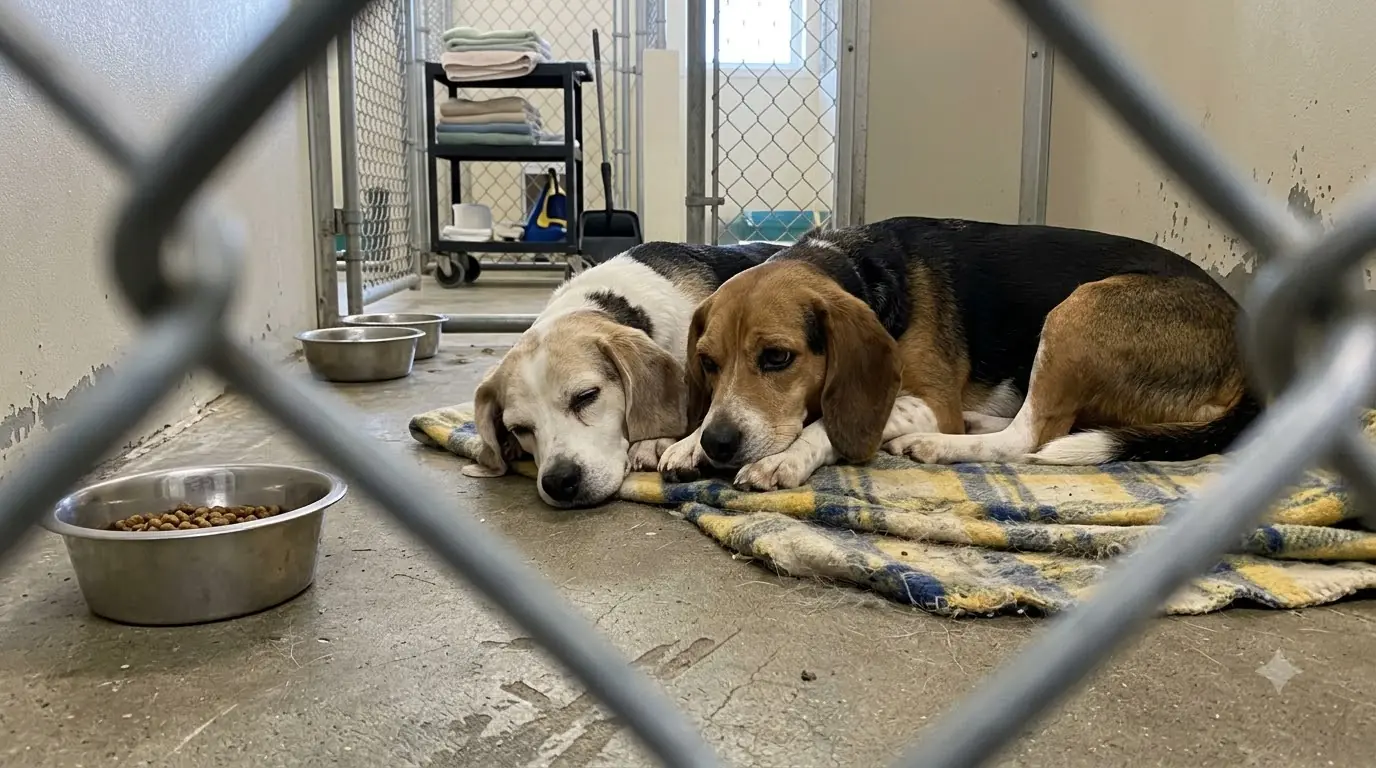
From the beginning, Bella and Daisy behaved like two dogs who were used to keeping track of each other.
The two 6-year-old Beagle mixes arrived at our shelter together, and while we did not have a complete history of their life before intake, it was immediately clear that they were comfortable sharing space.
They did not constantly cling to one another.
They did not panic every time one dog stepped several feet away.
But they checked.
Bella looked for Daisy when people entered the kennel.
Daisy often followed Bella during outdoor breaks.
When one dog stood up from the bed, the other usually lifted her head.
At night, they frequently chose the same blanket even when additional bedding was available.
The behavior that stood out most, however, happened at mealtime.
Their bowls were placed on opposite sides of the kennel to reduce pressure and allow each dog to eat comfortably.
Daisy usually approached her food first.
Bella did not.
Instead, she watched.
She stood near her own bowl, sometimes sniffing it, but she waited until Daisy lowered her head and began eating.
Only then did Bella start her meal.
At first, staff wondered whether Bella was simply cautious around food.
But the pattern repeated.
Breakfast.
Dinner.
The following morning.
Bella waited for Daisy.
Then, one day, Daisy did not get up.
The Morning Something Changed
Breakfast was delivered at the usual time.
Bella stood almost immediately.
Daisy remained curled on the blanket.
Staff gave her a moment.
Some dogs simply wake slowly.
Daisy lifted her head but made no effort to move toward her bowl.
That was unusual.
Bella walked to her food.
She looked across the kennel.
Daisy had not moved.
Bella sniffed her breakfast, then turned away.
She walked back across the kennel and lowered herself beside Daisy.
After settling, Bella gently licked one of Daisy's ears.
Then she stretched her neck forward and rested her chin across Daisy's front paws.
That quiet moment made the change impossible to dismiss.
A dog skipping one meal can happen for many reasons.
A dog who is normally food-motivated, remains curled up, and behaves differently from baseline deserves attention.
Daisy was moved for a veterinary examination.
Bella watched her leave.
Separating Them for Medical Care
Because the dogs appeared closely bonded, staff considered how to separate them without creating unnecessary stress.
Daisy needed medical evaluation.
Bella did not need to accompany her into every procedure.
Instead, Bella was kept in a nearby quiet area where she could hear familiar staff and maintain a predictable routine.
She was offered breakfast again.
She sniffed it.
This time she ate a small amount, but she repeatedly paused and looked toward the doorway.
The reaction did not prove Bella understood that Daisy was sick.
We cannot know exactly what she interpreted.
What we could observe was that Daisy's absence changed Bella's behavior.
That information became part of their care plan.
Daisy’s First Examination
Daisy was quiet but responsive.
Her temperature was elevated.
She appeared mildly dehydrated.
Her gums were slightly tacky, and she showed less interest than usual in food or treats.
Her heart and lungs were assessed carefully.
No immediate respiratory crisis was identified.
Her abdomen was mildly tense during palpation, although she did not show severe pain.
There was no obvious external injury.
Her joints moved appropriately, and she could walk when encouraged, but she clearly preferred to remain lying down.
The combination of fever, reduced appetite, mild dehydration, and lethargy required diagnostic testing.
Bloodwork Provided the First Clue
A complete blood count and serum chemistry panel were performed.
Daisy had an elevated white blood cell count consistent with an inflammatory or infectious process.
Her kidney values were mildly altered in a way that could be influenced by dehydration, so those results needed to be interpreted carefully.
Her liver values were not suggestive of acute severe liver failure.
She was not dangerously anemic.
Urinalysis was the next important step.
Daisy's urine contained an increased number of white blood cells and bacteria.
Those findings raised concern for a urinary tract infection.
A urine culture was submitted to identify the bacteria and determine which antibiotics would be most appropriate.
Because Daisy had a fever and appeared systemically unwell rather than simply having mild urinary signs, the veterinary team was also concerned that the infection might involve more than the bladder.
Imaging Added More Information
An abdominal ultrasound was performed.
The urinary bladder showed changes consistent with inflammation.
More importantly, one kidney appeared mildly enlarged and had changes that could be compatible with upper urinary tract infection.
Combined with the fever, lethargy, laboratory findings, and urine abnormalities, the overall picture supported a diagnosis of bacterial urinary tract infection with suspected pyelonephritis, meaning infection involving the kidney.
This was more serious than uncomplicated cystitis.
Daisy was stable, but she needed prompt treatment.
The diagnosis also explained why she had suddenly stopped behaving like herself.
Starting Treatment
Daisy received fluid therapy to correct dehydration and support kidney perfusion.
Because she was febrile and clinically ill, antibiotic treatment was started while the urine culture was pending.
Once the culture and sensitivity results returned, the medication plan could be adjusted if necessary.
Pain relief and supportive care were selected based on her overall condition.
Her appetite was monitored closely.
She was offered small portions of a palatable, complete diet rather than being pressured to eat a full meal immediately.
The first offering received almost no interest.
That was not surprising.
Fever, nausea, discomfort, and hospitalization can all reduce appetite.
The team focused on stabilizing Daisy rather than trying to force food.
Bella Was Still Waiting
Back in the kennel, Bella had eaten only part of breakfast.
At dinner, staff moved her bowl closer to the area where Daisy usually slept.
Bella sniffed it.
Then she looked toward the kennel gate.
She eventually ate, but slowly.
Her own physical examination showed no fever.
Her hydration was acceptable.
Her abdomen was soft.
She remained medically stable.
Still, we did not ignore the behavioral change.
Closely bonded dogs can experience stress when separated.
Bella's appetite, sleep, stool quality, and general behavior were monitored just as carefully as Daisy's medical signs.
We Did Not Want Bella to Become Dependent on Daisy’s Return
It would have been tempting to reunite the dogs immediately.
That was not automatically the best choice.
Daisy needed rest and controlled medical care.
Bella's presence might have comforted her, but it could also create movement, competition, or interruption when Daisy needed quiet.
Instead, staff used short, carefully supervised contact when medically appropriate.
The first reunion was brief.
Daisy was brought into a quiet room.
Bella entered on leash.
She approached slowly.
There was no jumping.
No frantic greeting.
Bella sniffed Daisy's face.
Then her shoulder.
Daisy gave a small tail movement.
Bella settled beside her.
For several minutes, neither dog did much.
That was exactly what we wanted.
Daisy’s Appetite Began to Return
The following day, Daisy's temperature improved.
She was still tired, but she showed greater interest in food.
A small meal was offered.
She ate a few bites.
Then she stopped.
Several hours later, she ate a little more.
By the next morning, she was eating approximately half of what was offered.
That gradual improvement matched the overall clinical picture.
Her hydration was better.
Her fever had resolved.
Her posture was less tense.
The veterinary team continued treatment while waiting for the final culture results.
The Urine Culture Confirmed the Plan Needed Fine-Tuning
Daisy's urine culture grew a bacterial organism consistent with urinary infection.
The sensitivity panel showed which antibiotics were likely to be effective.
The initial antibiotic had provided appropriate coverage, but the culture allowed the team to confirm and refine the treatment plan with confidence.
Because suspected kidney infection can require a longer course of therapy than a simple lower urinary tract infection, Daisy's medication duration was planned accordingly.
Follow-up urine testing would be important after treatment.
Improvement in behavior alone would not be enough to declare the infection fully resolved.
Why Did Daisy Develop the Infection?
That question was harder to answer.
Urinary tract infections can occur for several reasons.
Female dogs can be predisposed anatomically.
Incomplete bladder emptying, urinary incontinence, bladder stones, diabetes, immune-related disease, kidney disease, structural abnormalities, and other factors can increase risk.
Daisy's blood glucose did not indicate uncontrolled diabetes.
Ultrasound did not reveal an obvious large bladder stone.
There was no evidence of a urinary obstruction.
Her kidneys would be reevaluated after treatment to ensure the inflammatory changes resolved.
At this stage, the infection was confirmed.
The exact reason she developed it remained uncertain.
We did not invent one.
Bella’s Routine Changed While Daisy Was Away
Bella spent more time near the front of the kennel.
She also slept differently.
Normally, she and Daisy often curled together.
Without Daisy, Bella used the same blanket but positioned herself near the center rather than along one edge.
She remained social with staff.
She accepted petting.
She went outside normally.
She urinated and defecated without difficulty.
But at mealtimes, the difference was still obvious.
Bella approached the bowl slowly.
She looked around.
Only after a caregiver sat quietly nearby did she begin eating.
This told us that her appetite had an emotional component during the separation.
We responded by making meals calmer and more predictable.
Daisy Returned to the Kennel Area
After several days of treatment, Daisy was well enough to leave continuous medical housing.
She was still on medication.
She was still recovering.
But she was eating consistently enough and no longer required the same level of monitoring.
Before returning her to Bella, staff cleaned and reset their kennel.
Two beds were provided.
Two water sources.
Separate feeding areas remained in place.
When Daisy entered, Bella stood immediately.
Her tail began moving.
Daisy walked toward her.
They sniffed.
Bella briefly licked Daisy's face.
Then both dogs moved toward the blanket.
There was no dramatic reunion.
There did not need to be.
Breakfast the Next Morning
Staff were especially interested in the next meal.
Daisy approached her bowl.
Bella stood by hers.
For several seconds, Bella watched.
Daisy sniffed the food.
Then she started eating.
Only then did Bella lower her head to her own bowl.
The old pattern returned instantly.
That observation helped us understand something important.
Bella's waiting behavior had not been caused by a lack of appetite or physical inability to eat.
It was part of the social routine she had developed with Daisy.
We still fed them separately.
The behavior was touching, but safe food management remained necessary.
A Strong Bond Does Not Eliminate Individual Needs
From that point forward, staff made a deliberate effort not to treat Bella and Daisy as one patient.
Their bond mattered.
Their individuality mattered too.
Daisy needed follow-up testing for the urinary infection.
Bella needed her own preventive care.
Each dog had separate medical records.
Each had individual feeding quantities.
Each received solo handling and walks.
We wanted them to feel secure together without becoming incapable of functioning apart.
That balance would matter if one dog needed hospitalization again.
It would also matter later in life.
Bella’s Medical Evaluation
Bella's full examination was reassuring overall.
She was in reasonable body condition.
Her heart and lungs sounded normal.
She had mild dental tartar but no urgent oral disease.
Her joints showed no major painful response.
Her ears required routine cleaning but no significant treatment.
Baseline bloodwork did not reveal a major systemic illness.
Her urine was normal.
That last point was particularly useful given Daisy's infection.
Bella did not appear to have the same problem.
Daisy’s Follow-Up Examination
Two weeks into treatment, Daisy returned for recheck.
She was eating normally.
Her energy had improved.
She no longer appeared uncomfortable when urinating.
Her hydration was normal.
The veterinarian palpated her abdomen and kidneys without eliciting the same tension noted at intake.
Repeat bloodwork showed improvement in the inflammatory changes.
Her kidney values were reassuring.
A follow-up urine sample was collected.
The urinalysis was substantially improved.
Depending on the treatment stage and veterinary protocol, culture follow-up was used to confirm that bacteria were no longer present.
Daisy still had to complete the full medication course.
Stopping early simply because she looked better would have been inappropriate.
A Small Setback
Several days later, Daisy had one episode of reduced appetite.
She ate breakfast but ignored dinner.
Given her recent history, the foster and medical teams took it seriously.
Her temperature was checked.
It was normal.
She was drinking.
Her urination remained normal.
No vomiting occurred.
By the following morning, Daisy ate again.
The isolated episode did not develop into a recurrence of her infection.
Still, it reinforced the need to monitor her closely.
Dogs recovering from significant infections can have uneven days.
The key is recognizing when a change is temporary and when it signals a new problem.
Their Sleeping Arrangement Stayed the Same
Once Daisy returned, the two dogs resumed sleeping together almost immediately.
They had access to more than one bed.
They usually ignored the second.
Daisy often curled first.
Bella settled alongside her.
Sometimes Daisy rested her back against Bella.
Sometimes Bella placed her chin across Daisy's shoulder.
The positions varied.
The proximity did not.
Staff occasionally separated them for short rest periods.
Neither dog panicked.
That was reassuring.
Their bond was strong without being completely dysfunctional when temporarily apart.
Food Continued to Tell Their Story
Bella's mealtime behavior remained one of the most consistent parts of their relationship.
She almost always watched Daisy.
If Daisy became distracted, Bella waited.
If Daisy began eating immediately, Bella followed within seconds.
We did not encourage Bella to wait.
We also did not punish or repeatedly interrupt the behavior.
Because both dogs were maintaining appropriate weight and eating adequately, the routine did not create a medical problem.
Still, bowls stayed separated.
That protected both dogs.
Even bonded dogs deserve personal space around food.
Moving Into Foster Care Together
Once Daisy completed the most intensive part of her treatment and both dogs were stable, we began looking for a foster home.
Keeping them together was strongly preferred.
Unlike some shelter pairs who simply tolerate one another, Bella and Daisy consistently sought proximity in multiple contexts.
They slept together.
Moved comfortably together.
Recovered from brief separations without panic.
And showed clear social preference for each other.
An experienced foster caregiver agreed to take both.
The home was calm and had enough space for separate beds, feeding areas, and quiet zones.
The First Evening in Foster Care
Bella entered the house first.
She sniffed the doorway thoroughly.
Daisy followed.
The two dogs moved from room to room at a slow pace.
They checked corners.
They investigated the kitchen.
They found the water bowls.
Then they discovered the beds.
There were two.
Bella sniffed both.
Daisy selected one.
Bella walked around the second.
Then she returned to Daisy.
Within an hour, both were resting on the same bed.
The unused bed stayed empty.
Home Life Revealed Their Differences
At the shelter, their similarities were most obvious.
In foster care, their differences became clearer.
Bella was slightly more observant.
She noticed movement outside windows.
She followed the foster caregiver more often.
She waited near the kitchen before meals.
Daisy was more likely to settle quickly after a walk.
She loved soft bedding.
She also showed more interest in scent trails outdoors.
Both were unmistakably Beagle-like when an interesting smell appeared.
Their noses could delay a five-minute bathroom break into a much longer inspection of the yard.
Their Bathroom Habits
Both dogs appeared familiar with eliminating outdoors.
The foster still offered frequent scheduled breaks during the transition.
Daisy's urination was watched particularly closely.
There was no straining.
No increased frequency.
No accidents suggesting loss of bladder control.
Her urine remained normal in appearance.
Bella's bathroom habits were also normal.
Their stools remained formed.
These routine details mattered because subtle urinary changes could be an early sign of recurrence for Daisy.
Daisy’s Medication Routine
Daisy completed her antibiotics exactly as prescribed.
The foster caregiver recorded each dose.
No doses were skipped because Daisy appeared better.
Her appetite remained good.
She tolerated treatment without significant gastrointestinal side effects.
At the end of the course, follow-up testing showed no evidence of persistent bacterial infection.
That was the outcome we had hoped for.
Still, Daisy's medical file remained clear about the history.
If future urinary symptoms developed, her previous pyelonephritis would be important information for any veterinarian evaluating her.
Why Long-Term Monitoring Still Matters
A successfully treated infection does not guarantee a dog will never develop another one.
Daisy's future family will need to watch for increased urination, accidents, straining, blood in the urine, unusual odor, excessive licking around the urinary opening, reduced appetite, lethargy, vomiting, fever, or increased thirst.
Some urinary infections are subtle.
Because Daisy's most obvious early sign had been refusing food and remaining curled up, behavioral changes should also be taken seriously.
She had taught us that not every medical problem announces itself dramatically.
Bella Became More Independent in Foster Care
One of the goals in foster care was helping Bella feel comfortable eating even if Daisy was temporarily elsewhere.
The foster practiced very short separations.
Daisy might remain in another room with a food puzzle while Bella ate.
At first, Bella paused repeatedly.
She listened.
Then she ate.
The sessions remained short.
Over time, Bella became more comfortable beginning a meal without visually confirming that Daisy had already started.
That did not eliminate her preference.
When they ate in the same area, Bella still watched Daisy.
But she now had another skill.
Daisy Also Learned to Rest Alone
Daisy handled separation more easily.
Sometimes she chose another bed on her own.
That was a useful sign.
Their bond was not maintained by panic.
It appeared to be social preference.
One afternoon, Daisy slept in a sunny spot near the window while Bella rested in the hallway.
They remained apart for nearly an hour.
Later, Bella walked over and settled beside her.
There was no frantic reunion.
Just familiarity.
Their Health Remained Stable
Both dogs maintained healthy appetites.
Their weight remained within appropriate ranges.
They drank normally.
Their energy was moderate and appropriate for adult Beagle mixes.
They enjoyed daily walks without excessive exertion.
Neither dog showed significant mobility problems.
Their foster caregiver continued routine preventive care.
Dental follow-up was recommended for both as they aged.
At six years old, they were not geriatric, but they were moving into a stage of life where regular wellness monitoring became increasingly valuable.
The Bond Became Easier to Observe Outside the Shelter
In a home, there was more space.
More beds.
More rooms.
More choices.
Bella and Daisy still sought each other.
If one dog went outside first, the other often waited by the door.
If Daisy found a comfortable patch of sunlight, Bella eventually joined her.
If Bella settled near the couch, Daisy often positioned herself within a few feet.
At night, they usually chose the same bed.
Sometimes they fit poorly.
One dog's hind legs extended off the edge.
The other had more space available elsewhere.
They stayed anyway.
A Storm Gave Us Another Clue
One evening, a thunderstorm passed through the area.
Neither dog had previously shown severe storm anxiety.
Still, the thunder made both alert.
Bella stood.
Daisy lifted her head.
Bella looked toward the window.
Then toward Daisy.
Daisy remained on the bed.
Bella walked over and lay beside her.
The behavior resembled what staff had seen during Daisy's illness.
Except this time, both dogs were healthy.
That reminded us not to interpret every moment of closeness as a response to distress.
Sometimes bonded dogs simply prefer contact.
Adoption Planning
As both dogs became medically and behaviorally stable, adoption planning began.
Our team decided that Bella and Daisy should be placed together if at all possible.
They had arrived together.
They consistently chose each other.
Their relationship appeared beneficial.
And keeping them together did not create an obvious welfare problem for either dog.
Potential adopters would need to understand that taking two dogs involves greater responsibility.
Two sets of routine veterinary costs.
Two preventive-care plans.
Two diets.
Two dogs aging at approximately the same time.
Daisy also came with a known history of significant urinary infection.
That information would be provided in full.
What Their Future Family Needs to Know
Bella and Daisy do not need to be treated as identical dogs.
Bella is the more watchful eater.
Daisy tends to settle faster.
Bella often checks where Daisy is.
Daisy is slightly more independent during quiet periods.
Both enjoy scent-based walks.
Both appreciate soft bedding.
Both benefit from predictable routines.
Their future home should continue separate feeding stations.
They can sleep together if they choose.
They should also have individual beds available.
Choice remains important.
We Cannot Invent Their Earlier Story
It is natural to wonder how Bella and Daisy became so closely connected.
Were they raised together?
Did they live in the same home for years?
Did one dog help the other through difficult experiences before they entered rescue?
We do not know.
Unless reliable records become available, those details remain unknown.
Their current behavior is enough.
We do not need to make their past more dramatic in order for their relationship to matter.
Bella Never Became Daisy’s Nurse
It is also important not to romanticize what happened when Daisy was sick.
Bella did not diagnose her.
She did not treat her.
She did not replace veterinary care.
The medical team identified the infection.
Diagnostics established the problem.
Fluids, antibiotics, monitoring, and follow-up testing helped Daisy recover.
Bella's role was different.
She stayed near her.
And sometimes companionship is meaningful without being medical.
Daisy’s Final Follow-Up
At her later recheck, Daisy remained clinically well.
Her appetite was normal.
Her temperature was normal.
Her hydration was appropriate.
She showed no urinary discomfort.
Follow-up urine testing remained clear.
Her kidney values were stable.
The episode was considered successfully treated.
No ongoing antibiotic therapy was needed.
Her future care shifted to monitoring rather than active treatment.
That was an important milestone.
The Morning Routine Changed
Months after the day Daisy refused breakfast, the foster caregiver noticed the same old pattern.
Two bowls.
Two sides of the room.
Daisy approached hers.
Bella stood beside her own.
She watched.
Daisy began eating.
Bella immediately lowered her head.
The behavior had survived every change.
Shelter.
Medical separation.
Reunion.
Foster home.
Recovery.
The difference now was that everyone knew what Bella was waiting to see.
Not necessarily reassurance.
Not necessarily permission.
Perhaps simply Daisy.
Bella and Daisy Today
Daisy is no longer curled on a blanket refusing food.
Her urinary infection and suspected kidney involvement were treated with appropriate veterinary care.
She completed her medication.
Her follow-up testing is reassuring.
She is eating normally.
Drinking normally.
Urinating normally.
Her energy has returned.
Bella remains medically stable.
She eats well.
She maintains a healthy body condition.
She enjoys walks, naps, and the constant opportunity to investigate anything that smells remotely interesting.
Their foster caregiver continues giving them individual attention.
They take some walks separately.
They can rest apart.
Bella can now eat when Daisy is temporarily out of the room.
Those skills matter.
But given the choice, they still tend to come back together.
Most nights, they have more than enough sleeping space.
There are separate beds.
Blankets.
Quiet corners.
And still, one dog usually finds the other.
Daisy curls first.
Bella lowers herself beside her.
Sometimes their backs touch.
Sometimes their paws overlap.
And every so often, Bella stretches her neck across Daisy exactly as she did that morning in the shelter.
Only now, Daisy is not sick.
She is not refusing breakfast.
She does not need fluids or medication.
She simply closes her eyes while Bella's chin rests across her paws.
Their story did not need a miracle.
Daisy needed an infection recognized early.
She needed proper diagnostics.
She needed a full course of treatment.
Bella needed reassurance that her companion was coming back.
And both dogs needed people willing to recognize that medical care and emotional connection could matter at the same time.
The morning Daisy refused breakfast, Bella left her own bowl untouched.
She chose the blanket instead.
She licked Daisy's ear.
Then she rested beside her.
Today, Bella still looks across the room before she eats.
Usually, Daisy is already standing at her bowl.
Usually, everything is ordinary.
And for these two shelter dogs, ordinary has become one of the best signs of recovery we could have hoped for.