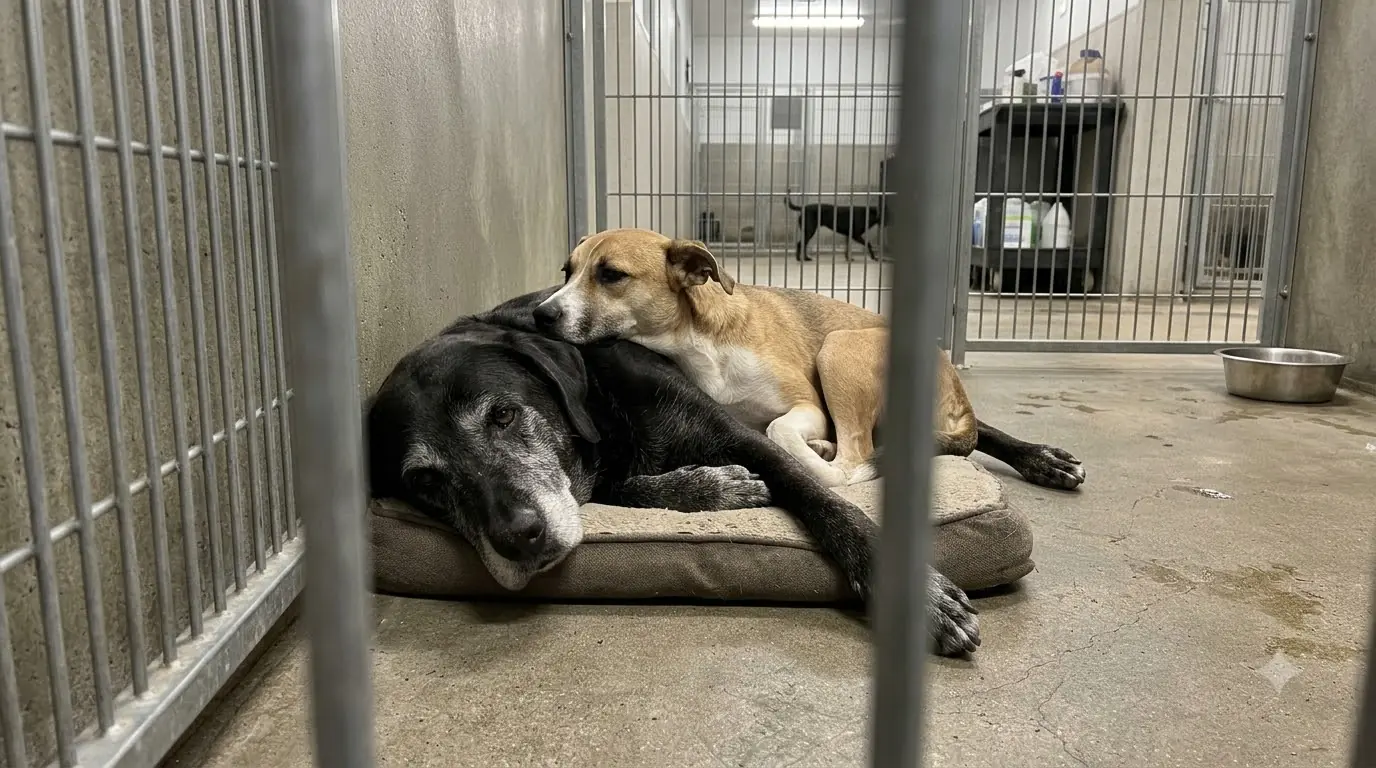
The shelter could be quiet for several minutes at a time.
Then one dog would bark.
Another would answer.
Within seconds, the sound could move through the kennel area in waves.
For Finn, those moments were difficult.
The younger dog would lift his head immediately. His ears pulled back, his body became tense, and his eyes moved rapidly toward the source of the noise.
If the barking continued, Finn usually did the same thing.
He moved toward Max.
Max was a 9-year-old Labrador mix who shared the kennel with him.
He was larger, older, slower, and noticeably less reactive to the surrounding noise.
Whenever Finn approached, Max rarely made a fuss.
He simply shifted.
Sometimes he moved a front leg.
Sometimes he scooted several inches across the bed.
That was enough.
Finn pressed his body against Max’s side and stayed there until the kennel became quiet again.
At night, even when much of the kennel floor remained empty, the two dogs chose the same small bed.
Max usually settled first.
Finn followed.
He circled once or twice, lowered himself beside the older dog, and eventually rested his head across Max’s back.
By morning, they were often still touching.
Two Dogs With Different Needs
Max and Finn did not enter our care with identical histories.
They were different ages.
They had different temperaments.
They also required different kinds of support.
What they shared was a growing reliance on each other.
Max, the older dog, came into the shelter needing a senior-focused medical evaluation.
He remained friendly and interested in people, but his movement was slower than that of a younger Labrador-type dog.
He took more time to stand after resting.
His hind legs appeared stiff during the first few steps.
He also carried less muscle over his back legs than we wanted to see.
Finn’s more obvious challenge was behavioral.
Loud or unpredictable noise made him visibly uncomfortable.
He did not become aggressive.
Instead, he attempted to create distance, lowered his body, and sought out Max whenever possible.
That pattern mattered.
It told us that Finn had found a coping strategy.
Our responsibility was to support it without assuming that Max should be expected to manage all of Finn’s stress.
Understanding Max’s Physical Condition
Because Max was nine, our veterinary team performed a thorough senior examination.
His temperature was within an expected range.
His heart and lungs sounded stable on initial assessment.
His abdomen was soft without obvious pain.
His eyes showed mild age-related changes but no acute problem.
His ears contained some debris, and his mouth had moderate dental tartar that would require ongoing care.
The most obvious concern was orthopedic.
When Max stood from his bed, he often paused.
His first several steps were short.
Once he had been moving for a few minutes, his gait became smoother.
That pattern commonly occurs with chronic joint disease, but age alone is never enough to make a diagnosis.
The veterinarian examined Max’s hips, knees, spine, shoulders, and paws.
There was mild discomfort with hip extension and reduced range of motion.
No acute fracture or unstable injury was suspected.
Because the findings were persistent, radiographs were recommended.
Max’s Diagnosis
Orthopedic imaging showed degenerative changes in Max’s hips and lower spine consistent with osteoarthritis.
There was no evidence of a recent fracture.
His decreased hind-limb muscle mass was likely related in part to reduced activity and chronic discomfort.
Osteoarthritis cannot simply be cured.
Management focuses on reducing pain, preserving mobility, maintaining muscle, and supporting a healthy body weight.
Max began a veterinary-directed pain-management plan.
His caregivers monitored appetite, stool, hydration, activity, and any potential medication-related side effects.
His exercise routine was also adjusted.
He did not need complete rest.
In fact, too little movement could worsen muscle loss.
Instead, Max received regular, moderate walks at a pace he could tolerate.
Finn’s Examination Looked Different
Finn also received a full veterinary examination.
His body condition was acceptable.
He ate reasonably well once he had time to settle.
No significant orthopedic problem was found.
His heart and lungs sounded normal.
His skin and coat were generally healthy.
Baseline parasite screening and preventive care were completed according to shelter protocol.
Physically, Finn appeared stable.
Behaviorally, however, the examination revealed something important.
Noise changed him.
When a metal object dropped in a nearby room, Finn immediately stopped taking treats.
His muscles became tense.
He lowered his body.
His attention shifted away from the veterinarian.
The team paused.
Rather than forcing the examination forward, they allowed Finn time to recover.
Once the environment became quiet again, he resumed taking food.
That distinction was important.
A dog accepting treats in one moment does not mean he is comfortable with everything happening around him.
We Could Not Diagnose Finn’s Past
It would have been easy to assign a dramatic history to Finn.
A dog frightened by loud noises may prompt people to assume previous abuse or some specific traumatic event.
We had no evidence supporting those conclusions.
Noise sensitivity can develop for many reasons.
Genetics can play a role.
Insufficient early socialization can contribute.
A dog may become more sensitive after frightening experiences.
Sometimes the precise reason is never known.
We did not need a complete explanation of Finn’s past to respond appropriately to his present behavior.
What mattered was that barking and sudden noises were stressful for him.
And that Max’s presence appeared to help.
Their First Nights Together
The decision to house Max and Finn together was made only after staff observed that their interactions were consistently compatible.
Shared housing is not appropriate for every pair of shelter dogs.
Dogs need enough space.
Resources must be managed.
Staff must watch for tension around food, toys, bedding, and access to people.
Max and Finn showed no concerning resource guarding during their supervised interactions.
Finn deferred naturally to Max’s space.
Max remained tolerant without appearing constantly bothered.
When Finn moved close, Max usually stayed relaxed.
The first night they shared a kennel, staff placed more than one sleeping option inside.
There was no requirement that the dogs lie together.
By morning, both were on the same bed.
Finn’s head rested against Max’s side.
The second night, the same thing happened.
Soon it became their routine.
Staff Began Watching Max More Closely
The bond was comforting for Finn.
But we needed to make sure it was not exhausting Max.
Older dogs with arthritis need undisturbed rest.
Constant physical contact from a younger dog can become uncomfortable even when the dogs generally get along.
Staff watched for subtle signs that Max wanted more space.
Turning his head away.
Getting up repeatedly.
Lip licking.
Moving to another bed.
Stiffening when Finn approached.
None appeared consistently.
Instead, Max often remained relaxed.
Sometimes he even shifted toward Finn before settling.
Still, we added another padded bed so Max always had the option to move away.
The important part was choice.
Max was allowed to be Finn’s companion.
He was not required to be Finn’s emotional support system every minute of the day.
Finn Needed Other Coping Skills
Finn’s behavioral plan focused on helping him feel safer without depending exclusively on Max.
The first step was environmental management.
Whenever possible, Finn spent time in quieter areas away from heavy kennel traffic.
Visual barriers reduced stimulation.
Staff used calm handling and predictable routines.
He was never intentionally exposed to overwhelming levels of noise in an attempt to “make him get used to it.”
Flooding a frightened dog can increase distress rather than resolve it.
Instead, we worked below Finn’s threshold.
At low levels of sound, he was offered food, enrichment, or calm social interaction.
If he stopped eating, froze, tried to escape, or became highly vigilant, the situation was made easier.
Progress depended on keeping him able to learn.
Max’s Presence Still Mattered
Even with those efforts, Max remained Finn’s most reliable source of reassurance.
During periods of barking, Finn often approached him before seeking a person.
Max would shift slightly.
Finn would press against him.
Sometimes Finn rested his chin on Max’s shoulder.
Other times he tucked himself alongside Max’s chest.
Max generally responded by staying still.
That behavior could look almost parental to human observers.
We resisted assigning a human relationship label to it.
What we could say was that the dogs had formed a strong affiliative bond.
They sought physical proximity.
They slept together.
They moved comfortably around each other.
Finn’s visible arousal often decreased when he could settle beside Max.
Those were observable facts.
Food Was Managed Separately
Because resource conflict can develop even between bonded dogs, Max and Finn were fed separately.
Each dog had space to finish without pressure.
Max ate slowly.
Finn tended to eat more quickly.
Allowing Finn access to Max’s bowl would have created unnecessary risk.
After meals were removed, the dogs could relax together again.
Treats and high-value chews were also managed carefully.
Their friendship did not eliminate the need for safe shelter protocols.
In fact, good management helped preserve the relationship.
Max’s Weight Became Important
Senior Labradors and Labrador mixes can easily gain excess weight, and extra pounds can worsen arthritis.
Max was not severely overweight at intake, but he carried slightly more body fat than ideal for a dog with painful joints.
His diet was adjusted gradually.
The goal was modest, controlled weight loss while preserving muscle.
Staff measured his meals carefully.
Treats used during enrichment were included in his daily calorie intake.
Max did not appreciate the concept of calorie management.
Like many Labrador mixes, he remained highly interested in food.
That enthusiasm was useful during rehabilitation.
Building Max’s Strength
As Max’s discomfort became better controlled, his exercise plan expanded.
He took short, regular walks rather than occasional long ones.
Good traction mattered.
He was allowed plenty of time to sniff.
Gentle movement helped warm his joints.
Staff monitored how he behaved later in the day, not just while walking.
If Max became noticeably stiffer afterward, the activity was adjusted.
Over several weeks, his movement improved.
He still rose slowly after long naps.
That did not disappear.
But he stood with less hesitation.
His stride became more even.
The muscles around his hindquarters began to improve.
Finn Started Joining Calm Walks
Finn also benefited from outdoor time.
Away from the kennel noise, he behaved differently.
His body loosened.
His tail came up.
He became more curious.
He sniffed trees, grass, and fence lines.
At first, Finn and Max were sometimes walked separately so each could receive individualized attention.
Later, once Max’s pace and Finn’s behavior allowed it, they occasionally walked together.
Finn often matched Max’s slower rhythm.
He did not pull as much when beside him.
For Max, the walks provided controlled exercise.
For Finn, they offered exposure to the world in a context where he felt safer.
Sleep Became a Window Into Their Adjustment
During the first week, Finn woke frequently.
A door closed.
He raised his head.
A dog barked.
He stood.
Metal bowls moved.
He looked immediately toward Max.
Max slept more deeply.
The older dog’s ability to rest seemed to influence Finn.
Over time, Finn stopped reacting to every minor sound.
He still responded to sudden barking.
But ordinary shelter noises became easier.
One afternoon, staff entered quietly and found both dogs asleep.
Max was lying on his side.
Finn was curled against him.
For once, a kennel door closing down the hall did not wake either dog.
Max Had a Brief Arthritis Flare
Progress was interrupted when Max had a stiffer-than-usual morning.
He hesitated before standing and took several uncomfortable steps.
Because older dogs can develop new problems, staff did not simply assume every change was caused by known arthritis.
Max was reexamined.
There was no new injury.
He continued bearing weight on all four limbs.
His appetite was normal.
No neurological deficit was found.
The episode was considered consistent with a flare of his chronic osteoarthritis.
His activity was reduced temporarily.
His pain-management plan was reviewed.
Within several days, Max returned to his recent baseline.
Finn seemed to notice the difference.
He approached Max more gently during that period and spent more time lying nearby rather than leaning heavily against him.
Whether that was a deliberate response to Max’s discomfort is impossible to know.
But the change reduced pressure on Max while he recovered.
Finn Had His Own Setback
Not long afterward, a particularly noisy afternoon affected Finn.
Multiple dogs began barking at once during kennel cleaning.
Finn became overwhelmed.
He moved rapidly toward the back of the kennel.
His breathing accelerated.
He refused treats.
Max was temporarily in another area for a veterinary check, meaning Finn could not use his usual coping strategy.
Staff immediately reduced stimulation.
The kennel area was made quieter.
No one tried to coax Finn forward.
A caregiver sat at a distance without demanding interaction.
Several minutes passed before Finn began sniffing again.
Then he accepted a treat.
That incident confirmed something important.
Finn had improved, but he was not yet comfortable enough to manage intense noise without support.
Our behavioral plan needed to continue.
Helping Finn Recover Without Max
After that episode, we increased Finn’s independent quiet-time sessions.
The goal was not to separate the pair emotionally.
It was to make sure Finn could function if Max was at a veterinary appointment, resting elsewhere, or eventually unavailable.
Finn spent short periods in a calm room with enrichment.
At first, he repeatedly checked the door.
Over time, he began engaging with food puzzles.
He learned that quiet spaces could feel safe even without Max physically beside him.
The sessions remained short enough to avoid overwhelming him.
This was not about forcing independence.
It was about expanding his coping options.
Their Bond Continued Anyway
When Finn returned to Max after those sessions, the greeting was usually simple.
A sniff.
A loose wag.
Then proximity.
No dramatic reunion.
No frantic jumping.
The normality of those interactions was reassuring.
Their bond did not depend on constant physical access.
They could separate temporarily and come back together calmly.
That was exactly what we wanted to see.
Bathroom Habits and Daily Health
Both dogs maintained normal urination during shelter care.
Max benefited from regular outdoor opportunities because stiffness made long waits uncomfortable.
Finn quickly learned the bathroom schedule.
Their stools remained generally formed.
Any changes in appetite, water intake, bowel movements, urination, mobility, or energy were documented separately.
Sharing a kennel did not mean sharing a medical record.
Each dog remained an individual patient.
Max’s Senior Follow-Up
Repeat veterinary evaluation showed Max was responding well to arthritis management.
His weight moved gradually toward a healthier range.
His hind-limb muscle condition improved.
He continued to have chronic degenerative changes, as expected.
The goal had never been to make his radiographs look normal.
The goal was functional comfort.
Could he stand?
Walk?
Rest?
Use the bathroom comfortably?
Participate in normal daily life?
The answer was increasingly yes.
His dental disease remained on the long-term care list, and senior bloodwork would continue to be monitored according to veterinary recommendations.
Finn’s Behavioral Follow-Up
Finn’s behavioral progress was measured differently.
He began taking treats while moderate barking occurred at a distance.
He recovered more quickly after sudden sounds.
He started approaching familiar staff instead of immediately retreating.
He spent more time resting without pressing against Max.
Most importantly, he began choosing Max because he wanted proximity, not only because he was frightened.
The distinction became visible during calm periods.
Finn would sometimes walk across the kennel and lie beside Max even when nothing stressful was happening.
Their closeness was becoming part of ordinary social behavior.
The Question of Adoption
As both dogs became stable, a difficult placement question emerged.
Should Max and Finn be adopted together?
Shelters must approach bonded pairs carefully.
Keeping two dogs together can be beneficial when their relationship is truly important to their welfare.
But requiring joint adoption without sufficient reason can also dramatically reduce placement opportunities.
Our team considered their behavior across multiple contexts.
How did they eat separately?
How did they walk separately?
Could Finn settle without Max?
Did Max appear stressed when Finn was absent?
Did Max ever seek distance from Finn?
Could each dog function independently?
The answers suggested a nuanced picture.
They were strongly bonded.
But neither dog became completely unable to function when separated briefly.
Why We Still Wanted to Protect the Relationship
Although Finn was developing independent coping skills, Max clearly remained important to him.
And Max appeared to enjoy Finn’s company.
When given multiple resting places, they frequently selected the same one.
When separated for appointments, they often chose proximity after being reunited.
There was no evidence that Finn’s presence significantly reduced Max’s quality of life.
For those reasons, our placement team decided to prioritize a home willing to consider both dogs together.
That did not mean rushing them into the first available household.
A two-dog adoption requires practical planning.
Financial responsibility doubles in many areas.
Max had senior medical needs.
Finn had behavioral needs.
The right family would need to understand both.
Moving Into Foster Care Together
Before making a permanent placement decision, Max and Finn entered foster care together.
The foster home was quieter than the shelter and offered something we needed to observe.
Would Finn still rely on Max when barking was no longer constant?
Would Max choose to sleep separately if given more room?
Would their bond change outside the kennel?
Their foster caregiver prepared two beds.
Then a third.
There was no shortage of sleeping space.
The first evening, Max selected the larger bed near the couch.
Finn explored the room.
He sniffed the second bed.
Then the third.
Finally, he walked back to Max.
He curled beside him.
By bedtime, Finn’s head was resting across Max’s back.
The First Night in a Home
Finn reacted to unfamiliar household sounds.
The refrigerator cycling on made him lift his head.
A car door outside made him stand.
Max mostly slept.
When the neighborhood became quiet, Finn gradually settled.
Around midnight, the foster caregiver checked the room.
Both dogs were asleep.
Max was stretched on his side.
Finn was pressed against his ribs.
The two unused beds remained empty.
Home Life Changed Finn
Within several days, Finn’s noise sensitivity became easier to manage.
The absence of constant kennel barking helped considerably.
He still reacted to sudden sounds.
A dropped pan sent him briefly out of the kitchen.
A truck braking outside made him alert.
But his recovery was faster.
Sometimes he looked at Max.
Other times he looked toward his foster caregiver.
Eventually, he began settling without needing to touch either one.
That was an important step.
Safety was expanding beyond a single dog.
Home Life Changed Max Too
Max also benefited from the quieter environment.
He slept more deeply.
Rugs provided traction.
His bed was thick enough to support arthritic joints.
He could move through the house at his own pace.
His foster caregiver continued measured meals and controlled exercise.
Max became surprisingly interested in the kitchen.
The sound of a food container opening could bring him from another room.
Finn usually followed.
The older dog’s appetite remained excellent.
His weight continued moving toward the veterinary target.
Separate Walks Still Mattered
Although Max and Finn enjoyed walking together, the foster continued giving them individual outings.
Max needed a controlled pace for arthritis.
Finn needed opportunities to develop confidence independently.
On solo walks, Finn initially looked behind him frequently.
After several days, he began focusing more on scents.
His posture became looser.
He was able to explore without Max beside him.
When he returned home, however, he almost always went directly to Max.
Sometimes he sniffed his face.
Sometimes he simply lay nearby.
Their Sleeping Arrangement Never Changed Much
The foster tried moving the beds.
Max and Finn still found each other.
One night, Max chose a bed in the bedroom.
Finn followed.
Another evening, Max rested in the living room while Finn initially settled elsewhere.
Twenty minutes later, Finn got up, walked across the room, and lowered himself beside Max.
Even when there was enough room for two dogs to stretch separately, Finn frequently placed his head across Max’s back.
Max did not appear bothered.
If he wanted to reposition, he simply stood and moved.
Finn adjusted.
Their relationship remained flexible rather than tense.
A New Concern With Max
During foster care, Max developed a small lump along his side that had not been prominent during initial intake.
Any new mass in an older dog deserves evaluation.
The veterinarian examined it and performed a fine-needle aspirate.
Cytology was consistent with a benign lipoma, a common fatty mass in older dogs.
That was reassuring.
Still, the mass would be monitored for changes in size, firmness, attachment, or appearance.
We did not treat “benign today” as permission to ignore it forever.
Max’s age meant ongoing senior care would remain important.
Finn Learned a New Response to Noise
Several weeks into foster care, a thunderstorm passed through the area.
Finn became restless as the first thunder sounded.
He stood.
His ears went back.
He walked toward Max.
Max was asleep.
Finn paused beside him.
Then something different happened.
Instead of immediately climbing against Max’s body, Finn turned toward the covered resting area his foster caregiver had created.
He walked inside.
He lay down.
The thunder continued.
Max eventually woke and looked around but remained on his bed.
Finn stayed in the quiet area.
His foster caregiver sat nearby without forcing contact.
For the first time, Finn had managed a significant noise event using a coping strategy that did not depend entirely on Max.
That was a major behavioral milestone.
It Did Not Weaken Their Bond
Later that evening, after the storm passed, Finn left the covered area.
He walked directly toward Max.
Max was still lying down.
Finn circled once.
Then he lowered himself beside him.
His head landed across Max’s back.
The old routine returned.
That moment reflected exactly what we wanted for Finn.
Independence did not require losing connection.
He could learn to cope on his own and still choose Max for companionship.
Preparing Both Dogs for Permanent Placement
As adoption planning progressed, our team became increasingly confident that keeping Max and Finn together would be the preferred outcome if the right home became available.
Their future family would need to understand that they were not medically identical.
Max was a senior dog with chronic osteoarthritis.
He would need appropriate weight management, controlled exercise, routine senior veterinary care, dental monitoring, and ongoing assessment of his mobility.
His needs could increase as he aged.
Finn was younger and physically healthier, but his noise sensitivity required thoughtful management.
He benefited from predictable routines, quiet spaces, positive reinforcement, and the freedom to retreat when overwhelmed.
He should not be punished for fear.
He should not be intentionally exposed to extreme noise in the hope that he will simply stop reacting.
A Permanent Home Would Need to Plan for the Future
There was another reality we could not ignore.
Max was nine.
Finn was younger.
If they spent the rest of Max’s life together, Finn could eventually face the loss of the dog who had helped him feel safe.
That possibility made Finn’s independent coping skills even more important.
A responsible adoption plan could not rely on Max being available forever.
The foster continued working with Finn separately.
Short walks.
Quiet enrichment sessions.
Resting in another room.
Positive associations with safe spaces.
Finn became more confident.
That was not preparation to separate the dogs now.
It was preparation for life.
Max Was Allowed to Be an Older Dog
Throughout this process, staff and the foster protected Max’s right to rest.
He did not have to entertain Finn.
He did not have to participate in every activity.
He did not have to comfort anyone simply because people found the behavior touching.
Some afternoons, Max chose a bed in another room.
Finn might follow.
Sometimes he did not.
If Max wanted distance, he got it.
That choice was essential to keeping their bond healthy.
Their Medical and Behavioral Progress Continued
Max remained stable on his arthritis-management plan.
His mobility improved enough for regular neighborhood walks.
He maintained a healthier weight.
His appetite remained good.
His bathroom habits were normal.
He still took several careful steps after waking from a long nap.
That was expected with chronic degenerative joint disease.
Finn continued progressing behaviorally.
He remained sensitive to loud barking, thunder, and sudden metallic noises.
But his recovery time became shorter.
He accepted food sooner after startling.
He used his quiet space voluntarily.
He increasingly looked to his foster caregiver as well as Max for reassurance.
What Their Story Is Really About
It would be easy to describe Max as a hero and Finn as the dog he rescued emotionally.
Reality is more subtle.
Max did not cure Finn’s fear.
Finn did not give Max a miraculous new purpose.
They were simply two dogs who formed a relationship that appeared to benefit them both.
Finn found comfort in Max’s calm presence.
Max appeared to enjoy Finn’s company.
Their bond became part of a larger care plan involving veterinary treatment, behavioral support, environmental management, nutrition, exercise, and foster care.
That is what responsible rescue looks like.
Connection matters.
So does professional care.
Max and Finn Today
Max is still the slower one.
He takes his time standing.
He enjoys measured walks.
He expects meals with the enthusiasm of a Labrador.
He prefers soft bedding and calm evenings.
His arthritis remains a chronic condition that will require lifelong attention.
Finn is still the more sensitive one.
A sudden bark can make him tense.
Thunder still gets his attention.
He sometimes seeks cover when the environment becomes too loud.
But he no longer depends on Max for every difficult moment.
He has learned to use quiet spaces.
He trusts familiar people.
He can walk, eat, play, and rest independently.
And yet, when night comes, the same thing often happens.
There are multiple beds available.
There is plenty of floor space.
Max picks a spot and slowly lowers himself down.
Finn waits.
Sometimes only for a few seconds.
Then he walks over.
He circles.
He curls beside Max.
And sooner or later, his head finds the same place it has found so many nights before.
Across Max’s back.
Max shifts slightly.
Finn settles.
The house becomes quiet.
Two dogs who entered rescue with very different needs fall asleep touching.
Not because anyone placed them there.
Not because there is nowhere else to go.
But because, when given every other option, they still choose each other.