“Excuse me, Sheriff. My car is clearly within the lines.”
He spat on the asphalt.
“You’re parked too close. That’s a violation.”
“Too close? There’s two feet of space.”
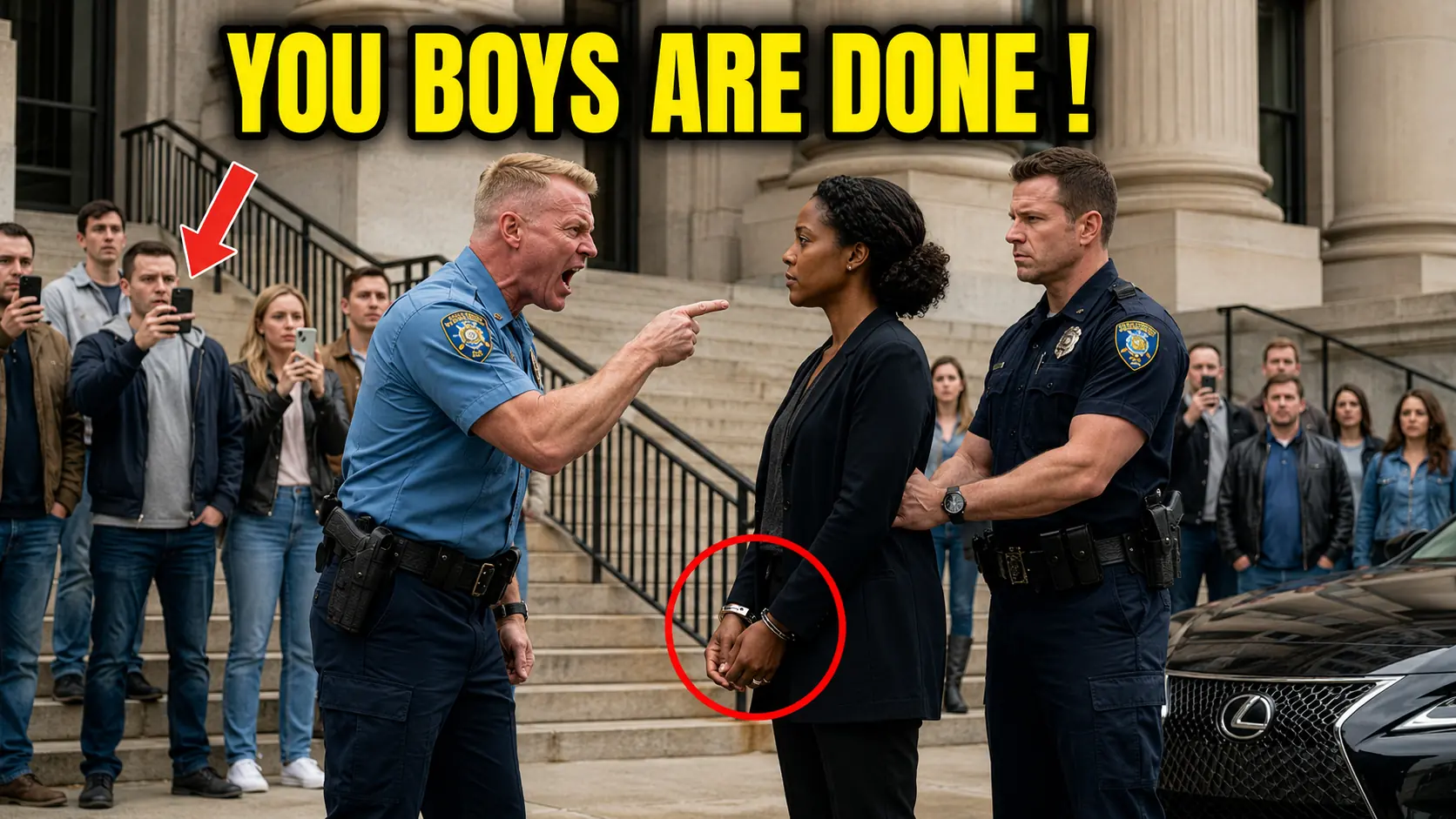
“A Black woman driving a car like this?” He circled her vehicle slowly. “In my county? You’re either a thief or a—” He grabbed her arm. “Hands behind your back. Now.”
The parking lot filled with onlookers. Phones raised. Recording. Smirking. A mother pulled her child closer but said nothing. Nobody helped.
In exactly fifteen minutes, this sheriff would read one small business card. And for fifteen seconds, he wouldn’t be able to say a single word.
Saturday afternoon. June 15th. The Georgia sun beat down with the kind of heat that makes the air shimmer above the asphalt. Ninety-four degrees. Not a cloud in the sky.
The highway cut through Holbrook County like a scar through farmland. Cotton fields stretched endlessly on one side. Pecan groves heavy with summer growth lined the other. Eighteen thousand people called this place home, living ninety minutes south of Atlanta but feeling like a world apart.
This is the kind of place where the same families have owned the same land for five generations. Where certain people run things and have always run things. Where change comes slowly, reluctantly, and often not at all. Where everyone knows their place, and God help anyone who forgets it.
Pamela Crawford drove along this highway with her window cracked open. The warm air carried the smell of red Georgia clay and the promise of afternoon rain. Old soul music played softly on the radio. Otis Redding singing about sitting on the dock of the bay. She hummed along, fingers tapping the steering wheel in rhythm.
She is fifty-two years old. A professor of criminal justice at Georgia State University. One of the most respected voices in her field. Twenty years she has spent studying police reform, publishing research that has shaped policy across the nation. Three books bear her name, cited in academic journals worldwide. Twice she has testified before congressional committees. Her work has influenced reform efforts in twelve states.
But none of that mattered today. Today she was not Dr. Crawford. Not the professor. Not the expert. Today she was simply a daughter driving home to see her mother.
Dorothy Crawford lives alone in the small house where Pamela grew up. Seventy-eight years old now. Widowed for fifteen years since Pamela’s father passed. Dorothy still bakes cornbread every Saturday morning—the same recipe her grandmother taught her. Still hangs laundry on the backyard line because she says the sun makes the sheets smell better than any dryer. Still reads on the front porch every evening until the fireflies rise at dusk, signaling the end of another day.
Pamela pulled into the familiar gravel driveway. The crunch of stones beneath her tires sounded like childhood. Before she even reached the porch steps, the screen door creaked open with that same squeak it’s had for thirty years.
Dorothy stood in the doorway, flour dusting her faded apron. Her hair was grayer now. Her frame smaller. But her eyes still held that same sharp warmth.
“You’re late.”
“Traffic outside Atlanta, Mama. You know how it gets on Saturdays.”
“Mhm.” Dorothy pulled her daughter into a tight embrace. “Cornbread’s almost ready. Come inside before this heat melts you down to nothing.”
Inside, the house smelled exactly as Pamela remembered. Butter. Memory. And decades of love soaked into every wall. The ceiling fan clicked with each slow rotation—the same rhythmic sound that once lulled her to sleep as a child. Light filtered through lace curtains yellowed by years of Georgia sun.
On the living room wall hung a row of family photographs. Pamela paused at one in particular. Her brother, Curtis. Younger in this picture than she is now. Smiling. Unbroken.
Twenty-five years ago, Curtis was driving home from a late shift at the warehouse. A routine traffic stop on a dark county road. Four officers. What started as a broken taillight ended with a broken nose and two cracked ribs. Curtis came home that night with blood dried on his shirt and something shattered behind his eyes that never fully healed.
He never filed a complaint.
“What’s the point?” he said when Pamela begged him to report it. “Nothing ever changes for people like us.”
Curtis lives in Seattle now. As far from Georgia as he could possibly run. He doesn’t talk about that night. He doesn’t talk to police. Ever.
Pamela chose a different path. She decided she would become the change. Working from inside the system. Through research. Through testimony. Through evidence that couldn’t be ignored or dismissed.
After lunch, Dorothy mentioned a book she’d been wanting to read. A biography of Eleanor Roosevelt.
“I’ll pick it up,” Pamela offered. “The library’s just ten minutes away.”
She had no idea that this simple errand would change everything.
The Holbrook County Library sits quietly under the afternoon sun. A modest brick building with white columns, built in 1952 and barely updated since. The parking lot was nearly empty. Pamela pulled into a spot, checked her mirrors, and walked inside.
Fifteen minutes later she stepped back out, Eleanor Roosevelt tucked under her arm, and the Georgia heat hit her like a wall.
Then she stopped.
A patrol car now sat directly behind her vehicle, blocking any exit. Not just any patrol car. The door read in bold letters: Sheriff. Holbrook County.
And the man leaning against it, arms crossed, watching her approach with cold eyes. He wasn’t a deputy.
Sheriff Wayne Hollister. Forty-eight years old. Tall and broad-shouldered with salt-and-pepper hair cropped military short. Oakley sunglasses hid his eyes, but not the sneer on his lips. He has held this position for twelve years. Elected three times by comfortable margins. Known throughout the county for being hands-on. Unlike most sheriffs who delegate patrol duties, Hollister still drives these roads himself every Saturday. Staying connected to the community, he calls it.
Others call it something else.
He pushed off from the car as Pamela approached her vehicle.
“This your car?”
“Yes, Sheriff. Is there a problem?”
His eyes traveled slowly from her face to the car to her face again. The assessment was deliberate. Degrading. The look of a man examining something he finds distasteful.
“A Black woman driving a Lexus in Holbrook County.” He laughed. A short, harsh sound with no warmth in it whatsoever. “Either you stole this vehicle or you’re selling something I don’t want to know about. Which is it?”
Pamela kept her voice steady. Measured. Twenty years of professional composure serving her now.
“Sir, I’m a professor at Georgia State University. I’m visiting my mother who lives on Maple Street. I’ve just been to the library.”
“A professor.” He said the word like it was an insult. Like it left a bad taste in his mouth. “Right. And I’m the Pope of Rome. License and registration. Now.”
She retrieved them from her purse without argument. Handed them over. He examined her driver’s license with exaggerated slowness.
“Georgia State University address. So you’re not from around here.”
“I grew up in this county, Sheriff. This is my home.”
“It doesn’t matter where you grew up. What matters is you’re parked too close to the vehicle next to you. County ordinance 14-9. That’s a violation.”
Pamela glanced at the gap between her car and the one beside it. Two feet of space. Maybe more. Well within the painted lines by any reasonable measurement.
“Sir, with respect, I’m clearly within the marked boundaries. Anyone can see.”
“You’re parked where I decide you’re parked.” His voice hardened. “And I decide you violated ordinance 14-9.”
His right hand moved to his chest. His fingers touched the body camera mounted there. The small red recording light blinked once, then went dark.
Pamela noticed. She said nothing. But she noticed.
“Step out of the vehicle.”
“May I ask why, Sheriff?”
“Because I told you to. That’s why.” He stepped closer, deliberately crowding her space, using his height and badge to intimidate. “People like you need to learn respect. People like you need to understand how things work in my county. Now turn around. Put your hands behind your back.”
By now a small crowd had gathered. Martha Shelton, sixty-eight years old, a retired schoolteacher, watched from the library entrance with her hand pressed to her mouth in shock. Two teenagers stood near the sidewalk, phones raised, recording everything with eager grins. A man in a pickup truck had slowed down to watch the spectacle. Someone in the gathering crowd laughed. Someone else muttered something Pamela couldn’t quite hear but could certainly imagine.
No one stepped forward to help. No one said a word in her defense.
“You’re under arrest for disorderly conduct and obstruction of justice.”
“I haven’t done anything wrong. I was returning a library book.”
“You were being uppity. That’s more than enough for me.”
The handcuffs clicked shut. Cold metal bit into her wrists, pinching skin. He tightened them more than necessary. She could feel each ridge of the restraints pressing into her flesh.
He grabbed her arm roughly. Marched her toward the patrol car. His hand pressed down hard on her head as he shoved her into the back seat, not bothering to protect her from the door frame.
The door slammed shut with finality.
The drive to the sheriff’s office took fifteen minutes. Pamela sat in silence behind the metal cage partition. The handcuffs dug deeper with every bump in the road. Through the window she watched the cotton fields roll past—the same fields she drove through as a child—feeling like a stranger in her own hometown.
The Holbrook County Sheriff’s Office is a single-story red brick building set back from the road. Inside, the booking area reeked of industrial bleach and coffee that’s been sitting on the burner for far too long. Fluorescent tubes buzzed overhead, casting everything in harsh, unflattering light.
A young deputy stood behind the intake counter. He looked at Pamela, then at Sheriff Hollister. Confusion flickered across his face.
“Book her,” Hollister ordered. “Disorderly conduct. Obstruction.”
The deputy hesitated visibly.