Sheriff Threatened to Bury a Black Woman Under Her Father’s Case — Then a Hidden Key Reopened the Crime He Buried
Reader Theme:
Font Size:
24px
The handcuffs struck the chrome-edged counter hard enough to make Nicole Turner’s coffee jump inside its cup. Sheriff Don Harper kept one thick palm spread across the open steel cuffs while Travis Cain stood close enough for the burgundy sleeve of his work jacket to press against Nicole’s faded gray sweatshirt. Behind the counter, Nicole’s mother, Evelyn Turner, froze with a glass coffee pot in her good hand and her injured left arm held against her body in a stained sling. Nobody inside Bellwether Diner spoke, though every customer had turned far enough to watch without appearing brave enough to intervene.
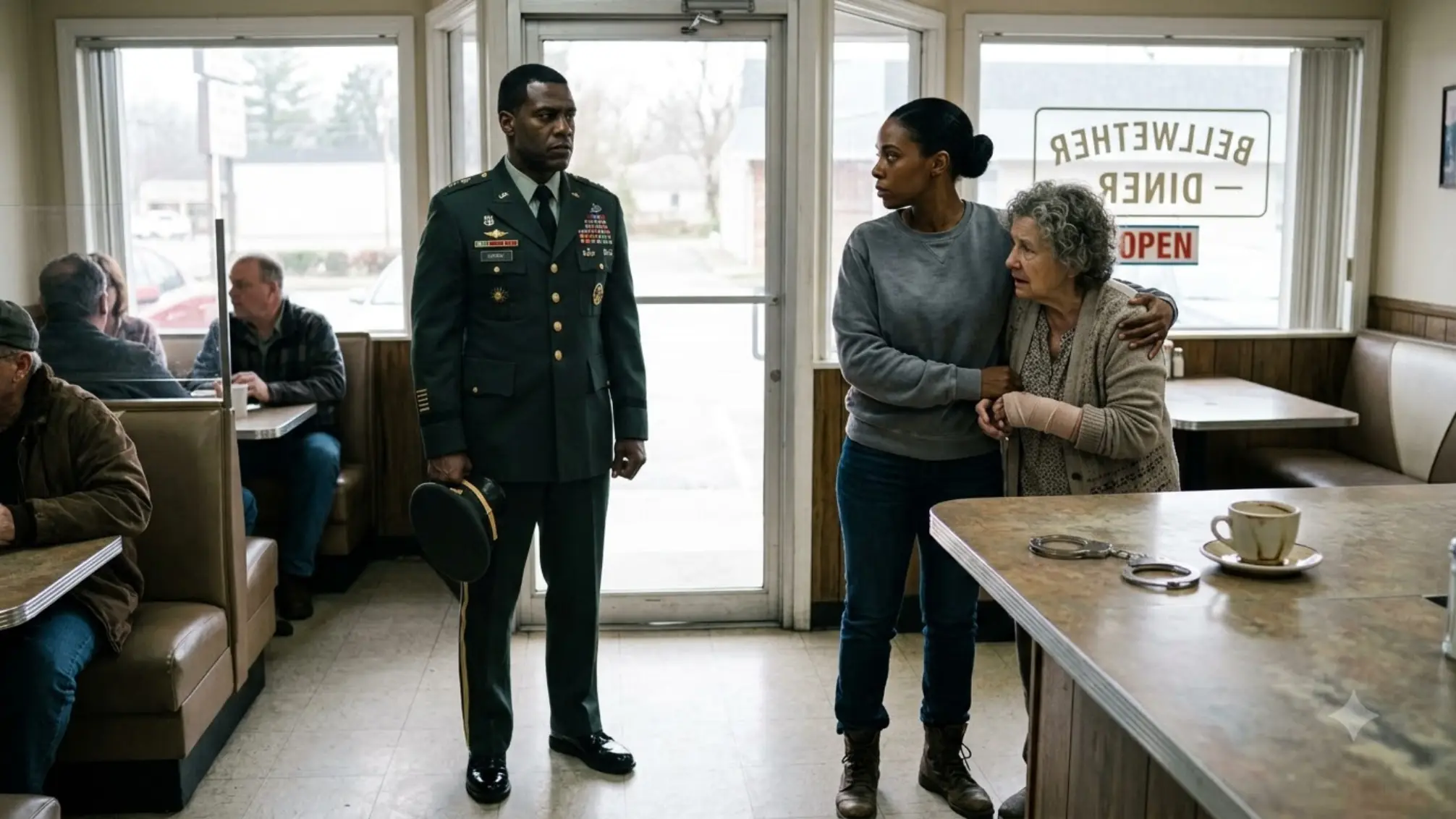
The brass bell above the entrance rang once more as Darius Reed crossed the threshold in an immaculate U.S. Army service uniform. Rainwater glistened on the shoulders of his dark coat, rows of ribbons covered his chest, and his polished black shoes made almost no sound as he walked toward the counter. Two black government SUVs remained outside with their engines running, and several uniformed soldiers stood beside them without entering. Darius removed his cap, tucked it beneath his arm, and stopped beside Nicole without touching the sheriff or making any claim of civilian authority.
Sheriff Harper slowly lifted his hand from the cuffs. Travis’s smile remained in place, but the muscles around his mouth had tightened. A roofer sitting in the nearest booth dropped his coffee cup, and the ceramic broke across the floor while everyone pretended not to notice. Nicole glanced at the phone resting beside her drink, where a small red symbol confirmed that the entire confrontation was still being recorded.
Darius Reed had served beside Nicole for six years, first during disaster-response operations and later at Army North headquarters. He knew she was supposed to address a military-family leadership conference in Raleigh that afternoon, and he knew she had never missed an official engagement without calling. When her location stopped moving at Bellwether Diner and her secure check-in went unanswered, he contacted her aide, checked the emergency contact she had filed, and drove out with the personnel already traveling to the conference. What he found was not a delayed officer but a colonel surrounded by a sheriff, a local businessman, and a room full of frightened witnesses.
Darius Reed (controlled, looking at Nicole): “Colonel Turner, are you injured?”
Colonel Nicole Turner (firmly, keeping her eyes on Harper): “No. My mother is.”
Evelyn Turner lowered the coffee pot, but her hand shook hard enough to spill a dark stream across the counter. She wore a faded floral blouse beneath her blue diner apron, and the sling pulled the fabric crooked across her shoulder. Two nights earlier, someone had shoved her into a supply shelf after closing, dislocating her shoulder and cutting the side of her face. The sheriff’s report described the injury as an accidental fall.
Nicole had driven from Raleigh after her mother called and claimed she had simply lost her balance while reaching for a box. The explanation changed when Nicole spoke to the emergency-room nurse, who remembered Evelyn arriving with bruises around her wrist and a tear in the back of her blouse. When Nicole asked why the nurse’s assault referral had disappeared from the county system, the hospital administrator stopped returning her calls. By the time Nicole reached the diner, Sheriff Harper and Travis Cain were already waiting.
Travis’s family controlled Cain Development, the largest private employer in Bellwether County. The company owned trucking yards, fuel depots, construction sites, rental homes, and half the commercial property along the highway. Travis’s late grandfather had served as county commissioner, his father sat on the regional bank board, and Don Harper had been sheriff for twenty-one years with Cain money behind every campaign. In Bellwether, the Cain name did not need to appear on a uniform because everyone already understood the authority it carried.
Nicole’s father, Isaiah Turner, had challenged that authority eighteen years earlier. Isaiah was a retired Army command sergeant major who accepted a civilian logistics position at the Bellwether National Guard support facility after completing twenty-six years of service. His job involved tracking fuel deliveries, vehicle parts, communications equipment, and emergency supplies assigned to Guard units across three counties. Within eight months, he discovered that thousands of gallons of military fuel and several pallets of vehicle components had disappeared from official inventories.
The missing supplies were not lost through ordinary mistakes. Isaiah found delivery numbers duplicated across military and civilian records, with Guard fuel transferred into trucks registered to Cain Transport. Some vehicle parts officially declared damaged later appeared in equipment owned by Cain Development. Isaiah copied the records, reported the discrepancies through military channels, and told Evelyn he expected arrests. Three days later, a county warehouse burned, one security guard died, and police claimed Isaiah had started the fire to destroy evidence of his own theft.
Sheriff Harper led the investigation. Travis’s father supplied statements identifying Isaiah as a desperate employee facing debt. A county technician claimed to find Guard property inside Isaiah’s truck, while an anonymous witness said he saw Isaiah near the warehouse before the fire. The military suspended Isaiah’s civilian clearance, the county charged him with arson and theft, and newspapers turned a decorated veteran into a criminal before his first court appearance.
Isaiah insisted the property had been planted. He told investigators the Cain family had been stealing military supplies and using Harper’s department to erase the transfers. His attorney requested the Guard inventory files, but several had been corrupted or mislabeled after the warehouse fire. Before Isaiah could stand trial, he suffered a fatal heart attack inside the county jail.
The charges died with him.
The accusation did not.
Nicole had been twenty-four and completing officer training when her father died. She arrived home in uniform and found reporters waiting outside the family house, demanding to know whether the Army planned to reclaim his medals. Evelyn begged her daughter not to fight Bellwether because she had already buried one member of the family. Nicole returned to duty carrying grief, anger, and a private promise that she would never seek revenge without evidence strong enough to survive every challenge.
For eighteen years, she kept that promise by staying away.
Then Evelyn was assaulted.
Nicole looked toward the sling. “Tell them what happened.”
Evelyn’s mouth tightened. “I fell.”
Colonel Nicole Turner (hurt, turning toward her): “You told the nurse someone grabbed you.”
Evelyn Turner (frightened, lowering her eyes): “I was confused.”
Sheriff Harper seized the hesitation. “Your mother says there was no crime, Colonel. You entered this diner, demanded sealed records, and created a disturbance.”
Nicole turned toward the sheriff. “Then why did you arrive carrying open handcuffs instead of an accident report?”
Harper’s jaw shifted. “Because you threatened a civilian.”
Travis Cain (smugly, folding his arms): “She accused my family of attacking an old woman and murdering her father.”
Colonel Nicole Turner (coldly, looking directly at him): “I said my mother found something that made you afraid.”
The room changed.
Travis glanced at Evelyn.
It was brief, but Nicole saw it, and so did Darius.
Darius Reed (quietly, watching Travis): “What did she find?”
Evelyn gripped the edge of the counter with her good hand. The coffee machine hissed behind her, filling the silence with a sound that suddenly felt enormous. She looked at Nicole, then at Harper, and finally toward the booths occupied by people who had known the Turner family for decades. None of them offered encouragement, but none looked away anymore.
Evelyn Turner (trembling, reaching beneath the counter): “Your father left something.”
Harper moved first.
Nicole stepped between him and the counter before he could reach Evelyn. Darius shifted beside her, not threatening the sheriff but making it impossible for Harper to pretend any physical contact would go unwitnessed. Evelyn removed a grease-stained envelope from beneath the cash register and placed it beside the handcuffs.
Inside was a small brass key and a strip of paper bearing six handwritten numbers. Isaiah’s handwriting covered the back.
Motor pool inspection bay. Floor locker beneath Lift Three. If anything happens, do not trust county evidence.
Travis went pale.
Sheriff Harper recovered faster. “That note is meaningless.”
Nicole picked up the key. “Then you won’t mind if federal investigators examine what it opens.”
Harper pointed toward her phone. “I’m seizing the device and that envelope as potential evidence.”
Colonel Nicole Turner (fiercely, covering the items with her hand): “You threatened me, buried my mother’s report, and investigated my father. You’re not touching either.”
Darius turned toward the front windows. Two dark sedans had entered the diner lot behind the Army vehicles. A woman in a navy suit stepped from the first car, followed by three agents wearing jackets marked FBI. From the second vehicle emerged a civilian investigator carrying credentials from the Department of the Army Criminal Investigation Division.
Sheriff Harper stared through the glass. “You brought federal agents into my county?”
Nicole shook her head. “I reported missing military property through the proper channel three weeks ago. My mother’s assault gave them probable cause to move faster.”
That was the first thing Nicole had concealed from everyone in the diner. She had not returned to Bellwether only because Evelyn was hurt. A retired Guard auditor contacted her after finding an archived inventory discrepancy connected to Isaiah’s final report. Nicole forwarded the information to Army investigators without mentioning her family connection until they confirmed the serial numbers belonged to missing military equipment.
The FBI joined because Cain Transport had moved goods across state lines and used federal disaster contracts. The agents had been preparing warrants when Nicole traveled to Bellwether. Darius’s call reporting a possible threat to a serving colonel did not give the Army control over a civilian crime, but it did provide investigators with the location of witnesses and a live recording of Harper threatening her over her father’s case. That recording was now preserved on a secure server beyond the sheriff’s reach.
Special Agent Maya Brooks entered the diner carrying a warrant folder. She was a forty-five-year-old Black American woman with calm eyes and the practiced restraint of someone who expected powerful men to mistake courtesy for weakness. She looked at the cuffs, Evelyn’s sling, the envelope, and Sheriff Harper’s hand hovering near his weapon.
Special Agent Maya Brooks (firmly, displaying the warrant): “Sheriff, step away from the counter and keep both hands visible.”
Sheriff Harper (angrily, squaring his shoulders): “This is my jurisdiction.”
Special Agent Maya Brooks (coldly, holding his gaze): “Not over stolen federal property, witness intimidation, or evidence destruction.”
Travis attempted to walk toward the rear exit. An FBI agent moved into the aisle and asked him to remain. Travis laughed and said he was not under arrest. Maya agreed, then explained that anyone leaving after receiving notice of an active evidence-preservation order could be charged if property disappeared.
Travis sat in the nearest empty booth.
The agents secured Nicole’s phone recording, photographed the envelope, and interviewed every person inside the diner separately. Several customers claimed they had heard nothing. Then Mack Dillard, the roofer whose cup had broken, admitted Harper had threatened Nicole and Travis had shoved her.
His wife confirmed it.
A waitress named Janice remembered Evelyn arriving for work with a torn blouse two mornings earlier. Another customer said he saw Travis’s truck behind the diner after closing on the night of the assault. Once the first witness spoke, others found fragments of courage they had hidden for years.
Evelyn finally gave a complete statement. She had discovered the envelope while repairing an old drawer beneath the register, where Isaiah had hidden it before his arrest. She called Travis’s father years earlier, hoping to exchange the key for a public statement clearing Isaiah’s name, but fear stopped her. Two nights before Nicole returned, Travis learned she still possessed it.
He entered after closing and demanded the envelope. When Evelyn refused, he grabbed her wrist, twisted her arm, and shoved her into the supply shelf. Sheriff Harper arrived twenty minutes later, took her statement, then ordered the responding deputy to describe the injury as a fall. He warned Evelyn that reopening Isaiah’s case would destroy Nicole’s military career by connecting her to a convicted thief.
Nicole closed her eyes when she heard that detail.
Her mother had remained silent to protect her.
The silence had protected everyone except the Turner family.
The FBI detained Travis for questioning after investigators found Evelyn’s blood on the cuff of his burgundy jacket. Harper was not immediately arrested, but agents confiscated his department phone, suspended his access to the county evidence system, and ordered a state officer to take temporary control of the scene. He left the diner without handcuffs, yet the absence of steel around his wrists no longer looked like freedom.
By noon, Army CID investigators entered the abandoned Guard support facility with the brass key. Lift Three stood inside an inspection bay that had not operated in more than a decade. Beneath a rusted floor plate, they found a narrow locker wrapped in oilcloth.
Inside were copies of fuel manifests, serial-number lists, photographs of Cain trucks beside military storage tanks, and a microcassette recorder. Isaiah had recorded a meeting with Travis’s father, Sheriff Harper, and two Guard contractors. Their voices discussed diverting emergency fuel, falsifying damaged-equipment records, and using a county warehouse fire to destroy documents.
One man objected.
The recording captured Sheriff Harper answering him.
“Then Turner takes the fall. People already believe a Black man in uniform must have stolen his way into respect.”
The room inside the temporary federal command center fell silent when investigators played the sentence. Nicole sat beside Evelyn while Darius remained near the wall, giving the family privacy without leaving them alone. Evelyn covered her mouth with her uninjured hand.
Nicole did not cry until Isaiah’s voice emerged near the end of the recording.
“My daughter will wear this uniform after me. I won’t leave her a country that rewards men like you for hiding behind it.”
The evidence reopened the entire case.
Investigators exhumed archived materials from the warehouse fire, including photographs of the property allegedly found in Isaiah’s truck. Serial numbers showed the components had never been assigned to his facility. They came from a neighboring Guard depot supervised by one of the contractors recorded in Isaiah’s locker.
The anonymous witness against Isaiah turned out to be a Cain employee who later received a house and a company pension. Confronted with the recording, he admitted Harper had threatened to charge him in the guard’s death unless he identified Isaiah. The technician who processed Isaiah’s truck confessed that evidence had been placed inside before the search warrant was executed.
The dead security guard had discovered the stolen supplies too.
His death was not accidental.
Travis’s father ordered the warehouse fire, believing the guard had already copied documents for Isaiah. Harper delayed firefighters, removed a working security camera from evidence, and built the case around the one man who could no longer defend himself. When Isaiah died in custody, the conspiracy lost its loudest opponent.
Until Nicole returned.
Sheriff Harper was arrested at his home before dawn three days later. Agents recovered boxes of old case files hidden behind a false wall in his garage, including Evelyn’s original assault complaint. Travis was charged with assault, witness intimidation, obstruction, and conspiracy after messages showed he planned to destroy the diner and blame an electrical fault if Evelyn refused to surrender the envelope.
Cain Development’s offices were searched. Investigators found records of stolen military fuel, fraudulent disaster invoices, and equipment sold through shell companies across four states. The money involved exceeded forty million dollars.
Travis’s father had died seven years earlier, but the organization continued under his son.
Darius remained in Bellwether only long enough to ensure Nicole received proper military support and legal counsel. Before returning to Raleigh, he met her outside the diner, where workers were replacing the shattered coffee cup and cleaning the counter.
Lieutenant Colonel Darius Reed (gently, holding out his cap): “You don’t owe the uniform an apology for coming home.”
Colonel Nicole Turner (emotionally, looking toward her mother): “I spent eighteen years believing duty meant leaving this behind.”
Lieutenant Colonel Darius Reed (firmly, meeting her eyes): “Duty also means carrying the truth back when everyone else buried it.”
The trials lasted more than a year. Harper’s attorney claimed Isaiah’s recording had been manipulated, but military forensic specialists verified the device, tape age, and continuous audio. Fuel records matched the numbers Isaiah had written decades earlier, and recovered financial documents confirmed the payments discussed during the meeting.
Harper was convicted of conspiracy, obstruction, evidence tampering, civil-rights violations, and crimes connected to the warehouse death. Travis Cain was convicted on federal fraud charges and state counts involving Evelyn’s assault. Several former deputies and contractors accepted plea agreements and testified about years of altered reports.
Isaiah Turner’s record was cleared publicly.
The Department of the Army restored every honor attached to his service and issued a formal statement confirming that he had exposed theft rather than committed it. During a ceremony at the Guard facility, Nicole received her father’s framed service record from a general who acknowledged that military systems had failed to protect the man trying to defend them.
Evelyn stood beside her without the sling.
The rebuilt inspection bay was later named for Isaiah Turner. A small display contained copies of his manifests, photographs, and the brass key that survived beneath Lift Three. Nicole refused to place the original recording on public display because her father’s final words belonged to the family, not to visitors searching for an inspiring story.
Bellwether changed more slowly than the court records.
The Cain companies collapsed under restitution claims. Sheriff Harper’s department entered state oversight, and every complaint closed during his tenure was independently reviewed. Mack Dillard joined a civilian accountability board after admitting that he had spent years watching injustice from diner booths and calling silence neutrality.
Evelyn kept working at the diner.
Nicole tried to convince her to retire, but Evelyn said leaving would make the counter belong forever to the men who had threatened them there. She replaced the old router, installed new cameras, and kept the bent handcuffs inside a locked glass case beneath the register after they were released from evidence.
A small card beside them read:
Authority without truth is only fear wearing a badge.
Months after the final conviction, Nicole returned to Bellwether in civilian clothes. She sat at the counter while Evelyn poured coffee into the cup that had jumped when Harper slammed down the cuffs. The diner was busy, but the room no longer fell silent when Nicole entered.
Evelyn Turner (softly, placing the cup before her): “Your father would have been proud.”
Colonel Nicole Turner (quietly, touching the brass key): “I wish he had lived long enough to hear them clear his name.”
Evelyn Turner (tearfully, reaching for her hand): “He knew who he was. We were the ones who needed the truth returned.”
Nicole looked through the front windows toward the road where the black government SUVs had once stopped. She remembered Harper’s hand over the cuffs, Travis pressing into her shoulder, and every customer lowering their eyes. They believed the danger came from the colonel asking questions.
The real danger had been the case they thought no one would ever reopen.
Sheriff Don Harper threatened to bury Nicole beneath her father’s name because he believed shame could be inherited more easily than truth. He never imagined Isaiah had hidden the records beneath a military lift, or that Evelyn had protected the key through eighteen years of fear.
Most of all, he never imagined the daughter he tried to intimidate had returned wearing more than a rank.
She carried her father’s discipline, her mother’s endurance, and the one piece of evidence powerful men had failed to destroy.
When Harper slammed the handcuffs onto the diner counter, he believed he was ending the Turner family’s final challenge.
Instead, he struck the sound that woke the case from the dead.
News in the same category


I Came Home Early from Work and Found My Wife Pouring Ice-Cold Water on My Sick Mother While Shouting

The Hotel Clerk Handed Me a Spare Key Because He Thought I Was My Husband’s “Usual Guest”… Then I Opened the Door
I Rushed to the ICU After My Husband’s Accident… Then Another Woman Told the Doctor, “I’m His Legal Wife.”
At My Husband’s Funeral, Another Woman Wearing My Wedding Ring Walked to His Coffin and Said, “I Lived With Him for Twelve Years.”
I Was Showing Clients an Apartment Listed as “Never Occupied”… Then I Found My Husband’s Wedding Photo in the Bedroom
Our Baby Monitor Connected to the TV During Family Dinner… Then I Saw My Husband With the Woman Sitting Beside Me

I Was About to Give Birth When a Nurse Called My Husband Into the Room Across the Hall… Then I Saw Who Was Inside
My Rich Neighbor's Black Belt Son Mocked Me and Demanded a Fight — Then Everything Changed

They Forced Her to Her Knees Before 600 People — Then She Started Counting
Police Demanded ID From a Black Woman on Her Own Porch — Then Their Captain Recognized the U.S. Attorney They Had Threatened
Black CEO Walks Into His Daughter’s School Cafeteria — The First Thing He Hears Makes Him Stop Cold

HOA President Poured Gasoline Into a Black Homeowner’s Private Pool — Then His Security System Exposed Her $2.4 Million Property Scheme

A Cocky Black Belt Thought the Quiet Farmer Was Easy Money — Until He Learned About His Elite Past

“Easy Money.” A Cocky Black Belt Bet Against a Quiet Farmer — Unaware He Was a Former Elite Officer
Restaurant Manager Called Black Woman "Homeless Trash" — Nearly Fainted When She Owns Entire Chain
Cop Kicks Black Coffee Vendor's Cart In Street His Voice Cracks as She Reads Out a Federal Number

Old Black Mechanic Helps 12 Stranded Riders in the Rain — What Arrives at His Shop Leaves Him in Tears