A stranger arrived in town with a car too old for the woman driving it and a name nobody had ever heard before.
No one suspected that the quiet woman renting the last house on Maple Street was the same person running a corporation worth tens of billions of dollars.
Every single day, she walked into a small woodworking shop owned by a widowed father.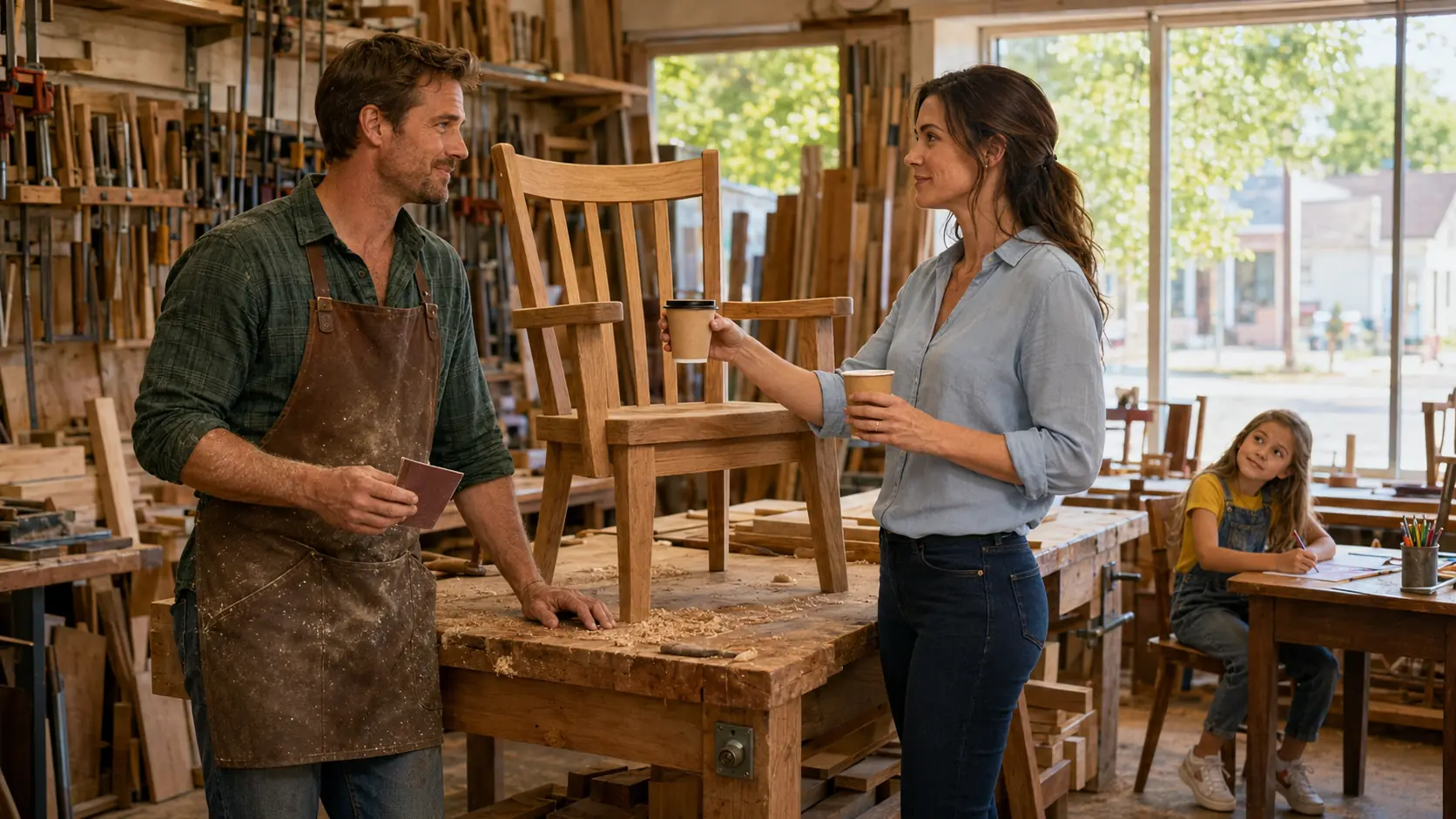
Not to buy anything.
Not to invest in anything.
But simply to watch him smile while he worked.
Nobody could have guessed that long before her real name surfaced, she had already reshaped his entire life in ways he would only understand when it was almost too late.
The town of Cedar Hollow woke up slowly every morning, the way small towns do, with the smell of coffee drifting from the diner on Main Street and the sound of the church bell marking seven o’clock sharp.
Ethan Carter was always awake before the bell rang.
He unlocked the door to his woodworking shop at six in the morning, turned on the single overhead light that buzzed for a few seconds before settling, and ran his hand along the workbench like he was greeting an old friend.
The shop had been his father’s before him and his grandfather’s before that.
Three generations of sawdust had soaked into the floorboards.
Ethan moved through his mornings with a kind of quiet ritual, sweeping corners that did not need sweeping, sharpening tools that were already sharp because the motion of his hands kept his mind from wandering somewhere he did not want it to go.
By eight o’clock, old Mr. Callaway would shuffle in with his cane, complaining about his kitchen chair wobbling again, and Ethan would fix it without charging him a single dollar, the same way he had fixed it the three times before.
By ten, Pastor Reynolds might stop by needing a hinge replaced on the church’s side door, and Ethan would drop whatever he was doing to drive over and take care of it himself.
When veterans came in needing shelving or repairs for their homes, Ethan waved off their money with a firm shake of his head, telling them their service had already paid enough.
The whole town loved him for it.
The kind of love that shows up in casseroles left on porches and waves from across the street.
But love from a town does not fill the silence of an empty house at night.
His house sat at the end of a gravel road, modest and weathered, and inside, nothing had changed in three years.
Her sweater still hung on the hook by the back door.
Her gardening gloves still sat on the windowsill above the kitchen sink, stiff with disuse.
A pair of reading glasses she had never gotten around to replacing still rested on the nightstand, exactly where she had left them the morning she went to the hospital for what everyone assumed would be a routine appointment.
Ethan walked past these things every day without touching them.
Without moving them.
As if rearranging a single object might somehow erase the last traces of a life that had ended too soon.
Sometimes, late at night, he would stand in the doorway of the small room they had once planned to turn into a nursery.
A plan abandoned long before Sarah’s diagnosis, for reasons that had nothing to do with illness.
He would simply look at the empty space without going inside.
He was a man who gave everything to everyone around him and kept nothing for himself.
The town saw a hero where Ethan only saw a man trying to survive each day without falling apart.
Some evenings, he sat on the porch with a glass of sweet tea, watching the sun drop behind the tree line, listening to the crickets start their slow chorus in the tall grass.
The loneliness would settle into his chest like a stone he had long since stopped trying to lift.
He had grown so used to the weight of it that he sometimes forgot what it felt like to walk without carrying something heavy.
Then one Tuesday afternoon, a car nobody recognized rolled slowly down Main Street.
Its city plates caught the attention of every porch sitter and shopkeeper within view.
It was an older sedan, practical and unremarkable.
Dust from some highway still clung to its fenders.
Heads turned.
Curtains shifted.
The woman at the hardware store set down the box of nails she was carrying just to watch it pass.
In a town where everyone’s vehicle was as familiar as their own, a stranger’s car felt like an event.
The kind of small disruption that would be discussed at the diner counter for days afterward, long before anyone understood just how much that single car was about to change.
The car belonged to a woman who called herself Victoria Hale.
Within two days, she had rented the small house at the end of Maple Street, the one that had sat empty for almost a year.
She told the landlord, and later the woman at the post office, and eventually anyone who asked, that she was a writer looking for somewhere quiet to finish a book.
Nobody questioned it.
Writers came through small towns sometimes, looking for silence and cheap rent.
Victoria carried herself with the kind of plain, unhurried manner that made the story easy to believe.
She wore simple clothes, drove herself everywhere, and never once mentioned a job title or a company name.
What none of them could have known was that the woman renting that small house was Victoria Blake, chief executive officer of one of the largest technology and logistics conglomerates in the country.
A woman whose decisions moved markets.
A woman whose face, when it did appear publicly, appeared in carefully managed photographs designed to reveal nothing personal at all.
On her third day in town, Victoria walked into Ethan’s shop for the first time.
The bell above the door gave a soft chime, and Ethan looked up from the table he was sanding, wiping his hands on his apron before greeting her with the same warmth he gave every stranger who wandered in.
She told him she wanted a reading chair.
Something simple.
Something that would fit in the corner of a small house with good light.
Ethan walked her through the wood samples, explaining the grain of oak versus the warmth of cherry.
Victoria listened more closely than most customers did, asking questions that were not really about furniture at all.
She wanted to know how long he had run the shop.
Whether he had always lived in Cedar Hollow.
What made him choose this life over a city like the one she had just left behind.
He answered simply, the way he answered everything, without performance or pretense.
He told her his family had built furniture in this town for three generations, and that he could not imagine doing anything else with his hands.
There was no calculation in his voice.
No awareness that he was being observed.
No sense that the woman across the counter from him was quietly comparing him to the dozens of men who had pursued her over the years, every one of them polished and ambitious and utterly transparent in their hunger for what she represented.
Victoria found herself staring a beat too long at the easy way Ethan smiled at nothing in particular.
At the way he seemed entirely unbothered by the silence between sentences.
She left that day with an order for a reading chair and a strange, unfamiliar warmth sitting somewhere beneath her ribs.
One she did not have a name for yet.
That night, in the small rented house, Victoria opened a leather notebook she had carried with her for years.
Mostly empty.
Reserved for thoughts she did not trust to anyone else.
Not her assistants.
Not her lawyers.
Not even the handful of friends who had survived her rise to the top of the company.
She uncapped a pen, hesitated for a long moment with it hovering over the page, and wrote a single line about the man at the woodworking shop.
About his hands.
About the unhurried way he moved through his own life, as though time owed him nothing and he owed time nothing in return.
She read the sentence back twice.
Then she closed the notebook before she could examine why she had written it at all, setting it on the nightstand the way someone sets down something fragile they are not quite ready to hold.
Over the following two weeks, Victoria found reasons to return to the shop more often than any reading chair required.
She asked Ethan to change the wood stain twice, claiming the color did not match the light in her living room.
She requested a small bookshelf to match the chair, then adjusted the dimensions after he had already begun cutting the boards.
She asked about the proper way to oil the wood so it would not dry out, then asked again a week later as though she had forgotten the answer entirely.
Ethan never once seemed annoyed by the repeated visits.
If anything, he seemed to look forward to the sound of the bell above his door in the early afternoon, the hours when Victoria tended to appear.
One afternoon, she asked if she could learn to do some of the finishing work herself, just to understand the process for a chapter she claimed to be writing.
Ethan handed her a piece of sandpaper and showed her the motion.
His hand briefly rested over hers to correct the angle, and something passed between them that neither acknowledged out loud.
Over the following days, he taught her how to use the handsaw without splintering the grain, how to apply varnish in long, even strokes instead of small circles, and how to tell when a piece of wood was ready to be sanded smooth.
Victoria’s hands, more accustomed to keyboards and pen signatures on million-dollar contracts, began collecting small calluses she found herself oddly proud of.
She laughed in his shop one afternoon, a real, unguarded laugh, when a poorly clamped board sprang loose and sent a cloud of sawdust into the air between them.
It was the kind of laugh she had not allowed herself in years.
The kind that came without a calculation of who might be watching or what story the moment might generate.
Ethan laughed with her, brushing sawdust from his sleeves, and for a moment, the only thing in the world was the warm afternoon light slanting through the shop windows and the sound of two people who had both forgotten, briefly, how heavy their lives usually felt.
Word reached the small town slowly.
In the particular way gossip moves through a place where everyone knows everyone, people began to notice that the writer renting the house on Maple Street seemed to be spending an awful lot of time at Ethan Carter’s shop.
Mrs. Higgins from the bakery mentioned it to her sister.
The sister mentioned it to the mailman.
Nobody thought much of it beyond a pleasant curiosity.
The kind of harmless speculation small towns thrive on.
Certainly nobody imagined the truth behind the woman’s quiet visits.
Late one evening, while Victoria sat at the small kitchen table in her rented house, reviewing emails she had been ignoring for days, her phone rang with a number she recognized immediately.
It was her chief financial officer, his voice tight with the particular urgency reserved for board matters.
The board wanted a call, he said, regarding the upcoming merger vote and certain shareholders expressing concern about her extended absence from headquarters.
Victoria stared at the phone for a long moment.
Then she told him she would call back later in the week and ended the conversation before he could press further.
She set the phone face down on the table and sat in the silence of the small house, feeling for the first time in years that the distance between her two lives was beginning to narrow in ways she was not ready to confront.
A few days later, something shifted between them that neither had planned.
Victoria had stayed later than usual helping Ethan close up the shop, and as they stood near the back door waiting for the rain outside to ease, she found herself talking about things she rarely spoke of, not even to the handful of people she trusted at the company.
She told him, without using names or details that might give her away, that she had spent most of her adult life surrounded by people who only wanted something from her.
Board members who smiled while plotting against her.
Suitors who proposed marriage within months of meeting her because the merger of fortunes appealed to them more than she ever could.
She told him she had stopped trusting compliments a long time ago because compliments had always come with strings attached.
Her voice cracked slightly as she spoke, and to her own surprise, tears followed.
The kind she had not allowed herself in front of another person in longer than she could remember.
Ethan did not reach for his phone.
He did not ask follow-up questions, trying to identify who she meant or what world she came from.
He simply listened, his presence steady and unhurried.
And when she finished, he offered her a clean rag from his workbench instead of a tissue, which made her laugh through the tears in a way that loosened something tight in her chest.
She did not tell him she was a chief executive officer.
She did not tell him about the billions of dollars, the board meetings, or the merger threatening to consume the next several months of her life.
She only let him see the exhaustion underneath all of it.
And that alone felt like more honesty than she had offered anyone in years.
In return, Ethan opened a door of his own that he rarely let anyone near.
He told her about his wife, Sarah.
About the diagnosis that had come without warning.
About the eighteen months that followed, during which he had watched the woman he loved most in the world disappear piece by piece while he stood by, helpless to stop any of it.
He told her he had once been offered a position at a furniture design firm in another city.
A real opportunity to expand the family business into something larger.
But after Sarah passed, he could not imagine leaving the town where every street corner held a memory of her.
He had chosen to stay small, he said.
Not because he lacked ambition, but because the life he had left was the only thing connecting him to the life he had lost.
Victoria listened to him the way he had listened to her.
Without trying to fix anything.
Without offering empty reassurances about time healing all wounds.
She simply sat with him in the quiet of the closing shop.
Two people who had each spent years performing strength for everyone around them, finally allowing themselves to be tired in front of someone else.
When she left that night, neither of them said anything about what had passed between them.
But both walked away changed, carrying something new and fragile they were not ready to name.
Meanwhile, back at corporate headquarters two hundred miles away, Daniel Whitford sat in his office reviewing reports with a growing frustration that had nothing to do with quarterly earnings.
Daniel had been pursuing Victoria for the better part of two years.
Not out of any genuine affection, but because a merger between their two family-controlled companies would create an empire neither could build alone.
He had proposed marriage eight months earlier in a manner so calculated it had embarrassed even his own assistant, framing the union as a strategic partnership before he had ever mentioned love.
Victoria had declined without much explanation.
Daniel, unaccustomed to rejection in any form, had simply waited for an opportunity to try again.
When he learned through a colleague on the board that Victoria had quietly disappeared from the city for weeks at a time, citing vague reasons about needing space to think, Daniel’s curiosity sharpened into something closer to obsession.
He hired a private investigator under the guise of due diligence for the upcoming merger, instructing the man to discreetly track Victoria’s movements and report back anything unusual.
The investigator, a methodical man named Russo, began his work quietly, starting with credit card statements and gas station receipts, slowly piecing together a trail that led, much to his own surprise, toward a small town called Cedar Hollow.
A town that did not appear on any list of business destinations Victoria Blake had ever frequented.
Back in Cedar Hollow, life continued in its gentle rhythm.
But strange and wonderful things had begun happening throughout the town.
Things nobody could quite explain.
The community hospital, which had been on the verge of closing its doors due to mounting debt, suddenly received an anonymous donation large enough to clear every outstanding loan and fund new equipment for the next five years.
The elementary school, whose roof had been patched with tarps for two winters running, was completely renovated overnight by contractors who arrived, finished the work, and left without ever revealing who had hired them.
A small vocational fund appeared, offering free trade school tuition to any young person in town who wanted to learn a skilled trade, with no fine print and no name attached beyond the simple phrase, an anonymous benefactor.
The town library received an upgrade nobody had requested.
New computers.
New shelving.
A children’s reading room built where a storage closet used to be, complete with a small mural of the town painted across one wall by an artist who arrived, worked for three days straight, and disappeared without ever giving her name.
Several small business owners who had quietly been drowning in debt found their loans mysteriously paid off in full, with bank representatives unable or unwilling to explain who had settled the accounts, only that the payments had arrived through channels too complicated to trace back to a single source.
The diner where Ethan ate breakfast most mornings received a new roof after years of leaking during heavy storms, and the owner, a widow herself, wept openly at the counter the morning she found the repair already finished and paid for.
The whole town buzzed with theories, guessing at lottery winners or distant relatives of long-dead founders.
But nobody guessed the truth.
Every single gift had come from the quiet woman renting the house on Maple Street, moving money through layers of shell accounts and trusted intermediaries so carefully that even her own legal team could not trace it back to her without specific instruction.
Ethan noticed the changes the way everyone else did, with a kind of grateful disbelief.
One afternoon, as he and Victoria walked past the freshly painted library on their way back from lunch, he remarked that it felt like the whole town had been touched by some kind of miracle.
As though Cedar Hollow had quietly been chosen by some unseen hand.
Victoria only smiled and said that maybe good things happened to good places sometimes.
That towns like this deserved a little luck after years of being overlooked by everyone who mattered.
Ethan, having no reason to suspect otherwise, simply nodded and went back to sanding the table in front of him, his thoughts already drifting to the next order waiting on his bench.
He had no idea that the miracle sat across the workbench from him nearly every single day, learning to use a chisel and laughing at her own clumsy mistakes.
Her billions of dollars were worth less to her in that moment than the splinter she had just pulled from her thumb.
It was during this stretch of quiet happiness that Russo, the investigator hired by Daniel, finally arrived in Cedar Hollow himself.
He posed as a traveling salesman, asking careful questions at the diner and the gas station.
Within a day, he had confirmed what his research had already suggested.
The woman calling herself Victoria Hale matched every physical description of Victoria Blake, right down to the small scar above her left eyebrow that no makeup ever fully concealed.
He photographed her from a distance outside the woodworking shop, careful not to be seen, and sent his findings back to Daniel along with a single text message confirming the location of Cedar Hollow.
Daniel wasted no time.
Within forty-eight hours, he had arranged a convoy that felt entirely out of place rolling down the quiet streets of Cedar Hollow.
Two black sedans carried his personal security team.
A third car held his legal counsel.
Trailing behind them, against his explicit instructions but unable to resist the story, was a small van from a regional news outlet that had picked up a tip about an executive’s mysterious disappearance.
The convoy stopped directly in front of Ethan’s woodworking shop on a bright Thursday afternoon, drawing every set of eyes on the street.
Daniel stepped out first, dressed in a suit that cost more than most houses in town, his security detail flanking him like an entourage from a world Cedar Hollow had only ever seen on television.
He walked straight into the shop, found Victoria standing near the workbench with sawdust still clinging to her sleeve, and announced, loud enough for half the street to hear through the open door, that the board needed Chief Executive Officer Blake back in the city immediately.
The shop fell into a silence so complete that the dust motes seemed to stop moving in the afternoon light.
Ethan stood frozen behind the counter, a half-finished chair leg still in his hand, staring at Victoria as the words settled over him like cold water.
Outside, the small crowd that had gathered exchanged stunned glances.
The writer from Maple Street had suddenly transformed into someone none of them could reconcile with the quiet woman who had been learning to sand wood beside their town’s most beloved widower.
Victoria turned to Ethan immediately, her face pale, already reaching for words that might explain everything.
But Ethan had already set the chair leg down on the counter with a quiet, deliberate motion that somehow felt louder than any shout.
He looked at her for a moment, searching for something in her expression.
What he found instead was confirmation of everything Daniel had just announced.
Without saying a word, Ethan turned and walked out the back door of his own shop, leaving Victoria standing among the wood shavings and the silence and the wreckage of a secret she had never managed to tell him herself.
She called his name once, her voice breaking on the single syllable.
But Ethan did not stop walking.
Daniel, sensing an opportunity in the chaos, stepped forward to usher Victoria toward the waiting car, speaking quickly about damage control and press statements and the merger vote that could not wait another day.
Victoria allowed herself to be guided toward the sedan, too stunned by the look on Ethan’s face to resist.
Within the hour, the convoy was gone, leaving Cedar Hollow buzzing with a story that would dominate every porch conversation for weeks to come.
That night, alone in her hotel suite in the city, Victoria sat staring out at a skyline that had never once made her feel as peaceful as a single afternoon in that small woodworking shop.
She thought about leaving the company altogether.
Walking away from the empire her grandfather had built.
Simply disappearing back into Cedar Hollow and begging Ethan to understand.
But morning brought board meetings and merger paperwork and the particular gravity of responsibilities she could not simply abandon.
Days turned into a week.
The week turned into the beginning of a decision Victoria had not yet made peace with.
Whether to return to the town that had given her the only real happiness she had known in years, or to disappear from Ethan’s life entirely and spare him whatever chaos her real world might bring crashing down on his quiet one.
Back in Cedar Hollow, the truth continued unraveling in pieces too large to ignore.
A reporter who had tagged along with Daniel’s convoy published a story identifying Victoria Hale as Victoria Blake.
Within days, residents began connecting threads that had previously seemed like unrelated good fortune.
Mrs. Higgins remembered the timing of the hospital’s miraculous rescue and realized it had happened just weeks after Victoria arrived in town.
The bank manager, after persistent questioning from curious neighbors, finally admitted under pressure that the anonymous payments clearing several small business loans had originated from a trust connected to Blake Industries.
The school board discovered, buried in renovation paperwork, a donor name that had been redacted everywhere except a single overlooked invoice, where the letters spelled out Victoria Blake in plain, undeniable print.
Piece by piece, the town reconstructed a portrait of the woman they thought they had known as a quiet writer.
What emerged left even the most skeptical residents stunned into respectful silence.
It was not only the hospital or the school or the small business loans.
Someone eventually discovered that months earlier, before anyone in town had even met Victoria face-to-face, the parcel of land beneath Ethan’s woodworking shop, land his family had only ever leased rather than owned, had quietly changed hands.
The county records showed the property had been purchased by a holding company nobody recognized just days before the original landowner had planned to sell it to a developer eager to turn Main Street into something far less personal.
Without that purchase, Ethan would have lost his shop entirely within the year.
Evicted from the building his grandfather had built with his own hands.
And he would never have known the reason behind his sudden stay of fortune.
The town began to understand, with a kind of dawning awe, that the woman who had silently saved their hospital and their school and their small businesses had also, before ever stepping foot in Ethan’s shop, ensured he would still have a shop to walk into at all.
It was not calculated affection or strategic kindness designed to win him over.
The timeline made that clear.
She had protected his livelihood before she had ever spoken a single word to him, before she had ever learned his name or seen his face.
As though some instinct had told her this man, in this town, deserved protecting long before she understood why.
Neighbors who had known Ethan his entire life found themselves sitting on their porches in the evenings, turning the story over and over, trying to reconcile the image of the billionaire executive with the quiet, sawdust-covered woman who used to wave at them from across the street.
Most concluded, after enough conversation, that perhaps the two images were not so different after all.
Ethan heard these stories secondhand.
From neighbors stopping by his shop with apologetic faces, unsure whether to offer congratulations or condolences for a heartbreak that had played out in front of the entire town.
He absorbed the information slowly, sitting alone in his shop each evening long after closing, running his fingers along the grain of unfinished wood while turning the truth over in his mind.
He was not certain yet whether to feel grateful or betrayed.
The uncertainty kept him awake most nights, staring at the ceiling of a house that suddenly felt emptier than it had in years.
It was during one of these long evenings that Ethan found the notebook.
Victoria had left it behind in the chaos of that final afternoon, tucked beneath a stack of wood samples on a back shelf, where it had gone unnoticed for days.
Ethan discovered it while reorganizing the shop, a simple leather-bound book with no title, no name on the cover, nothing to suggest it belonged to anyone in particular.
He almost set it aside without opening it, respecting what felt like a private object.
But curiosity, and perhaps a need for answers he had not allowed himself to ask aloud, won out.
The pages inside told a story entirely different from the one the town had pieced together through bank records and renovation invoices.
There was nothing about mergers or shareholders or strategic philanthropy designed to win goodwill.
Instead, Ethan found page after page of small, careful observations written in handwriting that grew looser and more honest as the entries progressed.
The earliest pages described, with almost clinical detachment, a man at a woodworking shop who seemed unlike anyone she had encountered in her entire adult life.
Someone who gave freely without calculating what he might receive in return.
As the entries continued, the detachment fell away entirely.
She had written about the way he hummed quietly while working, off-key and entirely unaware of it.
She had written about the calluses forming on her own hands and how proud they made her feel, prouder than any business deal she had ever closed.
She had written, on a page dated only a few weeks earlier, that he was the first person in longer than she could remember who made her want to slow down, who made the idea of stillness feel like a gift instead of a wasted opportunity.
Nowhere in the entire notebook did she mention his usefulness to her company, his potential as a business asset, or any strategic value at all.
There was only a woman falling in love with a man for no reason beyond the simple fact that being near him made her feel like a person again instead of a title.
Ethan closed the notebook slowly, his hands trembling slightly as the full weight of what he had been wrong about settled over him.
He had assumed, in his hurt and shock, that everything between them had been some elaborate distraction for a bored billionaire.
A temporary indulgence before returning to a real life that had no place for a small-town widower.
The notebook told a different story entirely.
One of genuine, unguarded affection that had nothing to do with the empire she controlled and everything to do with who she became when she was simply Victoria, sitting beside him in a shop full of sawdust and afternoon light.
He sat with that knowledge for the rest of the night.
By morning, something in him had shifted from hurt into resolve.
He could not undo the silence that had passed between them since that terrible Thursday afternoon.
But he could refuse to let it become the final word.
He packed a small bag, told Mr. Callaway to keep an eye on the shop, and drove the two hundred miles to the city for the first time in longer than he could remember, carrying the notebook with him like proof of a truth he needed her to remember herself.
He arrived at the headquarters of Blake Industries on the morning of an emergency board meeting that had been called specifically to address what Daniel and several shareholders were calling instability in leadership.
A polite phrase for the fact that Victoria’s recent disappearances had given certain board members the opening they had been waiting for to push through a forced merger on terms heavily favorable to Daniel’s family company.
Inside the boardroom, Daniel stood at the head of a long table, methodically laying out a case for why Victoria’s judgment had become compromised.
Why a strategic marriage and merger between their two companies would stabilize the company’s public image and reassure nervous investors.
Victoria sat at the opposite end of the table, her expression carefully composed despite the exhaustion visible beneath her eyes.
She listened as Daniel suggested, with a calm that bordered on condescension, that she sign over a controlling percentage of her shares as a gesture of good faith toward the merger.
A gesture he framed as necessary, given recent questions about her commitment to the company.
Several board members nodded along, their loyalty to Daniel’s family fortune outweighing any loyalty to a woman who had quietly run the company with integrity for nearly a decade.
Victoria’s voice, when she finally spoke, carried a steadiness that surprised even herself.
She told the room plainly that she would not be signing over her shares.
She would not be entertaining a marriage proposed as a corporate strategy.
She would not allow her grandfather’s company to be absorbed into someone else’s legacy simply because a handful of board members preferred convenience over loyalty.
Daniel’s expression hardened.
He opened his mouth to respond with the kind of practiced authority that had worked on every other room he had ever stood in.
But before he could speak, the door at the back of the boardroom opened.
Ethan walked in wearing the same flannel shirt he wore in his shop, sawdust still faintly visible on the cuffs, utterly out of place among the tailored suits and polished conference table.
And yet, he crossed the room with the same unhurried confidence he carried everywhere else in his life.
His boots were the same ones he wore every day at the workbench, scuffed and worn at the toe.
The contrast between him and the gleaming glass conference room was so complete that, for a moment, nobody seemed to know whether to laugh or call security.
Every head in the room turned.
Confusion rippled through the assembled executives, who had no idea who this stranger was or why security had not stopped him at the door.
Several were already reaching for their phones to summon someone who would.
Victoria’s breath caught in her throat as their eyes met across the long table.
For a single suspended second, the entire room of investors and lawyers and board members simply ceased to exist for her.
Ethan did not address the board.
He did not acknowledge Daniel at all.
He did not engage with the merger talk, the shares, or any of the language that had filled the room for the past hour.
He looked only at Victoria and said simply that he had not come to discuss the company, the merger, or anything happening in that boardroom.
He had come because he needed her to know he had read the notebook.
Every page.
And that he understood now what he should have understood that day in the shop before he walked away without listening.
He told her he had come for her, plainly and without performance, the same way he had always spoken to her.
Whatever happened with the company afterward was hers to decide.
But he was not going to let pride or hurt feelings keep him from saying what he should have said weeks ago.
The boardroom sat in stunned silence.
Several of the older board members, women and men who had known Victoria since she first inherited the company from her grandfather, exchanged glances that carried more meaning than words could have.
They had watched Victoria for years.
Watched her grow increasingly guarded.
Increasingly exhausted.
Increasingly hollow beneath the polished exterior she presented to shareholders.
The woman standing in front of them now, color rising in her cheeks as she looked at a sawdust-covered widower from a town none of them had ever heard of, looked more alive than any of them had seen her in years.
One of the eldest board members, a woman named Eleanor Vance, who had served on the board since Victoria’s grandfather ran the company, rose slowly from her chair.
She remarked, to no one in particular, that whatever this man had done for Victoria, it had clearly done more good than every merger discussion they had held in the past two years combined.
Several others murmured agreement.
Daniel, sensing the room shifting beneath him in real time, attempted to redirect the conversation back toward the merger, his voice rising with barely concealed panic.
But the momentum had already turned.
Eleanor proposed a motion to table all merger discussions indefinitely, citing the obvious lack of board consensus and the inappropriate pressure Daniel had attempted to apply through a proposal that blurred personal and professional lines in ways the board should never have entertained in the first place.
The motion passed with an overwhelming majority.
Daniel, his face flushed with humiliation, gathered his papers and left the boardroom without another word.
His ambitions for an empire built on convenience rather than genuine partnership crumbled in real time in front of the very people he had hoped to impress.
Victoria walked around the long table toward Ethan, her composure finally breaking into something softer.
Something the boardroom had never witnessed from her before.
She told him, quietly enough that only he could hear, that she was sorry for never finding the right moment to tell him the truth herself.
That she had been afraid the truth would change the way he looked at her, the way it had changed the way everyone else looked at her for as long as she could remember.
Ethan took her hand, the same hand he had once guided across sandpaper in his quiet shop.
He told her that nothing about who she really was could ever change what he already knew to be true.
That she was the first person in years to make him feel like living again instead of merely surviving.
In the weeks that followed, life in Cedar Hollow began to settle into something new.
A rhythm that honored both the quiet town it had always been and the larger world that had now, undeniably, become part of its story.
Victoria did not disappear back into the city.
Nor did she abandon the company her grandfather had spent decades building.
Instead, she began splitting her time deliberately, handling the responsibilities that genuinely required her presence in the city while making Cedar Hollow the place she returned to whenever she could.
No longer hiding behind the name Victoria Hale.
Walking through town as exactly who she was.
She announced, in a quiet conversation with the mayor rather than through any press release, that she intended to invest directly and openly in the town that had given her something no amount of money had ever provided.
A sense of belonging she had not realized she was missing.
The vocational fund that had once operated under the vague label of an anonymous benefactor now bore her name proudly, expanded to offer not just tuition assistance, but full apprenticeship placements with local craftspeople.
Starting, fittingly, with Ethan’s woodworking shop.
The shop itself received funding for an expansion, a second workspace built onto the back of the original building, large enough to host classes for anyone in town wanting to learn the trade that had sustained Ethan’s family for three generations.
Together, Victoria and Ethan opened what they decided to call Maker’s House.
A community workshop where anyone, young or old, could come learn woodworking, leatherwork, and other trades from teachers who genuinely loved what they did.
The grand opening drew nearly the entire town.
Folding chairs were set up in rows across the gravel lot.
Lemonade was served in mismatched pitchers.
And Mr. Callaway, of all people, cut the ribbon with a pair of shears Ethan had sharpened for him that very morning.
It became, almost immediately, the heartbeat of a town that had always valued craftsmanship over flash.
Watching Victoria teach a group of teenagers how to properly sand a tabletop, her sleeves rolled up and sawdust dusting her forearms, no one watching would have guessed she had once stood in boardrooms commanding the attention of investors managing billions of dollars.
She found, to her own quiet surprise, that she preferred the sound of sandpaper against pine to the sound of applause in any conference hall she had ever stood in.
Ethan, for his part, never changed the fundamental rhythm of his life.
He still opened the shop at six every morning.
Still fixed Mr. Callaway’s chair whenever it wobbled.
Still refused payment from veterans who tried to insist.
What changed was the quiet absence that used to fill the house at the end of the gravel road.
Victoria’s presence settled into his life gradually, never overwhelming the simplicity he cherished, learning instead to love the slowness of his days rather than trying to fill them with anything more complicated than they needed to be.
On one particular afternoon in early autumn, the kind where the light turns gold and the air carries the first real chill of the coming season, Victoria and Ethan sat together on the porch of his house.
The same porch where he used to sit alone with sweet tea and quiet grief.
They watched the same tree line.
The same fading light.
But he no longer carried the weight he once carried into every quiet evening.
The sweater that had hung by the back door for three years had finally been moved, folded gently and placed in a box Ethan kept in the closet.
Not forgotten.
But no longer a wound left open for the world to see.
He had done it himself one Sunday morning without Victoria asking him to, and afterward he had sat on the porch step for nearly an hour before going back inside, letting himself feel whatever needed to be felt before closing that particular door for good.
Beside that old memory now sat small traces of a new life slowly weaving itself into the old one.
A second coffee mug in the kitchen cabinet.
A pair of boots by the front door that were not his.
A stack of mail addressed to Victoria Blake that the postman delivered without comment, as though the town had simply decided, without ever discussing it, that she belonged here now as much as anyone born within its limits.
Victoria leaned her head against Ethan’s shoulder, watching the sun drop slowly behind the tree line the way it always had.
The same crickets began their evening chorus in the tall grass.
She told him, with a small laugh in her voice, that she had originally come to this town hoping to hide from the entire world for just a little while, expecting nothing more than a quiet place to disappear for a few weeks before returning to a life that demanded every part of her.
Ethan wrapped his fingers around hers, feeling the small calluses that had not been there when they first met.
Calluses earned honestly through hours spent learning a craft that had nothing to do with the empire she controlled and everything to do with the woman she had quietly become while no one was watching.
He told her, in the same plain and unhurried voice he used for everything that truly mattered to him, that somewhere along the way, without either of them quite realizing it was happening, she had stopped being someone hiding from the world and had instead become the entire world he thought he had lost the ability to want.
The town of Cedar Hollow went on much as it always had.
The church bell rang at seven.
The diner filled with the smell of coffee.
The woodworking shop opened its doors at six sharp every morning.
But within that familiar rhythm now lived something new.
A quiet proof that the truest miracles rarely announce themselves with fanfare.
Sometimes they arrive disguised as a stranger with an old car and a borrowed name, patiently waiting in a small shop full of sawdust and afternoon light for someone to teach them, finally, how to slow down and simply live.