The SUV lay upside down at the bottom of the slope, its rear wheels turning slowly against the rain-dark sky. Smoke poured from the engine bay in thick gray ribbons, flattened by the wind before rising over the ditch.
Graham Danner slid through the mud toward it with his flashlight clenched between his teeth, one hand braced against the wet grass and the other reaching for the twisted door frame.
The man trapped inside had no wallet and no phone, only a plain gold ring gripped so tightly in one fist that the knuckles around it had gone white. Every time Graham told him to hold on, the man looked past him toward the road above and whispered the same warning: “Leave before they come back.”
Graham did not leave. He had spent most of his forty-three years being underestimated by people who mistook quiet for weakness and a worn work jacket for a lack of ambition. He had also spent nine years volunteering with the county rescue squad before the demands of his garage made it impossible to keep answering every call, and his body remembered the training even when the rest of him was tired enough to ache.
He braced his shoulder against the crushed door, worked at the seat-belt release, and finally drew a pocketknife when the mechanism refused to move. Seconds after he dragged the stranger clear of the wreck, the engine compartment caught fire and swallowed the front of the vehicle in a hard orange bloom.
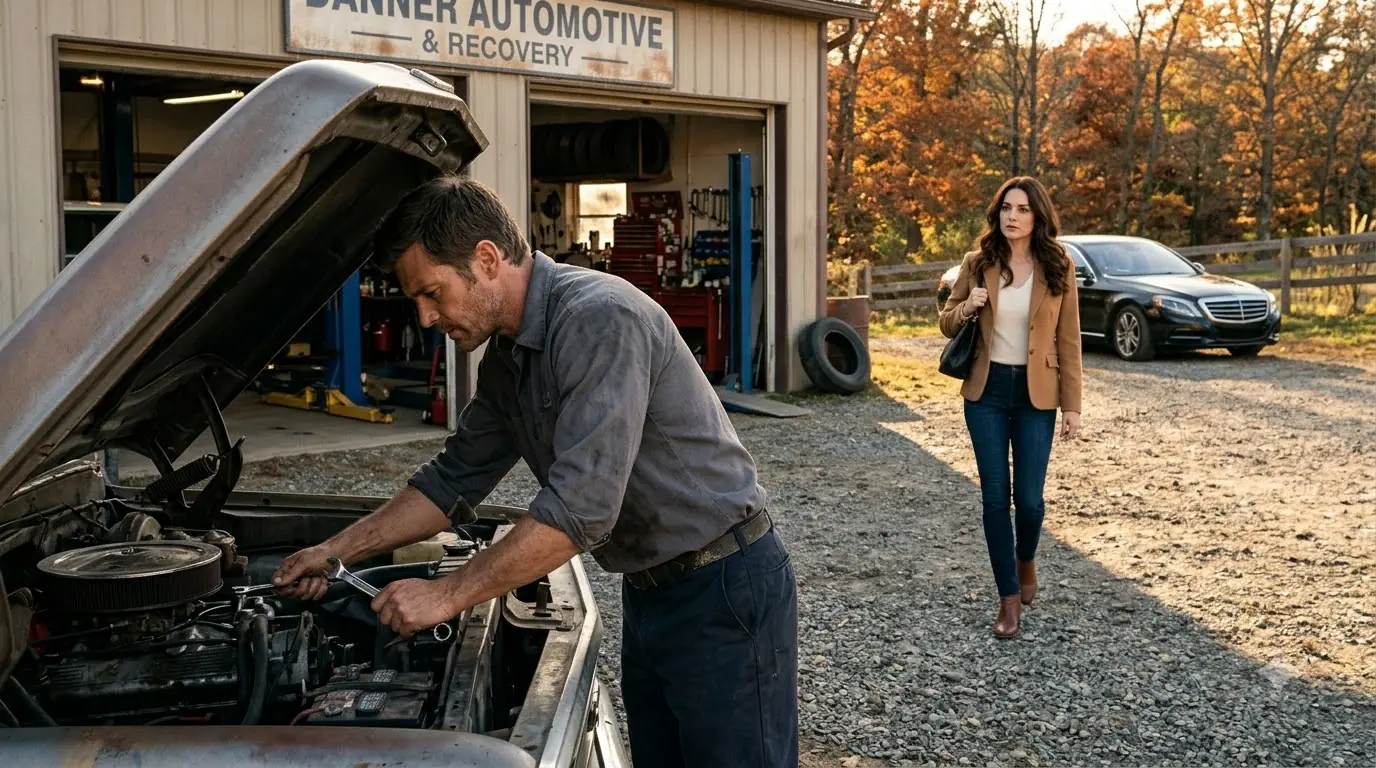
Two days later, three black SUVs would roll into Graham's gravel lot, and a woman with a face trained to reveal nothing would step out and ask him one question: “Who saved my father?”
By then, Graham would have learned that the crash had not been an accident, that the man he had pulled from the wreck was Gideon Whitmore, the founder of a powerful industrial technology company, and that the people who wanted Gideon dead had begun to dismantle Graham's life simply because he had been there. He would also discover that the most dangerous part of the story was not the attempt on Gideon's life, but the reason it had happened. That reason had been hidden inside a small piece of metal Graham almost threw into a drawer and forgot.
The rain had been falling for six hours by the time Graham turned his tow truck onto the county road along the ridge. Beyond the windshield, the world had narrowed to two cones of yellow light, the rhythmic sweep of the wipers, and a long silver wall of water that seemed to rise from the pavement rather than fall out of the sky. He had been on the clock since before sunrise, first pulling a delivery van from a muddy shoulder, then changing a customer's alternator in the last hour before closing, and finally answering a late call from a stranded driver who had mistaken a warning light for a catastrophic engine failure. He was heading home at last, thinking about the sandwich in the refrigerator at the back of his shop and whether the leaking kitchen faucet could survive another weekend without repair.
Then his headlights caught the guardrail. A section of it was gone, peeled outward as if someone had opened a can with a blunt knife. Graham eased off the accelerator and brought the truck to a stop on the shoulder, leaving the hazard lights flashing while the rain drummed against the roof. For several seconds he sat with both hands on the steering wheel, studying the empty gap and the dark slope beyond it. A broken rail meant a vehicle had left the road, and in weather like this the difference between a survivable slide and a fatal fall could be a few feet of clay.
He took the heavy flashlight from the door pocket, pulled his hood up, and stepped into the storm. The wind carried the sharp chemical stink of hot fluid and burning insulation from below, a smell that did not belong in a place where the only other scent should have been wet earth and crushed leaves. Graham called emergency dispatch, gave the route number and mile marker twice so the dispatcher would not mistake one for the other, and reported a vehicle over the embankment with at least one occupant. He stayed on the line long enough to hear that rescue and fire crews were being sent, then put the phone in his pocket and moved toward the edge.
The SUV lay about forty feet below, upside down in a shallow drainage cut where rainwater was already gathering around its roof. Its wheels turned with a slow, useless persistence, and one headlamp still shone into the brush, illuminating a patch of weeds that shook under the falling water. There were no other vehicles on the road, no person standing near the rail, and no voice calling for help. Graham swept his light across the slope, looking for movement, then began his descent sideways, planting each boot carefully in the slick clay before shifting his weight to the next patch of ground.
He had learned years ago that panic wasted time and time was often the only thing a rescuer had. At the bottom, he crouched beside the shattered driver's window and aimed the beam inside. A man hung upside down in the seat belt, gray hair plastered to his forehead and blood running along his temple toward his ear. He was perhaps in his late sixties, wearing a dark suit that had been torn at the shoulder, and his right leg was trapped awkwardly between the seat and the collapsed door. His eyes were open and clear, and instead of staring at Graham he was watching the road above them.
“Sir,” Graham said, keeping his voice low and steady. “My name is Graham. I'm here to get you out. Can you tell me if you can move your hands?”
The man looked at him as if the question had come from a great distance. His right hand was clenched around a plain gold ring, the kind worn smooth by years of handling, while his left pressed against the roof lining. He did not ask for an ambulance or say that his leg hurt.
Instead, he said, “Leave it. Don't take anything out of this vehicle. Don't look for anything. Just go.”