The summer of 1883 came to Dodge City like a punishment. Heat pressed down on the Kansas plain so thick and mean a man could choke on it just standing still. The grass along the South Trail had gone yellow weeks ago. The creek beds showed their ribs.
Even the dust seemed tired, hanging in the air long after horses passed through, as if it had forgotten how to settle. Clara Whitmore had been on that South Trail since before sunrise. She hadn't slept, hadn't eaten since the half biscuit she'd found wrapped in cloth inside her satchel, the one Martha O'Neal had pressed into her hands three nights ago, whispering, "Go, child. Go now before he knows you're gone." Martha's hands had been shaking. Clara had never seen Martha O'Neal's hands shake before in her life. That alone told her everything about how bad things had gotten. She made it 11 miles on foot before they found her.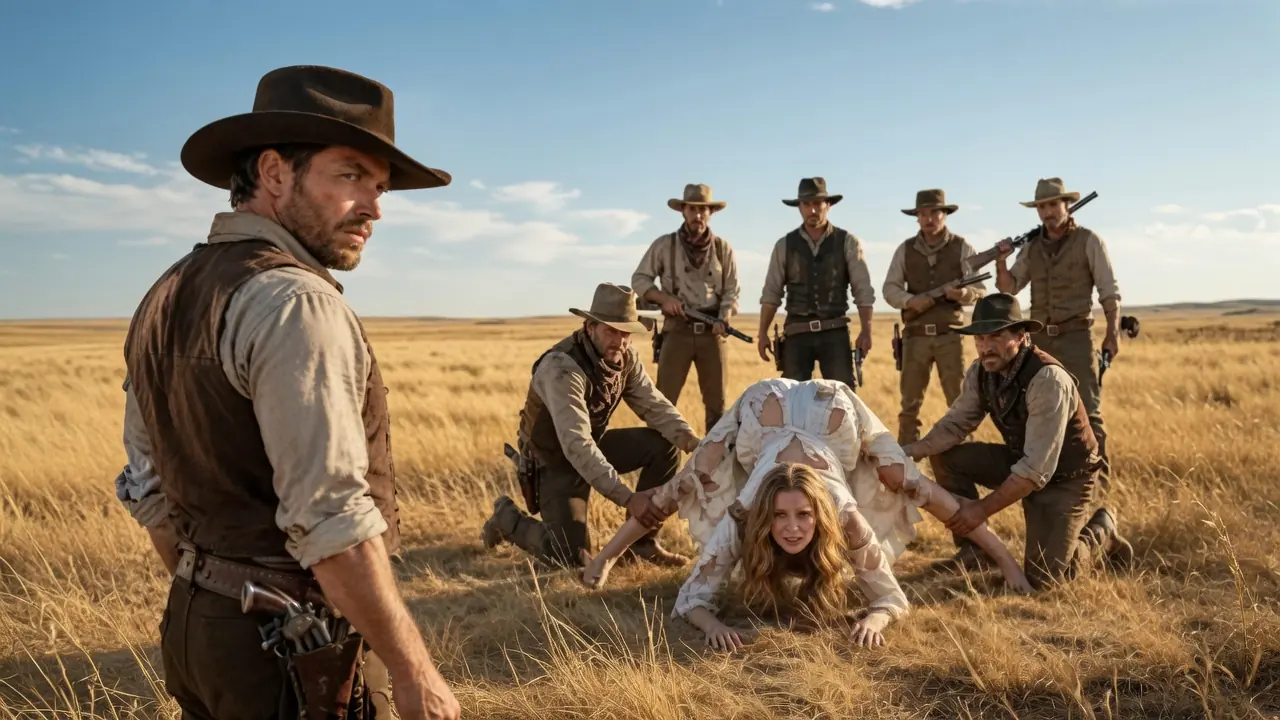
She heard the horses first. Four sets of hooves, then two more coming hard from the northwest, cutting across the open plane like they knew exactly which direction she'd run. She didn't look back. She kept walking, kept her eyes on the pale strip of road ahead, told herself it might be travelers, traders, anyone.
Then she heard Thaddeus Cain's voice. "Miss Whitmore," he said her name the way a man sets down a trap. Quiet, precise, completely certain she wasn't going anywhere. Clara stopped walking.
She didn't turn around. "Figured you'd head for Hays," Cain said, closer now, the creak of saddle leather filling the silence. "Barrett thought Wichita. I know you better than that, though.
You always did like the long road. " She heard him dismount, heard the boots hit the dirt. "Turn around, Miss Whitmore. " She turned around.
There were six of them. Cain at the front, tall, pale-eyed, wearing that gray duster. He never seemed to take off no matter how hot the season ran. Behind him, five men she recognized from the saloon.
Barrett Silvers's men. Two of them she'd served drinks to not four days ago. One of them had called her sweetheart. She'd smiled and said nothing and gone back behind the bar and kept her face perfectly blank the way she'd trained herself to do.
"She wasn't smiling now. You took something that doesn't belong to you," Cain said. He walked toward her unhurried like a man who had never once been uncertain of an outcome. "Mr.
Silvers would like it returned." "I don't know what you're talking about." Cain stopped three feet from her. His pale eyes moved to the satchel on her shoulder, then back to her face. Clara, he said, softer now, which was somehow worse. "Don't make this harder than it needs to be." Give me the ledger, and we'll ride back to town together.
Nice and easy. Mr. Silvers will explain the misunderstanding to you himself. "There's no misunderstanding," she said.
I know exactly what that ledger is. I know exactly what those names mean. Something moved behind Cain's eyes. Not surprised, she'd half expected surprise, but something colder than that.
Recognition, like he'd been waiting to see if she actually understood what she'd found. And now he had his answer. "Then you know," he said quietly, "that we can't let you walk away with it. He nodded to the men behind him.
Two of them came forward. Clara ran. She didn't make it 20 yards. One of them caught her by the arm, spun her hard, and she hit the ground on her palms and knees.
Satchel flying. She heard the stitching on her sleeve tear. She tasted dust. Before she could push herself up, hands closed around her arms from both sides and hauled her upright like she weighed nothing at all.
"Don't," she said. Her voice came out steady, which surprised her. "Shouldn't have run," the man on her left said he wasn't unkind about it. That was almost worse.
The complete matter-of-factness of it like this was a normal thing. Like a woman fighting to breathe in two strangers grip was just Tuesday in Kansas. Cain picked up the satchel. He reached inside.
He pulled out the folded ledger, the pages she'd spent three weeks carefully, silently copying down in her cramped handwriting during every hour she had alone. And he looked at it for a long moment without speaking. Then he looked at her. "Start walking," he said.
"Where back to Dodge? " A pause. "Eventually. " The way he said eventually made her stomach drop to her boots.
They were a quarter mile down the road. Clara walking with Cain's men, bracketing her on both sides, her wrists pinned behind her back, the sun beating down on all of them when the man appeared. She almost didn't see him at first. He was standing just off the road in the thin strip of shade thrown by a lightning struck cottonwood that had been dead so long it had gone silver.
He wasn't doing anything. Just standing there, Hat pulled low arms loose at his sides, watching them come down the road with the patient unhurried attention of a man waiting on a train. Cain slowed. The men around her slowed.
Clara felt their grip tighten on her arms. The stranger didn't move. He wasn't especially tall. He wasn't carrying himself like a man trying to look dangerous.
No wide stance, no hand near his holster, none of the theater she'd seen men put on when they wanted to seem like something to fear. He was just still, completely absolutely still. And something about that stillness, the total absence of nerves in it made the hair on the back of her neck stand up. "Afternoon," Cain said.
The stranger looked at him. Then his eyes moved to Clara. They stayed there for a moment, not long, just enough, taking in her torn sleeve, the dust on her hands and knees, the grip the two men had on her arms. His jaw moved slightly, like he was working something over in his mind.
"Let her go," he said. His voice was low, not loud, not theatrical, just clear the way a statement of fact is clear. Cain almost smiled. "This ain't your business, friend.
I'm making it mine. " "That," Cain said, "would be a significant mistake on your part. He glanced back at his men, five armed men, six counting himself. He looked back at the stranger with the expression of a man who has done arithmetic and is satisfied with the result.
"Ride on. There's nothing here for you." The stranger looked at Cain for a long moment. Then he looked at Clara again. "You all right, ma'am?" he asked.
Clara blinked. In the middle of all of it, Cain the six rifles her wrist twisted behind her. Someone had stopped to ask if she was all right. She didn't know what to do with that.
She hadn't been asked that question in so long she'd nearly forgotten it existed. "No," she said. "I am not. " The stranger nodded once like she'd confirmed something he already knew.
"Last chance," he said to Cain. "Let her go. " Cain's hand moved toward his holster. What happened next?
Clara could not describe an exact order afterward. No matter how many times she tried, she remembered the stranger moving not fast, the way she expected, but efficient, like every motion had been thought through years in advance. She remembered Cain's two men releasing her arms, not because they chose to, but because something about the sudden shift in gravity around the stranger made them instinctively step back. She remembered the sound of a pistol being drawn.
She remembered Cain's hand stopping halfway to his own gun. And then she remembered the silence. Cain was looking down the barrel of the stranger's revolver. Six inches from his face.
The stranger hadn't fired, hadn't threatened. He'd just moved, and now the revolver was there, and it was absolutely steady. And the stranger's face behind it was completely expressionless. "Call them off," the stranger said.
Cain's pale eyes measured the distance, measured the man. Clara watched him do it. Watched him run the calculation. She'd seen him run a hundred times, the one where he counted his odds and decided what he could take and what he couldn't.
This time, for the first time in her memory, she watched Thaddeus Cain decide he couldn't take it. "Stand down," he said to his men, flat, controlled, a man used to losing without showing it. The men around Clara took another step back. The two who'd been holding her moved away entirely, hands raised to chest level in the universal language of, "Not my problem anymore." The stranger kept the revolver on Cain. "The satchel," he said. "Give it to her. " Cain's jaw tightened.
He held it out. Clara reached forward and took it from his hand, and she felt the weight of the ledger inside. All those pages, all those names, and she held it against her chest like it was something alive. "Now walk back the way you came," the stranger said.
"You don't know who you're crossing," Cain said quietly. I got some idea. "Barrett Silvers will—" "I know who Barrett Silvers is." The stranger's voice didn't change. Didn't rise.
And he knows my name if it matters to you. Tell him Luke Emerson sends his regards. Something crossed Cain's face at that. Clara couldn't read it exactly.
Not quite fear, but something adjacent to it. A recalibration like a man who thought he was playing checkers and just realized the board was set up for something else entirely. Cain looked at her one last time. "This isn't finished, Clara." "No," she agreed.
The stranger Emerson had holstered his revolver. He was looking at her now with an expression that wasn't quite concern and wasn't quite nothing. Somewhere in between the look of a man who had seen bad situations before and was assessing how bad this particular one was going to get. "You hurt?" " he asked.
"My knees." " She looked down, palms too scraped raw. Nothing permanent. "Where were you headed?" She hesitated. Then "Hays originally." I thought if I could get to the territorial office.
Hays is three days on foot. He looked at the horizon back at her. "You got a horse?" They ran her off two nights ago. She paused.
I think they ran her off. I didn't hear a shot. He nodded slowly. "What's in the satchel?" She studied him.
He'd just faced down six armed men without anyone firing a single round, had called one of the most feared men in Dodge County by name, and was standing here in the heat asking her questions in the same tone a man might use to order coffee. "Evidence," she said carefully, of what Barrett Silvers has been doing, who he's been selling, where the money goes. She paused. It's all in there.
Every name, every transaction, three years of it. Something moved through his eyes at that. Not surprise, more like grief. Old and practiced and very carefully kept at a distance.
"How'd you get it?" " "I worked for him," she said. Behind the bar at the Silver Rail before that, in the back office, I did his books. She said it plainly, the way she'd learned to say things she wasn't proud of. I needed the work and then I saw what the books actually said and I she stopped.
I couldn't unknow it. "No," he said quietly. "You can't." He picked up her satchel strap where it had slipped from her shoulder and handed it back to her. And she noticed his hand scarred across the knuckles, steady in the way that only came from having been unsteady for a very long time and learning not to be.
"Territorial office in Hays won't do much," he said. You want this to land somewhere it'll stick. You need the federal marshal's office. There's a deputy marshal operating out of Ellsworth.
He paused. I know him. "Why would you help me?" she asked. Not suspiciously, genuinely.
He was quiet for a moment. The dead cottonwood threw its thin silver shadow across the road between them. "I knew a girl," he said finally. "About your age.
Situation wasn't unlike this one. His voice didn't waver, but something behind it did. I wasn't in a position to do much about it. I've been in a position ever since, and I try not to waste it.
Clara looked at him for a long moment. She had spent years in the Silver Rail, learning to read men, which ones were trouble, which ones were posturing, which ones had something real underneath the leather and the bravado. She had learned to trust that reading above almost everything else. Luke Emerson wasn't posturing.
There was nothing theatrical in him at all. He was just a man standing in the Kansas heat with an old grief and a steady hand and an apparently sincere interest in not wasting an opportunity to do something right. "All right," she said. "All right.
All right, Mr. Emerson. I'll accept your help." A pause. Thank you.
He reached up and touched the brim of his hat. Not a flourish, just an acknowledgement. "We should move," he said. Cain will ride back to Silvers, and Silvers will send more men.
We've got maybe 2 hours before this road isn't safe. He looked south. I've got a horse. We can make Ellsworth by nightfall if we push.
Two of us, one horse. Wouldn't be the first time. He started walking. "You'll ride.
I'll lead." Clara fell into step beside him. The satchel was heavy on her shoulder. Three years of Barrett Silvers's crimes folded into paper and ink pressed against her ribs. She'd stolen it in the dark of a Wednesday night hands, shaking so badly she'd spilled her lamp oil twice.
She'd spent every minute since, terrified it would be taken from her before it could mean anything. It was still here. She was still here. "Mr.
Emerson," she said as they walked. "Luke." "Luke." She tried the name. It fit him plain. No extra syllables.
How do you know Barrett Silvers? He was quiet for three steps. Four. Worked for him.
He said seven years ago. Before I knew what he was doing with the money. Another pause. When I found out I left.
Just left. We didn't part on friendly terms. Clara absorbed this. Somewhere to the north.
Thaddeus Caine was riding back to Dodge City with news that was going to make Barrett Silvers very, very angry. Somewhere to the south, a federal deputy marshal was sitting in an office in Ellsworth, who might or might not be the kind of man who could be trusted with what she was carrying. And between those two points, the Kansas plane, a dead cottonwoods worth of shade, and a man with a steady hand and an old grief walking beside her like he'd decided this was what he was going to do today. And that was simply that "You could have ridden past," she said.
"I don't ride past things I can stop," he said. "Not anymore." " The sun bore down. The dust settled. Somewhere ahead, Emerson's horse waited at the end of the road, and somewhere after that, a reckoning was coming that neither of them fully understood yet.
Clara Whitmore straightened her spine, adjusted the strap of her satchel, and kept walking. She had not survived three years inside Barrett Silvers's operation by flinching. She was not about to start now. The ledger was in her hands.
A man she didn't know, but was beginning to trust was walking beside her. That was more than she'd had at sunrise. For now, it was enough. They made seven miles before the horse started favoring her left foreleg.
Luke felt it before he saw it. A slight hitch in the rhythm, a hesitation where there shouldn't be one. He stopped walking and put his hand along the mare's neck, speaking low and even, and she blew air through her nose and shifted her weight. "She's not lame," he said, "but she's close." " Clara slid down from the saddle without being asked.
She'd been quiet the last 2 miles, not the frightened quiet of a woman in shock, but the focused quiet of someone thinking hard. He'd noticed the difference. It wasn't a small one. "How far to the next town?" " she asked.
Millbrook, four miles, maybe a little less. He checked the angle of the sun. "We'll walk her in." "Both of us walking?" "Both of us walking," he confirmed. She didn't complain.
Didn't ask to get back in the saddle. Just adjusted the strap on her satchel and started walking. And he led the mare alongside her and they went on in silence for a while with the afternoon pressing down on all three of them. "Tell me about the deputy marshal." Clara said finally.
The one in Ellsworth. James Roar. Known him 12 years. He paused.
"He's honest." "That's rarer than it sounds." "I know how rare it is." Worked the Texas border before he came north. He's seen what men like silvers do. Another pause. He'll listen to what you have and then and then it depends on what you have.
She was quiet a moment. I told you. "Every transaction, every name." "I heard you."
I'm asking how solid it is. He looked at her. You said you did his books. Is what's in that ledger your handwriting or his?
She met his eyes. His accounting chief's handwriting. A man named Croft. Edmund Croft.
He's been with Silvers's 11 years. She paused. I copied it, but the originals are still in Silvers's office, in a locked drawer in the left-hand desk. She paused again.
The key is on a hook behind the false panel on the east wall, second panel from the door. Luke looked at her for a long moment. You memorized all of that, he said. I memorized everything, she said simply.
From the first day I walked into that office, I didn't know what I was looking for yet, but I knew that if I ever found something worth knowing, I'd need to be able to prove it. A beat. three years of practice. He didn't say anything to that.
There wasn't much to say. She was 20 years old at most. He'd revised his estimate downward over the last few miles, and she'd spent three years inside one of the ugliest operations in western Kansas, keeping her face blank and her memory sharp, and waiting for the right moment. He'd known men twice her age who couldn't have done it.
You said you couldn't unknow it, he said. "What was the first thing you saw that told you what it was?" She didn't answer right away. He didn't push. The mare's hooves fell soft on the dry road.
There was a column, she said finally. In the fourth month, I was there headed transport livestock. Croft had me reconcile it against the invoices. A pause.
The invoices were for feed tac boarding fees at a ranch outside of Pratt. She stopped walking for just a moment, not long, just a half step, then continued. But the numbers were wrong. The boarding fees were charged by the week.
Same rate every time, regular as a clock, and there were 12 of them, then 14, then nine. Her voice stayed even. Livestock don't board at a flat weekly rate. Not unless someone's being very careful about how the ledger reads.
Luke said nothing. I asked Croft about it, she said. Told him I thought there might be an error in the reconciliation. He looked at me for a long time and then he said, "Miss Whitmore, some columns you reconcile and some columns you leave alone." And the way he said it, she stopped. I left it alone, but I started writing things down that night. They walked another h hundred yards before either of them spoke. "How many names?" " he asked.
"In three years," she exhaled slowly. "41 that I could confirm, possibly more. Some of the early ledger pages had been cut. " Her jaw tightened.
Girls, Luke. Most of them young. Some of them from Dodge. Some from the settlements further south.
A pause. Some of them I recognized. Women I'd seen in town. Women I'd served drinks beside.
Her voice didn't crack. He noticed that it cost her something to keep it from cracking. Two of them I'd called friends. The weight of that sat between them for a moment.
Heavy and absolute. "That's why you ran," he said. I ran because Kane figured out I'd been in the files. She adjusted the satchel again.
But yes, that's why I started because of those two women because I had their names in a ledger under transport livestock and I couldn't put them back. They came into Millbrook 40 minutes later, the mare walking easier. By then, the worst of the hitch worked out and Luke led them to the livery at the far end of the main street without stopping anywhere else first. He'd passed through Millbrook twice before.
It was the kind of town that kept its head down and tried not to attract attention from the larger operations in Dodge, which meant it had a livery owner who asked few questions, and a hotel with thin walls that nobody much cared about. The livery owner was a heavy set man named Pruitt, who looked at Luke's face, looked at Clara, looked at the mare, and said, "Dollar a night for the horse. Two bits to look at the leg. " Look at the leg first, Luke said.
Pruitt crouched down, ran his hands along the foreleg with the focused attention of a man who genuinely cared about horses more than people, which Luke respected. "Stone bruise," he said finally. "She'll need two days' rest." "I've got one day." Pruitt looked up at him. "Then you've got a lame horse in 20 miles." Luke felt the math of it settle in his chest.
Two days was two days they didn't have. One day was a risk he couldn't take with Clara on the road. He thought of Cain riding back to Dodge. Thought of Silvers, hearing the name Luke Emerson, and understanding immediately what that meant.
Not just a stranger who'd interfered, but a man who knew where the bodies were buried because he'd helped carry some of them there seven years ago before he understood what he was part of. Silvers wouldn't send six men the second time. "Is there a horse I can buy?" he asked. Pruitt considered him.
"Got a gray gelding. Sound. Not fast." "How much?" "$30." "Done." He looked at Clara. She was watching the exchange without expression, arms crossed over the satchel held to her chest.
He said quietly. "I'm going to need what cash you're carrying." She reached into her coat without hesitation and produced a folded set of bills. $22, she said. Everything I had saved.
He counted out his own money. Between us, we've got 31. Pruitt. He looked at the man.
29 and the mare as trade. Pruitt sucked his teeth. Looked at the mare. She was a good horse.
Anyone could see that. And the bruise would heal clean. Done. He said.
The gelding was gray and plain-faced and looked at the world with the mild, unimpressed expression of an animal that had been everywhere and found nothing particularly surprising. Luke saddled him while Clara waited, and he noticed she'd gone back to that focused stillness again, the thinking quiet, not the frightened one. "What are you working through?" " he asked, not looking up from the cinch. "Cain knew which direction I'd run," she said.
He said Barrett thought Witchita. He said he knew me better than that. She paused. How would he know which direction I'd choose?
I've never told anyone about Hays about the territorial office. Luke pulled the cinch snug, stood up slowly. You think someone told him? He said, I think, she said carefully that there are very few people who knew what I was doing, and one of them is Martha O'Neal.
He turned to look at her fully. "Martha sent you running," he said. "Martha told me to go. In the middle of the night, pressed food into my hands.
She met his eyes. What if she didn't send me running to save me? What if she sent me running to flush me out into the open where Cain could find me? " The silence in the livery was complete.
"That's a hard thing to think about a woman who helped you," he said. "Yes," Clara said. "It is." " Her voice was steady. But Cain came from the northwest.
The only road from the northwest that intercepts the south trail is the Pratt road. You'd only take the Pratt road if you already knew I wasn't heading south. She looked at him. He knew before he ever got within sight of me.
He knew which way I'd run. Luke was quiet for a moment, processing, rearranging things. Or, he said slowly. Cain's smarter than we're giving him credit for.
And he sent men down every road. "Maybe, but you don't think so." I think he looked entirely unsurprised to find me exactly where he found me. She exhaled. And I think if Martha O'Neal is in Silvers's pocket, then Silvers knows more about what I took and what I know than we've been assuming.
She paused. Which means going to Roar and Ellsworth may not be as clean as we hoped. If Silvers has someone who can get ahead of us, "Roar is clean," Luke said flatly. I'd stake my life on it.
"You may be staking mine," she said. It wasn't an accusation. It was a fact stated plainly, and he received it that way. "You're right," he said.
So, we go in careful. We don't send word ahead. We ride directly to the marshal's office. We ask for Roar by name and we don't say anything to anyone else in that building until he's in the room.
He looked at her. Can you live with that? I've been living with worse for three years. She said, "Yes." They left Millbrook as the sun was tilting toward the west, the gray gelding moving sound and steady beneath Clara while Luke rode alongside on a borrowed saddle Pruitt had thrown in without being asked. The road to Ellsworth ran southeast flat and opened the kind of terrain that gave a person a great deal of time to think and very little to look at while doing it. They were 6 mi out of Millbrook when Clara said, "Tell me about the girl. " Luke didn't answer immediately.
"You don't have to," she said. "I know. " He watched the horizon. Her name was Nora.
She was 17. She came into Dodge on a wagon with her family father. Two younger brothers heading west. The father got into a card game at the Silver Rail.
Lost badly. Silvers offered him a way to settle the debt. Clara didn't say anything. I didn't know what the offer was.
Luke said I was working the door then. Security. I saw the father shake Silvers's hand and I saw the girl get walked to the back room and I told myself it was none of my business. A pause.
She was gone the next morning. Father and brothers rode out at dawn. I never saw them again. And Nora.
I looked for her after I understood what I'd stood there and watched happen. His voice didn't change. I never found her. The gelding's hooves beat a steady rhythm on the road.
"That's why you left," Clara said. "I left because I went to Silvers and told him I knew what he was doing and I wouldn't be part of it. " He paused. He told me I already was part of it.
That if I went to any law in the territory, he'd make sure I was held as responsible as he was. Another pause. He wasn't wrong about that. I'd been there 2 years.
I'd stood at that door 2 years. But you left anyway. I left anyway. Figured if I was going to be guilty of something, I'd rather it be leaving than staying.
Clara thought about that for a long time. He'll try to use that, she said. When this goes to Roar, he'll say you're a former employee with a grudge. He'll say, "I'm a woman who stole from him.
He'll build a story that makes us look like. " I know what story he'll build. Luke said, "That's why the ledger matters more than our testimony. " "And if the ledger isn't enough, then we get the originals." She looked at him sharply. "The ones in his office? " "You said you know where they are. " I said the key is behind the false panel on the Yes, I know where they are.
I also know that getting into that office means going back to Dodge City, back into the Silver Rail with Silvers and Cain and however many men Silvers sends after us between here and Ellsworth. She stared at him. You're talking about walking back into the lion's den. I'm talking about making sure the lion can't talk his way out of the cage when we finally get him in one.
He met her eyes. But that's only if Roar thinks we need it. Maybe the copies are enough. She turned back to the road, quiet again.
The thinking kind. You've been planning this since Millbrook, she said. It wasn't a question. Since the livery, he said when you told me about the false panel.
You might have mentioned it. I'm mentioning it now. She made a sound that in other circumstances might have been a laugh. Short, dry, involuntary.
She pressed her lips together after it like she was surprised at herself. Luke said nothing, but something in the set of his shoulders eased very slightly. The miles passed. The sun dropped further.
They stopped once to water the gelding at a creek crossing, and Clara knelt beside the bank and washed the dried blood from her palms, and Luke watched the road behind them while she did it. And neither of them said anything about what it meant that he was watching the road. They both already knew. They were three miles from Ellsworth, close enough to see the smudge of wood smoke from chimneys on the horizon when they heard the horses behind them.
Luke heard them first. He held up his hand and Clara stopped the gelding immediately, no question asked, and he turned in the saddle and listened. "Four horses moving fast, not the casual pace of travelers. Off the road," he said.
They moved into the scrub brush to the east and waited. And the horses came past at a hard canter. Four men rifles across their saddles, not looking left or right, eyes fixed forward. Silvers's men.
He recognized one of them from seven years ago. Broader now meaner looking, but the same man. They were riding toward Ellsworth. Luke and Clara stayed still until the sound faded.
He already sent men ahead, she said very quietly. "Roar," Luke said. The word came out flat. They're going to get to him first.
Try to poison the well before we arrive. Or worse. She looked at him. If Silvers has someone inside the marshal's office.
"Roar is clean." "You keep saying that." "Because I believe it." What if you're wrong? He thought about that. Really thought about it. Weighed 12 years of knowing James Roar against the fact that Silvers had been buying people in this territory for a decade and the fact that four armed men were riding toward that office right now.
"Then we're wrong together," he said. And we find another way. He looked at her. But I don't think I'm wrong.
Clara held his gaze for a moment. Then she squared her shoulders. "All right," she said. "We go in, but not through the front." He raised an eyebrow.
There's a back entrance to the Ellsworth Marshal's office, she said. Loading dock. They take in prisoners there to avoid the street. She saw the look on his face.
I grew up in Ellsworth, Luke, before my father died and I went to Dodge looking for work. I know that building. He stared at her. You grew up in Ellsworth?
He said, "Yes, and you didn't think to mention that. You didn't ask. She turned the gelding toward the edge of the road. Are you coming or not?
He looked at the road ahead, thought about four armed men and a federal marshal's office and a loading dock that a woman who'd spent three years surviving Barrett Silvers knew about from childhood. He touched the brim of his hat. "Lead the way," he said. They came into Ellsworth from the east as the last light drained from the sky, moving quiet and low.
The gelding's hooves soft on the packed earth of the back alleys. Somewhere ahead of them, four men were talking to someone in a room Luke hoped was Roars and nobody else's. Clara moved like she belonged here, which she did. She turned without hesitating, cut between buildings without checking, navigated the back of a town she hadn't seen in years, with the total confidence of someone whose memories had never quite let go.
She stopped at a heavy wooden door set into the rear wall of a flat-roofed building. Iron hinges, no window. "Here," she said. Luke dismounted, tied the gelding to a post, stood beside her at the door.
If those four men are already in there, she started. Then we deal with what's in there, he said. "Together." She looked at him. In the fading light, her face was tired and dust-covered and completely steady.
"I want you to know," she said, "that I don't make a habit of trusting strangers." " "Neither do I," he said. "And yet." "And yet," he agreed. " She raised her hand, knocked three times on the iron hinge door, and they waited. The door opened inward on the third knock.
The man who opened it was short, broad-shouldered with a deputy's badge pinned crooked on his vest, and the look of someone who hadn't slept well in several days. He took one look at Luke, one look at Clara, and his hand moved toward his sidearm. "Easy," Luke said. "We're looking for Roar." " "Marshal Roar's occupied." The deputy's eyes moved to the satchel on Clara's shoulder, then back to Luke's face.
"Who's asking?" "Luke Emerson. Tell him that name." Something shifted in the deputy's expression. Not recognition exactly, more like the echo of a name he'd heard before in a context he was now rapidly trying to remember. "Wait here," he said.
He closed the door. They heard footsteps moving away inside, then voices too low to make out more than two people, possibly three. Clara pressed close to the wall beside Luke, and he could feel the tension in her without touching her. The coiled readiness of someone who had run out of margin.
"How many voices?" " she murmured. "Three," he said. "Maybe four." " "The four men who passed us. " "Could be." "If they're already in there with Roar, then we listen to what Roar does next," he said. "That'll tell us everything we need to know. " 30 seconds, a minute. Clara's hand moved to the satchel strap and gripped it.
The door opened again. The man standing in it this time was different. Taller, somewhere in his late 40s, with a face that had been weathered past handsome into something more durable. Gray at the temples.
A Marshal star on his chest worn flat and unpolished. The way a man wears a thing he's forgotten he's wearing because it's been there so long. James Roar looked at Luke for a long moment without speaking. Then he said, "You look worse than the last time I saw you." " "Seven years will do that," Luke said.
Roar's eyes moved to Clara. Assessed her the way a man assesses a situation quickly, completely without making her feel like an object of it. "You're the one with the ledger." " Clara blinked. "How do you?" " "Four men came through my front door 20 milesinutes ago," Roar said.
Told me a woman had stolen documents from Barrett Silvers and was heading this way with a known criminal to extort the Silvers operation. He paused, told me her name was Clara Whitmore. Said she was dangerous. He looked at her for another moment.
"You don't look dangerous." "She's more dangerous than she looks," Luke said. I don't doubt it. Roar stepped back from the door. "Come in, both of you, fast." They stepped inside and he closed the door behind them and threw the bolt.
And Clara's eyes moved immediately around the room, not panic inventory. She'd been doing it since the livery he'd noticed. Always counting exits, always noting who was where. "Where are the four men now?" Luke asked.
"Front office. Waiting on my answer." Roar moved to a desk against the wall and turned to face them both. They want me to arrest Miss Whitmore and return the stolen property to Silvers pending an inquiry and I told them I'd look into it. His expression didn't change.
I did not tell them I'd do it in the next five minutes. Clara let out a slow breath. James Luke said, "How much do you know about Silvers?" "More than he thinks I do." " Roar folded his arms. Less than I can prove.
His eyes moved to the satchel until possibly right now. Clara stepped forward and set the satchel on the desk. She unbuckled it herself, pulled out the folded ledger pages, three years of careful, cramped handwriting on 40-odd sheets, and laid them in front of Roar without ceremony. Column headers in Edmund Croft's hand, she said.
Dates, amounts, receiving parties. There's a column marked transport livestock that runs the length of the operation. 41 confirmed names. I have a key to the coding system Croft used in the margins.
I developed it over eight months. She pointed to the corner of the first page where a separate sheet of annotations sat cross-referenced against the invoice records I could access. The billing address for the Pratt ranch appears 14 times. I have the name of the owner of record.
She looked up at Roar. And I know where the originals are. Roar hadn't moved. He was looking at the pages with the expression of a man who has waited a long time for something and is now being very careful not to appear to want it too badly.
The originals, he said. Locked desk, Silver Rail, back office, Dodge City, left-hand drawer. The key is behind a false panel on the east wall second from the door. She held his gaze.
If you can get a federal warrant and men you trust inside that building before Silvers has time to move them. He'll move them the moment he knows we're coming. Roar said he already knows something's wrong. Luke said he sent those four men, but he doesn't know how much she has.
He thinks she grabbed the ledger and ran. He doesn't know about the annotation key. He doesn't know she can decode the whole system. He paused, which means he thinks containing her contains the problem.
If we move fast enough, a knock on the door, the interior door, the one leading to the front office. All three of them went still. Marshal Roar, a man's voice from the other side, smooth patient accustomed to being listened to. We've been waiting on your answer.
Roar looked at Luke. Luke looked at Clara. She gave a single small nod. Roar raised his voice.
Give me another 10 minutes, Mr. Tanner. I'm reviewing the complaint. A pause.
Of course, Marshal. Footsteps retreating. Roar turned back to them immediately. Tanner's the one Silver sent to speak.
Smart man. Careful. He's been in my office before three years ago. Different matter, different story.
He's good at telling them. He picked up the first ledger page and scanned it with the focused speed of a man who knew what he was reading. His jaw tightened once, then again. These names.
You recognize some of them? Clara said. It wasn't a question. Three of them are active missing person's cases in my jurisdiction.
His voice was controlled barely. Filed by families, never closed. He set the page down and looked at her. How are you still alive, Miss Whitmore?
Luck, she said. And three years of practice at being invisible. Martha O'Neal, Luke said. She's connected to Silvers.
Roar looked at him sharply. Cain knew which road she'd take. Luke said only person who could have told him is someone Clara trusted enough to tell she was running. Roar's expression went somewhere dark.
Martha O'Neal has been in Dodge City 12 years. She runs a boarding house. He stopped. She's reported information to my office twice about other matters.
He stopped again. If she's been feeding to Silvers as well, "Then Silvers knows more about this territory's law enforcement than he should," Clara said quietly. The room held that thought for a moment. "Right," Roar said.
He moved to a cabinet on the far wall, unlocked it, and pulled out a map. Spread it on the desk over the ledger pages. Here's what we can do. I've got two deputies I trust completely, Patterson and Welch, both out of town on a separate matter due back by tomorrow noon.
He pointed to Ellsworth on the map. I can telegraph Hays tonight for federal authorization. If I frame it correctly and the duty officer is who I think it is, I can have provisional authority to search the Silver Rail within 2four hours. Silvers has 2four hours to move everything, Luke said.
I know that we need to go tonight. Roar looked at him steadily. With what? Two people in a badge.
Three people in a badge, Clara said. Both men looked at her. I know that building, she said. I know every room, every exit, every hiding place Silvers uses.
I know which floorboards creek and which windows don't latch properly and where Croft keeps the spare office keys because he loses the original three times a month. She looked at Roar then Luke. You take me in there. I can go directly to the originals.
1five minutes, maybe less. It's not a question of navigation, Roar said. It's a question of armed men. Cain.
Luke said, "How many men does Silvers keep at the Silver Rail on a regular night? Depends on the night. Thursday, Roar checked. Thursday, he runs a card operation in the back.
More traffic, more bodies," he paused. "But not all of them armed on his behalf. Some are just customers. So, we use the customers," Clara said.
Both men looked at her again. A busy saloon is covered. Tanner and his men are here. Cain rode back to Dodge.
He's the primary muscle. If we move tonight while Tanner is still in this building thinking he's waiting on your answer. Cain's still in Dodge. Luke said understanding where she was going.
With fewer men than usual, she said because the best four are sitting in your front office. Marshal Roar looked at the map, then at the ledger pages, then at Clara, who was standing in front of his desk with dust on her face and blood dried on her palms and 41 names behind her eyes that she couldn't unknow. You planned this in the last 10 minutes, he said. I planned this the last three years, she said.
The last 10 minutes was just the final piece. Roar was quiet for a long moment. Luke watched him do what careful men do. Weigh risk against necessity.
Caution against the 41 names. A lifetime of doing things correctly against the possibility that doing things correctly would give Silvers enough time to make the evidence disappear and start the whole machine running again somewhere else. All right, Roar said. He began folding the map.
Here's how we do it. He told Tanner he needed until morning, that he was taking the complaint seriously, that there was a process, that he respected Mr. Silvers's property rights and would handle this through proper channels. Tanner listened with the smooth patience of a man who knew how to wait and said he'd relay the message and thanked the marshal for his time.
They watched through the back window as Tanner and his three men mounted and rode north out of Ellsworth. He'll telegraph Silvers the moment he's out of sight, Roar said. How long to dodge by wire? 20 milesinutes.
He was already pulling on his coat, which means we need to be moving in 15. What followed was the fastest preparation Luke could remember making for anything. Roar assembled what he needed with the efficiency of a man who'd run dangerous operations before, and knew that excess weight meant excess time. He left a sealed envelope with the desk deputy to be opened if he wasn't back by dawn containing the ledger copies and a full written account.
He checked his rifle. He did not explain to the desk deputy where he was going, which was the most reassuring thing about him. Clara used the 10 minutes while the men prepared to sit at Roar's desk and write. Fast, cramped, deliberate, the same handwriting as the annotation key.
She wrote for 8 minutes straight without stopping. And when she was done, she folded it and handed it to Roar. "What's this?" he asked. The complete coding key for Croft system, she said.
Everything I know about how the ledger works. In case, she held his gaze. In case we get to the Silver Rail and the originals are already gone, and the copies are all we have, I want someone besides me who can read them. Roar took the paper, looked at it, looked at her.
How long did it take you to memorize all of this? About four months, she said. The first month I just watched. The second month I started writing things down.
The third month I burned the notes and memorized what was on them. A pause. The fourth month I started building the key. Roar put the paper in his breast pocket directly against his chest.
Miss Whitmore, he said, I want you to know that what you've done, the time you spent, the risk you took, it matters. It's going to matter a great deal when this is finished. Clara looked at him for a moment. Something moved through her expression.
Not gratitude, exactly, more like the careful relief of a person setting down a weight they'd been carrying alone for so long, they'd forgotten it wasn't supposed to be solitary. "Let's finish it first," she said. They rode out of Ellsworth on the north road as the first stars appeared. Three horses, three people, no lanterns.
Roar knew the road well enough in the dark, and Clara rode between the two men with her satchel still across her shoulder and the original ledger copies against her ribs and her mind running ahead to the Silver Rail. The layout, the timing, the window latch on the east side of the building that Croft had complained about to Silvers twice, and Silvers had never fixed because it was behind the wood pile, and he didn't think anyone knew about it. Clara knew about it because she'd watched Croft use it twice to come in late without Silver seeing him. She was going to use it herself tonight.
"There's something I need to tell you both," she said somewhere in the dark between Ellsworth and the long road north. About the ledger. Luke looked at her. There's a name in the back section, she said.
Column headed legal consultation. Payments going out, not in regular monthly. She paused. The receiving party is listed under a code I didn't break until the sixth month.
It took me that long because I didn't want to believe it. Roar said very carefully. "What's the name?" Judge Arthur Prentice. She said.
Territorial circuit court, Dodge City. The silence that followed was the kind that changes things. Prentice, Roar said. Just the one word, flat and controlled.
18 payments, Clara said. Over a period of three years. The timing matches three separate cases that came through his court involving complaints against the Silver Rail. All three were dismissed.
She looked at Roar. One of them was a missing person's complaint filed by a family named Callaway. Roar was quiet for a long time. I know the Callaway case, he said finally.
The daughter was 16. The complaint was dismissed for insufficient evidence. His voice had gone to somewhere Luke recognized the place where anger was stored when there was still work to do and the anger couldn't be used yet. Prentice dismissed it personally.
Called the family's testimony unreliable. He'd been paid two months before the hearing, Clara said. I have the date and the amount. Another silence.
This changes the warrant. Roar said it changes everything. If Prentice is compromised, anything we file through his court gets buried. Luke said, "We need federal," Roar said.
"Not territorial. We need to go above Prentice entirely. " He was thinking out loud. The words clipped and fast.
There's a federal circuit judge in Hays, Beaumont. He has no connection to Silvers that I know of. He paused. But to get to Beaumont, we need the originals.
The copies alone won't carry a federal case against a sitting territorial judge. "Then we get the originals," Clara said. We get the originals, Roar agreed. They rode on.
The dark pressed close. Somewhere behind them, Tanner was sending a wire to Dodge City. Somewhere ahead, Barrett Silvers was sitting in the back office of the Silver Rail, possibly already knowing that Luke Emerson was alive and moving toward him, possibly already telling Cain to get the ledger out of the locked desk and into something that burned. They had to move faster.
"Luke," Clara said quietly. "I know," he said. He pushed the gelding to a canter. Roar matched him.
Clara leaned forward over the horse's neck and let the dark rush past her face and thought about the east window, the loose latch, the second panel from the door, the key on the hook. She thought about 41 names. She thought about the two women she'd called friends. She did not think about being afraid.
She had used up her fear budget somewhere on the South Trail that morning when six men had stopped her on the road and a stranger had stepped out of nowhere and said four words like they were the most natural thing in the world. Put her down now. She was not afraid anymore. She was something else entirely.
Something harder and more deliberate than fear. Something that had been building for three years in the back office of the Silver Rail. While she kept her face blank and her handwriting small and her memory absolute, the lights of Dodge City appeared on the horizon like a wound in the dark yellow and warm and completely indifferent to what was about to happen inside them. Clara Whitmore straightened in the saddle.
She'd spent three years getting to this moment. She was ready. They left the horses a quarter mile out of Dodge tied at a dry creek bed where nobody would find them before morning. Roar checked his rifle.
Luke checked his revolver. Clara checked the satchel ledger copy secure annotation key gone to Roar's breast pocket where it needed to be. And then she checked nothing else because she had nothing else to check and she was all right with that. "The east side of this building," she said, keeping her voice low.
There's a wood pile against the wall. Behind it, a window. The latch is broken. It lifts up and out from the bottom if you know where to push.
Croft used it when he came in late and didn't want Silvers to see him on the front stairs. "How far from the window to the office?" Roar asked. 20 ft straight down the back corridor. The office door locks from inside, but Croft always left it on the latch when he was working late.
If Silvers is in there, the door will be properly locked. She paused. If it's just Croft. "If it's just Croft, can you handle him?" Luke asked.
She looked at him steadily. "I handled him for three years." He nodded. Said nothing else. I'll go in through the window, she said.
Get to the office. Get the originals out of the desk. She looked at Roar. You and Luke cover the front and back exits.
If I'm not out in 20 milesinutes. "15," Luke said. 15, she amended. Then something's gone wrong and you come in.
We're not leaving you in there alone for 1five minutes, Luke said. Luke, you're not leaving me anywhere. I'm going in on purpose. She held his gaze.
I know that building better than anyone in it. In the dark, that matters more than a gun. She paused. I need you outside.
If Cain comes back, Kane's been back, Roar said quietly. Both of them looked at him. He was watching the lights of Dodge City on the horizon, and his expression had gone to something careful. Look at the street in front of the Silver Rail.
They looked. The saloon was lit up as usual, windows, yellow, the faint sound of music carrying on the night air. But the number of horses at the hitching post was wrong. Too many.
And the two men standing outside the front entrance weren't the usual doormen. "He reinforced," Luke said. "After Tanner's wire," Roar said, "he's been expecting us." Clara felt the shift in the air between them, the recalculation, the plan bending around a new obstacle. She felt it and she didn't let it become fear.
The east window is still blind, she said. Those men are watching the street. Nobody watches the wood pile. She looked at Luke.
Has that changed anything? He looked at the two men outside the front entrance, looked at the hitching post. Counted. "No," he said.
"It hasn't." " He looked at her. "1five minutes." "1five minutes," she said. She moved before either of them could say anything else. The back alleys of Dodge City at night were familiar in the way of things learned under duress.
She knew them not because she'd walked them for pleasure, but because she'd walked them every night for three years between the boarding house and the Silver Rail head down, moving fast, learning the city the way a woman learns a city she can't afford to misread. She went low and quiet past the back of the livery, past the rear of the dry good store, past the alley where the kitchen workers from the hotel threw their scraps. She found the wood pile by feel as much as sight. The window was exactly where she'd left it in her memory.
She pressed her palm against the lower left corner Croft had shown her by accident, reaching past her to prop it open on a warm day, not realizing she was watching his hands instead of his face, and pushed up and out and the latch gave with a soft metallic click that sounded enormous in the silence and then was gone. She was inside in 10 seconds. The back corridor was dark and close and smelled of lamp oil and sawdust and the particular mixture of cheap tobacco and cheaper whiskey that had been the background note of three years of her life. She knew where the floorboards creaked third from the left 8 ft in and again near the corner and she moved around them without thinking, her body remembering what her mind had cataloged.
The office door was on the latch. She stopped outside it listened. Silence inside. No lamp glow under the door.
She pushed it open. Empty. She was at the desk in four steps. Left-hand drawer.
She found the false panel on the east wall. First, second from the door, pressed the lower corner exactly as she'd told Roar, and the panel swung open on a hinge so smooth it was clearly used regularly. The hook was there. The key was on it.
Her hands were steady. She unlocked the left hand drawer, pulled it open, and found the ledger. Not a bound book, a series of folded sections held together with a leather strap, thick and dense with Croft's careful accounting hand. She pulled it out and held it in both hands and felt something she hadn't felt in three years.
She'd done it. She was putting it into the satchel when she heard the footsteps. Not from the corridor, from above the second floor. Footsteps crossing overhead, then a door, then voices on the stairs at the far end of the building.
Two voices. One of them she recognized before she could see the face attached to it. Barrett Silvers. She pressed herself against the interior wall beside the office door and did not breathe.
Silvers was talking as he came down the stairs to Cain. She realized Cain's lower voice coming in underneath his. They were moving toward the front of the building, not the back. She waited, counted the footsteps, heard them pass the end of the corridor without slowing.
She was at the window in 12 seconds outside back through the wood pile into the dark alley. She moved fast now, not bothering with quiet distance, being better than silence at this point. She came around the corner of the building at a near run and almost walked directly into James Roar. He caught her by the shoulders.
"You've got it," he said. Not a question he could see it in her face. Silvers is downstairs. Cain, too.
She caught her breath. They came down from the second floor, moving toward the front. They're going to move the ledger, Luke said. He'd appeared from the other side.
She hadn't heard him coming. If Silvers is already downstairs. He's too late, she said. She held up the satchel.
"It's here. It's all here." " Luke looked at her for a moment with an expression she couldn't entirely read. Then he looked at Roar. We need to move, Roar started.
The front door of the Silver Rail crashed open. Barrett Silvers stood in the doorway with Cain directly behind him and two armed men fanning out on either side. And even at this distance, even in the poor light, Clara could see the exact moment Silvers understood what had happened. She watched it cross his face.
The look she had imagined for three years. The look of a man who has kept himself untouchable for so long that the sensation of being touched is genuinely incomprehensible to him. He found her face across the distance between them. "Miss Whitmore," he said.
His voice carried perfectly in the still night air. "I'd like my property returned. " "It isn't your property," she said. Her voice came out clear, steady.
"three years of practice. It's evidence. " Silvers looked at Roar. His expression recalibrated the way Clara had watched him recalibrate a hundred times when a situation moved in a direction he hadn't planned for smoothing back to something controlled and almost courteous.
Marshal Roar, he said, I appreciate your diligence in responding to my complaint, but I think there's been a significant misunderstanding here. What that woman has taken from my office is private business documentation, and I'd like "Mr. Silvers," Roar said. "I'm placing you under arrest." The words landed flat and final in the night air.
Silver stared at him. "On what charge?" "I'll start with 41 counts and work my way from there." Something happened in Silvers's face. Then a crack small and quickly controlled. But Clara saw it because she'd spent three years watching that face, and she knew every one of its movements.
Fear. Real fear moving through him and then being put away behind the courteous mask. Cain, he said, and everything happened at once. Cain's hand went to his gun, and Luke was already moving, not drawing, not firing, but moving sideways and putting himself between Clara and Cain's line of sight with the absolute physical decisiveness of a man who has made a choice and is not revisiting it.
Roar brought the rifle up. The two men flanking silvers spread apart. "Don't," Luke said to Cain. Quiet.
Exact. The same tone he'd used on the South Trail that morning. Put her down. Now Cain's hand stopped.
He was looking at Luke the way he'd looked at him on the South Trail. That recalculation, that arithmetic, and his hand stayed on the grip of his gun without drawing. There are two ways this ends," Roar said loud enough for all of them. "One way everybody lives." " He kept the rifle level.
"I strongly recommend that way." " The two flanking men looked at each other, at Silvers, at Roar's rifle, at Luke, who still hadn't drawn and was somehow more frightening for it. One of them raised his hands. The other followed. Cain looked at Silvers.
Silvers was looking at Clara, not at Roar, not at Luke, not at the rifle, at Clara. Like he was trying to understand how a woman who had served drinks in his saloon for three years and kept her face blank and her voice pleasant could be the thing that ended him. She looked back at him without flinching. "It was always going to be this," she said.
"You just didn't see me doing it." " Cain let go of his gun. Roar was moving forward. Clara keeping pace beside him, and she heard Luke fall into step on her other side. The three of them crossing the distance to the front of the Silver Rail while the knight held its breath around them.
Then the side door of the saloon opened. Martha O'Neal stepped out. Clara stopped walking. Martha was in her house clothes, not her daydress, like she'd come quickly, like she'd been nearby.
She was looking at Clara with an expression that mixed grief and something else Clara had to look at for a moment before she recognized it. Shame. Clara, Martha said. Her voice was rough.
I didn't when I told him you were running. I didn't know what he'd. Yes, you did. Clara said quietly.
You knew exactly. Martha's chin dropped, her hands twisted together in front of her. How long? Clara asked.
Martha was quiet. How long, Martha? Four years. The words came out barely above a whisper.
He bought my boarding house debt. 4 years ago when my husband died and the creditors came. He said he just wanted information, nothing that would hurt anyone. 41 people, Clara said.
41. Martha flinched like she'd been struck. I didn't know all of it, she said. I told myself I didn't know all of it.
That's what people tell themselves, Clara said. So they can keep living comfortably. She turned away from Martha and kept walking. Roar had Cain's wrists in irons.
The two flanking men were on their knees in the dirt, hands laced behind their heads. Silvers was still standing in the doorway of his saloon with that look on his face. The look of a man in the process of losing everything he'd spent 20 years building and knowing it and not yet knowing what comes after knowing. He tried one more time.
Roar, he said, "Whatever she's told you, whatever's in those pages, I can make it worth your while to look at this differently. You know how these things work. You know what the territory needs. I have connections in Topeka in Kansas City.
Stop. Roar said just the one word. Silver stopped. "You just attempted to bribe a federal officer," Roar said in front of two witnesses.
I want to thank you for that genuinely because it's going to make the paperwork considerably simpler. He put the irons on Silvers himself. Clara watched it happen and felt something she hadn't expected. Not triumph, not relief, not even the satisfaction she'd imagined in the back office of the Silver Rail on a hundred sleepless nights.
What she felt was quieter than any of those things, more like the strange stillness of a room after a very loud noise has finally stopped. three years, 41 names, one loose window latch. Luke appeared beside her. He didn't say anything.
He stood close enough that she could feel the solid fact of him, the steadiness she'd cataloged from the first moment on the South Trail, the complete absence of theater in him. It's not over, she said. Prentice, the federal warrant. The case will take months probably, he said.
Silvers will get a lawyer. He'll argue the copies are inadmissible. He'll argue my employment gives me motive to fabricate. He'll argue all of that.
Luke said, "And you've got the originals, the annotation key, a federal Marshal, and three years of unimpeachable memory. " He looked at her. "Let him argue. " She looked at the originals solid and real in her satchel.
"Judge Prentice has to be reported," she said. "Tonight before anyone can warn him. " "Roarkor's already thinking it," Luke said. "Look at him," she looked.
Roar was handing silvers off to the two flanking men now conscripted into their own arrests management apparently with the peculiar efficiency of a marshal who was used to having fewer hands than he needed. He was moving with the focused energy of a man whose mind was already on the next three problems. He'll need someone to ride to Hays tonight. Clara said for the federal judge Beaumont he will.
I can write the summary statement on the way. He'll need a formal account of the ledger contents and the Prentice payments before he approaches a federal judge. Clara Luke said her name not sharply, just her name in a tone that meant stop for a moment. She stopped.
You just walked alone into a building full of Barrett Silvers's men. He said in the dark with 1five minutes and a broken window latch and you came out with everything you went in for. He looked at her. You can write the summary statement in 20 milesinutes.
She looked at him. Something in his voice, not praise, something plainer than that. Something that didn't ask her to be less than what she was or more than what she was. Just acknowledged exactly what she'd done.
Reached past three years of keeping her face blank and her voice pleasant and found something that had been waiting a long time to be found. "Yes," she said. Her voice was steady. I can.
Roar came back to them. I need one of you to ride to Hays tonight. I'll go, Luke said. I'll go, Clara said at the same moment.
They looked at each other. You're better on a horse, she said to him. And Roar needs someone here who knows the full ledger contents in case Silvers's lawyer arrives before morning. Luke looked at her for a moment.
Then he looked at Roar. She's right. I know she's right, Roar said. I've known that for the last two hours.
He handed Luke a folded paper, the sealed authority letter Clara realized the one he'd prepared before they left Ellsworth. Beaumont federal courthouse haze. He'll be irritated to be woken. Tell him what you told me.
Luke took the paper. He looked at Clara one more time with that expression. She still couldn't entirely read the one that wasn't quite concern and wasn't quite nothing. The one she was beginning to understand was simply the way he looked at things he considered worth looking at carefully.
"I'll be back by morning," he said. "I'll be here," she said. He turned and walked toward where the horses were tied at the dry creek bed, and Clara watched him go, and then she turned back to Roar and said, "Tell me what you need. " "Everything," he said.
"In writing, "Starting with the first column you noticed. " She opened the satchel, pulled out the ledger, sat down on the front step of the Silver Rail Barrett Silvers's front step, and began to write. Behind her, inside the saloon, she could hear Silvers's voice rising as the reality of iron wrists and a federal marshal's authority settled fully over him. She heard Cain say nothing at all, which was in some ways louder.
She heard the card players in the back room asking confused questions that nobody was answering yet. She kept writing. She wrote everything she knew. Every column, every code, every payment to judge Prentice, every entry marked transport livestock, every name she'd memorized in the small hours of three years worth of sleepless nights.
She wrote it with the same careful, deliberate hand she'd used in the office upstairs, the same precision she'd brought to three years of double bookkeeping, the same absolute refusal to leave anything out. The night moved around her. Dodge City went on being Dodge City noise and lamplight, and the particular restlessness of a frontier town that never quite slept, but something had shifted in the architecture of it. Some load-bearing wall had come down quietly, and the building was standing in a new shape now.
Clara Whitmore kept writing. She had 41 names to account for. She was not going to stop until every single one of them was on the record. She was still writing when the first gray light came into the sky.
Roar had set up a temporary operation inside the Silver Rail itself. The irony of it was not lost on either of them using Silvers's own back tables to process the arrest paperwork, while Silvers sat in irons in the corner of the room he'd owned for 12 years. Cain was in the storage room under a deputy's watch. The two flanking men had been cooperative enough that Roar had them sitting rather than kneeling, which was the closest thing to Mercy the knight had produced.
Clara had filled 11 pages by the time Roar set a cup of coffee beside her hand. She looked up. You need to stop for 10 minutes, he said. Drink that.
I'm almost through the Prentice payments. The Prentice payments will still be corrupt in 10 minutes. He pulled out the chair across from her and sat down heavily. He looked tired in the way that men who carry large responsibilities look tired not just physically but in some deeper place that sleep doesn't entirely reach.
You've been writing for four hours. There's a lot to write. I know. I've been reading it as you go.
He wrapped both hands around his own cup. It's meticulous, Clara. Every entry cross-referenced every code explained. He paused.
Beaumont is going to have everything he needs. She set her pen down, picked up the coffee. Her hand ached from writing, and she hadn't noticed until just now. Prentice will argue the payments were legal consultation fees.
She said he will. Silvers's lawyer, whoever he sends for, will argue the ledger copies are fabricated, that I had motive and access to create them. He'll argue that, too. The originals counter that.
But if Prentice has jurisdiction over the initial hearing, Prentice won't have jurisdiction over anything by tomorrow afternoon. Roar said, "I sent a wire to the federal circuit at midnight. The duty officer is an old colleague. He knows Beaumont's signature cases." He looked at her steadily. When Luke arrives with the authority letter and your summary statement, Beaumont will move to assume jurisdiction before Prentice knows there's anything to assume. He paused. That's why tonight mattered.
We had to move fast enough that Prentice couldn't be warned. Clara absorbed this. The chess of it, the careful sequencing of moves that Roar had been running in his head while she wrote while Luke rode through the dark toward Hays while Silver sat in his own corner and tried to understand how the board had been taken from him. You've done this before, she said.
This exact kind of operation. Not this exact kind. He drank his coffee. But I've been trying to build a case against Silvers for 2 years.
Couldn't get close enough to the books. Couldn't get anyone inside who was willing to talk. He looked at her. I knew someone was in there.
Had to be. The operation was too clean to not have inside accounting. A pause. I just didn't know it was a 20-year-old woman doing the books in the back office.
I was 18 when I started, she said. Something moved through his expression. Even worse, "Or better," she said. "He didn't watch me as carefully as he'd have watched a man.
That was the whole point. " She looked at the pages spread in front of her. "He thought I was just keeping the numbers clean. He never imagined I understood what the numbers meant." "Most people would have kept that knowledge to themselves," Roar said. Stayed safe, stayed quiet. I thought about it," she said honestly, for about four months. The first month, I understood what I was looking at.
She picked up her pen again, turned it in her fingers. And then one morning, I was reconciling the transport column, and I saw a new entry, a name I recognized, a girl who'd been in the saloon 2 weeks before I'd lent her my hair pin because she'd lost hers. She stopped. She was 17.
Roar said nothing. After that, Clara said, "Staying quiet stopped being an option I could live with. The saloon was quiet around them. Outside, Dodge City was beginning its morning.
The distant sound of a cart on the main street, a dog somewhere, the particular quality of early light that made everything look briefly honest before the day got going. " Silver spoke from his corner. "You think this ends it? " His voice was controlled, courteous, even with the hollow steadiness of a man who has decided that dignity is the only currency he has left.
"You think you finished something tonight, Miss Whitmore? " Clara didn't look up from her pages. "I'm not talking to you," she said. "You should listen regardless." He shifted in his seat. "I have lawyers in Kansas City and Topeka and St. Louis. I have relationships with men in this territory that go back 15 years.
Whatever that marshal thinks he's built tonight, my attorneys will dismantle in a preliminary hearing. A pause. You'll be called a thief. A woman with a grudge and a talent for forgery.
Your word against mine. A respected businessman. A property owner. A taxpayer.
Barrett. Roar's voice was flat. Stop talking. I'm simply explaining the reality of the reality, Roar said, is that you just spent the night explaining your innocence to a room full of your own accounting records.
He looked at Silvers over his coffee cup. I'd save the speech for someone who hasn't read them. Silvers closed his mouth. Clara kept writing.
She was finishing the last of the Prentice documentation when she heard the horse outside. One horse moving fast, pulling up hard in front of the Silver Rail. She was already straightening in her chair when the front door opened and Luke Emerson walked in and the look on his face told her everything before he said a word. Beaumont's coming, he said.
Personally, he's bringing two federal deputies. He looked at Roar. He said, and I'm quoting, "If what's in that ledger is half of what you say it is, I'll have Prentice off the bench before the end of the month. " Roar set his coffee cup down very carefully.
When? He asked. He was already saddling when I left. four hours, maybe less.
Luke looked at Clara. He wants to meet her first before the formal proceeding. He wants to go through the ledger with her directly. Clara felt the weight of that land fully.
A federal circuit judge riding through the night to meet a 20-year-old bookkeeper from Dodge City because of 11 pages of handwriting and three years of keeping her face blank. "All right," she said. Luke crossed the room to the table. He didn't sit.
He stood beside her chair and looked at the pages spread in front of her. All of it, the full accounting of three years. And she watched his eyes move across the columns, the codes, the names. "You wrote all of this tonight," he said.
"Most of it was already written," she said in my head. I just had to get it out. He looked at her for a moment. That expression again, the one she'd been learning the shape of since the South Trail.
Not wonder exactly, something quieter than wonder. The look of a man who has spent a long time believing that things worth hoping for were mostly behind him confronting evidence to the contrary. Beaumont will try to rattle you. He said federal judges usually do not out of malice.
It's how they assess witnesses. He'll challenge the methodology push on the coding key. Ask why you waited. Ask why you didn't go to law enforcement directly.
I'll answer him. I know you will. He paused. I want you to know whatever he asks.
However he frames it, what you did in there tonight stands on its own. You don't have to justify it to anyone. She looked up at him. You went into that building alone, he said in the dark with 1five minutes and the knowledge that if Cain had come down that corridor instead of going toward the front, there was nothing between you and him but a broken window latch.
His voice was even. That's not luck, Clara. That's something else. What is it? she asked.
"Courage that doesn't make noise," he said. "Rarest kind there is. " She held his gaze for a moment. Then she looked back at her pages and picked up her pen.
"Sit down, Luke," she said. "I need someone to read the Prentice section before Beaumont gets here. " "Tell me if there are gaps. " He pulled out the chair Roar had vacated and sat down and she pushed the pages toward him and he read with the focused attention of a man taking something seriously and neither of them said anything else for a while and that was exactly right.
Roar was at the bar reviewing arrest documentation when the deputy came in from the street. Marshal. The young man's face was uncertain in the way of someone delivering news they don't fully understand the significance of. There's a woman outside asking for Miss Whitmore.
Clara looked up. Who? Roar asked. Says her name is O'Neal.
Martha O'Neal. The deputy paused. She's been outside for about an hour, sir. Just standing there.
Clara set her pen down. She looked at the door. Luke looked at her. She could feel him reading her face the way she'd been learning to read his.
The slight change in the set of her shoulders, the breath she took before she answered. "Send her in," Clara said. Luke said nothing. Roar said nothing.
They both watched. Martha came in looking like a woman who had spent the night with something she couldn't put down and hadn't slept for a single minute of it. She was pale. Her hands, when she clasped them in front of her, were not steady.
She stopped 10 ft from the table where Clara sat. I want to give a statement, Martha said to the marshal about what I know. Her voice was rough, but it wasn't wavering. Everything I told Silvers, every piece of information I passed, all of it.
She paused. I know it won't fix what happened. I know that. But I'm not going to let you carry the whole weight of this when I helped build it.
The room was very quiet. Martha, Clara said, "What you did, I know what I did. " Martha's chin came up, and Clara saw the particular stubbornness in it that she'd always known was in the woman. The stubbornness she'd mistaken for reliability, for backbone, for the kind of strength that meant safety.
I told myself I didn't know what he'd do with what I told him. I told myself that for 4 years, and I almost believed it. Her voice broke once briefly, and then steadied. I don't believe it anymore.
Clara looked at her for a long moment. The woman who had pressed food into her hands in the dark of a Wednesday night and told her to run. The woman who had told Silvers which direction she'd run in the same breath. Both of those things were true at once.
And Clara understood finally that people were rarely just one of the things they did. That a person could be both the hand that helped and the hand that harmed and that this did not make the harm less real or the guilt less earned. "Tell Roar everything," Clara said. "Don't leave anything out." Martha looked at her with something that wasn't quite gratitude. Too much shame in it for gratitude and nodded once and turned to find the marshal. Luke watched Martha across the room, then looked back at Clara. You could have said no, he said quietly.
She's evidence. Clara said she can testify to how Silvers operated, how he bought information, who he used. She paused. I'm not doing her a kindness.
I'm being practical. Is that all it is? She was quiet for a moment. No, she said, but the practical part is also true.
He almost smiled. Just the edge of it. She was beginning to be able to see when it was coming. A certain shift around his eyes, subtle like light changing in a room where the window has been opened a half inch.
Judge Beaumont arrived as the morning came fully into its own. He was smaller than Clara had imagined, compact, sharp-eyed, somewhere in his 60s, with the bearing of a man who had spent 40 years being the most prepared person in any room he entered, and had simply stopped noticing it. He came with two federal deputies who positioned themselves at the door with the quiet efficiency of men who did this regularly. And he looked at the scene in the Silver Rail silvers in irons Cain in the back room.
Clara at the table with 11 pages of documentation and he said nothing for a full 10 seconds. Then he sat down across from Clara and said, "Show me the ledger." " She showed him. He went through it the way Roar had gone through it, but slower and with questions, precise, pointed questions that came so fast she barely had time to answer one before the next arrived. He challenged the coding key.
She explained her methodology. He challenged the timeline. Why three years? Why not sooner?
Why not the territorial office? She told him about Edmund Croft's warning. About the Callaway case dismissed by Prentice, about the calculation she'd made that no complaint would survive a judge on Silvers's payroll, that the only way to make the evidence matter was to make it irrefutable before anyone had the chance to bury it. Beaumont listened without expression.
He asked about her employment, she told him. He asked about her training. She told him she'd taught herself accounting from her father's books at 14 and had been working as a bookkeeper since 16. He looked at her steadily when she said that and she looked back without flinching.
The Prentice documentation, he said. She walked him through it. Every payment, every date, every case timing that matched. He stopped her twice to verify figures against the original ledger, which she'd laid in front of him, and both times the figures matched to the cent.
When she finished, Beaumont sat back in his chair. Miss Whitmore, he said, "In 40 years on the federal bench, I have reviewed evidence presented by marshals, lawyers, detectives, and trained federal agents. " He looked at the pages in front of him. "What you have assembled here alone over three years at significant personal risk is as thorough a documented case as I have seen come across this bench." A pause. I want to be very clear about something. The quality of this evidence is what will convict Barrett Silvers, not the arrest, not the testimony. This, he tapped the pages.
Your work. Clara sat with that for a moment. There are 41 names in that ledger, she said. The case needs to be about them, not about me.
It will be about them. Bowman said, "It will also unavoidably be about you. Both things are true. " He looked at her over the pages.
"Are you prepared for that?" " "Yes," she said. "Good." He stood, and the two federal deputies by the door came to attention automatically. "I'm issuing a federal warrant for the arrest of Judge Arthur Prentice. I am assuming jurisdiction over the Silvers's case immediately, and I'm going to need you and Hays for the federal proceeding." He looked at Roar Marshal. Excellent work. The work was mostly hers, Roar said. Beaumont looked back at Clara.
Yes, he said. It was. He moved toward Silvers. Clara didn't watch that part.
She'd watched enough. She gathered her pages, all 11, the original secured in the satchel, the annotation key somewhere against Roar's chest, and she set them in a neat stack and held them in both hands, and felt very slowly the three years begin to lift. Not all at once. She hadn't expected all at once.
These things didn't leave like that. They left the way they came piece by piece in the quiet when you weren't quite watching. But something had shifted. Something was lighter.
Luke was beside her. She wasn't sure exactly when he'd moved one moment across the table, then simply present in the way he'd been present on the south trail, steady and untheoretical. Roar will need you in haze for the proceeding. She said, I know that could be weeks.
I know that too, she looked at him. "What will you do after?" He considered the question with the seriousness it deserved. I reckon that depends on some things. "What things?" "Where you end up," he said.
"For one," she was quiet for a moment. Outside, she could hear Beaumont's voice, formal authoritative, the voice of federal law, landing on Barrett Silvers, like something long overdue. She could hear Cain being brought out from the back room. She could hear Martha O'Neal giving her statement to Roar in a low, steady voice that sounded like a woman finally putting down something too heavy to carry.
"I grew up in Ellsworth," she said. "I've been thinking about going back. Ellsworth's a good town. It has a federal marshal's office, she said.
And a courthouse and a shortage of people who can read a fraudulent ledger at 50 yards, she paused. Roar mentioned before we left Ellsworth that the territory has been trying to establish a formal evidence review office for financial crimes. She kept her voice even. He said they'd been looking for someone with the right skills.
Luke looked at her. He mentioned that. Luke said. Did he?
Sometime between the stable and the back door. She said he's efficient. He is. Luke agreed.
He looked at the room around them. The Silver Rail turning from a crime scene into a courthouse in real time. Silvers's world, dismantling itself under the careful weight of 41 names and 11 pages. Evidence review office.
Sounds like the kind of work that lasts. It does. She said it's also the kind of work that sometimes requires someone who can ride to Hays on short notice or keep six men from doing something unfortunate on a south trail. Something like that, she said.
He was quiet for a moment. I'm not an easy man to know, he said. Not defensively, just plainly the way he said most things. I've got a history with this territory that isn't clean.
People who know my name don't always know it for good reasons. I'm not. He stopped. "I'm not a simple proposition, Clara." I spent three years doing double bookkeeping in a criminal enterprise, she said.
"I don't have any use for simple propositions." That edge of a smile again, more of it this time, enough that she could be certain she'd seen it. "Ellsworth," he said. "Ellsworth," she confirmed. I know a good livery there, he said.
Fair prices, man. Doesn't ask too many questions. Pruitt, she said. I know.
He fixed the mare's leg, and threw in a saddle. That's the one. She stood up from the table, straightened her papers, picked up her satchel, and settled the strap on her shoulder, the same shoulder it had been on since Wednesday night. The same motion she'd made a hundred times in the last 30 hours.
But it felt different now, lighter. The weight of it was real, the originals and the copies, and the 11 pages of her own accounting. But it was the weight of something finished rather than something carried. Beaumont was escorting Silvers toward the door.
Two federal deputies bracketing him. Silvers walked without speaking. No more speeches. No more courteous maneuvering.
Just a man moving through the end of the story he'd written for himself into a different kind of room. Cain passed without looking at her. Clara watched him go. Then she looked at Roar, who was standing near the bar finishing his documentation with the meticulous efficiency of a man who would probably be finishing documentation for the next six weeks and had already made his piece with it.
"James," she said. He looked up. The evidence review position, she said. Is it real or did you invent it on the ride from Ellsworth?
Roar considered her with the expression of a man deciding how honest to be. It's real, he said. I may have accelerated the timeline somewhat. How accelerated?
It exists on paper. It needs someone to make it exist in practice. He looked at her steadily. I can't think of a better candidate.
She nodded slowly. I'll need to be in Hays for the proceeding first. Weeks, not months, he said. Maybe six weeks.
And then Ellsworth. And then Ellsworth. He paused. I'll have the formal offer written before you leave, Hays.
He looked past her at Luke, and something in his expression said that he had noticed things over the last 12 hours, and had drawn conclusions that he was keeping to himself with the discipline of a man who understood that some things were not his to name. "Both of you did good work tonight. " "She did the work," Luke said. "I just kept up." "That's more than most manage," Roar said. Outside the morning had fully arrived. Dodge City moving into its daily shape around the strange altered fact of Barrett Silvers in federal custody. Cain in irons.
Four of Silvers's best men sitting in the marshal's temporary office trying to decide how much cooperation was in their best interest. Clara walked out the front door of the Silver Rail. The air was cool. The street was quiet in the particular way of a town that doesn't yet know it's changed.
By noon, everyone would know. By tomorrow, the territory would know. By the time the federal proceeding opened in haze, there would be newspapers. She stood on the front step, Silvers's front step, which was nobody's front step anymore, and let the morning air hit her face, and thought about a girl named Nora, who was 17 and gone into the back of a saloon and never found.
About two women whose names appeared in a column marked transport livestock. About 41 people who deserve to have their names mean something beyond a line in a fraudulent ledger. Luke came out and stood beside her. He didn't say anything.
He didn't need to. He was simply there the way he had been on the South Trail present and steady and completely without theater. And she felt the solid fact of him, the way she'd felt it since the beginning. The way you feel something real as distinct from something performed.
"It won't bring them back," she said quietly, "convicting him." The proceeding, none of it. "No," he said, "it won't, but it stops it from happening to the next one. She looked at the street and the one after that. Yes, he said it does.
She took a slow breath. Let it out. You were right, she said. On the trail yesterday when I asked why you'd help me and you said you try not to waste a position when you're in one.
I remember I've been in a position for three years, she said. "I didn't waste it." He looked at her. That expression fully visible now, no longer just the edge of it, quiet and certain and real in the way of things that have earned themselves. "No," Luke Emerson said, "you did not." The morning held them there for a moment.
Two people standing in the early light outside a saloon that was no longer a criminal empire in a town that was waking up to a different shape than it had gone to sleep with on the first day of whatever came after three years of keeping her face blank and her memory sharp and her courage absolutely completely silent. Clara Whitmore had walked into Barrett Silvers's world with nothing but a borrowed hairpin and an 18-year-old's desperate need for work. And she had walked out of it with 41 names, 11 pages, and the kind of record that does not burn, does not disappear, and does not forgive. She had not been rescued. She had done it herself, and the man standing beside her had been wise enough to know the
END