The city breathed in neon and exhaust that night, its streets slick from an earlier rain, its silence broken only by the hum of a flickering sign above a corner store. A woman stepped out of that store carrying nothing but a bottle of water and the exhaustion of a 12-hour shift. Before she could reach her car, six men spread across the parking lot like a net closing around a fish that did not yet know it was caught. They laughed.
They whistled. One of them stepped forward with a grin stretched wide across his face. "Come here, sweetheart," he said, his voice dripping with a confidence built on years of nobody standing up to him. He believed she was just a lone officer, tired and unarmed of anything but a badge.
He had no idea that the woman in front of him had survived deployments that made this parking lot look like a playground. He had no idea that her stillness was not fear. It was calculation. three minutes later, that same man and every one of his friends would be on their knees, begging for mercy, while a security camera captured every second of a lesson the whole city would soon be talking about. Her name was Maya Jackson, 38 years old, a detective with more than a decade on the force, and a past that very few people at the precinct fully understood.
She moved through the department like a shadow that everyone respected and nobody quite dared to question. Her colleagues admired her instincts, the way she read a room before she ever spoke a word, the way her eyes tracked exits and hands and distances without her seeming to try at all. They also worried about her because Maya preferred to work alone, disappearing into cases that other detectives avoided, chasing threads that led into the darkest corners of the city. At the precinct, younger officers whispered about her service record, though nobody had ever heard the details from her own mouth.
There was a stillness to Maya that unsettled people who did not know her, and a warmth that surprised those who did. She rarely raised her voice. She never needed to. When she walked into a briefing room, veterans who had 20 years on the job found themselves sitting up a little straighter, though none of them could explain exactly why.
Some said she had served overseas. Others said she had trained recruits in combat tactics before she ever wore a badge. Nobody knew the full truth, and Maya never offered it freely because for her, the past was a locked door she opened only when necessary. What everyone did know was this.
When Maya Jackson walked a street at night, trouble tended to notice her before she ever noticed it. That instinct was about to be tested in ways nobody, not even Maya, could have fully predicted. Her partner during her first years on the force, a heavy set veteran named Walter Combs, used to tell rookies that working alongside Maya felt less like partnering with a detective and more like walking beside a loaded weapon that had simply learned patience. He meant it as the highest compliment he knew how to give, though it took most new officers a while to understand exactly what he was describing.
Walter had retired two years earlier, but he still stopped by the precinct occasionally, and he still spoke of Maya with the same quiet reverence, telling stories of nights when her calm had diffused situations that should have ended in bloodshed. Those stories had become something like legend among the newer officers, repeated in break rooms and locker rooms until nobody could quite separate fact from embellishment anymore. What made Maya different, according to those who had worked closest with her, was not simply her competence, but her restraint. She had every reason, given her background, to lead with force.
Yet she consistently chose the opposite, diffusing arguments with a lowered voice, calming, frightened witnesses, with patience that never seemed to run dry. That restraint had earned her a reputation throughout the department as someone who could be trusted with the most volatile situations precisely because she never let volatility become contagious. It was a rare quality, one that made her superiors comfortable handing her cases that others might have mishandled through impatience or fear. On a Tuesday evening, a report crossed her desk about a series of incidents in the Southern District.
Maya read the file twice, then closed it, her jaw tightening in the quiet way that colleagues had learned to recognize as the moment she had made up her mind about something. The Iron Kings had grown bold over the past several months, expanding from petty theft into something far more organized and far more dangerous. At the center of it all stood a man named Marcus Carter, known on the street as Big M, a former boxer turned gang leader who ruled through intimidation and violence. He had built a reputation for punishing anyone who dared to resist him.
And that reputation had made an entire neighborhood too afraid to speak. Shop owners paid what they called protection money simply to keep their windows intact. Families avoided certain corners after dark, not because of curfews, but because of fear that had become its own kind of law. Maya began pulling case files late into the night, cross-referencing addresses, times, and witness statements that never quite added up because nobody wanted to go on record.
A grocery store owner named Ellen Brooks had reported a break-in three weeks earlier. But by the time officers arrived to follow up, she had recanted every detail out of terror. A delivery driver named Tommy Reyes had been beaten outside his own truck for refusing to hand over cash he did not have. Yet he refused to identify his attackers when questioned.
Each file told the same story in different words. People who had been silenced, not by the law, but by fear of men who answered to no one. The Southern District had once been a place where neighbors knew each other by name, where porches stayed lit late into the evening, and children played stickball in the street until their mothers called them in for supper. That version of the neighborhood had faded slowly, replaced by boarded windows and storefronts that opened only during daylight.
Their metal gates pulled down the moment the sun began to set. Maya remembered the earlier version of those streets from her own childhood, a detail she rarely shared with anyone at the precinct. A quiet motivation that shaped how personally she took every file crossing her desk. She spent three consecutive nights parked a block away from a laundromat there.
She noted which cars circled the block more than once, which young men lingered on corners without any apparent purpose, which storefronts seemed to receive visitors who left without ever making a purchase. Patience had always been one of her sharpest tools, and she applied it now with the same discipline she once used, waiting out threats in far more dangerous terrain. Marcus believed, as men like him often do, that the badge meant nothing on his turf. He had watched officers drive past his corners for months without intervening, either out of caution or simple lack of resources, and he had come to see that hesitation as proof of his own untouchability.
He mocked the department openly, sometimes standing on a street corner in plain sight of a passing patrol car, daring anyone to stop him. His arrogance had become armor thick enough that he no longer bothered to look over his shoulder. While Marcus grew louder, Maya grew quieter. She spent her days building a case, brick by brick, speaking softly to frightened witnesses, promising protection she intended to deliver personally if the department could not.
She photographed damaged storefronts. She mapped patterns of extortion across three city blocks. She noted names, dates, license plates, anything that might eventually stand up in a courtroom. She did not chase headlines.
She built evidence the way a soldier builds a perimeter, methodically and without wasted motion. It did not take long before word of a persistent detective reached Marcus himself. One of his men mentioned a woman asking questions in the neighborhood, a woman who did not scare easily and who kept coming back no matter how many doors were slammed in her face. Marcus laughed it off at first, assuming she was simply another officer chasing a promotion.
But as the reports continued, his amusement curdled into something closer to irritation, then into something closer to obsession. By the end of that week, Marcus Carter had a new target in mind, and he intended to make an example of her. The Iron Kings began watching Maya without her fully realizing the extent of it, tracking her patrol patterns, her favorite coffee stops, the small convenience store she visited most nights after her shift ended. Marcus wanted to understand her rhythm before he made his move.
The same way a predator studies the paths of its prey before ever showing itself. His men reported back with details that fed his growing certainty that she was in the end just another woman who could be frightened into silence. He was wrong, though he had no way of knowing that yet. One night, after a shift that had stretched longer than usual, Maya pulled into the familiar parking lot of that same convenience store.
She was tired in the ordinary way that comes from long hours and heavy thoughts. Her mind still turning over case details even as she stepped out of her car. She did not notice the four extra vehicles parked at odd angles along the edge of the lot, nor the men positioned near each exit like pieces on a chessboard. By the time she stepped back outside with her water bottle in hand, the trap had already closed.
Six men emerged from the shadows around the lot, moving with the practiced casualness of people who had done this before. Marcus stepped forward first, flanked by men whose names would later become familiar to prosecutors. Rey, Dominic, Eddie, Vince, and a wiry young man called Jason, who seemed eager to prove himself. They spread out, blocking her path to the car, blocking the side exit, blocking the alley that led back toward the street.
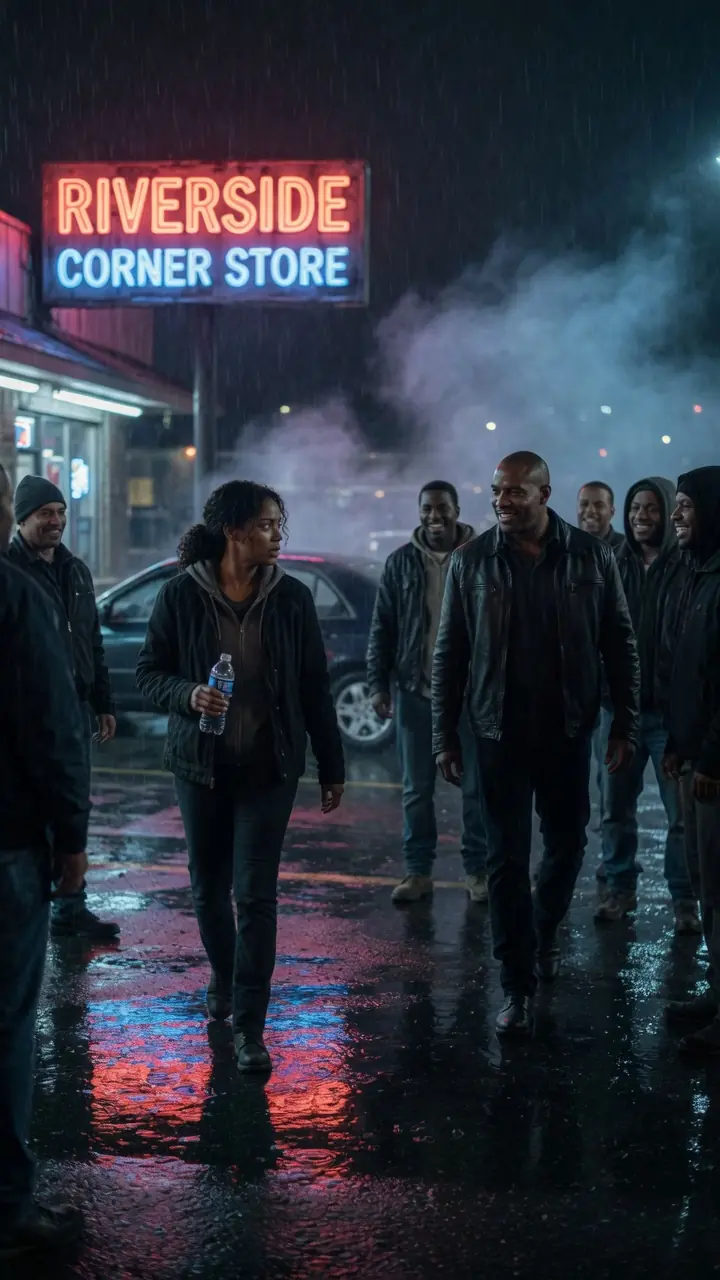
Marcus'ss grin widened as he closed the distance between them. "Come here, sweetheart," he said again. The words landing with mock sweetness meant to unsettle her. The rest of the group laughed, some of them clapping, treating the moment like theater performed purely for their own amusement.
They expected fear. They expected trembling hands, a wavering voice, perhaps a plea for mercy that would confirm everything Marcus believed about power and weakness. Instead, Maya stood perfectly still, her eyes moving across the lot with a stillness that had nothing to do with fear and everything to do with assessment. She noted the security camera mounted above the store entrance.
She noted the distance between each man. She noted which of them stood closest to a weapon and which of them stood closest to a way out. The night around them seemed to hold its breath. The hum of the store's neon sign the only sound cutting through the tension.
Marcus took another step closer, emboldened by her silence, mistaking her calm for surrender. He had no idea that in the quiet space behind her eyes, a different kind of storm was already gathering. one built from years of training that never fully leaves a person. No matter how many years passed since they last wore a uniform in a war zone, the Iron Kings had chosen their target with confidence. They were about to learn how wrong that confidence had been.
For Marcus, this moment had been building for days, ever since his men first reported that a woman detective kept circling back to the same neighborhood, asking questions people were too afraid to answer honestly. He had convinced himself that a public confrontation staged in front of witnesses who owed him their silence would settle the matter permanently and remind the entire district exactly who controlled these streets. He had chosen the location deliberately, close enough to his usual territory that word would spread quickly, far enough from main roads that patrol cars rarely passed through without reason. Every detail of the ambush had been planned with the kind of careless confidence that comes from a man who has never once faced real consequences for his actions.
What Marcus failed to account for was the simple truth that confidence built on fear is a fragile thing, dependent entirely on the compliance of people too frightened to resist. Maya Jackson had spent years learning to operate in environments where fear was the expected response and where refusing that expectation often made the difference between survival and disaster. She had faced ambushes far more sophisticated than six men in a parking lot, had trained for years to recognize the exact moment when passive observation needed to become decisive action. That moment was arriving now, and she was more than ready for it.
Marcus reached out and let his hand fall onto Maya's shoulder, a gesture meant to establish dominance in front of his men. She turned her head slowly and looked at him, her voice low, and even when she finally spoke. "Take your hand off me," she said. "This is the only warning you get."
" The words should have carried weight. But Marcus only laughed harder, glancing back at his crew as if inviting them to share the joke. Nobody in that parking lot had ever heard a woman speak to him with that particular kind of certainty. The certainty of someone who was not bluffing.
Eddie, standing near the alley, pulled a folding knife from his jacket and flicked it open with a metallic click that briefly silenced the laughter. Vince, emboldened by the sight of the blade, reached toward the holster at Maya's hip, his fingers grazing the leather before she reacted. What happened next unfolded in seconds that would later be replayed frame by frame on security footage, studied by investigators and civilians alike. Maya's hand closed around Vince's wrist before his fingers ever reached the weapon, twisting with a speed that sent him crashing to the pavement with a cry of pain.
She pivoted in the same motion, catching Eddie's knife hand and redirecting it with a controlled sweep that sent the blade skittering across the asphalt. Her elbow found Rey's jaw as he lunged from the side, dropping him instantly. There was no wasted motion in anything she did. Every strike landed exactly where it needed to.
Every block absorbed force without excess effort. Every step repositioned her so that no two attackers could reach her at the same time. Dominic tried to grab her from behind, and she used his own momentum against him, flipping him over her shoulder and into a stack of empty crates near the store entrance. Jason, the youngest and most eager of the group, hesitated for a fraction of a second too long, and that hesitation cost him as Maya's forearm connected with his chest, knocking the wind from his lungs and the fight from his body.
Marcus stood frozen for a moment, watching his crew fall one by one, the confidence draining from his face as reality replaced arrogance. He had walked into that parking lot certain of an easy victory, certain that numbers alone would guarantee his dominance. Instead, he watched five grown men crumble in less time than it took to order a coffee. Each of them realizing in the worst possible way that they had chosen the wrong woman to corner in the dark.
The truth about Maya Jackson unspooled slowly in the minds of everyone who witnessed that night, though the full picture belonged only to her. Years before she ever wore a detective's badge, she had worn the uniform of the United States Marine Corps, enlisting at 19, with a determination that surprised everyone who had known her as a quiet, careful teenager. She trained in close quarters combat, learning to read an opponent's intentions before the first move was ever made. She trained in survival, learning to endure conditions that broke stronger-looking recruits within days.
Her deployments took her through environments where hesitation cost lives and instinct became the only currency that mattered. She served in crowd control operations in cities where the line between civilian and threat blurred by the hour, learning to deescalate when possible and to act decisively when it was not. She trained extensively in urban tactics, learning how buildings and alleys and open lots could be read like maps, how shadows and sightlines could become either weapons or shields, depending on who understood them first. Her fellow Marines gave her a nickname during those years, one that stuck long after she left the service.
They called her the wall because no matter what came at her, she did not break, she did not retreat, and she did not fall. Her commanding officer once said that Maya possessed a rare stillness under pressure, the kind that could not be taught, only forged through repeated exposure to chaos until chaos itself became familiar ground. When she finally left the Marine Corps and joined the police force years later, she carried that stillness with her, folding it quietly beneath the surface of her daily life, rarely speaking of the battles that had shaped her. Her training had included long stretches in environments designed to strip away comfort entirely, forcing recruits to make decisions with limited sleep, limited resources, and limited certainty about what waited around the next corner.
She had learned to assess a room in the span of a single breath, cataloging exits, weapons, and threats before her conscious mind had even finished processing the scene. She had learned that panic was a choice, one she could refuse to make, even when every instinct screamed otherwise, and that refusal had saved her life more than once in places far from home. Those lessons had not faded with time. They had simply gone quiet, waiting beneath the surface for a night that would call them forward again.
Back in the present, in that parking lot lit by flickering neon, none of that history was visible to Marcus Carter, only its consequences. He watched Maya turned toward him, her breathing steady, her expression unreadable, and something inside him cracked. His pride refused to accept defeat in front of the one man still standing beside him, a wiry enforcer they called Slim, who had wisely kept his distance during the chaos. Marcus lunged forward with a wild swing, driven more by desperation than strategy.
And Maya sidestepped with an ease that made the punch look almost rehearsed. Marcus's fury only deepened with every failed attempt to land a hit. His shouts growing louder, echoing across the empty lot. He was no longer thinking clearly, no longer calculating, simply reacting the way cornered men often do when their sense of control collapses entirely.
Maya, by contrast, remained precise, absorbing his rage without losing her footing, without wasting a single motion on anger of her own. The gap between them had never been about strength alone. It was about discipline, and discipline was something Marcus had never bothered to build. Word spread through the neighborhood faster than anyone expected, carried by a nervous voice over a phone line and by the quiet churn of a security camera that never blinked.
Marcus, humiliated and desperate, pulled out his own phone and called for backup, summoning four more members of the Iron Kings from a nearby block. Within minutes, the parking lot that had once held six men now swelled with 10, their headlights cutting harsh angles across the pavement as more vehicles rolled in. Maya assessed the shifting situation with the same calm precision she had shown from the beginning. She moved toward a cluster of parked cars, using their bulk to limit how many attackers could reach her simultaneously.
She positioned herself near the edge of the store's overhead lighting, where shadows worked in her favor without blinding her own vision. She noted a stack of delivery pallets near the loading dock, recognizing them as both an obstacle for her opponents and a potential barrier she could use if the numbers grew too heavy to handle in the open. While she maneuvered through the lot, her hand found the radio clipped to her belt, and her voice, low but urgent, requested immediate backup at her location. She gave her position with the clarity of someone trained to communicate under pressure.
No wasted words, no panic bleeding into her tone. Somewhere across the city, a dispatcher's eyes widened at the address, recognizing it as a location already flagged for gang activity, and units began rolling before the call even finished. The new arrivals from the Iron Kings spread out with more caution than their predecessors, having heard secondhand what had already happened to five of their own. They approached in a loose formation, testing distances, glancing toward Marcus for direction he could no longer confidently provide.
Maya used their hesitation to her advantage, closing distance on the nearest attacker before he could fully commit to a plan, dropping him with a controlled strike that left him gasping against the side of a parked truck. What the growing crowd of onlookers began to realize, peering from apartment windows and cracked doorways, was that this fight had never truly been about brute force. It was about geography, timing, and the kind of composure that could not be rattled by numbers alone. Maya fought like someone who had trained for exactly this scene, using the terrain as a silent ally, letting every parked car and shadow and beam of light become an extension of her own strategy.
Marcus, watching his reinforcements falter one after another, finally understood the shape of the mistake he had made hours earlier, though understanding it did nothing to reverse it. An elderly man named Harold Simmons watched from his second floor window above the laundromat across the street, phone pressed to his ear as he narrated the scene to his daughter, his voice equal parts disbelief and something close to awe. He had lived in that neighborhood for over 30 years. He had watched the Iron Kings tighten their grip on these blocks with a patience that felt inevitable, had long since stopped expecting anyone in uniform to change that trajectory.
What he witnessed that night, one woman methodically dismantling an entire crew's confidence in real time, was enough to make him call his daughter a second time just to make sure she believed him. Word of what Harold described would ripple through the building by morning, then through the block, then through the district, growing with each retelling, but never straying far from the essential truth captured on that security camera. Inside the convenience store, the young clerk who had watched the entire confrontation unfold through the front window, finally found the courage to act. His hands trembling, he dialed emergency services, describing the chaos in the parking lot with a shaking voice that nonetheless conveyed every critical detail investigators would later need.
The store's security system, mounted discreetly above the entrance, had been recording from the very first moment Marcus said those words that started everything, capturing angle after angle of a confrontation that would soon travel far beyond that single block. Patrol units arrived within minutes, their lights washing the scene and alternating red and blue, illuminating a parking lot littered with fallen men and scattered debris from the struggle. Officers moved quickly to secure the area, cuffing Iron Kings' members who could no longer stand fast enough to flee, while paramedics tended to injuries that ranged from bruised egos to genuinely broken bones. Maya stood near the center of it all, her uniform disheveled, but her composure fully intact, giving a clear and methodical account of events to the responding sergeant.
Marcus, still defiant, despite the overwhelming evidence surrounding him, attempted to twist the narrative in his favor, claiming that Maya had attacked first, that she had provoked an otherwise peaceful gathering. His words fell apart almost immediately once investigators pulled the store's security footage, which told a story far more damning than anything he could talk his way around. The video showed with unmistakable clarity six men closing in on a lone woman, showed the moment Marcus placed his hand on her without invitation, showed the flash of a blade drawn by one of his own men before Maya ever raised a hand in response. Detectives reviewing the footage later that night noted something that would become central to the case moving forward.
At no point did Maya escalate beyond what was necessary to neutralize each threat. She struck to disable, not to punish. She restrained rather than retaliated, even when circumstances would have justified far harsher force. That restraint captured in high definition and impossible to dispute transformed the footage from simple evidence into something closer to a masterclass in professional conduct under extreme pressure.
By the time internal affairs reviewed the incident the following morning, the department's initial concern over the violent nature of the confrontation had shifted entirely toward admiration for how precisely Maya had handled an ambush that could easily have ended in tragedy. Her captain, a stern man named Robert Ellison, who rarely offered praise freely, watched the footage twice in silence before turning to his staff and saying simply that this was exactly the kind of officer the department needed more of. Word of the parking lot confrontation spread through the precinct within hours, carried by officers who could not stop talking about what the footage showed. Marcus, however, had not yet been taken fully into custody.
In the chaos following the arrival of backup units, he had slipped away through a gap in the perimeter, disappearing into the darkened streets behind the store before officers could close in around him. His escape sent a ripple of urgency through the responding units, transforming what had been a violent altercation into an active manhunt that would stretch through the industrial edges of the city before the night was over. Maya, despite the adrenaline still coursing through her system, volunteered immediately to join the pursuit, her request granted, without hesitation, given her intimate knowledge of the case and the neighborhood surrounding it, she moved through the streets with the same precision that had defined her every action that night, tracking Marcus through alleys and side streets, with an instinct that seemed to anticipate his path before he ever committed to it. Radio chatter filled the night air as units coordinated their search, sealing off exit points across a grid that grew tighter with every passing minute.
The chase eventually funneled toward the old warehouse district near the waterfront, a maze of abandoned buildings and rusted shipping containers where Marcus had grown up running errands for older gang members long before he ever became one himself. He knew those alleys intimately, knew which fences had gaps wide enough to slip through, knew which loading docks offered hiding places that outsiders would never think to check. But Maya had studied the case files obsessively for weeks, memorizing not just names and dates, but the geography the Iron Kings depended on for their operations. She anticipated his route toward the shipping containers stacked near the old pier, cutting through a service alley that shaved crucial seconds off her pursuit.
Marcus, breathing hard and increasingly desperate, scrambled over a low fence and into the maze of containers, hoping the darkness and confusion would finally offer the escape he needed. Instead, he found himself boxed into a narrow corridor between two stacked rows of steel. the only way forward blocked by a locked gate he had not anticipated, the only way back occupied by the very detective he had underestimated hours earlier. The waterfront at that hour was nearly silent, save for the distant clang of loose cables against metal poles and the low groan of tide against the pier supports. Fog had begun rolling in off the water, curling low around the stacked containers, and turning every shadow into a possible hiding place.
Maya moved through that fog with the same measured patience she had shown throughout the entire night. Refusing to rush, refusing to let urgency compromise the discipline that had carried her this far, she could hear Marcus's ragged breathing somewhere ahead of her, could hear the scrape of his shoes against loose gravel as he searched frantically for an exit that did not exist. Cornered and out of options, Marcus attempted one final desperate move, grabbing a startled dock worker who had been finishing a late shift nearby, holding him roughly by the arm in a crude attempt to create a bargaining chip. The man's eyes widened in terror, his hands raised instinctively, caught in a situation that had nothing to do with him.
Only moments before, Maya's voice cut through the tension with the same measured calm she had maintained throughout the entire night, instructing Marcus clearly to release the man and step away from him immediately. Marcus hesitated, his grip tightening for a moment as he weighed his rapidly narrowing options. But something in Maya's stance told him this particular gamble would not pay off the way he hoped. She had already positioned herself at an angle that gave her a clear path to intervene without endangering the hostage, her eyes tracking every subtle shift in Marcus's posture.
When he finally shoved the dock worker aside and lunged toward her instead, she was ready, closing the distance in a single fluid movement and bringing the confrontation to its end without ever reaching for her weapon. Within seconds, Marcus lay face down against the cold concrete. His wrists secured behind his back, his bravado finally extinguished after a night that had stripped away every illusion of untouchability he once carried. Backup units arrived moments later.
Their flashlights sweeping across the scene as they took in the sight of the Iron Kings' leader, finally subdued. Not through gunfire or bloodshed, but through discipline that had outmatched him from the very first moment their paths crossed. The dock worker, shaken but unharmed, thanked Maya repeatedly as paramedics checked him over, his voice trembling with the kind of gratitude that comes only after realizing how close a night had come to ending far worse. In the days that followed, the case against the Iron Kings unraveled with a speed that surprised even the most experienced investigators on the task force.
Witnesses who had spent months too afraid to speak suddenly found their voices. Emboldened by news of Marcus's arrest and the undeniable proof captured on camera. Ellen Brooks, the grocery store owner who had once recanted her statement out of fear, returned to the precinct on her own, providing a detailed account of months of extortion that had gone unreported for far too long. Tommy Reyes, the delivery driver who had been beaten months earlier, finally identified his attackers.
His testimony corroborated by phone records and financial documents seized during subsequent raids. Detectives working alongside Maya uncovered an extensive network of extortion that stretched across multiple neighborhoods, forcing small business owners to pay so-called protection fees under constant threat of violence. They discovered evidence of a smuggling operation running through the same waterfront district where Marcus had eventually been caught, linking the Iron Kings to stolen goods moving through the port under the cover of night. Cold case files that had gathered dust for years suddenly found new relevance as investigators connected several unsolved assaults directly back to members of the very crew that had cornered Maya in that parking lot.
The financial records seized from a storage unit registered under Marcus's cousin revealed a level of organization that surprised even veteran investigators who had spent careers studying similar criminal networks. Ledgers tracked payments from over 20 businesses across three separate neighborhoods. Each entry was a quiet testament to months and sometimes years of extortion that had gone unreported out of fear rather than ignorance. Bank records traced a portion of those proceeds to a legitimate-seeming auto shop that had served as a front for moving stolen merchandise.
Its books doctored just well enough to survive casual inspection, but not the forensic accounting that followed once the case gained momentum. Each new discovery added weight to a prosecution that had already seemed unassailable, transforming what began as a single violent confrontation into the dismantling of an entire criminal enterprise that had operated in plain sight for years. Marcus Carter now faced a staggering list of charges that extended far beyond that single violent night. charges that included armed robbery, extortion, assault, and conspiracy tied to organized criminal activity spanning years. His attorney attempted to argue that the parking lot confrontation had been provoked, but the security footage combined with the growing wall of witness testimony made that defense collapse before it ever gained real traction in the courtroom.
Prosecutors described the case as one of the strongest they had seen in years, built not on speculation, but on undeniable video evidence paired with the courage of witnesses who had finally found the strength to come forward. The trial itself stretched across several weeks, drawing a steady stream of former victims willing to testify now that Marcus sat behind a defense table instead of standing free on a street corner. Ellen Brooks spoke about months of sleepless nights spent listening for footsteps outside her shop after closing hours. Tommy Reyes described the specific fear of watching a group of men circle his delivery truck, knowing that resistance meant a beating, and compliance meant losing wages he could not afford to lose.
Each testimony added another brick to a wall of evidence that made any possibility of an acquittal disappear entirely. And when the verdict finally came, few in that courtroom were surprised by what they heard. Throughout the growing media attention surrounding the case, Maya remained notably reserved, declining most interview requests and redirecting credit toward the broader team that had worked the investigation for weeks before that final confrontation. When a local reporter finally caught up with her outside the precinct, asking how it felt to single-handedly take down half a violent gang, Maya offered a response that was as understated as everything else about her demeanor.
"This is my job," she said simply before turning to walk back inside without further elaboration. That refusal to embrace the spotlight only deepened the respect her colleagues already held for her, reinforcing what many at the precinct had suspected for years, but never fully understood until that night. She was not chasing recognition. She had never been chasing recognition.
She had simply been doing the work quietly and consistently long before anyone outside her small circle ever noticed the discipline behind it. In the weeks following Marcus Carter's arrest, the Southern District began to shift in ways that were subtle at first, then increasingly unmistakable. Shop owners, who had once kept their doors locked during business hours out of fear, started leaving them open again, greeting customers without glancing nervously toward the street every few minutes. Delivery drivers resumed routes they had quietly avoided for months, no longer bracing themselves for confrontations that had become an unspoken tax on doing business in that part of the city.
Community meetings that had once drawn only a handful of frustrated residents began filling with people eager to discuss neighborhood improvement rather than survival tactics. A sense of cautious optimism spread through blocks that had spent years feeling forgotten by the very institutions meant to protect them. Trust, once broken, rarely rebuilds quickly. But something had shifted that night in the parking lot.
A visible reminder that the law could still show up, could still hold, could still matter, even in places that had almost given up expecting it. Ellen Brooks reopened her grocery store an hour earlier than usual the following week, unlocking the front gate with hands that no longer shook the way they had for months. Tommy Reyes returned to his old delivery route, waving to shopkeepers who had once avoided eye contact out of shared unspoken fear. Small changes accumulated quietly across the district, each one insignificant on its own, yet together forming the outline of a neighborhood slowly remembering what it felt like to exist without constant dread.
None of it happened overnight, and none of it erased years of damage in a single gesture. But the direction had changed, and that alone meant more to the people living there than any official statement ever could. Back at the precinct, Captain Ellison organized a small gathering to recognize Maya's role in dismantling one of the most dangerous gangs the district had faced in years. It was not an elaborate ceremony, no cameras, no speeches stretching longer than necessary, simply a room full of colleagues who understood exactly what she had accomplished and wanted a moment to acknowledge it properly.
Officers who had worked alongside her for years raised their coffee cups in a quiet toast, while younger recruits watched with the kind of admiration reserved for people whose reputation had finally caught up with their reality. A young officer named Sarah Whitfield, only a few months into her career, approached Maya near the edge of the room after most of the crowd had thinned. She had heard the stories circulating through the department, had watched the security footage along with everyone else, and found herself both inspired and slightly intimidated by the woman standing in front of her. After a moment of hesitation, she finally asked the question that had been sitting on her mind since she first watched that video.
"What makes you not afraid? " Sarah asked, her voice carrying the genuine curiosity of someone still finding her footing in a demanding profession. Maya considered the question for a moment, her expression softening into something warmer than the composed intensity she usually carried. She thought back through years of training, through deployments that had tested every limit she once believed she had, through nights not unlike the one that had just passed, where fear and duty collided, and only one of them could win.
"Courage isn't the absence of fear", Maya finally said. "It's doing what's right, even when you're afraid. " The words settled over the room quietly, carrying a weight that needed no further explanation, resonating with officers who had faced their own moments of doubt over the years. Sarah nodded slowly, tucking the sentiment away in the place where young officers keep the lessons that will guide them through the harder nights still waiting ahead of them.
It was not a grand speech, not a rallying cry meant for headlines, simply a quiet truth passed from one generation of officers to the next. As the evening wound down and colleagues drifted back to their own responsibilities, Maya slipped out of the precinct and back into her patrol car, the city stretching before her in its familiar rhythm of lights and shadows. The Southern District looked different to her now, not because the buildings had changed, but because something intangible in the air had shifted, a neighborhood breathing a little easier after years of holding its breath. She drove slowly past the convenience store where it had all started.
The same flickering neon sign still buzzing above the entrance, though the parking lot beneath it now sat calm and empty. Her radio crackled to life without warning. Dispatch relaying details of a new call, requiring immediate response. somewhere across the city. Maya's expression did not change, her hands steady on the wheel as she reached for the switch that activated her lights.
There was no hesitation in the motion, no lingering fatigue from the night before allowed to slow her down. Only the same quiet readiness that had carried her through every challenge that had come before this one. The lights began to pulse against the darkened storefronts as she pulled back onto the road, cutting a path through the city that had for one more night at least become a little safer because of the work she refused to abandon. Somewhere out there, another person was waiting for help to arrive, unaware that the officer responding carried within her the discipline of a soldier and the steady heart of someone who had long ago decided that fear would never be allowed to make her decisions.
The city swallowed her car into its glowing maze of streets, red and blue light fading into the distance, carrying Detective Maya Jackson toward whatever the night still had waiting for her. Long after the case against the Iron Kings moved through the courts, long after Marcus Carter's name became a footnote in the department's ongoing record of dismantled criminal networks, the story of that parking lot confrontation continued to circulate quietly among officers and residents alike. It became something closer to folklore within the precinct. Retold not for its violence, but for the discipline it represented, a reminder of what true preparation looked like when tested by chaos nobody could have fully predicted.
New recruits heard the story during training. Some version of it always finding its way into conversations about composure under pressure. Maya herself rarely spoke of it unless directly asked, preferring instead to focus on the cases still waiting for her attention. The neighborhood still needing the same quiet diligence she had shown from the very beginning of her career.
She understood, perhaps better than most, that a single night of recognition changed very little about the actual work still required day after day. The badge she wore carried the same weight it always had, and the streets she patrolled still needed someone willing to walk them without flinching. What had changed in the end was not Maya herself, but the certainty with which an entire community now understood what kind of officer walked among them. They had watched through grainy security footage and word passed door-to-door a woman who refused to be intimidated, who turned a moment meant to humiliate her into an unmistakable demonstration of skill, restraint, and unshakable resolve.
The Iron Kings had believed they were choosing an easy target that night, a lone woman standing between them, and an evening of cruelty they had grown far too comfortable inflicting on others. Instead, they had chosen the wrong ex-Marine, a mistake that would follow every one of them through years of legal consequences still unfolding long after that parking lot had gone quiet again. And somewhere across the city, night after night, Detective Maya Jackson continued driving into the darkness without hesitation. Because for her, courage had never been about the absence of fear.
It had only ever been about showing up anyway again and again. For every person still waiting for someone willing to answer the
END