Hey, old man. Where do you think you’re going with that?
Just buying crayons for my granddaughter.
Sir, buying you. Don’t make me laugh. People like you don’t buy things. You steal them.
I have money right here.
I can shut your mouth. You stink up this store just standing here.
Sir, please. There’s no need.
Get on the ground.
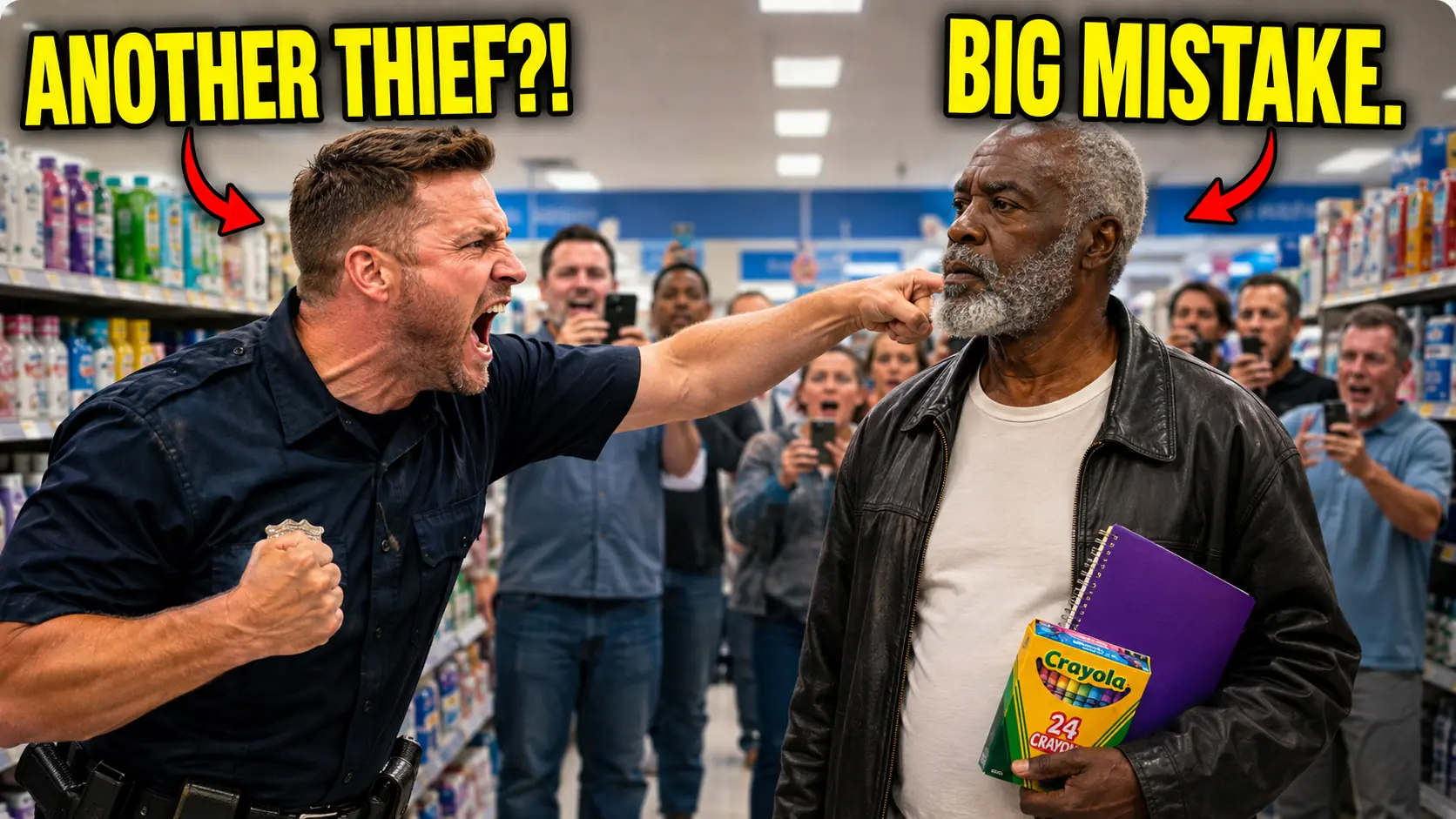
A knee slammed into the old man’s back. His cheek hit the cold tile. A box of crayons skidded across the polished floor. The guard stood over him, chest puffed, grinning like he had caught a dangerous criminal. He had no idea he just tackled someone who carried a federal badge for 30 years, and who knew exactly which camera was recording every second.
Three hours before his face met that tile floor, Benjamin Fletcher stood in front of his bathroom mirror, adjusting the collar of his black jacket. It was the same jacket he had worn for 15 years. The leather along the cuffs had softened to a pale gray. The zipper caught if you pulled it too fast, but it still fit the way it always had—square across the shoulders, snug at the waist, the kind of fit that came from decades of standing straight.
He was 68 years old. His hair had gone white at the temples and thin across the top. His knees ached when it rained. His hands, wide, scarred across the knuckles, the skin rough from years of work that had nothing to do with office desks, moved slowly now. But they moved with purpose. Benjamin Fletcher had retired four years ago from the United States Marshals Service. Thirty years. Deputy Marshal. Fugitive Task Force. He had kicked down doors in El Paso, tracked fugitives through the Louisiana bayou, and once spent 11 days in a Juárez safe house waiting for an extraction that almost never came. The scars on his hands were not decorative.
But today was not about any of that. Today was about Lily. His granddaughter turned nine tomorrow. She liked two things more than anything in the world: drawing and the color purple. Benjamin had promised her a new set of crayons and a sketchbook. The fancy kind, she had said. The ones with the sharpener built into the box. He pulled on his gray trousers, checked his wallet—three twenties, a ten, and his retired Marshal ID tucked behind his driver’s license—and headed out.
Morrison’s department store sat on the corner of Fifth and Callaway, three floors of polished marble, soft jazz through ceiling speakers, and the kind of lighting that made everything look expensive. The parking lot was full of SUVs and sedans that cost more than Benjamin’s annual pension. He walked through the automatic doors at 2:14 p.m. No one greeted him. The woman at the fragrance counter glanced up, then looked away. A mother pulled her child slightly closer as he passed. Small gestures. Familiar ones.
Benjamin had learned to read rooms before he learned to read Miranda rights. He noticed everything. He said nothing. He found the art supply section on the second floor. Rows of colored pencils, watercolor sets, sketchbooks with smooth cream pages. He picked up a 64-piece crayon set, the one with the built-in sharpener, and a spiral-bound sketchbook with a lavender cover. Lily would love it. He tucked both items under his arm and headed for the escalator.
That was when Derek Hadley first saw him. Derek was 34, broad-shouldered, thick-necked, with a jaw that looked like it had been set in concrete. He wore the store’s dark navy security uniform, pressed crisp, sleeves rolled once above the wrist to show off his forearms. His badge sat high on his chest, polished to a mirror shine every morning before his shift. He walked the floors like he owned them.
Derek had been a security guard at Morrison’s for three years. In that time, he had filed more incident reports than any other guard on staff. His supervisor, a quiet man named Craig, had told him twice to ease up. Derek had ignored him both times. He had a habit. Everyone who worked the floor knew it, though no one said it out loud. When a Black customer walked in, Derek followed. He stood at the end of aisles, arms crossed, watching. He positioned himself between the customer and the exit. He called it instinct. Craig called it something else.
Today, Derek saw an old Black man in a worn black jacket carrying merchandise without a bag. No receipt visible. Moving toward the escalator. Derek uncrossed his arms and started walking—twelve feet behind, then eight, then five. Benjamin felt the footsteps before he heard them. Thirty years of fieldwork had trained his peripheral awareness to a razor edge. He knew someone was tailing him. He knew the distance. He knew the pace. He did not turn around. He simply continued toward the register, the crayon box tucked under his left arm, his right hand hanging loose at his side, the way it always had, out of habit, even though he had not carried a sidearm in four years.
Benjamin stepped off the escalator on the first floor and turned left toward the registers. Derek cut him off at the end of aisle 9. He did not ask a question. He did not introduce himself. He planted himself in the middle of the aisle, legs apart, arms folded across his dark navy uniform, and looked Benjamin up and down the way a man looks at something stuck to the bottom of his shoe.
“Where’d you get those?”
Benjamin stopped. He held up the crayon box and the sketchbook. “From the second floor. Art supplies. I’m heading to the register now.”
“Sure you are.” Derek took a step closer. His badge caught the overhead light. His name was printed in white block letters across a black strip on his chest. Hadley. “You know what I think? I think you grabbed those and you were heading straight for the door.”
“No, sir. I’m buying them for my granddaughter.”
“Your granddaughter?” Derek repeated it slowly, like the words tasted wrong. He tilted his head and snorted. “Right. And I’m the Queen of England. You walked past two registers on the second floor. Why didn’t you pay up there?”
“There was a line. I thought I’d try down here.”
“A line?” Derek smiled. It was not a kind smile. “That’s a new one. I’ve heard every excuse in the book, old man. You people always have one ready.”
The words “you people” hung in the air like smoke. Benjamin did not flinch. “I’d prefer to speak with a manager, please.”
“I am the authority on this floor. Empty your pockets.”
“You don’t have that right, son.”
Something shifted behind Derek’s eyes. The word “son” landed on him like a slap. His neck flushed red above the dark navy collar. He unfolded his arms and took another step forward. Close enough now that Benjamin could smell the cheap aftershave and the energy drink on his breath.
“What did you just call me?”
“I called you son because you’re young enough to be mine and you’re about to make a mistake that’s going to follow you for a very long time.”
Derek grabbed the front of Benjamin’s black jacket with both hands and shoved him backward. Benjamin’s shoulders hit the endcap display. A pyramid of glass candle holders rattled. Two fell and shattered on the floor. The sound cracked through the quiet store like a gunshot.
“You think you can talk to me like that?” Derek’s voice had gone loud now. Loud enough for the whole floor to hear. “You come in here looking like you just crawled out of a shelter. You steal merchandise and then you lecture me in my store.”
“I haven’t stolen anything.”
“Then why are you sweating?”
Benjamin was not sweating, but it did not matter what he said. Derek had already written the story in his head, and Benjamin was the villain in every chapter. A small crowd had gathered at both ends of the aisle. A teenager held up his phone, recording vertically. A woman in a red coat watched with her hand over her mouth. Two men in business suits stood near the cologne section, watching with their arms crossed, making no move to help. An older white man in a golf shirt shook his head slowly, but said nothing. A young mother steered her stroller in the opposite direction. No one intervened. Not one person.
Derek keyed his radio. “Tony, aisle 9. I need backup. Got a shoplifter resisting.” Benjamin heard the word “resisting” and something cold settled in his chest. Not fear. Recognition. He had heard that word weaponized a thousand times in his career. In courtrooms, in depositions, in internal affairs files. It was the word people attached to a situation after the fact to justify whatever violence came next.
“I’m not resisting,” Benjamin said calmly. “I’m standing completely still. Your cameras will confirm that.”
“Yeah, and I’m sure your lawyer will love hearing about it,” Derek laughed. “Oh, wait. You probably can’t afford one.”
A few people in the crowd chuckled. The teenagers zoomed in. Derek turned to the growing audience and raised his voice, performing now. “Everyone stay back. This individual is being detained for theft. For your safety, please keep your distance.”
“I have not stolen anything.” Benjamin held up the crayon box. “Sixty-four crayons, $14.99. The money is in my pocket. I can pay right now.”
“You should have thought about that before you tried to walk out.”
“I was walking toward the register. You stopped me before I could get there.”
“That’s not what I saw.”
A woman near the back of the crowd spoke up. “He was walking toward the register. I saw him.” Derek turned sharply. “Ma’am, please stay out of this. This is a security matter.” The woman fell silent. The crowd tightened. More phones appeared.
Tony Marsh arrived from the stock room. He was younger than Derek, 26, slim, nervous energy in his hands. He took in the scene—an old Black man in a black jacket holding a box of crayons pressed against a display case, glass on the floor, Derek red-faced and breathing hard. Tony hesitated.