Sweat dripped from Caleb Mercer’s chin and struck the grease-stained concrete beneath the motorcycle lift.
The drop disappeared almost instantly into years of oil, brake dust, and ground-in dirt. Outside, the San Joaquin Valley shimmered beneath a brutal mid-July sun, the kind of heat that bent the horizon and made every sheet-metal roof in the industrial park crack and groan.
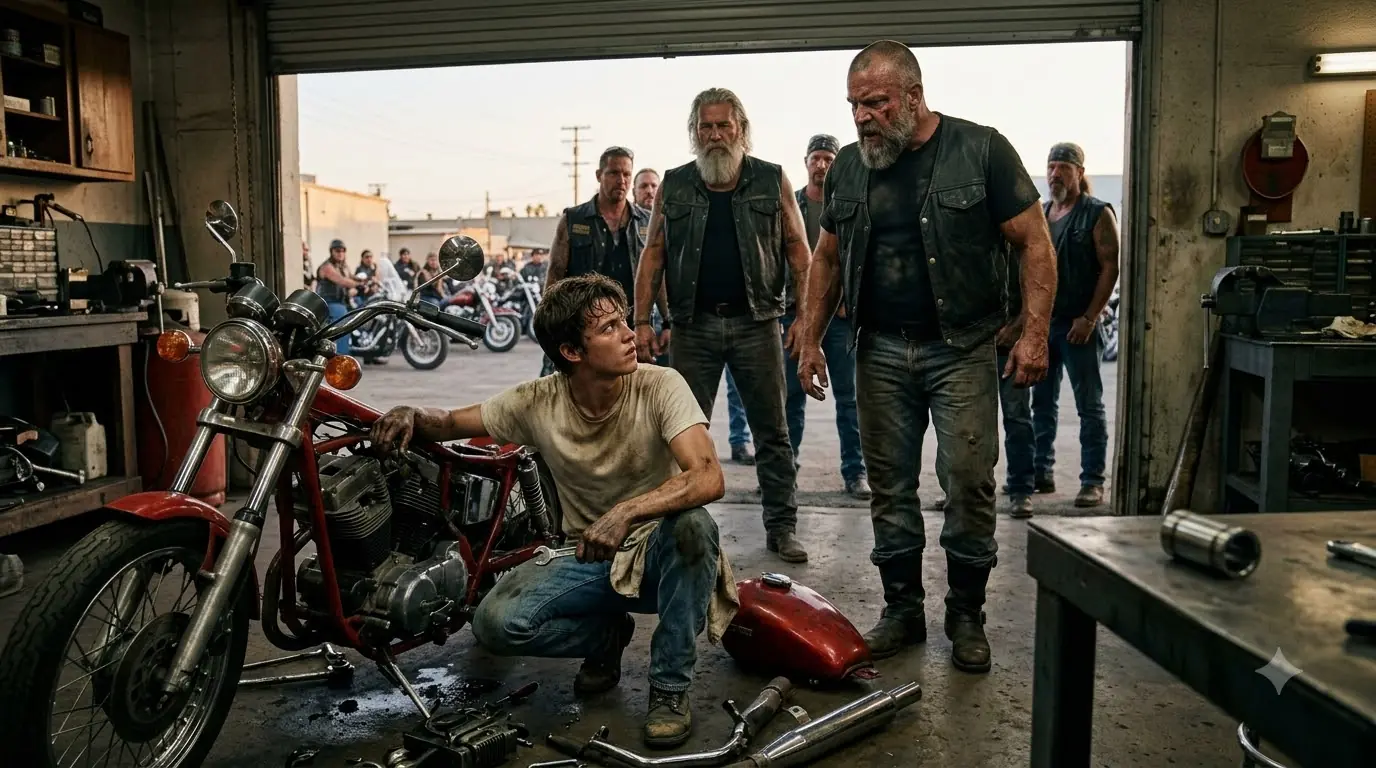
Inside Oildale Customs, the two old swamp coolers mounted high on the cinder-block wall pushed around hot air without meaningfully changing the temperature.
Then the tools on Caleb’s workbench began to vibrate.
A socket rolled half an inch.
A wrench trembled against a steel tray.
The coffee in a chipped mug beside the register developed concentric ripples.
Caleb stopped breathing.
It was not an earthquake.
The sound came next.
Low at first.
Far away.
A rolling mechanical thunder rising from somewhere beyond the warehouses.
One motorcycle engine had a rhythm.
Ten had a presence.
Hundreds became weather.
Caleb slowly turned toward the open bay doors.
His stomach tightened.
The sound grew deeper until the old windows rattled inside their aluminum frames. Dust loosened from the rafters. A fluorescent tube flickered overhead.
Then headlights appeared at the far end of the industrial road.
One row.
Then another.
Then another.
Caleb stared at the dismantled motorcycle spread across his shop floor.
A candy-apple-red gas tank sat on a padded wooden crate. Chrome exhaust pipes rested beside a drain pan. The saddle was upside down near the tire machine. The rear fender leaned against a cabinet. Electrical leads hung loose from the handlebars. The legendary 1947 Harley-Davidson Knucklehead that had entered Oildale Customs as one of the most feared machines in Kern County now looked like the aftermath of an autopsy.
And the man who owned it was returning.
With company.
A lot of company.
Caleb looked at the clock.
8:07 p.m.
Three minutes before the deadline Silas “Grip” Henderson had given him.
Caleb’s hands were bleeding in four places.
His forearms trembled from exhaustion.
And the motorcycle was nowhere near ready.
Six hours and fifty-two minutes earlier, Oildale Customs had been dying quietly.
That was almost worse.
Caleb understood dramatic failure. An engine blew a rod, a transmission locked, a piston shattered, something broke and announced itself with violence. You found the damage. You replaced the damage. You moved forward.
The shop’s failure was different.
It came in envelopes.
Past-due notices.
Declined parts orders.
Phone calls from suppliers who used apologetic voices while informing Caleb they could no longer extend credit.
The building sat at the dead end of a cracked industrial lane north of Bakersfield, wedged between a shuttered upholstery warehouse and an irrigation-equipment company that had moved operations to Fresno. Oildale Customs had once been busy enough that motorcycles lined up outside on Saturday mornings.
Those days belonged to Caleb’s uncle Raymond.
Ray Mercer had opened the place in 1982 with four thousand dollars, a secondhand lift, and a belief that old American motorcycles deserved mechanics who listened before they replaced things.
Ray hated unnecessary parts swapping.
“Any fool can keep changing pieces until the noise goes away,” he used to tell Caleb. “A mechanic finds out why the noise started.”
Caleb had first entered the shop at six years old.
He had spent most afternoons there after that.
His mother worked long shifts as a respiratory therapist at Mercy Hospital. His father had disappeared from his life before Caleb formed any useful memories of him. Uncle Ray became the man who taught him how to hold a flashlight without shining it directly into someone’s eyes, how to keep track of removed bolts, and how to feel through a wrench when threads were beginning to complain.
At eight, Caleb could identify basic engine sounds.
At eleven, he rebuilt his first carburetor under supervision.
At fourteen, he diagnosed a failing bearing in a customer’s generator before Ray could find it.
At sixteen, he rebuilt an old Panhead transmission almost entirely on his own.
Ray had watched him work, arms crossed over his stained coveralls.
“You hear machines wrong.”
Caleb had looked up.
“Wrong?”
“Different.”
Ray tapped the side of his own head.
“Most people hear noise. You hear relationships.”
Caleb never forgot it.
Then, fourteen months before Grip Henderson rolled through the door, Raymond Mercer suffered a massive heart attack behind the shop.
He died before the ambulance reached the hospital.
He was fifty-seven.
Caleb was eighteen.
The will left Caleb Oildale Customs.
It also left him everything attached to it.
The unpaid equipment loan.
The commercial mortgage.
Supplier balances.
Back taxes Ray had been slowly catching up on.
A roof that leaked near the paint booth.
An air compressor that sounded like it might explode every morning at 8:00.
A customer list that had shrunk while Ray’s health quietly deteriorated.
People told Caleb to sell.
His mother begged him to sell.
A real-estate investor offered enough to pay most of the debts if Caleb surrendered the building immediately.
He refused.
Not because refusing was financially rational.
Because every wall carried Ray’s fingerprints.
The scarred wooden workbench had been built by his uncle.
The old gray tool cabinet had belonged to Caleb’s grandfather.
The hand-painted OILDALE CUSTOMS sign above the bay doors had been made by Ray during the first week the shop opened.
Caleb could still remember being seven years old and watching his uncle sharpen a drill bit beneath that sign.
Selling felt too much like burying him twice.
So Caleb worked.
Seven days a week when jobs existed.
He slept on the office sofa more than once when a customer needed a machine finished by morning.
He stopped eating restaurant food.
Stopped going out with friends.
Stopped replacing clothes until the knees of his jeans became pale and thin.
He sold his own dirt bike.
Then his stereo.