“These rotten old barrels? What are you going to do with them, Walter? Catch rainwater?”
Leonard Pike’s laughter rolled across the storage yard loudly enough to make two bank employees turn around.
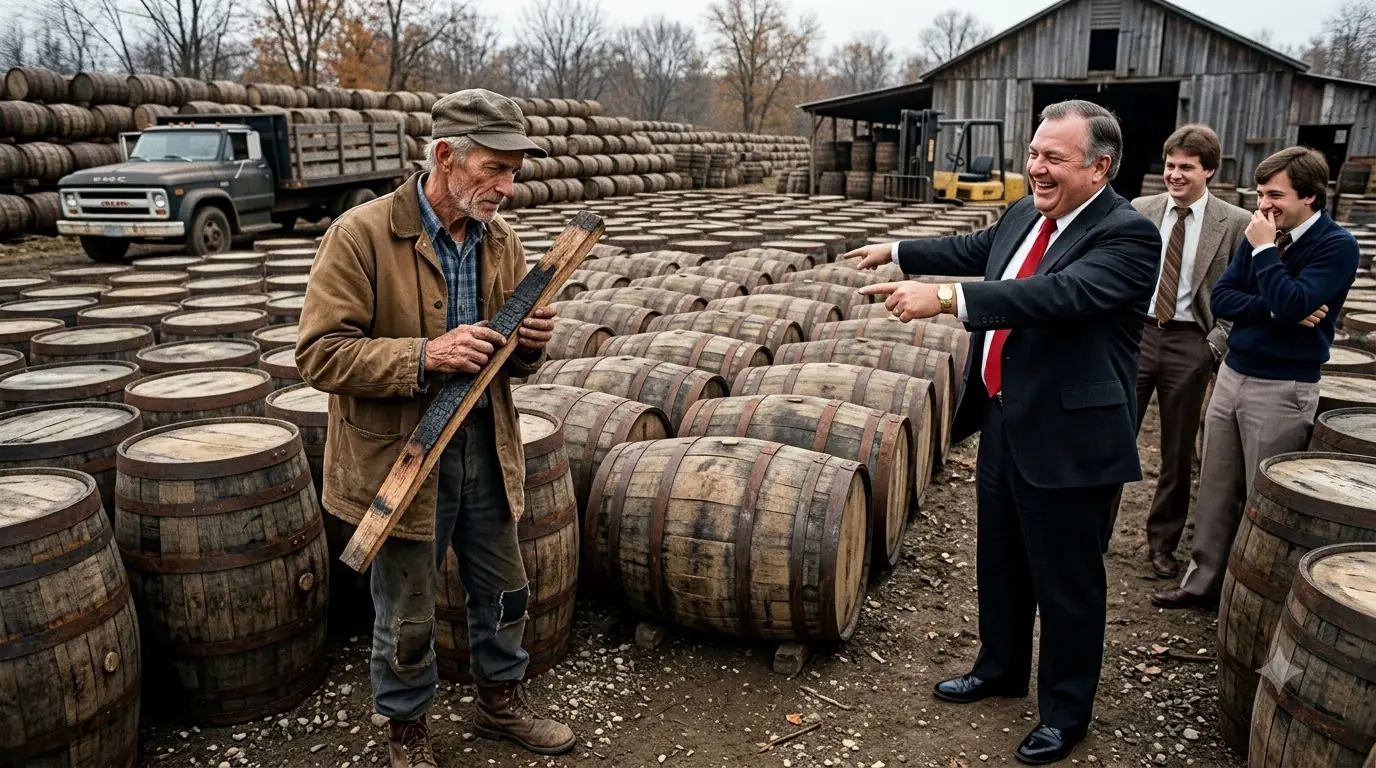
Walter Hensley did not answer.
The sixty-seven-year-old farmer crouched beside the nearest barrel, pressed one thumb against the blackened interior of an exposed oak stave, and scraped away a thin layer of char.
Black became reddish brown.
Beneath that appeared a deep amber color unlike anything Walter had seen in ordinary lumber.
He lifted his thumb to his nose.
Whiskey.
Faint after all those years, but unmistakable.
Around him stood 1,140 used white-oak barrels that Farmers County Bank had acquired when it foreclosed on the assets of a failed barrel-processing and liquor distribution business outside Chillicothe, Ohio.
To Leonard Pike, the barrels were a problem.
A large problem.
The storage property had to be cleared before the bank could sell it.
The machinery inside the warehouse had buyers.
The forklifts had buyers.
The trucks had buyers.
Shelving could be auctioned.
Office furniture would disappear eventually.
The barrels were different.
They filled almost an entire fenced yard.
Some leaned against one another.
Some had missing hoops.
Others had split heads.
Rain had silvered the exterior wood.
Rust covered the iron bands.
Several barrels were blackened inside from their original charring.
A hauling contractor had quoted the bank more than five thousand dollars to supply trucks, labor, loading equipment, transportation, and disposal.
Leonard hated that number.
Five thousand dollars to get rid of something he could not sell felt like paying for failure twice.
Then Walter Hensley had appeared.
Old coat.
Work boots.
Thin frame.
Gray hair.
He still owed the bank $41,600 on his family farm.
Leonard knew that because the loan file sat three doors from his office.
So when Walter walked slowly among the barrels, examining the hoops and knocking his knuckles against the oak, Leonard assumed the old farmer was searching for two or three containers he could repurpose around the farm.
Maybe feed storage.
Maybe water.
Maybe fence posts.
Walter stood.
“I’ll take them.”
Leonard smiled.
“How many?”
“All of them.”
The smile disappeared.
“All what?”
“All 1,140.”
One of the bank employees stopped writing on his clipboard.
Leonard looked across the yard.
Then back at Walter.
“You’re serious.”
“Yes.”
“What are you offering?”
“Seven hundred fifty dollars.”
Leonard laughed again.
It was not even insulting.
It was relief.
“You’re offering me seven hundred fifty dollars to haul away every barrel in this yard?”
“Yes.”
“You provide the trucks.”
“Yes.”
“Labor.”
“Yes.”
“Bank doesn’t load one barrel.”
“Correct.”
“You damage something, that’s yours.”
“Fine.”
Leonard held out his hand.
“You’ve got a deal.”
Walter did not shake it yet.
“I want it written down.”
Leonard’s expression changed.
“What?”
“All 1,140 barrels.”
“Yes.”
“Full ownership passes when I pay.”
“Yes.”
“No later reclamation.”
“No storage charge while I remove them as long as they're gone by the date we agree.”
Leonard waved toward the office.
“Walter, I’ll write anything you want as long as you get these things out of here.”
That sentence would matter later.
At the time, Leonard believed he was making one of the easiest decisions of his career.
Instead of paying more than five thousand dollars to clear the yard, the bank would collect $750 and transfer the burden to someone else.
By Leonard’s arithmetic, the difference approached six thousand dollars.
He joked about it while the bill of sale was being typed.
“Put in there that he gets every rusty hoop too.”
The secretary smiled.
Walter did not.
The final receipt read:
1,140 used white-oak whiskey barrels, various conditions.
Total purchase price: $750.
Buyer accepts all transportation, handling, and removal expense.
Full ownership transfers to Walter Hensley upon payment.
No right of reclamation retained by seller.
Walter read every line.
Then he paid.
Leonard signed.
He slid the paper across the desk.
“Take every last one.”
Walter folded the receipt once.
Then again.
He placed it inside an envelope and slipped it into the interior pocket of his brown coat.
Leonard grinned.
“Just don’t come back complaining when you realize you paid us for the privilege of hauling away trash.”
Walter finally smiled.
“I won’t.”
Eleven years later, when properly selected and prepared whiskey barrels were selling in Walter’s market for roughly $460 each, Leonard Pike would remember that conversation in painful detail.
By then, the bank would be the one asking for help.
But in November 1980, none of that existed yet.
There was only a sixty-seven-year-old farmer with a mortgage, an old pickup, a borrowed trailer, and 1,140 barrels he still had to move forty miles.
Walter Hensley had lived on the same 148 acres since childhood.
The Hensley farm sat northeast of Chillicothe in rolling Ohio ground where corn and soybeans grew well in good years and merely survived in bad ones.
The farmhouse was white.
The barn red once, though weather had turned most of it brown.