People think violence is loud. They think it's chest beating, screaming, and perfectly choreographed spinning kicks under bright gymnasium lights, but real violence is terrifyingly quiet. It's the heavy, breathless silence right before a car crash. Trent, a local black belt with a fragile ego and a point to prove, decided to humiliate the limping handyman in front of his evening class. He expected a cowering victim.
He didn't know the man pushing the broom spent 12 years in the teams. He didn't know he was waking up a ghost. The fluorescent lights of Westridge Plaza always flickered with a rhythmic dying pulse. It was a strip mall that had seen better days, wedged between a failing laundromat and a discount auto parts store. Sam Hayes liked it that way.
The decay felt honest. It didn't demand anything from him other than a wrench, a mop, and the occasional application of heavy-duty duct tape. Sam was 44, though the deep lines etched around his eyes and the permanent stiff-legged drag of his right step made him look closer to 50. A roadside IED outside of Helman Province had seen to that. It had shredded his femur, chewed up his meniscus, and bought him a one-way ticket out of the Navy Seals and back into a civilian world he barely recognized.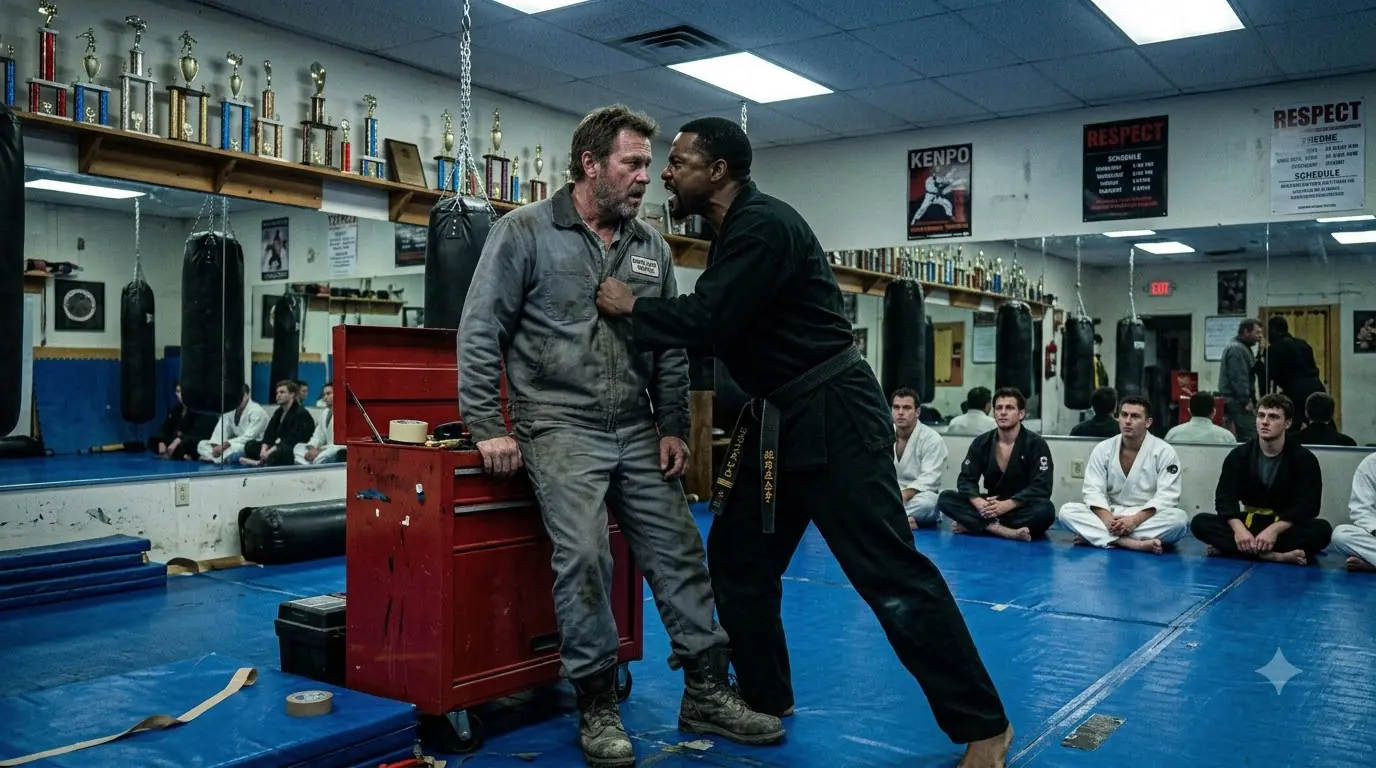
Now he was just the maintenance guy. He wore faded canvas workpants, a gray thermal shirt smeared with grease, and heavy boots that scuffed against the linoleum. He preferred the invisibility. When you spend over a decade operating in the darkest corners of the globe doing things that politicians lied about on television, peace isn't found in a crowded room. Peace is found in a quiet boiler room tightening a valve.
Peace is a stripped screw that finally bites. But peace was hard to come by on Tuesday and Thursday nights. Three doors down from Sam's supply closet was Apex Tactical Martial Arts. The name itself used to make Sam crack a dry smile, but the novelty had worn off months ago. The dojo was run by Trent.
Trent was 28, built like a fitness model and moved with the loud, aggressive swagger of a man who had never truly been punched in the mouth. He wore a tailored midnight black gi covered in sponsor patches. The front window of the storefront was lined with cheap plastic trophies and oversized gold medals from regional point sparring tournaments. Sam usually ignored the place. He'd clean the shared hallway, empty the trash bins, and listen to the rhythmic thump of shins hitting leather pads through the drywall.
He didn't care what people did with their time. If they wanted to pay 150 bucks a month to learn how to break pine boards and yell at themselves in the mirror, it wasn't his business. But Trent was loud. He wasn't just a teacher. He was a performer.
And his favorite audience was always himself. Through the thin walls, Sam would hear the lectures. Trent would pace the mats, projecting his voice so it carried out into the parking lot. He talked about the warrior mindset. He talked about alpha dominance and street lethality.
He used military terminology he had learned from podcasts. Words like kinetic, operator, and flanking, throwing them out to a room full of suburban accountants and high school kids trying to build their confidence. Sam would just lean against his mop handle, feeling the dull, familiar ache in his titanium laced knee, and wait for the noise to stop. He knew what a real warrior looked like. A real warrior usually looked tired.
They looked like young men bleeding out in the dust, calling for their mothers. They didn't look like Trent, strutting across foam mats and bare feet, high on his own supply of testosterone. On a rainy Tuesday in late October, the plumbing in the men's locker room of the dojo decided to back up. The property manager called Sam at 6:00 in the evening. Sam sighed, packed his red metal toolbox, and walked down the covered sidewalk through the drizzle.
He pushed open the glass door of Apex Tactical. The air inside was thick and humid, smelling heavily of stale sweat and cheap coconut air freshener. The evening adult class was in full swing. Sam kept his head down, clutching his toolbox. He dragged his right leg slightly, navigating around the edge of the blue mats, trying to make himself as small and unnoticeable as possible.
He just wanted to fix the urinal, bleach the tiles, and go home to his quiet apartment. But the room was unnervingly tense. Sam paused by the reception desk. He looked out over the mats. Trent was standing in the center of the room.
He wasn't smiling. The performative swagger was gone, replaced by something uglier, something cruel. He was pacing circles around a student who was on his hands and knees, gasping for air. Sam recognized the guy on the floor. His name was Richard.
He was a software developer who worked across the street. a soft-spoken man in his early 50s who had joined the gym a few months ago after his car got broken into. Richard was currently clutching his ribs, his face pale and slick with sweat, a thin line of blood leaking from his nose onto the pristine blue foam. "Get up," Trent snapped. His voice didn't have the booming theatrical quality it usually did. It was sharp, belittling Richard was trying to push himself up on trembling arms.
I... I just need a second, Sensei. You caught me right in the liver. I didn't catch you. Trent sneered, looking around at the other 10 students who were standing in a rigid, uncomfortable line, too afraid to speak.
You gave it to me. You dropped your hands. In a real street fight, you don't get a second. The street doesn't care that you're tired, Richard. Get up.
Sam stood in the shadows by the front desk. His grip on the handle of his toolbox tightened. The plastic handle creaked under the sudden immense pressure of his calloused hand. He knew this dynamic. It had nothing to do with teaching.
He wiped the blood from his nose with the back of his hand, smearing it across his cheek. He looked humiliated, defeated. He raised his hands in a weak, trembling guard. "Good," Trent said, a vicious little smirk playing on his lips. "Now block the roundhouse." Trent didn't wait.
He stepped in hard, hips twisting, and fired a heavy right kick. It was fast, technically proficient, and completely merciless. Richard didn't even have time to flinch. The shin struck Richard's forearms with a sickening crack, blowing right through his weak guard and slamming into his neck and jaw. Richard's eyes rolled back.
He collapsed instantly, hitting the mat like a dropped sack of cement. He didn't move. The room went dead silent. The other students shifted on their feet, their eyes wide with shock. No one stepped forward.
Fear kept their feet rooted to the foam. Trent exhaled slowly, rolling his shoulders. He looked down at the unconscious man. "Weakness," Trent announced to the terrified room. "Is a disease, and it is entirely your choice." In the back of the room, Sam Hayes set his toolbox down on the laminate floor.
It made a solid, heavy thud that echoed through the silent dojo. Trent's head snapped toward the sound. His eyes narrowed, trying to pierce the dim lighting near the reception area. When he saw it was just the handyman, his irritation morphed into a condescending glare. "Can I help you?
Maintenance?" Trent asked, dragging out the word like an insult. "Class is in session. If you need to fix the toilet, use the back door. You're interrupting." Sam didn't move toward the back door. He didn't look at Trent.
His pale blue eyes were fixed on Richard, who was just starting to groan, twitching on the mat. "He's out cold," Sam said. His voice was gravelly, quiet, and entirely devoid of emotion. It didn't bounce off the walls. It just sat in the air, heavy and unmovable.
You gave him a concussion, put him in the recovery position. Trent let out a sharp barking laugh in disbelief. He looked at his students, shaking his head before turning back to Sam. Excuse me. Trent took three long strides toward the edge of the mat, closing the distance.
He stopped a few feet away from Sam, looking the older man up and down. He took in the grease-stained thermal, the fading gray hair, and the way Sam leaned most of his weight onto his left leg to spare his ruined right knee. "Did the guy changing light bulbs just try to give me medical advice?" Trent asked, pointing a thumb at his own chest. "I run a combat gym, old man. People get hit.
It's called conditioning. If you don't like it, look away and go plunge the drain." Sam finally looked at Trent. He didn't see a martial arts master. The part of Sam's brain that had been rewired by a decade of urban warfare and close quarters combat automatically went to work. It was involuntary.
A physiological software program booting up. He looked at Trent's stance. Weight too far forward on the lead leg. Chin raised. Breathing shallow.
Trapped in the upper chest. Adrenaline spiked. unpredictable but mechanically flawed. "He's 50 years old," Sam said, his voice remaining totally flat. "He's carrying an extra 30 pounds, and he has zero spatial awareness. You didn't teach him anything.
You just hit a heavy bag that breathes." The students in the back gasped. Richard was slowly sitting up now, holding his head, looking dizzy and nauseous. A deep, ugly flush crept up Trent's neck. His ego, fragile as glass and twice as sharp, had just been publicly fractured by a crippled janitor. He stepped off the mat, his bare feet slapping the linoleum, and walked right up to Sam.
Trent was three inches taller. He loomed over the handyman, invading his personal space, trying to use proximity to force submission. He puffed out his chest. "Listen to me, you washed up loser," Trent hissed, his voice dropping into a menacing whisper meant only for Sam. I am a third-degree black belt.
I have competed at the national level. You clean up the piss in my bathrooms. You don't know the first thing about combat. You don't know the first thing about violence. So, pick up your little red box, limp your broken ass into the bathroom, and keep your mouth shut.
Sam didn't blink. He didn't step back. His heart rate, which hovered at a resting 60 beats per minute, didn't elevate by a single fraction. He looked at the space between Trent's eyes. I'll fix the pipes tomorrow, Sam said quietly.
He bent down slow and deliberate to pick up his toolbox. He wasn't retreating out of fear. He was retreating because he knew what would happen if he stayed. He knew the monster that lived inside his own chest. He had spent years burying it beneath layers of medication, therapy, and mundane physical labor.
He didn't want to dig it up, not for a punk in pajamas. But as Sam grabbed the handle and began to turn, Trent couldn't let it go. He needed the total victory. He needed the handyman to cower. Trent reached out and shoved Sam hard in the shoulder.
"I didn't say you were dismissed," Trent snapped. "Sam was shifting his weight. The sudden push caught him off balance. His bad right leg took the brunt of it. The knee buckled slightly.
A sharp, blinding spike of pain shot up Sam's thigh, causing him to stumble back a half step and catch himself against the reception desk. The toolbox clattered against the floor. Trent barked a laugh. It was a loud, cruel, echoing sound. He looked back at his students, making sure they saw the dominant display.
"Look at you." Trent sneered, pointing a finger at Sam's leg. "You can barely stand up. You're pathetic. You come in here trying to lecture me about weakness. You're too weak to fight gravity, old man.
Sam stayed, leaning against the desk. He closed his eyes for a fraction of a second. Breathe in 4 seconds. The smell of cheap coconut spray faded. The smell of copper and dust took over.
Hold 4 seconds. The strip mall disappeared. The fluorescent lights vanished. Breathe out. 4 seconds.
The lock on the cage snapped. The ghost woke up. Sam opened his eyes. The tired, aching handyman was gone. The face looking back at Trent was completely devoid of humanity.
It was an empty, chilling mask of absolute calculated violence. It was the face of a man who had cleared rooms in Rammani with an empty rifle and a fixed blade. Trent stopped laughing. He saw the shift in Sam's eyes. A sudden, cold prickle of deep, primitive unease washed down Trent's spine.
His instincts, buried under years of fake tournament rules and foam padding, screamed at him that he had just made a catastrophic error. But his ego wouldn't let him back down. What? Trent challenged, raising his chin, slipping into a fighting stance. "You got something else to say?" "Yeah," Sam whispered.
He slowly pushed himself off the desk. He didn't favor the bad leg anymore. The adrenaline had completely severed the pain receptors in his brain. Sam kicked his toolbox out of the way. It skidded across the floor and hit the wall.
"Put your hands up," Sam said. Trent sneered, shaking off his momentary hesitation. The guy was crippled. He was old. "This was going to be a bloodbath, and Trent believed it would be entirely legally justified: self-defense on his own property.
"You want to do this?" Trent asked, bouncing lightly on the balls of his feet, his hands rising into a crisp textbook Muay Thai guard. Fine, I'll make an example out of you. Waivers don't cover trespassing, old man. The students in the background scrambled backward, pressing themselves against the mirrored walls. Richard was still on the floor, watching through dazed half-open eyes.
Trent initiated. He didn't respect Sam enough to gauge distance. He stepped forward aggressively, launching a lightning fast one-two punch combo aimed squarely at Sam's jaw, followed immediately by a heavy low kick aimed at Sam's bad leg. It was a textbook sequence, fast, flashy, and designed to overwhelm. But Sam wasn't there.
He didn't block. Blocking is for sports. Blocking absorbs impact. Sam slipped inside the arc of the punch. He moved with a sudden shocking economy of motion.
There was no bounce in his step, no wasted energy. He simply shifted his head off the center line by a fraction of an inch. Trent's right cross cut the air right next to Sam's ear. Before Trent's foot could even leave the ground for the low kick, Sam closed the distance. He stepped directly into Trent's personal space, violently crowding him.
Trent's eyes went wide as his momentum carried him forward into the solid wall of Sam's shoulder. Sam didn't throw a punch. He didn't try to knock Trent out. He went to work on the architecture of Trent's body. Sam's left hand shot out, not as a fist, but as an open palm.
He seized the heavy lapel of Trent's uniform right at the collarbone. His grip was like a vice forged by decades of hauling gear and pulling men through mud. He yanked forward and down with bone-jarring force. Trent's posture was instantly broken. His chin, which he had kept so arrogantly high, was pulled down toward his chest.
His balance was shattered. Panic flared in Trent's eyes. He tried to swing wildly with a left hook, but the angle was dead. Sam stepped on Trent's lead foot with his heavy steel-toed work boot, pinning it to the floor. At the exact same moment, Sam drove his right forearm upward, smashing it into the nerve cluster just under Trent's jawline.
It wasn't a strike meant for points. It was a frame. A solid bar of bone jammed under the chin, leveraging against the neck. Trent gagged. His hands flailed, trying to break Sam's grip on his collar, but he couldn't move his feet.
He was pinned, his spine bent backward at an unnatural angle. "You talk too much," Sam whispered, his voice a low, terrifying rumble right next to Trent's ear. Sam pivoted his hips. With a sharp explosive twist, he used the leverage on the collar and the jaw to violently throw Trent to the ground. Trent didn't fall onto the soft blue mats.
Sam made sure of that. Trent slammed onto the hard linoleum floor just off the edge of the mat. The impact forced all the air from Trent's lungs in a wet, ragged hiss. He bounced slightly, the back of his head bouncing off the floor. Before Trent could even register the lack of oxygen, Sam was on him.
But Sam didn't mount him. He didn't rain down cinematic punches. He dropped his left knee directly onto Trent's floating ribs. The knee dug in, pressing all of Sam's weight into the fragile bones. Trent screamed, a pathetic, high-pitched sound that tore through the silent dojo.
Sam's right hand clamped around Trent's throat. Not choking him, just holding him in place. Feeling the frantic, terrified fluttering of the black belt's carotid artery. Trent was entirely paralyzed. The pain in his ribs was blinding.
The pressure on his throat was absolute. He couldn't move his arms. He couldn't breathe. The illusion of his dominance had been dismantled in exactly 3.2 seconds. Sam looked down into Trent's eyes.
He saw the terror. He saw the desperate, humiliating realization that all the trophies, all the belts, all the loud speeches meant absolutely nothing. when faced with a man who knew how to turn a human body into broken furniture. "You think this is a game?" Sam said, his voice entirely steady. He pressed his knee a millimeter deeper, Trent whimpered. "You think violence is a sport?
You think it's fair? You put on a costume and you bully people who don't know any better to make yourself feel like a man." Trent choked, his hands weakly pawing at Sam's wrists. Tears were welling up in the corners of his eyes, spilling over onto the floor. This isn't a sport, Sam told him, his blue eyes cold and empty. When real violence shows up, there is no referee.
There is no tap out. There is just physics and anatomy and the ground. Sam leaned in closer. The smell of rust and sweat was heavy between them. "I am weak," Sam whispered.
My body is broken, but I can kill you right here in front of your students with my bare hands, and it won't even elevate my heart rate. Do you understand the difference now? Trent couldn't speak. He just nodded frantically, his eyes wide, pleading, rolling back in his head from the pain and the lack of oxygen. Sam held him there for three more agonizing seconds.
He let the silence stretch. He let the reality of the situation burn itself permanently into Trent's ego. Then abruptly, Sam let go. He stood up, taking his weight off Trent's ribs. Trent gasped, rolling onto his side, coughing violently, clutching his chest.
He didn't try to get up. He just curled into the fetal position on the cold linoleum, shivering. Sam didn't look at him again. The switch flipped. The ghost faded back into the dark.
He reached down, favoring his bad leg once again, and picked up his red toolbox. The adrenaline was fading and the sharp familiar ache in his knee was returning with a vengeance. Sam turned and looked at the row of students. They were plastered against the wall, staring at him as if he were a demon that had just materialized from the floorboards. Richard was sitting upright now, his mouth hanging open in sheer shock.
"Class is dismissed," Sam said quietly. He turned around and limped out the front door, stepping back into the cool, dark drizzle of the sullen night. He had a clogged urinal to fix in the morning. Adrenaline is a short-term loan with a predatory interest rate. When the debt comes due, it takes everything you have left.
Sam woke up at 5 in the morning to a deep, throbbing ache radiating from his right hip down to his ankle. He sat on the edge of his mattress in the dark, staring at the faded pattern of his cheap rug, waiting for his brain to fully sink with his body. His knee was swollen, hot to the touch, and stiff as rusted iron. The sudden violent pivot he had used to throw Trent to the linoleum had torn at the fragile scar tissue webbing his joint. He didn't regret it, but he hated the reminder.
He limped into his cramped bathroom, swallowed three ibuprofen dry, and wrapped his knee tightly in a frayed ace bandage. He dressed in silence, heavy canvas pants, a faded olive drab henley, scuffed boots. By 6:30, he was back at Westridge Plaza. The strip mall was completely abandoned, sitting quietly under a low ceiling of bruised gray clouds. Sam unlocked the back door of Apex Tactical.
The air inside was stale, holding the ghost of yesterday's sweat. The blue mats looked exactly the same. The cheap plastic trophies on the front window sill hadn't moved. The room held no memory of the violence that had occurred 12 hours prior. Buildings don't care about human pride.
He walked past the main floor and pushed into the men's locker room. It smelled faintly of mildew and cheap deodorant. Sam opened his red toolbox, pulled out a heavy pipe wrench, and went to work on the backed up urinal. This was where he belonged. Cold porcelain, rusted pipes, problems that had logical mechanical solutions.
You turn the valve to the left, the water stops, you clear the blockage, the drain empties. There was a beautiful mindless honesty to plumbing. It didn't ask him to be a hero. It didn't ask him to pretend he was normal. It just required a tight seal.
He was up to his elbows in a mixture of bleach and stagnant water when he heard the locker room door squeak open. Sam didn't look up. He kept his grip on the wrench, tightening a brass fitting. "Jim doesn't open until noon," Sam said, his voice flat, echoing slightly off the tiled walls. I know, Sam paused.
The voice was quiet, lacking the aggressive cadence of the usual meatheads that frequented the morning sessions. Sam wiped his hands on a shop rag and turned around. Richard was standing in the doorway. He looked terrible. The entire left side of his jaw was painted in ugly shades of violet and yellow.
His nose was swollen, slightly off-center. He was wearing an oversized gray cardigan and clutching two paper cups from a local bakery chain. He looked out of place against the backdrop of lockers and MMA posters. Richard offered one of the cups forward. His hand was shaking slightly.
Black? Richard said softly. I figured you for a black coffee kind of guy. I'm sorry if I'm interrupting. The property manager, Gary.
He told me you usually get here early. Sam looked at the cup then at Richard. He didn't want the coffee. He didn't want the conversation. He wanted to finish the pipe, pack his tools, and go check the roof drains over the laundromat.
Interactions meant attachments, and attachments meant complications. But he also saw the deep, hollow exhaustion in Richard's eyes. It was a look Sam knew intimately. It was the look of a man who had suddenly realized how fragile he was. Sam sighed.
He reached out and took the cup. The cardboard was hot against his calloused skin. "Thanks," Sam muttered. He took a sip. It was bitter and burnt.
It tasted perfect. Richard stood awkwardly for a moment, looking at the half-disassembled urinal. "Did you did you fix it?" "Almost," Sam said, leaning back against the row of sinks. Flange was cracked. Someone kicked it.
A heavy silence stretched between them. "The only sound was the faint hum of the building's HVAC system kicking on. "I canceled my membership this morning," Richard said finally, staring down at his own coffee cup. sent Trent an email. I don't think he's coming in today anyway. A guy from the evening class texted me.
Said Trent posted on Facebook that he had a severe training injury and had to suspend the adult sessions for a week. Sam took another sip of coffee. He felt nothing. No triumph, no smugness, just a weary resignation that the world was full of men like Trent. And sometimes you had to break their ribs to get them to shut up.
You shouldn't have been on the mat with him in the first place, Sam said. He's an insecure kid playing a dangerous game. Richard looked up. I thought he could teach me how to fight. He teaches people how to score points in a cage with a referee, Sam corrected bluntly.
He teaches a choreographed dance. That's fine if you want to work out, but it's useless if you're trying to survive. I know that now, Richard said. He swallowed hard. I saw what you did to him.
You saw a mechanic dismantle a machine," Sam said, putting his coffee cup down on the edge of the sink. "Nothing more. Go home, Richard. Ice your jaw. Don't come back to this place." Richard didn't move.
He took a step closer, his eyes searching Sam's weathered face. "You didn't even look angry," Richard whispered, the memory clearly disturbing him. "When he hit me, Trent was furious. His face was red. He was yelling.
But when you grabbed him, your eyes were completely empty. You looked like you were just taking out the trash. "Who are you?" Sam picked up his pipe wrench. The metal was cold and heavy, a comforting weight. "I'm the maintenance guy," Sam said, turning his back to Richard and kneeling back down by the porcelain.
"Shut the door on your way out." 3 days later, the rain finally broke, leaving behind a bitter biting wind that swept through the parking lot of Westridge Plaza. Sam was out back by the dumpsters. He was throwing away broken drywall from a water leak in the auto parts store. He moved methodically, favoring his right leg a little less today. The swelling had gone down, leaving only a dull ache.
He heaved a heavy contractor bag over the lip of the rusted green dumpster. It hit the bottom with a wet thud. When he turned around, Richard was standing next to Sam's ancient rusted F-150. Sam stopped. He wiped a smudge of drywall dust from his forehead with the back of a gloved hand.
He stared at the software developer for a long, silent moment. "You're making a habit of this," Sam said. Richard shoved his hands deep into the pockets of an expensive looking wool peacoat. The bruising on his face had settled into a deep, sickly yellow. He looked nervously around the empty loading dock, the wind whipping his thinning hair.
"I need your help," Richard said. I don't fix computers, Sam replied, walking toward the truck. He reached for the door handle. Four months ago, I was sitting at a red light on Fourth and Elm, Richard blurted out, the words rushing out of him in a desperate torrent. It was 8:00 at night.
I was coming home from work. A guy walked up to my window. He had a tire iron. He smashed the glass. It shattered everywhere.
It was in my hair and my lap. Sam stopped. His hand rested on the rusted metal of the truck door. He didn't turn around, but he listened. He pointed the iron at my face and told me to give him my wallet and my phone.
Richard continued, his voice trembling now, fighting against the wind. I gave them to him. He took them, spit on me, and walked away. The whole thing took maybe 20 seconds. Sam turned his head slightly, looking at Richard over his shoulder.
Richard was staring at the pavement, his breath pluming in the cold air. I'm 52 years old. I manage a team of 30 engineers. I pay my taxes. I follow the rules.
And in 20 seconds, none of it mattered. I was nothing. I was just prey. I sat in my car and cried until the police showed up. Sam let go of the door handle.
He turned to face Richard fully. He didn't offer pity. Pity was useless. "So, you joined a dojo?" Sam stated. I wanted to feel safe, Richard admitted, looking up, his eyes glassy.
I wanted to learn how to punch someone so hard they wouldn't take my things. Trent told me he could make me an alpha. He told me he could make me dangerous. He sold you a fantasy, Sam said softly. I know, Richard practically shouted, frustration leaking out of him.
I know. When he dropped me on Tuesday, I realized I was just as helpless on that mat as I was in my car. But then I saw you. Richard took a tentative step forward. You didn't use anger, Richard said, his tone shifting from desperation to an almost clinical fascination.
You used geometry. You used leverage. You dismantled him without taking a single breath through your mouth. I don't want to learn how to fight in a ring. I want to learn how to not freeze.
I want to learn how to breathe like you do. Sam looked away. He looked out past the dumpsters toward the gray highway in the distance, watching the endless stream of cars moving mindlessly toward their destinations. He remembered the smell of copper in the air over Rammani. He remembered the heavy, suffocating silence of a room after a breach went wrong.
He remembered the faces of men he had put in the ground and the faces of the men he couldn't save. "You don't want what's in my head," Richard, Sam said. His voice was quieter than the wind. "It doesn't make you safe. It makes you a ghost.
You stop seeing people. You start seeing targets. You walk into a coffee shop and you don't look at the menu. You look for the exits and you count the hands of everyone in the room to see who's carrying a weapon. It's an exhausting way to live.
I'm already exhausted, Richard countered, his voice cracking. I wake up every night at 3:00 a.m. because I hear glass breaking in my dreams. Please just talk to me. I don't need a sensei. I just need someone who knows the truth about the dark.
Sam stared at the middle-aged man shivering in his expensive coat. He saw the genuine unadulterated terror beneath the request. Richard wasn't looking to become a tough guy. He was a drowning man asking for a piece of driftwood. Sam sighed, a long, ragged exhalation that seemed to carry 10 years of fatigue.
He walked over to the bed of his truck, reached over the side, and pulled out a battered thermos. He unscrewed the cap and poured a half cup of lukewarm black coffee into the plastic lid. He drank it in one swallow, staring at the concrete. "Fighting isn't about what you do with your hands," Sam finally said, not looking at Richard. "It's about what you do with your panic.
Panic makes you hold your breath. It locks your knees. It gives your brain a thousand options when you only need one." Richard was dead silent, hanging on every word. Trent thinks he's dangerous because he can kick high, Sam continued, turning back to face him. But he fights in an environment where the floor is padded and the temperature is controlled.
"Real violence doesn't happen when you're ready. It happens when you're tired, when you're sick, when you have glass in your lap." Sam took a few steps toward Richard. He stopped just outside of arms reach. "I'm not going to teach you how to punch," Sam said. His pale blue eyes were entirely serious.
"I'm not going to put you in a gi. I'm a janitor. I fix things that are broken. Richard nodded slowly, accepting the boundaries. Sunday morning, 7 a.m., Sam said, turning back toward his truck door.
There's a diner 2 mi down the highway, the one with the neon sign that flickers. Meet me there. We'll drink bad coffee. We'll talk about spatial awareness. We'll talk about how to keep your feet moving when your brain wants to freeze.
Relief washed over Richard's battered face. A small, genuine smile broke through the tension. Thank you. I'll be there. I'm paying for breakfast.
Yeah, you are, Sam said dryly. He opened his truck door, the hinges screaming in protest. He climbed into the driver's seat, his bad knee throbbing slightly as he bent it. He slammed the door shut and rolled down the window. "And Richard," Sam called out over the idling engine.
"Yeah, don't wear the cardigan on Sunday," Sam said. "You look like a substitute teacher." For the first time in 4 months, Richard let out a loud, genuine laugh. Sam put the truck in gear and slowly drove out of the lot, leaving the empty dojo behind. The diner was called Patsy's, though the P in the neon sign over the door had burnt out a decade ago. It sat on the shoulder of the highway, a squat cinder block building that served burnt hash browns and coffee that tasted like battery acid.
It was perfect. Sam was in a booth in the far back corner. He sat with his back to the wall, his bad legs stretched out under the formica table. From his seat, he had a clear line of sight to the front door, the cash register, and the narrow hallway leading to the restrooms. At exactly 7, Richard walked through the door.
He was wearing a dark canvas jacket and heavy boots. He looked tired, but the bruised yellow swelling on his jaw had started to fade into a dull gray. Richard paused in the entryway, scanning the booths. He spotted Sam, offered a tight nod, and walked over. Richard slid into the vinyl booth across from Sam.
He unzipped his jacket. "I'm early," Richard said, checking his watch. "Or at least I thought I was." "You're on time," Sam replied. He didn't offer a smile. "Sit still.
Look at me. Don't turn your head." Richard froze, his hands resting on the table. Okay, you walked in 30 seconds ago, Sam said, his voice low, steady, slipping into the cadence of a man who evaluated risk for a living. Without looking around, tell me how many people are in this room. Richard blinked.
He swallowed. Uh, us, the waitress. There was a guy at the counter. Wrong, Sam said flatly. There are seven people in this room.
The waitress, the cook behind the window, the guy at the counter, two truckers in the booth by the bathrooms, and a teenager in the corner booth to your right wearing headphones. You missed half the room. Richard looked frustrated. He started to turn his head. Don't look, Sam snapped, a sharp command that stopped Richard instantly.
What was the guy at the counter wearing? A jacket, Richard guessed, his heart rate ticking up slightly. He's wearing a high-vis construction vest. He's left-handed. His coffee cup is on his left side.
His keys are on his left hip. The two truckers by the bathroom are exhausted. They haven't spoken a word to each other in 10 minutes. The teenager is completely checked out, staring at his phone. Sam leaned forward, resting his thick forearms on the table.
"You walk through the world asleep, Richard," Sam said, stripping away any comforting illusions. "You only look at what's directly in front of you. The door, the counter, me. You don't see the environment. Predators look for people who are asleep.
They look for tunnel vision. The guy who smashed your window didn't pick you at random. He watched the intersection. He saw you staring at your phone at the red light. He knew you wouldn't see him coming.
The waitress, an older woman with tired eyes and a stained apron, walked over and dropped two thick ceramic mugs of black coffee on the table. She didn't ask what they wanted. She just poured and walked away. Richard stared at the steam rising from the black liquid. The harsh truth stung, but he didn't argue.
He knew Sam was right. "So, how do I wake up?" Richard asked quietly. "You start by counting the exits," Sam told him. "Every room you walk into for the rest of your life. Before you look at the menu, before you find a seat, you find the doors.
Front door, back door, kitchen service door, you build a map in your head." Sam took a sip of his coffee. He didn't flinch at the heat. "Next, you look at hands," Sam continued. Faces lie. Hands don't.
Hands hold weapons. Hands clench when someone is getting angry. If you can't see someone's hands, you assume they are dangerous until proven otherwise. Richard reached for his coffee. His hand was remarkably steady.
In the panic, when the guy broke my window, I knew what was happening, but my body just quit. My arms felt like lead. I couldn't breathe. That's the OODA loop collapsing, Sam explained. He traced a circle on the condensation of his water glass.
Observe, orient, decide, act. It's the cycle your brain goes through to make a decision. When violence happens, it happens fast. A predator's loop is already running. Yours is just starting.
By the time you realize you're in danger, they're already acting. Your brain gets overloaded with conflicting data. So, it hits the emergency brake. You freeze. How do you override the brake? breathing.
Sam said, "Tactical breathing." In through the nose for 4 seconds, hold for four. Out through the mouth for four, hold for four. It's a mechanical override for your central nervous system. It drops your heart rate. It forces oxygen back into your frontal lobe so you can think instead of just react.
Sam pointed a callous finger at Richard's chest. Right now, you're breathing from your collar bones. Shallow, fast. You're stressed just talking about it. Richard realized he was holding his breath.
He forced his shoulders down. He pushed his stomach out, drawing in a long, deep breath through his nose. He counted to four in his head. He held it. He let it out slowly.
"Better," Sam said. "Do it a thousand times a day. Do it at your desk. Do it in traffic. Make it the default state of your body.
When the monster steps out of the dark, you won't have time to think about your breathing. It has to be automatic." They sat in the diner for 2 hours. Sam didn't teach a single punch. He didn't talk about stances or blocks or arm bars. He talked about distance management.
He talked about the psychological weight of verbal commands. He explained how to use a loud, deep voice to shatter an attacker's confidence and how backing away with your hands raised in a placating gesture was actually the perfect position to launch a preemptive strike if negotiations failed. He taught Richard the architecture of survival. When they finally walked out into the cold morning air, the gray clouds were low and heavy. "You're not going to turn into John Wick, Richard," Sam said, pulling his keys out of his pocket.
"You're a middle-aged guy with bad knees, just like me. The goal isn't to win fights. The goal is to see the fight coming from a mile away and not be there when it arrives." Richard nodded. He zipped up his canvas jacket. The nervous, shivering energy he had carried for 4 months felt a little lighter.
It wasn't gone. Trauma doesn't evaporate over burnt coffee, but it was manageable. It was contained. "Thank you, Sam," Richard said. Sam just grunted.
He climbed into his rusted truck, the door screaming on its hinges, and drove back toward the strip mall. He had a cracked tile in the women's bathroom to replace. Winter arrived in the city with a brutal biting indifference. 6 weeks had passed since the morning at Patsy's Diner. Richard was working late.
The quarterly software rollout had hit a massive bug, keeping him at the office until nearly 9:00 on a Thursday night. The building was dead quiet. He packed his laptop into his leather messenger bag, turned off the lights in his suite, and took the elevator down to the underground parking garage. The garage was a concrete cavern. Fluorescent tubes hummed overhead, casting long, sickly shadows between the concrete pillars.
The air was frigid, smelling faintly of motor oil and damp cement. Richard stepped out of the elevator. His footsteps echoed loudly. His Audi was parked 50 yards away, sitting alone in a sea of empty spaces. Four months ago, this walk would have paralyzed him.
He would have clutched his keys like a makeshift knife, his heart hammering against his ribs, sprinting for the driver's side door in a blind panic. Tonight, he stopped. He didn't move. He stood by the elevator doors and observed. Count the exits.
The elevator behind him, the concrete stairwell to his left, the ramp leading up to the street straight ahead. Scan the environment. He looked past his car. He looked between the pillars. Then he saw it.
A shadow moved against the far wall near the stairwell door. It was subtle, a shift in the darkness. Someone was standing behind a concrete pillar, waiting. Richard's stomach dropped. The familiar icy spike of pure panic shot up his spine.
His vision instantly began to narrow, the edges of the garage blurring as his fight-or-flight response flooded his system with adrenaline. His his knees felt weak. He could hear glass breaking in his memory. No. Richard stopped walking.
He planted his feet In through the nose. One, two, three, four. He felt his lungs expand. The icy spike of panic hit a wall of oxygen and dissipated. His vision widened back out.
The tunnel collapsed. The garage came back into sharp focus. Hold. One, two, three, four. The figure stepped out from behind the pillar.
It was a young man, early 20s, wearing a heavy oversized hoodie. His hands were stuffed deep into the front pocket. His head was down, but his trajectory was clear. He was walking on an intercept course toward Richard's car. He was trying to close the distance before Richard could unlock the doors.
Out through the mouth. One, two, three, four. Richard didn't run to the car. Running triggered a predator's pursuit instinct. He didn't pull out his phone and stare at it, pretending he didn't see the threat.
Instead, Richard changed his angle. He stepped out of the direct path to his car, moving toward the center of the driving lane, keeping the man in his full field of view. The man in the hoodie noticed the shift. He sped up slightly, altering his own course to cut Richard off. The man's hands stayed buried in his pockets and could hide a weapon.
The distance closed 40 feet, 30 feet, 20 feet. Richard stopped entirely. He squared his shoulders to the approaching man. He didn't drop into a ridiculous karate stance. He just stood his ground, rooted to the concrete.
He raised his hands, bringing them up to chest height, palms facing outward in a universal gesture of stop. But it wasn't a weak gesture. His elbows were tucked. His frame was solid. He was building a wall.
"That's close enough," Richard said. He didn't yell. He didn't scream for help. He spoke from his diaphragm, projecting his voice so it echoed off the low concrete ceiling. It was deep, authoritative, and totally devoid of fear.
It was the voice of a man who managed 30 engineers. It was the voice of a man who owned the space he was standing in. The man in the hoodie stopped dead in his tracks. He was 15 feet away. The sudden, loud command shattered the script in the man's head.
Predators rely on the social contract. They rely on the victim being polite, avoiding eye contact, and freezing in uncertainty. By speaking first, by giving a direct order, Richard had seized the initiative. He had broken the man's OODA loop. "Hey man, I just need the time," the guy mumbled, taking a hesitant half step forward.
"I don't have the time," Richard boomed, stepping forward himself. One heavy, deliberate step, closing the gap aggressively instead of retreating. "Back away!" The dynamic in the cold garage violently shifted. The man in the hoodie looked up. He saw a middle-aged guy in an expensive coat.
But he didn't see a victim. He saw a man with steady eyes, raised hands, and a voice that didn't shake. He saw a bad target. He saw a risk. The man hesitated for three long seconds.
The silence hung heavy in the damp air. Then the man pulled his hands out of his pockets. They were empty. He raised them defensively, muttered something under his breath, and turned around. He walked quickly toward the ramp leading to the street, his shoulders hunched against the cold.
Richard stood in the center of the lane until the man disappeared around the corner. He didn't collapse. He didn't shake. He just lowered his hands, took one final deep breath through his nose, and walked to his car. He unlocked the door, got in, and started the engine.
He had survived, not by fighting, not by throwing a spinning heel kick. He survived because he refused to be prey. The next morning, the neon lights of Westridge Plaza were fighting a losing battle against the pale winter sun. Sam Hayes was standing in the alley behind the auto parts store, wrestling with a frozen padlock on a storage unit. His breath plumed in the freezing air.
He grunted, hitting the lock with a heavy wrench. The rust cracked and the lock popped open. Sam said, slipping the wrench into his canvas pocket. He heard the crunch of tires on gravel. He turned around to see a sleek black Audi pull up to the loading dock.
The driver's side door opened and Richard stepped out. He looked different. He still wore the expensive wool coat and he still looked like a software developer, but the hollow haunted look was gone from his eyes. His shoulders were relaxed. He didn't look over his shoulder at every shadow.
Richard walked up to Sam. He was holding a large insulated paper cup. "Thought you might need this," Richard said, handing the cup over. "It's from Patsy's. Extra burnt.
Sam looked at the cup, then up at Richard. His pale blue eyes searched the older man's face, reading the micro expressions, looking for the lingering signs of panic. He found none. "You sleep all right last night?" Sam asked quietly. "I slept like a rock," Richard said.
A small, genuine smile touched the corners of his mouth. "Turns out you can stop a lot of trouble just by breathing." Sam took the coffee. The heat seeped through his thick gloves, warming his aching hands. "Yeah," Sam muttered, taking a sip. "You can." They stood there in the cold alley for a moment.
Two men from completely different worlds, bound by the quiet, brutal realities of the dark. Richard didn't ask for another lesson. He didn't need one. He had the tools. "Take care of yourself, Richard," Sam said, turning back toward the open storage unit, picking up a heavy box of parts.
"You, too, Sam." Richard walked back to his car, got in, and drove away. Sam stood alone in the freezing alley. He looked at the cracked asphalt, feeling the deep, familiar ache in his ruined knee. The world was still a broken, dangerous place it always would be. But today, one piece of it was a little less fragile.
Sam picked up his wrench, took another sip of terrible coffee, and went back to work. Violence isn't a game, and survival isn't a sport. It's about managing the space between panic and action. Sam knew that the real battles aren't won with flashy kicks under bright gym lights. They are survived in the quiet, terrifying moments in the dark by those who remember to breathe.
END