I survived three deployments, two bullet wounds, and a helicopter crash in the dust of the Kunar Province. Now, I spend my days formatting Excel spreadsheets for a corporate logistics firm. It's quiet, safe, numbing. Until the CEO's 24-year-old son decided the company gym was his personal fight club, and I was his next punching bag. He had a black belt, an ego the size of a boardroom, and absolutely no idea who he just trapped in a cage.
There is a specific kind of silence that exists in a corporate office at 8:15 on a Tuesday morning. It's not a peaceful silence. It's the heavy, suffocating quiet of 80 people staring at glowing rectangles, collectively pretending they aren't trading the best years of their lives for a mediocre dental plan and a 401k match. My name is John Cole. I'm a senior data analyst for Prescott Logistics.
I take columns of numbers representing shipping weights from cargo vessels in the Pacific, and I put them into other columns so that people who make 10 times my salary can point at pie charts in boardrooms. It is a remarkably useless existence. I love it. I love it because spreadsheets do not bleed. Pivot tables do not scream for their mothers when a roadside IED rips through the floorboards of a Humvee.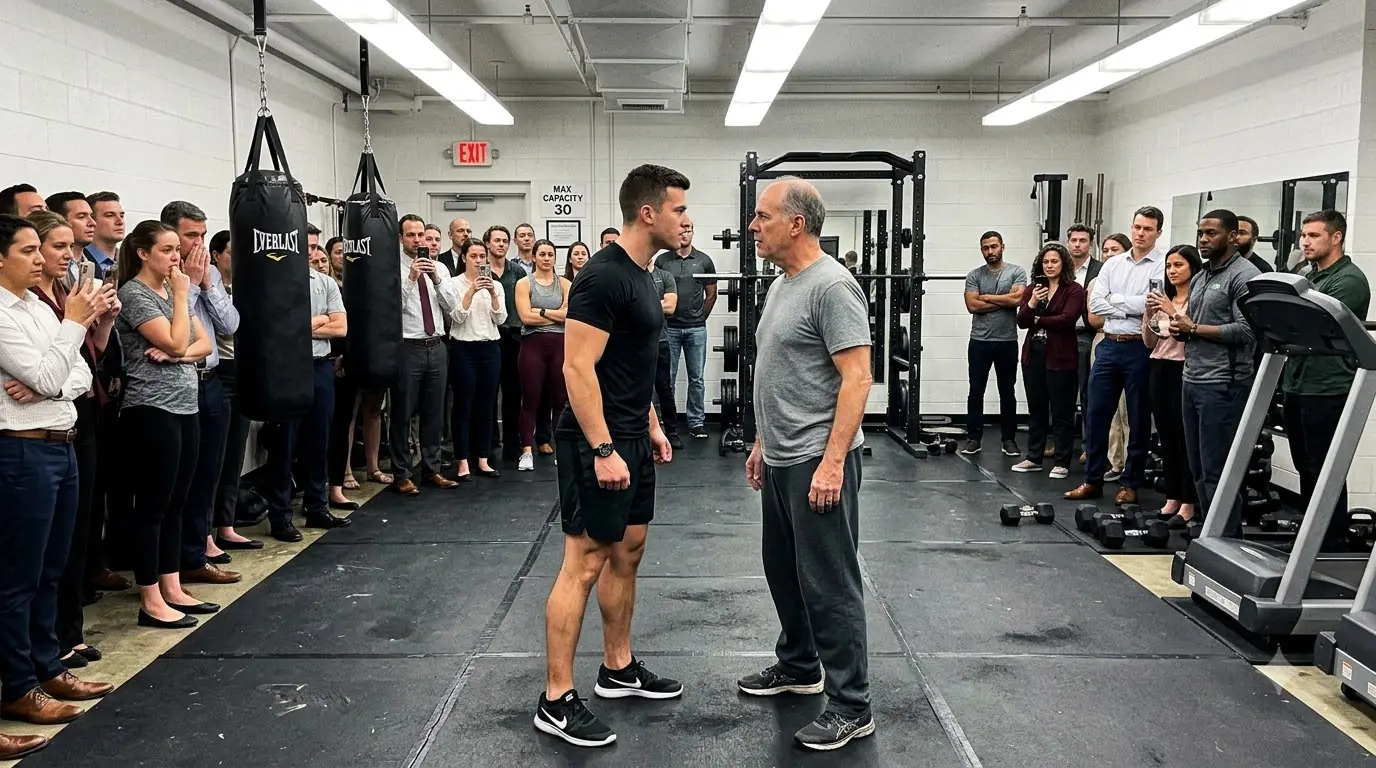
A missing decimal point will not result in a folded flag being handed to a weeping widow in San Diego. When you spend 7 years leading a Navy SEAL extraction team, pulling hostages out of concrete basements, and dragging wounded brothers through waist-deep mud, you develop a profound appreciation for the mundane. I wanted a life where the highest stakes were a jammed copy machine. For 3 years, I had exactly that. I wore beige slacks.
I drank the acidic break room coffee. I smiled at Sharon from accounting when she talked about her golden retriever's digestion issues. I was a ghost. A 36-year-old man with a slight limp when it rained, broad shoulders hidden under ill-fitting button-downs, and a stare I actively had to soften so I wouldn't make the interns nervous. Then came Connor.
Connor Prescott was the CEO's son, newly appointed to the nebulous role of Executive Vice President of Strategic Culture. He was 24, fresh out of a business school his father had likely bought a library for, and he possessed the kind of unearned confidence that only comes from never having been punched in the mouth. Connor was obsessed with the aesthetic of alpha male dominance. He wore custom Italian suits tailored so tight he could barely lift his arms. He listened to podcasts about biohacking and cold plunges.
And most dangerously, he had spent the last four years collecting martial arts belts from expensive private instructors who knew better than to bruise a wealthy client. He had a black belt in taekwondo and was a blue belt in Brazilian jujitsu. He made sure everyone in the building knew it. His first act as EVP of Strategic Culture was to renovate the basement level. He ripped out the dusty storage units and the old ping-pong tables, replacing them with a state-of-the-art combat gym.
Heavy bags, speed bags, grappling dummies, and a massive expansive pristine 2-inch-thick synthetic tatami mats. At first, it was just an eyesore, a vanity project. But then Connor instituted Warrior Wednesdays. It was framed as an optional team-building exercise, a way to blow off steam and build resilience. But in the corporate world, when the CEO's son sends an optional calendar invite, it isn't optional.
Middle managers looking for promotions started showing up. Junior executives wanting face time with the Prescott heir strapped on boxing gloves. I avoided it entirely. I preferred to get my exercise running 5 miles outside in the freezing Seattle drizzle. The cold rain numbed the phantom pains in my knees and drowned out the ringing in my left ear, but I couldn't avoid the aftermath.
Every Thursday morning the office felt different. I would see a junior sales rep with a slight limp or a marketing coordinator trying to hide a bruised jaw with makeup. Connor wasn't teaching them. He was using them. He was treating the employees of his father's company as compliant salaried sparring partners.
He would dominate them on the mat, submit them, humiliate them, and then pat them on the back calling it character building. Human resources looked the other way. William Prescott, the CEO, was a hard-nosed old-school businessman who thought his son's aggressive streak was exactly what the company needed to stay competitive. "The boy's got fire." William boomed during a quarterly all-hands meeting, clapping Connor on the shoulder. "That's what it takes to win in logistics, killer instinct." I sat in the back row during that meeting, staring at my hands.
My knuckles were scarred, the skin permanently thick and white in patches. Killer instinct isn't a sport. It isn't a corporate buzzword. It's a cold, ugly thing that leaves a metallic taste in your mouth and ruins your ability to sleep through the night. I wanted no part of it.
I kept my head down. I updated my spreadsheets until Toby Fisher ran out of options. Toby was a junior accountant. He was 23, built like a damp paper towel, and wore wire-rimmed glasses that constantly slid down the bridge of his nose. He was also married, and his wife was 6 months pregnant with twins.
Toby was terrified of everything. He was terrified of the impending hospital bills, terrified of his mortgage, and absolutely terrified of losing his job. Connor smelled the fear on him like a shark tasting blood in the current. It was a Tuesday afternoon. The network servers had gone down on our floor, forcing a rare moment of idle time.
I decided to walk down to the basement to retrieve a box of archived tax documents from the remaining storage closet next to the gym. The basement smelled of fresh rubber mats, eucalyptus surface cleaner, and sweat. As I approached the storage closet, I heard the sharp sickening smack of skin hitting synthetic leather. I paused. The gym door was propped open.
He had 16-ounce boxing gloves laced onto his hands. His glasses were off, leaving him squinting blindly. His left cheek was bright red, and a thin line of blood was trickling from his nose, dripping down over his pale chin. "Come on, Toby." Connor barked, bouncing lightly on the balls of his feet. "You're dropping your hands.
I told you to keep your hands up. In the real world, nobody gives you a warning. "I'm trying, Connor," Toby wheezed. He could barely hold his arms up. The oversized gloves looked like anvils on his wrists.
"Can we take a break?" "Breaks are for the weak, Toby. You think our competitors take breaks? You think the shipping unions take breaks? Push through it. Be a man." Connor stepped forward, faked a jab, and whipped his right leg up in a roundhouse kick.
He didn't pull the strike. The heavy shin slapped directly into Toby's thigh. Toby cried out, a high pathetic yelp, and collapsed. He hit the mat hard, curling into a fetal position, clutching his leg. "Get up." Connor sighed, rolling his eyes in exaggerated disappointment.
He looked over at a few of the mid-level managers who were awkwardly standing by the water cooler, forcing them to chuckle along with him. Unbelievable. 5 minutes in and he's crying on the floor. I didn't make a conscious decision to move. My body just reacted.
Years of conditioned response bypassed my brain entirely. I set the empty cardboard box I was carrying down on a bench. My boots made no sound as I walked onto the pristine mat. "He's done," I said. My voice wasn't loud.
It didn't need to be. It cut through the echoing acoustics of the gym like a scalpel. Connor spun around, his brow furrowing. He looked me up and down, taking in my beige slacks, my blue button-down shirt, my slightly graying temples. It took him a second to place me.
"Cole, right? Data analytics?" Connor smirked, wiping sweat from his forehead. "This is a closed session, Cole. Go back to your keyboards." I didn't look at Connor. I walked straight past him, closing the distance to Toby.
I knelt beside the kid. He was trembling violently, tears mixing with the blood on his face. "Can you walk?" I asked quietly. "My leg." Toby gasped. "It's on fire." "I know.
Deep breaths. I'm going to help you up." I grabbed Toby by the back of his shirt and hoisted him to his feet, letting him drape his arm over my shoulder to keep the weight off his battered thigh. "Hey!" Connor snapped. His bare feet squeaked on the mat as he marched toward us. "I didn't say the session was over.
Put him down." I turned my head. I looked at Connor Prescott, truly looked at him. I saw the dilated pupils, the flared nostrils. I saw a boy playing dress-up in the skin of a fighter. For a fraction of a second, the fluorescent lights of the gym flickered, and I smelled the copper reek of an Afghan compound, felt the grit of sand in my teeth.
I felt the familiar cold stillness wash over my spine. "The session is over," I said. Connor stopped 3 ft away. Something in my eyes must have registered, a subconscious warning system firing off in his primate brain, because he hesitated. But then his ego shoved the instinct aside.
He had an audience. "You got a problem with company culture, Cole?" Connor sneered, closing the distance again, getting right in my face. He was an inch taller than me. "Because if you think you're tough, there's plenty of room on this mat for you. Or are you just a coward who hides behind a desk?" "I hide behind a desk because it pays my rent," I said evenly.
"Have a good afternoon, Connor." I turned my back on him, a cardinal sin in his world, and walked Toby off the mat toward the locker room. I could feel the heat of Connor's glare burning into my shoulder blades. That was Tuesday. By Wednesday morning, the retaliation began. My access to the primary database was inexplicably revoked.
I had to email Connor's assistant for permission just to pull a daily report. By Thursday, a minor formatting error in one of my spreadsheets was CC'd to the entire executive team with a note from Connor calling it a catastrophic lack of attention to detail. He was squeezing me. He knew I needed the job. He knew the job market for 36-year-old veterans with spotty employment histories and gaps in their resumes was bleak.
On Friday morning, I received a calendar invite. Subject: Mandatory Department Alignment and Resilience Training. Location: Level B2 Gym. Time: 4:00 p.m. Required attendees: Analytics Department Executive Team, including William Prescott. Attached to the invite was a direct message from Connor.
"Bring gym clothes, Cole. Time to see if you can back up that attitude. Refusal to participate will be considered insubordination and grounds for immediate termination. I stared at the screen. The white glare of the monitor burned the back of my skull.
I felt my pulse slow down. It's a strange physiological quirk. Most people's heart rate spike when they are threatened. Mine drops. My body starts conserving oxygen, preparing the muscles for explosive sustained violence.
I didn't reply to the email. I just closed my laptop. I'd spent 3 years trying to be a ghost. But sometimes people insist on dragging the ghost back into the physical world, and they rarely like what happens when it materializes. By 3:55 p.m. the basement gym was packed.
The air was thick, suffocating with a mixture of nervous sweat, expensive cologne, and the sharp chemical tang of the mat cleaner. Nearly 40 people were crammed against the walls, standing awkwardly near the heavy bags. William Prescott stood at the front, leaning against a reinforced steel pillar. The CEO was a large man wearing a bespoke gray suit sipping a diet soda. He looked amused.
To him, this was a gladiator pit, a minor Friday afternoon entertainment where he got to watch his son exert dominance over the peasant class. I stood in the locker room for a long time. I stripped off my button-down shirt. I looked at the mirror. My torso was a road map of bad memories.
A puckered star-shaped scar on my left shoulder from a 7.62 round. A jagged line across my ribs where shrapnel had torn through my armor carrier in Fallujah. I'd spent years hiding these marks under layers of cotton and wool. I pulled on a faded unmarked gray T-shirt and a pair of standard-issue black sweatpants. No brands, no flashy compression gear.
I didn't bother taping hands or wrists. Taping is for people who plan on punching things repeatedly. I didn't plan on punching anything. I just planned on surviving until 5:30 p.m. I pushed through the locker room doors and walked into the gym. The murmuring of the crowd died down instantly.
Every eye turned to me. I kept my gaze fixed straight ahead, walking toward the edge of the mat. Connor was already out there. He looked like a walking billboard for an energy drink company. He wore tight red grappling shorts, a skin-tight black rash guard that showcased his meticulously sculpted abs, and heavy MMA-style sparring gloves.
He was bouncing around, throwing sharp theatrical shadow punches. He threw a high spinning kick that snapped the air, drawing a smattering of polite, terrified applause from the middle managers. "All right, everyone." Connor shouted, clapping his padded hands together. He looked at me, a wolfish grin spreading across his face. "Thanks for coming.
Today, we're going to talk about pressure. In business, pressure crushes the weak and creates diamonds out of the strong. John here is going to help me demonstrate how we handle pressure when we can't hide behind an Excel sheet." He pointed a gloved finger at me. "Shoes off, Cole. Let's go." I sat on the wooden bench at the edge of the mat.
I unlaced my boots slowly, methodically. I placed them side by side. I took off my socks. The cold air of the basement hit my bare feet. I stepped onto the mat.
It was soft, too soft. Real ground doesn't give way when you step on it. Real ground pushes back. Real ground is uneven, littered with rocks and broken glass and shell casings. This mat felt like a trampoline.
It was designed to keep people safe. "Rules are simple," Connor said, pacing in front of me, playing to his father in the crowd. "Light contact, MMA rules, strikes, takedowns, submissions. We go until someone taps out or quits. You know how to tap out, John?
"I know how," I said quietly. "Good. Put your hands up." I didn't put my hands up. I let my arms hang loose at my sides. My shoulders were relaxed.
I sunk my weight slightly into my hips, widening my stance just an inch. To the untrained eye, I looked entirely, completely open, entirely defenseless. Connor took the bait. He didn't want to spar, he wanted an execution. He wanted a highlight reel knockout in front of his father.
He rushed forward, closing the distance with a loud grunting exhale. He threw a stiff left jab at my nose, followed instantly by a heavy right cross aimed at my jaw. In a professional fight, a fighter parries or blocks. Blocking absorbs kinetic energy. It damages the arms, wears down the guard.
In combat, you don't block unless you have to. You cease to be where the strike is. As Connor's left jab extended, I simply tilted my head a fraction of an inch to the right. The leather of his glove grazed my ear, rustling the hair. As his right cross fired, I pivoted on my left heel, shifting my entire torso.
The punch sailed past my chin, hitting nothing but empty space. Because Connor had put so much power into the punch, hitting air threw his momentum completely off. He stumbled forward, his chest bumping into my shoulder. I didn't strike back. I just gently placed my hand on his hip and guided his momentum past me, sending him staggering three steps forward before he caught his balance.
A confused murmur rippled through the crowd. William Prescott stopped smiling, his brow furrowing. Connor spun around, his face flushing crimson. The wolfish grin was gone, replaced by a tight grimace of embarrassment. "Lucky slip," Connor muttered.
He came at me again. This time he decided to use his legs. He stepped into a heavy, devastating low kick, aiming his shin directly for the side of my knee. The exact kick that had dropped Toby. If it connected, it would tear my ACL.
I watched his hips drop. Hips don't lie. A fraction of a second before his foot left the mat, I knew exactly where it was going. I didn't step back. Stepping back is slow.
Instead, I stepped slightly forward into an angle, cutting off the arc of his kick before it could generate speed. His thigh slammed harmlessly into my hip, deadening the blow completely. Before he could pull his leg back, he threw a wild looping right hook at my head. Again, I didn't raise my hands. I dropped my elevation, bending at the knees.
The punch whistled an inch over my scalp. While I was under his guard, I stepped around to his blind side and stood back up, completely out of his line of sight. Connor swung around, swinging blindly, but I was already 6 ft away, standing perfectly still. My arms still hanging loosely at my sides. I wasn't breathing heavily.
My heart rate was a steady, rhythmic drum in my chest. "Stand still and fight!" Connor roared. His breathing was already becoming ragged. Anger burns oxygen faster than exertion does. "I thought the lesson was about handling pressure," I said, my voice calm, projecting just enough to bounce off the walls.
"I'm handling it." Someone in the crowd, maybe Toby hiding in the back, let out a short, stifled laugh. That laugh broke Connor. It snapped the thin veneer of his corporate martial arts discipline. He stopped seeing me as an employee to be humiliated. He saw me as a threat to his entire identity.
He charged. No setup, no feints. Just pure, unadulterated aggression. He lunged forward, throwing a flurry of punches, lefts, rights, hooks, uppercuts. It was a chaotic storm of leather.
I slipped, ducked, and weaved. Left, right, under, away. It was simple geometry. I wasn't fighting him. I was solving a math problem in real time.
Angles and distances. He was burning massive amounts of energy trying to hit a target that evaporated the moment he pulled the trigger. For 45 seconds, Connor swung at me with everything he had, and for 45 seconds, he hit absolutely nothing. The silence in the room was deafening. The only sound was Connor's heavy, desperate panting and the squeak of his bare feet on the mat.
Finally, out of sheer exhaustion, Connor stopped. He stood in the center of the mat, his chest heaving violently, his arms heavy. Sweat poured down his face, stinging his eyes. I stood in front of him, entirely unbothered. I hadn't thrown a single strike.
Connor looked at his father. William Prescott's face was a mask of cold fury. The CEO wasn't angry at me. He was humiliated by his son's impotence. Connor saw that look.
Desperation flooded his eyes. He took a deep breath, feigned a step back, and then, completely disregarding his own light contact rule, he threw a spinning back elbow. It was a dirty move, an illegal strike in most sparring sessions, designed to cut the skin and shatter bone. I saw it coming, but I was boxed in near the edge of the mat. I leaned back, but not quite fast enough.
The point of his elbow grazed the high crest of my left cheekbone. Skin split. The dull, hot sting of raw nerves firing radiated across my face. The crowd gasped. The sound of collective shock bounced off the ceiling.
I stood still. I raised my right hand slowly and pressed two fingers to my cheek. When I pulled them away, the tips were painted a bright, glossy crimson. I looked at the blood on my fingers. For 3 years, I'd held it back.
I'd locked the monster in a deep, dark cage, feeding it the spreadsheets and weak coffee, hoping it would starve. I'd let myself become small. I'd let myself become a ghost. But as the smell of my own copper blood hit my nostrils, the lock on the cage snapped. The cold stillness in my brain vanished, replaced by a terrifying absolute clarity.
I lowered my hand. I looked at Connor. He was smiling again, thinking he had finally scored, thinking he had proven his dominance. He had no idea. I didn't drop my stance.
I didn't raise my hands into a boxer's guard. I simply shifted my weight from my heels to the balls of my feet. "Okay," I whispered. The spar was over. Now we were going to work.
I didn't drop my stance. I didn't raise my hands into a boxer's guard. I simply shifted my weight from my heels to the balls of my feet. "Okay," I whispered. The spar was over.
Now we were going to work. Connor saw the blood on my cheek and smiled. It was a broad teeth-baring grin of a boy who thought he had just won a video game. He had drawn first blood. In his mind, the narrative was complete.
The old guy had dodged a few hits, but youth, speed, and expensive training had ultimately prevailed. He bounced on his toes, raising his padded gloves ready to finish it. "Told you, Cole," Connor panted, his chest heaving. "Pressure?" He rushed me again. He led with a double jab, stepping hard into the strikes, intending to follow up with a heavy overhand right.
This time I didn't step away. I stepped directly into his center line. There is a fundamental misunderstanding about hand-to-hand combat perpetrated by movies and sports. People think it's about trading blows. It isn't.
Real violence is about space and structure. It's about taking your opponent's balance and never giving it back. As Connor's first jab extended, I brought my right forearm up, rigid as an iron bar. I didn't just block the punch, I smashed my bone directly into the soft radial nerve on the inside of his wrist. Connor let out a sharp hiss of pain.
His arm recoiled instinctively, dropping his guard for a fraction of a second. That was all the time I needed. I slid my left foot forward, closing the distance completely until our chests were almost touching. I bypassed his padded gloves entirely. With my open left hand, I slapped the inside of his right bicep, deadening the muscle while my right hand shot up and gripped the back of his neck.
I pulled his head down sharply while driving my own forehead directly into the soft tissue of his shoulder, locking him in a tight, inescapable clinch. Connor panicked. He was used to sparring at a polite distance. He wasn't used to the claustrophobic, suffocating pressure of a man who intended to occupy his physical space. He flailed, trying to throw short, ineffective uppercuts that merely bounced off my ribs.
"Get off!" he grunted, trying to wrench his head free. He had a blue belt in Brazilian Jiu-Jitsu. He knew how to grapple on a mat, but sport grappling relies on rules. It relies on your opponent allowing you to transition between positions. I didn't let him transition.
I just broke his structure. I stepped my right foot behind his left knee. I didn't throw him. I simply pushed his center of gravity past the point of no return. I drove my forearm into his collarbone, using my body weight as a fulcrum.
Connor went airborne. He hit the mat flat on his back. The sound was like a wet sack of cement dropping from a two-story window. The air rushed out of his lungs in a violent, rattling cough. Before the kinetic energy of his fall even dispersed into the foam, I was on him.
In the dojo, when a man falls, you back away or you engage his legs to pass his guard. In a room in Fallujah with a hostile combatant, you neutralize the threat before they can reach into their waistband. Connor instinctively pulled his knees to his chest, trying to establish a defensive guard, trying to wrap his legs around my waist. It was textbook BJJ. I ignored his legs entirely.
I dropped my left knee heavily onto his right bicep, pinning his arm to the floor. All of my 200 pounds was concentrated on that 1 square inch of his muscle. He screamed, a high reedy sound that echoed off the basement walls. With his right arm pinned, I grabbed his left wrist with both of my hands. I twisted it outward, locking the elbow joint, and pushed it flat against the mat above his head.
He was completely immobilized in less than 3 seconds, but I wasn't finished. I dropped my chest low, pressing my sternum against his ribs, making it impossible for him to draw a full breath. I slid my chin across his jawline, digging the point of my shoulder bone directly into the side of his neck, compressing the carotid artery. It's a technique called cross-facing. It doesn't restrict the airway, it just creates a pain so intense and blinding that the brain forgets how to process anything else.
Connor thrashed blindly beneath me. His legs kicked against the mat. He tried to bridge his hips, trying to buck me off, but I was liquid heavy, constantly adjusting my weight to counter his movements before he even made them. "Tap!" someone in the crowd yelled. It sounded like Toby.
He's tap- tapping. Connor's free left hand, the one I was holding down, was desperately slapping the mat. Smack, smack, smack. He was surrendering. I didn't let go immediately.
I held the pressure for exactly 2 more seconds. I wanted him to feel it. I wanted him to understand the profound, terrifying vulnerability of being completely at the mercy of another human being. I wanted him to realize that his black belt was just a piece of dyed cotton and that the world outside his father's corporate empire did not care about his seminar certificates. I leaned my head down until my lips were an inch from his ear.
My breathing was slow and even. "This is pressure, Connor." I whispered. My voice was devoid of anger. It was just a cold statement of fact. "This is what it actually feels like when someone decides you don't get to win." I lifted my shoulder.
I released his wrist. I stood up. I stepped back, smoothing the front of my gray t-shirt. I wasn't sweating. My pulse was still a steady resting rhythm.
Connor did not get up. He rolled onto his side, curling into the fetal position, gasping for air. His face was a mottled, bruised, purple. He clutched his right arm to his chest, sobbing, real, ugly, heaving sobs. It wasn't just the physical pain.
It was the complete, catastrophic shattering of his ego. The basement gym was dead silent. The humming of the fluorescent lights suddenly seemed deafening. 40 people stood frozen, their mouths slightly open, staring at the mat. Nobody looked at their phones.
Nobody whispered. They just stared at the 24-year-old executive vice president crying on the synthetic rubber. And then they slowly turned their eyes to me. I walked over to the wooden bench at the edge of the mat. I picked up a clean white towel and pressed it against my cheekbone.
The bleeding had already started to slow, the blood coagulating in the cold basement air. I wiped the crimson smear from my skin, folded the towel neatly, and dropped it into the laundry bin. I picked up my socks. I sat on the bench and pulled them on. In my peripheral vision, I saw William Prescott moving.
The CEO pushed off the steel pillar he had been leaning against. His face was pale, his jaw locked tight. He didn't look at his son. He looked directly at me. He marched across the gym, his heavy leather shoes squeaking loudly on the bare floor, and stopped at the edge of the mat.
"What the hell was that, Cole?" William demanded. His voice was a low rumble, laced with years of boardroom authority. It was the voice of a man who was used to making people shrink. I laced up my left boot. I pulled the knot tight.
I didn't look up. "That was mandatory department alignment training, Mr. Prescott," I said mildly. "You assaulted an executive." "I participated in a sparring session under the rules established by your son," I replied, lacing my right boot. "Light contact until he threw an illegal elbow, then the rules changed." William pointed a thick finger at me. "You're fired, Cole.
You're done in this city. You understand me? I'll make sure you never touch a keyboard in a logistics firm from here to Chicago." I finally stood up. I looked William Prescott in the eyes. He was a big man, but up close, I could see the soft, pampered edges of a life lived indoors.
He was a man who ordered violence, economic or otherwise, from a safe distance. "You talk a lot about killer instinct, William," I said. My voice carried across the silent room. Every employee was hanging on every word. "You tell these people they need it to succeed.
You encourage your son to beat it into junior accountants." I gestured vaguely toward Connor, who was finally sitting up, holding his ribs, looking at the floor in absolute shame. "That isn't killer instinct," I continued. "That's bullying. It's a cheap imitation of strength by people who have never had to survive anything real." William's face flushed red. "Who do you think you are lecturing me in my own building?" "I'm John Cole," I said.
"And for 7 years before I came to work here, I commanded a naval special warfare extraction unit. I spent my 20s pulling mutilated hostages out of basements in Fallujah and Helmand Province. I know what killer instinct looks like, Mr. Prescott. I've watched it bleed out on a dirt floor. The silence in the room deepened.
It felt like the air pressure had dropped. A few of the mid-level managers physically took a step back, suddenly looking at my beige slacks and graying hair with an entirely different context. I saw Toby Fischer near the heavy bags. He was staring at me, his eyes wide behind his wire-rimmed glasses. "I came to your company because I wanted a quiet life," I said, my voice dropping back to a tired conversational tone.
"I wanted to look at spreadsheets. I wanted to drink bad coffee. I didn't want to hurt anyone ever again. I tried very hard not to." I reached into the pocket of my sweatpants and pulled out my plastic blue key card. The little company lanyard dangled from it.
"But you couldn't leave well enough alone," I said. I tossed the key card. It landed softly on the blue mat, right next to where Connor was sitting. "You don't need to fire me, William. I quit." I turned my back on the CEO.
I didn't wait for a response. I walked toward the locker room doors. As I approached the crowd of employees clustered near the exit, a strange thing happened. They didn't just step aside. They parted completely.
They flattened themselves against the mirrors and the heavy bags, giving me a wide berth, looking at me with a mixture of awe and deep instinctual fear. I didn't acknowledge them. I just pushed through the heavy wooden double doors of the locker room. The air in the locker room was cool and smelled of cedar. I walked to my locker, grabbed my duffel bag, and shoved my button-down shirt and slacks inside.
I didn't bother changing. I just wanted to be out of this building. I zipped the bag shut and threw the strap over my shoulder. When I pushed back out into the hallway leading to the elevator bank, the basement gym was still quiet. I could hear William Prescott's voice, sharp and angry, finally berating his son.
Connor wasn't arguing back. I pressed the button for the ground floor. The metal doors slid open. I stepped inside and pressed the lobby button. As the doors closed, cutting off the fluorescent light of the basement, I caught my reflection in the polished steel panel of the elevator.
My cheek was swollen, a dark purple bruise blooming around the thin red cut. My eyes looked older than 36. They looked tired. I let out a long, slow breath. The cold stillness was fading, retreating back into the dark corners of my mind.
The ghost was gone. I had made myself visible again. I knew it meant uncertainty. It meant looking for another job. It meant explaining why I left Prescott Logistics so suddenly.
It meant dealing with HR background checks and awkward interview questions. But as the elevator lurched upward, carrying me away from the synthetic mats and the corporate warlords, I felt something I hadn't felt in a very long time. My knuckles unclenched. My shoulders dropped. I felt awake.
The lobby of Prescott Logistics was a cathedral of glass and brushed steel. It was designed to make you feel small. I walked across the polished marble floor, my boots leaving dull scuff marks on the pristine surface. The security guard at the front desk, a retired cop named Stan who usually gave me a nod and a complaint about the weather, didn't say a word. He just stared at the angry purple bruise swelling on my cheek.
I pushed through the revolving doors and stepped out onto Fourth Avenue. The Seattle rain was falling in a fine, persistent mist. It was cold. It cut right through the thin cotton of my T-shirt. I didn't care.
I stood on the sidewalk for a long minute, letting the freezing moisture settle on my skin, washing away the stale, recycled air of the corporate basement. I started walking. I didn't have a destination. I just needed to move. I walked 10 blocks north, weaving through the late afternoon crowds of commuters hunched under umbrellas, their faces illuminated by the pale glow of their smartphones.
I was a man in sweatpants carrying a duffel bag in the middle of the financial district. A few people gave me wide berths, their eyes flicking to my battered face before quickly darting away. I was used to it. The civilian world has a visceral aversion to physical damage. It reminds them that the safety they buy with their mortgages and their alarm systems is an illusion.
My stomach rumbled. The adrenaline crash was setting in, leaving behind a hollow aching exhaustion. I ducked into a small narrow diner tucked between a high-end coffee shop and a dry cleaner. It was empty except for a guy reading a newspaper in the back booth. The air smelled of old grease and industrial floor cleaner.
It was perfect. I sat at the counter. The waitress, an older woman with tired eyes and a stained apron, handed me a laminated menu. She didn't ask about my face. I ordered black coffee and a plate of scrambled eggs.
I sat there, wrapping my hands around the thick ceramic mug, letting the heat sink into my knuckles. My phone buzzed in the pocket of my sweatpants. I ignored it. It buzzed again and again. I finally pulled it out.
16 missed calls, a dozen emails. HR wanting to discuss the incident. Connor's assistant demanding my company laptop back. A frantic message from my landlord reminding me that rent was due next Friday. I turned the phone off and shoved it back into my pocket.
The bell above the diner door jingled. A gust of wet wind blew inside. I didn't turn around until a cardboard box slid onto the Formica counter next to me. I looked up. Toby was standing there.
He was breathing hard, his hair plastered to his forehead by the rain. His wire-rimmed glasses were fogged up. He was wearing his oversized raincoat and he looked terrified. "I had to ask Stan which way you went," Toby panted, wiping his glasses on the hem of his damp shirt. "You walk fast." I looked at the box.
Inside was my meager collection of desk items, a cheap ceramic mug, a spare phone charger, a framed photograph of my old platoon taken outside a dusty compound in Ramadi, the only personal item I had ever kept in the office, mostly because it faced away from the door and nobody ever asked about it. "You shouldn't have left the building, Toby," I said, picking up my coffee. "Connor is going to be looking for blood. Anyone seen talking to me is going to have a target on their back." Toby sat down on the stool next to me. He winced as he bent his knee, the bruise from Connor's kick still fresh.
"He went home," Toby said quietly. "Connor?" "His dad dragged him into the private elevator." The whole HR department is in a panic. They're trying to figure out how to frame it so you can't sue them for a hostile work environment. I let out a short, cynical bark of a laugh. "Tell them they can keep their money.
I don't want anything from them." The waitress brought my eggs. She looked at Toby, then poured him a cup of coffee without asking. Toby wrapped his hands around it, staring into the dark liquid. "Why did you do it, John?" he asked. His voice was soft, genuinely confused.
You had a good job. You were safe. I I know what you said down there, about what you used to do, but why throw this away for me? I'm nobody. I picked up my fork.
I pushed the eggs around on the plate. "You're not nobody, Toby. You're a guy trying to take care of his pregnant wife." I took a good bite of the food. It tasted like cardboard, but I forced it down. I didn't do it for you, not entirely.
I did it because I was tired of pretending. "Pretending what?" "Pretending that the world is polite," I said, looking at him. Connor Prescott thinks the world is a playground designed for his amusement. He thinks violence is a transaction you can win if you pay enough for the lessons. He needed to be corrected, not for his sake, but because if nobody stops guys like him, the rest of us end up living in their cage.
Toby swallowed hard. "I don't know how to fight." "You don't need to know how to fight, Toby. You just need to know how to endure." I pointed my fork at his bruised leg. "You took that kick today. You got back up.
That's endurance. You show up every day to a job you hate to pay for a life you love. That's endurance. Don't let a rich kid in spandex make you think you're weak because you don't want to throw a punch." Toby stared at me for a long time. The tension in his shoulders slowly uncoiled.
He reached into his pocket and pulled out a small folded piece of paper. He slid it across the counter. "I pulled this from the server before they locked your credentials out completely." Toby whispered. I opened the paper. It was a printed list of names and phone numbers, the private contacts of the major shipping vendors that Prescott Logistics used.
"I don't know what you're going to do next." Toby said standing up. "But I figure a guy who knows how the supply chains work might need some contacts, real ones, not the corporate gatekeepers." I looked at the list. It was a massive breach of company protocol. It was a firing offense for Toby. He had risked his own job, his own security, to give a departing ghost a fighting chance in the real world.
"You're a brave kid, Toby." I said quietly. Toby offered a small hesitant smile. "I'll see you around, John. Thank you." He turned and walked out into the rain. I watched him go through the smeared glass of the diner window.
He walked with a limp, but his head was up. I looked down at the box on the counter. I picked up the framed photo of my platoon, nine men in tactical gear, smiling through exhaustion and dust. Four of them were dead. Three were scattered across the country fighting their own silent wars.
And I was here eating cold eggs in a diner holding a stolen list of shipping contacts. For the first time in three years I felt like I was back on mission. Two weeks passed. The bruise on my cheek faded from angry purple to a dull sickly yellow. My bank account drained with terrifying speed.
Seattle is not a city that forgives the unemployed. I spent my days in a small public library firing off resumes into the digital void getting back nothing but automated rejection emails. "We are looking for candidates with a more linear career trajectory." One recruiter told me over the phone. "Your gap in traditional employment is concerning." "I was in the military." I told him. "Yes, but we need someone who understands agile corporate frameworks.
Thank you for your service, Mr. Cole." Click. The civilian world wanted my service as a bumper sticker, not as a skill set. They wanted the idea of a veteran, not the reality of one. I didn't panic. Panic is a luxury you can't afford when the walls are closing in.
You just assess the variables and keep moving. It was a Tuesday afternoon, the exact time I would normally be formatting pivot tables for Connor's father. I was sitting at my kitchen table drinking cheap instant coffee staring at Toby's list of vendor contacts. I'd called three of them. They all hung up the moment they realized I wasn't officially representing Prescott Logistics.
My phone rang. It was an unknown number. I let it ring three times before picking it up. "Cole." I answered. "John Cole?" The voice on the other end was deep, gravelly, and carried the distinct clipped cadence of a man used to giving orders over radio static. ""Who's asking?"" "My name is David Miller.
I run an independent supply chain operation down in Tacoma. Miller Global Logistics. We specialize in rapid response freight. There was a pause. The sound of a lighter flicking, a deep inhale of smoke.
I got a phone call from a mutual acquaintance, a guy named Stan, used to be a cop in Seattle. Stan, the security guard from the Prescott lobby. "I know Stan," I said carefully. Stan handles some freelance security consulting for my warehouses on the weekends, Miller said. He told me a very interesting story.
Said he watched a data analyst fold a 24-year-old black belt like a cheap lawn chair in front of half the corporate executive board. I leaned back in my chair. News travels fast. In this industry? Fast doesn't even cover it, but that's not why I'm calling.
Stan told me your background, Naval Special Warfare, 7 years, honorable discharge. That's on my resume, yes. I don't give a damn about resumes, Cole. I care about what happens when the plan goes to hell. Right now, my company has a massive contract with FEMA.
We're moving emergency medical supplies and water filtration units into hurricane disaster zones in the Gulf. It's a logistical nightmare. The ports are backed up. The local infrastructure is wiped out. And the corporate freight guys I have working the spreadsheets are having panic attacks because the numbers aren't lining up.
I stared at the peeling paint on my kitchen wall. "And you need a new data guy." "I need a data guy who doesn't panic when the building's on fire," Miller corrected him. I need a guy who understands that supply chains aren't just lines on a graph. They're physical things in a physical world, and sometimes you have to break the rules to get the cargo where it needs to go. I need someone who knows how to operate in chaos.
He paused again. Stan said you looked like a man who was done hiding. Are you done hiding, John? I looked down at my hands. The knuckles were scarred, permanently thick.
I thought about the basement gym. I thought about the cold, terrifying clarity that had washed over me when I put Connor on the mat. I had spent 3 years trying to run away from that part of myself, convinced it was a monster that needed to be caged. But it wasn't a monster. It was just a tool.
It was a capacity for enduring pressure, and pressure wasn't just physical violence. Pressure was keeping a clear head when a storm wiped out a port and a thousand people needed antibiotics by Tuesday. I realized in that moment that I didn't have to choose between being a killer and being a ghost. I could just be John Cole. I could use the discipline forged in the dirt of the Kunar Province to organize the chaos of the civilian world.
"I'm done hiding." I said. "Good." Miller grunted. "Be at the Tacoma port office tomorrow at 0600. Bring your boots. You're going to be walking the dock before you touch a keyboard.
Starting salary is 20% higher than whatever Prescott was paying you to hate your life." "I'll be there." I said. I hung up the phone. The apartment was quiet, but it wasn't the suffocating heavy silence of the corporate office. It was a clean silence. The air felt lighter.
I walked over to the cardboard box sitting by the door. I pulled out the framed photograph of my platoon. I walked into the living room, picked up a hammer and a nail, and hung the picture right in the center of the wall above the television. I didn't need to turn it around anymore. I went to the bedroom and pulled my duffel bag out of the closet.
I packed my boots. I packed a few clean T-shirts. I threw in a battered heavy-duty thermos. I was going back to work. Not as a drone, not as a victim, and not as a weapon.
Just a man doing a job that mattered. The next morning, the sun broke through the Seattle clouds, casting long, sharp shadows across the pavement. I walked to the train station. My legs felt strong. The phantom ache in my knees was gone.
The world was still loud, still chaotic, still broken in a million different ways, but I was finally ready to step back into it.
END