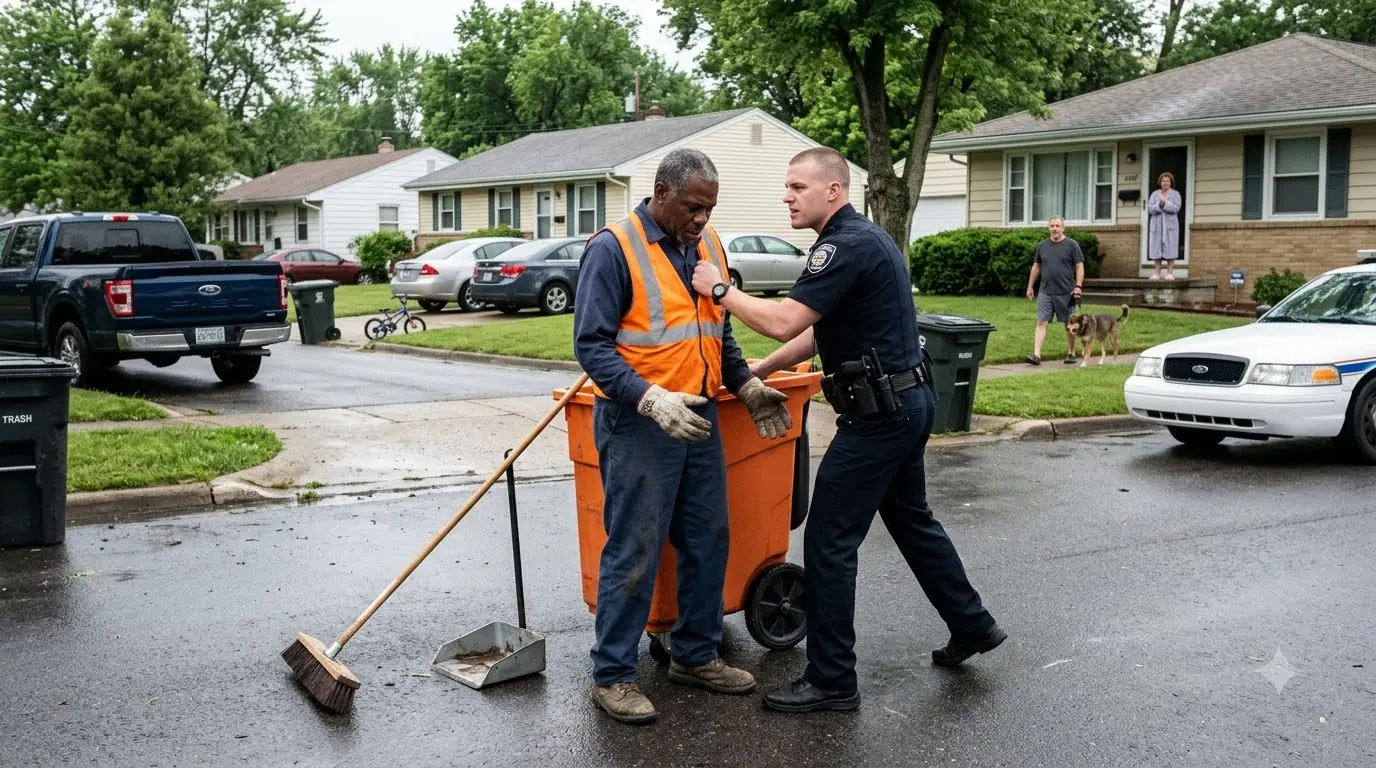
A man with a mop is usually invisible. But when Officer Bradley Jenkins looked at the new night shift janitor, he didn't see a ghost. He saw a target. Driven by deep-seated prejudice, Jenkins brutally humiliated the quiet, older black man, violently throwing him out of city hall into the freezing rain. Jenkins smirked, thinking he had asserted his dominance over a nobody.
He had absolutely no idea that the nobody bleeding on the pavement was the beloved older brother of the city's brand new mayor. The Oak Haven City Hall was a towering monument of limestone and polished marble, a building that demanded respect from anyone who walked through its heavy oak doors. By day, it was a hive of political maneuvering, ringing phones, and sharp-suited bureaucrats. By night it became a cavernous echoing mausoleum, disturbed only by the low hum of ventilation systems and the rhythmic squeak of rubber soles on freshly waxed floors. For Henry Hayes, the night shift was a sanctuary.
At 58 years old, Henry possessed a quiet, towering dignity. He was a man with broad shoulders, graying temples, and hands that told the story of a lifetime of grueling physical labor. For 30 years, Henry had worked the blast furnaces at the old Reynolds steel mill on the city's industrial east side. When the mill shuttered its doors, Henry hadn't complained. He simply tied his boots tighter, went out into the world, and found a way to make an honest living.
Now he wore the navy blue uniform of a municipal custodian, pushing a heavy Tennant floor scrubber down the long historic corridors of city hall. Henry took immense pride in his work. He wasn't just cleaning a building. He was maintaining the seat of his city's government. But there was a deeper, intensely private reason for the meticulous care he took in buffing every smudge off the brass fixtures.
Two months ago, the city of Oak Haven had elected a new mayor, a dynamic, brilliant 42-year-old former civil rights attorney named David Hayes. David was Henry's younger brother. No one in the building knew this. Henry had deliberately kept his identity a secret. When David had secured the mayoral office in a historic landslide victory, his first act had been to offer Henry a comfortable administrative position, a desk job with a hefty salary.
Henry had flatly refused. He didn't want anyone whispering about nepotism, and more importantly, he didn't want to be a distraction to David's groundbreaking administration. Instead, Henry had quietly applied for a night shift janitorial position through the city's standard portal, using his middle name on his application badge, A. Thomas Hayes. He just wanted to be near his brother's legacy, content to make sure the floors David walked on were shining.
But Henry's quiet existence was entirely disrupted by the presence of Officer Bradley Jenkins. Jenkins was 32, built like a linebacker, and carried himself with the bloated swagger of a man who believed a badge granted him absolute supremacy. He was a legacy cop, the son of a former deputy chief, and he wore his prejudices as openly as he wore his service weapon. Jenkins had a long whispered history of excessive force complaints, mostly from minority neighborhoods, but his union representative, a notoriously bulldoglike man named Tom Gallagher, had always managed to sweep them under the rug. From the first week Henry started on the night shift, Jenkins had made him a target.
It started with microaggressions. Jenkins would deliberately knock over a fresh cup of coffee near the security desk just as Henry finished mopping, offering a lazy, mocking smirk as he stepped over the puddle. "Clean it up, old man," Jenkins would say, his voice dripping with condescension. "That's what your kind is good for, right? " Following orders and sweeping up, Henry never reacted. He would simply retrieve his mop, his face, a mask of practiced stoicism, and clean the mess.
He had survived the overt racism of the 1970s, a peaked-in-high-school bully in a police uniform, wasn't going to break his spirit. Henry knew that reacting, losing his temper, would only give Jenkins the excuse he was so desperately searching for. Henry's restraint, however, only infuriated Jenkins more. To Jenkins, a black man who refused to cower, who maintained eye contact, and who carried himself with unwavering self-respect, was an intolerable affront to the natural order of things. The tension simmered for weeks.
Jenkins's partner, a young, impressionable rookie named Kyle Higgins, often looked away, too afraid of Jenkins's temper to intervene. Kyle would occasionally offer Henry a tight, apologetic smile when Jenkins wasn't looking, but apologies meant little in the face of complicit silence. The catalyst for the ultimate confrontation occurred on a bitter Tuesday evening in late November. The city was being battered by a freezing, sleet-filled storm that coated the streets in black ice. Inside city hall, the heating system struggled against the drafts.
Henry was assigned a special task that night. The head of facilities had left a work order for the third floor, the executive suite, which housed the mayor's private offices. A donor reception had taken place earlier in the evening, and the floors needed to be immaculate for a major press conference Mayor Hayes was hosting the following morning. Henry felt a swell of quiet pride as he keyed his security badge to access the third floor. He rarely got to clean David's personal floor.
As he stepped off the elevator, the plush carpets and mahogany-paneled walls stood in stark contrast to the linoleum of the lower levels. Henry immediately set to work, carefully gathering discarded champagne flutes and wiping down the heavy oak conference tables. He lingered for a moment outside the door marked office of the mayor, gently polishing the brass name plate that read David A. Hayes. A small warm smile touched Henry's lips.
Downstairs in the security rotunda, Officer Jenkins was reviewing the surveillance feeds. His eyes narrowed as he saw the feed for the third floor. He saw the older black man standing outside the mayor's office, lingering near the door. Jenkins's jaw tightened. He didn't care about work orders.
In his mind, Henry didn't belong on the executive floor. He belonged in the basement. "Higgins," Jenkins barked, pushing his chair back violently. "We've got a situation on floor three. The new janitor is snooping around the mayor's office.
Higgins looked up, confused. Henry, the supervisor said he was assigned up there tonight to clean up after the reception. I don't give a damn what the supervisor said. Jenkins snapped, adjusting his utility belt, his hand instinctively resting on his baton. I know his type.
He's probably looking for something to steal. I'm going up there to clear him out. You stay here and watch the monitors. Higgins swallowed hard, nodding nervously. Brad, take it easy.
All right. He's just an old guy. Jenkins didn't answer. He stalked toward the elevators, his eyes cold and devoid of empathy. The stage was set.
The halls were empty, and Jenkins was finally going to teach the old man a lesson in hierarchy. The third floor corridor was silent except for the soft swoosh of Henry's dusting cloth against the cherrywood wainscoting. The grandfather clock at the end of the hall ticked steadily, displaying 1:15 a.m. Outside the wind howled, rattling the heavy historic window panes and plastering freezing sleet against the glass. The sharp ding of the elevator shattered the quiet.
Henry didn't turn around immediately, assuming it was another night shift worker or a late-working aide, but the heavy aggressive thud of tactical boots against the hardwood floor made him pause. He turned slowly to see Officer Bradley Jenkins marching down the hallway, his posture rigid, his hand resting menacingly on the butt of his taser. What do you think you're doing up here? Jenkins's voice boomed down the corridor, harsh and echoing. Henry lowered his dusting cloth, turning to face the officer.