The Critical Days After Benny Returned to Charlie
 PART 2 — CURRENT CONDITION UPDATE
Charlie and Benny are now recovering together in a medical foster home after Benny underwent emergency surgery for an intestinal obstruction. Benny remains under close veterinary supervision, while Charlie is physically stable and gradually returning to his normal routine now that his younger brother is beside him again.
Their reunion at the shelter was carefully controlled.
Although Charlie clearly wanted to move closer, staff did not allow him to climb on Benny, press against the surgical area, or initiate rough play. Benny had only recently become stable enough to leave the clinic’s intensive monitoring area, and the incision across his abdomen required protection.
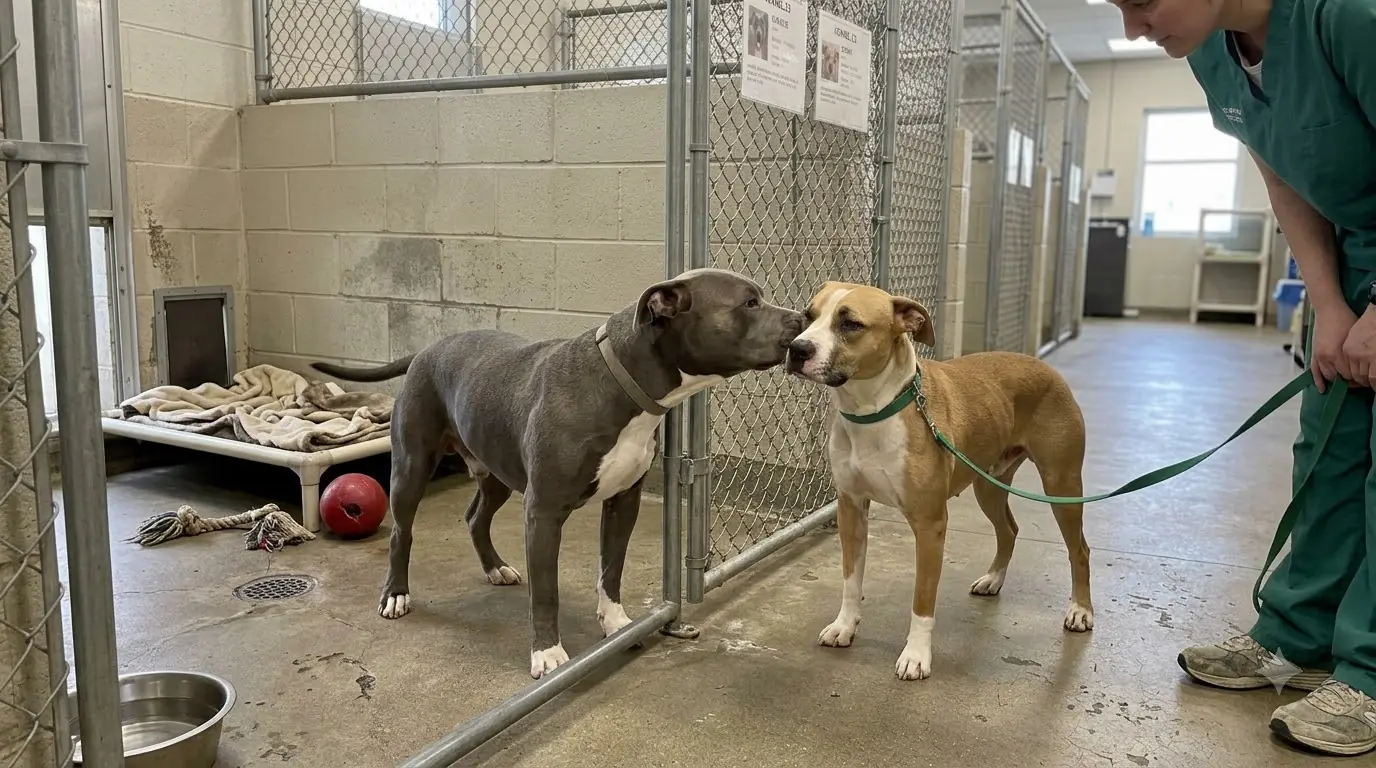
The brothers were first allowed to greet through a secure barrier. Charlie moved directly toward Benny, smelled his muzzle, and wagged from his shoulders to the base of his tail.
Benny was weaker. He stood for only a few seconds before lowering himself onto a padded blanket.
Charlie remained near him without barking or pawing at the divider. Once staff confirmed that both dogs were calm, they were moved into a larger recovery enclosure with supervised contact.
Charlie smelled Benny’s face, ears, neck, and legs. When he reached the recovery garment covering the incision, a caregiver quietly redirected him before he could investigate further.
Benny then rested his chin across Charlie’s front paw.
That was the position in which shelter staff later found them sleeping.
The reunion was emotionally important, but it did not change the seriousness of Benny’s medical condition.
Benny became ill shortly after arriving at the shelter. During intake, he appeared thin and anxious but alert. He ate his first meal, drank water, and stayed close to Charlie.
The following morning, staff noticed that part of the kennel blanket had been torn. No one saw either dog swallow the material, and both initially behaved normally.
Later that day, Benny refused food. He vomited a small amount of partially digested material and began repeatedly stretching with his chest close to the floor and his hindquarters raised.
That posture can have several meanings, but when it appears with vomiting and appetite loss, abdominal pain becomes a concern.
The medical team examined him immediately. Benny’s abdomen felt tense, and he reacted when pressure was applied near the middle portion.
His gums remained pink, and he was not yet in shock, but his heart rate was elevated. Staff moved him to the medical room for bloodwork and imaging.
Charlie became restless as soon as the kennel door closed behind his brother. He watched Benny leave but was not permitted to follow because the clinic needed a controlled environment for testing.
Benny’s first X-rays showed an unusual gas pattern inside the small intestine. Several loops appeared wider than expected, suggesting that food, fluid, and gas were not moving normally.
Fabric does not always appear clearly on ordinary X-rays. However, the shape and position of the intestines raised suspicion that something was blocking them.
An abdominal ultrasound provided more information. The veterinarian identified folded material inside the intestine and noticed that part of the bowel had gathered into an abnormal pattern.
This can happen when a long piece of fabric, string, rope, or another flexible object becomes anchored while the intestine continues trying to move around it.
The contractions can cause the bowel to bunch together. The foreign material may then cut into or damage the intestinal wall.
Benny needed surgery. Waiting to see whether the fabric would pass created too much risk because his pain was increasing and the affected intestine was already showing signs of impaired blood flow.
Before the operation, he received intravenous fluids, medication for pain and nausea, and antibiotics selected for the possibility of bacterial contamination.
His electrolytes were corrected carefully. Repeated vomiting and the movement of fluid into an obstructed intestine can disrupt sodium, potassium, chloride, and hydration.
Benny’s blood pressure and heart rhythm were monitored while the surgical team prepared.
During the procedure, the veterinarian found several pieces of cloth extending through part of the small intestine. The material was consistent with the damaged kennel blanket.
The fabric had not remained in one compact piece. It had stretched along the bowel, and normal intestinal contractions had pulled sections into tight folds.
Most of the material was removed through carefully placed openings. However, one portion of the intestine was dark, swollen, and no longer receiving enough blood.
Damaged intestine cannot always recover after the obstruction is removed. Leaving dead or severely compromised tissue inside the abdomen can lead to leakage, infection, and life-threatening inflammation.
The surgeon removed the affected section and joined the two healthy ends together. This procedure is called an intestinal resection and anastomosis.
The remaining bowel was examined for additional damage. No other area required removal, and no second object was found.
The abdominal cavity was flushed, and samples were collected because a tiny amount of contaminated fluid was present near the damaged section.
Benny’s incision was closed, and he was transferred to a warm recovery area with continuous monitoring.
The first several days after intestinal surgery are critical. The repaired bowel needs time to create a secure seal.
If the connection leaks, digestive contents and bacteria can escape into the abdomen. This may cause septic peritonitis, a severe infection that can lead to shock and organ failure.
Veterinary staff monitored Benny for increasing abdominal pain, fever, rapid heart rate, falling blood pressure, vomiting, weakness, pale gums, or changes in his bloodwork.
A small amount of discomfort was expected after surgery, but worsening pain rather than gradual improvement would have been concerning.
Benny remained quiet during his first night. He slept for short periods and changed positions only with assistance.
His blood pressure stayed within an acceptable range, and his temperature did not rise. Repeat laboratory tests showed inflammation but no clear evidence that the repair was leaking.
He received intravenous fluids adjusted according to his hydration, urine production, blood pressure, and electrolyte measurements.
Too little fluid could reduce circulation to healing tissue. Too much could create additional problems, so the rate was reassessed frequently rather than left unchanged.
Pain relief was provided on a schedule. The medical team did not wait for Benny to cry.
Dogs may show abdominal pain through a tense posture, rapid breathing, reluctance to move, facial tension, repeated repositioning, loss of appetite, or guarding when approached.
Benny’s medication plan aimed to keep him comfortable enough to rest and begin eating without making him excessively sedated.
Nausea control was also essential. Vomiting could increase discomfort and place strain on the healing gastrointestinal tract.
Several hours after surgery, Benny was offered a very small amount of an easily digestible veterinary diet. He smelled it but turned his head away.
The team did not force a large meal into him. His nausea medication was continued, and another small portion was offered later.
The following morning, Benny licked food from a spoon and swallowed several bites. This was a modest but encouraging sign.
Early controlled nutrition can support intestinal healing when a veterinarian determines that feeding is safe. The amount remained small so his digestive system would not be overwhelmed.
Benny gradually progressed to several tiny meals each day. Staff recorded how much he consumed, whether he vomited, and how his abdomen felt afterward.
He did not vomit again. His first bowel movement was small and soft, which was expected after fasting, surgery, medication, and a limited diet.
There was no visible blood, and he did not strain.
Cultures from the abdominal fluid did not show heavy bacterial growth. Antibiotics were continued according to the surgical team’s judgment and were not extended unnecessarily once the immediate risk had decreased.
Benny’s temperature, heart rate, appetite, and comfort continued moving in the right direction.
Even so, the veterinary team remained cautious. Dogs can appear brighter shortly before a complication becomes obvious, and outward improvement alone cannot confirm that an intestinal repair is secure.
Repeat ultrasound showed a small amount of postoperative fluid but no pocket suggesting active leakage. The bowel near the repaired area was mildly swollen, though movement through it had resumed.
Benny’s blood protein level fell after surgery. This can happen because of inflammation, fluid therapy, reduced intake, and loss through damaged intestinal tissue.
The level remained high enough that plasma support was not required. It began improving once Benny ate more consistently and the inflammation decreased.
His red blood cell count also fell slightly but stabilized. There was no evidence of continued internal bleeding.
By the time Benny returned to the shelter’s recovery area, he was eating small meals, keeping them down, urinating normally, and walking short distances with assistance.
He was not medically finished with recovery. He was simply stable enough to leave intensive care.
Charlie had undergone his own evaluation while Benny was hospitalized.
Because both dogs lived in the same kennel and had access to the torn blanket, staff needed to determine whether Charlie had swallowed fabric as well.
Charlie had not vomited, and his abdomen remained soft. He passed normal stool and showed no obvious pain during examination.
X-rays did not reveal an obstructive pattern. Ultrasound found no suspicious foreign material.
The medical team continued monitoring his appetite, bowel movements, energy, and abdominal comfort. A normal test at one moment cannot guarantee that every piece of soft material has been identified, so staff remained observant.
Charlie’s primary difficulty during those days was emotional and behavioral.
He stopped using the shared bed soon after Benny was moved. Instead, he lay directly against the kennel gate with his muzzle pointed toward the medical hallway.
Whenever wheels rolled across the floor or a collar jingled nearby, he stood and looked through the gate.
His food intake decreased. Charlie usually ate quickly beside Benny, even when two bowls were provided.
During the separation, he smelled the food and took several bites, then returned to the gate.
Staff first considered whether he might also be physically ill. His temperature, hydration, bloodwork, abdominal examination, and imaging remained reassuring.
Stress was considered only after medical causes had been investigated.
Dogs bonded to another animal may respond to separation with appetite changes, restlessness, vocalization, withdrawal, or increased attention to doors and sounds.
That does not prove Charlie understood Benny’s diagnosis or knew surgery was occurring. It shows that the sudden disappearance of his familiar companion disrupted the routine on which he relied.
Caregivers placed a blanket carrying Benny’s scent inside Charlie’s kennel. Charlie smelled it carefully and lay with his front paws touching the fabric, but he continued choosing the area beside the gate for sleep.
Staff spent quiet periods sitting outside the kennel. They avoided repeatedly exciting him with greetings or calling him away from the door.
One caregiver moved his bowl closer to the gate and sat sideways several feet away. Charlie ate part of the meal while remaining able to watch the hallway.
His intake improved slightly. When necessary, a more aromatic veterinary food was offered in measured portions.
No one tried to compensate by giving unlimited rich treats, which could have caused gastrointestinal problems and made it harder to monitor his health.
Charlie lost a small amount of weight during the separation but did not become dangerously thin or dehydrated.
His drinking remained normal. He urinated and passed stool without difficulty.
The shelter also introduced short walks away from the kennel. Charlie initially pulled back toward the building after only a few minutes.
His caregiver used the same route each time and returned before he became highly distressed. By the third day, he walked around the small yard, smelled several trees, and accepted food from the caregiver.
When they reentered the shelter, Charlie moved directly toward the medical hallway.
He could not be taken to Benny’s treatment area. Benny required infection control, rest, and medical procedures that would have been more difficult with another dog present.
Instead, the team exchanged small scent items when medically appropriate. A clean cloth was rubbed gently along Benny’s shoulders and placed near Charlie’s bed.
Charlie smelled the cloth for several seconds and carried it to the gate.
The staff did not claim that the scent explained Benny’s condition. It simply provided a familiar cue during the separation.
Once Benny became stable, the team considered whether reunion would support recovery or create additional risk.
Charlie’s behavior with his brother had always been gentle, but any dog can become excited after separation. A jump, paw, collision, or attempt to play could damage Benny’s incision.
The first meeting therefore occurred through a barrier, with two experienced handlers present.
Charlie’s body remained loose. His tail moved broadly, and he lowered his posture rather than jumping upward.
Benny approached slowly. His tail made several small movements, and he pressed his nose against Charlie’s muzzle through the divider.
Neither dog barked or displayed tension.
When direct contact was allowed, Charlie smelled Benny thoroughly. The scents of the hospital, medication, disinfectant, and surgical preparation were unfamiliar.
Some dogs react cautiously when a companion returns smelling different. Charlie paused, examined him, and then remained close.
He did not guard the bed, toys, water, or staff attention when Benny returned.
For the first night, the brothers slept inside a large recovery enclosure with a low divider separating part of the space.
The arrangement allowed them to see and smell one another while protecting Benny from accidental contact when staff were not directly supervising.
Charlie chose the side closest to the divider. Benny rested against the opposite side.
Later, when a caregiver checked the camera, both dogs were asleep with their backs aligned along the barrier.
The next day, supervised time together increased. Charlie remained calm, so the team allowed them to share a larger bed while a caregiver watched.
Benny turned twice before lying down. Charlie waited, then placed himself along Benny’s back without pressing against the abdomen.
That night, staff found them sleeping together again.
The familiar image was reassuring, but the medical team continued preventing unrestricted play.
Benny wore a soft recovery garment to cover the incision. A rigid plastic cone caused him to panic and move too abruptly, so the garment was selected once staff confirmed that it protected the area adequately.
The garment is removed several times daily for inspection. Caregivers check for redness, heat, swelling, discharge, odor, missing sutures, or separation of the skin edges.
Charlie is moved behind a gate during these checks. His presence can comfort Benny at other times, but the medical team needs enough space to examine the incision safely.
Benny receives medication according to a written schedule. His foster caregivers document every dose.
He is not given human pain relievers or leftover medication from another pet.
His meals remain smaller and more frequent than Charlie’s. The food is complete, digestible, and measured.
The family watches him for nausea, repeated swallowing, drooling, lip licking, abdominal tension, vomiting, diarrhea, or sudden loss of appetite.
Benny now approaches the kitchen when meals are prepared. He sometimes finishes too quickly, so the food is spread across a wide shallow dish.
A complex puzzle feeder is not used yet because the medical team wants him to eat without frustration or excessive movement.
Charlie eats several feet away. Although the brothers previously shared bowls, the foster family provides separate measured meals.
Sharing may appear affectionate, but it prevents caregivers from knowing exactly how much each dog ate. It can also create competition when one dog requires a medical diet or different portion.
The water arrangement has changed for similar reasons. Two large bowls are available in different areas.
The dogs may still drink from the same bowl by choice, but access does not depend on one shared resource.
Benny’s hydration remains good. His gums are moist, and he urinates regularly.
His stool has become more formed as the diet and intestinal movement normalize. There has been no persistent diarrhea or visible blood.
The foster family collects photographs and notes if an abnormal bowel movement occurs. This gives the veterinary team more useful information than a vague description.
Benny’s activity is strictly restricted while the abdominal wall and intestine heal.
He takes only short leash trips outside for elimination. He cannot run, jump onto furniture, climb stairs, wrestle with Charlie, or stand on his hind legs.
The home uses baby gates to block stairs. Nonslip rugs cover the main walking areas.
A low bed allows Benny to settle without climbing. The bedding is made from durable, closely monitored material because of his history of swallowing fabric.
Loose blankets, rope toys, socks, towels, and soft objects that can be torn are not left unattended.
This change applies to Charlie as well. Although no one saw which dog damaged the shelter blanket, Benny swallowed the pieces, and both lived in the same environment.
The foster family does not assume that only one dog will ever chew fabric.
Laundry is kept behind a closed door. Shoes and children’s items are stored out of reach.
Trash cans have secure lids, and no food packaging is left on counters where either dog might reach it.
Supervision and environmental management are more reliable than waiting to correct a dog after an object is already in his mouth.
Benny’s behavior around fabric is being evaluated carefully. He has not attempted to tear his recovery bed or garment.
He sometimes mouths the edge of a blanket when settling, so the caregiver redirects him to a safe rubber toy and removes the fabric when direct supervision ends.
Punishment is avoided. Shouting may cause a dog to swallow an object quickly to prevent it from being taken.
Instead, caregivers practice calm trading. Benny receives a high-value piece of his measured food when he releases an approved toy.
The goal is to make relinquishing an object safe and predictable.
Charlie participates in separate training sessions. He readily exchanges toys and does not show possessive behavior.
Both dogs learn cues such as “drop,” “leave it,” “wait,” and “place.” These skills support safety but do not replace keeping dangerous objects out of reach.
The exact reason Benny swallowed the blanket is unknown.
Dogs may consume fabric because of stress, boredom, habit, hunger, gastrointestinal discomfort, or the rewarding sensation of chewing and pulling.
Some swallow objects accidentally while shredding them. Others repeatedly seek nonfood materials.
The team will monitor whether Benny shows continued interest in fabric after recovering from surgery and adjusting to the foster home.
If the behavior persists, further medical and behavioral assessment may be required.
Benny was underweight at intake, which raised the possibility that hunger contributed to scavenging. His laboratory tests did not show diabetes or advanced organ disease.
A fecal test identified intestinal parasites common in dogs with inconsistent previous care. Both brothers received veterinarian-directed treatment because they shared an environment.
Follow-up testing will confirm that the parasites have cleared.
Nutrition is being increased gradually. Benny needs enough calories and protein to heal, but the veterinary team does not want rapid overeating or digestive upset.
His weight is checked weekly on the same scale. Early gains may partly reflect improved hydration, so body condition and muscle are evaluated alongside the number.
Charlie is near a healthy weight. His portions are designed to maintain rather than increase it.
Charlie’s physical examination found mild skin irritation, several small scars, and early arthritis in his hips.
He does not currently require intensive orthopedic treatment, but the family keeps him lean and provides regular controlled movement.
His nails were overgrown at intake. They were shortened gradually to improve traction without cutting sensitive tissue.
Both dogs were screened for heartworm disease and common tick-borne infections. Their results were negative, and preventive care has been started according to veterinary guidance.
Vaccinations are being updated based on medical status and previous records. Benny’s schedule was adjusted around surgery so his recovering body was not subjected to unnecessary procedures at the most vulnerable time.
Charlie has mild dental tartar but no painful fracture or active abscess. Benny has gum inflammation and one worn tooth that will be reassessed after his abdominal recovery.
Nonurgent dental procedures will wait until the surgical team considers anesthesia safe.
Benny’s incision check showed appropriate healing. The skin edges remain closed, and the surrounding tissue is not unusually hot or swollen.
A small firm ridge beneath the incision is consistent with normal healing, though it will continue to be monitored.
The deeper intestinal repair cannot be judged by looking at the skin. A clean external incision does not eliminate the possibility of an internal complication.
This is why appetite, comfort, temperature, stool, vomiting, and energy remain important.
At his first postoperative recheck, Benny’s abdomen was soft, and he tolerated gentle examination. His bloodwork showed improving inflammation and stable protein levels.
Ultrasound did not reveal abnormal free fluid or evidence of obstruction.
These findings were encouraging. The veterinarian still maintained activity restrictions because healing tissue remains vulnerable after a dog begins appearing normal.
One of the most difficult parts of recovery is preventing an energetic patient from doing too much as soon as he feels better.
Benny has started inviting Charlie to play. He lowers his front legs and moves his tail quickly, then attempts to bounce sideways.
The foster caregiver interrupts before Charlie responds. Benny is guided to his bed and given calm enrichment.
Charlie has adapted surprisingly well. He sometimes approaches with a toy but accepts redirection and lies nearby.
The brothers spend much of the day separated by a gate that permits visual contact. This arrangement prevents wrestling without recreating the complete separation that caused Charlie so much distress.
Short periods of direct contact occur when both are calm and a caregiver can supervise every movement.
The family does not rely on the idea that Charlie “knows Benny is injured.” Charlie may respond gently, but he cannot understand the strength of healing tissue or the consequences of one playful collision.
Physical management remains essential.
At night, their beds are positioned side by side with a secure barrier between them. Both dogs can smell and see each other.
Charlie initially slept against the barrier. Benny shifted until part of his back touched the opposite side.
As recovery progresses, the surgical team will decide when they can sleep together without separation.
Their emotional attachment is supported, but the foster family is also helping them tolerate short independent periods.
A close bond can be beneficial. It may reduce stress, encourage eating, and help dogs settle in an unfamiliar home.
However, severe distress whenever the other dog leaves can make medical care, walks, transportation, and ordinary daily life more difficult.
Charlie’s response during Benny’s hospitalization showed that independence training would be useful.
The training begins with very small separations. Charlie remains with a caregiver while Benny takes a brief bathroom trip.
At first, Charlie stood at the gate and stared after him. The caregiver scattered several pieces of food on a snuffle mat and waited.
Charlie ignored the food until Benny returned.
Later sessions lasted only seconds. The food activity began before Benny moved, and the same calm sequence happened each time.
Charlie has begun eating while his brother is outside. He still listens toward the door but no longer presses his entire body against the gate.
Benny practices the same skill when Charlie leaves for a walk. His response is less intense, although he watches the doorway.
The family avoids dramatic departures and excited reunions. The dogs learn that separation is temporary and predictable.
Charlie’s appetite returned quickly after Benny rejoined him. During their first meal near each other, both dogs ate from separate bowls on opposite sides of a barrier.
Charlie finished his portion and lay down facing Benny while the younger dog continued eating slowly.
He did not attempt to reach through the barrier or take Benny’s food.
His sleep has also improved. He no longer spends the entire night facing the hallway.
In the foster home, he chooses the bed closest to Benny and usually settles within several minutes after the lights are lowered.
During his first night there, Charlie became restless whenever the house made unfamiliar sounds. He walked between the front door and Benny’s recovery pen.
The caregiver sat on the floor without repeatedly calling him. Charlie eventually rested between her and the pen.
By the fourth night, he slept for several consecutive hours.
The foster home maintains a consistent routine. Meals, medication, bathroom trips, quiet enrichment, and bedtime happen at approximately the same times.
Predictability helps both dogs adjust after the abrupt changes of surrender, shelter intake, illness, surgery, and another move.
Little is known about their life before they entered the shelter.
They were brought in together by animal control after being found near a vacant property. No microchips were detected, and no owner came forward during the required holding period.
Their ages are estimates based on teeth, body development, and examination. Charlie appears to be about five, while Benny is believed to be roughly two years younger.
They may be biological brothers, or they may simply have lived together long enough to form a sibling-like bond. Without records or genetic testing, the exact relationship cannot be proven.
The shelter uses the term “brothers” because they arrived as a bonded pair and behaved like members of the same household.
Charlie often positions himself between Benny and unfamiliar sounds. Benny follows Charlie through doorways and looks toward him during handling.
Their attachment is observable even if its history remains unknown.
The rescue is currently planning for them to be adopted together.
That goal is based on their behavior and welfare, not only on an emotional story. They share space peacefully, recover from stress more quickly together, and have not shown conflict over food, toys, beds, or human attention.
Charlie’s distress during Benny’s medical separation adds weight to the plan, though it does not mean separate placement would be impossible under every circumstance.
The team will continue assessing them after Benny is fully recovered and both have spent more time outside the shelter.
Future adopters will need to understand that adopting a bonded pair involves more than providing two bowls and one bed.
Each dog needs individual veterinary care, training, identification, exercise, and attention.
Medical costs can occur at the same time or separately. Transportation must safely accommodate both dogs.
The home must also prevent fabric ingestion and other scavenging behavior. Leaving socks, towels, rope toys, or damaged bedding within reach could create another emergency.
Potential adopters will receive a detailed explanation of Benny’s surgery. Removing one obstruction does not prevent a future one.
Any repeated vomiting, refusal of food, painful abdomen, unusual stretching, severe lethargy, inability to pass stool, or attempts to vomit without producing anything require prompt veterinary attention.
Waiting several days could allow pressure and loss of blood supply to damage the intestine again.
The family will also need to continue independence training. Charlie and Benny should be able to attend separate veterinary appointments or take individual walks without extreme panic.
This will be developed gradually. The rescue will not attempt to “break” their bond by imposing long, unnecessary separations.
Their relationship is a source of safety. Training should add new sources of security rather than remove the one they already have.
Both dogs are affectionate with familiar caregivers. Charlie leans against legs and accepts slow chest rubs.
Benny is more playful and often offers a toy after several minutes of observation.
Neither dog has shown aggression toward adults in the foster home. Visitors are introduced calmly and are asked to ignore the dogs initially.
Charlie usually approaches first. Benny follows once he sees his brother relax.
Their history with young children is unknown. No assumptions will be made based only on breed, appearance, or friendly behavior with adults.
If a future home includes children, meetings must be supervised, and the children must be able to respect feeding areas, resting dogs, and boundaries.
The brothers have observed a calm dog through a secure fence. Charlie’s body remained loose, and Benny showed interest without lunging.
Direct introductions to other dogs will wait until Benny is medically cleared for normal activity.
Their history with cats is also unknown. A home with cats would require an appropriate assessment and careful management.
The recovery environment is intentionally quiet. Benny does not need frequent visitors while healing, and Charlie benefits from a predictable household.
The foster caregiver limits unnecessary handling. Medical tasks are grouped when possible so Benny can rest between them.
Benny has learned a simple chin-rest behavior. He places his chin on a folded towel while the caregiver checks his temperature or prepares medication.
The behavior gives him a familiar task and helps procedures feel more predictable.
If he lifts his head or moves away, the caregiver pauses whenever medically safe. Offering limited choice can reduce fear and preserve trust.
Charlie practices the same behavior during routine examinations. He learns that medical handling does not always mean being separated from his brother.
Neither dog is punished for fear, hesitation, or reluctance. Caregivers use secure equipment and calm guidance.
A well-fitted harness is used for walks. Identification remains attached whenever either dog leaves the house.
Doors and gates are secured with clips because two dogs moving together can push through an opening more easily than one.
The foster caregiver always confirms the location of both animals before opening an exterior door.
Benny’s next medical milestone will be a full postoperative examination and repeat abdominal imaging.
If the intestine continues healing normally, his meal frequency can gradually return to a standard schedule. His activity restrictions will be reduced in stages rather than removed all at once.
The first increase will involve slightly longer controlled walks. Running and wrestling will remain prohibited until the surgeon confirms that the abdominal wall and internal tissues are strong enough.
Rehabilitation may be recommended if Benny shows persistent weakness after weeks of restricted activity.
He has lost some muscle, but his current movement is balanced. He bears weight on all four legs and does not appear neurologically impaired.
Charlie’s walks are currently longer than Benny’s. An individual outing gives him exercise and supports separation training.
When Charlie returns, greetings happen through the gate until both dogs are calm. He is then allowed to enter the shared room under supervision.
Benny’s tail moves immediately, but he no longer attempts to jump against the barrier.
The brothers are learning that leaving does not always mean disappearing for days.
The rescue team remains cautiously optimistic about Benny’s prognosis.
The damaged intestinal section was removed, the remaining tissue appeared healthy, and he has shown no current evidence of leakage or severe infection.
He eats, drinks, passes stool, and rests comfortably.
The risk of postoperative complications decreases as healing progresses, but the team will not call the recovery complete until the scheduled rechecks are finished.
Charlie’s condition is stable. His mild arthritis and skin irritation are manageable, and his weight has returned to its intake level.
More importantly, he is sleeping away from the hallway again.
Recently, the foster caregiver moved Benny into the examination area for an incision check. Charlie watched him leave and walked to the gate.
He stood there for several seconds.
Then he turned, crossed the room, and picked up a food puzzle beside his bed.
Charlie continued listening toward the hallway, but he ate several pieces while Benny was gone. When his brother returned, he greeted him calmly instead of throwing his full body against the gate.
That small response did not mean he had stopped caring. It meant he was beginning to believe that departures could end in returns.
Benny’s recovery garment will soon be removed if the incision remains fully closed. The barriers will remain longer because internal healing continues beyond what can be seen on the skin.
Eventually, the brothers will be allowed to share a bed without protective separation. Their first play sessions will be brief, controlled, and held on nonslip ground.
Charlie will probably bring a toy. Benny will probably attempt the same sideways bounce that now earns immediate redirection.
Their caregivers will stop the session before excitement becomes rough.
Recovery is not defined by returning to every old habit at once. It is the careful rebuilding of ordinary life without sacrificing safety.
Charlie and Benny entered the shelter sharing one bed, several toys, and a single water bowl. Their closeness was obvious from the first day.
When illness removed Benny from the kennel, Charlie could not know where he had gone or why he did not return that night.
He waited at the gate because the hallway was the last place he had seen his brother.
Now the two dogs sleep in neighboring beds inside a warm foster room. Separate bowls allow caregivers to monitor them, secure toys protect Benny from another obstruction, and a barrier prevents one careless movement from damaging the healing incision.
The arrangement looks less simple than the kennel they once shared. It is also far safer.
Each evening, Charlie watches Benny finish his final small meal and receive his medication. Benny then walks to the bed closest to his brother.
Charlie circles once and lies down against the divider.
Some nights, Benny rests with his nose close to Charlie’s paw. Other nights, they sleep back-to-back with the barrier between them.
They are not yet allowed to curl together without supervision.
That day is getting closer.
For now, Benny’s intestine is healing, his appetite is returning, and his laboratory values continue improving. Charlie is eating normally, sleeping through the night, and learning that a closing door does not always take his brother away forever.
The kennel gate where he waited is behind them.
When Charlie lifts his head now, Benny is still there.