The Critical Hours After Ember Was Pulled from the Fire
PART 2 — CURRENT CONDITION UPDATE
Ember is now recovering in a medical foster home after receiving intensive treatment for smoke inhalation, thermal burns, eye irritation, carbon monoxide exposure, and severe emotional stress following the house fire.
She is breathing without supplemental oxygen, walking short distances, and eating full meals. However, her lungs, burned paw pads, and behavior continue to require close monitoring.
The fire occurred during the early morning hours. By the time emergency crews reached the property, flames had already spread through much of the small wood-framed home.
Neighbors could not confirm whether any people or animals remained inside. Firefighters entered once conditions allowed and completed a primary search.
No person was found inside the structure. The most heavily damaged rooms were checked again after the flames were controlled.
The crew believed the property was clear until one firefighter heard a sound while walking near the porch.
At first, the noise was almost impossible to distinguish from water dripping through burned boards. Then it came again—a short, strained whimper from beneath the structure.
Part of the porch had collapsed. Smoke continued drifting from the wet debris, and several boards remained unstable.
The firefighters could not simply pull the remaining wood apart without knowing exactly where the dog was positioned. A shifting board could have trapped or injured her further.
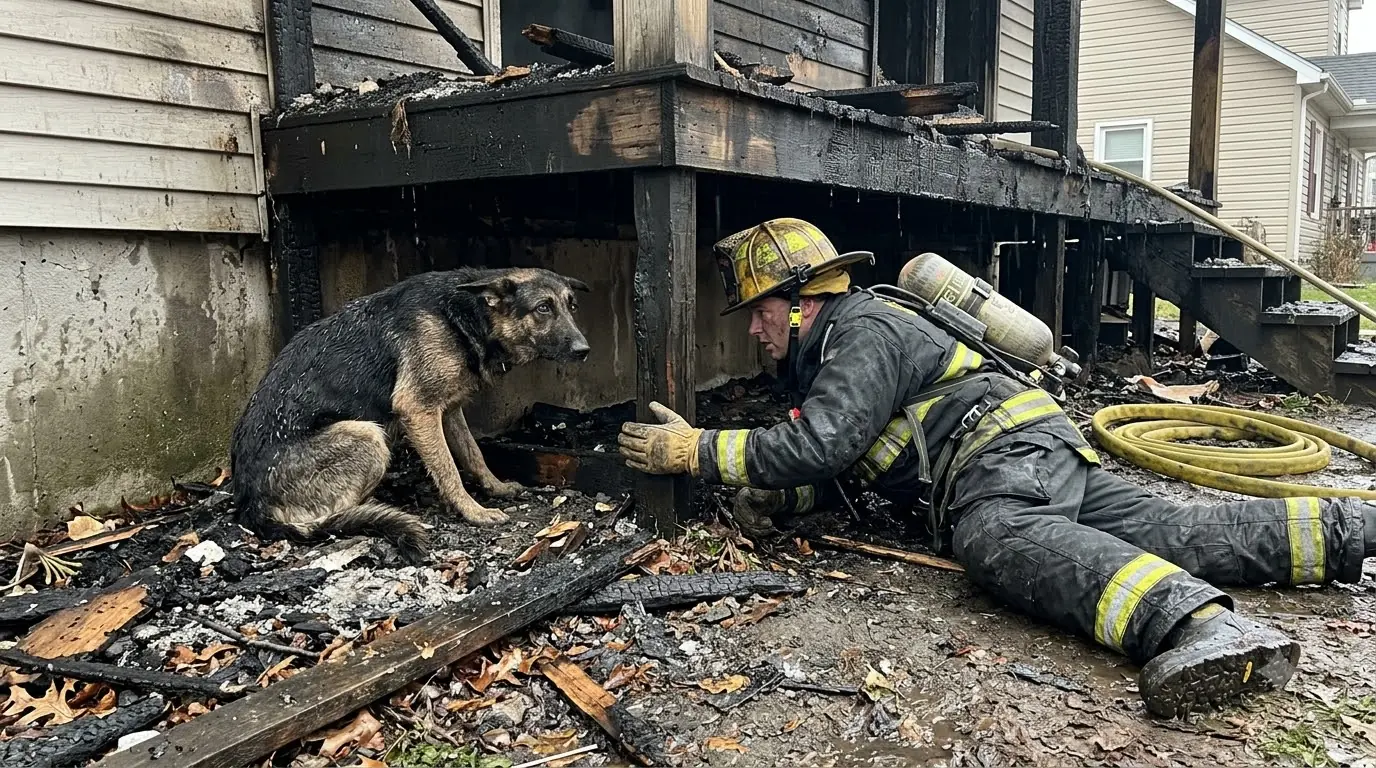
Daniel Hayes lowered himself near the opening and used a light to look beneath the porch.
He saw two eyes reflecting from a corner close to the foundation. Ember’s body was pressed flat against the dirt, and her coat blended with the soot-covered surroundings.
She did not move toward him when he called. Her breathing was fast, and each breath produced a faint rasp.
Daniel entered the narrow space wearing protective equipment. Another firefighter remained outside to monitor the structure and assist with extraction.
Ember attempted to move backward, but the foundation wall blocked her. Daniel stopped advancing and spoke in a low, steady voice.
The team could not wait for her to approach voluntarily. Smoke exposure, heat injury, and possible collapse made immediate removal necessary.
Daniel used a loop to secure her safely, then slid a protective sheet beneath her body. This prevented burned skin and paws from scraping across the debris.
Ember did not bite. She remained rigid until the firefighters moved her into the open air.
Once outside, she tried to stand but collapsed onto her chest.
Her gums and tongue appeared unusually dark red, and soot coated the fur around her muzzle. Black residue was visible inside her nostrils and along her gums.
A firefighter placed a canine oxygen mask over her face. Ember initially pulled away, then stopped resisting as the mask was held gently in place.
The crew contacted the nearest emergency veterinary hospital before transport so the medical team could prepare.
Ember traveled secured inside the rescue vehicle with oxygen continuing during the trip. She was not allowed to walk across the fire scene or jump into the vehicle.
At the hospital, the first priority was her airway and breathing.
Smoke inhalation can injure an animal in several ways. Heat may burn tissue in the mouth, throat, or upper airway. Soot and chemicals irritate the lungs. Carbon monoxide reduces the blood’s ability to carry oxygen.
House fires may also release toxic gases from burning plastics, insulation, furniture, cleaners, and construction materials.
A dog may appear awake while still having a dangerous lack of oxygen at the tissue level.
Ember’s respiratory rate was high, and she breathed with her mouth partly open. Her heart rate was also elevated.
The veterinary team placed her inside an oxygen-supported enclosure after performing a rapid initial assessment.
Her temperature was mildly elevated, but she was not dangerously overheated when she arrived. The cool ground beneath the porch may have protected her from more severe heat exposure.
Blood was collected immediately. A specialized test showed an elevated level of carboxyhemoglobin, meaning carbon monoxide had attached to part of her blood’s oxygen-carrying protein.
Ordinary pulse-oxygen equipment can be misleading in carbon monoxide exposure because it may not accurately distinguish healthy oxygenated blood from blood carrying carbon monoxide.
The team therefore interpreted the monitor alongside blood gas analysis, Ember’s appearance, breathing effort, and exposure history.
High-concentration oxygen was continued to help remove carbon monoxide from her bloodstream more quickly.
Her neurological status was also monitored. Carbon monoxide exposure can affect the brain, leading to confusion, weakness, seizures, collapse, or delayed neurological problems.
Ember appeared frightened and exhausted but remained responsive. She could track movement and react to touch.
She did not have a seizure during admission.
An intravenous catheter was placed so fluids and medication could be administered. Fluid therapy was calculated conservatively.
Ember needed support for circulation and dehydration, but excessive fluid could worsen swelling within injured lungs. Her rate was adjusted according to blood pressure, urine production, laboratory results, and repeated examinations.
Soot was gently removed from her mouth and nostrils. The team did not insert instruments deeply into the airway without adequate sedation and preparation.
Because smoke-related swelling can worsen, emergency airway equipment remained nearby.
The veterinarian examined Ember’s mouth for thermal damage. The tissues were irritated and coated with residue, but no severe full-thickness burn was visible in the throat during the initial assessment.
Her voice was weak, and she coughed when swallowing.
A more complete airway examination was performed once her oxygen status and stress level allowed. Sedation was selected carefully because suppressing breathing in a patient with damaged lungs creates additional risk.
The examination found swelling and inflammation in the upper airway. Soot extended beyond the visible mouth, confirming that Ember had inhaled smoke rather than merely being covered externally.
The team prepared for the possibility that swelling could obstruct airflow. A breathing tube would have been placed immediately if her airway narrowed critically.
At that stage, Ember continued moving air without intubation.
Her first chest X-rays showed only mild haziness. That result did not rule out serious injury.
Smoke inhalation damage can develop over several hours. The initial event injures the airway lining, and a later inflammatory response causes swelling, mucus, fluid leakage, and impaired oxygen exchange.
For this reason, Ember remained hospitalized even though she seemed slightly calmer after receiving oxygen.
Her burned paws were assessed after her breathing had been stabilized.
All four paw pads showed heat injury. The front paws were more severely affected, suggesting that Ember may have crossed a hot floor or burning debris before reaching the porch.
The outer layers of several pads were blistered and beginning to separate. Ash and fine debris adhered to the damaged surfaces.
She also had smaller burns along her lower abdomen and inside one hind leg. These areas may have contacted heated ground while she crawled.
The burns were cleaned with sterile fluid. Loose contamination was removed carefully without stripping away tissue that might still remain viable.
A veterinarian assessed the depth of each injury. Some areas were superficial, while others required time before the full extent could be determined.
Burned tissue can continue changing after the initial event. An area that looks moderately injured on the first day may declare itself as deeper damage over time.
Pain medication was given on a schedule. Staff did not wait for Ember to cry.
Dogs with burns may become still, refuse to move, pant, tremble, lick at an injury, or react when a person approaches. Ember’s quietness did not indicate that she was comfortable.
Her paws were covered with appropriate nonstick dressings. Each bandage was padded and secured without restricting circulation.
The toes remained visible when possible so staff could monitor swelling, warmth, and color.
Bandages were changed according to a medical schedule and sooner if they became wet or soiled. Moisture trapped against burned tissue can increase infection risk and damage surrounding skin.
Ember initially became highly distressed during dressing changes. She pulled her feet inward and attempted to hide her head beneath the towel.
The team coordinated pain medication and anxiety support before the procedure. Only necessary staff remained in the room, and supplies were prepared in advance to shorten handling time.
A technician supported Ember’s body while the veterinarian worked on one paw at a time.
No one punished her for pulling away. Her response was consistent with pain and fear.
Her eyes were red and partly closed at admission. Smoke, ash, and heat had irritated their surfaces.
The veterinary ophthalmic examination identified small corneal ulcers in both eyes. The left was more affected, but neither eye had ruptured.
The eyes were flushed thoroughly, and prescription medication was started to reduce pain and protect against infection.
Certain anti-inflammatory eye medications can delay healing or worsen an ulcer, so the treatment was chosen after the corneas were stained and examined.
Ember wore protective equipment when unsupervised to prevent rubbing. The medical team balanced this with her respiratory needs because some rigid cones can increase panic in a dog already struggling to breathe.
Her eyes were rechecked frequently. The ulcers began shrinking, and no deep infection developed.
Her vision remained functional. She followed movement and navigated the enclosure when allowed to stand.
Ember’s coat contained ash, soot, and fire-scene water. A complete bath was not performed immediately because her breathing and temperature needed priority.
Staff first cleaned the most contaminated areas with warm damp cloths while preserving body heat.
Once she was stable enough, the remaining residue was removed in stages with a veterinary cleansing product. Harsh household detergents or solvents were not used.
Her coat smelled of smoke even after the visible soot was gone. Odor trapped near the skin did not necessarily mean contamination remained inside her lungs, but it appeared to influence her behavior.
When a towel carrying the smoke odor was removed from the room, Ember’s body became slightly less tense.
The hospital used clean bedding and changed it frequently.
During the first day, Ember remained inside oxygen support and rested only for short periods.
She coughed intermittently and swallowed mucus. Her breathing rate decreased briefly, then increased again when she moved.
Food was not forced. Breathing and swallowing require coordination, and a patient working hard to breathe may aspirate food or liquid.
Medication for nausea was provided. Her mouth and throat were painful, so hard dry food was inappropriate.
A small portion of softened veterinary food was offered once the team believed swallowing could occur safely.
Ember smelled it but did not eat.
Several hours later, she licked a small amount from a shallow dish. Staff observed closely for coughing during and after the meal.
She kept the food down.
That night, Ember’s breathing became faster. Her nostrils widened with each breath, and her abdomen began contributing more visibly to the effort.
Her oxygen level declined despite the support she was already receiving.
Repeat chest imaging showed more extensive cloudy areas than the first X-rays. Fluid and inflammatory material had developed inside the lungs.
This progression was consistent with inhalation injury. The medical team could not assume that antibiotics alone would reverse it because much of the early damage was inflammatory and chemical.
Oxygen, airway care, fluid management, pain control, rest, and continuous monitoring remained essential.
The team increased the oxygen concentration and prepared for intubation. Ember’s blood gas results were repeated.
Mechanical ventilation was discussed with the rescue coordinator. If Ember became too tired to breathe effectively or could not maintain oxygen, a ventilator might have been her only chance.
Ventilation would require heavy sedation, a breathing tube, intensive nursing, and acceptance of significant medical risk.
The rescue authorized the procedure if it became necessary.
Ember remained close to that threshold through the night.
She rested on her chest with her neck extended. A technician watched continuously for reduced awareness, worsening effort, abnormal gum color, or exhaustion.
Her position was changed gently when tolerated to prevent prolonged pressure on one lung region and protect her burned abdomen.
Nebulization was introduced to humidify the airways and help loosen thick secretions. Gentle chest physiotherapy followed when her condition allowed.
The treatment was brief and controlled. Forceful handling would have increased pain and oxygen demand.
Ember coughed up dark mucus after one session. The material contained soot but no significant fresh blood.
Airway samples were collected for evaluation. The team wanted to identify bacterial infection without assuming every change was caused by one organism.
Smoke inhalation damages the normal clearing mechanisms of the respiratory tract. This can allow bacteria to establish a secondary infection.
Ember’s white blood cell count increased, and she developed a fever during the second day. The combination of clinical signs, imaging, and sample results supported antibiotic treatment.
Medication was selected based on likely organisms and later refined using culture results.
Her temperature, blood pressure, heart rhythm, oxygen requirements, and urine output were monitored closely.
Burns and lung injury can affect the entire body. The team watched for kidney problems, abnormal clotting, infection, gastrointestinal injury, and changes in blood protein.
Her kidney and liver values remained within acceptable ranges during the most critical period.
Her blood protein decreased moderately, likely because of inflammation, fluid shifts, and burn-related losses. The level did not fall low enough to require plasma support.
Nutrition became increasingly important. Healing burns and fighting infection require energy and protein, but Ember still could not eat a normal meal.
Small portions were offered frequently. Softened food reduced discomfort in her throat.
She accepted only a few bites at a time.
The team considered feeding-tube support if her intake remained inadequate. A tube can provide controlled nutrition without forcing repeated meals into a stressed patient.
Before placing one, the veterinarian assessed the safest route given Ember’s airway swelling and lung disease.
Ember began eating enough small portions to postpone tube placement. Her daily calorie intake was calculated rather than estimated from whether the bowl looked partly empty.
Water was also managed carefully. She had access when safe, but staff prevented frantic drinking because coughing and poor coordination could lead to aspiration.
Hydration was maintained through the treatment plan until she could drink normally.
On the second afternoon, Daniel arrived at the hospital.
The visit had been approved only because Ember’s condition appeared stable enough for a few quiet minutes. He changed out of fire-scene clothing and entered without boots or equipment that might frighten her.
Daniel spoke from outside the enclosure before the door opened.
Ember lifted her head immediately.
Whether she recognized his exact words could not be known, but her response to the voice was different from her response to ordinary hospital sounds.
Her ears moved forward, and she attempted to place her feet beneath her body.
A technician supported her because the bandaged paws and weakness made standing difficult.
Daniel sat on the floor beside the open enclosure. He did not call her repeatedly or pull her toward him.
Ember took two unsteady steps and pressed her head against his chest.
Daniel placed one hand along the side of her neck, avoiding the catheter, bandages, and monitoring wires.
For several seconds, Ember remained still.
Then her breathing effort increased. The monitor alarm sounded as her oxygen reading fell.
The team responded immediately. Daniel moved back without attempting to hold her in place.
Ember was returned to the oxygen enclosure and positioned comfortably. Her level improved after several minutes.
The episode did not mean the visit had harmed her lungs permanently. Standing, excitement, and movement had temporarily increased her oxygen demand beyond what the injured lungs could provide.
It demonstrated how little respiratory reserve she had.
Daniel ended the visit rather than asking for another moment. He remained outside the enclosure until Ember settled, then left quietly.
The medical team continued monitoring her for a sustained decline. None occurred.
That evening, Ember slept more deeply than she had since admission. Her respiratory rate remained elevated, but she stopped changing positions every few minutes.
By the following morning, her oxygen requirement had stabilized.
The team did not know whether the visit affected her emotional state, and they did not claim that recognition cured her. Her improvement resulted from intensive medical treatment and her body’s response.
Still, familiar calm contact may have helped her settle during an extremely frightening hospitalization.
Over the next two days, Ember’s lung sounds gradually improved. Her fever resolved, and the amount of dark airway discharge decreased.
Her oxygen concentration was reduced in small steps.
Each change was followed by observation. The team did not remove support entirely just because she appeared brighter.
Ember first tolerated several minutes in ordinary room air during a bandage change. Her oxygen level dipped mildly when she became anxious but recovered without escalation.
Later trials occurred while she rested.
Eventually, she remained outside the oxygen enclosure for several hours. She breathed with her mouth closed and no longer extended her neck continuously.
Her resting respiratory rate remained above that of a completely healthy dog, but the trend was downward.
Repeat chest X-rays continued showing abnormalities. Imaging often lags behind visible improvement.
The team based discharge planning on the complete picture: oxygen stability, breathing effort, appetite, temperature, mobility, medication tolerance, and the ability to rest safely outside intensive support.
Ember stayed hospitalized until she could maintain oxygen in room air, eat enough calories, take oral medication, and complete short bathroom trips without respiratory distress.
Her first steps were difficult.
All four paws were bandaged, and pressure on the front feet remained painful. A support sling helped distribute her weight.
The staff selected a clean nonslip surface. Ember moved slowly and placed each foot carefully.
She urinated after several minutes and immediately looked toward the hospital door.
The trip ended there. She was not forced to walk farther for exercise.
Her paw burns required repeated evaluation. Some superficial tissue healed quickly, while deeper portions of two pads separated and needed conservative removal.
No toe required amputation. The underlying tissue remained viable.
The veterinarian used dressings designed to protect the wound surface and support healing without adhering painfully.
Penny—correction: Ember’s bandage schedule was written clearly for every caregiver so no dressing remained unchanged too long.
As healing progressed, the amount and type of padding changed. A bandage appropriate during heavy drainage may not be suitable once the surface becomes drier.
Her abdominal burns remained superficial. The hair in those areas was clipped so the skin could be examined and treated.
The lesions stayed clean and did not require surgical reconstruction.
The rescue arranged a medical foster home experienced with burn recovery and anxious dogs.
Before Ember left the hospital, the foster caregiver attended a bandage lesson. She learned how to keep dressings dry, recognize slipping or swelling, and protect them during brief outdoor trips.
Waterproof coverings are used only outside and removed immediately afterward. Leaving a waterproof layer on indoors would trap moisture.
The caregiver also learned emergency respiratory signs. These include open-mouth breathing at rest, blue or gray gums, collapse, severe weakness, continuous coughing, inability to lie down, exaggerated abdominal effort, or a rapidly rising sleeping respiratory rate.
Written instructions and emergency contact numbers remain beside Ember’s medication chart.
Transportation to the foster home was planned around her breathing and burns.
Ember traveled inside a large secured crate with thick clean padding. The vehicle remained cool and quiet.
She was lifted using a supportive stretcher rather than asked to jump.
A backup oxygen source accompanied her on veterinary advice, though she did not need it during the trip.
At the foster home, the crate was carried into a prepared room before being opened.
Ember stayed inside for nearly two hours.
Her caregiver sat several feet away and avoided staring. Food, water, and a low bed were placed within easy reach.
When Ember emerged, she walked directly to the far wall and lay down facing the door.
The caregiver did not pull her toward the bed. A clean blanket was placed where she had chosen to rest.
That first night, Ember woke whenever the heating system started or a vehicle passed outside.
The smells and sounds of the home were unfamiliar. She also appeared alarmed by the click of the gas stove, so the kitchen was kept inaccessible and alternative appliances were used temporarily.
Her safe room contains no fireplace, candles, smoke-producing devices, or strong fragrances.
The smoke alarms remain functional. Their safety cannot be sacrificed to avoid noise.
Instead, Ember’s behavioral plan will eventually include carefully controlled exposure to recorded alarm sounds at a volume low enough not to trigger panic.
An actual alarm is not used for training because it must remain associated with emergency response for the human household.
Ember’s bed has a supportive base and clean washable covering. It sits away from heating vents and direct sunlight.
The room remains comfortably cool because respiratory patients and German Shepherd mixes can overheat during stress.
A baby gate allows Ember to see the caregiver without being approached constantly.
During the first several days, she ate only when the caregiver sat outside the gate.
Her meals were softened to protect her healing throat and divided into smaller portions.
Medication was hidden in a small amount of food offered before the main bowl. This allowed the caregiver to confirm that every dose had been swallowed.
Antibiotics were continued according to culture results. The course was not shortened when her cough improved.
Pain medication supported both her burns and her ability to move. Another medication reduced anxiety during bandage changes and veterinary transport.
No human pain medicine was given. Common household drugs can be toxic to dogs or interact dangerously with veterinary prescriptions.
Ember’s water remained freely available. Her caregiver observed drinking because rapid gulping initially caused coughing.
A wide shallow bowl encouraged a slower posture. If she drank too quickly, the caregiver offered smaller refills more often without limiting her total access.
Her appetite improved during the first foster week. She began waiting near the gate when food was prepared.
By the sixth day, she finished every measured meal.
Her weight had decreased during hospitalization, partly because of illness and reduced intake. She also appeared to have been slightly underweight before the fire.
Her ribs were easier to feel than expected, and muscle along the spine was limited.
The medical team planned gradual weight restoration. Excessive calories could create digestive upset and add strain before her activity returned.
Protein and energy needs were reviewed according to her burn healing, respiratory recovery, age, and body condition.
Treats used for handling exercises came from a measured daily allowance.
Ember’s bandage changes continued at the clinic.
The first foster recheck required medication before travel. Ember trembled when she saw the crate and resisted entering.
The caregiver had practiced feeding her near the open crate without closing it. Even so, the association with hospitalization remained strong.
No one pushed her headfirst through the door. A trail of food, a secure harness, and calm guidance helped her enter.
At the clinic, staff placed her directly in a quiet examination room rather than making her wait near barking dogs.
The same technician who cared for her during hospitalization performed much of the procedure.
Ember remained tense but accepted food between steps. Her paws showed healthy tissue growth and no spreading infection.
The dressings were becoming smaller. Two paws no longer required full bandages and were protected with lighter coverings during activity.
The deeper front-pad injuries needed additional time.
Her caregiver prevents licking with a recovery collar selected to minimize respiratory stress. The device is removed only during direct supervision.
Ember’s eyes healed faster than her paws. Repeat staining showed that both corneal ulcers had closed.
The surface remained mildly irritated, so lubrication continued temporarily.
She no longer squinted or rubbed her face. Her vision appears normal.
Her lungs required repeat imaging and bloodwork.
The first follow-up chest X-rays showed reduced but persistent inflammation. Her white blood cell count had moved toward normal.
The veterinarian listened to her breathing at rest and after a short controlled walk. No severe crackling sounds remained, though airflow was still harsher than normal in one area.
Ember’s sleeping respiratory rate is recorded every night. The caregiver counts for a full minute while she is deeply asleep.
The number has gradually decreased and remains within the range established by the medical team.
A single elevated count after a nightmare or sudden sound is noted but not interpreted alone. A sustained upward trend, especially with effort or coughing, would require evaluation.
Ember still coughs occasionally after drinking or rising. The cough is brief and becoming less frequent.
She has no fever, nasal discharge, or loss of appetite.
The team expects continued improvement, but smoke injury can leave some animals with airway sensitivity or scarring.
If Ember develops a persistent cough, exercise intolerance, repeated pneumonia, or abnormal imaging, additional diagnostics may be needed.
These could include advanced chest imaging, airway sampling, or evaluation for chronic inflammatory airway disease.
Her heart was also reassessed. The initial high rate had been linked to pain, fear, oxygen deprivation, and carbon monoxide exposure.
An electrocardiogram did not identify a sustained dangerous rhythm. Her heart rate normalized as her oxygen status improved.
There is no current evidence of permanent heart damage, though future changes would be investigated.
Neurological monitoring continues because severe carbon monoxide exposure can occasionally cause delayed signs.
The foster caregiver watches for confusion, seizures, unusual circling, sudden vision changes, weakness, loss of coordination, or dramatic personality shifts.
Ember has shown none of these problems.
She learns simple routines, recognizes familiar people, follows visual movement, and navigates the home without disorientation.
Her behavior around smoke-related cues remains the more significant concern.
During her first week, the smell of food browning in the kitchen caused Ember to leave her bed and hide behind a chair.
Nothing was burning, but the odor may have resembled part of the fire experience.
The caregiver turned off the appliance, ventilated the room, and allowed Ember to remain at a distance.
She did not carry the dog toward the kitchen to prove it was safe.
Later behavior work began with neutral kitchen activity that produced no heat or odor. Ember received food for resting calmly while the caregiver moved through the room.
Cooking smells will be introduced only gradually and with professional guidance.
The sound of crackling plastic from a food package also caused a startle response. Ember lowered her body, then recovered within several minutes.
Her reactions are documented so the team can identify patterns instead of assuming every fearful moment comes from the fire.
Ember may also have experienced fear and instability before the incident. Her complete history remains unclear.
Property records indicated that the damaged house had been vacant during part of the previous month, but neighbors occasionally saw a dog in the yard.
No person came forward with verified ownership during the required legal period.
The rescue followed local procedures for found animals. Ember was scanned for a microchip twice, including across areas where a chip might have migrated.
No chip was detected.
Public notices were posted while withholding some identifying details. Anyone claiming her would have needed to provide reliable proof and participate in the required investigation.
No valid claim was received.
Authorities continued examining the cause of the fire and the circumstances surrounding the property. The rescue did not speculate publicly about whether Ember had been abandoned, trapped accidentally, or living there with someone before the fire.
Those questions remained separate from her immediate care.
No evidence supported inventing a dramatic story about a person intentionally leaving her in the flames.
What could be documented was that Ember was alone beneath the porch when firefighters heard her.
Her emotional recovery is based on her observed behavior, not an assumed history.
She forms connections cautiously. Daniel’s visit demonstrated that his voice had become meaningful to her, but she did not immediately trust every person in similar clothing.
When another firefighter visited in a clean uniform, Ember remained behind the foster caregiver and watched.
The visitor sat sideways and placed his helmet on the floor several feet away.
Ember smelled the air but did not approach. No one forced the interaction.
During a later visit without the uniform, she entered the room and smelled his shoes.
The rescue treats both responses as valid.
Daniel has continued visiting at intervals approved by Ember’s medical and behavioral teams.
The second foster-home visit occurred after her breathing had stabilized. He entered quietly and sat on the floor.
Ember watched from her bed for nearly ten minutes. Then she stood, walked slowly across the nonslip rugs, and placed her head against his shoulder.
She remained there briefly before returning to her caregiver.
Daniel did not attempt to excite her or encourage standing longer than her paws could tolerate.
The visits are not used as publicity events. The room remains quiet, attendance is limited, and Ember can leave at any time.
Her bond with the foster caregiver has developed through daily routines.
The caregiver manages meals, medication, bandages, bathroom trips, and quiet enrichment. Ember initially associated approaching hands with painful procedures.
To prevent every interaction from predicting treatment, the caregiver spends time sitting nearby without asking for anything.
Sometimes she places food on the floor and looks away. Sometimes she reads while Ember sleeps.
Ember began choosing to lie closer.
One afternoon, she left the bed and settled beneath the caregiver’s desk. Her bandaged front paw rested lightly against the caregiver’s shoe.
The caregiver remained still until Ember moved away.
Cooperative-care training began when her pain decreased.
Ember learns to place her chin on a padded towel before a paw is examined. The behavior gives her a predictable starting position.
A hand moves toward the leg, pauses, and withdraws. Ember receives food for remaining relaxed.
Later, the caregiver touches the bandage briefly. Actual bandage removal remains a necessary medical procedure, but the smaller exercises reduce surprise.
If Ember lifts her chin, the caregiver pauses whenever medically safe.
This does not give the dog control over whether an infected burn receives treatment. It gives her control over the pace of nonurgent steps.
Ember’s mobility is improving.
During the early foster period, she took only short supported trips to a covered elimination area. Rough ground and moisture could damage healing pads.
Waterproof boot covers protected the bandages outdoors and were removed immediately afterward.
She now walks on clean grass for several minutes. Her gait remains careful, especially on the front paws.
A rehabilitation professional assessed her posture and muscle condition. No fracture or major ligament injury was found.
Exercises focus on maintaining strength without increasing pressure on the pads.
Ember practices slow weight shifts on a padded nonslip mat. She walks a short straight path and rests before fatigue alters her posture.
Running, jumping, stairs, and rough play remain prohibited.
She is not allowed to chase a ball simply because she appears excited. Burned paw tissue must become durable enough to tolerate ordinary movement first.
The caregiver examines the pads after every prescribed activity. Redness, bleeding, swelling, discharge, odor, or renewed limping is reported.
Ember’s nails were coated in soot but not severely damaged. They are kept at an appropriate length so they do not change how her feet contact the ground.
Her future walking surfaces will be considered carefully. Hot pavement could reinjure sensitive pads, and winter deicing chemicals may irritate them.
Boots may be introduced later, but only after proper fitting and gradual conditioning.
Ember’s enrichment currently relies on scent and low-movement activities.
Food is hidden beneath lightweight cups or inside folded towels. Every object is checked for sharp edges or loose pieces.
She works slowly and often looks toward the caregiver before making a choice.
A silent rubber toy has become her favorite. Squeaking toys initially caused her to retreat, possibly because the sound resembled an alarm or distressed animal.
The team removed them rather than repeatedly triggering her.
She carries the rubber toy from her bed to the kitchen and sometimes leaves it beside the caregiver.
The toy is rolled only a short distance across a rug. Ember walks after it instead of running.
Sessions end before her paws become sore.
She has not shown aggression over food, toys, beds, or handling. The team still respects warning signs.
A head turn, closed mouth, lowered posture, lip lick, tucked tail, visible eye white, freeze, or attempt to leave all communicate discomfort.
A dog does not need to growl before people give her space.
Visitors ignore Ember when they arrive. They do not reach over her head, block the doorway, or surround her bed.
She usually observes from behind the foster caregiver.
During the first visit from a woman carrying a large black bag, Ember retreated immediately. The bag’s shape may have resembled equipment from the rescue or simply been unfamiliar.
The visitor set it outside the room and sat down. Ember did not approach during that session.
On a later visit without the bag, Ember remained visible and accepted a piece of food tossed gently away from the visitor.
The food was thrown away rather than toward the person so Ember did not have to come closer than she wanted.
Her social progress is measured by recovery and choice, not by how many strangers can touch her.
Ember has observed one calm adult dog through a secure barrier.
She watched closely but displayed no barking or lunging. The other dog turned sideways and smelled the ground.
After several minutes, Ember also lowered her head and investigated the floor.
No direct greeting occurred because her burns and lungs still require protection.
When medically cleared, introductions will begin with a parallel walk at a comfortable distance.
Her history with cats and young children is unknown. The rescue will not describe her as universally safe based only on quiet behavior during illness.
Pain and weakness can suppress behavior. A stronger, more comfortable dog may respond differently.
Any adoption involving children or animals will require careful assessment and management.
Ember remains on medical hold. Several people expressed interest after hearing about the rescue, including members of the fire department.
Daniel has not made an immediate adoption promise. He understands that an emotional connection at the fire scene is not the same as a completed placement assessment.
His household, schedule, other responsibilities, and Ember’s long-term needs must all be considered.
The rescue appreciates his involvement but will choose a home based on Ember’s welfare rather than public pressure for a particular ending.
A suitable adopter must be prepared for respiratory monitoring, burn follow-up, gradual exercise, behavior support, and possible long-term sensitivity to smoke, alarms, or fire-related smells.
The home must have secure doors and gates. Ember may attempt to flee from sudden sounds.
A quiet neighborhood and predictable routine would benefit her. A home with frequent parties, fireworks, or uncontrolled outdoor access would be more difficult.
A securely fenced yard would be useful, but Ember should not be left outside alone.
Smoke from grills, fire pits, burn piles, cigarettes, or fireplaces may irritate her recovering lungs and trigger fear. Her future family should avoid exposing her to these environments.
Identification and microchip registration will be completed before adoption. A secure harness and backup connection are recommended during walks.
Her next medical milestone is another set of chest X-rays and bloodwork.
The team wants to see continued clearing of the lung inflammation and normalization of her white blood cell count.
Antibiotic decisions will be based on examination, imaging, laboratory results, culture information, and symptoms. Medication will not continue indefinitely without reassessment, but it will not stop early merely because Ember seems active.
Her paw pads will be evaluated for complete closure, tissue strength, and comfort during weight-bearing.
Even after the surface looks healed, the new tissue may remain sensitive. Activity will increase gradually.
If scar tissue limits movement or repeatedly breaks down, additional treatment may be required.
Her sleeping respiratory rate will continue to be recorded after medication ends. Recurrent cough, exercise intolerance, rapid breathing, fever, appetite loss, or nasal discharge would justify immediate veterinary contact.
Delayed neurological signs remain unlikely but are still part of the monitoring plan.
Emotionally, storms and emergency sounds may create setbacks.
During a recent thunderstorm, Ember woke when a loud crack shook the windows. She ran toward the corner beside her crate and began panting.
Her caregiver closed the curtains, turned on steady background sound, and sat nearby.
Ember did not accept food initially. She remained in the corner but kept the caregiver in view.
After the storm moved farther away, she approached and rested her head against the caregiver’s knee.
The next morning, she ate normally and completed her short walk.
The episode was documented. If storm fear remains severe, the veterinary behavior team may prescribe situational medication and develop a structured plan.
Ember will never be forced to endure a full-volume alarm recording or stand beside an open flame as a test of courage.
Recovery does not require reenacting the event that frightened her.
The goal is to help her feel safe during unavoidable household sounds and move away from danger with a trusted person.
A fire-safety plan has been created for the foster home. Ember’s crate and leash remain accessible near an exit.
A rescue alert sticker indicates that a dog is inside, though responders are never expected to risk human life based solely on a sticker.
The caregiver practices calm leash attachment and crate entry without activating alarms.
Emergency preparation protects Ember without turning every day into a reminder of the fire.
Her progress continues in small, observable ways.
She now sleeps on her side rather than remaining upright through the night. She enters the kitchen for meals and accepts medication without hiding afterward.
She walks across the room when Daniel visits, but she also returns willingly to the foster caregiver.
Her burned paws support her weight, her eyes are comfortable, and the cough that once followed every movement is now uncommon.
At her most recent recheck, Ember walked into the clinic on her own. She hesitated at the entrance and lowered her body when a metal door closed.
The technician waited. Ember looked toward her foster caregiver, accepted a piece of food, and continued into the examination room.
Her chest X-rays showed substantial improvement. Some residual changes remained, but there was no new area of pneumonia.
Her bloodwork was close to normal. The damaged paw tissue had been replaced by healthy healing surfaces, and only one front foot required a light protective dressing.
The veterinarian was cautiously pleased.
Ember is not yet medically cleared for unrestricted exercise or adoption. Her lungs need one more reassessment, and the pads must tolerate a gradual increase in activity.
Her behavior also needs continued observation outside the immediate recovery period.
No one knows whether she will always press her head against Daniel when she hears his voice. Dogs’ relationships change as their environments and needs change.
What can be said is that during the most frightening moment of her life, that voice came from the person crawling toward her through smoke and darkness.
Two days later, when she heard it again, Ember used the strength she had to move closer.
The effort temporarily exceeded what her injured lungs could manage. Daniel released her the moment the monitors sounded, and the medical team returned her to oxygen.
That response became part of her recovery too.
Trust did not mean holding on no matter what. It meant recognizing when she needed to breathe.
Ember survived because a firefighter stopped after the building had been cleared and listened to a sound beneath the porch.
She survived because another team prepared oxygen, because veterinary staff anticipated delayed lung injury, and because the rescue authorized care before the outcome was certain.
Her recovery continues because people change bandages, count breaths, measure food, keep appointments, respect fear, and do not mistake one emotional reunion for the end of the story.
The burned house no longer stands as it did that morning. The porch where Ember hid was removed during the investigation.
She will never return to that smoke-covered corner.
Most nights now, Ember sleeps on a clean bed beside her foster caregiver’s desk. Her silent rubber toy rests between her front paws.
When a truck passes or the heating system starts, she sometimes lifts her head.
Then she looks toward the person sitting nearby, lowers her muzzle onto the blanket, and breathes without oxygen, smoke, or flames between them.