The village of Ashkam had not seen a duke in living memory, and it did not quite know what to do with one.
It had managed admirably over the years with second sons, with the occasional baronet, with a colonel who had returned from the peninsula with one arm and excellent manners. But a duke, with his title and his carriage, and his three outriders, who looked as though they had never once been surprised by anything, was a different matter entirely.
The village watched him arrive on a Tuesday in October and talked of nothing else until Thursday when Mrs. Hartwell's chimney caught fire and gave them something more immediate to discuss. By Friday, however, they were back to the Duke.
His name was Edmund Ashford, and he was the fifth Duke of Caendale, and he had come to Ashkam for reasons that were, depending on who you asked, either perfectly sensible or deeply suspicious. He had a small property here, nothing grand, a manor house with 20 rooms and good farmland, and a name nobody in London would have recognized, and he had chosen it, so his solicitor, Mr. Payne, had explained to the relevant parties as the location for his marriage.
The relevant parties were the family of Miss Cesily Halt. Mr. Payne had presented himself at Holt House on a Thursday morning in September, asked for Mrs. Halt and explained with the careful precise diction of a man who understood that what he was saying was unusual and intended to convey it without appearing to that his grace the Duke of Caendale wished to propose terms of marriage to Miss Halt, eldest daughter of the late Reverend Halt, and that the settlement proposed was set out in the documents he had taken the liberty of bringing with him.
Mrs. Halt had needed to sit down. Cesily had not needed to sit down. She had read the settlement twice, asked three questions about the jointure, about the covenant proposed for her mother and sister, about the legal standing of the latter, which Mr. Payne confirmed was unusual, but binding, and said she would give her answer in the morning.
Her answer in the morning was yes. She had not said yes because she was in love with the Duke. She had met him twice, once the previous spring at the home of their mutual acquaintance, Lady Foresight, where they had been properly introduced, and subsequently talked for 20 minutes about the political situation.
He had asked her view on the parliamentary reform question with the directness of a man who expected an actual answer, and she had given him one, and he had disagreed with two thirds of it with equal directness, and she had found this so unexpectedly pleasant that she had forgotten to be strategic about the impression she was making.
The second time was at a county dinner where he had sat beside her and said almost nothing, but had listened to everything with the quality of attention that some people spend their whole lives performing, and he appeared simply to have. She had found him striking in the way that very contained people are striking.
You could not tell looking at him what was happening underneath, and that either intrigued you or unnerved you. It had intrigued Cesily, which she recognized even then as information about herself. She had said yes because the settlement was just, because her mother would stop lying awake at night, because the Duke had not seemed in either of their meetings like a man who would make her miserable, and because, if she was honest, and Cesily was relentlessly honest with herself, she was tired of managing alone. 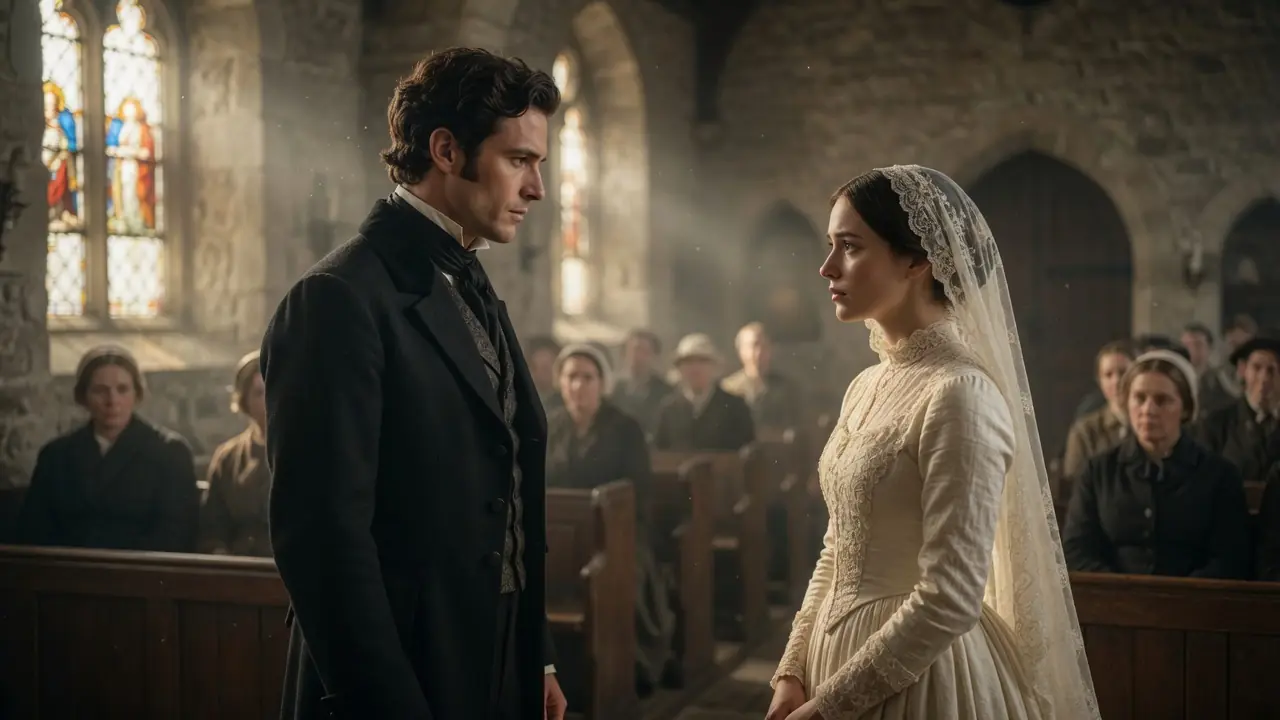
She had not told anyone that last part. It was not the sort of thing she said. The wedding was quiet in the church at the top of Ashkam's single significant street on a morning in November when the light came in low and pale through the east window and made everything look like an engraving.
Jane cried. Their mother held herself together with the particular rigidity of a woman who would cry later in private with great thoroughness. Edmund Ashford stood at the altar with the stillness of a man who had stood at attention in more demanding situations than this, and said his vows in a clear, even voice that carried to the back pews.
Cesily said hers and meant them, which he had decided beforehand was the only dignified way to approach the matter. The breakfast afterward was at Holt House, too small for the occasion, and full of neighbors who kept asking the Duke questions about London that he answered with minimum words and maximum courtesy.
Cesily watched him from across the room and noticed that he was not uncomfortable precisely. He simply existed at a slight remove from everything, as though there were a pane of glass between him and the proceedings that he had installed himself and was not yet sure how to remove.
She was standing at the bookcase, not reading, only standing the way she always did when she needed somewhere to be, when he crossed the room to her. She had a volume of Hannah More's "Coelebs in Search of a Wife" in her hand, which she had picked up without thinking, and which she now felt the slight absurdity of holding on her wedding day.
"I believe I have read that," he said without preamble. "It is not very good," she said. "No."
He looked at it briefly. "More is better when she is arguing than when she is instructing." "That is true of most people," Cesily said.
He almost smiled. She cataloged this immediately because it seemed like the kind of thing worth cataloging, a slight compression at one corner of his mouth, gone before it fully arrived. They found a corner of the room that was not occupied by neighbors or her mother's hospitality, and he spoke with the same directness he had applied to the parliamentary question at Lady Foresight's.
No preamble, no softening. The marriage was, he said, a practical arrangement. He needed a wife who was not ornamental, who could manage an estate, who would not require him to perform emotions he did not have time for.
He had obligations that were significant and constant, and would frequently take precedence. He would not pretend otherwise. Cesily let him finish.
She had the discipline trained by years of reading arguments she disagreed with, to let a thing be fully said before responding to it. And in return, she asked, "The settlement, security for your family, the covenant is binding. I want you to be certain of that. Access to the Caendale library, which is considerable."
A brief pause. "And I will not interfere with your thinking." "You say that as though it is a concession," she said.
"Some men would consider it one." "Then I am glad I am not marrying some men."
He nodded once. The manner of a man who has reached a conclusion. And then because she was Cesily and she had been carrying the question since Mr. Payne's visit, she asked it.
There is the matter of succession, she said. It was not comfortable to say, and she said it anyway, because discomfort was not a reason to avoid precision.
He met this without flinching. It is a consideration. I will not pretend otherwise.
He looked at her steadily. I will not, however, reduce this marriage to that consideration. What happens between us will be, I hope, a matter of time and mutual accord, not obligation.
It was more honestly said than she had expected. She filed it accordingly. You could have married someone with connections, she said.
Someone useful to your position. Yes. Why didn't you?
He was quiet long enough that she thought he might not answer. Then because I needed someone who would not mistake the arrangement for something it isn't.
She understood, or she thought she did. She carried that understanding into the carriage and into the marriage and into Caendale, where she arranged her books on a shelf in the sitting room she claimed as her own.
She placed her copy of Wollstonecraft's "Vindication" at eye level, her private reading, not for drawing rooms, but hers, and told herself she knew exactly where she stood. She was wrong, but she would not know that for some time.
Caendale Manor sat at the end of a long elm-lined drive that made it look more impressive on arrival than it perhaps warranted and rather more melancholy in November than it likely appeared in June. It was a house that had been well-managed and not in some time much loved.
Cesily could see that within the first hour. The rooms were clean and correct and had the quality of spaces arranged for function rather than habitation. Good portraits, cold fireplaces, and a housekeeper, Mrs. Webb, who showed her around with the weariness of a woman not yet sure whether to be relieved or threatened by the new duchess.
Cesily thanked her with enough specificity that Mrs. Webb departed slightly less weary. Edmund showed her the library himself, which he had not expected.
It was on the ground floor, south-facing, and in the low November light, it had a warmth the rest of the house did not. Two walls of shelves from floor to ceiling, a reading desk by the window, a fireplace that had been recently cleaned.
"It was my father's," he said from the doorway. He did not come in. 
He used it considerably more than I have. What did he read? History, law, agricultural improvement, a pause.
He was not a man who read for pleasure. Are you? He looked at the shelves.
I used to be. She wanted to ask what had changed. She did not because it was their first day in the house.
He nodded and left, and she stood alone in the library in the fading afternoon light. She chose a shelf for her own books and unpacked them that evening, placing the Wollstonecraft at eye level, and told herself this was enough.
The first month at Caendale had a careful rhythm to it. Edmund was gone by 8 each morning to the estate office or the farms or the various demands a dukedom generated regardless of season.
He returned for dinner which they took together in the smaller dining room. Her suggestion since the formal room sat 12 and felt with two people like eating inside a very large very quiet argument.
He agreed without discussion. They talked at dinner. This was not she gathered guaranteed.
He had warned her about efficiency and unavailability, and she had expected a husband who treated the dinner table as somewhere to be physically present and mentally absent. Instead, he asked her things, specific things, what she had done with the morning, what she thought of Mrs. Webb's management of the still room, whether she had ventured as far as the South Field.
He listened to her answers with the qualities she had noticed at their county dinner, completely without performing attention. She answered honestly because honesty was her only mode.
She had reorganized the still room with Mrs. Webb's reluctant cooperation. She had walked to the South Field and found the drainage inadequate.
She had spent 2 hours in the library and read 40 pages of Gibbon and disagreed with most of them. Gibbon on what? He asked.
The decline. He is too willing to reduce everything to failures of character.
He underestimates structure. And you prefer structural explanations. I prefer accurate ones.
He looked at her across the candles. That is not the same thing. No, she conceded, but it is closer.
He almost smiled, the second kind, brief gone before it arrived, and she had not yet decided what it meant. She did not think about it afterward, or she tried not to.
December brought neighbors. Ashkam's small society had exercised considerable restraint, three full weeks, before concluding that the new duchess had settled sufficiently, and that calls were now not only acceptable, but practically overdue.
They arrived in the pattern Cesily recognized from years as a clergyman's daughter, the most important first, the merely curious second, the genuinely friendly last. Lady Foresight came on a Wednesday, which was correct.
She was 60, sharp, and had the kind of face that had been handsome so long it had calcified into authority. She sat in Cesily's sitting room and looked at the bookshelves with the expression of someone whose suspicions had been confirmed.
"You've made it a study," she said. "I've made it liveable," Cesily said. "Same thing for you."
She accepted her tea. How is he? Cesily understood the question was not social. Occupied, she said.
He is always occupied. Lady Foresight looked at her directly. That is not an answer.
It is the accurate one. Cesily, she set down her cup. I have known Edmund Ashford since he was 19 years old, and his father was dying, and he stood in that estate office, and did not flinch once.
I have watched him manage everything placed in front of him with extraordinary competence and almost no visible cost to himself. A pause. I introduced you to him because I thought you were the one person in this county who might refuse to take him at face value.
The arrangement is clear, Cesily said. We both understood it. Did you?
He was explicit. Edmund is always explicit. That does not mean he is complete.
Lady Foresight stood. Come to dinner on Thursday. Bring him if he can be extracted. After she left, Cesily sat for a moment with her hands around her cup and looked at the Wollstonecraft on the shelf and thought about the word complete.
She put the thought away. It was not useful. The snow came the second week of December, early for that part of the country, and inconvenienced everyone except Cesily, who found it clarifying.
The county roads became briefly impossible. Calls were suspended and Caendale contracted to itself, the house, the staff, the two of them.
They developed, without planning it, a habit of the library. It began practically. The library was warmest in the afternoon, south facing, and they both found themselves there around 3:00 with no particular coordination.
The first time it happened, they acknowledged it with the careful neutrality of two self-possessed people avoiding making anything of nothing. He took the chair at the reading desk. She took the window seat.
They read. They did not talk. She found after an hour that it was entirely comfortable.
The second afternoon he looked up from his estate correspondence. He read it in the library, which she found both practical and faintly melancholy, as though he could only permit himself to be in the room on a pretext, and said without ceremony, "What are you reading?"
She held up the book, not the Wollstonecraft, that she kept for evenings in her sitting room private. This was Astell's "A Serious Proposal to the Ladies" which she had found on the lower shelves that morning.
"I didn't know you had this," she said. "My mother's, I believe. She left a number of things. Have you read it?"
No. She argues that women's apparent inferiority is entirely the result of their want of education. Cesily looked up from the page.
She is somewhat undermined by then arguing that women should use this education chiefly to improve their virtue. Do you disagree with her conclusion? I disagree with her ceiling.
She fought for the right to build a mind and then told women to use it to become better wives. A pause.
It is like giving someone a door and telling them to make it into a better wall. He was quiet for a moment.
That is a rather good image. I know, she said, and went back to reading.
The third afternoon, he said without looking up from his papers. There is a first edition of the Wollstonecraft in the collection if you are interested.
She looked at him. He had not looked up. Which Wollstonecraft? The Vindication. 1792.
My father acquired it. I don't believe he read it. She went to the shelves and found it.
He had told her the section without being asked, which meant he knew where it was, which meant he had looked. It was a first edition.
The spine slightly faded, the pages uncut in places. She held it carefully.
She put it back and returned to her window seat and did not say what she was thinking. What she was thinking was that he noticed more than he showed.
She had suspected this. Now she was certain. The question was what to do with the certainty, and the answer she arrived at after a week of careful, honest thinking, was nothing.
The arrangement had been named. She had accepted it clearly. Noticing that he was more than he presented was not an argument against the arrangement.
It was simply additional information about the man she had married and she could file it accordingly and be sensible about it. She was very good at being sensible.
Christmas at Caendale brought his family. The Dowager Duchess arrived on the 22nd in a carriage considerably grander than Edmund's, which Cesily suspected was intentional.
She was 63, lean, elegant, and had the quality of a woman who had spent 40 years ensuring rooms arranged themselves around her without visible effort. She looked at Cesily the way one looks at a piece of furniture one did not choose and is not yet sure about.
"You are smaller than I expected," the Dowager said. "You are more direct than I expected," Cesily said pleasantly.
A pause. The Dowager's mouth curved very slightly. "Edmund said you were like this."
"Did he?" "He said you were. I believe the word was precise."
She looked around the entrance hall, which Cesily had arranged with fresh greens and new lamps, because the original arrangement had been dark, and she had found it oppressive. You have changed things.
Some things not structural. No, just the things that matter.
The Dowager handed her pelisse to a footman. I suppose that is sensible.
Edmund's younger brother arrived the following day, Lord Charles Ashford, 24, with their mother's angular face and none of her containment. He shook Cesily's hand too enthusiastically and talked for 45 minutes about a horse he had recently purchased and then looked mortified and said he had been told he talked too much about horses.
So you do, Cesily said, but it is a very interesting horse. He beamed at her.
She liked him immediately. It was Charles who said it 3 days before Christmas without any sense of what he was saying.
They were in the drawing room after dinner. Edmund at the window with a glass of port. The Dowager doing embroidery.
Cesily with a book she was not reading. Charles sprawled in an armchair with the physical ease of someone who had never been required to perform correct posture.
"It's better, isn't it?" Charles said to the room in general. "Having someone here, the house was," he made a gesture rather a lot of silence before.
"It was quiet," Edmund said from the window. "That is a kind word for it," Charles looked at Cesily.
He was here alone for nearly 3 years after. Well, he caught something in the air.
Edmund had not moved, had not made a sound, but something had shifted and adjusted course. At any rate, it is better now.
Cesily looked at her book. She could feel Edmund looking at her, and she did not look up.
After well, the Dowager had returned to her embroidery with the deliberateness of a woman choosing not to add to something. Charles wore the expression of a man who had put his foot somewhere he hadn't seen until it was too late.
After what? She did not ask. That night in her room, she sat at the small desk by the window and turned after, well over in her mind like a coin she couldn't identify.
She had believed she had taken the marriage with clear eyes. She was beginning to understand that clear eyes are only useful if you have been shown the whole picture.
She had not been shown the whole picture. Whether she was owed. It was a question she went to sleep without resolving, which was unusual for her, and woke with still unanswered, which was more unusual still.
January settled over Ashkam like a sentence. The Dowager departed on the third, having surveyed Caendale with the thoroughness of a general conducting reconnaissance, and took her leave of Cesily with a look that was not warm exactly, but was reconsidered, as though she had arrived with one assessment, and was departing with something less certain.
"Are you will write to me," the Dowager said, not a question. "If you would like," Cesily said.
"I would like to know. The house is in good hands. I believe it is." A pause.
Edmund does not talk about things you may have noticed. I have. It is not, the Dowager said carefully.
Because there is nothing to say. She got into her carriage before Cesily could respond.
Charles left the same morning, ringing Cesily's hand and telling her she ought to come to London for the season, that he would personally introduce her to everyone worth knowing, and quite a few who weren't.
"I look forward to it," she said, and meant at least the first part. And then it was the two of them again, and the house and the January light, not paler than November, but thinner, as though the sky had less to offer, and knew it.
The library continued. They did not discuss continuing it. It simply persisted, the way habits do when no one objects to them.
She had begun, without quite deciding to, to talk more, not about herself. She was not by nature a person who offered her interior life as conversation, but about what she was reading.
She had found that he responded to ideas the way other men responded to anecdote, with genuine engagement, push back when he disagreed, the occasional question that required her to think harder than she had been.
He had read more than she expected. He had opinions he kept compressed until invited, then expressed with a brevity that occasionally landed with more force than elaboration would have managed.
They disagreed about Gibbon twice more, about Locke once at some length, about whether the enclosure acts were economically inevitable or a moral failure dressed as economic necessity.
The longest argument they'd had, conducted over two afternoons in the library, ending without resolution because, Cesily said, neither of them could finish without more data.
You treat every disagreement as resolvable, he said. Aren't they? No.
He looked at her steadily. Some are simply disagreements, two positions, both defensible, irreconcilable. Then what do you do with them?
Hold them, he said, and keep talking to the person who holds the other one. She looked at him.
He had returned to his papers with the manner of a man who had said something ordinary. She picked up her book.
She did not look at the Wollstonecraft, her copy on the shelf, she had claimed, but she was aware of it. It was Mrs. Webb who told her, though not on purpose.
Cesily had developed over the winter months a habit of consulting Mrs. Webb in a manner that was technically deference and functionally collaboration. The housekeeper knew everything about Caendale's management and had been making decisions without sanction for years, which had produced a woman simultaneously highly competent and quietly resentful at not being credited for it.
Cesily credited her. The relationship had improved accordingly. They were discussing the East Wing, rooms that had been closed since before Edmund's tenure and needed assessment, when Mrs. Webb said, with the careful neutrality of someone navigating near something they'd been told to leave alone.
The late Duchess's rooms, of course, have been kept ready as they were. She stopped.
Cesily let the pause sit for precisely long enough to be a question without being one. His grace was married before your grace, Mrs. Webb said, with the thoroughness of a woman who believed in completion.
The late Duchess, Lady Harriet. They were married 5 years ago. She was with us 2 years.
A fractional pause. She died. Fever. It was very sudden.
Thank you, Mrs. Webb, Cesily said. It was all she said.
She walked back to the library. She stood in the doorway. He was not there.
It was morning. And looked at the shelves and the reading desk and the chair he used and the window where the thin January light came in.
And she thought after well after Harriet three years alone in this house a first marriage that had been something real not just arrangement or the Dowager would not have navigated so carefully and Charles would not have said rather a lot of silence with that particular face.
He had been here alone for 3 years and then he had married her chosen her specifically because she would not mistake the arrangement for something it wasn't because he could not do it again.
She sat down in her chair by the window and did not open the book in her lap for a long time. She was not angry.
She checked for that first and found it absent. What she felt was more difficult, not betrayal, because he had not lied.
Exactly. He had named the arrangement. He had been precise.
He had said, "Do not mistake this." And now she understood why, and the why made the naming more deliberate than she had given him credit for, and more costly probably than she had understood.
He had protected himself. She did not blame him.
What she had not considered was whether he had also protected her, given her clear boundaries, so she would not fall into something he could not promise to sustain, whether convenience had been chosen not in coldness, but in a kind of terrible care.
She sat with this for a long time. Then she opened her book.
She did not tell him she knew. It was not information that needed acknowledgement.
It was simply the fuller picture, and she had it now, and she would file it accordingly. The problem, a small problem she told herself, a manageable one, was that filing it did not change how the library felt in the afternoon, did not change the arguments about Locke, or the almost smile, or the first edition she had put back on the shelf, because it was the correct thing to do, and she was always going to do the correct thing.
She was beginning to understand that this was perhaps its own kind of damage. February brought a thaw, which brought mud, which brought the resumption of calls and the county reactivating itself after winter, and with the county came Sir Gerald Vain.
Vain held a small baronetcy, a moderate estate in the next parish, political ambitions he made no secret of, and the specific energy of a man who had decided at some point to make himself agreeable to everyone, and had become genuinely skilled at it.
He had a new wife, recently arrived from Bath, and they called on a Thursday in February, when the drive had dried sufficiently to risk a carriage. The new Lady Vain was pleasant and nervous, and clearly uncertain how to conduct herself around a duchess.
Cesily put her at ease with practiced efficiency. Sir Gerald himself was charming, articulate, and gave Cesily the very specific feeling within 20 minutes of being assessed, not impertinently, but deliberately, the way a man measures a room before he speaks in it.
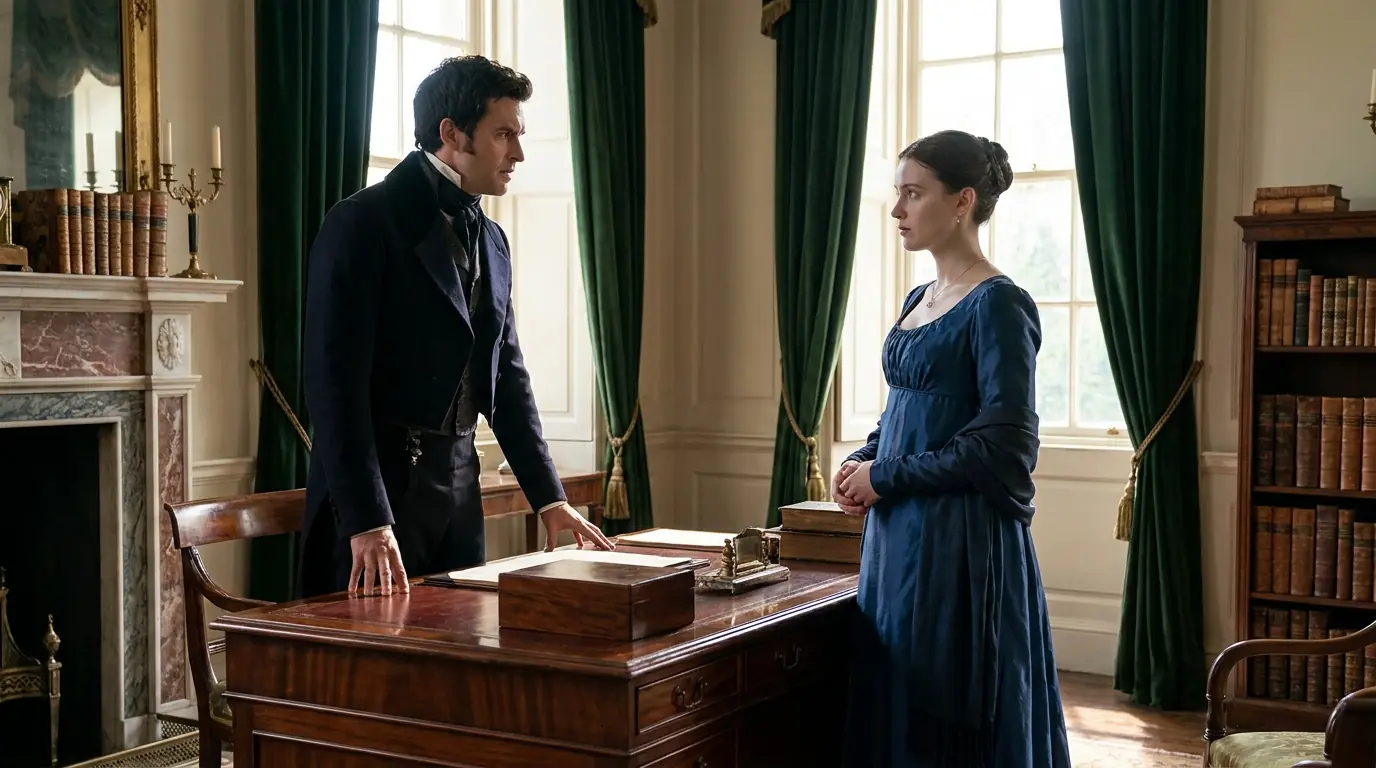
Edmund was present for the call in the way he was occasionally present for calls, there physically, contributing exactly enough, watching rather more. When Sir Gerald made a remark about the current state of the reform question, Cesily responded with more specificity than he had perhaps expected.
She saw him recalibrate. "You take an interest in politics, Duchess," he said.
"I take an interest in most things," she said. He smiled.
There was something in it that was neither impertinent nor entirely innocent. Across the room, Edmund set down his cup.
After the Vains had left, Edmund stood at the window and looked at their departing carriage with the expression he used for things he was thinking about without intending to share. Cesily collected the cups with unnecessary efficiency.
You did not like him, she said. I did not say that.
You said nothing. That was how I knew.
He turned from the window. He looked at her for a moment. He was taking a measurement.
Yes, she set the cups down. He does that.
I don't think he means harm by it. It is simply how he processes a room.
And you don't mind being processed? She minded slightly. I found it manageable.
You find most things manageable? She looked at him. There was something in how he said it.
Not criticism, but not neutral. A weight she wasn't sure how to read.
Is that a quality you object to? She asked. No.
He picked up a book from the side table. His left there yesterday which she had not moved.
It is a quality I He stopped. What I admire, he said after a pause a beat too long.
It is efficient. He left.
She stood in the sitting room with the cups and thought about that pause. She was not going to attribute meaning to a pause.
She was absolutely not going to do that. She moved the cups.
She went to the library. She took down the Wollstonecraft and read for an hour and did not think about the pause.
She thought about it the entire time. Sir Gerald returned two weeks later alone.
Lady Vain visiting her sister in Newbury with a copy of a recent pamphlet he thought would interest the duchess and a question about drainage on a shared boundary that technically required the Duke's attention.
Edmund received him in the estate office. Sir Gerald then called on Cesily in the sitting room as propriety permitted.
He was good conversation. She would not pretend otherwise.
He had read broadly, if not deeply, and held opinions firmly up to the point where she contradicted them, at which point he revised with a cheerfulness she found curious in a man who had seemed moments earlier so certain.
"You ought to come to the spring assemblies," he said near the end of his visit. "The county thinks well of you, but most have not yet seen you. You are rather shut away here."
"I am not shut away," she said pleasantly. "I am at home." Is there a difference?
Yes, one is a choice and the other is a condition. He smiled.
He was about to say something else when Edmund appeared in the doorway. He had finished with the drainage question and stood there a moment with the controlled expression of a man recalibrating the contents of a room.
Vain, he said, your grace. Sir Gerald rose smoothly and took his leave, and Cesily saw him out with the minimum of required courtesy, and returned to find Edmund standing in the sitting room, looking at nothing in particular, with an expression she had not seen on him before.
It was not neutral. He is harmless, she said.
I know that. Then what?
He was here 40 minutes, Edmund said. A call is 20.
She looked at him steadily. He is good conversation. Yes.
He picked up the pamphlet Sir Gerald had left and looked at it without reading it. He is Edmund.
He looked at her. If you have something to say, she said carefully. You can say it.
A long moment. She watched him decide. No, he said finally.
I don't. He set the pamphlet down and left.
She stood in the sitting room in the afternoon light and felt the shape of what had not been said move through the air between them. She had told herself she was sensible.
She had filed things. She had been in every sense she could measure precisely what he had asked for, capable, undemanding, present without requiring anything in return.
And she was beginning to understand, with the slow precision of a woman who understood things eventually and thoroughly, that she was not as detached as she had told herself to be.
She had not noticed exactly when it happened. Somewhere between the arguments about Gibbon and the afternoon light in the library, and the almost smile and the first edition whose location he knew without being asked, somewhere in the careful months of a man who did not perform attention, and therefore, when he gave it, made it mean something.
She had noticed. She had filed it. And filing, it turned out, was not the same as not feeling.
She sat down on the sofa alone in the room and was very still for a moment. Then she picked up the pamphlet Sir Gerald had left because she was above all things practical, and she read it and found it not very good, and set it aside, and allowed herself, for exactly as long as it took to breathe in and breathe out, to acknowledge that she was in a great deal of trouble.
Then she went to set the trouble aside, the way she always did. And found for the first time that it would not go.
March arrived with wind and the particular restlessness that comes when winter has lasted long enough to feel personal. Cesily had made a decision in February, sitting alone in the sitting room with a pamphlet she hadn't read and a feeling she couldn't file.
And the decision was this. She would not act on it.
The feeling was hers alone, and she would manage it the way she managed everything, with discipline, useful days, and a great deal of reading. She threw herself into the estate with a thoroughness that surprised even Mrs. Webb.
She reorganized the household accounts, found two places where the steward had been approximate in his arithmetic, and corrected them without drama. She called on the tenants, not required of her, and Edmund had said carefully she need not, and went anyway, because it was right, and because motion helped.
She visited old Mrs. Carol at the north end of the lane, who was 91 and largely blind, and had opinions about the previous four dukes of Caendale that she delivered without mercy. She walked every boundary of the home farm in boots unsuited to it, and came home with a thorough understanding of where the fencing needed work.
Edmund watched all of this. She knew because she had learned to feel his attention, not its presence exactly, but its quality, which was different from other people's.
Other people looked at her and saw what she was doing. He looked at her and seemed to be thinking about why.
She did not ask what he concluded. It was Lady Foresight who named it because Lady Foresight was 60 and had no patience for watching sensible people be idiots.
She came on a Tuesday in the first week of March, sat in Cesily's sitting room, drank half a cup of tea, and said, "You are working yourself into furniture."
Cesily looked up from the household ledger. I am managing the estate.
You are burying yourself in it. Lady Foresight looked at the ledger.
How are your evenings with Edmund? Adequate. Adequate.
Lady Foresight repeated. I see.
She set her cup down. What has happened? Nothing has happened.
Cesily, I have known you since you were 14 and argued with your father's curate about the epistles. Something has happened.
Outside the March wind moved through the elms. I understood the arrangement. Cesily said finally.
I believed I understood it completely. And now, now I understand it more completely, she looked at her hands.
That is all. Lady Foresight studied her with the look of someone who knows more than they are saying, and is deciding how much is useful.
He is not, she said eventually, as concluded as he appears. I know that.
Do you know why he appears so? Mrs. Webb told me about Harriet. Ah, a pause.
Then you know the shape of it, not the texture. She stood.
She had said what she came to say. He chose you, Cesily.
Edmund Ashford does not make accidental choices. He is constitutionally incapable of it.
At the door, she turned back. Ask yourself what a careful man chooses when he is done being careful.
She left. Cesily sat for a long time with the ledger open and unread and thought about careful men and the choices they make when they have been very alone for a long time and do not yet know how to stop.
The argument happened on a Thursday. It was not by any objective measure a large argument.
In a different marriage, it would not have been an argument at all. It concerned the spring assembly, a county affair organized by the local gentry committee held at the assembly rooms in the next village for which an invitation had arrived at Caendale through proper channels.
Cesily had accepted on their behalf, because accepting was correct, and she had not thought Edmund would object. He did not precisely object.
What he did was go quiet in the specific way she recognized as objection compressed into manners. You do not want to go, she said.
I did not say that. You went quiet.
I am often quiet. Not like that.
She looked at him across the dinner table. If you don't wish to go, say so, and I will decline for us both.
It is not a question of wishing, he set down his fork. Vain will be there.
Sir Gerald will be there, she said calmly, along with most of the county. He is a prominent figure on the committee.
That is not a reason to decline. I am not suggesting it is a reason.
Then what are you suggesting? He looked at her.
The candle light made his face less readable than usual, which was already not very readable. Nothing, he said.
Forgive me. We will go.
She looked at him across the table and felt something harden in her chest, not anger, but a sadness that was clean and precise. He had been about to say something.
She had felt the shape of it moving toward them, and then he had retreated into manners, and she did not know how to go in after him.
She had never known how to go in after people. It was, she understood now, exactly his problem, too.
This was perhaps the most complete disaster available to two human beings. Both the sort of person who waited for a door to open and neither knowing how to open it.
As you like, she said, they finished dinner in a quiet that was not comfortable. The assembly was on a Friday.
Four county families, a string quartet of variable quality, and the usual social machinery of a county gathering that had been starved of novelty all winter.
The rooms were well lit, and the supper adequate, and Cesily wore the dark blue silk she knew was her best color, which she had not put on without awareness of it.
Edmund handed her out of the carriage and offered his arm, and she took it, and they went in together, as they always did things, correctly, with the appearance of ease, and a silence between them that other people probably read as composure.
Sir Gerald greeted them near the door, with his customary energy, bowed correctly to Edmund, and expressed his pleasure at the Duchess, condescending to attend with the precise degree of deference a baronet owes a duchess in public.
His wife was beside him, warm and genuinely pleased to see Cesily, and drew her almost immediately into conversation about a novel she had been reading, which Cesily was grateful for.
She danced twice, once with young Mr. Fairclough, who was 17 and terrified, and once with old Mr. Pettigrew, who was 70 and not terrified, but whose dancing was an act of hope over physical reality.
Edmund did not dance. This was, she gathered, established county knowledge.
He stood near the windows with the stillness of a man entirely comfortable with his own watchfulness. She could feel him across the room.
She had stopped pretending she couldn't. Sir Gerald found her between dances and brought her a glass of lemonade with the ease of a man who had calculated that the gesture was within the limits of acceptable attention.
"You are good for the county, Duchess," he said. "They needed someone to look up to who would also argue with them."
"I don't argue with everyone," she said. You told me in February that the drainage question had a correct answer, and I had simply not found it.
I have been thinking about it since the drainage question had a correct answer. He smiled.
He lowered his voice a fraction, not conspiratorially, but with the register of a man shifting from public to semi-private. His grace watches you rather constantly.
I wonder if he knows he does it. She kept her expression pleasant.
He watches everything. It is how he manages rooms.
Sir Gerald looked at her with the assessing qualities she had noticed in February and said nothing further which was she thought the most interesting thing he had done all evening.
She moved away and stood beside Mrs. Pettigrew and discussed the comparative merits of various preserves with sincere attention for seven full minutes which was as long as it took her heart to settle.
In the carriage home the night was clear and cold and Edmund sat across from her and looked out of the window. Did you enjoy the evening? She asked.
Tolerably, he glanced at her. You tolerably, she said, the carriage moved through the dark.
The sound of the horses was even and steady, and she thought about careful men and what they choose, and about Lady Foresight's question, which she had not yet answered to her own satisfaction.
"Edmund," she said. Yes.
She had not planned what came next. She was a planner, a filer, a person who arrived at conversations prepared.
She had not prepared this one. I know about Harriet, she said.
The carriage was very quiet. Mrs. Webb, she said in January, she didn't intend to say it.
He was still in the way that was different from his usual stillness. The stillness of someone who has been moving toward a thing for a long time and has now arrived and does not yet know whether to step forward or back.
I see, he said. I am not asking for anything, she said too quickly, and she knew it.
I simply thought you should know that I know so that there is no I wanted you to know.
What do you know? He said quietly. That she was here, that she died, that you were alone for 3 years afterward.
She looked at her hands in her lap. That when you described the arrangement, you were describing protection for yourself.
I understood it. Did you? Yes.
Silence. The carriage slowed for a bend in the road.
You were reading Hannah More, he said. The first time we spoke properly at Foresight House, you had picked it up from the side table and were holding it without reading it because Lady Foresight had been talking for 20 minutes, and you were being too polite to redirect her.
She stared at him. You remember that? I remember all of it.
He looked at her steadily across the dark carriage. The parliamentary question, the way you listened before you answered, the fact that you disagreed with two thirds of what I said and were not in the least concerned about it.
That is not you remember what book I was holding. I noticed things, he said.
I have noticed most things about you since Foresight House. He turned back to the window.
It has been inconvenient. She sat with this Edmund.
He looked at her. The arrangement, she said.
You said it was less than You stopped. Less than what?
He looked at her across the dark carriage. Less than what? She said again, and her voice was very steady.
The carriage pulled up at Caendale before he answered. She did not go to the library the next morning.
She went to her sitting room and sat with her books and did not read them and thought about the carriage and the sentence he had not finished and whether she was going to be the one to finish it.
She was already by her own quiet reckoning considerably further in than she had intended to be. She had built her whole adult life on self-sufficiency as a virtue.
It had served her well. It had kept her functional through her father's death and her family's reduced circumstances and a hundred small negotiations with a world that did not always have room for a woman with her opinions and her reading habits.
She had not needed saving. She needed very little from anyone, and she was proud of that.
And it was also she was beginning to understand the thing standing directly between her and the life she actually wanted. She wanted she had not until recently let herself catalog what that meant.
She wanted the library in the afternoon, and the arguments about Locke, and the almost smile that meant he found her correct, and the quiet knowledge that he had noticed for months, things she had not known he was noticing.
She wanted the whole complicated, careful, honest fact of him. She wanted her husband, not the arrangement, him.
She picked up the Wollstonecraft and held it without opening it. He came to the library that afternoon.
She heard him before she saw him, the specific cadence of his step, and did not look up from her page, though she had been staring at the same paragraph for 20 minutes.
He sat at the reading desk. He did not bring papers.
She looked up. He was watching her with the expression she had not seen until the carriage, without the layer he usually maintained, without the control.
You didn't finish what you were saying, she said in the carriage. No.
Were you going to? I have been trying to finish it since November.
He looked at her steadily. I said convenience because I thought if you understood that it was not for me that I was all ready.
He stopped. I thought it would be a cruelty to tell you that you had walked into something I had not warned you about.
You were protecting me. She said, I was attempting to from your own feelings. Yes.
She sat with this. Her heart was doing something extremely inconvenient.
She was going to have to say it. He had moved as far as he knew how to move, and the remaining distance was hers to close, and she could either do it, or she could file this moment in the category of things she had managed alone.
And she knew, sitting in the library with the afternoon light and the book in her lap, and 5 months of careful, honest accumulation behind her, that she was not going to file it.
She was tired of filing it. I came into this arrangement believing I understood it, she said.
Believing I was suited to exactly this kind of marriage. No entanglements, no expectations.
I am self-sufficient. I have always been self-sufficient.
She looked down at the Wollstonecraft. But it is not a virtue I have been practicing.
It is a habit I formed because the alternative required trusting someone with something, and I did not know how to do that. She looked up.
And neither, it appears, did you? He said nothing.
She held his gaze. I have been falling in love with you, she said, since approximately the argument about Gibbon.
I have been filing it under manageable for 3 months. It is not manageable.
She set the book on the side table. That is what I have to say.
He stood from the reading desk. She watched him cross the library toward her, not quickly, not with the stumbling motion she had always considered over wrought in novels, but with the absolute focused intention of a man who has made a decision and is not reconsidering it.
He stopped in front of her chair. You said in the carriage, she said, her voice completely steady, which surprised her, that you had noticed things about me since Foresight House.
What did you mean? Less than what you wanted to offer.
Less than the truth, he said. The arrangement was the only framework I could construct that did not require me to say.
I am already in some difficulty with regard to you, and I do not know yet whether I am capable of what that means, because the last time I he stopped, began again.
With Harriet, I was not sufficient. I could not give her what she needed, and I could not change what the title required, and she was unhappy in ways I could not correct.
When she died, I had not been enough. For a long time I believed the answer was to ask less of myself, to need less, to arrange it so that no one could be failed because no one was relying on anything.
You failed yourself, she said, not unkindly. Yes, he looked at her.
I know that now. I have known it since approximately the argument about Gibbon, she said.
Before that, he said, "The morning after we arrived, you chose a shelf for your books and ordered them by argument rather than author, and I watched you from the doorway, and thought I had made either a very good decision or a catastrophic one."
The Gibbon argument merely confirmed it. She looked up at him.
"I have watched you walk the home farm in the wrong boots," he said. "I have watched you correct the steward's arithmetic without humiliating him. I have watched you make Mrs. Webb feel credited and my brother feel at ease and Lady Foresight feel she has done something right."
A pause. I have read the Astell you left on the window seat. I know which pages you mark.
You fold the corner a third of the way down, never at the top. And I know you only mark the pages where the argument makes you angry.
She stared at him. You looked at my books. Yes, Edmund.
That is a considerable invasion. Yes, he said. I know.
He did not look away. I am not certain I can be everything that is required of me and also this.
I have not managed both before. But I know that the arrangement, as I described it, was a lie I told to keep us both at a distance I thought was safe.
It was not convenient. It has never been convenient. It has been considerable, she offered very quietly.
Yes, the almost smile. The second kind, brief, entirely unguarded. Considerable.
He offered her his hand. She looked at it.
This was him asking, not reaching, not assuming, asking. She took it.
He drew her to her feet slowly, and they stood close together in the library in the afternoon light, and she looked at him, and thought about five months of almost smiles and arguments, and the specific quality of being known by someone who notices the way you order your books, and she thought about doors and walls, and the difference between the two.
Edmund, she said. Yes, he said, not an answer to a question she'd asked, but somehow exactly right.
He kissed her with the same quality that marked everything he did. Careful at first, and then once committed complete, she kissed him back with more thoroughness than she had applied to most things in her life, and felt for the first time in 5 months, entirely uninterested in being sensible.
The light moved across the floor between them, neither of them noticed. April came with mud and primroses and the county resuming its full social operations and the Duke and Duchess of Caendale attending the Foresight dinner looking in Lady Foresight's private assessment like two people who had recently stopped being idiots.
She said this to no one. She had, however, an expression of deep personal satisfaction that lasted the entirety of the meal and well into the carriage ride home.
The dinner was 12 covers, good wine, and the kind of conversation that Cesily had once moved through as a clergyman's daughter, and now moved through as a duchess.
The same conversation, with a different amount of room to breathe. She sat at Lady Foresight's right, and talked about the reform pamphlets circulating through the county, and ate good food, and felt the specific, unprecedented luxury of being exactly where she intended to be.
Edmund was at the other end of the table. She could manage this now because she had learned was still learning that wanting someone in the room was not the same as requiring them.
Self-sufficiency, it turned out, was a virtue after all. It had only been misdirected.
She looked at him across the candles. He was speaking to old Mr. Pettigrew about the shared boundary drainage question that Sir Gerald had raised in February, and that apparently required continued negotiation.
He looked up briefly and she held his gaze for a moment and looked away. The almost smile happened.
She felt it from 14 ft. "You are rather different," Lady Foresight said quietly beside her.
"I am the same," Cesily said. "You are the same, but you have stopped managing it."
She topped up Cesily's wine without asking. "It is an improvement."
She told him about Astell that evening. They were in the library.
Of course they were. It had become the true center of the house in a She suspected it had always been waiting to be, had only needed people who used it as people rather than as a duke managing his inheritance alone.
She was in the window seat. He was in the other chair, the one closer to hers, which had happened gradually and without discussion.
She liked that it had happened that way. The door and the wall, she said, I have been thinking about it differently.
How so? I thought I was using my mind as a door.
Astell's argument, the education given and then redirected into a wall. But I was making my own wall.
She looked at the Wollstonecraft on the shelf. Self-sufficiency as barricade.
I had confused needing with weakness. They are not the same, he said.
No, you did it too, she pointed out. The arrangement.
Yes, he was quiet a moment. I thought protecting you from expectation was the generous thing.
I had watched Harriet learn what the title required and find she could not sustain it, and I could not change the title, and I thought if I asked nothing, no one could be failed for not providing it.
"You failed yourself," she said again, not unkindly. "You are going to be relentlessly accurate about this for the foreseeable future."
"Yes," she said. "You should know that going in."
"I am in," he said. "I've been in since October. I simply required time to admit it."
She looked at him. You told me in the carriage you were decided at Foresight House.
I was decided, he said, being decided and admitting it are not the same thing.
You above all people should understand that. She opened her mouth.
She closed it. That is, she said, an extremely accurate point, and I resent it.
I know, he said with the dry compression at one corner of his mouth. It was convenient.
She laughed. It came up without permission, and she did not stop it, and he watched her with the open, unguarded expression.
She was still not entirely accustomed to and suspected she would not become accustomed to which was she thought probably the point.
Some things should retain the quality of the unexpected. It kept you honest.
She wrote to her mother on a Tuesday in April which was her habit. But this letter was different from the previous ones.
The ones that had been she recognized now dispatches from a careful distance. The library at Caendale is exceptional.
She wrote Edmund has been reading Astell. He claims he disagrees with significant portions of it, which means we will have an argument about it shortly, and I find I am looking forward to it considerably.
I am looking forward to most things at present. It is not a habit I have previously maintained, but I find it suits me.
I recommend it. Her mother would read between those lines with the thoroughness of a woman who had spent 3 years worrying.
Cesily hoped the worry would become something lighter. She thought it would.
She folded the letter and looked out at the April garden. The elms at the end of the drive were greening.
The primroses had come up along the south wall. The estate was doing what estates do in spring, becoming more than they were, incrementally, not transformed, more.
She thought that was approximately right. She found him in the library that afternoon, which was not surprising.
3:00 South Light, his chair closer to hers. He was reading something she didn't immediately recognize, and looked up when she came in.
"What is that?" she asked. He turned the spine toward her.
The Wollstonecraft, the first edition, 1792, the one his father had acquired and not read.
The pages had been cut recently, by the look of it, the edges still clean.
She stopped in the doorway. You are reading the Wollstonecraft.
You described it with sufficient precision over several months that I thought I ought to have an opinion.
He turned a page. She is considerably more rigorous than her reputation currently allows.
Her reputation is not her fault. No, he glanced up.
It rarely is. She came to her window seat and took up her own copy, the one she had read four times now, the corners folded a third of the way down on more pages than not.
She opened it to where she had stopped. "You will find," she said, that she builds an argument carefully and then does not flinch from where it leads.
"Unlike Astell." "Unlike Astell," she looked at the page.
It is the quality I admire most in a writer, following the argument where it actually goes rather than where one would prefer it to arrive.
He was quiet for a moment. Is that also the quality you admire most in a person?
She looked up at him over the top of her book. Yes, she said.
It is. He held her gaze for a moment with the direct unguarded expression she was still learning to receive without looking away from.
Then he returned to the first edition, and she returned to her own copy, and the library held them both in the afternoon light, the south window, the shelves, the two chairs closer together than the reading desk had ever been.
She turned to a page she had read four times, and found it said something new. That was the thing about certain books she had always known.
They said something different, depending on what you brought to them. She had brought something different now.
Edmund turned a page. Outside, the April wind moved through the greening elms.
The primroses were coming up along the south wall. Neither of them was alone.
She kept reading.