You don't give orders here. Adrian Cole walked into the precinct with a sealed order and no escort, and Officer Sloane Wexler laughed in his face. She blocked the hallway, looked at his plain gray suit, and said the words that would follow her for the rest of her career. Captain Grant Pembroke strolled out moments later, refusing to check a single piece of identification, and ordered his officers to confiscate the stranger's phone instead. Nobody in that building knew who Adrian really was, or why a locksmith named Leon Tate had been sitting handcuffed to a bench for 8 hours with no charges filed against him.
Then a phone rang at the front desk, and every officer in the room went quiet at once. Adrian had not come to file a complaint. He had come to end a captain's career before lunch. The message arrived at 5:40 in the morning. Three words stitched together in a language only two people in the city would recognize as a warning, rather than a routine memo, and Adrian Cole read it twice before he swung his legs out of bed.
The sender worked inside the 12th precinct and had agreed, months earlier, to flag anything that smelled like evidence being reorganized before anyone official arrived to look at it. Reorganized was the word the department liked to use. What it usually meant was that something inconvenient was about to disappear. Adrian had spent 11 years as a federal prosecutor chasing exactly that kind of disappearance, and he had learned that the difference between corruption and an honest mistake was almost always a matter of timing. He showered quickly, dressed in the same unremarkable suit he wore to every meeting that mattered and checked the leather folder on his dresser one more time before he left the house.
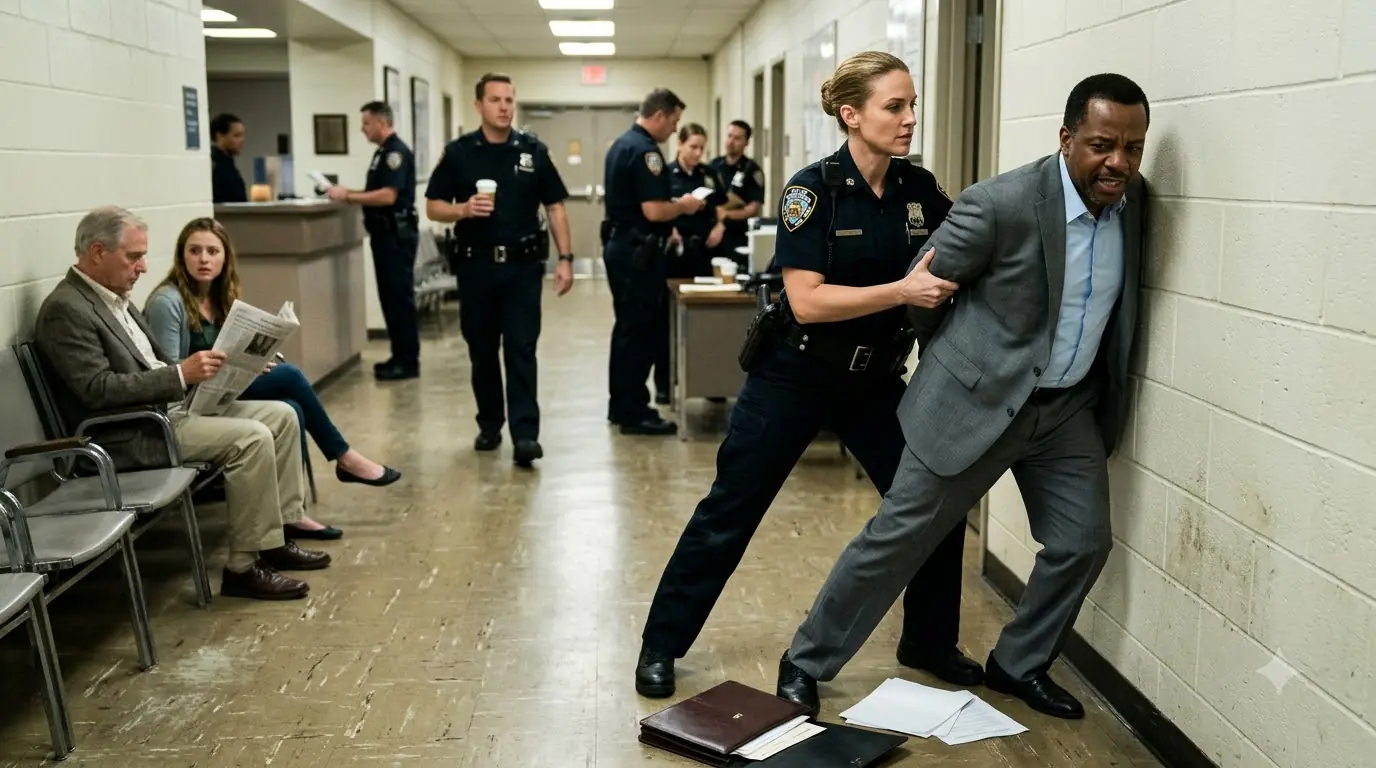
Inside that folder sat four things that would matter more than any badge pinned to his chest. There was his digital credential, a small card that linked to a citywide verification system the department could check in under a minute if anyone bothered to try. There was the preservation order freshly signed by the Public Safety Commission instructing every precinct in the city to halt any transfer or destruction of evidence until further notice. There was his appointment letter naming him acting deputy commissioner for professional standards and police accountability. A title that had been approved at 6:00 that same morning and transmitted electronically to every precinct captain in the city.
And there was an emergency authorization code, one that could summon the entire Inspector General's Office to a single address within the hour if things went wrong. Adrian had barely spoken a word during breakfast that morning turning the plan over in his mind while his coffee went cold on the counter beside him. He had built his career on the belief that institutions revealed their true character not in press conferences or polished reports, but in the small unwitnessed moments when nobody thought their conduct would ever be scrutinized. His assistant, Serena Pike, had offered to send a city vehicle with two uniformed officers to accompany him and Adrian had declined without hesitation. An escort would announce him before he ever stepped through the door and a captain given advance warning was a captain who had time to prepare an explanation.
Adrian did not want an explanation. He wanted to see how a precinct behaved when it believed no one of consequence was watching. That was the only way to learn the truth about a place like the 12th, where community complaints about missing property had piled up for 3 years without a single formal investigation. He drove himself, parked two blocks away out of habit, and walked the rest of the way in the gray light of early morning. The morning air outside carried the damp chill of a city not yet fully awake, and Adrian walked the two blocks with his collar turned up.
Going over the sequence of the morning in his mind, the way he once rehearsed opening statements before a jury. He had learned early in his career that the first 90 seconds inside any building told him more than an hour of testimony ever could, because people revealed themselves honestly only in the moments before they realized someone was paying attention. The precinct lobby smelled like burnt coffee and old paper, fluorescent light buzzing faintly overhead, and the linoleum floor still bore the scuff marks of a long overnight shift that nobody had bothered to clean. The first thing Adrian noticed was a heavy-set man in his late 50s sitting on a metal bench near the intake counter, one wrist cuffed to a bar bolted into the wall. The man's name, Adrian would later learn, was Leon Tate, and he had owned a locksmith shop three blocks from that precinct for over 20 years.
There was no paperwork clipped to the bench beside him, no visible booking number, nothing that explained why a business owner with no criminal history was restrained like a flight risk. Leon lifted his head and looked at Adrian with something between hope and exhaustion, the look of a man wondering if a stranger in a suit might finally be someone who could help him. And a young officer nearby snapped at him to keep his head down. Adrian filed that image away without reacting to it because reacting was exactly what would make a precinct dig in its heels. He approached the intake counter instead, set his folder down without opening it yet, and asked in a calm level voice to speak with whoever was supervising the current shift.