The First Night After River and Her Puppies Escaped the Flood
PART 2 — CURRENT CONDITION UPDATE
River and her three puppies are now safe in a medical foster home after being rescued from the porch of an abandoned house during severe flooding.
River is eating consistently, producing milk, and beginning to regain strength. Two puppies—Mason and Lily—are active and gaining weight. The smallest puppy, Poppy, survived a critical period of hypothermia, low blood sugar, dehydration, and suspected aspiration pneumonia, but she continues to receive closer monitoring than her siblings.
Their rescue began after emergency crews were asked to search a neighborhood where water had risen rapidly overnight.
Several homes had already been evacuated. Others had been vacant before the storm, and it was unclear whether animals remained behind.
A rescue boat moved slowly between partially submerged vehicles, floating trash cans, broken fencing, and branches carried into the street.
One team member noticed movement on the porch of an older home near the end of the block.
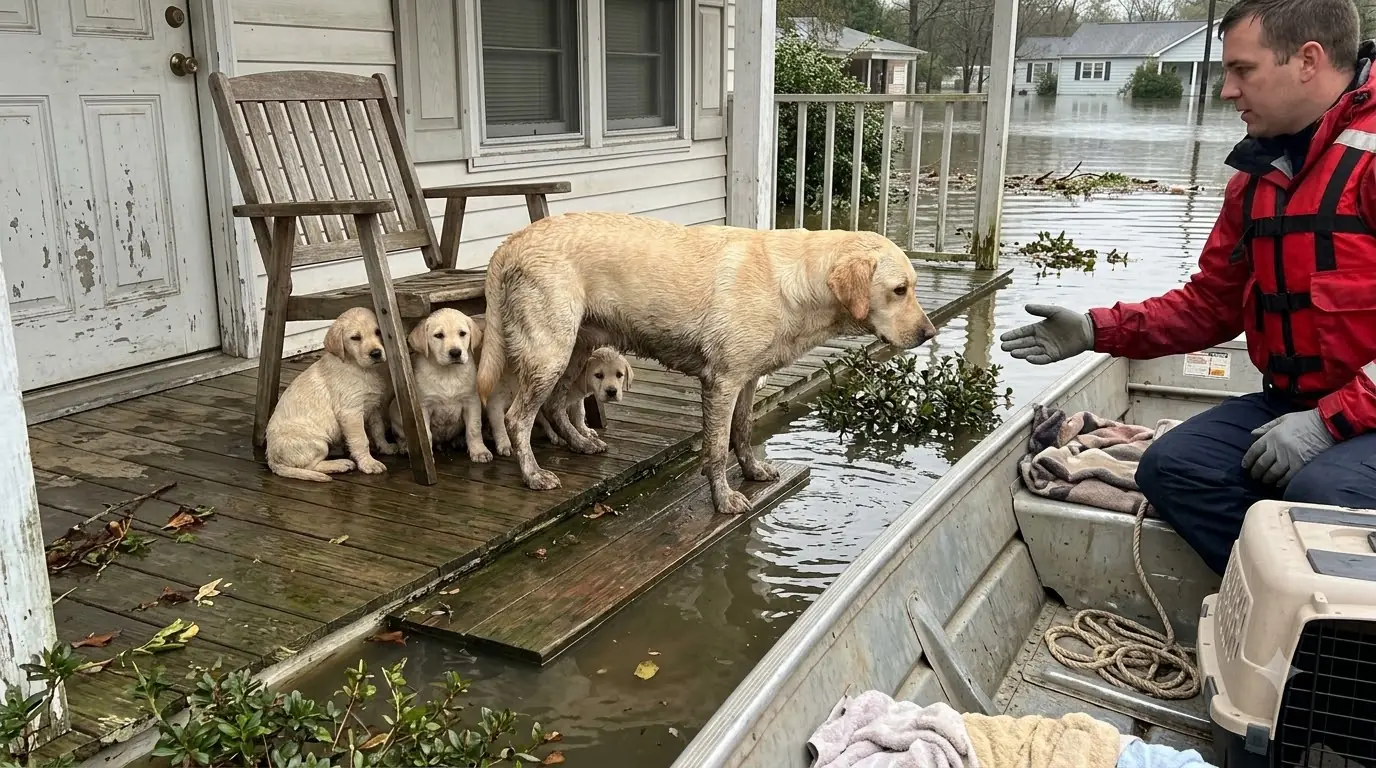
A yellow Labrador-type dog stood beside the wall beneath the roof overhang. The water had reached the lowest porch step and continued moving across the yard.
The dog was wet from the chest down. She could have stepped toward the rescue boat, but she remained near an overturned chair.
The team initially believed fear was preventing her from moving.
One rescuer brought the boat close enough to extend a catch pole and slip lead if necessary. The dog lowered her body and positioned herself between him and the chair.
She did not lunge or attempt to bite. Her mouth remained closed, her tail stayed low, and her eyes moved continuously between the rescuer and the space behind her.
The team stopped advancing.
A faint sound came from beneath the chair. It was almost lost beneath the boat motor, rain, and movement of water against the porch.
When the motor was turned off, the sound came again.
Several high-pitched cries came from the narrow space against the wall.
A rescuer stepped carefully onto the porch while another held the boat in position. The wood was wet and partly unstable, so only one person moved forward.
River shifted sideways but did not leave the puppies.
The rescuer lowered himself and looked beneath the chair. Three small puppies were pressed together on a damp piece of cardboard.
Their eyes were open, and they appeared to be several weeks old. They were old enough to move but too young and weak to escape rising water independently.
One puppy lifted his head and vocalized. Another attempted to crawl deeper into the corner.
The smallest remained nearly motionless.
The team decided to remove the puppies before attempting to lift River.
Taking the mother first could have caused her to panic as strangers reached toward the litter. Leaving the puppies while the water rose created an immediate risk.
The first puppy, later named Mason, was wrapped in a dry towel and transferred into a crate inside the boat.
River moved closer to the chair but allowed the rescue to continue.
The second puppy, Lily, was removed next. She squirmed weakly and cried when separated from the others.
River watched until Lily was placed beside Mason.
Poppy was last. She was wedged against the damp wall beneath part of the chair frame.
Her body felt colder than her siblings, and her breathing was shallow. She did not cry when lifted.
The rescuer kept her wrapped close to his chest while returning to the boat.
Only after River saw all three puppies inside the crate did she step away from the wall.
A slip lead was placed over her head, and a second safety line was attached. She still hesitated at the edge of the porch.
The boat shifted each time water struck it. River lowered herself and pulled backward.
No one dragged her by the neck. A rescuer supported her chest and abdomen while another steadied the boat.
River allowed herself to be lifted aboard.
The moment she reached the floor of the boat, she moved toward the crate and pressed her nose against the opening.
Mason and Lily cried. Poppy remained silent.
River lay beside the crate for the remainder of the trip. Her body shook, but she did not attempt to stand or escape.
The rescue team contacted the emergency veterinary hospital before reaching dry ground. Staff prepared warming equipment, oxygen, glucose support, and separate areas for the mother and puppies.
All four dogs were transported together. Complete separation could have increased River’s distress and made nursing more difficult.
At the hospital, each animal received an individual identification band and medical record. The puppies looked similar at first glance, so accurate identification was essential for recording weight, medication, feeding, temperature, and progress.
River’s examination began while she could still see the puppies.
She was underweight, dehydrated, and exhausted. Her ribs, spine, and hip bones were easier to feel than expected beneath her wet coat.
Her mammary glands contained milk, but the tissue around two glands was warm and mildly firm. The veterinarian monitored these areas for mastitis, an infection or inflammation that can become serious in nursing mothers.
River’s temperature was slightly low. Her gums were tacky from dehydration, and her paw pads were softened and irritated after prolonged exposure to dirty water.
She had shallow cuts between several toes and a larger abrasion on one front leg.
No major fracture was found. Her heart and lungs sounded reasonably clear during the first examination.
Bloodwork showed mild anemia, low protein, inflammation, and changes consistent with poor nutrition and physical stress.
Her kidney and liver values did not indicate advanced organ failure. Electrolyte abnormalities were present but could be corrected gradually.
River received warmed fluids calculated for her dehydration and nursing status. The team avoided giving an excessive amount too quickly.
Her response was monitored through heart rate, blood pressure, urine production, gum moisture, weight, and repeat laboratory testing.
Her coat was rinsed in stages once her temperature stabilized. Floodwater may contain sewage, fuel, pesticides, bacteria, parasites, and sharp debris.
The team used protective equipment while removing mud and contaminants.
A prolonged bath would have separated River from her puppies and risked lowering her temperature again, so the cleaning was divided into shorter sessions.
Her paw wounds were flushed. No embedded glass or metal was found.
The abrasions were treated, and River was placed on clean, padded bedding that could be changed whenever it became wet.
The puppies required more urgent warming.
Mason and Lily were cold but responsive. Their temperatures began rising inside a controlled incubator with careful external heat.
Young puppies cannot regulate body temperature as effectively as healthy adult dogs. Warming must be gradual because rapid heating can create additional physiological stress.
The team did not place them directly on an unprotected heating pad. Burns can occur when weak animals cannot move away from a hot surface.
Both puppies received warmed nutritional and fluid support according to their condition.
Poppy was in more serious danger.
Her temperature was significantly below normal, and her blood sugar was critically low. She was too weak to nurse safely.
Attempting to feed a severely cold puppy immediately can be dangerous because digestion and swallowing are impaired.
The team focused first on controlled warming, oxygen, glucose correction, and circulation.
Poppy’s gums were pale. Her breathing remained shallow, and fine crackling sounds were heard in portions of her chest.
A small oxygen mask was used initially. She was then placed in an oxygen-supported incubator where temperature and humidity could be controlled.
A tiny intravenous catheter was difficult to place because of her size and dehydration. The medical team established access and began carefully measured support.
Her blood sugar was corrected in stages. A sudden uncontrolled change could have caused additional complications.
Poppy became slightly more responsive as her temperature rose. She moved one front paw and opened her mouth when handled.
The response was encouraging but did not eliminate the risk.
Chest X-rays showed cloudy areas in the lungs. The pattern suggested that Poppy may have inhaled contaminated water while the porch was flooding.
She may have been briefly submerged, splashed repeatedly, or attempted to nurse while cold and weak.
Aspiration can introduce liquid and bacteria into the airways. Inflammation may worsen over several hours, just as it can in adult dogs.
Poppy’s breathing rate increased as she warmed. This indicated that her body was becoming more active, but the visible effort remained concerning.
The team monitored her oxygen level and blood gas measurements.
Antibiotic treatment was selected based on the contaminated exposure, clinical signs, imaging, and high risk of bacterial pneumonia.
Medication doses were calculated according to Poppy’s exact weight. Puppies cannot safely receive scaled-down guesses from adult doses.
Every medication, feeding, and fluid amount was recorded.
Poppy was not returned to unrestricted nursing immediately. She lacked the strength to remain latched and could have aspirated milk if her swallowing was poorly coordinated.
Once her temperature and blood sugar reached safer levels, the team tested her suckle response.
It was weak but present.
A small amount of appropriate milk replacement was offered under controlled conditions. Poppy swallowed several drops without coughing.
The volume remained intentionally small.
The medical team reassessed her after each feeding for abdominal distension, regurgitation, coughing, falling oxygen, or increasing respiratory effort.
River remained nearby throughout the first hours.
She was placed in a larger enclosure beside the incubators, allowing her to see and smell the puppies.
She became restless whenever staff carried one out of view. Her breathing quickened, and she stood despite her own weakness.
Caregivers reduced unnecessary separation and returned each puppy promptly after treatment.
When Mason and Lily were warm enough, they were allowed to nurse under supervision.
River immediately rolled partly onto her side. The puppies found the nipples and began feeding.
Their nursing also helped the medical team assess River’s milk production.
Poppy remained inside oxygen support, separated by a clear wall. River repeatedly smelled the edge of the incubator and lay facing her.
No one interpreted this as proof that River understood the details of Poppy’s illness. It demonstrated that she remained attentive to the puppy who was absent from the nursing group.
During the first night, Poppy’s oxygen requirement increased.
She became tired during one feeding and stopped swallowing. The team discontinued oral feeding rather than pushing her to finish.
A feeding tube was considered to provide nutrition while reducing the effort required to nurse. Tube feeding in a puppy must be performed by trained caregivers because incorrect placement can deliver food into the lungs.
The veterinarian measured the appropriate length and confirmed placement before each use.
Very small meals were delivered at scheduled intervals. Poppy’s abdomen and breathing were checked before and after every feeding.
Her blood sugar stabilized, and she maintained a normalizing temperature inside the incubator.
The lung infection remained the greatest danger.
Poppy coughed only occasionally. The absence of frequent coughing did not mean her lungs were clear.
Weak puppies may lack the strength to cough effectively.
Her respiratory rate, effort, gum color, oxygen level, alertness, and imaging provided more useful information.
Mason and Lily stayed medically stable during the night. They nursed frequently and slept in a warm enclosure beside River.
Their weights were measured before and after selected feedings to estimate intake.
Both initially lost a small amount, which can happen during illness, stress, hydration changes, and transition. The medical team expected the trend to reverse quickly.
Mason was the largest. He had a stronger suckle and pushed forward whenever River changed position.
Lily was smaller and quieter but maintained her temperature and feeding strength.
The team ensured that Mason did not consistently displace her from the most productive nipples.
Supervised rotation gave each puppy adequate access.
River’s milk production appeared moderate but not abundant. Her poor body condition and dehydration may have reduced supply.
The team supported her with complete, calorie-dense nutrition appropriate for nursing.
She was offered several measured meals rather than one large portion. Sudden excessive feeding after a period of poor nutrition can create digestive problems.
Her water remained available at all times. Nursing mothers require substantial fluid, and water was never restricted to reduce urination.
River initially refused food unless the puppy enclosures were close. Her bowl was moved beside them, and a caregiver sat several feet away.
She ate part of the first meal, then returned to smell Poppy’s incubator.
By the next morning, River finished an entire portion.
The two warm mammary glands were examined repeatedly. Milk remained normal in appearance, and River did not show severe pain when the puppies nursed.
The firmness improved with regular emptying and supportive care. Antibiotic decisions were based on her complete examination and the medications already required for the contaminated exposure.
No abscess developed.
River’s low blood protein required monitoring. Protein supports healing, milk production, circulation, and immune function.
Her level began rising once hydration stabilized and she ate consistently.
The team did not expect one meal or supplement to correct weeks of poor body condition.
Weight restoration would need to occur gradually throughout nursing and after weaning.
Parasite testing found hookworms and roundworms. These parasites can contribute to anemia, poor weight, diarrhea, and weakness.
Puppies may acquire certain parasites from their mother before birth or through nursing, depending on the organism.
River and all three puppies received age- and condition-appropriate treatment under veterinary direction.
Medication schedules differed because the puppies were young and Poppy remained medically fragile.
Repeat fecal testing was planned. One treatment does not always eliminate every life stage.
The foster home would also need careful waste removal to reduce environmental reinfection.
Additional testing evaluated common infectious diseases associated with floodwater and unknown vaccination history.
The team monitored kidney and liver values, urine, fever, appetite, and gastrointestinal signs.
No evidence of acute kidney failure developed.
River’s vaccination and preventive-care schedule was postponed until she became more stable. Immediate lifesaving needs and nursing took priority over nonurgent procedures.
The puppies were also too young for parts of the standard vaccination series. Their schedule would begin at the appropriate age and continue through the full recommended course.
At approximately 3:00 a.m. during the first night, Poppy’s breathing became more labored.
Her nostrils widened, her abdomen moved visibly with each breath, and her oxygen level dropped.
The team increased oxygen support and stopped all handling not required for stabilization.
Repeat imaging showed that the cloudy lung areas had become more pronounced.
Poppy remained responsive but exhausted. Her prognosis was guarded.
The rescue coordinator was informed that Poppy might require more advanced respiratory support if she could no longer maintain oxygen.
Mechanical ventilation in such a small patient would have involved significant risk and intensive care. The rescue authorized escalation if the specialists believed it offered a reasonable chance.
Poppy did not require a breathing tube that night.
After several hours of oxygen, airway support, medication, temperature control, and minimal handling, her level stabilized.
Her respiratory effort remained high but stopped worsening.
A technician stayed nearby, watching through the incubator wall.
River lay on the other side, facing Poppy. Mason and Lily slept against River’s abdomen.
Shortly before sunrise, Poppy lifted her head and crawled several inches toward the clear wall.
The movement used nearly all her available energy. She rested again immediately.
The medical team considered it a hopeful neurological and physical response, but continued treatment without assuming the crisis had passed.
During the second day, Poppy maintained her blood sugar without repeated emergency correction.
Her temperature remained stable with less external support. The oxygen concentration could be reduced slightly.
Tube feedings continued because nursing remained too tiring.
Her stomach tolerated the small volumes. She did not vomit or develop severe abdominal swelling.
Poppy passed urine and a small amount of stool. These basic functions helped the team assess hydration and digestive movement.
Her white blood cell count showed inflammation but no sudden collapse in immune cells.
Mason and Lily became more active. They crawled over one another and protested when removed for weighing.
Mason gained weight first. Lily followed during the next measurement period.
Both continued nursing and receiving supplemental feeding when River’s supply was insufficient.
River stood for a brief bathroom trip. Her gait was stiff, and her paws remained tender, but she could walk without support.
She urinated, smelled the ground, and immediately turned toward the hospital entrance.
The staff did not extend the walk. Her puppies remained her focus, and her own body needed rest.
Her leg wound stayed clean. The swelling around her paws decreased as the skin dried and healed.
On the third day, Poppy was removed from continuous oxygen for a short supervised trial.
She maintained an acceptable level for several minutes while resting. The trial ended before feeding or handling increased her oxygen demand.
Later that day, she remained stable for a longer period.
The veterinary team allowed Poppy to lie beside River for several minutes while connected to monitoring.
River smelled her from head to tail, then began licking the top of her head.
Poppy moved toward the abdomen and attempted to nurse.
The team supported her body and allowed a brief session. Her suckle was stronger than before, though she tired quickly.
She returned to the incubator before her breathing became distressed.
These controlled reunions increased over time. Poppy was not simply placed with the litter and assumed to be safe because River accepted her.
Her smaller size made it easy for a sibling or River’s body to trap her accidentally. Her respiratory status also required individual monitoring.
By the fourth day, Poppy could nurse for several minutes and recover without supplemental oxygen.
The feeding tube remained available until she demonstrated that she could consume enough calories independently.
Her weight finally increased.
The gain was small, but it marked a change from survival support toward growth.
Chest X-rays still showed pneumonia. Imaging often improves more slowly than outward behavior.
Antibiotics continued according to the treatment plan. The course would not be shortened because Poppy appeared brighter.
A culture result supported the chosen medication. No resistant organism requiring a major change was identified.
River’s condition also improved. Her gums became moist and pink, her appetite remained strong, and her blood protein level rose.
She continued looking thin because rebuilding body tissue takes time.
Her coat had been cleaned, but patches remained dull and sparse along her back. This could reflect nutrition, parasites, stress, and previous living conditions.
No severe skin infection developed.
The team found an old scar around River’s neck, possibly from a tight collar or previous injury. There was no active wound.
She had no microchip. A second scan was performed across her shoulders, neck, chest, and back in case a chip had migrated.
None was detected.
The abandoned home was investigated. Neighbors reported seeing a yellow dog in the area but could not confirm who owned her.
No one could provide reliable information about the puppies’ father or River’s previous veterinary care.
The rescue followed all local found-animal reporting and holding requirements. Public notices included enough information for a legitimate owner to respond while preserving identifying details for verification.
No valid claim was received during the required period.
The rescue did not publicly accuse anyone of intentionally leaving River in the flood. The house may have been vacant, partially occupied, or used without the neighbors’ knowledge.
There was no verified account explaining why she and the puppies were on the porch.
What rescuers could document was that River had access to a narrow dry area and refused to abandon her litter as the water rose.
Her behavior likely helped keep the puppies together and visible long enough for the boat team to find them.
It would be impossible to know how she moved them to the porch or how long she had been guarding them.
The rescue did not claim she counted each puppy or understood every step of the boat procedure in human terms.
What the team observed was consistent: River stayed beside the chair until all three puppies were removed, watched each transfer, and allowed herself to be lifted only after the last one reached the crate.
After five days, the family was ready to leave intensive hospitalization.
Poppy no longer required oxygen. She nursed, accepted supplemental food, maintained her temperature, and gained weight across consecutive measurements.
Her breathing rate remained slightly higher than that of her siblings, so she still needed close observation.
River could walk, eat, nurse, and take oral medication. Mason and Lily were medically stable.
The rescue selected a foster home experienced with nursing mothers and neonatal puppies.
The foster room had washable flooring, controlled temperature, clean bedding, and a separate rest area for River.
A low barrier kept the puppies contained while allowing River to step away whenever she needed a break.
Mother dogs should not be forced to remain in constant contact with growing puppies. River needed access to food, water, rest, and elimination without being climbed on continuously.
The room was quiet and separated from household animals.
Until vaccination and parasite protocols progressed, exposure to unfamiliar dogs and contaminated public ground remained unsafe.
The foster family used dedicated shoes and careful cleaning procedures. Equipment was not shared with unrelated animals.
Each puppy received a colored identification collar designed for safe neonatal use and checked frequently for fit.
Weights were recorded at the same time every day on a precise scale.
Mason remained the largest. He gained steadily and became the most active member of the litter.
He crawled toward River whenever she entered and often attempted to nurse before she had fully settled.
His lungs remained clear. He had no persistent cough, fever, vomiting, or diarrhea.
His parasite treatment was tolerated without complication.
Lily gained more slowly but consistently. She was quieter than Mason and slept for longer periods after feeding.
The foster caregiver ensured that quiet behavior did not lead to missed medical problems.
Her temperature, hydration, gum color, stool, breathing, and ability to nurse were checked like those of the other puppies.
Lily occasionally lost her position when Mason pushed forward. Supervised feeding gave her access to a productive nipple without competition.
She began gaining at the expected rate.
Poppy’s care remained more intensive.
She was weighed before and after selected nursing sessions to estimate milk intake. Supplemental feeding continued when she failed to consume enough.
Her foster caregiver had been trained in safe feeding position and volume.
Poppy was always fed with her body supported in a natural chest-down position, never on her back like a human infant.
Feeding a puppy on her back increases aspiration risk.
Milk flowed only at a controlled rate. The caregiver watched for coughing, milk at the nostrils, sudden weakness, or changes in breathing.
None occurred after discharge.
Poppy’s temperature stayed normal without an incubator. She slept in the warmed puppy area beside Mason and Lily.
A safe external heat source covered only part of the space, allowing the puppies to move away if they became too warm.
The surface temperature was checked directly rather than assumed.
River remained attentive to all three puppies. She cleaned them, responded when they cried, and allowed frequent nursing.
She appeared especially alert when Poppy moved away from the group, but the foster team did not assign a human explanation to every glance.
River’s maternal behavior was useful and appropriate.
At the same time, the caregiver did not rely on River to identify medical decline. A mother dog may continue nursing a sick puppy without showing obvious alarm.
Human monitoring remained essential.
During the first foster night, River refused to sleep on the bed placed beside the puppy enclosure.
She lay directly in front of the room’s door.
Every movement in the hallway caused her to lift her head.
The foster caregiver sat outside the gate and avoided trying to pull her toward the bed. A clean blanket was placed where River had chosen to rest.
She remained there until morning, moving only to nurse and check the puppies.
This behavior may have reflected vigilance after the flood, adjustment to another unfamiliar place, or a habit from her earlier life.
The team did not claim River was consciously guarding against another disaster. They simply gave her a secure environment and time.
On the second night, River rested with her front half on the bed and her hindquarters on the floor.
By the fourth night, she slept completely on it for nearly two hours.
She still woke whenever rain struck the windows.
The first storm after placement caused her to stand and circle the puppy enclosure. She smelled each puppy, then moved toward the room’s highest corner.
The foster caregiver closed the curtains, turned on steady background sound, and remained nearby.
River accepted food but did not settle until the rain weakened.
No one forced her outdoors during the heaviest part. A protected elimination area allowed a quick bathroom trip once conditions became safer.
Future storm anxiety will be monitored. If River continues showing severe distress, the veterinary behavior team may recommend additional support.
Medication would be selected carefully because she is nursing.
River’s meals are designed for lactation. She receives multiple portions throughout the day because milk production requires substantial energy.
Her food and water sit outside the puppy area so they cannot crawl into the bowls.
River can leave the litter, eat, drink, stretch, and return.
Her weight is checked regularly. She has gained, though nursing continues using much of the energy she consumes.
The goal is to prevent further loss while supporting healthy milk production. More noticeable body restoration is expected after weaning.
Her anemia is improving. Repeat bloodwork shows a rising red blood cell count and better protein measurements.
The mammary glands remain soft after nursing, and no fever, abnormal milk, severe redness, or increasing pain has developed.
The previously firm areas resolved.
Her paw wounds have closed. She walks without limping but remains cautious on wet surfaces.
Nonslip runners connect the foster room to the back door. River froze the first time her feet touched a glossy floor, so the route was covered before another attempt.
She now follows the runner confidently.
Her outdoor trips remain on leash inside a secure yard. A fence does not eliminate the risk of escape, particularly for a frightened dog in a new home.
She wears a well-fitted harness and identification.
River initially pulled toward raised porches and covered areas. She avoided puddles and stopped when water moved through the gutter.
The caregiver did not drag her through standing water as a test.
She was allowed to choose a dry path. Water-related fear can be addressed gradually after the immediate demands of nursing and recovery decrease.
River is gentle with the foster caregiver but reserved with visitors.
She approaches after several minutes, smells their clothing, and returns to the puppies.
No one reaches into the puppy enclosure without first allowing River to observe.
Visitors are limited because the litter needs medical protection and River needs predictability.
She has not shown aggression around the puppies. However, the foster family respects her body language.
A closed mouth, fixed stare, lowered head, stiff posture, positioning between a person and the litter, or refusal to move may indicate discomfort.
The caregiver increases distance rather than waiting for a growl.
Necessary medical handling occurs calmly with River present whenever safe.
Poppy’s first foster recheck produced encouraging results.
Her chest X-rays showed substantial improvement. A small amount of lung inflammation remained, but no new area had developed.
Her oxygen level was normal in room air. She maintained it during a brief examination and feeding.
Her white blood cell count was moving toward normal, and her blood sugar remained stable without supplementation.
The veterinarian continued antibiotics for the prescribed duration. Medication would end based on her full clinical picture rather than a single improved X-ray.
Poppy had gained weight every day since discharge.
She remained smaller than Mason and Lily, but the gap stopped increasing.
Her breathing was quiet during sleep. The foster caregiver continued counting her resting rate.
One evening, Poppy breathed faster after nursing. The caregiver recorded the number, observed her posture, and contacted the veterinary team.
Poppy’s gums stayed pink, she did not cough, and the rate declined after several minutes of rest.
The team advised continued observation. No emergency deterioration followed.
That incident demonstrated the value of written guidance. The caregiver neither ignored a potentially serious sign nor assumed every temporary increase required panic.
Mason’s and Lily’s development progressed normally.
Their hearing and vision became more functional, and they began exploring the edges of the puppy area.
Mason was the first to climb over a low cushion. Lily followed several hours later.
Poppy attempted the same movement but tired halfway. The caregiver did not lift her repeatedly to keep pace with her siblings.
A lower obstacle allowed her to succeed without exhaustion.
Development is compared with appropriate expectations, but Poppy is not forced to match Mason’s size or activity every day.
Her early illness may cause temporary delays. The team watches the direction of progress rather than demanding identical timing.
The puppies began showing interest in softened food as they approached weaning age.
A shallow dish was offered while River remained nearby.
Mason stepped into the food before eating it. Lily licked from the edge.
Poppy smelled it and returned to River.
The caregiver introduced the food repeatedly without forcing any puppy’s face into the dish.
Over several days, all three began consuming small amounts.
Weaning will occur gradually. Abrupt separation could distress River and the puppies, reduce nutritional intake, and create mammary discomfort.
River will continue nursing while the puppies learn to eat complete puppy food.
The frequency and duration of nursing will decline naturally and through careful management.
Her calorie intake will be adjusted as milk demand decreases. Continuing a very high lactation diet indefinitely could cause unhealthy weight gain once nursing ends.
The puppies will remain together long enough to learn appropriate social behavior from River and one another.
They practice bite inhibition, play signals, frustration tolerance, and communication through ordinary interaction.
Early adoption simply because they can eat solid food would not necessarily serve their development.
The rescue will follow age and medical requirements before placement.
Each puppy will receive vaccination, deworming, microchipping, and individual veterinary examination.
Spay and neuter timing will be decided according to veterinary guidance and rescue policy.
River will be spayed only after the puppies are weaned, her milk production has ended, and her body condition has improved enough for anesthesia.
Her recovery from flooding and nursing must be considered before scheduling an elective procedure.
The rescue has received many adoption inquiries.
Some people request Poppy because she was the smallest and most critically ill. Others want River because of the story of her remaining on the porch.
The rescue does not assign animals based only on who attracts the strongest emotional response online.
Every applicant must be evaluated for the individual dog’s needs.
Poppy’s adopter must understand her respiratory history and continue monitoring if the veterinary team recommends it.
A previous episode of aspiration pneumonia does not guarantee lifelong disease, but any recurrent cough, rapid breathing, exercise intolerance, weakness, or fever should receive prompt evaluation.
Mason’s larger size and confidence do not mean he requires less training. He is energetic and already explores every opening in the puppy pen.
His future home will need secure management, appropriate enrichment, and patient house-training.
Lily is gentler and more observant. She may need slightly more time when entering new environments.
Her quieter behavior should not be treated as automatic obedience.
Each puppy will develop further before a final placement match is made.
River’s future home will require different qualities.
She is an adult dog who has endured unknown conditions, pregnancy, nursing, a flood, rescue by boat, hospitalization, and multiple transitions.
She may remain anxious during storms or around moving water.
She benefits from a quiet routine, secure exits, respectful handling, and a family willing to let trust develop at her pace.
A home without frequent chaos may suit her best.
Her compatibility with other adult dogs is still being assessed. She has observed a calm dog through a secure barrier at a distance.
River noticed the dog, positioned herself closer to the puppy area, and remained quiet.
No direct introduction occurred while she was nursing. Maternal behavior can alter social responses, so assessment will continue after weaning.
Her history with cats is unknown.
The rescue will not guarantee behavior with young children based solely on her gentleness with caregivers.
Any child in the home must understand that River’s resting area, food, and puppies cannot be disturbed.
River may be adopted separately after the puppies no longer depend on her.
Some followers ask whether mother and puppies should remain together permanently. In most cases, healthy weaned puppies can form secure bonds in appropriate separate homes.
Keeping the entire family together is not automatically necessary or practical.
Placement decisions will focus on welfare rather than the emotional image of the rescue.
The foster caregiver has begun basic cooperative-care work with River.
She learns to stand on a mat while her paws and mammary glands are checked.
The caregiver touches one area briefly, then offers food. Sessions remain short.
River can move away during nonurgent practice. This helps necessary veterinary procedures feel more predictable.
She has also learned a hand signal for returning to her bed. The signal is used gently and never to send her away from the puppies when she is concerned.
Scent enrichment helps River relax. Pieces of measured food are hidden in folded towels or cardboard boxes inside a quiet room.
She was initially unwilling to leave the litter to search. The activity was moved closer.
River now investigates several boxes, then returns to check the puppies.
Her interest in toys remains limited. She occasionally carries a soft rubber toy from one side of the room to the other.
Loose rope, damaged fabric, and small objects are not left near the puppies.
Mason has already begun mouthing bedding, so every item is inspected frequently.
The foster home maintains an emergency flood plan. The property is outside the recently flooded zone, but weather can affect transportation and power anywhere.
Carriers for all four dogs remain accessible. Identification records, medication, food, water, and veterinary information are stored together.
The caregiver practices placing the puppies inside a transport crate while River watches. She receives food and calm reassurance during the exercise.
The goal is to make emergency movement organized rather than waiting for another crisis.
River’s fear during rain is acknowledged without allowing it to determine every routine.
On a recent afternoon, light rain began while she was outside. River froze beneath the covered porch.
The caregiver opened the door and stood inside rather than pulling on the leash.
River looked toward the yard, then walked indoors.
She went directly to the puppy enclosure and smelled each of the three puppies.
After confirming that they were present, she ate part of her meal and lay down.
The rain continued, but she did not remain standing at the door.
Poppy’s most recent examination found clear lungs on auscultation, a normal temperature, steady weight gain, and appropriate energy for her size.
Her final follow-up X-rays showed only minimal residual change.
The antibiotic course was completed under veterinary direction. The foster caregiver continues monitoring for recurrence.
Poppy now eats softened food and nurses alongside her siblings. She no longer requires tube feeding or supplemental oxygen.
She remains the smallest puppy.
Her size is part of her medical history, not a reason to treat her as permanently helpless.
The caregiver allows her to explore, play, and solve simple challenges while protecting her from being overwhelmed by Mason.
Poppy recently initiated a short wrestling game with Lily. She rolled onto her side, pawed at her sister’s face, and returned to her feet without coughing or becoming exhausted.
River watched from the bed but did not intervene.
Mason joined, and the game became more active. The caregiver redirected him before Poppy became trapped beneath both siblings.
All three settled together afterward.
River’s latest bloodwork shows meaningful improvement in anemia and protein levels. Her body weight is rising slowly.
Her coat has begun regaining shine, and muscle is returning around her shoulders.
She still looks lean, particularly while nursing. The veterinary team is satisfied with the direction of change.
Her paw abrasions have healed, and she no longer hesitates on ordinary dry ground.
No kidney or liver complications related to floodwater exposure have developed.
Repeat parasite testing will occur after the planned treatment interval. Preventive care is proceeding according to schedule.
The family is no longer under immediate medical crisis, but rescue care continues in daily details.
The puppies are weighed. River’s appetite and mammary glands are checked. Bedding is changed, stools are recorded, medication is completed, and breathing is observed during sleep.
These tasks do not look as dramatic as a boat approaching a flooded porch.
They are what turn an emergency rescue into lasting survival.
River is beginning to spend short periods away from the puppies by choice.
At first, she refused to leave the room except for bathroom trips. She ate beside the enclosure and slept within reach.
Recently, she followed the foster caregiver into the kitchen after the puppies had fallen asleep.
She stood near the table for several minutes, accepted a piece of her measured food, and lay on a rug.
When one puppy cried, River raised her head but did not immediately run back. The sound stopped as the litter resettled.
River lowered her head again.
This does not mean her bond with the puppies is weakening. It means she is beginning to rest as an individual rather than remaining on constant alert.
The puppies are also learning that River can step away and return.
That lesson will support gradual weaning and future adoption.
One evening, the foster caregiver moved the overturned-chair photograph from the rescue report into River’s medical file.
In the image, muddy water nearly reaches the steps. River’s body blocks the narrow space where the puppies are hidden.
It captures the moment that caused thousands of people to care about them.
It does not show the cold skin beneath the puppies’ wet coats, Poppy’s failing blood sugar, River’s anemia, the oxygen incubator, midnight monitoring, repeated feedings, parasite treatment, or weeks of careful recovery.
The photograph explains why the boat stopped.
The work that followed explains why all four dogs are still alive.
River could have boarded the boat first. She did not.
Whatever thoughts guided her, her behavior kept her beside three vulnerable puppies until rescuers reached them.
Mason was carried aboard crying. Lily struggled inside the towel. Poppy made almost no sound.
River watched each one enter the crate.
Only after Poppy—the last and weakest—was placed safely inside did River allow the team to lift her from the porch.
Weeks later, the order of care has changed.
River now steps through the foster-room gate before the puppies during controlled moves. She looks back while they are placed inside their carrier, but she no longer needs to remain in danger to keep them near.
Mason and Lily are thriving. Poppy breathes comfortably and continues gaining weight.
River eats several full meals each day and sometimes sleeps through light rain.
The water that surrounded the abandoned home has receded. The porch is empty now.
Inside the foster home, three puppies sleep together on dry bedding while River rests nearby.
For the first time since rescuers found her, she does not have to stand between them and the rising water.