"Get off my mat. Animals train outside." "I paid for this class. Same as everyone." Trent Caldwell, third-degree black belt, owner of Ironclad MMA, looked her up and down. "What'd you do? Lay under some man all night to earn that?" "Watch your mouth." "Or what?" Trent grabbed her bag off the bench and threw it across the floor. "Go on, pick it up. That's what you're good at, right?"
Willa's eyes locked on his, jaw tight, voice steady. "Put your belt where your mouth is." A few students smirked. One pulled out a phone.
Trent grinned, tapped the black belt around his waist. "You want to go? Fine. Fine. Get on the mat. Let's spar just for fun." She kicked off her shoes, stepped onto the mat barefoot. Trent Caldwell had no idea he just stepped on the mat with the wrong woman.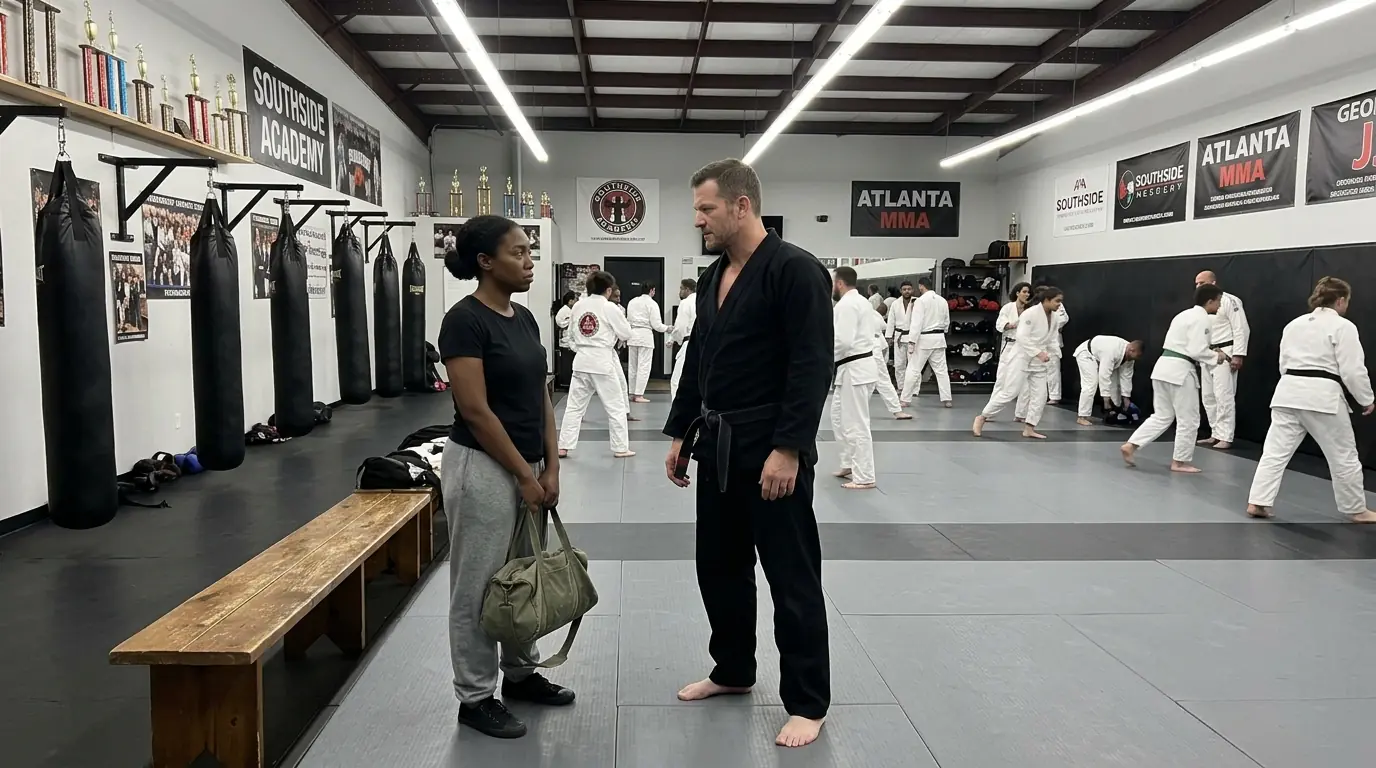
Atlanta, Southside. The kind of neighborhood where street lights flicker more than they shine, and the bus only runs twice an hour after dark. Willa Sanders lived in a one-bedroom apartment above a laundromat on Decar Street. The rent was late more months than it wasn't.
The fridge had just enough to get through the week. The hallway smelled like bleach and old carpet. She was 34 years old and worked the overnight shift at a distribution center 20 minutes outside the city, loading pallets, scanning boxes, stacking freight from 10 at night until 6:00 in the morning. Five nights a week, sometimes six when they offered overtime.
She never turned overtime down. 3 years ago, her husband passed. Heart attack at 31. No warning, no goodbye, just a phone call from a hospital and a life that split in half.
After that, Willa shrank. She stopped going out, stopped calling friends, stopped doing anything that wasn't work, sleep, groceries. Repeat. She moved through the world like she was trying not to take up space.
Head down, voice low. The kind of woman people looked straight through without seeing. But lately, something worse had started. Three times in the past month, a group of men had followed her from the bus stop to her building after her shift ended.
Calling out to her, getting closer each time. The third time, one of them grabbed her arm. She yanked free and ran up the stairs, locked the door, sat on the floor with her back against it, heart slamming, hands shaking. That night, she made a decision.
She needed to learn how to protect herself. Not tomorrow. Now. She searched online for gyms near her that offered evening classes she could attend before her shift.
Only one came up within bus distance, Ironclad MMA Academy. The website showed a clean facility, a wall of trophies, and the face of its owner grinning in a black GI, Trent Caldwell, third-degree black belt, over 10,000 YouTube subscribers. She signed up online and paid the monthly fee before she could talk herself out of it. What nobody at Ironclad would ever guess, what Willa herself had buried so deep she barely thought about it anymore was that she already knew how to fight.
Her grandfather, Colonel Herman Sanders, came home from the Korean War with two things, a Purple Heart and a deep love for martial arts he'd learned overseas. He built a training area in his backyard in Savannah. Hung a heavy bag from an oak tree. Laid old wrestling mats on the grass.
He started teaching Willa when she was six. Judo first, then Brazilian jiu-jitsu. Every Saturday morning, every summer break, every school holiday. He didn't believe in trophies or showing off.
He believed in one thing. "Skill is quiet. Let them be loud. " By 16, Willa earned her black belt.
She competed at regional level, won three tournaments in two years. She was fast, technical, and calm under pressure. Coaches said she had something you couldn't teach. An instinct for reading her opponent before they moved.
Then her grandfather passed. Then life got heavy. College debt, bad jobs, marriage, loss. The belt went into a duffel bag.
The duffel bag went under the bed. She hadn't opened it in over a decade. Now she was just a woman who worked nights and rode the bus home alone. That's who walked into Ironclad MMA Academy on a Tuesday evening.
That's who Trent Caldwell looked at and saw nothing. And that might be the most dangerous mistake he ever made because the quietest person in the room was carrying a secret that could put him on the floor. Willa showed up 15 minutes early. She wore the only athletic clothes she had.
Gray sweatpants, a plain black t-shirt, and a pair of old sneakers she kept clean for the gym. The dojo was already full. 30-something students in matching white gis warming up on the mat. Music pumping through speakers.
The walls were covered in banners, tournament wins, sponsorship logos, and a massive photo of Trent Caldwell midkick with the words discipline, power, legacy underneath. Willa stood near the entrance and waited. Nobody greeted her. Nobody even looked at her.
When Trent finally noticed her, he stopped mid-sentence, looked her up and down, took his time doing it. Help you? I signed up online, paid the monthly fee already. Trent tilted his head.
Yeah, see that online rate was a promotion. Expired last week. It's double now. The website still shows the same price.
Website's wrong. He shrugged. You want in? It's $200 a month.
You don't? Doors right there. $200. That was groceries for 3 weeks.
Willa's jaw tightened. She looked at the mat. Looked at the students. Every single one of them was watching now.
She paid. Class started. Trent ran drills in pairs. He walked the room correcting stances, adjusting grips, calling out names.
He passed Willa four times. Each time he looked right through her like she wasn't standing there. Her partner, a young guy half her age, threw sloppy technique at her the whole session. Trent saw it, said nothing.
After class, Willa approached him, calm, respectful. Excuse me. You skipped me on every drill. I'm paying the same as everyone here.
Trent was holding his phone, recording. The red light was on. He didn't lower it. Sweetheart, I run this floor.
You don't tell me how to teach. He raised his voice so the room could hear. You want to prove you belong? Get on the mat.
Let's spar just for fun. A few students laughed. Someone whispered. Nobody stepped in.
Willa looked at the camera, looked at the mat, looked at the man who had just turned her into content without asking. She should have walked out. Any reasonable person would have. But Willa Sanders was done walking away from things.
Trent didn't waste time. He snapped his fingers at one of his senior students. Get her some gear. The student came back with a chest protector two sizes too big and a headguard with a cracked strap.
Willa put them on without a word. The chest protector hung off her like a vest on a scarecrow. Trent looked at the camera propped on the shelf behind him. The red light was still blinking.
He adjusted his GI, tightened his belt, and stepped to the center of the mat. "All right, everybody, circle up. We got a special guest tonight. " The students gathered around the edge.
Some sat, some leaned against the wall. A few had phones out. One guy in the back was already recording. Trent bowed slow, exaggerated, like he was performing for a crowd at Madison Square Garden.
Whenever you're ready, sweetheart. Willa stepped to the center, hands up, feet apart, no expression. Trent threw a light front kick, barely touched her. He spun around with his hands up like he just landed a knockout.
The class laughed. He winked at the camera. "See that? That's called a jab.
Most people train two years before they can even block one. " He threw another, then another. Playful, flashy, the kind of technique designed to look good on camera, not to teach anything. Each time he landed, he'd pause, look at the students, and nod like he'd just proven a point.
Willa absorbed everyone, moved just enough to stay balanced, said nothing. Did nothing. Just watched. Here's the thing.
Sponsors were reaching out. Local news featured him twice. He was building something. Then the views dropped.
The algorithm stopped pushing his content. His last 10 videos barely cracked 1,000 views each. Two sponsors pulled out. A third stopped returning emails.
He needed a new angle, something raw, something that would hit the trending page. And 3 weeks ago, he found it. Open challenge content. Bring in someone who doesn't belong.
Film the mismatch. Play the generous coach who gives a free lesson to a beginner. Inspirational clickbait. Easy views.
Willa wasn't a student to him. She was a thumbnail. The out-of-shape woman in borrowed gear getting a lesson from a real black belt. He could already see the title.
Black belt teaches humble lesson to beginner mom. He could already count the clicks. So he turned up the pressure. The kicks got harder, faster, less playful.
A roundhouse caught Willa in the ribs. She stumbled sideways. The sound was sharp. Skin on skin.
The slap of impact echoing off the walls. She winced. Caught her balance. Didn't go down.
Trent circled her. Come on. You said you wanted a class. This is the class.
Another kick. This one to the thigh. Hard enough to leave a bruise by morning. Willa's leg buckled for a second, but she stayed up.
Someone in the crowd shifted uncomfortably. Nobody said stop. You can quit whenever you want, Trent said loud enough for the camera, soft enough to sound generous. No shame in it.
Willa didn't quit. She kept her hands up and her mouth shut. That made it worse because Trent didn't want a fight. He wanted a reaction.
He wanted her to cry, to beg, to walk off the mat so he could post the clip with a caption about resilience and discipline and how his dojo builds character. He needed her to break. She wouldn't break. So, he broke the rules.
Trent shot forward. A sweep to the ankle so fast Willa had no time to read it. Her feet went out from under her. She hit the mat flat on her back.
The impact echoed through the room. The air left her lungs in one sharp gasp. For two seconds, she didn't move. Trent stood over her, arms spread wide, chest out, grinning at the class like he'd just won a championship.
And that, he said loud and slow, is why we train. A few students clapped. One whistled. The guy in the back was still recording.
Trent reached a hand down, not to help, to perform. The generous champion offering mercy to the fallen beginner. Content gold. Willa looked at his hand.
She didn't take it. She stood up on her own. Slowly pulled off the oversized chest protector, set it on the mat, pulled off the cracked headguard, set it beside the protector. Her ribs ached, her back was on fire, her right thigh was already swelling.
She looked at Trent, looked at the camera, looked at 30 faces that had watched a man twice her training level beat on her for content and done nothing. She picked up her bag from the floor where he had thrown it earlier, walked to the door, stopped, didn't turn around. I'll be back, she said. Not loud, not angry, not dramatic, just a fact.
Like telling someone it's going to rain. The door closed behind her. Trent laughed. "Sure you will.
" He walked to the camera, stopped the recording, and replayed the footage. He was already planning the edit, the thumbnail, the title. He didn't hear what she said. Not really.
He heard a woman making an empty threat on her way out the door. But that wasn't a threat. That was a promise. And Willa Sanders had never broken a promise in her life.
Willa drove home in silence. No radio, no phone, just the sound of her own breathing and the ache spreading across her ribs with every inhale. She sat in her apartment for a long time, lights off, still in the same sweatpants, still smelling like that dojo floor. Then she walked to the bedroom closet, reached to the back, pulled out a duffel bag she hadn't touched in over 10 years.
She sat on the bed and unzipped it slowly. Inside a folded GI yellowed at the collar, a pair of worn grappling gloves, and at the very bottom, wrapped in a hand towel, her grandfather's black belt, faded, frayed at the edges, still holding the shape of the last knot he ever tied. Underneath the belt was a note, his handwriting shaky but clear. "Skill is quiet.
Let them be loud. " Willa held the belt to her chest and closed her eyes. For the first time in years, she could hear his voice. Not the words, the tone.
Calm, steady, the way he sounded every Saturday morning in the backyard before a session. She picked up her phone and called a number she hadn't dialed in years. Coach Enrique Vasquez, her grandfather's oldest friend, retired MMA coach, now running a free gym in a church basement across town. He picked up on the second ring.
Enrique, it's Willa, Herman's granddaughter. Silence, then a long breath. I know who you are, baby girl. I've been waiting for this call.
3 weeks. That's all she had before Trent posted the video and dared her to come back. Three weeks to wake up everything she'd buried. The question wasn't whether she still had it.
The question was whether she was ready to let the world see it. 3 weeks later, Trent posted the video. He titled it black belt gives free lesson to woman who walked in off the street. Thumbnail him standing over Willa on the mat, arms spread, grinning, her flat on her back.
The word humbled in red block letters across the bottom. It did numbers, not viral, but enough. 40,000 views in two days. The comments were split.
Half praised Trent for keeping it real. The other half called him a bully. He didn't care either way. Views were views.
Then he posted a follow-up 15-second clip. Just him standing in the dojo pointing at the camera. Yo, to the lady from last week, you said you'd be back. I'm waiting.
Open invitation anytime. Let's run it again. He tagged it #Ironclad challenge, pinned it to his page. 2 days later, Willa replied, one sentence in the comments.
Saturday, 7:00 p.m. The post exploded. Shares, reposts, quote tweets. By Friday night, every martial arts page in Atlanta had picked it up.
Trent promoted it like a title fight. He printed flyers. He streamed a countdown on his channel. He told his students to bring friends.
Saturday came. The dojo was packed. Double the usual crowd. Over 60 people pressed along the walls.
Students, friends, strangers, content creators with ring lights and tripods. The energy was loud and electric. Someone had brought a portable speaker playing walkout music. Trent was already on the mat.
Full competition, G. Fresh black belt. He was shadow boxing, rolling his shoulders, bouncing on his toes, playing the part, looking like the main event. Then Willa walked in.
The room got quieter. Not silent, not yet. But the volume dropped like someone turned a dial. She was carrying a gym bag, old faded green canvas.
She set it on the bench, unzipped it, and pulled out a GI. Not new, not white. Yellowed at the collar, soft from a thousand washes, her grandfather's GI. She put it on slowly, carefully, like she was putting on armor.
Then she reached into the bag and pulled out the belt, faded black, frayed at the edges. She tied it around her waist with a knot so practiced her hands didn't shake once. The room went quiet. Trent saw the belt.
His grin dropped for half a second. Just half. Then it came back wider than before, but something behind his eyes shifted. Nice costume, he said.
Let's see if it's real. Will stepped onto the mat. No borrowed gear this time. No oversized chest protector.
No cracked headguard. Just the GI, the belt, and bare feet on the canvas. They faced each other. Trent didn't bow this time.
He dropped straight into a fighting stance. Left foot forward, hands high, weight on his back leg. Taekwondo base. He was done performing generosity.
This was about dominance. He opened fast. A spinning back kick aimed at her midsection. The kind of technique that looks devastating on camera and drops beginners cold.
It was fast. It was clean. It would have ended most people. Willa shifted her weight two inches to the left.
The kick sailed past her ribs close enough to move the fabric of her GI. She didn't flinch. Trent reset. Threw a roundhouse to the head.
Fast committed. She ducked it. Not panicked. Measured like she'd seen it before he threw it.
He threw a combination. Front kick, spinning heel, back fist, flashy, athletic. Everyone missed by inches. Willa moved just enough, never more than she needed.
The crowd started murmuring. Trent's breathing got heavier. His technique got wider. He was throwing harder, reaching further, committing more weight, trying to land something, anything that would end this before the story changed.
"Stand still," he barked. "Stop running. " Willa wasn't running. She was reading every Saturday morning for 10 years.
Her grandfather had taught her one thing above all else. Before you move, you watch. Before you strike, you understand. You don't react to what they're doing.
You react to what they're about to do. Trent loaded up one more kick. A high roundhouse, full power, aimed at her temple. His whole body rotated into it.
Both feet nearly left the ground. Everything he had. Willa caught it. Her left hand wrapped around his ankle.
Her right hand gripped his gi at the collar. In one seamless motion, weight shift, hip turn, leg sweep, she executed a textbook osoto gari, a classic judo throw her grandfather had drilled into her 5,000 times on the grass in his backyard. Trent's back hit the mat so hard the sound cracked through the room like a gunshot. Before he could breathe, Willa transitioned, ground control, knee across his chest.
She isolated his right arm, locked her legs around it, arched her hips, and sank an armbar so clean it belonged in a textbook. Trent's face twisted. His free hand slapped the mat three times. Fast, desperate.
Tap, tap, tap, 8 seconds. From catch to submission, 8 seconds. Willa released the armbar. Stood up, stepped back.
The dojo was silent, not quiet. Silent. The kind of silence that has weight. The kind you feel pressing against your eardrums.
60 people, phones in the air, mouths open, nobody moved, nobody spoke. Then from somewhere in the back, one person started clapping. Then another. Then the whole room erupted, cheering, screaming, stamping feet on the floor.
Willa didn't celebrate, didn't raise her arms, didn't look at the crowd. She walked to the bench, folded her grandfather's GI, placed the belt on top, put them back in the bag. She walked out the same door she'd walked in. Trent stayed on the mat, sitting, holding his arm, staring at the floor.
The camera on the shelf was still recording, the red light still blinking. Within 1 hour, four different angles of the fight were online. By midnight, it passed 500,000 views. By Monday morning, 2 million.
#DojoSilence trended nationally. Sports blogs picked it up. MMA forums broke it down frame by frame. News outlets ran the clip on morning shows.
Everyone wanted to know the same thing. Who is she? Willa didn't do interviews, didn't post online, didn't respond to a single message, but someone else did. The next morning, Willa's phone buzzed with a voicemail from a number she didn't recognize.
A calm voice, professional, cold. Ms. Sanders, this is Nathan Caldwell, attorney at law. My client, my brother, intends to pursue legal action against you for aggravated assault.
You'll be hearing from us. The voicemail played three times before Willa set the phone down. She sat at her kitchen table, still in her work uniform, still smelling like cardboard and warehouse dust. The sun wasn't up yet.
The apartment was quiet except for the hum of the refrigerator and the sound of her own breathing. Aggravated assault. The words sat in her chest like a stone. She hadn't started the fight.
She hadn't thrown the first strike. She hadn't even wanted to be on that mat. But none of that mattered now because the story was already being rewritten. Nathan Caldwell moved fast.
By Monday afternoon, he had filed a civil lawsuit in Fulton County Superior Court. The complaint was 12 pages long. It alleged that Willa Sanders, a woman with no professional fighting record and no registered affiliation with any martial arts organization, had entered Ironclad MMA Academy under false pretenses and used excessive unreasonable force during what was clearly a casual consensual demonstration. The language was careful, clinical, designed to make a judo throw and an armbar sound like a premeditated attack.
But the paperwork was only half the strategy. The other half was the edit. Trent had 60 people recording that night. Most of those clips showed the full sequence, the dare, the taunts, the 8-second takedown.
But Trent had his own footage, the camera on the shelf, his angle, his edit. Nathan cut it down to 45 seconds. The new version started after the dare, after the taunts, after everything that gave context. It opened with Willa stepping onto the mat, looking focused and aggressive.
It showed her catching the kick, slamming Trent to the ground and locking the armbar while he screamed. It ended with Trent on the mat, holding his arm. Hurt, alone, no setup, no insults, no let's spar for fun, just a woman attacking a man in his own gym. Nathan sent the edited clip to three local news outlets with a press statement.
My client, a respected martial arts instructor and small business owner, was violently assaulted during a friendly training exercise. He is pursuing all legal remedies available. Two stations ran it. The segment aired Tuesday evening.
Anchor voice, serious tone. The edited clip playing on a loop behind the headlines. Local gym owner hospitalized after violent sparring incident. Hospitalized.
Trent hadn't been hospitalized. He'd gone to an urgent care clinic, got an X-ray that showed no fracture, and left with a standard arm sling. But Nathan made sure he wore that sling everywhere. The podcast, the grocery store, the gas station.
Social media photos showed Trent wincing while opening a car door, struggling to lift a coffee cup, looking at the camera with sad, wounded eyes. The narrative flipped overnight. Comments poured in. Not on the original viral clip, on the news story, on Trent's Instagram, on the reposted edit.
She walked in there looking for a fight. That wasn't self-defense. That was assault. He was just trying to teach her and she snapped.
Ban her. Lock her up. The people who had cheered 8 seconds ago were now calling her a criminal. Trent went on a podcast that Thursday.
Local sports show. 40,000 listeners. He showed up in the sling, voice soft, eyes red like he'd been crying before the interview. I just I try to run a place where people feel welcome, you know.
I invited her to train. I thought it would be fun. I never expected. He paused, swallowed, looked at the floor.
I never expected to get hurt like that in my own gym in front of my students. The host nodded, sympathetic. Do you feel safe going back? Trent shook his head.
Honestly, no, I don't. The clip from the podcast went viral. 3 million views, bigger than the original fight. The comments were brutal toward Willa.
Meanwhile, Willa's life was collapsing. Her supervisor at the distribution center called her into the office Wednesday morning. He didn't sit down. Didn't offer her a seat either.
Willa, this situation, the lawsuit, the news, it's creating a distraction. Corporate wants you off the floor until this is resolved. Unpaid administrative leave. Effective immediately.
I didn't do anything wrong. That's not for me to decide. Go home. We'll be in touch.
She turned in her badge at the front desk, walked to the bus stop, sat there for 40 minutes in the heat, waiting for a bus that was late. Her phone buzzed the whole time. Notifications, tags, messages from people she didn't know. Most of them angry, a few threatening.
She turned the phone off and put it in her pocket. At home, it got worse. Her neighbor across the hall, a woman she'd said good morning to every day for 2 years, saw her in the stairwell and turned around without speaking. The next day, someone left a note under her door.
No signature, just five words. We don't want trouble here. Willa sat on her bed that night and stared at the ceiling. The duffel bag was still open on the floor.
Her grandfather's belt was still on top. She thought about quitting, letting it go. Dropping the whole thing and disappearing back into the quiet, invisible life she had before. Nobody would notice.
Nobody would care. Then her phone rang, a number she didn't recognize. She almost didn't answer. Miss Sanders, my name is Claudia Jameson.
I'm a civil rights attorney. Enrique Vasquez gave me your number. Willa didn't speak. I've seen the original footage, all of it, every angle, and I've seen what they did to it.
Claudia's voice was steady, controlled, the kind of calm that comes from years of walking into rooms designed to keep people like her out. What they're doing to you is textbook. Provoke, edit, litigate. I've seen it before.
I can't afford a lawyer. I'm not asking you to pay me. I'm asking you to let me fight for you. Silence.
Ms. Sanders, I need to ask you one question. The dojo that night, was there anyone else there? Anyone official, police, security, anyone outside the gym?
Will thought, closed her eyes, tried to replay the night, the noise, the crowd, the parking lot. After there was a cop, she said slowly. A woman. She came to the door during the fight.
Someone in the building called about the noise. She stood in the doorway for maybe a minute, then left. Claudia went quiet for 3 seconds. When she spoke again, her voice had changed.
Sharper, faster. Do you remember if she was wearing a body camera? Will closed her eyes again, pictured the officer in the doorway, the uniform, the belt, the small black device clipped to her chest with a blinking green light. Yeah, Willa said she was.
Trent and Nathan had built their entire case on a 45-second edit. They'd cut the dare, cut the insults, cut every word that proved Willa didn't start this. But what they didn't know, what they had no way of knowing was that a police body camera had recorded everything. Every word, every taunt, every second of truth they tried to erase.
The hearing was scheduled for a Thursday morning in Fulton County Courthouse. Room 4B. Small, no jury, just a judge, two tables, and a gallery that seated maybe 40 people. Nathan Caldwell arrived first.
Navy suit, polished shoes, leather briefcase. He set up his table like a man who had done this a hundred times. Documents in order, tablet propped at an angle, two bottles of water lined up side by side. Trent came in behind him, sling still on, he walked slowly, carefully, wincing when he sat down, even though the armbar had been 5 weeks ago, and the X-ray had shown nothing.
He looked around the room with soft eyes. The victim, the small business owner, the man who opened his doors to a stranger and got hurt for it. Willa arrived with Claudia Jameson. No briefcase, no tablet, just a manila folder, a legal pad, and the look of a woman who hadn't slept in weeks, but had decided that today she was done being quiet.
The gallery was full. Reporters, bloggers, a few martial arts influencers who had followed the story, two sketch artists. The bailiff had to turn people away at the door. Nathan opened strong.
He played the edited clip on a mounted screen. 45 seconds. No dare, no insults. Just Willa stepping onto the mat, catching the kick, slamming Trent to the ground, locking the armbar, Trent tapping, Trent screaming, Trent on the floor holding his arm.
"Your honor, what you just watched is an unprovoked attack. " Nathan said, "My client, a licensed martial arts instructor, a business owner, a man who has served this community for over a decade, invited this woman to participate in a casual training demonstration. She responded with a level of force that was excessive, dangerous, and entirely unjustified. " He called his first witness, a senior student from Ironclad.
The student confirmed that the sparring session was casual, that Trent was going easy, that Willa escalated without warning. He called a second witness. Another student, same story, rehearsed. Word for word almost identical.
Nathan returned to his table, straightened his tie. Your honor, we believe the evidence is clear. Miss Sanders entered that gym with intent to harm. We are seeking damages for medical expenses, emotional distress, and loss of business revenue.
The judge turned to Claudia. Counselor. Claudia stood. She didn't rush, didn't raise her voice.
She buttoned her jacket and stepped around the table like she had all the time in the world. Your honor, opposing council just showed you 45 seconds of footage. I'd like to show you what happened before those 45 seconds. Nathan's pen stopped moving.
The defense calls officer Brenda Holloway. The courtroom shifted. Nathan looked at Trent. Trent looked at Nathan.
Neither one moved. Officer Holloway walked in through the side door. Full uniform badge, calm expression. She took the stand, placed her hand on the Bible, and sat down.
Claudia approached. Officer Holloway, were you present at Ironclad MMA Academy on the night of March 14th? Yes, ma'am. I responded to a noise complaint from the business next door.
Arrived at approximately 7:45 p.m. And when you arrived, what did you observe? A large crowd inside, loud music, two individuals on a mat, a man in a black GI, and a woman in an older GI. The man appeared to be taunting the woman.
"Were you wearing your body camera that evening?" "Yes, ma'am. It was activated when I arrived on scene. " Claudia turned to the judge.
"Your honor, I'd like to enter Officer Holloway's body camera footage into evidence, full and unedited. " Nathan stood. Objection. This footage was never disclosed during It was requested through proper channels 3 weeks ago, your honor.
The police department confirmed receipt. The judge looked at Nathan. Overruled. Play the footage.
The screen changed. The body camera footage was shaky at first. Holloway walking through the parking lot, pushing open the glass door. The sound hitting immediately.
Music shouting, cheering. Then Trent's voice clear as daylight. You want to go? Fine.
Get on the mat. Let's spar just for fun. The camera caught everything. Trent circling Willa, taunting her, the students laughing, and then the moment that broke the case wide open.
Trent leaned in close to Willa, close enough that only the body cam mic picked it up. His voice dropped to a whisper that carried like a shout in the silent courtroom. "Hit me for real. Make it look good for the camera.
" The gallery gasped. Not one gasp, a wave. 40 people inhaling at once. Nathan's face went white.
Trent's jaw locked. His good hand gripped the edge of the table. Claudia let the silence sit for three full seconds before she spoke again. Your honor, I have three additional witnesses, former students of Ironclad MMA Academy.
All three are prepared to testify under oath. She called them one by one. The first, a 26-year-old woman named Paige Thornton. She testified that Trent had challenged her during her second week at the gym.
She sustained a sprained wrist. When she complained, Trent told her to sign a document. She didn't read it. It was an NDA.
The second, a 19-year-old college student named Devin Marshall. Same story. Open challenge. Got hurt.
Signed an NDA the next day. Was told if he didn't sign he'd be banned from every gym in the city. The third, a 31-year-old named Grace Whitfield. She had been a member for eight months.
She testified that Trent staged at least four challenge videos during her time there. Each one targeted someone new, someone who didn't fit, someone he could use. Every single time, Grace said, her voice steady, he picked somebody who looked like they didn't belong. Then he filmed it, posted it, and if anyone got hurt, his brother made them sign papers.
The courtroom was dead still. Claudia turned to the judge. Your honor, the plaintiff didn't come to this court seeking justice. He came here to finish what he started on that mat, to silence a woman who fought back.
Every piece of evidence shows that Mr. Caldwell initiated the confrontation, consented to the sparring, and deliberately escalated the encounter for content. Ms. Sanders acted in self-defense, nothing more.
The judge looked at Trent for a long time, then at Nathan, then at the screen where the body camera footage was frozen on Trent's face, mid grin, mid dare. Case dismissed. I'm referring Mr. Caldwell's business practices to the state athletic commission for review.
He paused, looked directly at Nathan. And counselor. Submitting selectively edited footage to this court and to the media raises serious questions about your professional conduct. I'll be forwarding my concerns to the state bar.
Nathan didn't respond. Trent didn't move. The sling hung on his arm like a costume nobody believed anymore. Willa stood up.
She didn't smile. Didn't celebrate. She looked across the aisle at Trent. The man who had called her an animal, thrown her bag on the floor, beat on her for content, and then sued her for fighting back.
She said one sentence, quiet, clear. The whole room heard it. "I didn't come here to beat you. I came here to take a class.
" She picked up her folder and walked out. That one sentence hit harder than any armbar ever could. She didn't want revenge. She didn't want fame.
She didn't want his gym or his money or his reputation. She just wanted to learn. And he turned that into a war he was never going to win. The courthouse steps were crowded.
Reporters, cameras, microphones pushed toward anyone walking out the door. Willa didn't stop. She walked straight through the crowd, eyes forward, mouth shut. Claudia stayed beside her, one hand on her shoulder, guiding her toward a car parked at the curb.
Someone shouted a question. "Miss Sanders, how does it feel to win? " She didn't answer. She got in the car and closed the door, but the world answered for her.
Within an hour, the body camera footage leaked. Not from Claudia, not from the court. Someone in the gallery had recorded the screen with their phone. Shaky, grainy, but every word was clear.
"Hit me for real. Make it look good for the camera. " That one line did what no press statement ever could. It burned through the internet like a lit match dropped in dry grass.
By Thursday evening, #DojoSilence was trending again, but this time a new hashtag joined it. #JusticeForWilla. By Friday morning, it was the number one trending topic in the United States. The original viral clip, the real one, the full 8-second takedown with all the context, resurfaced everywhere.
People reposted it side by side with Nathan's 45-second edit. The comparison was devastating. You could see exactly what had been cut, exactly what had been hidden, exactly how the lie was built. Trent's world collapsed fast.
His YouTube channel lost 4,000 subscribers in 48 hours. His remaining sponsors pulled out by Friday afternoon. The gym's Google rating dropped from 4. 6 to 1.
2 overnight. Hundreds of one-star reviews flooding in from across the country. The state athletic commission launched a formal investigation into Ironclad MMA's practices, unlicensed sparring events, undisclosed injuries, coerced NDAs. Three former students filed individual complaints.
Two more were preparing to. By the following Monday, Trent Caldwell closed the doors of Ironclad MMA Academy. No announcement, no farewell post, just a padlock on the front door and a handwritten sign that read closed until further notice. It never reopened.
Nathan Caldwell didn't fare much better. The judge's referral to the state bar triggered a formal ethics investigation, submitting edited evidence, misleading media statements, two prior complaints already on his record. His law license was suspended pending review. The brothers who had built their careers on intimidation and performance were dismantled in less than two weeks.
Not by fists, not by force, by the truth. Meanwhile, Willa got a phone call from her supervisor at the distribution center. Different tone this time. Willa, we'd like you to come back.
Full reinstatement. Back pay for every shift you missed. We We should have handled this differently. She went back, clocked in that night like nothing had changed.
Same pallets, same boxes, same fluorescent lights buzzing overhead. But something had changed. The people on the floor looked at her different now. Not with pity, not with suspicion, with respect.
Two weeks after the hearing, Coach Enrique called Willa, the church basement gym. It's too small for what's coming. I've been getting calls. Women from all over the city wanting to train, wanting what you showed them was possible.
They built it together, Willa and Enrique. A free self-defense program operating out of the community center on Auburn Avenue. They called it the Sanders program, named after her grandfather, the man who taught her everything on a patch of grass in Savannah. Classes ran three nights a week, open to any woman.
No membership fees, no contracts, no NDAs, just a safe room, clean mats, and someone who understood what it meant to walk home alone at night. The first class had 12 women. The second had 30. By the end of the month, they had a waiting list.
The city council took notice. A councilwoman from district 5 proposed a resolution to fund community-based self-defense programs across Atlanta's underserved neighborhoods. She cited Willa's story by name. The resolution passed unanimously.
#StandUpOnTheMat spread nationally. Gyms in Chicago, Houston, Baltimore, and Oakland launched free programs inspired by the Sanders program. Women posted videos of their first classes, their first throws, their first moments of feeling something they hadn't felt in years. Safe.
Then one evening, Willa came home from a shift and found a letter in her mailbox, official letterhead, the National Martial Arts Federation. They were inviting her to speak at their annual conference in Washington, DC. She almost threw it away. Almost.
Then she looked at the duffel bag sitting by the door, the one she hadn't been able to put back in the closet since the night she opened it. Her grandfather's belt was still on top, faded, frayed, still holding the shape of the last knot he ever tied. The conference hall in Washington, DC held 2,000 seats. Every one of them was full.
Willa stood backstage. She was wearing a simple black dress and flat shoes. No makeup team, no stylist, no entourage. Just her, a glass of water, and the faded black belt folded inside her bag.
Coach Enrique had flown in from Atlanta. He sat in the third row, arms crossed, nodding slowly before she even started speaking. Claudia Jameson was two rows behind him. Officer Holloway was near the back, out of uniform for the first time since Willa had met her.
The MC introduced her. Read the bio Willa had written herself. Three sentences. Warehouse worker, granddaughter of a veteran, founder of the Sanders program.
No titles, no trophies, no exaggeration. Willa walked to the podium, set down a single index card, looked out at 2,000 faces looking back at her. She didn't read from the card. My grandfather taught me how to fight in his backyard.
She said, "He didn't have a gym. He had an oak tree and some old mats. He didn't have students. He had me.
" She paused. He never told me I was strong. He never told me I was special. He told me one thing every single Saturday morning before we started.
He said, "Skill is quiet. Let them be loud. " The room was still. I forgot that for a long time, 10 years.
I put his belt in a bag and I put the bag under my bed and I tried to be invisible. I thought if I was quiet enough, small enough, if I didn't take up too much space, the world would leave me alone. She looked down, then back up. It didn't.
A few people in the front row wiped their eyes. A man looked at me and saw nothing. He saw my skin and decided what I was worth. He saw my clothes and decided where I belonged.
He saw a woman standing alone in his doorway and thought, "Content. " Her voice didn't shake. It didn't rise. It stayed level, steady, the way her grandfather used to sound on those Saturday mornings.
But I wasn't nothing. I was never nothing. I was just quiet. And quiet is not the same as empty.
She picked up the index card, flipped it over, read the only thing written on the back. This card says, "Don't forget to say thank you. " She smiled. The first real smile anyone had seen from her in months.
So, thank you to Enrique who picked up the phone, to Claudia who picked up the case, to Officer Holloway who turned on a camera, and to my grandfather who gave me everything I needed and then trusted me to remember it. She folded the card, put it in her pocket. If you're sitting out there right now and you feel invisible, if someone has made you believe you don't belong somewhere, I need you to hear me. You belong.
Your skill belongs. Your presence belongs. And if anyone ever tells you different, you don't have to be loud about it. You just have to be ready.
2,000 people stood up at once. The applause didn't build. It erupted like the room had been holding its breath the entire time and finally let go. Willa stepped away from the podium, walked backstage, set her bag on a chair and unzipped it, took out her grandfather's belt, held it for a moment, then folded it carefully and put it back.
She didn't need to carry it anymore. She had become what it represented. "Hands on the wall now. You people always creeping around where you don't belong, like roaches.
" The officer slammed the black man against the brick hard. The man's groceries scattered across the sidewalk. Officer, I I live here. Let me shut your mouth.
I don't care where you think you live. A monkey in a suit is still a monkey. Turn around. Two neighbors stood on their porches, watching a Black man get shoved into a wall in broad daylight.
Nobody said a word. The man pressed against that wall didn't yell. He just said quietly, "Be careful with the jacket, officer. " Hadley ripped it open anyway.
A wallet tumbled out, hit the concrete, fell open under the street light. Something gold flashed. Hadley didn't see it. But what was inside that wallet was about to make this the worst night of his entire career.
Let me take you back to the beginning. Before the wall, before the badge, before any of it. Wesley Turner was 38 years old. Tall, athletic build, clean shaven.
The kind of man who walked into a room and stood straight, shoulders back, eyes forward, hands still. Not because he was trying to impress anyone. That's just how he carried himself. Like every step he took had a purpose.
On this particular Tuesday evening, Wesley was doing something remarkably ordinary. He was walking home from a corner store six blocks from his house, a paper bag of groceries in one hand, a bottle of sparkling water poking out the top. He was wearing a fitted charcoal blazer over a plain black t-shirt. Nothing flashy, nothing unusual, just a man walking home to make dinner.
Wesley had moved to Brierfield Heights 3 months earlier. If you've never heard of Brierfield Heights, picture this. A quiet suburb just outside Richmond, Virginia. Manicured lawns, American flags on every other porch.
Little security company signs staked into front yards like they were part of the landscaping. The kind of neighborhood where people smiled at you if they recognized you and stared at you if they didn't. And here's a detail that matters. In the 12 months before Wesley moved there, residents of Brierfield Heights had called 911 three separate times to report suspicious individuals.
All three times the person they reported was a Black man. All three times the man either lived in the neighborhood or worked there. All three times, no charges were filed. Not one.
That's the kind of place Wesley moved into. A place where being unfamiliar and being black meant the same thing to some people. Now, there's something about Wesley you need to understand. Something the outline won't tell you outright just yet.
Wesley was the kind of person who noticed things other people missed. License plates, body language, the way someone shifted their weight right before they lied. When he walked into a room, the first thing he did before he said hello before he sat down was map the exits every time. It wasn't paranoia.
It was habit. A deep, trained bone-level habit that had been drilled into him for over a decade. You might think, okay, maybe he's ex-military. Maybe he's just hyper aware from living as a Black man in America, which honestly trains you to notice everything whether you want to or not.
Both of those are reasonable guesses, but neither one is the full answer. Not even close. Keep that in the back of your mind. It's going to matter.
While Wesley walked home that evening, a woman named Tamara Hollands was watching him from behind her screen door. Tamara was 55, retired school teacher, lived on Magnolia Drive for over 20 years. She saw Wesley walking past her house, tall black man, nice blazer, paper bag, walking slowly, and she picked up her phone. She didn't call to say hello.
The 911 call was short. A woman reports a tall Black male possibly casing houses on Magnolia Drive. The dispatcher asks a standard question. Has the man done anything threatening?
There's a pause. Then Tamara says, "No, but he doesn't look like he lives here. " That's it. That was the whole basis.
He doesn't look like he lives here. Now, let me introduce you to the other side of this story. Officer Derek Hadley, 32 years old, 5 years on the force, blonde, buzzcut, mirrored sunglasses perched on his forehead, even though the sun was already going down. The kind of guy who talked louder than everyone in the room and never seemed to notice or care.
Hadley was mid-shift, riding in his patrol cruiser with his partner Craig Bowen, 29. Hadley was telling some story, laughing too hard at his own jokes, one hand off the steering wheel, filling the car with noise. Bowen was quieter, the kind of partner who laughed along but never added much. A follower.
One detail, Hadley's body camera was on, but it was angled slightly off center, tilted just enough that the frame didn't quite capture what was directly in front of him. Maybe it shifted during the drive. Maybe it didn't. Either way, remember that it's going to come up later.
The dispatch call crackled through the radio. Suspicious person, Magnolia Drive, tall Black male. Hadley grinned. Let's go see what we got.
His tone wasn't serious. It was eager, almost entertained. Bowen shifted in his seat, but didn't say anything. And two blocks away, Wesley Turner adjusted his blazer.
Specifically, he padded the inner left pocket. A small, quick, habitual gesture, like checking for his keys, except it wasn't keys. If you watched that moment on camera, you wouldn't think twice about it. Just a man adjusting his jacket.
But if you watched it again after hearing the rest of this story, you'd understand exactly what was in that pocket, and you'd realize Wesley Turner had been carrying the answer the whole time. The patrol car pulled up behind Wesley about halfway down Magnolia Drive. No sirens, just headlights flooding him from behind, stretching his shadow long across the pavement. Wesley stopped walking.
He didn't turn around immediately. He took a breath first. Slow, deliberate, then turned to face the lights. His hands were already visible.
Grocery bag in one hand, the other open at his side. This wasn't his first time being stopped. His body already knew the choreography. Stay still.
Stay visible. Don't make sudden movements. Don't give them a reason. Hadley stepped out of the cruiser.
His hand rested on his belt. Not on his weapon, not yet, but close enough to make a point. He left the door open. The radio hummed behind him.
"Evening. You live around here? " It wasn't really a question. It was a challenge.
The tone said, "I already know the answer, and I don't believe whatever you're about to tell me," Wesley answered calmly. "Yes, officer. I live on Birch Lane, just walking home from the store. " He lifted the grocery bag slightly.
A reasonable gesture, a normal answer to a normal question. Hadley didn't acknowledge it, didn't nod, didn't say okay. He just stared at Wesley for a beat too long, then said, "Let me see some ID. " Wesley nodded.
And then he did something very specific, something that at this point in the story seems like nothing more than a man being careful. He narrated his own movements out loud. I'm going to reach into my inner left jacket pocket for my wallet slowly. He said it clearly, deliberately, like he'd said it before, like the words were rehearsed, not from fear, but from training.
But right now, standing on a suburban street with a cop staring him down, it just looked like a Black man protecting himself from being stopped during a routine stop. And honestly, both of those things were true at the same time. Wesley reached into his blazer slowly. Two fingers.
He pulled out a leather wallet and handed over his driver's license. Hadley looked at the ID, looked at Wesley, looked at the ID again, then this says Birch Lane. That's correct. You just moved here about 3 months ago.
Hadley tilted his head. 3 months and nobody on this street knows you. That's interesting. Wesley didn't respond to that.
There was nothing to respond to. It wasn't a question. It was an accusation dressed up as curiosity. Hadley turned to Bowen, who was still standing near the passenger side of the cruiser.
Run this. He handed over the license. Bowen took it back to the car without a word. And there stood Wesley Turner, alone in the middle of the street, lit up by headlights like he was on a stage, a paper bag of groceries hanging from one hand.
A car passed on the next block. The driver slowed down, looked, kept going. This is what humiliation looks like when it's not loud. It's not always a shout or a slur.
Sometimes it's just standing in a spotlight you didn't ask for while a stranger decides whether you deserve to exist in your own neighborhood. Wesley waited. Then he asked politely precisely. Officer, am I being detained?
Because if not, I'd like to continue walking home. It was a legal question, textbook, the kind of sentence that comes from knowing your rights inside and out. But Hadley didn't hear a legal question. He heard defiance.
His posture changed, shoulders squared, jaw tightened. He stepped closer. Close enough that Wesley could smell the coffee on his breath. I'll tell you when you can go.
We got a call about someone matching your description. So, you're going to stand right there until I say otherwise. You understand me? Wesley's jaw tightened, but he didn't move.
Didn't argue, didn't escalate. Then his phone buzzed in his pocket. Just a vibration. Wesley's eyes dropped for half a second.
Instinct, nothing more, and that was enough. Hadley's hands snapped to his holster. Don't move. Wesley froze.
His hands went up immediately, open palms. It's my phone, officer. Just my phone. Hadley kept his hand on the holster for three full seconds before pulling it away.
3 seconds. That doesn't sound like a lot, but when a man with a gun is staring at you because your phone buzzed in your pocket, 3 seconds is a lifetime. Bowen came back from the cruiser. His voice was flat, almost bored.
He's clean. No warrants, no record. Address checks out. This should have been the end.
ID confirmed. Record clean. Address matches. There was nothing.
Literally nothing left to investigate. The call was a description match. The description matched. The man was who he said he was.
It was over. Except it wasn't. Hadley paused. A long pause.
The kind of pause where you can see a man choosing to ignore the facts in front of him. Then he said something that might be the most revealing line in this entire story. All right, but something's off about you. Why are you so calm?
Let that sit for a second. Wesley Turner had done everything right. He complied. He identified himself.
He narrated his own movement so he wouldn't get shot reaching for his wallet. His record was clean. His address was confirmed. And the officer's response to all of that, to a man being perfectly, completely cooperative, was suspicion because he was too calm.
Wesley almost smiled. A flicker barely there, then gone. I'm calm because I haven't done anything wrong, officer. Hadley didn't like that answer.
You could see it in the way his neck stiffened, in the way his hand drifted back toward his belt. A man like Hadley doesn't want calm. He wants fear. He wants submission.
And when he doesn't get it, he manufactures a reason to demand it. Turn around. Hands on the wall. Wesley's voice stayed level.
My record is clean. My ID checks out. The call was a description match, and I match the description. I understand that, but there's no basis for a search, officer.
I said, "Turn around. I'm not going to ask again. " Wesley held the officer's eyes for one more second. Then he turned slowly.
He placed his hands flat against the brick wall of a building on the corner of Magnolia and Birch. His grocery bag sat on the sidewalk between his feet. Hadley moved in. The pat down was rough from the first second.
Not procedural, not by the book. Aggressive. He yanked at Wesley's blazer, pulled at the pockets, squeezed the fabric like he was looking for something he already decided was there. Wesley said firmly, but without raising his voice, "Be careful with the jacket.
That set Hadley off. He heard it as an order from a suspect on his street during his stop. And Derek Hadley did not take orders from people he'd already decided were beneath him. You don't tell me what to do.
He shoved Wesley harder against the wall. Wesley's cheek hit brick. His grocery bag toppled. The sparkling water bottle hit the concrete and shattered.
Water and glass sprayed across the sidewalk. And during that shove, during that aggressive, unnecessary, violent motion, Hadley ripped the blazer open. The wallet, the same wallet from the very beginning of this story, tumbled from the inner pocket. It hit the ground, skidded two feet, and fell open.
Something gold caught the street light. Something blue. Hadley didn't see it. He was too busy pulling Wesley's arms behind his back, reaching for his handcuffs, too focused on control to notice that control was about to be ripped away from him permanently.
But across the street, a man named Earl Jennings had stepped onto his porch. 62 years old, lived on Magnolia Drive for 31 years. He'd seen officers stop black men on this street three times in the past 14 months. This time, he pulled out his phone and he pressed record.
The cuffs clicked shut around Wesley's wrists. And here's the part that will stay with you. Wesley didn't resist, didn't shout. His face was pressed against that wall, hands locked behind his back, groceries destroyed at his feet, and his eyes were open, calm, steady, scanning, like he was taking notes inside his own mind.
He had a choice in that moment. He could have said something. He could have spoken four words that would have ended this entire situation in a heartbeat, but he didn't. And there's a reason he didn't.
A reason that Derek Hadley was about to learn in the worst possible way. As Hadley walked Wesley toward the back of the cruiser, the radio crackled. But this time, it sounded different. The dispatcher's voice was tighter, more formal, like someone had just tapped her on the shoulder and handed her a script she wasn't expecting to read.
Unit 14, be advised. We have a priority inquiry from a federal agency regarding a person matching the description of your current contact. Standby for a direct patch. Hadley frowned.
Federal agency? He looked at Bowen. Bowen looked at the wallet still lying on the ground, then back at Hadley. He opened his mouth.
The radio cut in again. Unit 14. Confirm identity of individual before proceeding. Repeat.
Confirm identity before transport. Something shifted in the air. You couldn't see it, but you could feel it. The certainty that had been sitting on Derek Hadley's shoulders all night, that unearned confidence, that casual authority, it cracked.
Just a little, just enough. And for the first time since this stop began, the dread didn't belong to Wesley Turner. It belonged to the man holding the cuffs. While Hadley guided Wesley toward the backseat of the cruiser, one hand on his shoulder, the other on top of his head, pressing him down like he'd done it a hundred times before, Bowen walked back toward the wallet.
It was still lying on the sidewalk, open face up under the street light. Bowen crouched down, picked it up, and for a moment, he didn't move. He just stared at what was inside. A gold badge, an ID card with a holographic seal, a photograph.
Wesley Turner's face clean and professional and three letters printed in bold navy blue across the top. FBI, not a consultant, not a retired agent, not someone who used to work in law enforcement, a current active special agent of the Federal Bureau of Investigation. Bowen's hands went still, his fingers tightened around the wallet. He stood up slowly, the way a person stands when they've just realized they're holding a live grenade.
He turned toward Hadley, and his voice came out thin, almost cracked. "Derek, you need to stop right now. " Hadley was mid-motion. His hand was on the back of Wesley's head, guiding him into the cruiser.
"What? " he barked, not even looking. Bowen didn't answer with words. He just walked forward and held the wallet open.
"Badge out! " The gold caught the cruiser's flashing lights. Red, blue, red, blue, like it was pulsing. Hadley's eyes moved from the badge to Wesley's face.
Wesley was already seated in the back of the cruiser, cuffed, still, looking up at Hadley with the same expression he'd had the entire night, calm, patient, unbroken, like a man who had been waiting for exactly this moment, not with anger, but with something closer to certainty. Hadley stepped back from the car door, his hand dropped from the frame. He didn't speak. The narrator doesn't need to tell you what was happening inside his head.
His body told the whole story. A sharp inhale, an unconscious step backward. The kind of silence that only comes when a person realizes all at once that they have done something they cannot undo. Bowen was already on his radio, voice low, requesting a supervisor to the scene.
His hands were shaking now, too. And then from the back seat of the cruiser, still cuffed, still pressed against that hard plastic bench, Wesley spoke quietly, almost conversationally. I told you to be careful with the jacket. The same line, the exact same words he'd said minutes earlier when Hadley was yanking at his blazer, but now those words meant something completely different.
Before they sounded like a man trying to protect his clothing. Now they sounded like a warning that had already come true. The air around that cruiser changed. You could feel the power shift.
Not gradually, not in pieces, but all at once, like a trap door dropping open under Hadley's feet. The cuffs were still on Wesley's wrists, but the authority was gone. It had transferred completely, silently, and there was no getting it back. 12 minutes later, a supervisor arrived.
Sergeant Norah Swanson, 45 years old, squared away, no nonsense, the kind of officer who could read a scene in 5 seconds flat. She stepped out of her vehicle, looked at the cruiser, looked at the wallet in Bowen's hand, looked at the two officers who suddenly couldn't make eye contact with anyone, and she asked one question. Whose badge is that? Bowen nodded toward the cruiser.
Swanson's jaw tightened. She walked to the back door, opened it, and looked at Wesley. Her voice was steady, professional, but there was something underneath it. Something that sounded a lot like dread.
Sir, I'm Sergeant Swanson. I'm going to remove those handcuffs right now. Are you injured? Wesley shook his head.
The cuffs came off. Swanson turned to Hadley. She didn't raise her voice. She didn't need to.
Return to the station immediately. Do not speak to anyone until I get there. Hadley opened his mouth, then closed it. He walked to his cruiser like a man walking to his own sentencing.
Within the hour, a phone call came into the precinct. FBI Supervisory Special Agent Raymond Caldwell, Wesley's direct superior. His voice was described by the desk sergeant who answered the call as ice poured over gravel. He didn't yell, didn't threaten.
He identified Wesley, confirmed his assignment, and said one sentence. Just one. I want the body camera footage from both officers on my desk by morning. Every second of it.
That sentence didn't sound like a request. It sounded like the first page of a very long and very painful investigation. And back at the station in a break room with flickering fluorescent lights and a coffee machine nobody had cleaned in weeks, Derek Hadley sat alone. His sergeant had told him not to leave.
His partner had been separated from him. His badge and his firearm were still on him for now, but they felt heavier than they ever had before. He wasn't thinking about Wesley Turner's rights. He wasn't thinking about what he'd set on that sidewalk or how hard he'd shoved a man against a wall.
He was thinking about his pension. And somewhere deep in his gut, he already knew that pension was slipping away. Let me tell you who Wesley Turner actually is. Not the version Derek Hadley saw, a Black man in a blazer who didn't belong in a suburban neighborhood.
Not the version Tamara Holland saw, a stranger walking too slowly past her house. Not the version the 911 dispatcher logged. A tall Black male, no threat observed. The real version, the full picture.
Wesley Turner graduated magna cum laude from Howard University with a degree in criminal justice. He then earned his Juris Doctor from Georgetown Law, top 15% of his class. He passed the bar on his first attempt and instead of walking into a six-figure firm, he walked into a field office of the Federal Bureau of Investigation. That was 11 years ago.
In those 11 years, Wesley rose to the rank of special agent within the FBI's Civil Rights Division. Not the division that handles bank fraud, not counterterrorism, not cyber crime, the Civil Rights Division, the unit specifically tasked with investigating police misconduct and excessive use of force against civilians. That is what Wesley Turner did for a living. Every single day.
He investigated cops who abused their power. He built cases against officers who violated the constitutional rights of the people they swore to protect. He had testified before congressional subcommittees. He had sat across the table from police chiefs and sheriffs and internal affairs officers in a dozen cities.
He had put corrupt officers in federal prison. And on the night of this story, one of those officers slammed his face into a brick wall and called him a monkey. But here's where this story turns from painful into something else entirely. Something that made Derek Hadley's situation a thousand times worse than he could have imagined.
Wesley didn't move to Brierfield Heights because he liked the neighborhood. He didn't move there for the good schools or the quiet streets or the property values. Wesley moved to Brierfield Heights 3 months ago because the FBI sent him there. He was on assignment.
An active ongoing federal investigation. The bureau had received a cluster of complaints, multiple reports filed independently over the span of two years alleging a pattern of racially motivated stops, excessive force, and verbal abuse by officers in the local police department. The complaints came from Black residents, Latino residents, a biracial college student, a Black delivery driver. Different people, different incidents.
Same department, same pattern. The FBI opened a preliminary inquiry and as part of that inquiry, they embedded an agent in the community to observe, document, and assess the situation from the inside. That agent was Wesley Turner. So, when Wesley walked down Magnolia Drive that Tuesday evening, past the manicured lawns and the little security signs and the American flags, he wasn't just walking home from the store.
He was living inside his own case. Every walk, every interaction, every polite nod to a neighbor who didn't nod back. It was all fieldwork, all observation, all evidence. And Derek Hadley, the officer who was now sitting in a breakroom staring at a wall, hadn't just stopped the wrong person.
He had become a case study, a data point, a living, breathing exhibit in the exact investigation that was targeting his department. If this story were fiction, you'd say the irony was too perfect, too neat. But the thing about real patterns, real systemic patterns, is that they don't need coincidence. They just need time.
If an officer has a habit of targeting black men and you put a Black man in his path, the habit does the rest. Wesley didn't have to do anything. He just had to exist in that space. The system exposed itself.
Now, there's a question you've probably been asking since the cuffs went on, maybe even shouting it at your screen. Why didn't he just show the badge? It's the obvious move. The second Hadley started getting aggressive, Wesley could have said five words.
I'm a federal agent. And the whole thing would have stopped instantly. No shove, no wall, no cuffs. Five words and it's over.
So why didn't he? Three reasons, and each one matters. First, revealing his identity during a stop would have compromised the broader investigation. If Hadley or anyone in the department learned the FBI had an agent embedded in the community, evidence could disappear.
Witnesses could be pressured. The entire case, months of work, dozens of complaints could unravel overnight. Wesley's silence wasn't passivity. It was operational security.
Second, and this one cuts deeper, Wesley understood something that most people don't have to think about. If he flashed his badge to escape the situation, it would only protect him. The badge would save Wesley Turner, but it wouldn't save the next black man who walked down Magnolia Drive without a badge. It wouldn't change what Hadley believed or how he operated.
It would just teach Hadley to check for credentials before he slammed someone into a wall. That's not justice. That's just a smarter version of the same abuse. Third, and this is the one that sat with me the longest, Wesley wanted to experience exactly what any other black resident of Brierfield Heights would experience during a stop by this department.
Not as an agent, not as someone with power or protection, as a civilian. Because that experience, the shove, the language, the manufactured suspicion, the cuffs, that was the evidence, that was the data point. You can read a hundred complaint files and still not know what it feels like to have your face pressed against a brick wall by a man who's already decided you're guilty. Wesley chose to know and he chose to document it.
Every word, every second in real time inside his own mind. That's not a man who lost control of the situation. That's a man who understood the situation better than anyone else on that street. Within 24 hours, the precinct was in full crisis mode.
Police Chief Donald Marsh, 58, 30 years on the force, 18 months from retirement, was briefed in his office. The narrator doesn't need to dramatize his reaction. It was a long silence followed by a single word that can't be repeated here. Then he picked up his phone, called the city attorney, called the mayor's office, called his wife.
When a local police officer puts his hands on a federal agent, the paperwork alone can end a career. But when that federal agent is actively investigating your department for the exact type of misconduct that just happened on camera, that's not paperwork. That's a reckoning. Hadley was placed on administrative leave within 18 hours.
Badge collected, firearm collected. He sat in the precinct parking lot in his personal truck for 45 minutes before he could bring himself to start the engine. His union rep had been called. His partner Bowen had already been pulled into a separate room for individual questioning.
The blue wall, that invisible code that says you don't go against your own, was already cracking. And Wesley Wesley went home that night. He made dinner. He called Raymond Caldwell, debriefed for 20 minutes on a secure line, and then sat on his front porch, the same porch he'd been walking toward when the whole thing started.
He drank the only bottle of sparkling water that hadn't shattered on the sidewalk. He didn't celebrate. He didn't post anything. He didn't call a lawyer or a journalist or a friend.
He sat down at his kitchen table and wrote a field report. Three pages single-spaced. Every detail, every word Hadley said, every second of physical contact, every de-escalation opportunity that Hadley ignored, timestamps accurate to the minute. That report, those three quiet, precise, devastating pages would become the foundation of everything that came next.
Two investigations opened simultaneously. Two separate tracks, two different sets of teeth. The first was an internal affairs inquiry handled inside the department by Lieutenant Patricia Greer, 50 years old, 22 years on the force. Greer had a reputation that preceded her into every room she entered.
She was meticulous. She was thorough. And she was immune to political pressure. Officers who'd been through her interview room described the experience the same way.
She never raised her voice, never lost her temper, and never let you leave until she had exactly what she came for. She wasn't liked. She was respected. And in internal affairs, that distinction matters more than anything.
The second investigation came from the outside. FBI Civil Rights Division, overseen by Supervisory Special Agent Raymond Caldwell, working in coordination with regional director Victoria Stokes. This wasn't a courtesy review. This wasn't an advisory memo.
This was a federal probe into whether officer Derek Hadley had deprived Wesley Turner of his constitutional rights under color of law. That's federal language for a very simple idea. Did a government agent use his badge to violate someone's basic human rights? Two investigations, same incident, same evidence, but very different consequences.
Greer started with the body camera footage. And this is where that small detail from earlier, the one about Hadley's camera being angled slightly off center, paid off in the worst possible way for Hadley. His camera captured the audio clearly. Every word, every command, every slur.
But the video frame was tilted just enough to miss the critical moments. The initial shove against the wall was partially out of frame. The moment Wesley's face hit the brick, out of frame. The aggressive pat down, half visible at best.
If Hadley's camera had been the only footage, there would have been gaps, holes in the story, room for doubt. But Hadley's camera wasn't the only footage. Craig Bowen's body camera caught everything. Full frame, clear angle.
From the moment the patrol car pulled up to the moment the cuffs clicked shut, the shove, the force of Wesley's body hitting the wall, the grocery bag falling, the sparkling water shattering, Hadley's hand on the back of Wesley's neck, the wallet tumbling out of the jacket every second. Greer watched both recordings side by side. She noted in her report that the discrepancy between the two cameras was consistent with either accidental misalignment or deliberate obstruction. She flagged Hadley's camera angle for further review.
She didn't accuse. She didn't need to. The note was enough. It would sit in the file like a splinter.
Small but impossible to ignore. Then Greer began the interviews. First, Tamara Hollands, the woman who made the 911 call that started everything. Hollands came into the interview room nervous, defensive, arms crossed.
She spoke quickly, too quickly, explaining that she was just being a good neighbor, that she cared about her community, that she'd lived on Magnolia Drive for over 20 years, and she had a right to know who was walking past her house. Greer let her talk. Didn't interrupt, didn't push back, just listened. And then she asked one question.
Mrs. Hollands, you said the man was walking slowly and looking at the houses. If a white man had been doing the same thing at the same time of day, wearing the same clothes, would you have called 911? Silence.
Not the kind of silence where someone is thinking about their answer. The kind of silence where someone already knows the answer and can't bring themselves to say it out loud. Holland's eyes dropped to the table. Her voice cracked.
I don't I don't know. Maybe not. Greer didn't editorialize, didn't press further. She wrote the answer down and moved on.
But that silence, that one honest, devastating pause said more than a 100 pages of testimony ever could. The call that started everything was built on nothing, on assumption, on a feeling, on the belief that a Black man walking down a street was by default a threat. Next, Earl Jennings, the man who recorded the incident from his porch. Jennings was the opposite of Hollands.
Calm, direct, almost matter-of-fact. He'd lived on Magnolia Drive for 31 years. He'd seen enough. He provided his phone footage and a written statement.
He described the stop in detail, the cruiser pulling up, the conversation, the escalation. He described the shove, the sound of Wesley's body hitting the brick, the grocery bag falling, the bottle shattering, and then he said something that Greer wrote down word for word, something that cut through the entire investigation like a blade. That man didn't raise his voice once, not once. And they still put him against that wall.
Greer underlined it twice. Then came the interview that mattered most. Derek Hadley. Hadley walked into the interview room with his union representative beside him.
He was wearing civilian clothes, jeans, a gray polo shirt, sneakers. Without the uniform, he looked smaller, younger, less certain. But the moment Greer started asking questions, the defensiveness came back. The posture, the jaw, the rehearsed answers.
He described Wesley as non-compliant, as evasive, as someone whose behavior was inconsistent with a cooperative individual. Greer listened, took notes. Then she pressed play on Bowen's body camera footage. The screen showed Wesley Turner standing perfectly still in the headlights of the cruiser, hands visible, voice calm, answering every question.
Narrating his own movements before reaching for his wallet. Greer paused the footage. "Officer Hadley, you described the subject as non-compliant. Can you point to the moment in this footage where non-compliance occurs?
" Hadley shifted in his chair. "It's not about one moment. It's the totality of Can you point to a specific moment?" "Silence.
" Greer waited. She was very good at waiting. Hadley tried a different angle. It wasn't what he did.
It was how he carried himself. Something was off about him. He was too calm. Too polished for He stopped mid-sentence.
The word he didn't say filled the room like smoke. Greer leaned forward slightly. Too polished for what? Officer Hadley.
He didn't finish the sentence. His union rep put a hand on his arm. The interview continued, but the damage was done. Hadley couldn't justify the stop.
Couldn't justify the search, couldn't justify the force. And in trying, he'd exposed the only real reason behind all of it, a reason he couldn't say out loud, because saying it would end his career even faster than it was already ending. Too polished for a Black man in that neighborhood. That's what he meant.
Everyone in that room knew it. Craig Bowen's interview was a different kind of painful. He wasn't aggressive. He wasn't defensive.
He was scared. Sweating through his shirt, speaking in half sentences and fragments. He looked like a man who'd been carrying something heavy for days and had finally been told to set it down. He admitted he saw the badge when the wallet fell.
He admitted he tried to tell Hadley. He admitted, and this is the part that stuck, that he didn't try hard enough. Greer asked him directly, "Why didn't you physically intervene when you saw your partner use force against a compliant individual? " Bowen stared at the table.
He's my partner. You don't you don't go against your partner on a stop. That's not how it works. Even when your partner is assaulting a federal agent.
Bowen closed his eyes. I know. I know. Bowen wasn't a monster.
He wasn't cruel. He was something almost worse. He was passive. He watched it happen.
He saw the badge. He knew. And he still didn't step in front of his partner and say stop because the culture told him not to. The code told him not to.
The blue wall, that invisible agreement that says loyalty to your partner comes before everything else, told him to stay quiet and he listened. The system doesn't just produce Hadley's, it produces Bowens by the hundreds. Meanwhile, the FBI layer of the investigation added weight that the local inquiry couldn't match. Raymond Caldwell shared Wesley's three-page field report with Patricia Greer's team.
Greer read it in her office with the door closed. When she finished, she set it down and said to her assistant, "This is the most thorough incident report I've ever received from a complainant. " Caldwell on the phone corrected her gently. "He's not a complainant, Lieutenant.
He's an investigator. He was documenting it in real time while it was happening to him. That distinction mattered. Wesley's report wasn't written from memory the next morning.
It wasn't reconstructed from emotion or adrenaline. It was assembled in the moment, mentally cataloged beat by beat while his face was against a wall. Timestamps, direct quotes, physical descriptions of force applied, assessment of de-escalation opportunities ignored. It read less like a victim statement and more like a surveillance transcript.
And then the broader investigation delivered its final blow. The FBI's pattern inquiry, the one Wesley had been assigned to before any of this happened, produced 3 years of data on the department. Officer Derek Hadley had been involved in 14 use of force incidents in that period. 14.
11 of them involved black or Latino individuals. Three had generated formal complaints, and all three had been dismissed internally, quietly, without external review, without consequence. One complainant, a Black college student pulled over for a broken tail light, described being told by Hadley to go back where you came from. The student filed a complaint.
It was reviewed by Hadley's supervisor. It was closed within 2 weeks. No action taken. The pattern wasn't hidden.
It was just ignored over and over and over again until someone with the authority to do something about it walked right into the middle of it. And then the moment the entire story had been building toward. Not planned, not staged, just two men in a hallway at the wrong time. Wesley was at the precinct for a scheduled interview with the FBI team.
Hadley was there for a follow-up with internal affairs. They were on different floors, different schedules, but the building only had one stairwell. Hadley came around the corner first. Civilian clothes, no badge, no gun, just a man in jeans who used to be an officer.
Wesley came from the other direction. Suit, tie, FBI credentials hanging from a lanyard around his neck, visible, unmistakable. They stopped three feet apart. Neither spoke for a full beat.
Then Wesley said, "Evenly, without malice, without triumph, without raising his voice even slightly, you said something was off about me. You were right. I was paying attention. " He walked past, didn't look back.
Hadley stood in that hallway alone, frozen, staring at the wall like it had just spoken to him. 3 weeks later, Patricia Greer filed her report, 38 pages. It recommended termination of officer Derek Hadley on four grounds: excessive force, racial profiling, failure to deescalate, and filing a misleading incident report. It recommended a formal reprimand and mandatory retraining for officer Craig Bowen for failure to intervene.
And it recommended a department-wide review of use of force protocols, bias training, and supervisory oversight. The final line of the report read like a verdict. The conduct observed in this incident was not an anomaly. It was consistent with a pattern of behavior that this department failed to identify, address, or correct over a period of multiple years.
The system had finally named itself as the problem. It took a federal badge on the pavement to make it happen, but the words were on the page in ink. 38 pages of them. Police Chief Donald Marsh had two options.
Fire Hadley and face the union, the media, the scrutiny, or negotiate a quiet resignation and hope it all blew over. 6 months ago, option two might have worked, but not with the FBI sitting across the street holding 3 years of pattern data and a field report that read like a prosecution brief. Raymond Caldwell never said it directly. He didn't need to.
The message was clear. Handle it or we will. Marsh chose option one. Derek Hadley was formally terminated on a Thursday morning.
A meeting, a letter, a signature, a door that closed behind him. His union filed a grievance the same afternoon. It would be denied 8 months later. Hadley walked to his truck in the parking lot and sat behind the wheel for a long time.
He'd spent 5 years telling people who they were. Now, someone had told him. Craig Bowen received a formal reprimand, 80 hours of mandatory de-escalation training, reassignment to a different unit. He wasn't the one who shoved Wesley into a wall, but he was the one who stood three feet away and let it happen.
In policing, silence isn't neutral. Silence is a choice. 6 months later, Bowen requested a transfer to another county. He's still carrying a badge.
Whether he carries the memory of that Tuesday night is something only he knows. The FBI's civil rights probe concluded that Hadley's actions met the threshold for a federal violation under 18 U. S. C.
Section 242, deprivation of rights under color of law. The case was referred to the U. S. Attorney's Office.
A referral doesn't always end in a courtroom, but it always ends a career. The department implemented three reforms. Mandatory bias awareness training 40 hours annually. Revised use of force reporting with supervisory review within 24 hours.
And a civilian oversight board with subpoena power. Residents, not officers, sitting at a table with the authority to demand answers. Reforms on paper don't always become reforms in practice. But the paper is the first step.
And this department didn't take that step voluntarily. It took it because Wesley Turner stood still while someone tried to break him. And weeks later, on a quiet evening, Wesley walked down Magnolia Drive. Same blazer, same route, same time of day.
This time, nobody called. No cruiser pulled up behind him. Just a man walking home. The way it should have been from the beginning.
Wesley Turner's story didn't happen in a vacuum. In the year before this incident, the Department of Justice opened investigations into 12 police departments across the country for pattern or practice violations. 12 departments, 12 cities, 12 sets of complaints that had been filed, ignored, filed again, and ignored again until someone with enough authority and enough patience forced the door open. Wesley's case became one of them.
One story among many, but also one story that made the pattern impossible to deny. Because here's the thing, this story forces you to sit with. Wesley Turner got justice. Real justice.
Documented, procedural, consequence-driven justice. Hadley was fired. The department was reformed. The FBI's investigation moved forward.
The system worked. But the system worked because of who Wesley was. His badge was his shield, literally. His law degree was his armor.
His 11 years of federal service were the reason phones rang, supervisors showed up, and 38-page reports got written. The moment that wallet hit the pavement, and that gold badge caught the light, everything changed instantly. So, the question this story leaves behind isn't about Wesley. It's about the man who walks down Magnolia Drive next Tuesday.
The one without a badge, without a law degree, without 11 years of federal authority backing him up. The one who gets shoved into the same wall, hears the same words, feels the same cuffs, and has nothing in his wallet but a driver's license and a debit card. What happens to him? That question doesn't have a comfortable answer, but it has pieces of an answer.
Small ones, real ones, happening in real time. The civilian oversight board in Wesley's district is being studied by three neighboring jurisdictions as a model. Earl Jennings, the man who pressed record on his porch that night, started attending city council meetings for the first time in his 62 years. Tamara Hollands, the woman who made the 911 call that started all of this, volunteered for a community bridge building program the following spring.
She never said publicly what changed her mind. She didn't need to. The fact that she showed up said enough. Change doesn't always start with a march.
Sometimes it starts with a man on a porch pressing record. Sometimes it starts with a woman admitting, even if only to herself, that she was wrong. One last thing. After everything was over, the investigation, the termination, the reforms, a colleague asked Wesley why he didn't just show the badge during the stop, why he stood there and took it when five words could have made it stop.
Wesley's answer was short, and it's the last thing you'll hear in this story. "The badge isn't supposed to be the reason they treat you like a human being."
END