CHAPTER 1: THE THREE-DAY NOTICE
Celeste Whitmore set the envelope against my chest like she was handing down a verdict from a bench only she could see. "Three days," she told my mother and my sister, standing on our own porch with a security guard at her shoulder for effect. "Get your whole family out of Briar Glen or the association will have you removed." Then she looked at my boots, dusty from the truck, and asked what exactly a man like me thought he was going to do about it. I read the forged signature at the bottom of that notice, checked my watch, and handed the envelope back to her without raising my voice. "You're right about one thing, Celeste.
Someone is leaving Briar Glen today. You just don't have three days. You have three hours." The porch light was still on from the night before, burning uselessly in the morning sun when Celeste Whitmore climbed our steps with a folder pressed against her hip like a weapon she'd rehearsed drawing. She had brought a security officer named Curtis and a board member whose name I never bothered to learn because I understood immediately this was not a private conversation. This was theater staged for the neighbors already peering through blinds up and down Cardinal Way.
She wanted an audience for the moment she broke my family the way some people need a mirror to enjoy their own cruelty. I remember the smell of cut grass drifting over from the Hendersons' yard and the way the metal porch rail was already warm under my palm even though it was barely past nine in the morning. Celeste wore a cream blazer that never seemed to wrinkle no matter how long she stood lecturing someone, and she held that folder the way a prosecutor holds a closing argument like the outcome had already been decided somewhere upstream of this conversation, and she was only here to read the verdict aloud. Curtis stood a step behind her, hands folded, clearly uncomfortable with whatever role he'd been assigned that morning. The board member beside him kept glancing at his shoes, and I understood even then that he hadn't fully agreed to be part of this, only that he hadn't found courage to say so.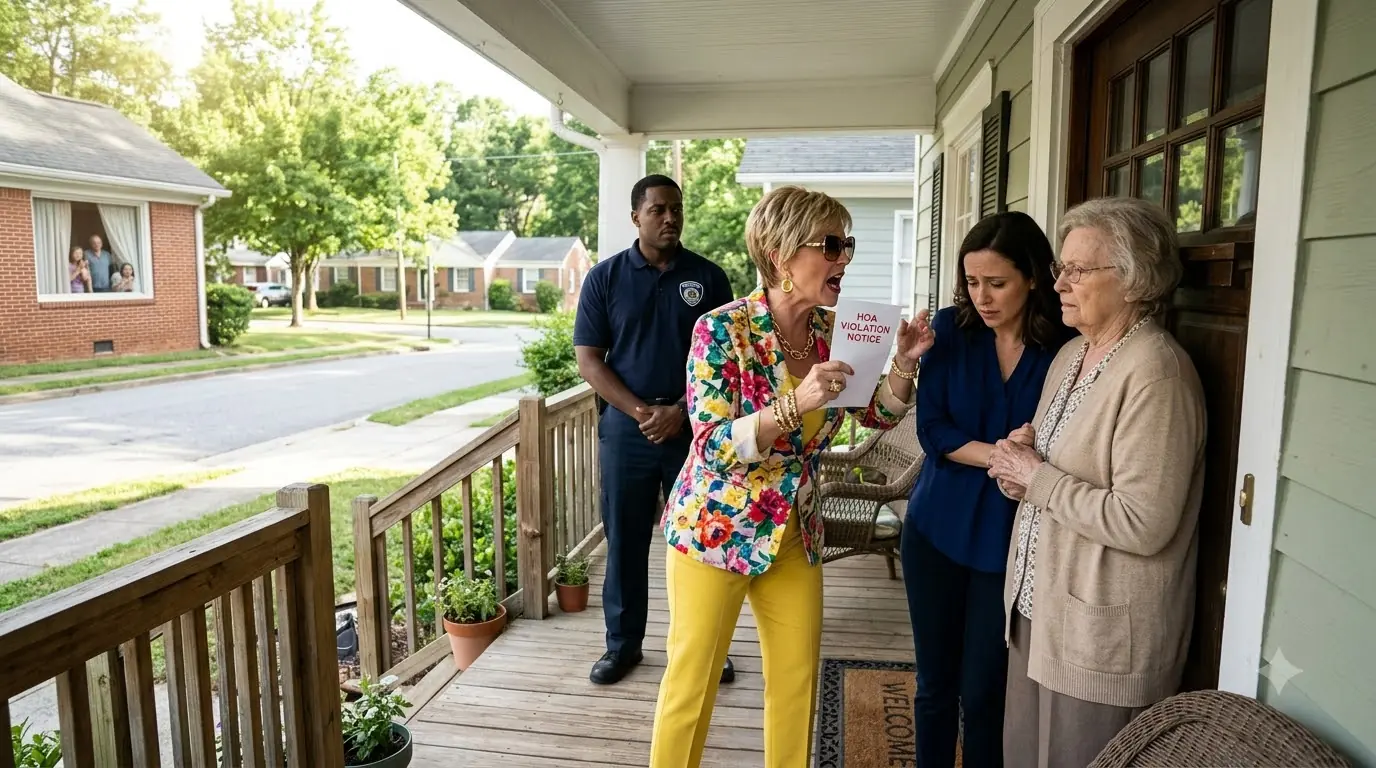
The notice claimed our house was harboring multiple unauthorized households, a phrase that would have been laughable if it weren't also the hinge on which she intended to swing us out of our own home. My mother, Elaine, my sister, Marlo, and I are blood, not tenants, not squatters, not some patchwork of strangers splitting rent. Celeste knew that. She said it anyway, because facts were never the point of the notice.
The point was humiliation, delivered with a deadline attached. She turned her attention to me the way a woman turns toward something she's already decided to be disgusted by. She asked why a man pushing 40 was still living under his mother's roof. She suggested, loud enough for the Hendersons two doors down to hear, that it was probably my sister paying the electric bill, the property taxes, keeping the lights on for a grown man who couldn't manage his own life.
She looked at the grease still ringed under my fingernails from working on the truck the night before, and called it proof I was good for nothing but odd jobs. "Men like you," she said, with a little laugh she clearly enjoyed, "always get loud because you've got nothing else to stand on." I didn't argue with any of it. I've learned that people who need an audience for their contempt rarely want a debate. They want a performance, and refusing to perform is its own kind of answer.
Instead, I read the notice twice, slowly, the way my father taught me to read anything with his name still technically attached to it. Three things jumped out before I'd even reached the second paragraph. The section she cited didn't exist anywhere in the current governing documents. The association had no authority to order a homeowner removed from private property in 72 hours, full stop.
And the signature at the bottom, credited to board member Grant Holloway, had the flat, lifeless uniformity of something that had been lifted and pasted, rather than written by a hand holding a pen. I looked at my watch, an old steel thing that used to belong to my father, and told Celeste she had exactly 3 hours to find new employment. She laughed in front of the Hendersons, in front of Curtis, in front of my mother and my sister, certain I was some unemployed man play-acting at authority to save face on his own porch. She had no idea how close to true that clock actually was.
When she finally turned to leave, her heels clicking down our front steps like punctuation, I flipped the envelope over out of habit, the way you check the back of anything before you throw it away. There was a file number stamped faintly in the corner, one my father had circled in red ink years earlier on a folder he kept locked with a note beside it that I would not fully understand until that afternoon. My mother Elaine didn't say a word until Celeste's car had pulled off Cardinal Way. She has never been the kind of woman who needs to fill silence with panic.
She simply stood there, arms crossed, watching the taillights disappear, and then she asked me quietly whether I remembered the number on that envelope. I told her I didn't, not yet, but that I intended to. My sister Marlo was already on her phone screenshotting the notice before Celeste could quietly disappear it from whatever system had generated it, because Marlo has never trusted a threat that arrives without a paper trail attached. I should explain why Celeste chose my family out of every household in Briar Glen to make an example of.
It wasn't sudden. It had been building for 6 months, ever since I moved back in after my father passed, back into the house I grew up in, back into a bedroom that still had his handwriting on the inside of the closet door, where he used to mark my height as a boy. Celeste fined my truck twice for parking in a spot I was legally entitled to use. She sent a warning because my tools sat on the porch for 2 hours while I fixed a hinge.
She demanded Marlo register as a tenant, despite being Elaine's own daughter, born in this house, raised in this house, with every legal right to be in it. She photographed me trimming the hedges and in an email to the board described me as unlicensed labor operating without authorization, as if pruning my own mother's boxwoods required a permit from the state. At one HOA meeting I attended in the spring, I asked a simple procedural question about how reserve funds were being allocated. Celeste looked past me entirely and asked if someone who actually owned property could repeat the question, as though my presence in the room were an inconvenience she was choosing to tolerate rather than a right I held by blood and by law.
Her contempt for me was never just personal irritation. It ran on an assumption, one she seemed to hold with real conviction, that a man living with his mother and sister could not possibly be the one making decisions in that household and therefore could not possibly be a threat worth taking seriously. There was another meeting back in early winter where she interrupted me twice in the span of a single sentence then apologized sweetly to the room for the delay. As if my speaking at all had been the interruption.
She once sent an email to the entire board suggesting my presence at community events made certain residents uncomfortable without ever naming a single resident who had actually complained. She had a habit of addressing every question I raised to whichever woman happened to be sitting nearest me as though my voice were simply background noise that needed a translator. I noticed the pattern long before that morning on the porch and I chose for months to let it slide off me rather than escalate a fight over something as small as being ignored in a folding chair once a month. What I hadn't accounted for was how much that restraint would embolden her.
Looking back, I think my silence read to Celeste as confirmation of everything she already believed about me that I had nothing behind me worth defending, no leverage, no standing, nothing but a quiet temper she assumed would eventually crack under enough pressure. She mistook patience for weakness which is a mistake people who rely on intimidation make more often than they'd like to admit. I told my mother and sister some of my history that morning though not all of it. I used to work as a contract auditor, the kind of job that trains you to read a document the way other people read a room looking for the places where the language doesn't quite match the intent behind it.
What I hadn't told them because I hadn't wanted to lean on it was the full weight of what I inherited when my father died. There is an entity called Roark Land Trust, and after his death, I became its legal successor. I had not used that inheritance for anything beyond quiet paperwork in the months since. I didn't see the need to swing something that large at parking tickets and passive-aggressive emails.
My mother recognized the file number on the back of that envelope the moment I read it aloud to her. She went inside without a word and came back holding a small brass key, one she'd kept in a drawer since my father's funeral, one that belonged to a locked filing cabinet in his old study that none of us had opened since he passed. She said only one thing as she pressed it into my palm. "Your father told me never to open that cabinet unless someone came for Gate 6." I didn't know what Gate 6 meant yet, but I understood, standing there on the porch with Celeste's taillights long gone, that whatever answer was waiting in that cabinet mattered more than any fine she'd ever issued us.
Inside that cabinet, beneath a layer of dust that told me my father hadn't opened it in years, either, I found a folded development map showing Briar Glen's four planned phases, a copy of the HOA's management contract, a succession document with my own name typed cleanly onto the final page, and a single handwritten note in my father's blocky print. "Never surrender Gate 6," it read. "Whoever controls it controls Phase 4." I sat at his old desk and unfolded the map, tracing the access road that ran directly along the side of our property, the only road wide enough and legal enough to reach the undeveloped final phase of the neighborhood. Gate 6 sat almost on top of our driveway, and Celeste, I now understood, hadn't come for a parking violation.
She had come for the road. The desk chair still creaked exactly the way it had when I was a teenager sneaking in to borrow tape or scissors while my father worked late over blueprints spread across that same surface. He used to tell me that most disputes over land aren't really about the land at all. They're about who controls the one narrow passage everyone else needs to get anywhere useful.
And whoever holds that passage holds the leverage whether or not they ever build a single thing on it. I hadn't thought about that lesson in years. Not until I was sitting in his chair reading his handwriting and realizing exactly what he'd meant. I called Marlo into the study and spread the map flat across the desk so she could see it, too.
She traced the line of gate six with one finger following it from our property line out toward the undeveloped acreage beyond the tree break at the edge of the neighborhood. And she said quietly that this explained more than six months of petty harassment ever could. Nobody spends that much energy chasing a man over a parking spot. People spend that kind of energy when there's real money sitting on the other side of a locked gate.
With just under 2 hours and 40 minutes left on the clock I'd set for her, I called Laurel the attorney who has handled Roark Land Trust matters since before my father passed. I forwarded her a photo of the notice within minutes. Laurel confirmed almost immediately what I already suspected, that this was not a lawful eviction order of any kind, only a threat dressed up in the costume of one. Built to look official enough that a frightened family might not question it before packing their bags.
But Laurel was careful to warn me that scaring off a bluff and actually ending Celeste's employment in 3 hours were two very different problems, and the second one would require proof of three specific things. Celeste had to have known she lacked the authority to issue that notice. She had to have used forged or falsified documentation to do it, and her actions had to trace back to a personal financial interest or a clear breach of her employment contract, not simply overzealous enforcement of community rules. Marlo, working from the kitchen table with her laptop open, pulled up the county's public development portal and found a new permit application filed only weeks earlier.
It requested access rights along the very driveway beside our house, granting a developer legal passage straight through land my family controlled. According to the application, the Roark family had already consented in writing. I had never signed any such consent. When Marlo zoomed in on the signature page, the handwriting looked disturbingly close to my father's, a man who had been dead for over a year, and therefore could not have signed anything dated 3 months ago.
That single discovery reframed everything. Celeste wasn't simply a difficult board president enforcing petty rules out of some misplaced sense of order. She needed either our house or, more precisely, the access rights that ran alongside it to complete some larger arrangement, one lucrative enough that she was willing to forge documents and threaten an entire family with removal to get it. I spent the next few minutes sending a formal evidence preservation notice to every relevant party I could think of.
It went to the full HOA board, to Sterling Crest Management, to the association's retained counsel, and to the development company itself, instructing all of them not to delete a single email, meeting record, or piece of camera footage related to our property, or to the notice she'd issued that morning. Less than 5 minutes after I hit send on that notice, Celeste fired back with a mass email to the entire neighborhood, one that called my family occupiers attempting to sabotage the community, language chosen for exactly the kind of panic it produced. Neighbors who had known us for years began texting my mother asking if it was true, if we were somehow squatting in a house we'd owned for three decades. It was an ugly, calculated move meant to poison the well of public opinion before anyone had a chance to see the actual documents.
I understood then that Celeste realized I wasn't bluffing, and that realization had made her dangerous in a different way. Within that first hour, she escalated far beyond a mass email. She deactivated the gate access cards for our entire household, cutting off the simplest way in and out of our own neighborhood. She had orange violations notices plastered across our front door for the entire street to see.
She ordered the security staff to photograph every vehicle registered to our address, building what looked disturbingly like a case file. She pushed out a community newsletter framing the association as protecting residents from what she called a household exhibiting threatening behavior, a phrase engineered to make us sound dangerous rather than simply inconvenient to her plans. And she scheduled an emergency board meeting for that same afternoon, one clearly designed to rubber-stamp a decision she had already made hours earlier rather than to actually deliberate anything. She called me directly not long after that.
Her voice sharpened into something almost gleeful. "You should use those three hours packing boxes." She said. "Men without jobs love to imagine their lawyers." I didn't answer with anger because anger was exactly what she wanted from me. Evidence for whatever narrative she was already building about a threatening unstable man.
Instead, I asked her a simple question. I asked her to read me the names of every board member who had voted to approve that morning's notice. She refused and the silence that followed told me everything I needed to know. Grant Holloway called me quietly less than 10 minutes later.
His voice low, almost apologetic. The voice of a man who knows he should have spoken up months earlier. He confirmed there had never been a vote authorizing that notice. The signature on it credited to him was not one he had written.
He admitted he'd stayed silent for months because Celeste controlled the association's financial records and he worried that any accusation against her might somehow implicate him too. Tangled as his own name apparently was in paperwork he'd never actually reviewed. I forwarded everything I had gathered so far to Avery Sloan, the regional director at Sterling Crest Management, the company that technically employed Celeste as community director. Avery's response was cautious, professional, non-committal.
He said the company would review the matter, but that I would need to demonstrate the trust's authority was still legally valid because Celeste had already filed a resolution the year before claiming that authority had lapsed entirely. That resolution turned out to be the single greatest obstacle standing between me and the truth. When Laurel pulled it up and read it aloud over the phone, I felt something cold settle in my chest because the signature at the bottom of that resolution, the one supposedly ending my family's authority over the land, was credited to me. It was a signature I had never written on a document I had never seen, dated at a moment I could prove I wasn't even in the state.
With roughly 1 hour and 50 minutes remaining, Laurel and I began tearing that resolution apart line by line. The date on the signature page fell during the exact week I had been out of state handling my father's funeral arrangements, a fact easily verified through flight records and funeral home paperwork. The notary listed on the document had let her commission expire months before the date printed on the page, meaning she legally could not have notarized anything that day. The meeting minutes claimed to have taken place in the clubhouse on a date when, according to the maintenance log, the entire building had been closed for electrical repairs.
There was no camera footage, no room booking record, no meeting invitation sent to anyone corroborating that any such gathering had occurred. Grant and Naomi were both listed as present at that phantom meeting, despite neither of them ever having attended it. I drove to the county records office, not far from Briar Glen, to pull a certified copy of the succession documentation naming me as the legal representative of Roark Land Trust. The building smelled the way every records office seems to smell, like old paper and floor wax, and the fluorescent lights buzzed faintly overhead as I waited at the counter.
A records clerk named Ellis Boone pulled the file without much urgency at first, the way someone handles a routine request, until he noticed the name on the folder and glanced up at me with a different kind of attention entirely. He confirmed within minutes that my authority remained fully valid, untouched by whatever fiction Celeste had constructed. He printed a certified copy, stamped it, and slid it across the counter, and then he mentioned something almost in passing that hit me harder than anything else that day. Celeste herself had requested a copy of that exact same succession file two months earlier, walking through these same doors, standing at this same counter, reading the same document I was holding now.
She had known from the beginning who I was and what I controlled. Her contempt for me on the porch that morning hadn't come from ignorance. It had come from calculation, a bet that humiliation and pressure would push me out the door before I ever thought to check what power I actually held. I asked Ellis if he remembered anything else about that visit, and he thought about it for a moment before telling me she'd seemed disappointed by what she found, as if she'd been hoping the succession had lapsed or gone unclaimed.
Instead, she'd learned that a man she'd never met, a man she would later mock on his own porch for wearing dusty boots, held the one piece of authority capable of undoing everything she was quietly building toward. That single detail told me more about her plan than any forged signature could have. She hadn't stumbled into this. She had scouted it first, decided I was the weak point in the way, and built her entire timeline around removing me before I noticed.
Celeste believed the forged notice had cornered a powerless family. She had no idea the dusty filing cabinet in their study contained the one document capable of stopping her entire plan.
The HOA Karen Tried to Throw His Family Out — Then He Came Home
Theme:
Font Size:
24px