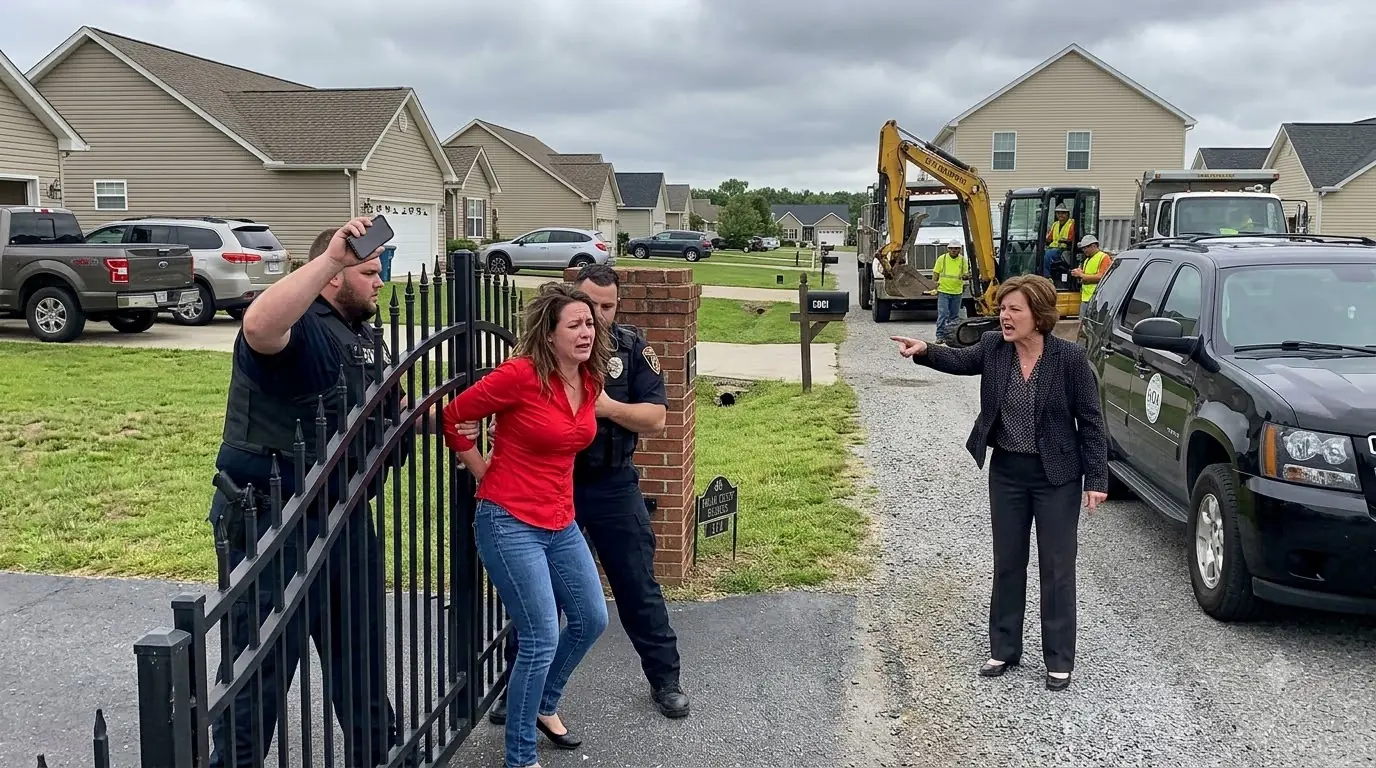
Marissa Rourke had barely touched the gate lock when three security
guards seized her. One ripped the phone from her hand. Two others
twisted her arms back and slammed her face against the cold iron bars of
her own gate. Lenora Whitcomb, president of the homeowners association,
stood watching calm and smug announcing the road now belonged to the
community. Marissa gasped that her husband would be home any minute.
Lenora only laughed. Then an engine roared down the gravel road. A truck
skidded to a stop. A man stepped out, saw his wife pinned against the
gate, and nobody there knew he had once been a United States Navy SEAL.
Three weeks earlier, none of this seemed possible.
Caleb Rourke and his wife Marissa lived on a 30-acre property at the
edge of a gated community called Briar Crest Estates, a development that
had been built nearly 20 years after their house was already standing. A
stone-paved road ran from the county highway straight through their land
and along the western edge of the neighborhood, a road that had always
belonged entirely to the Rourke family, recorded on every deed since the
property was first surveyed. The homeowners association had never held a
single legal right to use it, not one line in any filing, not one
easement, nothing. Lenora Whitcomb had just been reelected president of
that association, and she arrived in office with a plan worth several
million dollars, a new clubhouse, an outdoor event space, and an
expanded parking lot at the far end of the community. There was only one
problem.
The approved entrance to the project was too narrow for heavy
construction trucks, and if she could route those trucks through the
Rourke property instead, the association would save hundreds of
thousands of dollars. It would otherwise have to spend building a proper
access road from scratch. Lenora began politely enough with a letter
offering to purchase what she called temporary access rights. Caleb
declined. He explained calmly and in writing that the road surface was
not rated for heavy trucks and that a water line ran directly beneath
it, a line that could easily rupture under the weight of repeated
construction traffic.
Lenora did not accept the explanation. A week later, a new notice
arrived at the Rourke mailbox. This one declaring the road a shared
community access route, language that had no basis in any county record.
Marissa, who worked as a land use consultant and understood zoning maps
and property law better than most attorneys, pulled the original filings
and confirmed within an hour that the claim was entirely fabricated.
Caleb stayed quiet through all of it, telling his wife they would handle
this with paperwork, not arguments.
And when she asked why he never seemed rattled by any of it, he simply
told her that people who like to threaten others were usually counting
on the other person losing composure first. It was the first small hint
of something in his past that Marissa had never fully asked about.
Lenora escalated anyway. A sign reading authorized community access
appeared beside the Rourke gate without permission. Caleb took it down.
It reappeared the next morning. He took it down again, and the day after
that Lenora sent a private security team to patrol the edge of the
property led by a man named Derek Voss, who introduced himself with the
title of security commander, a title he had given himself. Derek told
Caleb they were simply enforcing association policy. And Caleb answered
that association policy ended precisely where his property line began.
Derek laughed and said they would see about that.
A few evenings later, Marissa found an orange survey stake driven more
than 18 feet into their land, well past any boundary the county had ever
recognized, and it was clear that someone was quietly trying to redraw
the line between what belonged to the Rourke family and what did not.
Owen Maddox himself would later admit that this quiet phase of the
conflict, the weeks before anyone raised a hand, was in some ways the
most dangerous of all because it gave Lenora time to convince herself
that she was the reasonable party in a dispute she alone had created.
She began describing Caleb to other board members as difficult and
uncooperative, a man standing in the way of progress for the entire
community. And few of them thought to ask why a private family road had
suddenly become community property in the first place. Some neighbors,
hearing only Lenora’s version of events, started giving Caleb and
Marissa uneasy looks at the mailbox cluster near the highway and one
even asked Marissa directly why they were being so difficult about a
simple community improvement.
Marissa answered every question, patiently explaining the deed, the
survey, the waterline beneath the road. But she quickly learned that
facts rarely traveled as fast or as far as rumors did. Marissa began
building a case of her own. She pulled the county land records, the
original deed transfer from 1998, and every easement filing on record,
and none of them showed any right of passage for the homeowners
association, not even a partial or contested one. She sent the full
packet to Lenora expecting a retreat.
Instead, she received an invoice for $8,500 citing what the letter
called obstruction of community infrastructure access, an accusation
with no legal footing whatsoever since the Rourke property had never
been part of the association in the first place. Caleb laughed when he
read it. Marissa did not find it funny at all because Lenora clearly
knew the association had no authority to fine them and was betting that
enough paperwork and enough pressure would eventually make the family
give in out of exhaustion rather than principle. Then the pressure
turned physical. A gravel truck attempted to drive straight through the
gate one afternoon, and when Marissa blocked it, the driver produced a
map he said had come from the association proving this was public
access.
Caleb examined the map and noticed almost immediately that the county
seal stamped across the top had been copied and pasted from an unrelated
document, a crude forgery that would not survive a single phone call. He
made that call. Miles Corbett, the county land engineer, confirmed
within minutes that his office had never approved or issued anything
resembling that document, and he agreed to send written confirmation the
same day. Caleb began keeping a file of his own quietly and
methodically, gathering camera footage, letters, the false invoice, the
forged map, and a running log of every trespass. And Marissa realized
her husband was assembling evidence with the discipline of someone who
had done this kind of work before.
When she asked how many times he had built a case like this in his life,
he only told her that evidence was always more reliable than anger.
Lenora, meanwhile, kept pushing, sending Derek and his team to stand
near the gate every day under the claim that they were staying strictly
on association land. Though the camera footage told a different story,
each time one of them stepped over the line without hesitation. The
guards Lenora hired were not local police, not licensed peace officers
of any kind, only private contractors paid by the association to patrol
a boundary they did not fully understand and were not legally entitled
to enforce. Derek liked to remind people that his company had handled
security for shopping centers and corporate campuses for over a decade
as if that history gave him some authority over a private residential
road, and Caleb never bothered correcting him, choosing instead to let
the cameras and the county records speak for themselves when the time
eventually came.
Marissa noticed that the guards grew bolder each week, parking closer to
the gate, walking the tree line at odd hours, even shining flashlights
toward the house late at night under the excuse of routine patrol. She