I was gone exactly 7 days. When I came back, my two-story wooden house had vanished, leaving nothing but a flat stretch of dust, deep tire scars from a bulldozer, and a mailbox standing alone like a headstone. The president of my homeowners association, a woman named Celeste Whitmore, walked toward me in white shoes that had never touched a construction site, and told me the crew had torn down the wrong house by mistake. She smiled when she said it, the way people smile when they think they have already won. She told me a man like me should be grateful the neighborhood had finally gotten rid of an eyesore.
She had no idea that the house she destroyed still held enough evidence to cost her organization $22 million in a courtroom. My name is Dean Holloway, and for 4 years I had rebuilt that house with my own hands, board by board, from a forgotten 1912 structure that everyone else had written off as a teardown. I worked as a structural damage investigator, the kind of specialist insurance companies and attorneys called in when a building collapsed, and someone needed to know exactly why. Because I wore work jeans and carried my own lumber up a ladder, Celeste assumed I was some struggling handyman playing pretend at home ownership. She never once imagined that the man she dismissed as a carpenter spent his career picking apart fraud, tracing collapsed buildings back to the decisions that caused them, and reading contracts the way other people read grocery lists.
That mistake would follow her all the way into a courtroom. I had bought the property years earlier at a foreclosure auction. Back when the house was little more than a sagging frame with a caved roof and a foundation cracked by decades of neglect. Most buyers who toured it before the sale walked away shaking their heads, convinced the only sensible option was to bulldoze it and start from nothing. I saw something different in the bones of that place, the kind of craftsmanship builders no longer bothered with.
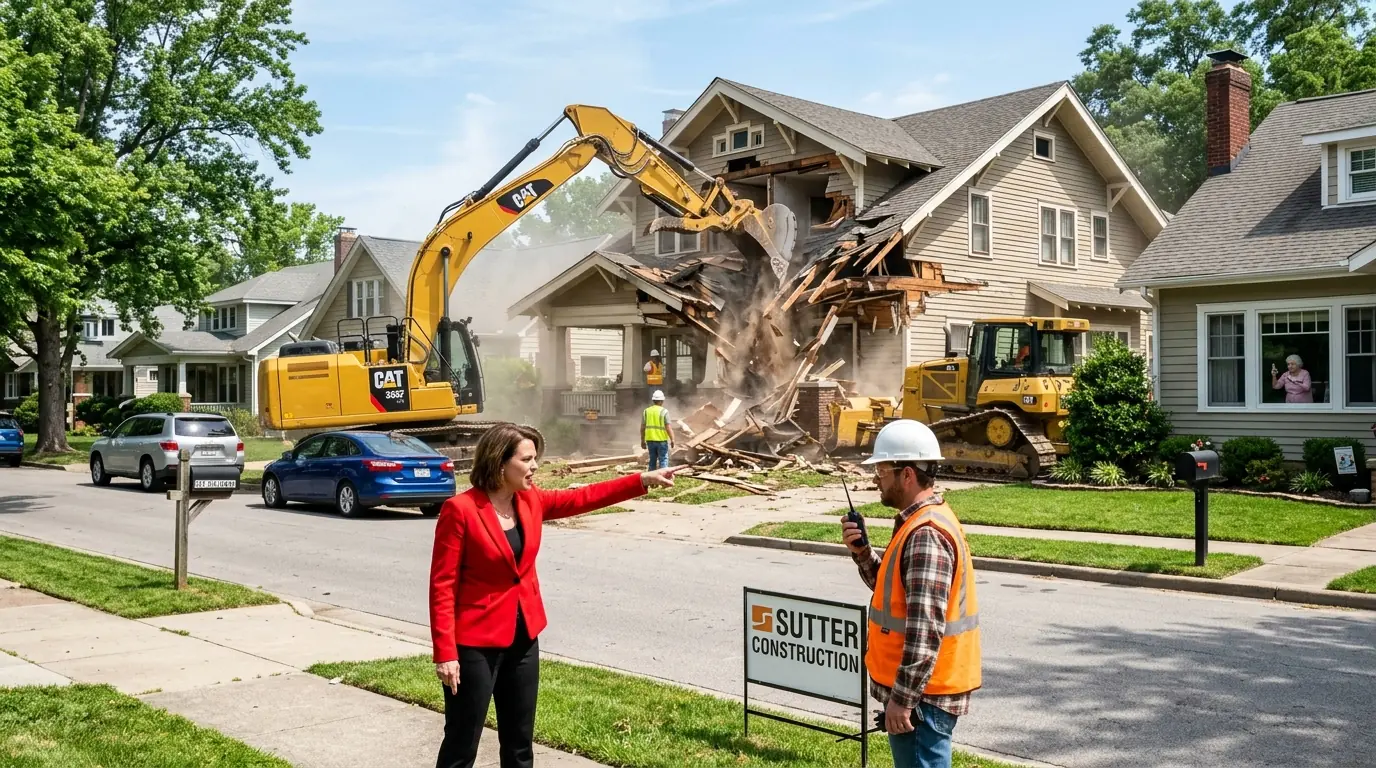
Hand-cut joints and old-growth timber that had survived a century of storms without ever giving way. I spent my evenings after work and every free weekend stripping away rot, reinforcing the frame, and slowly bringing the house back to a version of itself that honored what it had originally been. Neighbors used to slow their cars when they drove past, watching a man in a dusty truck haul salvaged lumber up a ladder alone, never once suspecting that same man spent his weekdays testifying in courtrooms about exactly how buildings failed and why. I had driven back into Ashcroft Ridge after a week-long consulting job out of state, tired and looking forward to nothing more than my own porch and a quiet evening. From the end of the street I noticed the familiar row of oak trees was still standing, but the roofline I had known for four years was simply gone.
At first I told myself I had turned down the wrong road, that somehow in my exhaustion I had confused one cul-de-sac for another. I slowed the truck, checked the house number on the curb, and realized with a cold drop in my stomach that 17 Ashcroft Lane was exactly where I was standing. There was nothing left to argue with. The house, the garage, the back porch, and the garden I had spent two summers building were all gone, scraped down to raw earth. I got out of the truck and walked the perimeter in silence, the way I would walk any site I had been called to investigate professionally, except this time the site was my own life.
All that remained was the mailbox, a capped water line jutting out of the dirt, and scattered splinters of wood that used to be my staircase. I had rebuilt that staircase from black walnut salvaged from a barn two counties over, along with hand-leaded glass windows and a stone fireplace I had reconstructed to match the original 1912 blueprints I had tracked down in a county archive. None of it mattered anymore. I called the police from the empty lot, and the officer who arrived told me the association had produced a demolition permit, which meant there was no active crime for him to stop, only a civil dispute for the courts to sort out later. While I stood there absorbing that answer, a white sport utility vehicle pulled up along the curb, and Celeste Whitmore stepped out as though she were inspecting an overgrown lawn rather than the wreckage of a home.
She walked toward me with the calm, unbothered posture of someone who had rehearsed this exact moment. She told me not to make the situation dramatic, explaining that the demolition crew had simply torn down the wrong structure, and that accidents happen in construction all the time. When I asked why no one had called me before or during the demolition, she looked me up and down, taking in my work boots and dust-covered jeans, and told me she assumed a man who built things could also rebuild them without much trouble. I did not argue with her in that moment. Instead, I quietly opened the recording application on my phone and asked her, as calmly as I could manage, exactly which structure the crew had been authorized to demolish.
She answered without hesitation that the target had been lot 81 Ashcroft Court, a property she described as a run-down storage structure long overdue for removal. I looked past her toward the flattened remains of my own house and understood immediately that the address she had just given me bore no resemblance to my own. Celeste called it an unfortunate coincidence of similar addresses, but as I walked the edges of my property afterward, I found survey stakes driven into the ground in precise positions around what used to be my foundation. Stakes that had clearly been placed before I ever left town for my trip. Two days later, Celeste called an urgent meeting at the association office, but pointedly did not invite my attorney or any independent expert to attend.
She wanted to speak with me alone, believing correctly that most homeowners in my position would be too shaken and too intimidated to push back. In that meeting, she slid across the table a settlement offer of $180,000, a figure far below the true value of the house, let alone the land beneath it or the possessions lost inside. She described my home as outdated and out of step with the association's new vision for the neighborhood, framing its accidental demolition as something that had conveniently solved a long-standing aesthetic problem for the community. She told me, without any apparent embarrassment, that men like me tended to attach sentimental value to things we built with our own hands, but that sentiment was not the same thing as market value. I asked her plainly whether she had ever set foot inside my house before it was destroyed, and she admitted she had not.
Yet, she still insisted it could not possibly have been worth what I claimed. When I refused to sign her settlement, her tone shifted from dismissive to threatening. And she warned that if I pursued legal action, the resulting legal costs would eventually be passed on to every homeowner in the neighborhood through a special assessment. She was trying to turn me into the villain of a story where she had already cast herself as the reasonable party protecting everyone else's finances. I told her plainly that the party responsible for demolishing a home without authorization should bear the cost, not the neighbors who had nothing to do with the decision.