The morning sun hit the street just right. Perfect lawns, white fences, and a silence that only ever breaks when someone decides to enforce it. I was tightening the last screw on my new mailbox when I saw them crossing the road. The HOA board in full formation. Mara Green, sun visor, clipboard, and that permanent expression that said she ran the world.
Doug Reeves followed with a tape measure. "Good morning," I said. "Mr. Carter," Mara announced. "Your mailbox color is non-compliant. It violates Oakrest Meadows standards." I glanced at my slate gray mailbox and smiled.
"That's fine. I'm not under your HOA." Her eyes flickered. First confusion, then insult. Doug snorted. "Every house on this street is under our HOA." "Not this one," I said calmly.
"You might want to check your map." They stared at me like I'd spoken another language. Mara's tone sharpened. "You can't just opt out. We'll call the authorities." I shrugged. "Go ahead." Doug tapped his phone.
Somewhere down the block, the hum of an engine grew louder. Moments later, a patrol car turned the corner. Sunlight glinting off the windshield. Red and blue lights washing over perfect driveways. Neighbors froze mid-lawn mow.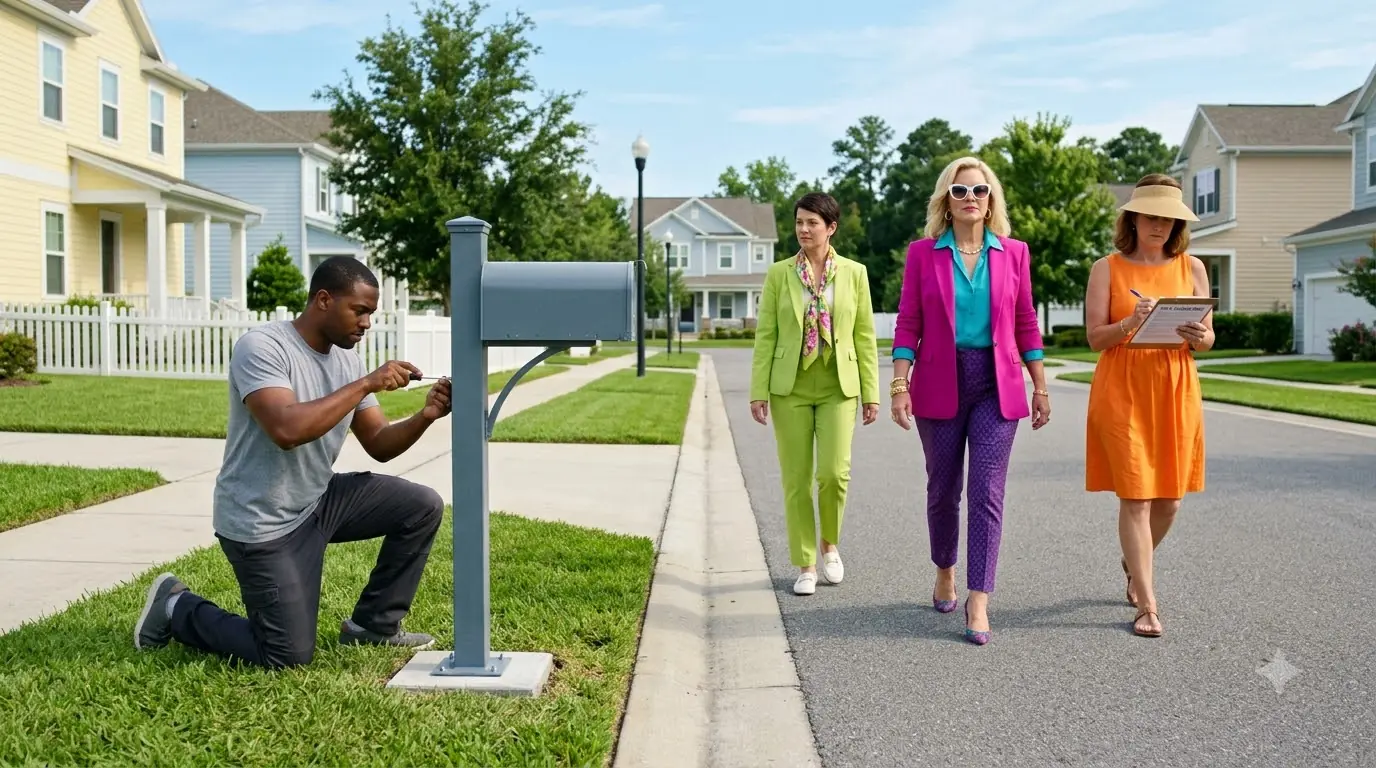
Phones out whispering. Broad daylight. Not a crime in sight. Just three HOA board members who thought they owned me. They didn't know the truth.
They didn't know I didn't just own my house. I owned the block they were standing on. Oakrest Meadows looked like the kind of neighborhood that could be printed on a postcard. Every house sat at a perfect angle, front lawns trimmed to identical heights, shutters painted in three approved colors, sandstone, ivory, or fog gray. Even the mailboxes stood at measured distances like soldiers in formation.
If peace had a zip code, it was probably this one. At least that's what I thought when I bought the place. I'm 36, an engineer by trade, and I deal in numbers, not neighbors. The house came through a county auction, a foreclosure lot that most people ignored because the previous owner had let the paperwork expire. I didn't mind.
It was quiet, affordable, and I like the idea of fixing something with my own hands. What I didn't realize at first was that this neighborhood didn't run on friendliness or fairness. It ran on rules. You could feel it in the air. The way people waved but kept their smiles short, the way sprinklers turned on at the exact same minute every morning, as if the whole block shared one schedule.
And at the center of it all was Mara Green. If Orest had a throne, she'd built it herself out of printed bylaws. Mid-50s, always in linen, always carrying that clipboard like it was the Constitution. She wasn't elected, she was enthroned. People said she'd been president of the HOA since the day the first moving truck arrived.
Her favorite phrase, community standards are non-negotiable. Behind her was Doug Reeves, treasurer and self-appointed enforcer. He was the kind of man who measured his self-worth by how many fines he could issue before lunch. Doug was the echo to Mara's thunder, nodding along, clicking his pen, and reminding everyone that rules are what keep the neighborhood safe. My first week here, I found a note taped to my garage door.
Welcome to Oakrest Meadows. Please remember that all trash bins must be hidden from street view at all times. A second note came two days later. Your porch light appears to be 25 watts above community standard. I hadn't even unpacked half my boxes, and already someone had decided I was a problem.
It didn't bother me at first. I'd lived in cities, worked under pressure, dealt with bosses who thought control equaled competence. Mara and Doug were just a new version of that suburban middle management with nicer lawns. But the tone was impossible to miss. Every friendly reminder carried the same message underneath.
This isn't just your home. It's ours, and we decide how you live in it. Neighbors went along to avoid trouble. They called Mara helpful and Doug dedicated, but you could see the tension in their smiles. The way people closed garage doors a little faster when her SUV drove by.
Me, I've never been good at letting people tell me what to do. It's not pride, it's habit. I build things that have to hold up under pressure, and I live the same way. Quiet, measured, independent. That independence was exactly what drew me to this property, tucked at the edge of the block, backed by a thin line of county-owned green belt.
It wasn't much, but it gave me breathing space. I liked knowing I could step into my yard and not hear the constant buzz of HOA small talk. Still, the signs were there, the warning emails, the slow stairs whenever I parked my car facing the wrong direction. It wasn't hostility yet, just disapproval polished to a shine. Oakrest Meadows was a neighborhood that looked perfect from the sidewalk.
But behind those matching mailboxes, you could feel it. Control disguised as community. And as I'd soon find out, perfection here wasn't something you achieve. It was something you owe. It showed up in my mailbox on a Tuesday morning.
Section 5, subsection D. I hadn't even unpacked my toolbox when they'd already assigned me a subsection. At first, I thought it was a mistake. Maybe the letter was meant for another address. But as I scanned the text, I noticed my name typed neatly at the top.
Ethan Carter, 2049 Oakrest Lane. They even gave me a deadline. repaint or replace within seven days to avoid fines of $75 per day. I turned the page over looking for a phone number or contact name. At the bottom in blue ink was a signature that looked aggressively confident. Mara Green, President Oakrest Meadows.
So, it wasn't a mistake, it was a warning. Out of curiosity, I flipped through the HOA welcome packet that had been shoved into my mailbox a week before. Inside was a glossy map labeled Oakrest Meadows jurisdiction phase 1 and two. Every property was outlined neatly in yellow. I ran my finger along the outer row of lots until I reached mine, the last one at the edge near the tree line.
Then I looked again. There was a faint gray outline showing the county property boundary, and my parcel extended beyond the HOA's shaded area by a small strip. The line was almost invisible, printed so faintly it looked accidental, but to an engineer's eye, it was obvious. My lot wasn't inside the HOA border. Just to be sure, I called the number printed on the county deed.
After a few transfers, a clerk named Janet picked up. This is property records, Fairfax County, she said. Hi, I just need to confirm a boundary detail. I explained. My address is 149 Oakrest Lane.
Is that part of the Oakrest Meadows HOA jurisdiction? She typed for a few seconds. I could hear the clicking through the receiver. Let's see. Parcel 24 C.
No, actually, that property sits just outside the Oakrest Charter boundary. How far outside? 27 ft. She said, "According to our records, that section was never annexed when the HOA expanded into an you're technically in the county's unincorporated zone." I smiled. "So, I'm not under the HOA?" "That's correct," Janet replied.
They can't issue violations or collect fees from that parcel. Perfect. Thank you. For the first time in weeks, I felt lighter. All those notes on my door suddenly felt meaningless.
The kind of noise you can tune out once you know where the volume knob is. That relief lasted about 6 hours. By that evening, my phone buzzed with an email notification. Subject: Urgent failure to comply with community standards. From Mara Green, president at Oakrest Meadows.
Mr. Carter. Despite multiple notices, you continue to display a mailbox that violates community color guidelines. The HOA board has voted to escalate this matter under the community annexation clause section 9D which grants jurisdiction over adjoining parcels that share visible frontage. Immediate compliance is expected. Failure to act may result in legal escalation and involvement of local authorities.
Mara Green, HOA president. I stared at the screen half amused, half annoyed. The community annexation clause. That wasn't law. That was imagination with a letterhead.
Still, her threat to involve local authorities told me exactly what kind of fight this was going to be. It wasn't about a mailbox anymore. It was about control, and I just challenged the queen on her own board. I printed out Janet's email confirmation from the county office and slid it into a folder labeled HOA correspondence. Old engineering habit, always document before you act.
As the sun dropped behind the row of perfect houses, I stood at the edge of my yard, looking at the invisible line that separated their world from mine. 27 ft. That was all it took to make me a problem. I wasn't angry yet, just curious. Curious how far they'd go to prove they own something they didn't.
Because after that email, one thing was clear. They just turned my front yard into a battlefield. By the end of that week, the friendly reminders had turned into fines. A yellow envelope was taped to my front door before sunrise. penalty notice. Day three of non-compliance.
By noon, another email arrived. Day four, $75 accrued total due. They'd even added a line that said, "Failure to pay may result in a property lien." I wasn't sure whether to laugh or frame it. It didn't stop there. Every morning, a different board member happened to walk by, snapping pictures of my mailbox, driveway, and lawn from different angles.
A post popped up later that week on the neighborhood's online forum. Non-compliant property threatens Orest aesthetic. Someone had uploaded a photo of my front yard with my address cropped out but still clearly visible. That was when the neighbors started whispering. When I waved during my morning walk, people smiled the way you do when you don't want to take sides.
One woman crossed the street instead of passing in front of my house. Another left anonymous note in my mailbox that read, "They did this to the Wagners, too. Don't back down." So, I didn't. I printed everything violation letters, emails, even screenshots from the HOA's forum. Then I pulled out the plat map and began cross-referencing it with the county's digital database.
If the HOA wanted to play legal games, I'd bring the rule book they didn't write. The first odd thing I noticed was that the HOA charter on record listed its last update as August 2018, the year they tried to expand their boundary, but there was no record of the expansion ever being finalized. It was labeled proposed amendment pending submission pending 6 years later. That meant Oakrest Meadows had been enforcing rules beyond its original boundary for half a decade and nobody had bothered to verify it. I decided to confirm in person.
The county registrar's office smelled like paper and old coffee. The kind of place where bureaucracy goes to nap. A woman at the front desk directed me to a cubicle labeled property archives. Behind it sat an older man with wireframe glasses and a stack of rolled maps taller than his chair. "Need something, sir?" "Yes," I said, setting down my folder.
"I'm trying to confirm whether Oakrest Meadows ever filed an updated charter after their 2018 annexation proposal." He typed for a few moments, then frowned. Let's see. HOA filings. Oakrest Meadows. Nope.
Nothing after 2018. Their annexation proposal was returned for revision and never resubmitted. So officially their boundaries haven't changed. Officially, he said, tapping the screen, they're still limited to the 2010 survey lines. In 2049 Oakrest Lane, he turned the monitor toward me.
My lot was clearly marked outside the shaded HOA area. That's county managed property, not under HOA authority. Always has been. He leaned back in his chair, smirking. Let me guess, they're still trying to find you every day.
He chuckled. Typical. They forget the law doesn't bend with their bylaws. I thanked him and asked for a certified copy of the original map. He printed it on legal paper, stamped it, and handed it over.
As I looked closer at the document, I noticed something else. Faint lines cutting across my parcel and into neighboring lots. Utility easements, old infrastructure lines dating back before the HOA existed. My property technically contained easements for water, fiber, and even the green belt drainage path that ran behind the houses across the street. That meant the HOA's underground utilities and a few of their signs sat partly on my land.
It wasn't much, but it was enough. Back home, I laid out everything on my dining table. The fines, the maps, the stamped documents, my little collection of truth. Outside, the sun glinted off my unauthorized mailbox like it was proud of the rebellion. That evening, Doug walked by again, pretending to check the curb height while taking another photo.
I waved. He didn't wave back. By nightfall, another email arrived. Subject: Escalation notice. Final warning.
Mr. Carter. Failure to comply with HOA orders constitutes willful defiance of community authority. Continued disregard will result in police involvement. The wording had shifted from non-compliance to defiance. I guess they'd finally taken it personally.
I sat back sipping my coffee, reading their threats like weather reports. For the first time, I didn't feel cornered. I felt curious because in my hands I had proof they were operating outside their legal boundary. And on paper in the fine print no one bothered to read. I had something even better.
Those easements, small but real, that connected half the block through my land. Their power was written in expired paperwork. Mine was written in law. As I folded the certified map back into its envelope, I smiled to myself. Maybe I didn't just own one house after all.
Maybe I owned more than they did. Saturday noon came dressed in sunshine and tension. The HOA had announced it as a mandatory compliance hearing. Printed flyers had been slipped under every doormat on the block as if I'd committed a crime worth spectating. By the time I stepped outside, the cul-de-sac looked like a makeshift courtroom.
Folding chairs lined the driveway in neat rows. Mara stood at a portable podium with a microphone that squealed every time she tapped it. Behind her, Doug Reeves arranged a stack of printed documents on a folding table like evidence in a trial. Even the police were there, one officer leaning against his cruiser at the curb, sunglasses on, arms folded, watching. I walked across the street carrying a single folder, the one labeled HOA correspondence.
My neighbors stared, some whispering, others pretending to check their phones. "Mr. Carter," Mara began, her voice amplified and sharp. "Thank you for finally joining us. This hearing is to address your continued refusal to comply with Oakrest Meadows community standards. Refusal?
I said, keeping my tone level. You can't refuse something you were never part of. Gasps scattered through the crowd like wind through dry leaves. Mara straightened. Let the record show the homeowner is uncooperative.
Doug clicked his pen and scribbled something down as if the act alone gave him authority. Today, Mara continued, we will review each violation in sequence. Item one, unauthorized mailbox color. Item two, unapproved landscaping. Item three, obstruction of visual uniformity.
Obstruction of what? I asked. Uniformity? She repeated. The visual continuity of Oakrest Meadows is what sustains our property values.
I looked around at the matching houses, the same flowers, the same fences. The sameness was suffocating. When she finished her list, I stepped forward slightly. Mara, before we go through all of that, can I just ask one question? She crossed her arms.
You may under which recorded covenant are you enforcing these rules? There was a murmur through the crowd. A few neighbors glanced at one another, the question hanging in the air heavier than any accusation. Mara blinked. All of them, she said finally, recovering her composure.
That's not an answer, I replied. Every HOA operates under recorded covenants and filed charters. I checked the county records yesterday. Oakrest Meadows last valid filing was in 2010. No annexations, no expansions, no 2018 amendment.
So unless you've invented new paperwork in the last 12 hours, your authority stops 27 ft before my mailbox. Doug looked uneasy. We've been enforcing these standards for years, he said. Everyone follows them. That doesn't make them legal, I said.
It just means no one checked. The officer at the curb shifted slightly, watching more closely now. Mara's face turned the color of her hydrangeas. You are undermining community order," she said, voice trembling. "We will not tolerate rebellion." "Rebellion?" I chuckled softly.
"I'm just asking you to follow your own rules." A few neighbors smiled nervously. One older man actually nodded. Mara snapped her fingers at Doug. Read the annexation clause. Doug flipped through a binder and began reciting, "Section 9B, community annexation, may extend to adjoining parcels that share visible frontage with Oakrest Meadows.
May extend. I interrupted. Not does, and it only applies if the amendment was filed and approved by the county registrar, which it wasn't. You can't annex land by pretending it's yours. The murmuring grew louder.
A few people leaned toward each other, whispering, "He's right." Mara slammed her binder shut. "This is not a debate. You are in violation, and you will repaint that mailbox or face legal consequences." Doug added, "We have the right to contact law enforcement if necessary." I looked over at the police officer. He hadn't moved, but his jaw flexed slightly, like someone trying not to laugh at a bad sitcom. I raised my hand.
Actually, that's a good idea, officer. Since you're here, maybe you can clarify something for us. All eyes turned to him. He pushed off the cruiser and walked over slowly, his mirrored sunglasses reflecting the whole crowd. What's the issue?
Mara jumped in. This resident is refusing to comply with HOA regulations. We're requesting assistance enforcing community law. The officer looked at me. Is that true?
I held up my folder. I live at 2049 Oakrest Lane. According to Fairfax County Records, my property sits outside the HOA's boundary by 27 ft. I've got certified maps to prove it. He took the papers and studied them.
The silence was thick. Only the buzz of someone's lawn mower broke it from down the street. After a long moment, the officer turned back to Mara. Ma'am, he's right. This property isn't under your HOA jurisdiction.
Her lips parted, but no sound came out. Doug looked like someone had unplugged him. "This is a civil matter," the officer added, handing the papers back to me. "Not a criminal one. The HOA can't enforce rules on property it doesn't govern." The crowd started whispering again, louder this time.
Mara tried to recover. Then we'll pursue annexation retroactively. "Good luck with that," I said, sliding the papers back into my folder. "I already spoke to the county registrar. That proposal was rejected 6 years ago." A few people laughed quietly.
Others just shook their heads. The balance of power was shifting and Mara could feel it slipping. Her voice cracked when she finally said, "This hearing is over. We'll handle this through formal channels." She turned to Doug. Write up a final notice.
Doug hesitated, then looked toward the officer. "Go ahead," I said lightly. "Write whatever you want." The officer's expression didn't change, but his hand moved slowly, deliberately toward his citation pad. For a moment, everyone froze, unsure of what was about to happen. Then I smiled.
The officer's fingers brushed the edge of his citation pad, but instead of writing anything, he paused, watching the tension ripple through the crowd like heat on asphalt. "Let's all take a breath," he said evenly. "Start from the beginning." I reached into my folder, pulled out the stamped county documents, and handed them to him. "Here's my deed," I said. "Certified last month.
And here's the official jurisdiction map from the county registrar's office. It shows the HOA boundary ending right here, 27 ft short of my property line. He unfolded the map, holding it so the sunlight caught the embossed county seal. The crowd leaned forward, necks craning to see. The bright paper looked almost ceremonial against the muted brick of the driveways.
The officer studied it quietly, eyes narrowing. "Where'd you get this county register?" I said, "I went in person. Their records show Oakrest Meadows never filed their 2018 annexation update. The proposal was returned for revision and never resubmitted. That means my lot 209 Oakrest is outside their authority.
Mara's voice sliced in. That can't be right. We've been enforcing regulations on this street for years. Everyone complies. Every single home.
The officer glanced at her over the edge of his sunglasses. Being in charge doesn't make something legal, ma'am. The paperwork does. Doug stepped forward, face flushed. We have the right to maintain standards.
The board voted on it. Then your board voted on air, I said. Because the county never approved it. Laughter rippled softly through the neighbors. A few covered their smiles, trying not to make eye contact with Mara.
The officer turned to Doug. Sir, your vote doesn't change land jurisdiction. Unless you can produce a county record. To the contrary, this property isn't covered by your HOA charter. He handed the map back to me, and until proven otherwise, Mr. Carter's within his rights to ignore any HOA directives.
The sunlight seemed to shift and almost brighter, as though even the day was siding with reason. Mara sputtered, flipping through her binder. "We we have a clause that allows annexation by visible frontage. That's not how property law works," the officer said dryly. "Annexation isn't contagious." A burst of laughter broke out in the back row.
Someone coughed to hide it. Marla's tone rose. This officer is mistaken. I'll be contacting the sheriff's department to file an appeal. Ma'am, he said patiently.
You're welcome to contact whoever you'd like, but I am the sheriff's department, and right now you're misusing police resources by treating a civil disagreement like a criminal one. That landed like a thunderclap. Doug's confidence collapsed. He lowered his clipboard like a shield. We only wanted compliance, he muttered.
The officer crossed his arms. There's a difference between compliance and harassment. For the first time, Mara's posture wavered. Her gaze flicked to the line of neighbors watching, people she'd lorded over for years now, staring back with something between disbelief and amusement. You can't just show up and rewrite the rules, she said.
Finally, her voice smaller but still sharp. I'm not rewriting anything, I said. I'm just reading what's already there. The officer nodded. That's called due diligence.
More people should try it. A woman from the crowd, Betty Walsh, who'd lived there longer than anyone, raised her hand. "So, officer, are you saying the HOA's been charging dues and fines to someone who's not even under them?" "That's exactly what I'm saying," he replied. The murmuring turned to a low roar. Someone whispered.
"That's illegal, isn't it?" "It can be," the officer said. "Depends how persistent it's been." Mara turned bright red. "This meeting is adjourned," she shouted. But nobody moved. Doug whispered something to her, but she shook her head.
Well settle this in court," she snapped. "You may think you're clever, Mr. Carter, but this isn't over." I met her stare. If you want to fight over land, you should first know who owns it. The crowd gasped softly as though the line had weight, and it did. The officer tucked his citation pad back into his pocket and adjusted his sunglasses.
"Ma'am, I strongly advise against pursuing any more contact until you confirm your legal standing, and don't involve law enforcement again, unless there's an actual emergency. This is civil, not criminal. He turned toward me. You're good here, Mr. Carter, but document everything. If they keep sending fines, save every copy.
Already have, I said, tapping the folder. "Good man." He nodded once, then walked back to his cruiser. As his car rolled away, the neighborhood felt different, lighter, like someone had cracked a window in a stuffy room. Mara stood frozen, gripping her clipboard so tightly her knuckles turned white. Doug hovered beside her, expression vacant.
The rest of the board scattered silently, avoiding eye contact. Across the street, two kids peeked over a fence, whispering. Someone's dog barked twice, then went quiet again. Mara turned back to me one last time. You think this is funny?
You think you can humiliate me in front of everyone? I shook my head. I think you humiliated yourself. Her lips trembled, but she didn't answer. She just spun on her heel and marched toward her SUV.
Doug scrambling behind her with the binder. The folding chairs stayed where they were. abandoned evidence of a trial that had gone sideways. Betty stepped forward, adjusting her sun hat. "Well," she said. "I always knew that woman would pick the wrong fight one day." I smiled.
"Guess I just gave her the opportunity." As the crowd dispersed, neighbors nodded politely, some offering quick, quiet words of congratulations. "Good for you." About time someone stood up to her. "27 ft, huh? That's poetic." By the time I was back on my porch, the street looked normal again, but it wasn't. Something had shifted permanently.
The illusion of control had cracked. I glanced at my mailbox, still slate gray, gleaming in the afternoon sun like a tiny monument to common sense. From my front steps, I could see the faint property markers near the sidewalk. The invisible border Mara had tried to erase with words. But paper doesn't lie, and maps don't bend.
And if she thought this was over, she hadn't learned a thing about boundaries. The week after the hearing, Oakrest Meadows felt like a quiet storm waiting to break. No more violation letters appeared, but the silence wasn't peace. It was the kind of pause that comes before someone doubles down. I used that silence.
I spent my evenings not watering the lawn or repainting the mailbox, but scrolling through county foreclosure listings and auction filings. Most people ignored those, but I'd learned a thing or two about maps, easements, and neglected paperwork. That's when I saw it. Three parcels up for bid. Parcel 11B, the abandoned retention lot behind the clubhouse.
Parcel 11 C, a 5-foot wide pedestrian walkway connecting the park to the cul-de-sac. Parcel 11D, a small strip of land labeled common area utility buffer. Each listing shared the same curious note. Lapsed ownership, taxes, unpaid county auction schedule. A quick check of the coordinates made me grin.
Every one of those parcels sat inside Oakrest Meadows common areas. In other words, the HOA's pride, their park, their little trail, even their decorative fountain, all rested on land that had quietly slipped into foreclosure. It wasn't under their name. It was under the defunct development company that had gone bankrupt years ago before the HOA ever formed. They'd been using someone else's land all along.
At the county auction that Thursday, there were only two bidders, me and an older man, looking for hunting land. He dropped out after the first parcel. By noon, all three were mine. Paid in full. Recorded.
Legal. The clerk smiled as she stamped the papers. You know what you're doing, right? I smiled back. I think so.
Just checking, she said, tapping the seal. Those parcels control access to most of the HOA's shared infrastructure. If you ever wanted leverage, I just want peace, I said, though I wasn't sure I meant it entirely. That night, I looked at the deed spread out across my kitchen table. The paper glowed softly under the warm light. each stamp and signature a quiet weapon.
For the first time, the balance of power had shifted completely. I didn't plan to use it out of spite. I planned to use it for clarity. The next HOA board meeting was scheduled for Saturday at noon. Inside their community hall, a building that technically now stood on my property.
When I arrived, I didn't come alone. With me was a man in a tan suit, Mr. Klene, a property lawyer from the county's land division who'd reviewed every deed and filing. Behind him, a uniformed sheriff's deputy carried a small folder marked verification copy. The same neighbors who'd witnessed my so-called hearing were back again. Curious, they sat in rows of folding chairs under skylights that spilled bright sunlight across polished floors.
Mara stood at the front of the room trying to maintain control. "Mr. Carter," she said coldly. "Attendance is for residents under active membership. You are not." "Actually, I interrupted gently. I'm here as a property owner a few times over." She blinked.
Excuse me. I set three thick folders on the table. Each was labeled parcel 11B, 11 C, and 11 D. Title and deed transfer. Doug leaned forward, frowning.
What are those? County filings, I said. As of last week, these parcels are registered under my name. They include the retention lot, the walking path, and the land under this building. The room went silent.
The kind of silence where even the air feels like it's listening. Mara's smile twitched. You're joking. Mr. Klein stepped forward. No joke, ma'am.
These deeds were legally transferred and recorded by the Fairfax County Recorder's Office. All taxes are current. Mr. Carter is now the rightful owner of the underlying parcels known as the Oakrest Common Tract. The sound of chairs creaked as people leaned forward, murmuring. Doug stammered.
That That can't be. Those are community properties, not according to the county, Klein said calmly. Your HOA has been using unclaimed land for years. You collected dues for maintenance on property you didn't legally own. Mara's voice cracked.
That's impossible. The developer donated these parcels to the HOA at incorporation. Klein flipped open a document. The developer filed intent to donate. Yes, but the transfer deed was never executed.
When the company went bankrupt, those assets reverted to the county until last week. He turned a page and now they belong to Mr. Carter. The sunlight through the skylights brightened as if on cue, golden, almost theatrical, illuminating the seal on the paper between us. Mara's jaw tightened, but her voice faltered. "You mean to tell me the park, the retention pond, even the clubhouse, or on my land?" I finished.
The murmuring became open chatter now, people whispering in disbelief. One man laughed softly under his breath. Another clapped once instinctively before stopping himself. Doug's pen slipped from his hand, clattering onto the table. Marlo looked pale.
You can't possibly think you can just take that from us. I didn't raise my voice. I didn't take anything. I bought what your HOA never bothered to protect. The sheriff stepped closer to the front of the room.
He's right, he said evenly. I've reviewed the filings myself. County records are clear. These parcels are now private property. The HOA has no legal authority over them.
The board sat frozen, their authority dissolving under fluorescent light and daylight combined. The perfect mix of exposure, and I wasn't finished yet. Mara's hand trembled as she grabbed the edge of the table. This is extortion, she hissed. You can't just walk in here and claim our property.
Mr. Klein's tone stayed calm. Professional surgical extortion would imply coercion, Miss Green. This is a matter of recorded ownership. The county recognizes Mr. Carter as the sole deed holder of the parcels Oakrest Meadows has been operating on. He opened his folder again, sliding a copy of the official county seal across the table.
These are certified titles, dated, stamped, and notarized. The sheriff nodded in confirmation, all verified. The land under this building, the walking trail, and the retention pond are no longer public HOA grounds. They're privately owned now. You could feel the temperature in the room shift.
The neighbors leaned in, whispering, realizing the absurdity of it all. The board, the same people who had once strutted through cul-de-sacs writing fines, now sat in a hall that wasn't legally theirs. Mara's confidence cracked into something brittle. You can't evict us from our own meeting place. I folded my arms.
I'm not evicting anyone. I'm just reminding you that before you threaten someone with property law, you should probably understand it. Laughter broke through the crowd, not mocking, but relieved. a shared exhale from people who'd lived under too much scrutiny for too long. Doug rubbed his forehead. You really bought all three parcels?
Every inch, I said, including the easements that connect to your irrigation system and parking lot. So technically, your HOA sprinklers are on my water line. A few people clapped quietly at first, then louder. It wasn't the sound of rebellion. It was the sound of balance being restored.
Mara's voice rose again, desperate. You can't just just take control of a community like this. We'll see. Mr. Klein smiled faintly. You're free to try, but considering you've been collecting dues and maintaining facilities on land your association doesn't legally own, I'd strongly recommend against inviting further legal attention.
The sheriff added, "He's not wrong. Continuing to operate on someone else's property could be considered trespassing." The crowd erupted again. Gasps, laughter, someone muttering, "Karma's got good timing." Mara turned to the neighbors, her voice cracking. You can't seriously be siding with him. He's dismantling your HOA.
Betty Walsh from the back row stood up and said what everyone was thinking. Maybe that's the best thing that could happen here. Applause followed, hesitant at first, then growing, echoing against the bright sunlit windows. The light hit the hardwood floor in long golden streaks, cutting through the tension that had ruled Oakrest for years. I looked around the room at people smiling for the first time, at Doug shrinking into his chair, at Mara gripping her clipboard like it could still save her.
And I realized something. This wasn't revenge. It was correction. I reached into my folder again and pulled out one final document, the simplest one. For what it's worth, I said, "I'm not shutting this place down.
I've already filed a temporary use agreement. The community can still use the park and this hall rent-free. All I ask is that the HOA formally dissolve its claim over properties it doesn't own. The room went quiet again, but this time it was peaceful. The sheriff nodded.
That's fair. Mara looked defeated now, shoulders sagging, her voice barely a whisper. You're doing this to humiliate me. I shook my head. No, Mara.
You did that when you called the cops on your own neighbor instead of checking a map. That landed like a gavel strike. The final line everyone had been waiting for. A ripple of laughter spread, followed by applause that filled the room completely. People stood clapping, some even cheering.
The sunlight through the tall windows turned everything gold, the kind of warm, forgiving light that only appears when a storm has finally passed. Doug looked at me across the table, half smiling now. "You really bought the land under our HOA?" I nodded. "If you want to fight over land," I said, echoing my own words from that day. "You should first know who owns it." The sheriff smiled slightly as he packed up his papers.
Well, I guess that settles it. Outside, as the meeting emptied into the sunlight, the sound of laughter replaced years of cautious silence. Neighbors shook my hand, clapped my shoulder. Some even said, "Thank you." The same sky that had once watched me stand alone in a driveway full of accusations, now looked brighter, freer. The way freedom always looks when it finally belongs to the right person.
And as I walked past the community sign, Oakrest Meadows, a place of harmony, I couldn't help but smile. For the first time, it actually was. By Monday morning, the silence in Oakrest Meadows had a different texture. It wasn't the strained waiting kind anymore. It was the kind that follows collapse.
Mara's SUV was gone from her driveway before sunrise. By 8, someone had already posted screenshots from the HOA's private group chat. Doug had apparently tried to delete the threads, but not before half the neighborhood saw everything. His emails, her directives, and the line that sealed their fate. Call the cops.
Make an example of him. By noon, the story had spread beyond the cul-de-sac. Fairfax Chronicle online ran a headline with a photo of me standing outside the community hall, the sunlight hitting the new private property placard beside me. Homeowner legally outsmarts HOA board, local association in crisis. They didn't exaggerate.
The HOA wasn't in crisis. It was in free fall. By Tuesday, two board members resigned via email, citing internal governance disagreements. Doug was next. His final message to the group read like a confession.
We were just following what we thought was right. Turns out we weren't even following the law. No one replied. By Thursday, the HOA's official website went offline. The forum that had once hosted hundreds of reminder posts and violation discussions now displayed a single sentence.
This domain has been suspended due to administrative non-compliance. The irony was so thick you could frame it. The county issued a brief statement verifying the transfer of parcels and confirming that Oakrest Meadows HOA no longer holds legal jurisdiction over the affected properties. Translation: The HOA had no teeth, no turf, and no claim left to bite with. Mara tried to hold a special session that weekend, but only five people showed up, four of them to return their keys to the clubhouse.
By the end of the week, the HOA voted to suspend all operations pending legal clarification. It wasn't a vote of authority. It was surrender. I didn't celebrate. I didn't need to.
The victory had already happened in daylight in front of everyone. This part, the unraveling, was just gravity doing its job. Still, it was impossible not to notice the changes. Neighbors who once looked away now waved. People who had ignored me at the mailbox now stopped to talk, half embarrassed, half curious.
Did you really buy the whole park? One asked, trying to sound casual. Not the park, I said. Just the ground under it. They laughed, then looked relieved.
Not at the joke, but at the return of something normal. Even Betty Walsh, who'd been the HOA's biggest offender for years, stopped by with banana bread and an apology. "We should have seen what they were doing," she said quietly. "They made us think you were the problem." I smiled. "They made me think so, too." The county sent a notice a few weeks later asking if I'd be willing to assist with advisory feedback during the HOA's formal dissolution process.
I agreed on one condition that the new community bylaws would be written around fairness, not fear. They accepted it. So I found myself one Thursday evening back in the same hall. Only this time it wasn't an inquisition. It was a round table.
No podium, no clipboards, just neighbors and paperwork. And this time the sunlight through the tall windows didn't feel like a spotlight. It felt like warmth. The proposed new charter was simple. No homeowner could be fined without verified documentation and due process.
No surveillance, public or private, without consent, and no governing board could ever extend authority beyond legally recorded boundaries. The room agreed unanimously. It didn't bring back the old Oakrest Meadows. It created something better, a neighborhood built on respect instead of regulation. When the vote passed, Betty looked over at me with a smile.
You know, maybe you should have been president all along. I laughed. I think I've had enough politics for one lifetime. That night, I walked home under a sky so clear it almost looked staged. The kind of blue black that feels earned after too much noise.
Halfway down the block, I noticed something new. A for-sale sign planted in front of Mara Green's house. The real estate logo gleamed in the porch light, and the sign's bright red letters read available immediately. In the front window, the blinds were half open. You could still see the faint outline of her trophy shelves, empty now, dust catching the glow of the street lights.
The same woman who once dictated everyone's paint colors and mailbox heights was moving out of the neighborhood she'd ruled. And right above her front yard, in the clear afternoon light, the same sunlight that once lit my violation, a breeze flicked the edge of that sign back and forth. For sale, for sale. For sale, like a quiet chant, marking the end of an era. The next morning, I saw Doug standing by the curb watching a moving van back into her driveway.
He didn't wave, just nodded. Maybe he knew, like I did, that no one had to humiliate her. Truth had done that already. By the weekend, the HOA's storage shed was empty, its sign removed. The community website redirected to a message that read simply, "Welcome to Oakrest, a free neighborhood again." For the first time, that phrase actually meant something.
The lawns were still perfect. The houses still pastel. The kids still rode their bikes down the same smooth pavement. But the feeling had changed. The fear was gone.
The gossip had quieted. And the mailbox, my stubborn slate gray mailbox, stood in the sun, unpainted, unpunished, untouched. The neighborhood didn't look different. It just finally felt honest. And as I stood there that morning, coffee in hand, watching the reflection of that for sale sign across the street, I realized that justice doesn't always come with flashing lights.
Sometimes it just arrives quietly under bright noon skies when the truth finally owns the land it stands on. Summer rolled back into Oakrest Meadows like it had been waiting for permission. The lawns were no longer identical. One house had wild flowers now. Another planted cacti instead of roses.
Kids bikes leaned on fences that were once measured to the inch. The hum of lawnmowers and laughter mixed into something that finally sounded like life, not maintenance. No one talked about compliance anymore. They talked about cookouts, about the new walking path I'd helped restore, about who was bringing dessert to the next block gathering. For the first time since I'd moved in, the neighborhood didn't feel like a showroom.
It felt like a home. But HOA was gone for good. Dissolved, archived and replaced by a community group with no fines, no power trips, just volunteer maintenance and shared coffee funds. Even the county took notice. They sent a short letter congratulating Oakrest for successful transition to self-managed residential cooperation.
Bureaucratic language, sure, but it still made me smile. I donated a portion of the old common parcel to the neighborhood for continued public use. The park, the pond, the trail, all under one simple rule written on a bronze plaque I installed myself at the entrance. Respect is stronger than rules. The plaque sat under a small oak tree that had been planted by the first homeowners 20 years ago.
Its roots had grown deep, almost poetic, given how shallow the HOAs had been. Sometimes on quiet mornings, I'd walk by with my coffee and see kids using chalk on the sidewalk beside it, drawing suns, rockets, stick figures, things no one would have dared mark on HOA property before. Now, no one cared about matching shades of gray. The only color that mattered was the one that made people smile. Betty still brought banana bread every Sunday, except now she laughed about the old regime.
Doug had moved two streets over, but still dropped by occasionally, sheepishly admitting, "I sleep better without all the meetings." No one ever saw Mara again. Her house sold within a week. Rumor was she moved to a no HOA rural property somewhere with more land and fewer neighbors. I couldn't blame her. Every so often, people asked how it all happened.
How one argument over a mailbox ended with a dissolved HOA and a redefined neighborhood. I always gave the same answer. They called the cops. I called the county. It usually got a laugh, but the truth behind it was simpler.
I hadn't wanted revenge. I just wanted to be left alone. And somehow that simple wish had turned into a movement. One afternoon, I found a note taped to my mailbox. Not a violation this time, but a thank you card.
Inside it read, "You didn't just fix a mistake. You reminded us we're neighbors, not suspects." No signature, just that one sentence. I stood there for a while reading it again, realizing it said everything that needed to be said. Months later, the old community hall, the one that once hosted compliance hearings, was now a book swap corner and a weekend art room. The same windows that had seen confrontation now glowed with soft light from kids painting inside.
It wasn't grand, it was genuine. The sheriff dropped by once for a friendly visit, walking the trail near the pond. "You did good here," he said. "You took the law out of the wrong hands and put it back in the right ones." "I just read the fine print." He smiled. That's where the truth always hides.
He was right. The truth had always been sitting quietly in the county archives, ignored by people who preferred control over clarity. All it took was one person willing to look. Now, every time I walked the block, I saw reminders of what changed. Mismatched mailboxes, flags fluttering in different colors, front porches full of character.
Imperfection had become our new uniform, and it suited us perfectly. On one of those walks, I passed by the park. As the sun began to set, a group of kids raced down the hill, their laughter echoing across the pond. One of them shouted, "Tag, you're free." It hit me harder than I expected. "Free!" That word used to sound like rebellion here.
Now it just sounded like truth. As I headed back home, I paused by the plaque again. "Respect is stronger than rules." The letters gleamed in the late afternoon light. Someone had tucked a small bunch of daisies at its base. No one knew who, but no one needed.
The block was quiet again, but not the kind of quiet that comes from fear or authority. The kind that comes from balance. For the first time since I'd moved to Oakrest, I didn't feel like I was living under anyone's watch. I wasn't rebelling anymore. I was just home.
And that I realized was the real victory. Not owning land, not winning arguments, but proving that peace doesn't need permission. It just needs people brave enough to claim it. 6 months later, Oakrest Meadows woke to another golden morning. The lawns shimmered under soft sunlight, sprinklers misting the air like a gentle applause.
The sound of a lawn mower hummed in the distance, a new homeowner trimming the grass at Mara Green's old place. Her house had sold fast. Young couple, two kids, and a golden retriever that barked at butterflies. No one mentioned what the property used to represent. The past here had become a story, not a scar.
I stood by my slate gray mailbox, the same one that started everything, and smiled at how normal the world looked now. No more warning letters, no more reminder emails, just neighbors waving as they passed, coffee mugs in hand, sunlight catching on car roofs like mirrors of calm. The HOA sign at the neighborhood entrance had been replaced with a new one. Welcome to Oakrest, a free community. Underneath, someone had added a small brass plate that read, "Freedom isn't disorder, it's trust." I didn't know who put it there, but I like to think the whole block had put it there together.
A few days ago, I received a postcard from Sheriff Grant. It was a picture of the county courthouse under clear skies. On the back, in neat handwriting, it said, "Neighborhoods quiet again, thanks to you." I placed it on my fridge next to a magnet that read, "One good decision can change the whole street. Sometimes I still walk past the community trail in the evenings. The air smells like cut grass and barbecue smoke." The same retention pond that once stood at the center of a territorial dispute now reflects the sunset perfectly. calm, golden, and clean.
Every time the light hits that water, I remember how it all started. One accusation, one flashing red light in the middle of a driveway, a woman mistaking control for order, and a man who decided to check the map instead of backing down. Truth didn't roar that day. It simply waited for the sun to rise because sunlight always wins. Now, as kids race their bikes past mismatched fences and parents laugh across driveways, I realize this isn't just my neighborhood anymore.
It's everyone's because freedom once shared multiplies. The mailbox still stands the same color. Not as defiance anymore, but as a reminder that doing what's right doesn't always need permission. And maybe that's the real story of Oakrest Meadows. That peace once found doesn't demand silence.
It invites light.
END