The Officer Dragged Him Out of the Gala — Then the Entire Room Went Silent
Reader Theme:
Font Size:
24px
Sir, I need you to step away from the table. The officer's hand was already resting on his belt when he said it, and General Marcus Reeves didn't move. 30 years in uniform had taught him one thing. The first sign of danger was rarely the weapon. It was the person reaching for it.
"Is there a problem, officer?" Reeves asked. His voice was even unhurried. "That's what I'm here to find out." Kesler's eyes lingered on Reeves's face a beat too long before dropping to the stars on his shoulders. He looked at the insignia, then back at Reeves, then at the insignia again as though the two things refused to belong to the same man. Behind Reeves, his wife Danielle set down her wine glass slowly, her eyes moving between her husband and the officer's name tag, R.
Kesler, stitched in gold thread above a silver holo police badge. 20 minutes earlier, none of this had seemed possible. The Ashford room of the Regency, all crystal chandeliers and white linen, had been humming with the easy warmth of 300 people who'd paid good money to honor the local Veterans Legacy Foundation. Reeves and Danielle had been seated near the front, close enough to the podium that the foundation's director had leaned over earlier to whisper that his award, a lifetime service commendation, would be presented right after dessert. He hadn't wanted the fuss.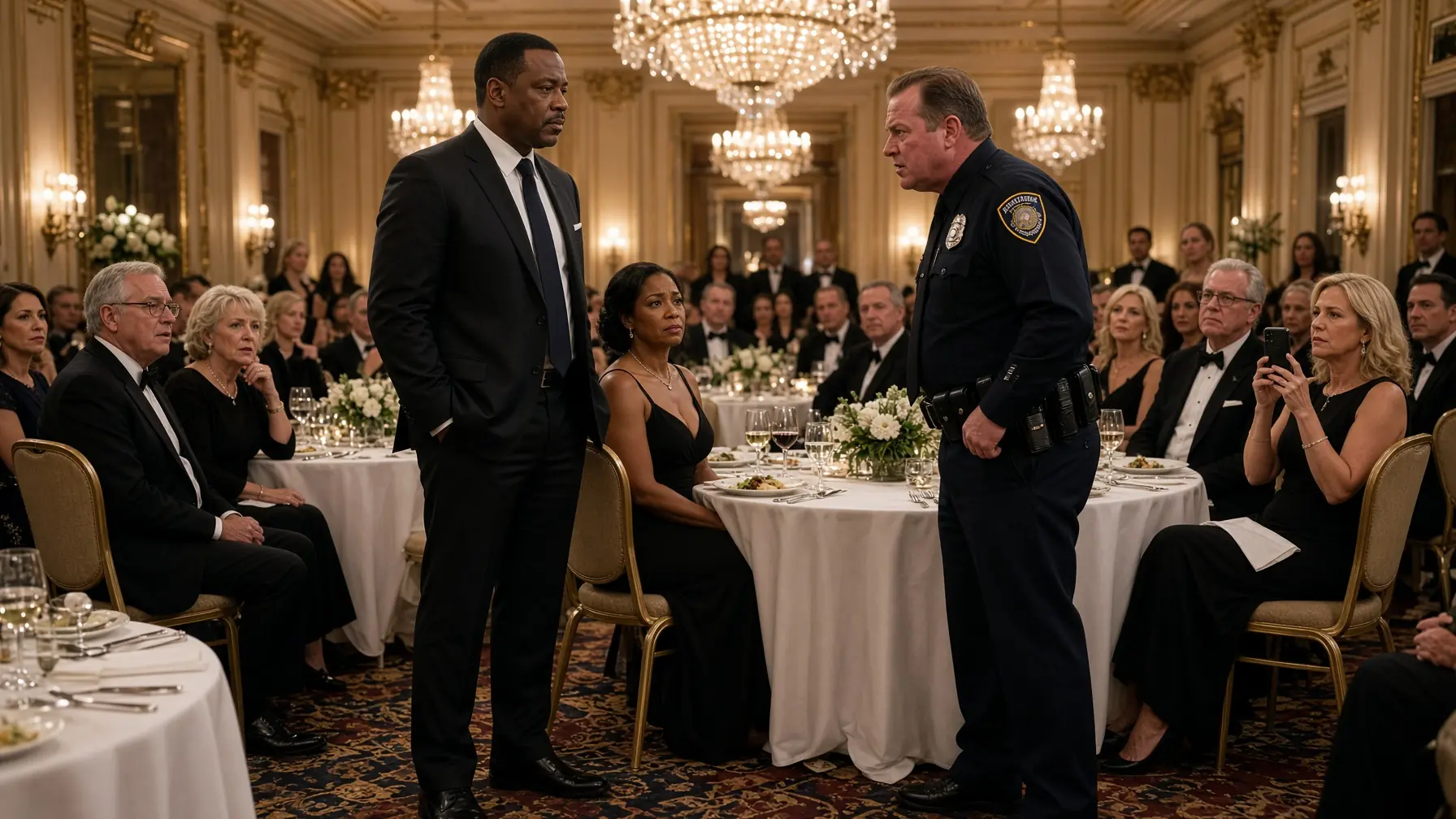
He never did. But Danielle had insisted on the good uniform, the one with the fourth star freshly sewn on, and he'd let her win that argument the way he let her win most of them. "Now a man he'd never met was standing over their table like Reeves was something that had wandered in off the street. "I received a complaint," Kesler said loud enough that the two tables nearest them went quiet. That someone matching your description was seen accessing the staff corridor by the kitchen, impersonating personnel.
I haven't left this table since dinner started, Reeves said. That's not what I was told. Told by whom? Kesler didn't answer. He glanced past Reeves toward the head table, then back, his gaze settling again on Reeves in a way it hadn't settled on anyone else in the room tonight.
You mind telling me where you got the outfit? Not the uniform. The outfit? Danielle's hand found Reeves's arm under the table. Marcus, it's fine.
Reeves murmured, not looking away from Kesler. then evenly. This is my service dress uniform officer. I'd be happy to have someone from the foundation verify my credentials. My ID is in my left breast pocket. If you'd like to see it, I'd like you to stand up.
A woman at the next table had her phone out now, angled low but recording. A man in a tuxedo two seats down had stopped mid-sentence, fork frozen halfway to his mouth. At the table just behind Kesler, an older white veteran in a nearly identical dress uniform sat undisturbed, his own credentials clipped openly to his jacket, and no one had asked him a single question all evening. The room was folding in on itself, conversation by conversation until the clink of silverware was the only sound competing with Kesler's voice. Reeves stood slowly.
He was a tall man, and Kesler's jaw tightened as he looked up at him. Turn around. Hands behind your back. On what charge? Trespassing.
Impersonating a federal official. We'll sort out the rest downtown. I haven't, I said. Turn around. What happened next took 4 seconds, and every person in the Ashford room would describe it differently for months afterward.
Kesler's hand closed on Reeves's wrist. Reeves didn't resist, didn't so much as tense, but the cuff still went on hard enough that Danielle gasped audibly, half rising from her chair before the foundation director's wife gently, uselessly put a hand on her shoulder to hold her back. "You are making a serious mistake," Reeves said quietly. The only thing he allowed himself, his eyes found Danielle's over Kesler's shoulder. "It's okay," he tried to tell her without words.
"I've survived worse rooms than this one. Nobody at the surrounding table said a word. Not the retired colonel two seats down who'd shaken Reeves's hand an hour earlier. Not the foundation's own board chair, who had gone pale and silent, phone in hand, but frozen, unable to decide whether calling someone would help or make it worse. Kesler marched him toward the exit, past 300 people who had come to applaud him.
At the double doors, Reeves stopped just for a second, just long enough to look back at his wife. And then at the podium, where his name had been printed in gold script on a placard nobody would read tonight. "Move," Kesler said, and shoved him through. Outside under the Port Koshair lights, as Kesler radioed for a transport unit, he didn't notice the valet standing frozen by the curb. a young man who' parked General Reeves's car himself an hour earlier, who had seen the base decal on the windshield and who was already reaching, hands shaking for his phone. The transport car smelled like old coffee and vinyl cleaner.
Reeves sat in the back seat, hands still cuffed behind him, watching downtown slide past the window in streaks of amber street light. Kesler hadn't said a word since they left the Regency. Kesler's silence wasn't hesitation. It was satisfaction. "You never answered my question," Reeves said.
"Who told you I was in that corridor?" Kesler's eyes found him in the rear view mirror. "Doesn't matter. It matters to me. You'll have plenty of time to think about it." Reeves let it go. Pushing now would accomplish nothing.
He'd learned that lesson three decades ago in rooms far worse than the back of a silver hollow cruiser. What mattered was memory. Every word, every mile marker, every minute stamped on the dashboard clock. He was building a record the only way he could by holding still and paying attention. What Kesler didn't know, what he had no reason to suspect, was that 15 minutes earlier, while Reeves stood cuffed under the Port Kosher lights, a phone call had already gone out.
Not from Reeves. From Danielle, her voice shaking, but her instincts intact, dialing a name in her contacts that she'd never had to use before tonight. Colonel Ashworth, base legal. She hadn't reached him. It rolled to voicemail, but the message was timestamped, and timestamps didn't disappear.
At the Regency, the Ashford room hadn't emptied. If anything, more people had drifted toward the front tables, drawn by the particular gravity that surrounds a wrong nobody quite understands yet. The foundation's board chair, a soft-spoken man named Harlon Voss, stood near the podium with his phone in his hand, still not certain what to do with it, said the retired colonel who'd shaken Reeves's hand an hour before. His name was Burn, and there was an edge in his voice now that hadn't been there during dinner. That man is a general Harland, a fourstar.
Silver Hollow PD just marched a flag officer out of a charity dinner in handcuffs. I know who he is, Voss said quietly. Then why didn't you say something? Boss didn't answer right away. He was still replaying the 90 seconds before Kesler arrived.
The moment a man he didn't recognize seated two tables back, had leaned toward the matradite and said something Voss hadn't caught, gesturing toward the front of the room. The man had left immediately after before Kesler even walked in. There was someone, V said slowly before the officer showed up talking to the staff. Burns jaw tightened. Description: gray suit didn't have a table assignment.
I recognized Voss looked toward the doors Kesler had marched Reeves through. I should have asked who he was. Across the room, a young servant named Prianire was still holding a tray of untouched desserts, watching the whole thing settle over the room like dust after a collapse. She hadn't said anything during the arrest. Hadn't been able to, but she'd been 3 ft from that table when the man in the gray suit spoke to the matra day, and she'd heard four words clearly enough to remember them for the rest of the night.
He doesn't belong here. She didn't know yet what she was going to do with that, but she didn't forget it either. Silver Hollow's third precinct at 11:00 on a Saturday night ran the way it always did, loud, overworked, indifferent to whatever walked through its doors. Kesler pulled Reeves through the booking entrance without ceremony, past two officers processing a DUI, past a bulletin board thick with wanted flyers curling at the corners. "Got a live one," Kesler told the desk sergeant.
A heavy set man named Doyle, who didn't look up from his monitor. "Tpassing, impersonating personnel, real theatrical about it, too." "Coughs off," Doyle said automatically, sliding an empty plastic bin across the counter. pockets in the bin. Kesler unlocked the cuffs. Reeves rolled his shoulders once, said nothing, and began emptying his pockets with the same unhurried precision he'd shown at the table. Wallet, keys, a folded card he didn't offer any explanation for.
His phone last. Doyle reached for the wallet without much interest. The way a man reaches for something he expects to be exactly what it looks like. He flipped it open. For a moment, nothing in the room moved.
Then Doyle's eyes lifted. First to the laminated card in his hand, then to the four stars on Reeves's shoulder, then slowly to Kesler, who was still typing an incident number into the terminal, entirely unaware that the ground under his career had just quietly given way. "Kesler," Doyle said, and his voice had changed completely. "Who exactly did you say you arrested?" Kesler laughed. It was a short disbelieving sound, the kind men make when they think someone's about to be embarrassed on their behalf.
What are you talking about, Sarge? Doyle didn't answer. He turned the wallet around and set it on the counter, sliding it toward Kesler, the way a man slides something he doesn't want to keep touching. The gold seal caught the fluorescent light. Beneath it, in plain black lettering, the ID read Universal T.
Reeves, United States Army, vice chief of staff. Kesler picked it up, read it once, then again slower, as if the words might rearrange themselves into something that made sense. This is fake, he said. Anybody can print a card like this. It's not fake, Tommy.
Doyle's voice had dropped to something low and urgent. Look at the hologram. Look at the seal. I did 6 years on federal task force liaison before I came back here. I know what a real one looks like.
Reeves said nothing. He stood at the counter with his wrists still red from the cuffs, watching the two men argue over a piece of laminated plastic as though the truth of who he was hadn't been available to them the entire time simply for the asking. There's been a mistake, Doyle said louder now, already reaching for the desk phone. Sir, General, I need you to know this is being handled right now. I appreciate that, Sergeant.
Reeves's voice was calm, but something in it had shifted. Not anger, not yet. Just a terrible clarity. The sound of a man doing math he didn't want to be doing. I'd like my phone back.
Kesler's hand tightened around the ID card. Hold on. We don't know this is legitimate, Tommy. Doyle's tone had gone flat and final. Put the badge down.
Sit in the breakroom. Don't say another word to him. I had probable cause. Kesla said louder now. and two officers across the booking floor turned to look. He wouldn't identify himself when I ordered him to.
You didn't ask for identification, Reeves said quietly. You told me to turn around. The room went still in the particular way rooms go still when everyone in it suddenly understands they've been watching something they'll be asked to explain later. Sir, Doyle said, "Your phone." He slid it across the counter. Reeves picked it up and for a moment his thumb hovered over Danielle's name before he chose another contact instead.
One buried three menus deep. One he hadn't called in over a year because he'd never needed to. The line rang twice. This is Ashworth. Colonel, it's Marcus Reeves.
I'm at third precinct in Silver Hollow. I was arrested tonight at the Regency. A pause, brief, and precise. What happened? The officer who arrested me acted on information given to the restaurant before he arrived.
What information? That I didn't belong there. Silence on the other end, the kind that meant Ashworth understood exactly what those four words meant and exactly how bad the next 20 minutes were going to get for everyone involved. I'll have someone there in 20 minutes, Ashworth said finally. Don't sign anything.
Don't say anything else to them. And Marcus, is Danielle safe? She's still at the Regency. I need someone to reach her. Consider it done.
Reeves ended the call and set the phone down on the counter with the same unhurried precision he'd used to empty his pockets an hour earlier. Kesler was watching him now with an expression that had started to curdle. Not remorse, not yet. Something closer to a man watching a door close that he hadn't realized was the only one in the room. "You still haven't told me," Reeves said, who spoke to the staff before you arrived.
Kesler's jaw worked. I don't know what you're talking about. Someone did. A man in a gray suit. He told the matrid I didn't belong there and left before you ever walked through those doors.
Reeves let that sit for a second. I'd start remembering, Officer Kesler, because in about 20 minutes, remembering on your own is going to look a great deal better than being reminded. Kesler didn't answer. He set the ID card down on the counter with two fingers like it had gotten hot and took a half step back from it. I want a union rep, he said to no one in particular.
To the room. You'll want more than that, Doyle muttered. At the Regency, the last of the plated desserts had gone untouched and cold. Harlen Voss stood near the doors with his phone pressed to his ear, finally speaking to someone from the base's public affairs office, his voice tight with the particular anxiety of a man realizing his event was about to become a headline he had no way of controlling. Danielle sat alone at their table.
Reeves's chair, still pushed back at the angle he'd left it. A colonel she'd never met, young, professional, apologetic in a way that made the apology feel almost worse, was crouched beside her, phone already to his own ear. Ma'am, Colonel Ashworth is on route to the precinct now. He'll have your husband out within the hour. I know, Danielle said.
She wasn't looking at the colonel. She was looking at the doors Kesler had shoved her husband through, still half expecting them to swing open and for this to simply be over. Behind her, unnoticed, Prianire set down her tray at the service station and pulled her own phone from her apron pocket, not to call anyone yet, just to look one more time. At the four words she'd typed into her notes app, the moment the officer walked in, before she'd even known whose name would end up attached to them, "He doesn't belong here." She was starting to think she knew exactly who'd said it. A four-star general just proved Kesler never asked for ID.
He only gave an order. And somewhere inside that restaurant, a man in a gray suit walked away before any of this started. Convinced no one had seen him. Someone did. Now Silver Hol PD is about to discover just how far this goes.
And the man who started it all is about to realize he can't hide anymore. Colonel Ashworth arrived at the third precinct at 11:47 p.m. and the building changed shape around him the moment he walked through the door. He didn't shout. He didn't need to. He crossed the booking floor in a plain black overcoat.
Flanked by two Jag officers Reeves hadn't met, and the entire room seemed to reorganize itself around his presence, the way water reorganizes around a stone dropped into it. "Where is he?" Ashworth asked, and Doyle pointed without a word. Reeves stood when Ashworth reached him, and for the first time all night, something in his shoulders eased. Not relief exactly, but the particular tiredness that comes after, holding a weight alone for longer than a person should have to. Colonel General Ashworth's eyes moved once over Reeves's wrists, still faintly marked, then over his shoulder to where Kesler sat in the breakroom doorway watching.
"Tell me everything from the beginning. Don't leave anything out, including what you think doesn't matter," Reeves told him. The complaint about the corridor, the refusal to produce ID rather than the demand for it Kesler had claimed. The man in the gray suit gone before anyone thought to ask his name. Ashworth listened without interrupting, and when Reeves finished, he turned to one of the JAG officers behind him.
Pull the restaurant staff logs and reservation list for tonight. Every name, I want to know who was seated near that corridor before the officer arrived. Sir, that's going to require the restaurant's cooperation. Then get their cooperation. Ashworth's voice didn't rise.
It didn't need to. A general officer was detained tonight based on a stranger's claim that he quote didn't belong somewhere. That's not a routine use of force complaint. That's potentially a civil rights matter, and I intend to find out. Doyle, still behind the desk, cleared his throat.
Colonel, for what it's worth, the department's already pulling body cam footage. Internal affairs got a call 20 minutes ago. I think somebody at the Regency already reached out to the mayor's office. Ashworth's expression didn't change, but something behind it sharpened. Good.
That saves me a phone call. By midnight, the precinct's parking lot held four unmarked government sedans, a Jag legal van, and a silver holo patrol captain who'd been pulled out of bed and had arrived in a windbreaker over pajama pants. Trying and failing to look like a man in control of his own building. Captain Elena Marsh found Ashworth in the hallway outside the breakroom where Kesler still sat, arms crossed, staring at the floor like it owed him an explanation. Colonel, I want to be clear.
This department takes this seriously. Officer Kesler will be placed on administrative leave pending review. That's not going to be sufficient, Captain. With respect, sir, until the internal investigation. There won't just be an internal investigation.
Ashworth's voice was quiet enough that Marsh had to lean in to catch it, which made it land harder than if he'd shouted. A general officer was physically restrained in front of 300 civilians on the word of an unidentified man who has yet to be located. Whatever your department calls that internally, the Department of Justice will have its own name for it. Marsh's face went the particular shade of gray that comes from watching a career start to slide sideways in real time. Sir, I understand this looks bad.
It doesn't look bad, Captain. It is bad. Ashwith glanced past her toward Doyle, who was still at the desk, quietly pulling up dispatch logs he hadn't been asked for yet, but suspected someone would want soon, and I'd start wondering how bad before someone else does it for you. The break happened at 12:20 a.m., and it didn't come from Ashwood's investigators. It came from Priairire, standing outside the Regency in the cold with her phone in her hand, finally deciding what to do with four words she'd been carrying for 2 hours.
She hadn't called the police. She'd called Harlon Voss. I think I knew who it was, she said when he picked up. The man in the gray suit. I've seated him at three of your foundation dinners.
I know his face. I just didn't want to say a name until I was sure. Voss went quiet. Are you certain now? Warren Puit.
The name sat on the line for a second, unremarked on. Did he say anything else? Voss asked. Anything you didn't tell me before? Priya hesitated.
No, but he looked at General Reeves before he walked away. Just for a second before he ever talked to the matraee. How did he look at him? Like he already knew him. Voss didn't answer right away.
He was thinking the way a man thinks when a small detail suddenly refuses to stay small. Write down everything you remember, Priya. Tonight, while it's fresh, Colonel Ashworth is going to want to hear it directly from you. Back at the precinct, Reeves sat in a borrowed office with Ashworth, a cup of untouched coffee cooling on the desk between them when the colonel's phone buzzed with a message from Voss. Ashworth read it twice.
Then he looked up at Reeves and for the first time that night, there was something in his expression that hadn't been there before. Not surprise, exactly. Recognition. Marcus, he said slowly. I think you're going to want to hear this.
He turned the phone around. Reeves read the name on the screen, Warren Puit, and something in his face changed quietly. The way a man's face changes when a stray fact he'd stopped looking for finally walks back into the room. You know him, Ashworth said. It wasn't a question.
Reeves was quiet for a moment. He was thinking of a conference table 18 months earlier, a fundraising dinner much like tonight's, a disagreement over a line item in the foundation's budget that Reeves had pushed back on, and a look across the table afterward that he hadn't been able to name at the time and hadn't thought about since. I've met him, Reeves said finally once. He didn't care for something I said. He didn't say more than that.
He didn't need to. It wasn't proof of anything yet, just a thread, thin and uncomfortable, connecting a man in a gray suit to a name Reeves hadn't expected to hear again tonight. Outside, in the parking lot, a second wave of headlights swept across the precinct's front windows, more government plates, more people who hadn't planned to be awake at this hour, all converging on a building that 12 hours from now would look nothing like the quiet third precinct it had been that morning. Warren Puit answered his door at 7:00 a.m. still in his bathrobe, coffee in hand, and didn't understand what he was looking at until the two JAG officers behind Colonel Ashworth stepped forward with a folder. Mr. Puit, we'd like to ask you about a conversation you had with restaurant staff at the Regency last night.
I don't know what you're talking about. The server remembers you clearly. So does the matraar once we asked him directly instead of letting him decide on his own whether it mattered. Ashworth's voice was level or most gentle the voice of a man who had already won and felt no need to prove it. You have an opportunity right now to tell us what you said.
After this folder is opened that opportunity disappears. Puit's eyes move to the folder, then to the sedans in his driveway, then briefly to a framed photograph in his own hallway. himself and General Reeves shaking hands at a fundraising dinner 18 months earlier. The same donor gala where Reeves had questioned a foundation expenditure had quietly steered toward a company he owned a stake in. I told the staff the truth, Puit said finally chinlifting. He was in a corridor he shouldn't have.
He never left his table, Ashworth said. We have the seating chart. We have four witnesses. We have a time stamp on his wife's phone call that puts him in his seat the entire evening. He let that settle.
You're not being asked to defend a policy, Mr. Puit. You're being asked to explain why you told a stranger that a decorated general didn't belong in a room you'd both paid to be in. Puit didn't answer. He looked at the photograph again. By 9 that morning, Silver Hollow's mayor had personally called the base to apologize. not through a press office, not through a statement, but on the phone to Reeves directly, his voice carrying the particular strain of a man who understood exactly how this would look by noon.
Kesler was placed on administrative leave within the hour. His badge and service weapon was surrendered before his union representative had finished reading the incident file. He didn't argue. There was by then nothing left to argue with. body camera footage, Doyle's statement, Priya's written account, and a dashboard timestamp that contradicted every version of events Kesler had given, one after another. Each contradiction narrowing the room he had to stand in until there was none left.
Captain Marsh announced by that afternoon a full department review of use of force procedures and a mandatory retraining program, not because Ashworth had demanded it, though he had, but because three other complaints against Kesler, buried for years under a department that had never wanted to look too closely, surfaced within hours of the first one becoming impossible to ignore. Reeves asked for none of it. When a reporter caught him outside the base gates and asked whether he wanted Kesler prosecuted, he said only, "I want the next person in that dining room to be safe. What happens to Officer Kesler is not my decision to make. It's his department and it's the laws." He didn't smile for the cameras.
He didn't linger for them either. That evening, Danielle found him on their back porch, still in uniform, watching the last of the light go out of the sky. Harlen Voss called. She said, sitting beside him. The foundation wants to reschedule your ceremony properly this time.
I told him I didn't need it. I know you did. She took his hand, turning it over gently, her thumb resting where the cuffs had marked him the night before. You don't need it, Marcus. But I think some of those 300 people do.
I think they need to watch you walk back into that room and be given what should have been yours the first time. It was quiet for a long moment. It was never about the ceremony. I know that, too. She smiled, small and tired and real.
That's exactly why you should let them give it to you anyway. Two weeks later, the Ashford room filled again. The same chandeliers, the same white linen, though the seating chart had changed, and so quietly had the security details standing near the doors, unarmed, differential, briefed twice before anyone was allowed to work the event. Harland Voss stood at the podium and did not make a speech about what had happened. He simply said General Reeves's name.
And the room rose to its feet. Not performing for a phone, not whispering behind their hands, just standing all of them. The way people stand for something they finally understand, they almost lost the chance to honor. Reeves walked to the podium slowly, the same walk he'd been marched away from 3 weeks earlier, except this time no hand closed on his arm, and no one asked him where he'd gotten the uniform. He didn't speak long.
He thanked the foundation. He thanked his wife, seated exactly where she had been seated the last time, though this time her eyes were dry. Then he said the only thing that mattered. Dignity was never something anyone could take from me that night. It was only something they refused for a few hours to see.
He stepped down. Danielle reached for his hand as he sat and across the room. Prianire off duty invited as a guest this time not staff allowed herself for the first time in 3 weeks to fully exhale. The commendation sat on the table in front of him. Gold lettering catching the chandelier light exactly where it had been meant to sit all along.
This story was never really about the uniform. It was about a man judged before anyone bothered to ask who he was. Kesler's mistake wasn't loud hatred. It was quiet certainty, the kind that never gets questioned because it's never made to answer for itself. The harder truth belongs to everyone else in that room who saw it happen and said nothing.
And the badge was never what gave Reeves his dignity. It just made everyone else finally see what had already been true. Most people who are misjudged this way don't get a colonel and a badge to set the record straight. That part is fiction. The silence at the table is real. and it's the easiest part to change.
END
News in the same category

The Black Belt Mocked the Old Man — Then He Stepped Onto the Mat
The HOA Woman Smashed His Chicken Coop — Then the Old Farmer Came Running
Three Thugs Shoved the Old Mechanic — Then He Stepped Between Them and the Fighter
Six Men Surrounded the Old Biker — Then One Stranger Stepped Out of His Truck
They Slammed the Old Biker to the Floor — Then the Room Heard His Name
Max and Shadow’s Recovery After Waiting Together for Their Owner
Two Cops Stormed Into Her House — Then Someone Hit the Front Porch
The Officer Dragged the Elderly Woman Toward His Patrol Car — Then Someone Started Recording
Koda’s Journey After Waiting for a Family at the Shelter
They Started Towing His Work Truck — Then the Owner Came Running Out
Black CEO Enters His Daughter’s School Cafeteria — What He Hears Makes Him Freeze Instantly
Martial Artist Mocked a Quiet Black Woman in Front of 600 People — Until Her True Skill Left Him Stunned
The Black Belt Shoved the Old Man — Then He Stepped Onto the Mat
The Old HOA Lady Called Her Yard a Disaster — Then a State Vehicle Pulled Up
Boxer Dares a Black Janitor to Evade His Punch — Seconds Later, He Learns He Once Ruled the Ring

NEXT VIDEO: A Cocky MMA Fighter Bet an Old Farmer $500 He Couldn't Last 3 Minutes — Biggest Mistake of His Life