The dashboard clock of the Mercedes-Benz S-Class read 11:42 p.m. Evelyn Hayes kept both hands loosely on the leather steering wheel, her eyes fixed on the rain-slicked asphalt of Route 114. The rhythmic thrum of the windshield wipers was the only sound in the insulated cabin, a stark, peaceful contrast to the chaotic federal courtroom she had occupied for the last 14 hours. At 38, Evelyn was a force of nature in the legal world.
As the newly appointed United States Attorney, she was the highest ranking federal law enforcement officer in the district, overseeing a massive jurisdiction and hundreds of assistant prosecutors. She had just wrapped up the closing arguments on a grueling multi-agency public corruption and racketeering trial. Her shoulders ached, her eyes burned from reading thousands of pages of financial transcripts. All she wanted was to reach her home in the quiet, affluent enclave of Oakbrook Hills, pour a glass of cabernet, and sleep.
She was two miles from her driveway when the darkness in her rearview mirror was violently shattered by the strobe of police lights. Evelyn glanced up, her brow furrowing slightly. She checked her speedometer. 35 in a 35 zone.
Her registration was current. Her tail lights were perfectly functional. She hadn't swerved or braked erratically. Decades of legal training, and her innate sense of situational awareness kicked in.
She calmly engaged her right turn signal, smoothly guiding the heavy luxury sedan onto the well-lit shoulder of a closed strip mall. She placed the car in park, turned off the engine, and immediately rolled down all four windows, a standard safety protocol she knew by heart. She turned on the interior dome light, illuminating the pristine beige leather and her impeccable charcoal gray pants suit. Finally, she placed both hands flat on the top of the steering wheel, fingers spread in plain view.
In the side mirror, she watched the door of the patrol cruiser open. A tall, broad-shouldered officer stepped out. Even from a distance, Evelyn could read the aggressive posture. He didn't approach casually.
He stalked toward her car, his hand resting conspicuously on the butt of his sidearm. The beam of his heavy tactical flashlight sliced through the darkness blindingly bright as he aimed it directly into her driver's side mirror. then straight into her face. Evelyn squinted, turning her head slightly. "Good evening, officer," she said, her voice steady, modulated, and professional.
Officer Greg Mitchell didn't return the greeting. He was 26, barely three years on the force, and possessed the kind of dangerous overconfidence that often infected young cops assigned to wealthy low crime districts. He leaned in the harsh beam of the flashlight, still trained squarely on Evelyn's eyes. "License, registration, and proof of insurance," Mitchell barked.
There was no please. No statement of why she had been stopped. Just a blunt authoritative demand. They are in my glove compartment, officer, Evelyn said smoothly, not moving an inch.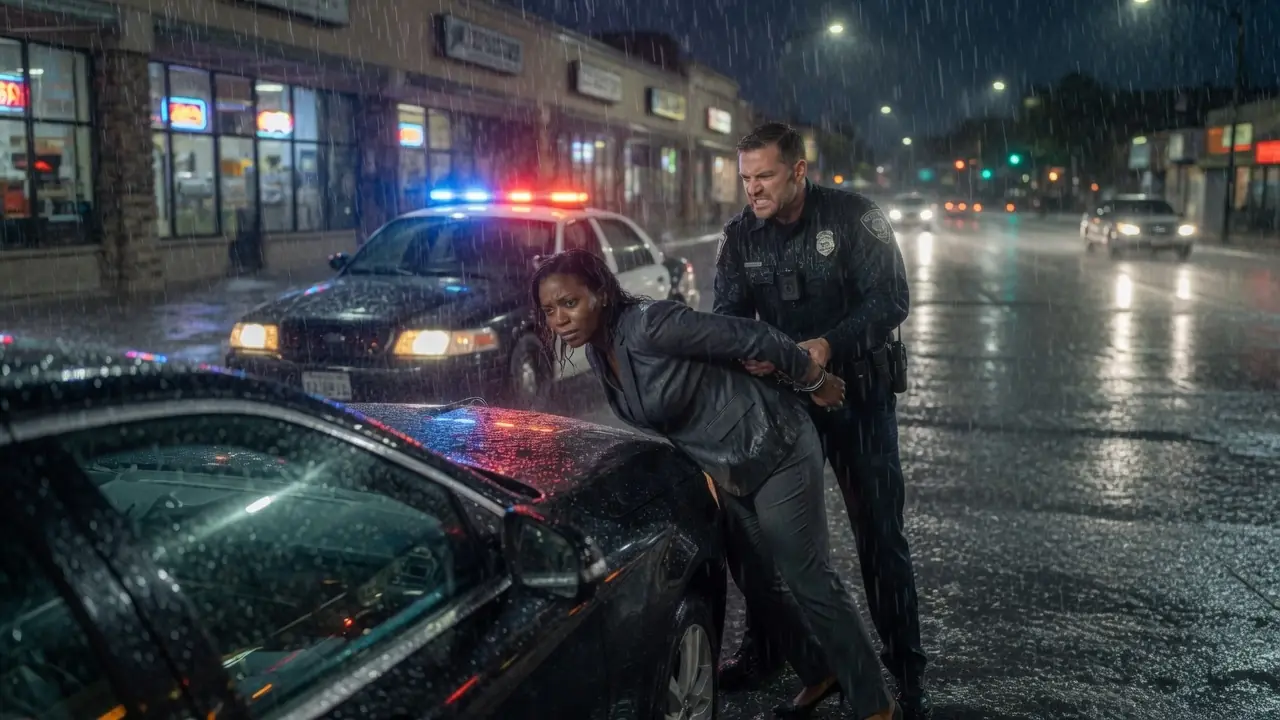
I'm going to reach over with my right hand to retrieve them. Is that acceptable? Mitchell's eyes darted around the interior of the high-end vehicle, taking in the expensive wood trim, the sophisticated dashboard, and finally the Black woman behind the wheel. His lips curled into a faint, dismissive sneer.
Just get the documents, and no sudden moves, Evelyn slowly reached across the console, popped the glove box, and retrieved her leather document wallet. She extracted her state driver's license and the vehicle's registration, handing them through the window. She purposely did not hand him her federal credentials. The leather folder containing her badge and Department of Justice identification remained tucked safely in her briefcase on the passenger floorboard.
Mitchell snatched the cards from her hand. He shined his light on the license reading the name Evelyn Hayes. He looked from the plastic card to her face, his expression souring further. "Whose car is this?
" Mitchell asked, his tone dripping with an unwarranted suspicion. "It's my vehicle, officer," Evelyn replied. "Is that right? " Mitchell challenged, leaning closer to the window, invading her space.
"This is a $120,000 car, Evelyn. "You want to tell me how you can afford to drive a vehicle like this? " Evelyn's jaw tightened imperceptibly. She recognized the script.
She had prosecuted dozens of civil rights violations involving this exact scenario. Driving while black, the immediate assumption that a person of color in a luxury vehicle in a wealthy neighborhood must have acquired it through illicit means. I bought it with the money from my salary. Evelyn answered calmly, refusing to break eye contact.
"Officer, may I ask why I was pulled over? " "You drifted over the yellow line. " Mitchell lied smoothly. It was the classic unprovable pretext for an investigatory stop.
" Mitchell snapped. "Where are you coming from? " "Work downtown. " At midnight, Mitchell scoffed, a patronizing laugh escaping his throat.
What kind of work do you do downtown at midnight, Evelyn? "You a cleaning lady? " "Or is it something else? " Evelyn stared at him.
The sheer audacity, the textbook racial profiling was almost breathtaking to witness firsthand. She could end this in two seconds. All she had to do was reach into her briefcase, pull out the solid gold DOJ shield, and watch the color drain from this arrogant rookie's face. She could demand his supervisor right now flash her title and have him stammering apologies, but as the United States Attorney Evelyn Hayes possessed a deep, unyielding commitment to justice.
If Officer Mitchell was treating her this way, a well-dressed woman complying perfectly with instructions, how was he treating the teenage boys in the neighboring districts? How was he treating people who didn't know their constitutional rights inside and out? She made a split-second decision. She wasn't going to use her badge to escape the situation.
She was going to let Officer Mitchell dig his own grave exactly by the book. "I was finishing up a trial," Evelyn said evenly. "I work in the legal profession. " Mitchell rolled his eyes.
Right. A legal professional. Sit tight. Don't move and keep your hands on the wheel where I can see them.
Mitchell turned and strutted back to his cruiser, the documents in his hand. Evelyn let out a slow, controlled breath. She watched him in the mirror as he sat in the driver's seat, picking up his radio. She knew he was running her plates, running her license for warrants.
He was going to find absolutely nothing. Her record was cleaner than the freshly paved road beneath her tires. five minutes passed. The rain picked up drumming heavily against the roof of the Mercedes. When Mitchell finally stepped back out of his cruiser, his posture had changed.
It wasn't apologetic. It was agitated. He hadn't found the warrants he was so certain he would find. He hadn't found a stolen vehicle report.
His narrative was falling apart, and rather than accept he had made a baseless stop, his ego doubled down. He marched back to her window, not returning the documents. "Step out of the vehicle. " Mitchell commanded his voice loud and aggressive over the sound of the rain.
Evelyn did not move. She looked up at him through the open window, her expression composed, projecting the quiet authority that made defense attorneys sweat in the courtroom. "Officer Mitchell," she said, having read the silver name tag on his uniform. I have provided my license, registration, and insurance.
They are all valid. You have informed me I drifted over the yellow line, which is a minor traffic infraction. Unless you are issuing a citation for that infraction, I am legally free to go. On what legal grounds are you ordering me out of my vehicle?
Mitchell's face flushed red with sudden anger. He was not used to being questioned. In his three years on the force, a badge and a gun usually commanded absolute unquestioning submission. The calm, educated defiance of the woman in front of him felt like a direct assault on his authority.
"I don't need a law lesson from you," Mitchell shouted, resting his hand forcefully on his holster. This is a lawful order. You match the description of a burglar. I'm investigating a crime.
Now get out of the car before I pull you out. Under Pennsylvania versus Mims, you do have the authority to order a driver out of the vehicle for officer safety. Evelyn recited her voice chillingly calm. However, given the context of this stop, the lack of a matching description beyond my race, and the absence of any reasonable articulable suspicion of an ongoing crime, this extended detention is becoming a violation of my Fourth Amendment rights under Rodriguez versus United States.
" Mitchell blinked, momentarily stunned by the sudden flawless barrage of Supreme Court case law. But the hesitation lasted only a second before his fragile ego flared into pure rage. He interpreted her intelligence as a threat. "Are you refusing a lawful order?
" Mitchell barked, unfastening the retention strap on his holster. "I'm complying," Evelyn said smoothly. She reached down, unclicked her seat belt, and slowly pushed the heavy door open. She stepped out into the cold rain.
Standing at 5'9 in her modest heels, she was nearly eye to eye with the officer. The rain immediately began to dampen her expensive suit, but she stood perfectly straight, an aura of utter dignity surrounding her. "Turn around and face the car. Put your hands behind your back," Mitchell ordered, pulling his heavy metal handcuffs from his belt.
"Am I under arrest? " Evelyn asked, not turning around just yet. You're being detained. "For what crime?
" For being uncooperative and obstructing my investigation, Mitchell yelled, stepping forward and aggressively grabbing her left arm. His grip was entirely too tight, his fingers digging into the wool of her sleeve. Evelyn didn't flinch. She didn't pull away.
She knew that any sudden movement would be written up as resisting arrest or assaulting an officer. She simply let him turn her around and press her chest against the cold, wet metal of her car's roof. Officer, Evelyn said, her voice, dropping an octave, carrying a warning weight that he was entirely too foolish to recognize. I advise you to think very carefully about your next action.
You are acting outside the scope of your legal authority. If you place those cuffs on me, you are making an unlawful arrest. "Shut up. " Mitchell hissed.
He yanked her arms behind her back with unnecessary force. Click, click, click. The cold steel clamped down on her wrists, ratcheted tight. The metal pinched her skin.
A sharp jolt of pain shot up her arms as Mitchell wrenched them slightly upward to assert physical dominance. Evelyn stood there handcuffed in the rain, cars passing by on the adjacent road, their headlights illuminating the humiliating scene. She felt the heavy wet droplets sliding down her neck. But internally, her mind was a steel trap, recording every second, every word, every violation.
Mitchell patted her down a crude, invasive search that skirted the edge of propriety. He found her cell phone in her pocket and tossed it onto the driver's seat of her car. "Where are the stolen goods? " he demanded, leaning into her ear.
"You fence them downtown? "Is that what it is? " I am invoking my fifth amendment right to remain silent, Evelyn stated clearly. And I am requesting my attorney.
Mitchell laughed a harsh, ugly sound. "Oh, you're going to need one, lady. " He grabbed her by the bicep and marched her toward the back of his cruiser. He opened the rear door and roughly shoved her inside, pushing her head down so she wouldn't hit the frame, but pressing hard enough to make her neck twinge.
The heavy door slammed shut, sealing her in the claustrophobic plastic-centered rear of the police car. Through the plexiglass divider, she watched Mitchell walk back to her Mercedes. He opened her passenger door. Evelyn's eyes narrowed.
He was conducting a search of her vehicle without a warrant, without probable cause, and without her consent. It was a blatant, gross violation. She watched as he picked up her leather briefcase from the floorboard. Evelyn felt a brief spike of anticipation.
Her DOJ badge and credentials were in that case. All he had to do was open it, look inside, and realize he had just handcuffed the chief federal law enforcement officer in the region. But Mitchell, careless and rushed by the worsening rain, merely tossed the briefcase onto the driver's seat next to her phone, slammed the door shut, and locked the car. He didn't even look inside.
He was too eager to get his prize back to the station. Mitchell got into the driver's seat of the cruiser, shaking the water from his uniform. He keyed his radio. "Dispatch unit 4.
I have one female suspect in custody. Proceeding to the precinct for booking. Request a tow truck for a vehicle left secured on the shoulder of road 114." Evelyn sat silently in the back, the hard plastic seat incredibly uncomfortable against her bound wrists. She looked at the back of Mitchell's head.
"You have no idea what you've just done," she thought. "Enjoy the ride, Officer Mitchell. " "It will be the last one you ever take in a police car. " The drive to the 12th District Precinct took 1five minutes.
" Officer Mitchell spent the entire ride in smug silence, occasionally glancing at Evelyn in the rearview mirror, hoping to see fear or panic. He saw neither. The woman sat rigidly upright, her face an unreadable stoic mask. Her silence was beginning to unnerve him, though he would never admit it.
Most people he arrested yelled, cried, or begged. This woman sat with the quiet poise of a predator, waiting for the cage door to open. The cruiser pulled into the gated rear lot of the precinct. Mitchell parked, killed the engine, and stepped out into the pouring rain.
He opened the rear door, grabbed Evelyn by the arm, and pulled her out. "Keep moving," he ordered, marching her toward the heavy steel double doors of the rear entrance. They stepped into the harsh fluorescent lit hallway of the precinct. The air smelled of stale coffee, industrial floor cleaner, and sweat.
It was a busy Friday night. Uniformed officers walked briskly through the corridors. Plain clothes detectives stood in corners, drinking from Styrofoam cups. A chorus of ringing phones and radio chatter filled the space.
Mitchell marched Evelyn straight toward the main booking desk, a raised wooden platform where the desk sergeant sat, surrounded by monitors and paperwork. As they walked through the bullpen, a few officers glanced over. They saw Mitchell looking deeply pleased with himself, leading a Black woman in handcuffs. Some looked away, uninterested, but one or two veteran detectives paused, their eyes locking on to Evelyn.
They noted the expensive rain-soaked suit. They noted her posture. They noted the absolute terrifying calmness in her eyes. One detective slowly lowered his coffee cup, his brow furrowing as if trying to place a face he had seen on the evening news.
Mitchell brought her to a halt in front of the booking desk. Sergeant David Lacitta, a 20-year veteran with a graying mustache and a permanent look of exhaustion, didn't immediately look up from the arrest report he was typing. "What do you have, Mitchell? " Lacitta asked in a gravelly, bored voice, "Caught a live one.
" Sarge" Mitchell boasted, leaning his elbows on the high desk. "Suspicious vehicle on 114 matched the description of the Oakbrook burglaries. Refused a lawful order. uncooperative combative, bringing her in for obstruction and resisting pending investigation on the break-ins. Lacitta sighed, hitting the save button on his keyboard before finally looking up.
He adjusted his reading glasses and looked down at the suspect. Lacitta's eyes swept over Evelyn. He saw the tailored clothes ruined by rain. He saw the handcuffs cutting into her wrists.
Then he looked at her face. Lacitta froze. The color instantly drained from the veteran sergeant's face. His mouth parted slightly.
The pen he had been twirling in his right hand slipped from his fingers and clattered onto the desk. He blinked hard as if hoping the optical illusion would correct itself. It didn't, Mitchell Lacitta said, his voice suddenly sounding hollow strained. Who?
"Who did you say this is? " Wouldn't give me straight answers. Mitchell scoffed completely, missing the absolute terror blooming in his sergeant's eyes. License says Evelyn Hayes claims she's a legal professional, probably a paralegal with a chip on her shoulder.
Lacitta slowly stood up. His knees actually wobbled. He looked past Mitchell, locking eyes with Evelyn. Evelyn did not break his gaze.
She offered a microscopic icy tilt of her head. It was a silent confirmation. Yes, it's me. And yes, your officer actually did this.
Sarge, you want me to put her in holding cell, too? Mitchell asked, oblivious, reaching out to grab Evelyn's arm again. "Take your hands off her," Lacittata bellowed. The sheer volume and panic in his voice acted like a gunshot in the precinct.
The entire bullpen went dead silent. Detectives stopped typing. Officers stopped talking. Every head in the room snapped toward the booking desk.
Mitchell physically recoiled, dropping Evelyn's arm as if it were on fire. He looked at Lacitta in shock. "Sarge, what's the problem? " She was combative.
"Shut your damn mouth, Mitchell. " Lacitta roared, scrambling down the short flight of stairs from the raised desk. He practically sprinted over to Evelyn. His hands were shaking as he reached for the keys on his duty belt.
Ma'am, Madam Attorney, I I am so profoundly sorry. Lacittata stammered his voice, trembling as he jammed the key into the handcuffs. I don't know what this idiot has done, but I swear to you, we will rectify this immediately. Mitchell stood frozen, his brain struggling to process the words coming out of his supervisor's mouth.
"Madam Attorney." The handcuffs clicked open. Evelyn pulled her arms forward, slowly rubbing the deep red indentations on her wrists. She didn't look at Lacitta. She turned her head slowly, her cold, piercing gaze locking onto Mitchell.
"Sergeant Lacitta," Evelyn said. Her voice was not loud, but in the dead silence of the bullpen, it carried to every corner of the room. It was the voice of a woman who wielded the full crushing weight of the United States federal government. "Yes, Madam Attorney," Lacitta gulped, standing rigidly at attention.
"Who is the shift commander tonight? " Evelyn asked calmly. "Captain Callahan, ma'am, "I want Captain Callahan down here now. " Evelyn's eyes remained fixed on Mitchell, who was now visibly trembling. his smug arrogance replaced by a dawning catastrophic realization.
And I want the local FBI field office director on the phone. Officer Mitchell and I are going to have a very long, very detailed conversation about the deprivation of rights under color of law. The silence in the 12th district precinct was absolute suffocating and heavy with impending doom. The only sound was the steady hum of the fluorescent lights and the rhythmic drumming of rain against the high wire meshed windows.
Every officer, detective, and civilian clerk in the bullpen stood frozen, their eyes locked on the dripping wet, impeccably poised woman standing before the booking desk. Officer Greg Mitchell felt as though the floor beneath his boots had suddenly turned to quicksand. His mouth opened closed and opened again, but no sound emerged. His brain scrambled to rewind the last 30 minutes, desperately searching for the moment he could have realized his catastrophic error.
Madam Attorney, he had handcuffed the United States attorney for the district. He had mocked her. He had illegally searched her vehicle. He had dragged her through the rain and paraded her into the station like a common criminal.
Sergeant Evelyn Hayes said her voice slicing through the thick silence like a scalpel. I asked you to summon Captain Callahan. Yes, ma'am. Right away, Ma'am.
Lacitta stammered. He didn't even use the intercom. He turned and practically sprinted down the hallway toward the commander's office, his heavy duty belt jingling frantically. Mitchell finally found a fraction of his voice.
He took a hesitant step forward, his hands raised in a plecating, desperate gesture. Look, lady. Ma'am, I didn't know who you were. You didn't identify yourself.
If you had just shown me your badge, we could have avoided all this. Evelyn turned her head slowly, fixing him with a stare so cold it could have frozen Mercury. Do not attempt to shift the burden of your misconduct onto me, Officer Mitchell, she said, her tone devoid of emotion, but radiating authority. The law does not require a citizen to hold a federal office to be treated with basic constitutional respect.
My identity is irrelevant to the fact that you lacked reasonable suspicion for a traffic stop, lacked probable cause for an arrest, and conducted an illegal search of my vehicle. If I were a high school teacher, a nurse, or a janitor, your actions would be equally reprehensible. The only difference is that I have the power to destroy your career for it. Several detectives in the bullpen winced.
They knew she was right, and they knew Mitchell was dead in the water. Before Mitchell could stammer another excuse, the heavy wooden door at the end of the hall flew open. Captain Robert Callahan burst into the bullpen, still buttoning his uniform collar, closely followed by a pale-faced Sergeant Lacitta. Callahan was a 30-year veteran, a man who had survived city politics by knowing exactly whose toes never to step on.
Callahan skidded to a halt a few feet from Evelyn. He took in her soaked suit, the angry red welts forming on her wrists, and the terrified posture of Officer Mitchell. Callahan looked as if he might physically vomit. Miss Hayes.
Callahan breathed his voice tight with panic. My God, I am so profoundly sorry. I cannot fathom how this happened. Please come into my office.
Let me get you a towel, some dry clothes. We can sort this out quietly. "We are not sorting anything out quietly, Captain. " Evelyn interrupted, holding up a single hand. and I will not be going into your office.
We are going to handle this out here in the open where your officers can witness the consequences of what your precinct allows. " Callahan swallowed hard beads of sweat forming on his forehead despite the cool air conditioning. "Madam attorney, please. Mitchell is a young officer.
He made a terrible mistake. It was a misunderstanding. A mistake is writing down the wrong license plate number. Captain, a misunderstanding is giving bad directions," Evelyn replied, her voice echoing off the cinder block walls.
"What officer Mitchell engaged in is a blatant violation of Title 18, United States Code, section 242, deprivation of rights under color of law. It is a federal crime. " She took a step toward Mitchell, who instinctively shrank back. He profiled me based on my race.
Evelyn continued her voice, rising in volume, addressing the entire room. He fabricated a traffic violation to justify a stop. He detained me without cause. He unlawfully ordered me out of my vehicle.
He subjected me to an unconstitutional arrest using excessive physical force, and then he illegally entered and searched my private property without a warrant. She turned her gaze back to Callahan, who was now trembling visibly. "This wasn't a mistake, Captain Callahan. " She said, "This was a routine.
" He was far too comfortable executing this script. He knew exactly what he was doing, which tells me he has done it dozens of times before to people who did not have the resources to fight back. " Callahan looked at Mitchell, his eyes blazing with sudden furious hatred. Mitchell had not just stepped in a mess.
He had detonated a nuclear bomb in the middle of Callahan's precinct. Officer Mitchell. Callahan barked, his voice cracking like a whip. "You are relieved of duty effective immediately.
" "Hand over your weapon and your badge. " Mitchell gasped, his chest heaving. Captain, wait, please. She was uncooperative.
She was refusing orders. She is the chief federal law enforcement officer in this jurisdiction. Callahan roared, completely losing his composure. Give me your gun, Greg, before I have you thrown in a cell myself.
With trembling, reluctant hands, Mitchell unclipped his holster. He handed over his heavy service weapon, followed by the silver badge he had pinned to his chest only three years prior. He looked completely broken, a man watching his life evaporate before his eyes. "Captain," Evelyn said quietly, drawing Callahan's attention back to her.
"Where is my vehicle? " "It it was ordered to be towed. " "Ma'am," Lacitta chimed in nervously from the back. "To the municipal impound lot.
Cancel the toe, Evelyn ordered. Immediately, if my car has already been hooked up, tell them to drop it. My federal credentials and highly sensitive grand jury materials are inside that vehicle. If any unauthorized personnel breach that vehicle, I will have the FBI arrest them for tampering with a federal investigation.
Lacitta scrambled for his radio barking frantic orders to dispatch to intercept the tow truck on route 114. Now, Evelyn said, checking her gold wristwatch. I requested the special agent in charge of the FBI field office. Has he been notified?
Callahan nodded miserably. Yes, ma'am. Director Reynolds is on his way. He said he was 10 minutes out.
Good, Evelyn said, crossing her arms over her damp chest because this precinct is officially a crime scene, and nobody is leaving. Twenty minutes later, the front doors of the 12th district precinct slid open with a sharp mechanical hiss. The bustling energy of the station, which had been frozen in terrified silence since Evelyn's identity was revealed, completely flatlined. Thomas Reynolds, the special agent in charge.
SAC of the local FBI field office, strode into the bullpen. Reynolds was a towering man in his late 50s, wearing a sharp navy trench coat over a dark suit. His face was a chiseled mask of authority, weathered by decades of hunting domestic terrorists and corrupt politicians. He was flanked by four solemn-faced FBI special agents, all wearing tactical windbreakers with the bright yellow letters FBI emblazoned across the back.
Reynolds bypassed the front desk entirely, his eyes scanning the room until they locked onto Evelyn Hayes. He saw her wet hair, her ruined suit, and the visible red marks on her wrists. A dangerous dark fury sparked in his eyes. He walked straight past Captain Callahan, completely ignoring the commanding officer's extended hand, and stopped in front of Evelyn.
"Evelyn," Reynold said, his deep baritone voice, carrying a mixture of professional concern and lethal intent. "Are you injured? " "I'm fine, Tom," Evelyn replied, her posture relaxing just a fraction in the presence of her federal colleague. just a bit of bruised skin and a profound loss of faith in the 12th district's training protocols. Reynolds turned on his heel, his towering frame casting a shadow over Captain Callahan and the disgraced officer Mitchell, who was now sitting on a bench, holding his head in his hands.
"Captain Callahan," Reynold said softly. The quietness of his voice was far more terrifying than if he had yelled. "Care to explain why my United States attorney was brought into this facility in handcuffs? Agent Reynolds?
It was a colossal brakedown in judgment. " Callahan stammered, wiping sweat from his brow. "Officer Mitchell acted completely outside of departmental policy. He has already been stripped of his badge and weapon, and I am initiating a full internal affairs investigation as we speak.
Internal affairs. Reynolds scoffed a humorless sound. Internal affairs doesn't handle federal civil rights violations, Captain. We do.
Reynolds snapped his fingers. Two of the FBI agents immediately stepped forward, moving toward Mitchell. Mitchell looked up his eyes wide with sheer panic as the agents flanked him. "Wait, wait.
You can't arrest me. I have rights. I want my union rep. You're not under arrest, Mr.
Mitchell. " "Not yet," Reynolds said, deliberately, dropping the title of officer. "But you are going to be escorted to an interrogation room by my agents. You will sit there until Department of Justice Civil Rights Division attorneys arrive from Washington.
If you so much as sneeze without asking permission, I will have you charged with obstruction. " The two agents hauled Mitchell to his feet. The young man, who had been so eager to exert his dominance over a Black woman on a dark road just an hour prior, now looked like a terrified child. His legs barely supported him as they marched him down the hallway and out of sight.
Reynolds turned back to Callahan. Captain, I am placing an immediate federal hold on all evidence related to this incident. My agents are going to secure the dash cam footage from Mitchell's cruiser, the body cam footage from his uniform, the GPS telemetry of his vehicle, and all radio dispatch logs. If a single byte of data goes missing or gets accidentally deleted, I will arrest you and your shift supervisors for evidence tampering.
Callahan nodded vigorously. Of course, you have full cooperation, complete transparency. Tom, Evelyn interjected, stepping forward. There is a twist to this that Captain Callahan isn't aware of yet.
Both Reynolds and Callahan looked at her. Evelyn reached into her damp pocket and pulled out a small waterproof notebook. For the past six months, my office, in conjunction with the Civil Rights Division, has been quietly reviewing statistical anomalies in traffic stops within Oakbrook Hills and the broader 12th district. We noted a 400% discrepancy in the detainment and search rates of minority drivers compared to white drivers.
Callahan's face went from pale to a sickly shade of ash. He grasped the edge of the booking desk for physical support. We were lacking a clear, undeniable precipitating event to petition a federal judge for a full pattern or practice investigation into this precinct. Evelyn continued her eyes locking onto Callahan's.
Officer Mitchell just provided me with the golden ticket. He didn't just violate my rights, Captain. He exposed the culture of your precinct. He was too brazen, too practiced.
He knew there would be no consequences from his superiors for hauling in a Black woman in a nice car. Reynolds let out a low whistle, a grim smile touching the corners of his mouth. He picked the absolute worst person on the planet to pull over. "Indeed," Evelyn said.
She turned to one of the remaining FBI agents. Agent, please drive me to my vehicle on Route 114. I need to secure my grand jury files and drive myself home. "Madam Attorney, we can have a car take you home," Callahan pleaded, desperate to salvage even a shred of goodwill.
"Let us tow your car safely to your residence. " Evelyn looked at the captain, her expression utterly devoid of pity. Captain Callahan, the only thing your department will ever do for me again is comply with the federal subpoenas that will be arriving on your desk at 8:00 a.m. on Monday. She turned and walked toward the sliding glass doors, the heels of her ruined shoes, clicking sharply against the linoleum floor.
The entire bullpen watched in stunned silence. Not a single police officer moved. Every cop in the room, from the veteran detectives to the rookie patrolman, stood at rigid attention as she passed a silent, terrified acknowledgment of the power she wielded and the storm she was leaving in her wake. Reynolds watched her go, shaking his head in quiet admiration before turning a predatory gaze back onto Callahan.
"All right, Captain," Reynolds said, pulling a notebook from his trench coat. Let's start with your server room. Show me where you keep the footage. At exactly 8:00 a.m. on Monday morning, the glass doors of the 12th district precinct swung open.
There was no rain today, only the harsh, unforgiving glare of the morning sun. Captain Robert Callahan was sitting in his office aggressively chewing antacids and staring at a blank incident report. He had spent the entire weekend doing damage control, calling local politicians, the police union president, and his own defense attorney. He had planned to force officer Greg Mitchell to take early retirement, bury the internal affairs report, and issue a formal, heavily redacted apology to the U.
S. Attorney's Office. He foolishly believed the storm might pass. He was wrong.
The storm had just arrived in the form of 25 federal agents. Special agent in charge Thomas Reynolds strode into the bullpen flanked by a phalanx of FBI agents carrying empty cardboard bankers boxes. Behind Reynolds was a man Callahan didn't recognize. A tall, sharply dressed man with silver hair and wire-rimmed glasses carrying a leather briefcase.
Captain Callahan. Reynolds announced his voice booming across the suddenly paralyzed squad room. Step out of your office. Callahan stood up, his knees popping, and walked out into the bullpen.
Agent Reynolds, I told you on Friday. We are fully cooperating. This isn't a cooperative inquiry anymore, Captain. Reynolds interrupted smoothly.
He gestured to the silver-haired man. This is Arthur Pendleton, Deputy Assistant Attorney General for the Civil Rights Division, flown in directly from Washington, DC. Pendleton did not offer his hand. Instead, he unlatched his briefcase and pulled out a thick stack of papers bound with heavy blue staples.
Captain Callahan. Pendleton said his voice quiet, but echoing with institutional menace. I am serving you with a federal subpoena for all digital communications, emails, text messages, radio logs, holding cell logs, and financial records of this precinct spanning the last 48 months. Furthermore, I have a federal search warrant for the lockers of 14 specific officers currently on your roster.
Callahan's face turned the color of old parchment. 14. On what grounds? On the grounds of a criminal conspiracy, Pendleton replied coldly.
Across town, in the secure mahogany paneled conference room of the United States Attorney's Office, Evelyn Hayes stood at the head of a massive table. The room was transformed into a federal war room. Whiteboards were covered in organizational charts of the 12th district precinct. Agent Reynolds had brought Evelyn the initial findings from Mitchell's phone at 300 a.m. on Sunday.
The twist, they discovered, had elevated the situation from a single civil rights violation into a sprawling multi-million dollar federal racketeering case. Evelyn looked at the faces of her senior prosecutors. "Let's review the findings," she said, tapping a laser pointer on a projected image of a WhatsApp group chat log. When the FBI mirrored Officer Mitchell's personal phone, they didn't just find racist jokes.
They found a private encrypted group chat named the gatekeepers. It includes 14 active-duty officers in the 12th district, including two shift supervisors. She advanced the slide. A series of text messages appeared on the screen.
Mitchell got a blacked-out Range Rover on 114. Out of state plates, driver matches. Supervisor Davies, light them up. See if they've got cash.
We need the numbers for the end of month. Mitchell, copy that. Going fishing. A collective murmur of disgust rippled through the federal prosecutors.
It wasn't just racial profiling, Evelyn explained her voice, steady and lethal. It was a coordinated profit-driven racket. The 12th district has been utilizing aggressive civil asset forfeiture to pad a precinct slush fund. They explicitly targeted minority drivers in high-end rental or luxury cars passing through the affluent suburbs.
They assumed these drivers were either involved in narcotics or would be too intimidated by the police to fight the seizure of their cash or vehicles in court. Evelyn leaned forward, placing both hands flat on the polished table. Mitchell pulled me over because he saw a Black woman in a $120,000 Mercedes. The burglary suspect line was just his fabricated probable cause to get me out of the car so he could search it for cash to seize.
He was hunting for a payday. One of her senior deputies raised a hand. Evelyn does Captain Callahan know about the gatekeeper's chat. He doesn't have an active account in the chat.
Evelyn replied. However, FBI forensic accountants spent Sunday tracing the asset forfeiture funds. The money seized by the gatekeepers was used to purchase unauthorized tactical gear, high-end espresso machines for the breakroom, and fully funded training trips to Las Vegas. Callahan signed off on every single one of those expense reports.
He was willfully blind, turning a blind eye to the constitutional violations because it kept his precinct rich and his officers happy. Evelyn straightened up, her eyes, blazing with an unyielding commitment to the law. Because I am a victim and a direct witness to Mitchell's actions, I am formally recusing myself from prosecuting this specific case to avoid any conflict of interest. Arthur Pendleton from Maine Justice will lead the prosecution.
But I want this district cleaned out. I want every single officer in that chat indicted under the Hobbes Act for extortion and Title 18, Section 242 for the deprivation of rights. We are going to dismantle the 12th district and rebuild it from the ground up. Back at the precinct, the FBI was tearing the building apart.
Federal agents with bolt cutters were snapping the locks off the lockers of the 14 officers named in the warrant. They confiscated burner phones, unauthorized cash hidden in duty bags, and a disturbing amount of racist paraphernalia. Officer Greg Mitchell, out on bail, was sitting in a windowless room at the FBI field office, sweating through his shirt. Agent Reynolds sat across from him, sliding a printed transcript of the WhatsApp chat across the metal table.
"Here is your reality, Greg," Reynold said, leaning in close. "You are facing up to 10 years in a federal penitentiary just for what you did to the U. S. attorney on Friday night. But with this conspiracy charge, the extortion, the falsified police reports to cover up the illegal seizures, you are looking at 2five years.
You will be 50 years old before you see the outside of a cell. " Mitchell began to hyperventilate. The arrogant, untouchable aura he had worn, like armor, was completely shattered. He put his head on the table and began to sob.
But Reynolds continued letting the silence stretch out. The Department of Justice is willing to offer you a plea deal. five years in a minimum security facility, but you have to give us Callahan. We need you to testify that he explicitly ordered you to target minorities to drive up civil asset forfeiture numbers. Mitchell looked up, tears streaming down his face. his career, his freedom, and his pride entirely decimated.
"Where do I sign? " seven months later, the sky above the federal courthouse was a brilliant cloudless blue. The plaza was swarming with news vans, satellite trucks, and hundreds of reporters holding microphones. The story of the gatekeeper takedown had become a national sensation.
The sheer audacity of a racist police ring accidentally kidnapping the United States attorney had captured the country's attention. Inside courtroom 4B, the air was heavily air-conditioned and thick with tension. Evelyn Hayes sat quietly in the first row of the gallery, wearing a sharp navy blue suit. She was not sitting at the prosecution table, but her presence dominated the room.
At the defense tables sat 14 former police officers stripped of their badges, their authority, and their dignity. Among them was Captain Robert Callahan, looking 10 years older, his face gaunt and pale. Arthur Pendleton stood at the podium delivering his closing arguments to the federal jury. These men took an oath to protect and serve the public.
Pendleton said his voice carrying the moral weight of the United States government. Instead, they built a predatory enterprise behind a badge. They operated under the assumption that the people they targeted, citizens of color, were powerless. They believed that a badge granted them immunity from the Constitution.
Pendleton turned and pointed directly at the defense table. They were so consumed by their own arrogance, so deeply entrenched in their illegal routine that they didn't even bother to verify the identity of the woman they abducted from the side of the road on a rainy Friday night. They assumed she was a criminal simply because of the color of her skin and the car she drove. But they did not abduct a criminal.
They abducted justice itself. Evelyn watched without a flicker of emotion as the jury was dismissed for deliberations. It didn't take long. two days later, the foreperson stood up and read the verdicts. Guilty.
Guilty. Guilty. 14 officers convicted on charges ranging from wire fraud and extortion to civil rights violations and perjury. Captain Callahan, who had refused a plea deal in a desperate bid to save his pension, was found guilty of conspiracy to deprive civil rights and obstruction of justice.
The judge handed him a brutal 12-year sentence in federal prison. Greg Mitchell, having honored his plea agreement and testified against his colleagues, was sentenced to five years. As the federal marshals moved in to handcuff Mitchell to transport him to holding, he turned his head and made eye contact with Evelyn in the gallery. The young man who had once sneered at her, who had illegally detained her in the rain, now looked at her with a profound, shattered remorse.
Evelyn did not smile. She did not gloat. She simply gave a slow, deliberate nod, an acknowledgement that the scales had finally been balanced. The heavy steel handcuffs clicked around Mitchell's wrists, the sound echoing the exact metallic snap Evelyn had endured seven months prior.
30 minutes later, Evelyn walked out of the heavy brass doors of the courthouse. The press corps erupted, shouting questions, camera flashes blinding the morning light. Evelyn stepped up to a cluster of microphones. She looked out at the sea of lenses, and the citizens gathered beyond the barricades.
Today, a federal jury sent a clear and uncompromising message. Evelyn began her voice, steady, commanding absolute silence from the press. The badge is a symbol of public trust, not a shield for corruption. The men convicted today forgot that they serve the Constitution of the United States.
She paused, taking a breath of the crisp air. When I was unlawfully detained on Route 114, I experienced firsthand the terrifying reality that far too many citizens face daily. The feeling of absolute powerlessness in the face of armed, unchecked authority. But the law is not powerless.
The Department of Justice is not powerless. As part of today's resolution, the 12th District Police Department has been placed under a federal consent decree. Their operations, their training, and their traffic stop protocols will be overseen by federal monitors for the next 10 years. We will dismantle the culture of prejudice, and we will rebuild a culture of accountability.
She stepped away from the microphones, ignoring the frantic follow-up questions. Agent Reynolds was waiting by the curb, standing next to her pristine Mercedes-Benz. "Hell of a day, madam attorney," Reynolds said, offering a rare, genuine smile. "It's just the beginning, Tom," Evelyn replied, unlocking the car door.
"There are a lot of precincts out there. We have plenty of work left to do. " Evelyn Hayes slid into the driver's seat. She closed the door, shutting out the noise of the world.
She placed her hands on the leather steering wheel exactly as she had that night in the rain. But this time there were no flashing lights in her rearview mirror. There was only the open road ahead, illuminated by the bright, unyielding light of justice.
END