The international terminal in Los Angeles was already crowded by 7:00 in the morning. A river of rolling suitcases and tired travelers moving beneath fluorescent lights that never seemed to dim. Somewhere in that river walked a woman in a faded hoodie and worn jeans pulling a cheap suitcase with a broken wheel that squeaked against the tile. She looked like nobody in particular and that was exactly how she wanted it.
Nobody in that terminal could have guessed that the quiet woman gripping a scuffed backpack strap had once been trained to disappear into rooms full of danger and walk out without leaving a single trace. Within the hour a police officer would slam his boot into her leg in front of hundreds of witnesses accusing her of resisting arrest for a crime she had nothing to do with. Cell phones would rise into the air, screams would echo off the terminal ceiling, and nobody standing there filming would understand that they were about to witness the awakening of a woman the government itself had once been too afraid to name out loud. Her name was Maya Brooks and she was 34 years old though something in the stillness of her eyes made her seem both younger and far older than that number suggested.
She wore no jewelry, carried no expensive luggage, and moved through the terminal with the unhurried patience of someone who had learned a long time ago that panic never solved anything. To anyone watching she looked like a woman heading home from a long shift or perhaps a traveler stretching a modest budget across a long trip. In truth, she was flying to Washington to start a quiet unremarkable civilian job. The kind of position that came with a badge that opened doors but never announced itself.
She had chosen it on purpose. After everything she had lived through, she wanted mornings that felt ordinary, coffee that tasted like nothing more than coffee, and a life where nobody looked twice at her. Even so, certain habits refused to leave her body no matter how many years passed. She counted exits without meaning to, cataloging every door, every stairwell, every gap in the crowd where danger could slip through unnoticed.
She never sat with her back to an open room. She noticed the rhythm of footsteps around her, the way other people noticed music, picking out anything that broke the pattern. She had once explained this briefly and reluctantly to a therapist assigned to her after leaving the service, who had gently suggested that such hypervigilance might ease with time. It had not eased, not fully, though she had learned to carry it quietly, folding it into the background of an otherwise unremarkable life, rather than letting it define her every waking moment.
These were not choices anymore. They were instincts carved so deep into her that she barely registered doing them, the same way a person breathes without thinking about their lungs. Years earlier, before the quiet apartment and the modest wardrobe and the careful anonymity, Maya had served in a classified special operations unit that did not exist on paper, the kind of unit whose members were erased from official records the moment they were recruited. She had walked into embassies under siege and walked out again before backup even arrived.
She had done things that saved lives and things she chose never to speak of again. Now, she simply wanted to be forgotten. And for years, the world had cooperated. Years earlier, in a life she rarely allowed herself to remember in detail, Maya had operated under conditions that most people could never imagine surviving even once, let alone repeatedly across a decade of service.
She had spent nights in places without names on any official map, waiting in silence for hours at a time, trained to control her own heartbeat the way other people controlled their breathing. She had learned to read a room in less than three seconds to identify the single most dangerous person in a crowd before that person even realized they had been noticed. That training had cost her friendships, relationships, entire years of her life spent invisible to everyone who might have loved her. And when she finally left the service, she carried both pride and quiet grief in equal measure.
Maya checked the time on a cracked phone screen, calculated how long she had before boarding, and allowed herself, just for a moment, to imagine the calm apartment waiting for her on the other coast. She had no idea that a young officer standing near the gate had already noticed her, had already begun building a story about her in his mind that had nothing to do with the truth. She had no idea that within 20 minutes that story would nearly cost her everything she had worked so hard to leave behind. Officer Ryan Coleman had been on the force for less than two years, and in that short time he had developed a reputation among his colleagues for two things: an eagerness to prove himself, and a temper that flared faster than it should have.
He wanted commendations. He wanted his name mentioned in briefings. He wanted, more than almost anything, to be the officer who caught something big on an otherwise uneventful shift, and that hunger made him dangerous in a way none of his supervisors had fully addressed. His training officer had warned him twice already about jumping to conclusions before gathering facts, but Ryan had brushed off both warnings as the caution of someone too timid to make real decisions in the field.
He believed, with the unshakeable confidence of the inexperienced, that his instincts were sharper than his colleagues gave him credit for, and he had been waiting for a chance to prove it. That morning, as he scanned the crowd near the business-class corridor, his eyes landed on Maya, and within seconds he had already decided who she was without asking a single question. To Ryan, everything about her seemed wrong for the space she occupied. Her clothes were plain, her suitcase was old, she traveled alone, and she was walking near a section of the terminal reserved for travelers who, in his mind, looked nothing like her.
He noticed her skin before he noticed anything else about her, and though he would never admit that out loud, it shaped every judgment that followed. He told himself he was simply being observant, simply doing his job, simply trusting the instincts his training had supposedly sharpened. In reality, he was building a case against an innocent woman based on nothing but appearance and prejudice dressed up as procedure. The excuse arrived a few minutes later, small and almost meaningless, the kind of accident that happens in crowded places a hundred times a day.
A businessman rushing toward his gate bumped into another traveler and dropped his wallet without noticing, the leather billfold sliding across the polished floor and coming to rest near a support pillar. Nobody around him seemed to notice, except Ryan, who scanned the immediate area and once again fixed his attention on Maya, standing roughly 10 feet away with her eyes on the departure board. He did not check security footage. He did not ask the businessman a single clarifying question.
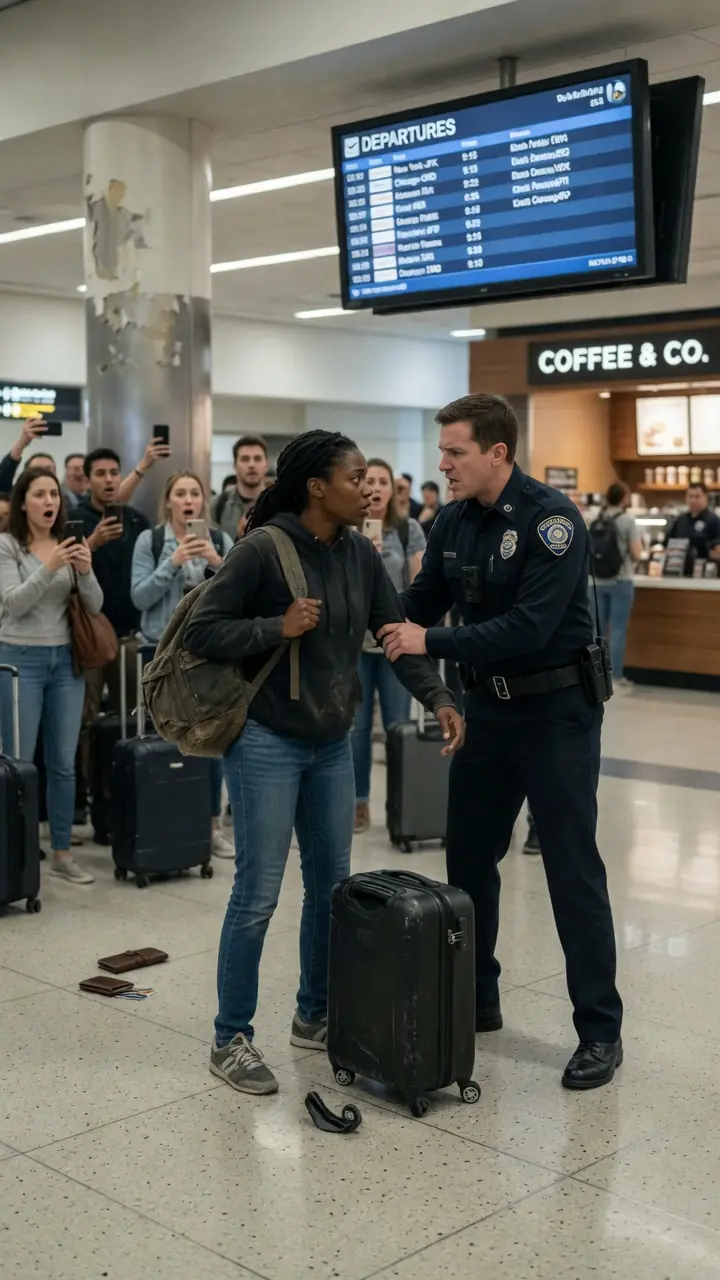
He did not consider, even briefly, any explanation other than the one his bias had already written for him. He crossed the floor toward her with the exaggerated confidence of someone who had already decided the outcome of an encounter that had not yet begun. Maya noticed him approaching and felt the familiar tightening in her chest that came whenever authority moved toward her without warning. A feeling she had learned to manage through years of discipline rather than instinct.
She met his eyes calmly, waiting to hear what he wanted, prepared to cooperate the way she always did in ordinary civilian life. When he accused her of taking the wallet, she blinked in genuine surprise, then explained, evenly and politely, that she had not touched anyone's belongings and had been standing near the pillar simply checking her flight information. Ryan did not listen. He demanded she hand over her bag immediately, his voice rising loud enough to draw glances from nearby travelers.
Several people slowed their pace to watch, sensing the tension building between them, while others quickened their steps instinctively, eager to avoid whatever was unfolding near the pillar. Maya, still calm, offered to open her bag voluntarily, explaining that he was welcome to look through it if it would resolve the misunderstanding quickly. Instead of accepting her cooperation, Ryan grabbed her arm and shoved her toward the pillar, his grip far rougher than any situation like this required. Something in the crowd shifted immediately, phones lifting into the air as people sensed that they were witnessing something they needed to record.
Maya kept her hands visible, her voice steady, repeating that she was not resisting and had done nothing wrong. But Ryan's anger had already outpaced his judgment entirely. Then, without warning, he swept his boot against the back of her leg, driving her down onto the hard terminal floor in front of everyone. Gasps rippled through the crowd as Maya's knees struck the tile, the sound sharp enough to silence nearby conversations instantly.
She caught herself with one hand, refusing to fully collapse, but her expression tightening not with fear, but with a kind of controlled disbelief that came from years of training herself never to react emotionally in moments of danger. Passengers froze mid-step, phones rising higher. Someone near the coffee kiosk shouting for him to stop. Ryan, breathing hard and clearly startled by his own escalation, reached for his handcuffs as if physical force could somehow justify what he had just done in front of an entire terminal of witnesses.
He yanked one of her wrists behind her back, then the other, snapping the cuffs shut with more force than necessary while pressing his knee against her shoulder to keep her down. Maya's voice stayed level even as pain shot through her joints, repeating the same phrase over and over, calm and clear enough for the recording phones to catch every syllable. "I am not resisting"," she said again and again, refusing to give him any excuse to escalate further despite everything in her training screaming that she could end this encounter in under two seconds if she chose to. Ryan ignored her completely, ordering her to kneel, then shoving her shoulder downward when she did not move quickly enough for his liking, his frustration turning into something closer to cruelty with every passing second.
A woman near the security podium, one of the airport's own personnel, watched the scene unfold with a growing knot of unease in her stomach that had nothing to do with procedure and everything to do with instinct. Her name was Denise Walker, and she had worked airport security for 11 years, long enough to recognize genuine threats and long enough to recognize when an officer was spiraling out of control instead of following protocol. She noticed that Maya's posture, even cuffed and kneeling, remained oddly composed. Her breathing controlled.
Her eyes tracking the room with a calmness that seemed almost impossible given what was happening to her. Denise had seen frightened people before, and this woman did not look frightened. She looked like someone waiting patiently for a mistake to correct itself. Overhead, the terminal security cameras captured everything in wide unblinking detail, recording every shove, every accusation, every moment of Ryan's escalating aggression without a single frame missing.
Maya knew the cameras were there, and she said so clearly, suggesting more than once that reviewing the footage would resolve the entire situation within minutes. "Check the cameras"," she repeated, her voice never rising, never breaking, simply offering the fastest path to the truth available to everyone in that terminal. Ryan refused outright, insisting he did not need footage to know what he had seen. His pride clearly unwilling to entertain the possibility that he had made an enormous mistake in front of dozens of witnesses.
At one point, leaning down toward her with a sneer that several bystanders would later describe in eerily similar terms, he asked her who she thought she was, as if the question itself proved his authority over her. Maya said nothing in response, and that silence unsettled him more than any argument could have, though he would never have admitted it. Something shifted behind her eyes in that moment, subtle enough that only a trained observer would have caught it. A flicker of calculation replacing the patience she had held on to until then.
The crowd, still filming, still murmuring in disbelief, began to sense the same thing Denise had already noticed. This woman was not simply enduring what was happening to her. She was choosing to. The moment everything changed happened faster than most witnesses could fully process.
Faster than the shaky cell phone footage could clearly capture in real time. Ryan, frustrated by her continued calm and desperate to reassert control in front of the growing crowd, reached for his baton and swung it toward her in a motion meant to intimidate rather than genuinely strike. What happened next was not a decision so much as a reflex. A survival instinct built through years of training so intense that it lived beneath conscious thought, waiting in her muscles like a coiled spring.
Maya's wrists, though restrained, twisted with a speed that seemed to bend physics itself. Her body pivoting low and fast as she intercepted his arm before the baton could complete its arc. In one fluid motion, she redirected the weapon out of his grip, locked his wrist at an angle that made resistance instantly pointless, and used his own forward momentum to bring him down onto the terminal floor. The entire sequence lasted less than three seconds.
So quick that several witnesses would later swear they had missed the middle of it entirely, their eyes simply jumping from Ryan standing to Ryan lying flat on his back with Maya's knee controlling his shoulder. She did not strike him. She did not retaliate with anger or excess force of any kind despite every justification she might have claimed after what he had just done to her. She simply neutralized the threat with the precise, economical control of someone who had spent years learning exactly how much force a situation required and never using a single ounce more.
For a long moment, the terminal fell into a stunned, almost theatrical silence as if the entire crowd had collectively forgotten how to breathe. Two nearby officers, who had been watching the confrontation from a distance without intervening, stood frozen in place, their hands hovering uselessly near their belts as they tried to process what they had just witnessed. Passengers who had been filming lowered their phones slightly, then raised them again, suddenly aware that whatever this woman was, she was not the person Ryan had accused her of being. Someone in the crowd murmured that it looked like something out of a movie, and in that strange, suspended silence, nobody disagreed.
A young mother pulled her child closer, whispering that everything was fine now, though her eyes never left Maya, who stood there with a calm that felt almost otherworldly against the chaos surrounding her. An elderly traveler near the coffee kiosk lowered his newspaper slowly, staring at the scene with the expression of a man who suspected he had just watched history happen in front of him without fully understanding why. Maya rose calmly, stepped back from Ryan, and raised both of her still cuffed hands into plain view, making it unmistakably clear to everyone watching that she had no intention of causing further harm. The alarm came seconds later.
A piercing tone that cut through the terminal's ambient noise as Ryan, humiliated and furious, scrambled to his radio and screamed that he was being attacked by a suspect resisting arrest. His voice shook as he spoke, betraying an unmistakable panic beneath the anger. Though none of the responding officers had time yet to question the accuracy of what he was reporting. Within moments, additional officers began pouring into the terminal from every direction, boots pounding against tile, radios crackling with urgent, conflicting reports of an assault in progress.
Maya stood perfectly still amid the chaos, hands raised, expression calm, making no sudden movements that could be misread as aggression, despite the mounting tension surrounding her. She had faced far more dangerous rooms than this one, and she understood with absolute clarity that stillness was now her greatest weapon. Ryan, scrambling back to his feet with his pride in tatters, shouted louder than before, insisting to every officer arriving that the woman had attacked a police officer without provocation. His voice cracked with a mixture of anger and something closer to fear, though he would not have named it that way even to himself.
Within minutes, a call went out requesting a specialized tactical response and a heavily armed unit began moving toward the terminal with the kind of urgency usually reserved for far more serious threats. Maya remained motionless at the center of it all, watching the situation escalate around her with the detached calm of someone who had survived circumstances infinitely more dangerous than an airport corridor filled with startled officers. The commander of the tactical unit arrived within minutes, moving through the gathered officers with the brisk authority of someone accustomed to controlling chaotic scenes in seconds rather than minutes. His name was Marcus Delaney, a veteran of both domestic tactical operations and years earlier several classified assignments he rarely discussed even with close colleagues.
As he approached, his eyes settled on Maya's posture rather than her face. On the precise, economical way she stood with her weight balanced and her breathing controlled despite the chaos surrounding her. Something about that stance triggered a memory buried deep in his mind, faint and distant but insistent. The way certain songs return unbidden from childhood.
He had seen that exact posture only once before, years earlier, during a briefing so classified that most of the room had not even been allowed to take notes. He remembered a superior officer describing an operative whose training was so complete that even at rest, her body remained ready to respond to any threat within a fraction of a second. And he remembered thinking at the time that such a description sounded almost impossible. Standing here now, watching Maya breathe evenly amid a terminal full of armed officers and shouting bystanders, Delaney no longer doubted that description at all.
Standing near the edge of the gathered crowd, largely unnoticed until this moment, was a federal agent named Thomas Reyes, who had been passing through the terminal on entirely unrelated business when the commotion began. As he watched Maya standing calmly amid the swirling chaos, his expression shifted from casual curiosity to something far more alarmed, his eyes narrowing as pieces of a distant memory clicked into place with unsettling speed. He had seen a face like hers once before, in a single briefing photograph so heavily redacted that only a sliver of her features had been visible, attached to a name that was not really a name at all. He stepped back from the crowd, pulled out his phone with hands that were not quite steady, and dialed a number reserved for situations far more serious than airport misunderstandings.
"I think I am looking at Ghost Raven"," he said quietly into the phone, his voice tight with a mixture of disbelief and urgency that made the person on the other end go completely silent for several long seconds. Ghost Raven was not a name spoken casually, even among people cleared to know it existed at all. And Reyes understood immediately the weight of what he had just said aloud in a public terminal. The operative behind that designation was a legend among a very small circle of people, someone credited with hostage rescues that never appeared in any newspaper and counterterrorism operations that had quietly unraveled organizations most of the public had never even heard of.
She had, on more than one occasion, provided close protection for heads of state during situations too sensitive to ever be declassified, moving through rooms full of danger so quietly that even the people she protected sometimes never knew how close disaster had actually come. Almost nobody had ever seen her face. And fewer still had ever spoken her real name aloud, which was precisely why the news of her possible presence in a civilian airport terminal, in handcuffs, sent an immediate shockwave through the small number of officials who received that call. Word moved with startling speed, climbing quickly from local field offices toward Washington, where it landed on desks belonging to people whose titles rarely appeared in public directories.
Within the Department of Defense, a handful of officials who had worked directly with Maya years earlier received the alert within minutes. And the reaction among them was immediate and unambiguous. Some of them remembered briefings where her operations had been discussed only in the vaguest terms, code names substituted for locations, outcomes summarized in a single line without any acknowledgement of the danger involved in achieving them. Others remembered simply the results of her work, quiet resolutions to crises that could easily have become international incidents had she not intervened exactly when and how she did.
This was not a situation to be managed through ordinary channels. This was a situation that required intervention from the very top, and quickly. Sirens rose in the distance within 20 minutes, growing louder as an entire convoy of federal vehicles descended toward the terminal with an urgency that made the surrounding tactical officers visibly nervous. Ryan, still nursing his wounded pride and utterly unaware of the storm now heading directly toward him, continued insisting to anyone who would listen that the situation was exactly as he had described it from the beginning.
He genuinely believed, even now, that his instincts had been correct, that the woman kneeling in handcuffs earlier had been exactly the threat he imagined her to be. That certainty was about to collapse entirely, and there would be no way for him to salvage it once it did. Commander Delaney's radio crackled with a voice carrying an authority that silenced the surrounding chatter almost instantly, delivering a single instruction with unmistakable finality. "No one is to point a weapon at that woman under any circumstances.
" the voice said, and Delaney felt the weight of those words settle over the entire tactical team like a physical force. Officers exchanged confused uncertain glances, lowering weapons they had only just raised, unsure why. An unarmed woman standing quietly with her hands visible now commanded this level of caution from people several ranks above their pay grade. The confusion deepened moments later when a black federal vehicle pulled directly onto the terminal floor through an emergency access route, an act so unusual that several nearby officers had never witnessed anything like it in their entire careers.
A tall man in a plain dark suit stepped out of the vehicle, his posture immediately marking him as someone of significant rank despite the absence of any visible uniform or insignia. He crossed the terminal floor with brisk purposeful steps, his eyes fixed entirely on Maya, ignoring the swarm of officers and bystanders surrounding her as if they simply did not exist. Behind him, two more vehicles pulled up along the curb outside, disgorging additional personnel who fanned out quietly around the perimeter of the scene without drawing their weapons. Their presence alone enough to communicate the gravity of the situation to everyone watching.
When he reached her, he stopped abruptly, straightened his shoulders, and rendered a crisp formal salute in front of an entire terminal of stunned onlookers who had no idea what they were witnessing. Maya, still handcuffed, met his eyes with quiet recognition and offered the faintest nod in return. A gesture that somehow conveyed more history and respect than any words could have managed. The terminal, which moments earlier had buzzed with confusion and panic, fell into a silence so complete that the hum of the overhead lights became audible.
Ryan's face drained of color as he watched a general saluting the very woman he had thrown to the ground less than an hour earlier. His mind scrambling desperately to reconcile what he was seeing with the story he had built in his head. He opened his mouth to say something, anything, but no words came. His earlier confidence evaporating entirely under the weight of what was unfolding in front of him.
Passengers who had been filming throughout the entire encounter now stood frozen, phones still raised, capturing a moment that none of them could have possibly anticipated when they had woken up that morning. Denise Walker, watching from her position near the security podium, felt a strange mixture of vindication and dread settle over her. The instinct she had trusted from the very beginning now proven correct in the most dramatic way imaginable. The general, whose name was Harold Whitfield, turned toward the surrounding officers and ordered the handcuffs removed immediately.
His voice carrying a tone that left absolutely no room for hesitation or debate. An officer fumbled with the key, hands trembling slightly under the weight of the moment, finally freeing Maya's wrists as the crowd watched in reverent uncertain silence. She rubbed her wrists gently, her expression calm, betraying none of the pain she must have felt after everything Ryan had put her through only minutes earlier. Whitfield asked quietly whether she was hurt and Maya shook her head, telling him she had endured far worse in far worse places.
A statement that carried an unspoken history none of the surrounding civilians could ever fully understand. With the immediate danger resolved, attention in the terminal shifted swiftly toward addressing the truth of what had actually happened. And airport officials moved quickly to pull the security footage from every camera covering the incident. The recordings were transferred to a large screen near the terminal's central information desk where a growing crowd gathered to watch the entire sequence unfold from multiple angles simultaneously.
The footage left no ambiguity whatsoever, showing with painful clarity that Ryan had approached Maya without any legitimate cause, had shoved her without provocation, and had struck her leg with a deliberate unprovoked kick that sent her crashing to the ground. Every accusation he had shouted throughout the encounter was directly contradicted by the footage now playing in front of dozens of witnesses, officials, and increasingly furious bystanders. The businessman who had originally dropped his wallet stepped forward at that point, having finally realized what his own carelessness had triggered, and confirmed loudly and clearly that Maya had never come anywhere near his belongings. Security personnel located the wallet exactly where it had fallen near the support pillar, untouched, confirming beyond any doubt that the entire foundation of Ryan's accusation had been built on nothing more than a careless assumption fueled by prejudice rather than evidence.
Murmurs of anger rippled through the gathered crowd as the full picture became clear. Passengers shaking their heads in open disgust at what they had just watched unfold in real time. Someone in the crowd said quietly that this could have gotten her killed, and nobody around them offered any disagreement. Within the hour, clips of the confrontation, filmed from a dozen different angles by passengers throughout the terminal, had already begun spreading rapidly across the internet, drawing outrage from people who had never set foot in that airport and never would.
Commentators and ordinary viewers alike expressed fury at the casual cruelty displayed in the footage, many pointing out that had Maya not possessed extraordinary training, the encounter could have ended in tragedy rather than vindication. News anchors across several networks picked up the story by early afternoon, replaying the clearest segments of footage, while panels of former officers and legal experts debated what had gone wrong and how such an encounter could have been prevented entirely. Civil rights advocates pointed to the incident as yet another example of a pattern they had been documenting for years, a pattern where assumptions about appearance too often replaced actual evidence in the split-second decisions officers were trained to make. Ryan, standing near the edge of the terminal with his career visibly crumbling in front of him, seemed to finally understand the magnitude of what he had done.
His earlier bravado replaced entirely by a hollow, defeated silence. Internal affairs investigators arrived within the hour, moving through the terminal with grim efficiency as they began the process of formally addressing what had occurred. They interviewed witnesses one by one, pulling aside anyone who had a clear vantage point of the confrontation, cross-referencing every account against the footage now playing on a continuous loop near the information desk. The lead investigator, a stern woman named Patricia Hayes, watched the recording three separate times before finally turning to her team with an expression that left no doubt about her conclusions.
There was no ambiguity here. She said quietly. No gray area to debate in a closed room later. Ryan was informed, in front of many of the same witnesses who had watched him make his initial accusation, that he was being relieved of duty pending a full investigation into his conduct.
His badge was removed on the spot, and he was placed in handcuffs himself, the same restraints he had used on Maya, now closing around his own wrists in a moment of stark, undeniable irony. He was led out through the terminal in full view of the crowd, his head down, offering no resistance and no further protest, the fight having drained entirely out of him. Denise Walker stepped forward without hesitation to provide a full account of everything she had witnessed. Her testimony carrying particular weight given her professional experience and her clear, immediate concerns raised throughout the encounter.
She described, in careful detail, the exact moment she had first sensed something was wrong, long before the physical confrontation had even begun, and investigators noted her account as remarkably consistent with the footage. Several other passengers came forward as well, offering consistent, detailed accounts that corroborated the footage in every meaningful respect, leaving investigators with an overwhelming body of evidence against the disgraced officer. One young father explained that he had almost intervened himself before Maya's training took over, and that he had never in his life felt so powerless watching an injustice unfold in front of his own children. Within days, officials from the police department issued a formal public apology, acknowledging the department's failure and promising a thorough review of training and accountability procedures moving forward.
A senior official personally sought Maya out to deliver that apology in person, his voice heavy with genuine regret as he expressed how deeply sorry the department was for what she had endured. Maya listened patiently, her expression calm, and when he finished speaking, she offered a response that would later be repeated in news coverage across the country in the days that followed. "I do not need an apology"," she said quietly. "I just want this to stop happening to people who have done nothing wrong.
" The simplicity and quiet dignity of that statement silenced the room completely, carrying far more weight than any lengthy speech could have managed. Officials nodded solemnly, aware that no formal apology could fully address the deeper pattern her words had pointed toward. A pattern far larger than one officer or one incident in one terminal. In the days that followed, Maya declined every single interview request that came her way, turning away journalists, producers, and curious officials alike with the same quiet, unwavering resolve she had shown throughout the entire ordeal.
Reporters staked out the arrivals gate at her final destination, hoping for even a brief statement, but she moved past them without a word. Her expression polite but entirely closed to the possibility of conversation. Producers from national programs offered generous compensation for an exclusive account of what had happened, and she declined every offer without hesitation, explaining to the one persistent caller who reached her directly that some stories were better left without a spotlight attached to them. She had spent her career avoiding attention, and she had no intention of allowing one chaotic morning to undo years of carefully maintained privacy.
She retrieved her worn backpack from where it had been set aside during the chaos, adjusted the strap over her shoulder, and quietly requested to be rebooked onto a later flight, wanting nothing more than to complete her simple journey without further disruption. Airport staff, still visibly shaken by everything that had happened, arranged everything for her without hesitation, treating her now with a mixture of respect and quiet awe that she neither sought nor particularly welcomed. She walked back through the terminal alone, past the same gates and kiosks she had passed hours earlier, though everything about how people looked at her had changed entirely in that short span of time. Nobody approached her.
Nobody asked for photographs or statements. They simply watched her pass with a kind of hushed reverence, understanding, even without fully knowing her story, that they had witnessed something rare and significant that morning. She boarded her new flight quietly, found her window seat, and settled into it with the same understated calm she had carried since the moment she first entered the terminal that day. Later that afternoon, in a quiet office, far from the noise of the airport, a young recruit training under General Whitfield's command found the courage to ask a question that had clearly been on his mind since hearing about the incident.
He asked how strong Ghost Raven really was, his voice carrying the kind of eager curiosity common among those still early in their careers. Whitfield considered the question for a long moment before answering, his expression thoughtful rather than boastful, as though weighing exactly how to convey something that words rarely captured adequately. He walked to the window, looked out over the base for a moment, and thought back to reports he had read years earlier describing operations most people would never be permitted to know had happened at all. The most frightening thing about her was never how many people she could defeat, he finally said.
It was that for years she consistently chose not to. That answer settled over the young recruit slowly, its full meaning taking shape only as he considered everything he had heard about the morning's events, the restraint Maya had shown, even while being wrongfully accused, restrained, and struck in front of an entire terminal of strangers. True strength, Whitfield continued, was never about the ability to dominate a room. It was about the discipline required to walk away from a hundred opportunities to do exactly that, choosing instead the harder, quieter path of restraint.
He added that anyone could learn to throw a punch or win a fight, but almost nobody was ever taught the far more difficult skill of choosing peace when violence would have been so much easier to justify. The recruit nodded slowly, beginning to understand a lesson that no manual or training exercise could have fully taught him. And he found himself wondering quietly whether he would ever possess even a fraction of that same discipline. Somewhere over the country by then, Maya sat beside the window of her flight, watching clouds drift past in slow, silent formations beneath a sky turning gold with the fading afternoon light.
Her wrists still ached faintly from the cuffs, and a small bruise was forming along her leg where Ryan's boot had struck her, but her expression carried none of the tension or anger the morning might have justified. She thought briefly of the crowd's stunned silence, of Denise's steady testimony, of the general's crisp salute in the middle of a chaotic terminal floor, and she allowed herself a small, private moment of quiet satisfaction. She thought too of Ryan, led away in the very cuffs he had used on her, and found that she felt no real anger toward him anymore, only a tired kind of sadness for how easily assumption had replaced judgment in a moment that never needed to become anything at all. Not because she had proven anything to anyone, but because the truth, however delayed, had ultimately found its way into the light where it belonged.
She closed her eyes as the plane leveled out above the clouds, her breathing slow and even, her body finally allowing itself to rest after a morning that had tested every ounce of discipline she had spent years building. She thought briefly of all the missions she had completed in silence, all the rooms she had walked out of without anyone ever knowing she had been there at all, and she realized that this morning, for the first time in a long while, the truth about her had been forced into the open against her wishes. It was a strange kind of exposure, one she had spent her entire career avoiding, and yet she found that she did not regret it because it had also exposed something far more important than her own identity. It had exposed, in front of an entire terminal of strangers, exactly how easily an innocent person's dignity could be stripped away by someone wielding authority without wisdom, and exactly how rarely such moments were ever corrected before real harm was done.
The terminal behind her would remember that day for a long time, retelling the story of the woman nobody suspected until the moment everything changed in the space of a few unforgettable seconds. But for Maya, it was simply one more chapter closed quietly. Another reminder that the greatest strength a person could carry was not the power to strike, but the wisdom and self-command to know precisely when never to use it at all. And somewhere above the clouds, carried gently forward toward a new beginning, she finally allowed herself to rest in the kind of peace that only comes to those who have already proven, again and again, exactly who they are.
END