Get your black ass off my courthouse steps. Officer Brennan's boot came down hard, crushing Franklin Oliver's papers into the concrete. Legal documents, a keynote speech, 30 years of credentials, all treated like garbage. Franklin sat frozen. 72 years old, hands cuffed behind his back, blood soaking through his slacks where Brennan had shoved him to the ground.
I said, "Move, old man. " Brennan kicked his briefcase down the steps. You too stupid to understand, officer? I'm speaking at the police reform summit. Brennan laughed cold and cutting. Sure you are.
You people always have some story about why you're trespassing where you don't belong. You people where you don't belong. Because to Brennan, Franklin was just another elderly black man loitering on his courthouse steps. Another problem to remove. He had no idea he'd just arrested the former chief justice of North Carolina.
The man who could destroy his career with one phone call. 7:45 in the morning, 15 minutes before the courthouse opened. Franklin had arrived early like he always did. Punctuality was a habit formed over four decades in courtrooms. Now his briefcase lay open at the bottom of the steps.
Papers scattered across concrete. One page tumbled toward the parking lot stamped in red confidential Office of the Governor. Brennan didn't notice, too busy yanking Franklin to his feet. Officer Hayes stood nearby, younger, uncertain. His eyes darted between Franklin's calm face and the scattered credentials.
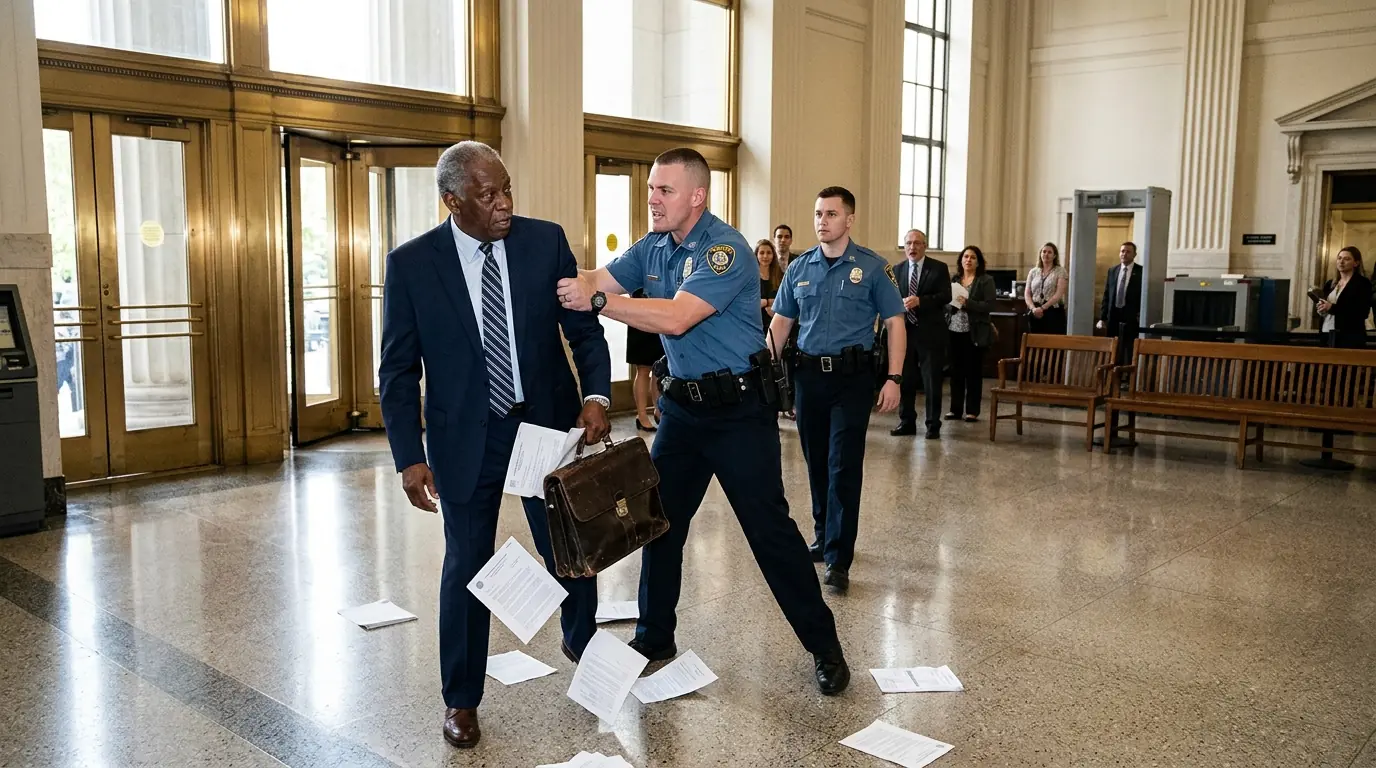
Brad, maybe we should verify. Verify what? Brennan snapped. That he's got a good cover story. These guys practice this.
They sound educated. Stay calm. It's all part of the con. Franklin said nothing. Arguing with someone convinced of your guilt only gave them ammunition.
Let them talk. Let them reveal themselves. His knee throbbed where it had hit the curb. Blood pulled in his sock. Now at 72, even minor injuries took time to heal.
These are the black stories that get buried under procedural language. Subject was non-compliant. Officer felt threatened. Words that sanitize violence. Words that turn humans into statistics.
Sarah Bennett hurried up the walkway. Junior prosecutor. Gray suit. Coffee in one hand, phone in the other. Running late.
She glanced up. saw Franklin on the ground, blood visible. Brennan standing over him with that particular cop stance. Their eyes met. She saw what this was. Another elderly person treated like a criminal.
Another morning in America. She looked away, walked faster, disappeared through the brass doors. This is how injustice persists. Not through active cruelty alone, but through accumulated silence. People who see and choose not to look, who witness and choose convenience over courage.
Gregory Hayes watched from inside the security checkpoint. 23 years on the job. He recognized Franklin's face immediately despite the gray beard and weight loss. His hand moved toward the door. He could stop this.
Could tell Brennan who he was manhandling. But Gregory had twin daughters in college. Tuition bills that didn't pause for righteousness. He'd seen security guards fired for interfering with police operations, so he pulled out his phone instead, started recording through the glass. Helen Dobson pushed her maintenance card around the corner just as Brennan kicked Franklin's briefcase.
The leather case tumbled down the steps, brass clasps breaking, papers exploding outward. "Wait," Helen called out. 31 years of maintenance work meant she knew every face in this courthouse, including Franklin Oliver's. Officer, stop. That's not Ma'am.
Step back. Brennan moved to block her hand near his weapon. This is official police business. But he's justice. Final warning.
Helen stumbled backward, nearly dropping her supplies. Her hands shook as she grabbed her phone. She picked up one of Franklin's papers, saw his photo, saw the title, Chief Justice, North Carolina Supreme Court. Tears filled her eyes. This was wrong, but Brennan's hand was near his weapon, and she was 65, and her granddaughter needed picking up at 3:00.
She dialed 911 with trembling fingers. Brennan's hand gripped Franklin's shoulder again. Rougher, less patience. Time to move. Time to be processed.
Time to become another number. They walked toward the patrol car. Each step sent pain up Franklin's injured leg, but he kept his face neutral. Dignified. He'd learned that from his father.
Birmingham, 1969. Franklin was 5 years old. He watched through a diner window as white police officers cuffed his father for causing a disturbance. His crime, asking for water at the whites only counter. Young Franklin had pressed his hands against the glass, powerless.
His father looked back and mouthed three words. Be better, son. So Franklin spent 56 years being better, studying harder, working longer, climbing higher. He became a lawyer, a judge, chief justice. And yet here he was, handcuffed, blood in his shoes, being arrested on the steps where he'd dispensed justice for 30 years.
Time moved in circles after all. Watch your head. Brennan's hand came down on Franklin's head, not gently. The classic perp move, forcing him to duck into the caged back seat. Franklin's glasses slipped from his face, clattered on pavement.
Hayes bent down without being asked, picked them up, handed them through the window. Their eyes met. Hayes looked away first. Small mercies. Inside the patrol car, Franklin smelled everything.
Stale coffee, vinyl seats, baking in heat, sweat, and fear, the scent of everyone who'd sat here before. The radio crackled. All units be advised. Summit event at courthouse. Governor's office requesting security.
Event starts at 900 hours. Franklin closed his eyes. That was his event. His speech. His moment to announce real reform.
Brennan turned down the volume. Not our problem. But it was his problem. He just didn't know it yet. A crowd formed on the plaza.
Morning joggers stopping, commuters slowing, everyone with phones out, cameras recording, a young black woman's voice. They're arresting a grandpa for sitting. This is sick. What did he even do? Nothing.
I saw the whole thing. Brennan noticed the cameras. Everyone step back. Disperse or you'll be charged with obstruction. Nobody moved.
They'd seen this before, watched this story in their own neighborhoods, and they were tired of watching it end the same way. So they kept filming, kept bearing witness. Franklin watched through the partition as the car pulled away. Watched Gregory frozen at the door. Watched Helen gathering his papers, watched the brass doors close, watched his courthouse disappear while steel pressed cold against his wrists and blood soaked warm through his socks.
He'd built his career believing the law was blind to race. That justice would prevail, that the system would bend toward righteousness. Officer Brennan had just shown him how wrong he'd been. But Franklin Oliver had spent 30 years learning patience, learning strategy, learning that sometimes the most powerful thing you can do is let your opponents reveal themselves completely. So he stayed quiet, stayed calm, and waited for the moment when everyone would realize exactly who they'd put in handcuffs.
The precinct smelled like burnt coffee and industrial cleaner. Fluorescent lights hummed overhead. 8:15 in the morning. The desk sergeant looked up from his computer. Name tag Miller.
43 years old. Night shift ending. Eyes red from 12 hours of processing drunk drivers and domestic disputes. Name? Miller's fingers hovered over the keyboard.