Every Tuesday, just after sunrise, two flatbed trucks turned off the county road outside Millbrook, New York, and rolled through the open gate of the Carter farm.
The gate had once hung crooked on one hinge, tangled in blackberry canes. Now it swung freely, though the paint on its posts remained faded and the gravel beneath it had been worn into two deep tracks.
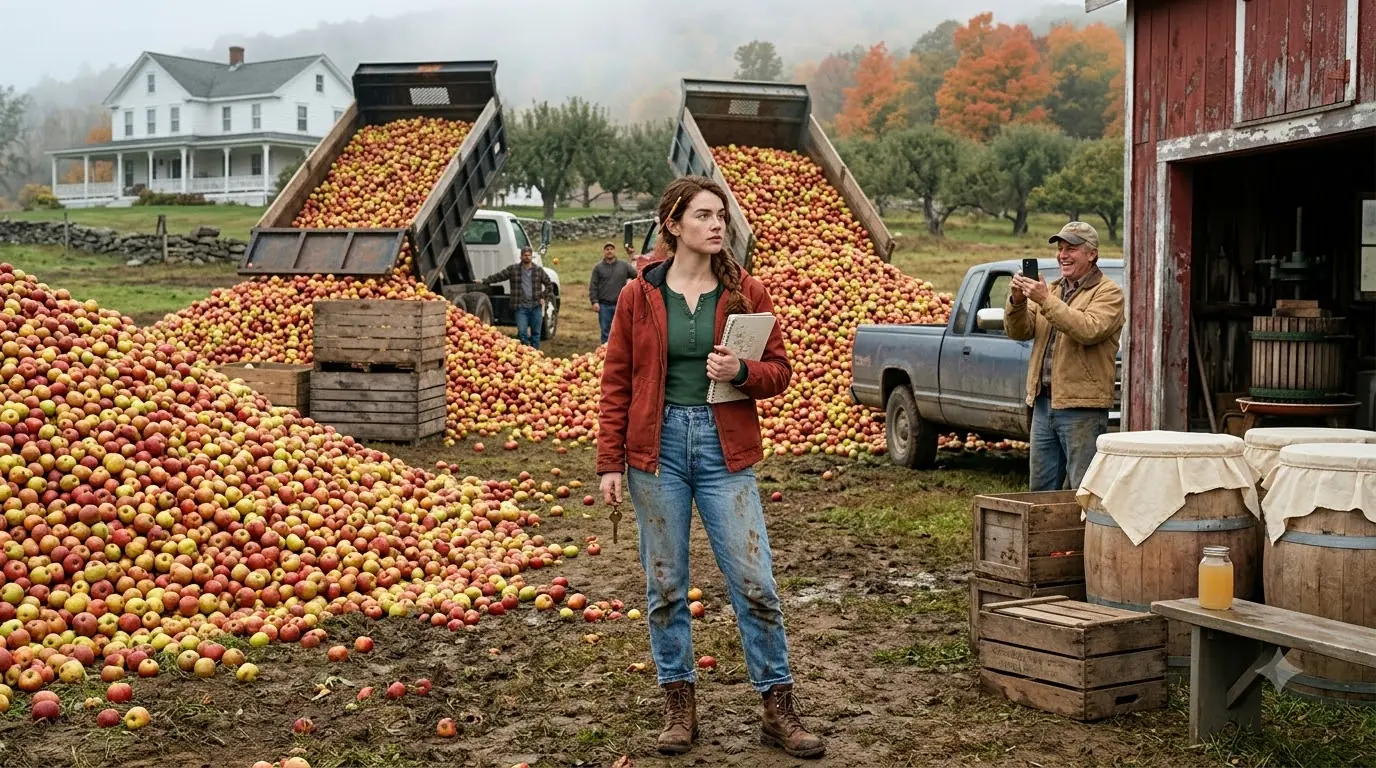
The drivers no longer needed directions. They knew to pass the old farmhouse, circle the cider barn, and stop beside a stretch of compacted ground where a young woman in muddy boots would already be waiting with a clipboard.
From the road, the deliveries looked like a slow-moving disaster. Thousands of pounds of apples tumbled down the beds in heavy, uneven waves, bouncing against one another and striking the earth with hollow thuds. Red skins split open; yellow ones carried brown bruises as large as fists. A sweet, fermenting smell drifted toward the roadside, especially when the air was still. In the autumn months, when the trees all across Dutchess County were heavy with fruit, the smell could reach the nearest mailbox before the engines had even stopped.
People slowed to stare. Some drivers laughed through rolled-down windows, and some shook their heads as if they were looking at an accident someone had inexplicably decided not to clean up. A man who owned property on the other side of the hedgerow once stopped his pickup and asked whether she was building a monument to bad decisions. Another neighbor said she should paint a sign on the barn that read COUNTY DUMP, since that was what the place had apparently become. The woman receiving the apples listened, checked the load tickets, and went back to work.
Her name was Emily Carter. She was twenty-four when the first truck arrived, and for eleven months she had accepted nearly every scheduled delivery that Halverson Orchards offered her. She had not charged the orchard a disposal fee. She had not made a public announcement, asked for investors, or shared a photograph of herself posing triumphantly beside the piles. As far as the drivers and the people passing on the county road could tell, she was spending her inheritance turning usable farmland into a mountain of rejected fruit.
But the mountain was only what people could see from a moving vehicle. Behind a line of old fencing, out of sight from the road, Emily had built separate receiving areas, one for fruit that could still pass a careful food-grade inspection and another for material that would never enter her kitchen or fermentation barrels. She had ruined enough batches to learn that ugly apples and unsafe apples were not the same thing. There was an entire process behind the barn now, and it began with the part of the delivery that nobody else cared enough to sort.