The old woman stood in the center of the Belmont Hotel lobby with one small suitcase beside her.
A uniformed security guard held open the enormous brass-framed door.
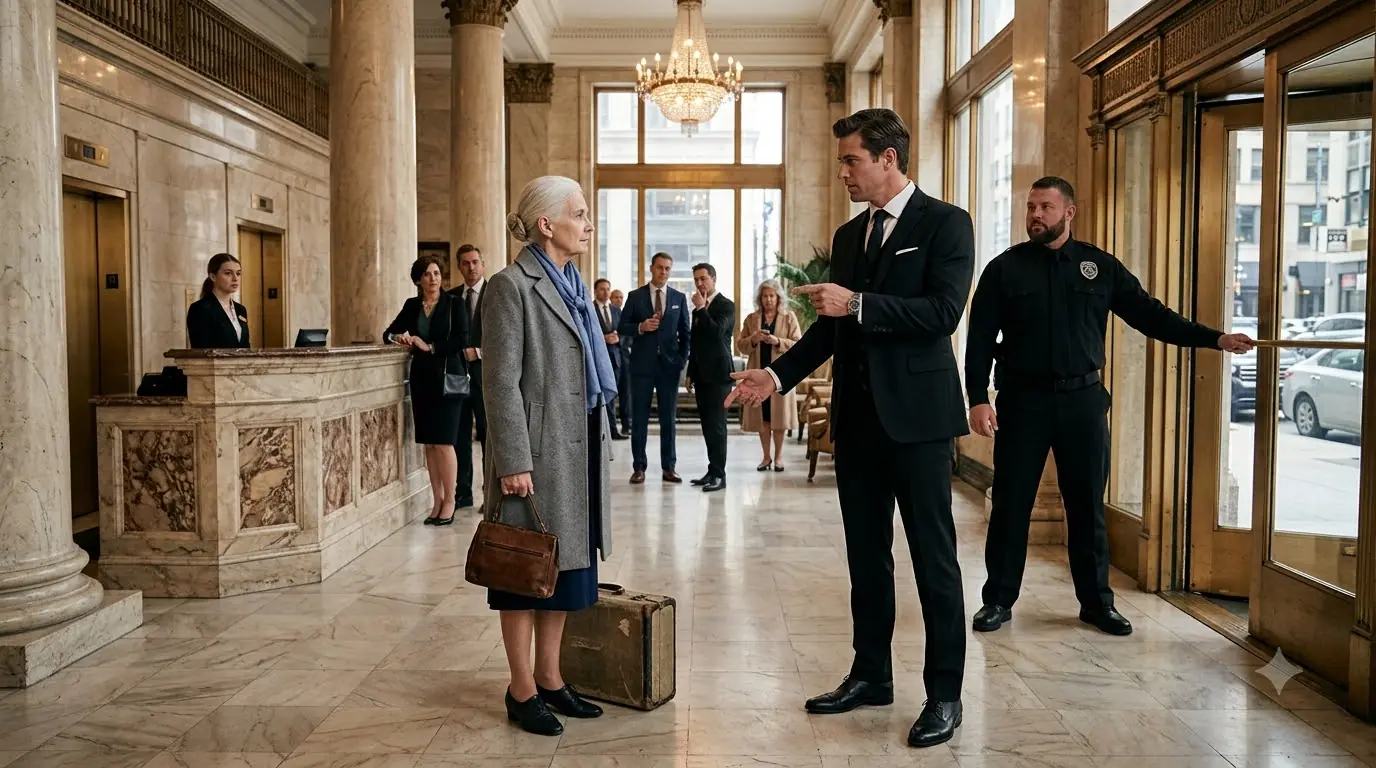
“Ma’am,” he said quietly, almost apologetically, “you need to leave.”
She did not move.
Around her, the lobby continued pretending nothing unusual was happening. Guests crossed polished marble carrying leather luggage. A bellman pushed a brass cart toward the elevators. Soft piano music drifted from the lounge near the west windows.
At the reception desk, Daniel Reed stood in a tailored black suit.
He had come down from the executive floor personally.
One minute earlier, he had pointed toward the woman’s suitcase and said, loudly enough for several guests to hear:
“She doesn’t belong here.”
The woman looked at him now.
There was no anger on her face.
Only disappointment.
Then she opened her worn brown handbag.
Daniel watched as she reached inside and removed a small brass key.
It was old.
The edges had darkened with age, and a tiny number, 12, had been stamped near the top.
She placed it carefully on the marble reception desk.
The sound was almost nothing.
A soft click.
Yet Daniel’s eyes locked onto the key.
The woman said:
“That is interesting.”
Daniel’s expression tightened.
She continued:
“Because this building belongs to me.”
The security guard slowly lowered his hand from the door.
A receptionist stopped typing.
Several guests turned.
Daniel stared at the old brass key.
Then at the woman.
Her name was Margaret Bell.
She was seventy-one years old.
And six weeks earlier, nobody inside the Belmont Hotel had believed she mattered at all.
For most of her life, Margaret had lived quietly in the same Midwestern city where the Bell family once operated a modest furniture-manufacturing business.
The business had never become nationally famous.
It employed fewer than two hundred people even at its peak, producing solid wood tables, cabinets, hotel furniture, and custom pieces for restaurants throughout the region.
Margaret had worked there too.
Not in some ceremonial family role.
She handled payroll for seventeen years, managed vendor accounts, and knew exactly which customers paid thirty days late despite always promising fifteen.
Her husband, Thomas Bell, was the one who saw opportunities everywhere.
Thomas could walk past an abandoned warehouse and imagine apartments.
He could look at a failing restaurant and see a better location for something else.
Margaret used to tease him that he could not drive through downtown without mentally purchasing half of it.
The Belmont Hotel was one of those purchases.
When Thomas first saw the building in 1988, it was not the luxury property people knew decades later.
It was already old.
Twelve stories of limestone and brick, built during the 1920s when rail passengers arrived downtown wearing hats and hotels competed over grand staircases.
By the late 1980s, the Belmont was tired.
Several upper floors needed major plumbing work.
The ballroom had water damage.
The brass elevators still functioned, but one stopped several inches below the lobby floor if too many people entered at once.
Thomas loved it immediately.
Margaret did not.
“It is a money pit,” she told him after their first tour.
Thomas stood beneath the chandelier, looking upward.
“It’s beautiful.”
“Those are not opposites.”
He laughed.
They purchased the building with two other investors.
Over time, the Bells bought out those partners until Thomas and Margaret controlled the property outright through a family holding arrangement.
The Belmont survived recessions.
A fire in a laundry room.
Two roof replacements.
Three management companies.
A near foreclosure during a particularly bad tourism year.
Margaret learned to appreciate the building slowly.
Thomas adored it from the beginning.
He kept an office on the eleventh floor even when there was no reason for him to be there.
He knew the maintenance staff by name.
He sometimes walked through the boiler room with engineers despite understanding almost none of what they said.
One Christmas, when Margaret complained that he spent too much time at the hotel, Thomas gave her a small brass key.
“Room twelve?” she asked.
“No.”
“What does it open?”
“The old owner’s office.”
“You have a new electronic lock on that door.”
“I know.”
“So this is useless.”
Thomas smiled.
“Probably.”
She rolled her eyes.
But she kept the key.
Years later, it became one of the few physical things she had left from the earliest days of the Belmont.
By 2016, Thomas was seventy-four.
His health had begun declining.
He had survived one mild stroke and had trouble climbing stairs.
The furniture business had already been sold.
The Belmont remained.
That was when Northstar Hospitality entered the story.
Northstar was a hotel-management company founded by Daniel Reed and two financial partners.
Daniel was thirty-eight then.
Aggressive.
Polished.
Ambitious.
He had built a reputation for taking older hotels and making them fashionable again without stripping away the features that gave them character.
Thomas liked him.
Margaret liked him less.
Not because Daniel was rude.
He wasn’t.
At least not then.
He listened carefully.
Remembered names.