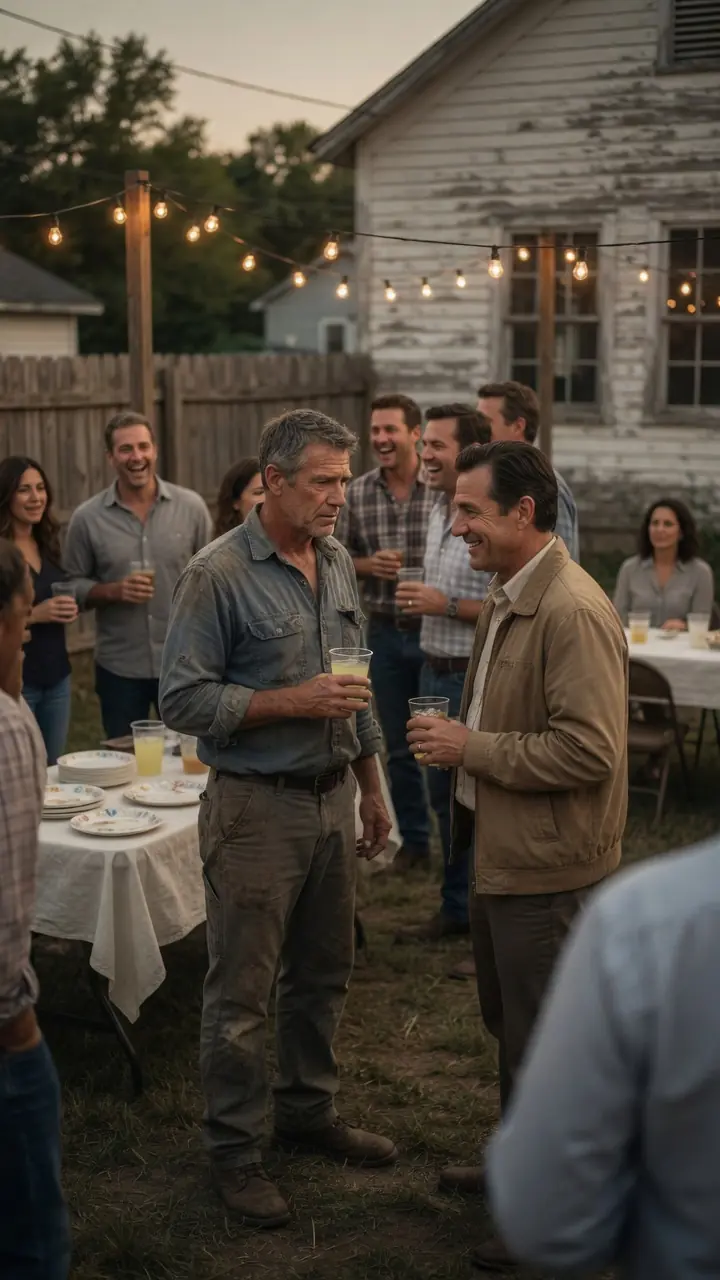
The reunion was held in the yard behind the old Brier Glenn community hall where string lights hung crooked between fence posts and someone had pushed folding tables together to look like something fancier than they were. Dorian Vale stood near the lemonade table in a collared shirt that had seen better days, holding a cup he hadn't touched in 20 minutes. Preston Hail's voice carried across the yard like it always had. Loud, confident, aimed, still patching up chicken coops for a living.
Dorian. A few people laughed. Most just looked away. Dorian said nothing.
And then Celeste Marin, CEO of Marin Ridge Group, the most powerful person in that yard by a distance, walked across the grass, took Dorian's arm, and said, "He's with me." Dorian Vale had not planned to come. The invitation had sat on the kitchen counter for 11 days, face down beneath a grocery list and a permission slip Mara needed signed for her school field trip. He had told himself he would throw it away. He kept not throwing it away.
It was Mara who found it on a Tuesday evening while he was washing dishes. She turned it over, read it quietly, and set it back on the counter right side up. "You should go," she said. He didn't answer right away.
Through the kitchen window, the last light was going out over the fields behind their house. The kind of slow orange fade that happened every evening and still somehow managed to look like something worth stopping for. "It's just people from a long time ago," he said. Mara was eight years old and had her mother's way of looking at a person when she thought they were avoiding the point.
"Mom wouldn't want you to stay home forever," she said. Not cruel, just true the way children sometimes say true things because they haven't yet learned to soften them. Dorian dried his hands on the dish towel and looked at his daughter for a long moment. She had already gone back to her homework, pencil moving across the page, unbothered as if the matter were settled.
Maybe it was. He went. He wore the best shirt he owned, a blue collared shirt he'd ironed that afternoon and drove his truck down the long stretch of County Road that led from his place on the creek to the edge of town. The community hall sat at the far end of Brier Glenn's main street, a low white building with a covered porch and a gravel lot out front.
Someone had strung lights in the yard out back, and he could hear voices before he even got out of the truck. He sat in the parking lot for a while. He thought about Mara at home, probably already halfway through a book she wasn't supposed to be reading yet. He thought about what she'd said.
Then he got out. The moment he stepped into the yard, he felt it. That slight shift in the air, the way conversations don't exactly stop, but seem to redirect. Eyes moved toward him and then quickly away.
He had grown used to that particular kind of attention over the years, the kind that looked and then looked away, as if holding his gaze too long required a decision no one wanted to make. He found a spot near the lemonade table and poured himself a cup he didn't plan to drink. Around him, his former classmates gathered in the loose clusters that form when people who used to know each other no longer quite do talking too loud about things that didn't matter much, filling the space with noise. Because silence between people who've grown apart has a particular weight to it.
Dorian watched them and felt not for the first time that he existed slightly outside the frame of whatever picture everyone else was posing for. He noticed the woman at the head table before he knew who she was. She sat with three members of the town council and a man in a dark jacket who kept checking his phone. She was dressed simply a gray blouse, her hair pulled back, but she carried herself the way people do when they have spent years being the most prepared person in whatever room they walk into.
He hadn't known her well. Most people hadn't. She had moved through their school years with the particular invisibility of someone who had decided that being noticed carried more risk than reward. He didn't dwell on it.
He looked away and focused on getting through the next hour without incident. He had almost managed it. Preston Hail had not changed in the ways that mattered. He was heavier now and louder and wore the kind of confidence that comes not from earning something, but from never being seriously challenged.
He stood near the center of the yard with a group of men who laughed at everything he said, and he said a lot. He talked about his dealership, agricultural equipment, three locations now, a fourth planned for the spring. He talked about the house he'd built on the hill outside of town, the truck he'd bought his son for graduation, a fishing trip to Montana that had cost more than Dorian made in two months of contract work. Then his eyes found Dorian.
Veil. Preston said the name the way you'd say the name of a street you'd driven past without much interest. He crossed the yard with his drink in hand, wearing a wide smile that didn't reach the part of his face where smiles are supposed to reach. "Didn't expect to see you here," Preston.
Dorian said, still out on Creek Road. "Still doing the" Preston gestured vaguely with his glass a wave that was meant to encompass whatever it was Dorian did. "Handyman stuff." "Carpentry, contracting, some roofing." "Right." "Right." Preston nodded. The way people nod when they've already decided not to listen.
"Keeping busy." He looked at Dorian's shirt, his hands, his shoes. He took his time about it. "Good for you, man." "Seriously, not everyone needs the big life." A few people nearby had turned to listen. Not enough to make a crowd, just enough to make an audience.
Dorian said nothing. He had learned a long time ago that some silences were the most honest thing you could offer. Preston took the silence as an invitation. "You drive that same truck, the blue one," he laughed a little.
"That thing was old when we were in school." "It runs," Dorian said. "Sure." Preston looked at the people around them and smiled the way a man smiles when he wants others to share in something he finds funny. "I'm just saying 20 years later." "Same truck, same town, same." He gestured again. "Everything." "That's a choice, I guess." The people nearby did not laugh exactly, but some of them smiled in the uncertain, noncommittal way people do when they don't want to be associated with cruelty, but also don't want to be the one to name it.
Dorian had decided he was going to leave. He had set his cup down on the table and was thinking about how to get from where he was standing to the gate without passing through the center of the yard when Preston said the thing he said next. He didn't say it cruelly which was the cruelest part. He said it in the soft performed voice of someone offering condolences.
"I heard about your wife by the way few years back." Preston shook his head slowly. "She was a sweet woman." "At least she didn't have to." He seemed to choose his next words. "Struggle the way things were going." "You know," the yard went quiet, not gradually, all at once. Dorian placed both hands flat on the table behind him.
He looked at Preston, and when he spoke, his voice was low, and even the kind of quiet that is not the absence of something, but the presence of something being held very carefully in place. "Don't," Dorian said, don't ever speak about her like that. Preston raised his hands in a gesture of mock innocence. "I'm just saying, man.
"She's in a better" I heard what you said." Preston smiled. And the smile was the worst thing because it was the smile of a man who believed that Dorian's restraint was evidence of weakness that the quieter Dorian stayed, the more it proved Preston had nothing to fear from him. Celeste Marin had been watching for the past 10 minutes. She had noticed Dorian earlier in the evening, not because she recognized him, but because of the things she watched him do when he thought no one was paying attention.
She had seen him thank the young server by name after she refilled his cup. She had watched him give up his chair to an older man, a retired teacher, without being asked, and without making anything of it. and she had seen him slip quietly to the edge of the small stage at the back of the yard when she heard the hall manager mention that one of the support beams had worked itself loose, watched him examine it, tighten it with a tool she hadn't even seen him produce, and returned to his spot at the lemonade table before anyone thought to thank him. She had been trying to figure him out since then. Now she watched Preston smile and she watched the stillness in Dorian's face and she recognized something in that stillness that she had felt herself a long time ago in a different room.
The particular stillness of a person who has absorbed too many of these moments to spend energy on outrage but who has not become numb to them not entirely and whose silence is being misread by exactly the kind of person who has never had to practice it. She had grown up two miles from this hall. She had left at 18 and built something large and serious and her own. But she had never fully lost the memory of what it felt like to be the person in the room that everyone looked past.
And she had made herself a quiet promise a long time ago that she would not be the kind of person who looked past someone else when it counted. She set her glass down. She stood up. The man in the dark jacket, Graham Lorn, her legal counsel, who had arrived uninvited and unannounced, as he sometimes did when he believed events warranted a witness, looked up from his phone and watched her cross the yard.
Celeste walked through the gathered silence past the people who were looking and the people who were pretending not to until she reached the lemonade table. She stood beside Dorian. She took his arm, not dramatically, not as a performance, just plainly the way you take someone's arm when you want the room to understand something without making a speech about it. She looked at Preston Hail.
"He's with me," she said. Preston's smile didn't disappear. It changed. It became the smile of a man recalculating.
Dorian did not pull away. He also did not say anything. He looked at this woman, Celeste Marin, who he had not spoken to in 20 years, who ran a company larger than anything in this county, who had just walked across a yard full of people to stand beside him without knowing a single thing about who he was or what he was worth. And he felt something he had not felt in a very long time.
He didn't have a word for it yet, but it was there. The yard did not go back to normal. People resumed their conversations, picked up their drinks, turned back to whoever they'd been talking to, but the volume had shifted, become slightly more deliberate, the way sound does when people are pretending not to listen while listening very carefully. Preston had moved to the far end of the yard where two men from his circle stood close to him, talking in low tones.
He had not left. That was the thing about men like Preston. They didn't leave. They regrouped.
Dorian accepted a refilled cup from the young server, thanked her again, and became aware that Celeste Marin was still standing beside him. "You didn't have to do that," he said. "I know," she said. He looked at her.
She was watching the yard the way someone watches a situation they've decided they're responsible for, which was not what he'd expected. He had expected after the gesture some kind of retreat, a polite withdrawal, the satisfied exit of someone who had made their point, but she was still there and she did not appear to be performing anything. "I don't need protecting," he said. He said it without edge.
It was simply true and he thought she deserved to know it. "I'm aware of that," Celeste said. "I wasn't protecting you." "I was objecting to him." Dorian considered this. There was a difference and she'd named it accurately and he found he didn't have a ready response for that.
During the break between the informal dinner and the program, Celeste found him on the back porch away from the string lights and the noise. The porch looked out over a long stretch of dark field and the air out there smelled like cut grass and the particular damp coolness that came off the creek after sundown. Dorian was leaning against the railing, not looking at anything in particular. Celeste came and stood a few feet away, close enough to talk far enough that it wasn't a presumption.
For a moment, neither of them said anything, and the silence was not uncomfortable, which surprised him. "Why did you come tonight?" she asked. He thought about giving her the easy answer. Instead, he told her the true one.
"My daughter found the invitation. "She said her mother wouldn't want me to stay home forever." He kept his eyes on the dark field. "She's eight." "She says things like that." Celeste was quiet for a moment. "She sounds like she's figured some things out." "More than I have," Dorian said.
Most days it was the most he had said to anyone at the reunion. And he wasn't entirely sure why he'd said it to her. But there was something about the way Celeste listened, not filling the space, not steering toward anything that made words feel less like a risk than they usually did. He asked her what had brought her back to Brier Glenn.
She told him about the development project, the school, the library, the clinic. She said it in the clipped factual way of someone who has explained something many times and no longer needs to perform enthusiasm for it, which made him believe her more, not less. Then she said something he hadn't expected. "I grew up two miles from here," she said.
"Everybody who looked like they might amount to something left." "I left." She studied the dark line where the field met the sky. "I've been trying to figure out for a long time whether leaving was something I did or something that was done to me." Dorian looked at her then. She wasn't asking him to answer the question. She was just setting it down in the open air the way you set something down when you've been carrying it long enough.
He understood that. Graham Lorn appeared at the back door of the hall without making any particular entrance of it. He was a lean man in his late 50s with the posture of someone who had spent decades in rooms where the furniture was expensive and the conversations were careful. He wore the same dark jacket Dorian had noticed at the council table earlier in the evening, and he held a thin folder against his side with the undemonstrative ease of a man who always had a folder somewhere on his person.
He had been Celeste's legal counsel for nine years, and in those nine years, he had developed an instinct for which moments required documentation and which required presence. Tonight, he had decided required both. He caught Celeste's eye and held it. She excused herself from Dorian without explanation and followed Graham into the small storage room that sat just off the back of the stage, a narrow space with a single overhead bulb.
Filing cabinets from a previous decade and the faint smell of old wood and paper. Graham set the folder on top of one of the cabinets. He preferred information delivered plainly without preamble, and he had worked with Celeste long enough to know she preferred receiving it the same way. "During the title search on the community trust," he said, "We ran into a holding structure we couldn't map to any entity in the original filing.
It took my team several weeks to trace it." He opened the folder. "The founding donor and controlling stakeholder of the Marin Ridge Community Trust is a private individual." He pointed to a name on the page, Dorian Vale. Celeste looked at the name. She looked at it for long enough that Graham, who was not a man easily made uncomfortable, shifted his weight slightly.
The trust had been funding the school restoration, the library, the vocational scholarships, the medical clinic, the entire framework of the Brier Glenn revitalization project that her company had been brought in to help administer. It had been operating quietly for years, structured specifically to prevent any public association with the person behind it. The legal architecture was careful, methodical, the work of someone who had thought at length about how to give without being thanked. "He was a structural engineer," Graham said before.
"He holds several patents in prefabricated construction systems." The returns on his early investments are substantial. He turned one more page. "There's something else." He indicated a section of the document. a loan approval record, a business development grant issued in the trust's early years to a small agricultural equipment startup in the county. The name of the recipient was Preston Hail.
Celeste read the entry twice. The amount, the date, the signature of the review board. The conditions of the grant had required the applicant to submit a personal statement. Graham had attached a copy in it.
Preston had written that a successful man's first obligation was to lift others as he climbed. She closed the folder. Graham took it back without comment because there was nothing further to say. He left the way he'd come quietly and pulled the storage room door shut behind him, leaving Celeste alone under the single overhead bulb.
She stood there for a moment with the smell of old wood around her and the muffled sounds of the reunion filtering through the wall. And she thought about the man on the porch who had fixed a loose beam without being asked, given his chair to an old teacher without being thanked, and driven to a party where he knew he wasn't wanted because his eight-year-old daughter had told him his dead wife would have wanted him to. Then she thought about Preston Hail's voice. At least she didn't have to struggle.
She turned off the light and went back inside. Preston had found his moment. The formal part of the evening had begun. a short program, a few remarks from the class president, the presentation of a local scholarship given in the name of a teacher most of them remembered. It should have been unremarkable, but Preston had positioned himself near the front of the room, and when the class president opened the floor for anyone who wanted to say a few words, Preston stood up before anyone else could.
He raised his glass. He smiled at the room with the ease of a man who had never once worried about whether a room wanted to hear from him. "Before we get too sentimental," he said, "I think there are some things worth being honest about, about where people came from, about where they ended up." His eyes moved to Dorian, who was standing near the back wall. We talk a lot about this community lifting people up, but some people let the community carry them their whole lives and never give much back.
A few people in the room stiffened. No one spoke. Preston continued. He had done some research, he said casually as if the research had simply come to him.
He mentioned the registered business filing for Dorian's carpentry work, the low revenue figures, the single employee classification. He presented these numbers as facts, which they were stripped of every context that would have made them mean something accurate. "I'm not trying to be harsh," Preston said with the tone of a man being deliberately harsh. "I'm saying that some of us built something and some of us" Another glanced toward the back of the room.
Well, then he looked at Celeste and his expression shifted into something that was almost sympathy. "I just think it's worth asking whether everyone here is being straight with the people around them, whether everyone in this room is exactly who they say they are." The implication was clear enough. He was suggesting that Celeste had been deceived that standing beside Dorian had been a mistake she hadn't known enough to avoid. Dorian set his cup on the windowsill beside him.
Celeste was already moving toward the front of the room when she felt his hand settle gently on her wrist, not restraining, just present. She looked at him. His expression was the same calm she had been watching all evening. But there was something different underneath it now.
Not anger, something older than anger. and more deliberate. "Let me," he said quietly. She stayed where she was. Dorian walked to the front of the room.
He did not move quickly. He did not look around at the audience. He walked the way he did everything without performance, without announcement, and stopped a few feet from Preston, who was still holding his glass and still wearing his smile, though the smile had tightened considerably. "You should sit down, Preston," Dorian said.
Preston laughed short and dismissive. "Why is that?" Dorian took a breath. He thought about Mara at home, probably already asleep, her books stacked beside her bed, one left open on the page she'd stopped at. He thought about the years he'd spent building something that had no name attached to it on purpose because he'd believed the most useful things were the ones that didn't need a signature.
He thought about his wife, whose name Preston had used like a punchline, and who had been the reason he'd built any of it at all, who had told him in the last months of her illness, that the only thing she wanted him to do with whatever they'd worked to save was to make sure it mattered to someone. He turned to face the room. "My name is Dorian Vale," he said. "Most of you know that." "What you don't know, what I've made sure you don't know is that I'm the founding donor of the Marin Ridge Community Trust." The fund that paid for the school roof four years ago, the fund that built out the library annex.
The fund that's kept the medical clinic staffed for the past six years. He said it plainly without flourish. The vocational scholarships that three people in this room received, those came from the same fund. The room did not make a sound. the agricultural equipment startup that Preston Hail used to open his first dealership, the grant he received in the trust's second year of operation that came from the same fund, too.
Preston's glass lowered. "I want to be clear about something," Dorian continued. "I'm not telling you this because I want credit for it." "I'm telling you because a man just stood in front of this community and used my wife's death to score a point and used my income to suggest I have nothing worth respecting." "And I've decided that tonight, for once, I'm not going to let that stand without correction." He looked at Preston directly. "You wrote in your grant application that a successful man's first obligation is to lift others as he climbs." "I voted to approve your application because I believed you meant it." He did not say anything else to Preston after that.
He looked out at the room, at the people who had laughed and the people who had looked away and the people who had simply stood by and then he walked back to where he had been standing. The room stayed silent for a long time. And in that silence, something shifted. Not loudly, not with ceremony, but in the way that true things shift a room when they've finally been said out loud.
Dorian walked out through the back door of the community hall and into the night air. He didn't make an announcement of it. He didn't look at anyone on his way out. He just moved quietly and directly through the room that had gone so still he could hear the string lights humming faintly in the yard.
And he pushed open the back door and let it close behind him. The field beyond the porch was dark. The creek somewhere past the tree line made its low constant sound. He stood on the porch steps and breathed and tried to locate how he felt and found it was not the relief he might have expected.
He had told himself for years that he kept his name off the trust because of principle because help given for recognition wasn't really help. It was a transaction and that was true. But standing in that room with everyone looking at him in that new way, he understood there was something else he had been protecting too. Something quieter and more personal than principle.
The version of himself that could walk into a hardware store or a diner or a school meeting and simply be Dorian Mara's father. The man who fixed your fence last spring. Not an institution, not a revelation, just a person. That version was going to be harder to hold on to now.
Behind him, the door opened. He didn't turn around, but he heard her footsteps unhurried the same way she'd crossed the yard earlier. Celeste came and stood at the railing a few feet from him, looking out at the same dark field. For a while, neither of them spoke.
The sounds from inside the hall filtered through the walls in a low murmur. Movement voices rearranging themselves around what had just happened. "He's trying to reframe it," Celeste said finally, "telling people it was a misunderstanding that he didn't know." "He didn't know," Dorian said. "Not about the trust." "That's not the part that required knowing," Celeste said.
Dorian didn't argue with that. He looked out at the dark line of trees at the edge of the field and thought about Preston's grant application, the handwriting of a younger man who had believed, or at least wanted to appear to believe that climbing meant something beyond yourself. "Before I left," Dorian said, "I told him what he wrote in the application." He said it without satisfaction. "I don't know what I expected that to do." "I think you expected it to be true." Celeste said what he wrote.
You believed it when you approved the grant and part of you still wanted to believe it when you said it tonight. Dorian was quiet for a moment. Then he said, "That's probably right." It was not a comfortable thing to admit, but she'd said it without contempt. The way you name something that simply is not something to be ashamed of, and so it landed without the weight it might have otherwise carried.
Inside the hall, things were moving. Through the window beside the door, Dorian could see it in fragments. The class president saying something at the front of the room, a few people nodding. Preston sitting down with the posture of a man who had decided that stillness was his best remaining option.
The men who had laughed along with him earlier in the evening were no longer standing nearby. They had redistributed themselves around the room with the careful casualness of people who needed to not be associated with a particular outcome. Dorian watched this without feeling much about it. He had not told the room the truth in order to watch Preston shrink.
He had told the truth because it was the only thing left that was honest and because Celeste had stood beside him in a yard full of people without knowing anything about him and he had decided that kind of gesture deserved something real in return. He turned from the window. "Why did you walk across the yard?" He asked. He had been wanting to ask since it happened.
"You didn't know me." "You didn't know what was going on." Celeste considered the question as if she were deciding how much of a true answer to give. "I knew enough," she said. "I watched you for about 40 minutes before any of that happened." "The way you talked to people, the way you fixed the beam on the stage without waiting to be asked." She looked at him steadily. "And I knew what his face looked like when he thought he'd found someone he could say anything to." "I've seen that face before." "I grew up around that face." Dorian thought about the quiet girl near the windows in junior year English.
"I didn't realize you had it that hard here," he said. "Nobody did," Celeste said. "That was the point." She looked out at the field for a moment, then said something she hadn't planned to say. "Do you remember Mr.
Tilson junior year English." "He used to make everyone read aloud." Dorian nodded slowly. "He'd call on the same people twice if he thought they weren't paying attention." "He called on me three times in one class." Celeste said he said I was rushing. Her voice was dry and even. "I was rushing because I had a hole in the sole of my left shoe and I didn't want to stand up long enough for anyone to notice." "Every single day that year, I walked in ready for someone to see it." She kept her eyes on the tree line.
"Nobody ever did." "But that kind of ready, it changes how you move through a room for a long time." "It does," Dorian said. "I recognized it in you tonight," she said. "That's why I walked over." "Not because I thought you needed help, because I knew exactly what it cost you to stand there the way you were standing, and I didn't want to be one more person who watched and did nothing." The back door opened and Graham Lorn stepped out onto the porch. He stopped when he saw them both with the mild, unsurprised expression of a man who had anticipated finding them there.
"Mr. Vale," he said. He offered his hand. "Graham Lorn, I work with Ms.
Marin." Dorian shook it. "I figured," he said. Graham looked briefly at Celeste, one of those looks that carried information between people who have worked together long enough, then returned his attention to Dorian. "I want you to know that the trust documentation will remain confidential within our organization." "What happened tonight was your disclosure to make." "We didn't bring it into the room." "I know," Dorian said.
"I'm not concerned about that." Graham nodded once satisfied and went back inside. Celeste watched the door close. "He showed up tonight without being invited." She said he does that sometimes. "Does it work out?" "Usually," she said he found your name in the trust filing 6 weeks ago.
"He sat on it because he didn't think it was his place to surface it without talking to me first." "He was waiting for the right moment." "And a Tuesday night reunion in Brier Glenn was the right moment." "It was the only moment." She said he knew that. From inside came the sound of a chair scraping, then footsteps, then the quality of quiet that follows when someone has crossed a room to say something they've been holding for a while. Through the glass panel beside the door, Dorian could see a woman, someone who had stood near Preston's group for most of the evening, speaking to the class president. Then another person joined them, then another.
Not a crowd, just a handful of people gathering around something that felt overdue. He didn't go back in. Celeste looked at him. You're not going to let them apologize.
"They can do whatever they need to do in there," Dorian said. "I'm not responsible for what makes them feel better about tonight." She nodded slowly, turning that over. "Is that easy for you, not carrying it?" "No," he said, but carrying it doesn't help Mara. "So, I practice." Something in Celeste's expression resettled like something held at a slight angle. finally coming level.
She was quiet for a moment, and when she spoke again, her voice had lost the last of its professional distance. "I've spent a long time building things," she said. "Fixing things, funding projects. I got very good at evaluating what things are worth," she kept her eyes on the dark field.
"I'm not sure I've been as good at knowing who people are before I've seen their file." "You knew enough tonight," Dorian said. before you saw any file. She didn't answer right away. When she did, it was quiet. "Yeah," she said.
"I did." They stood there a while longer after that in the easy silence of people who have said something real and don't feel the need to cover it with more words. Eventually, Dorian said he should get home. Mara would be up early. She had a table at the Saturday market selling cookies she'd baked to raise money for the library's summer reading program.
She took the enterprise seriously in the way children take seriously the things that are truly theirs. Graham will send over the full trust documentation Monday morning. He said everything you need to understand the structure and the operating decisions. Celeste nodded.
I'll have my team ready. Then instead of saying anything about the documents or the project or the work ahead, she asked, "Will you be at the market tomorrow?" "I'll be there," Dorian said."unless she burns the batch again." "Has she done that before?" "Every third time, roughly," "she gets distracted reading while they're in the oven." Celeste looked at him and something crossed her face that was close to a smile, but quieter than one. "I'll be there," she said. Dorian said good night.
He went around the side of the hall to the gravel lot, got into his truck, and drove the County Road home under a sky that was clear all the way to the horizon. The fields on either side of the road were dark and still. The creek ran somewhere out there in the black, the same as it always had. He thought about Mara and about his wife, and about the thing he had built quietly over years in her name, the schools and the library and the clinic and the scholarships, all the things that existed because she had asked him to make sure it mattered to someone.
He thought it probably did. The Saturday market opened at 7:00 in the morning when the dew was still on the grass and the vendors were setting up their tables in the long strip of lawn behind the feed store. By 8, the usual crowd had gathered. Families with strollers, older couples walking slowly, kids running ahead of their parents toward the table that sold kettle corn.
Mara's table was near the end of the row. She had decorated it with a strip of yellow ribbon along the edge and arranged two dozen cookies in small paper bags tied with kitchen twine. Her handwritten sign read, "Cookies for the library. $2 each, or three for $5." She had worked out the math herself and checked it twice.
She had burned six of them. The six were in a separate bag at the end of the table labeled in her careful handwriting, "Slightly crispy. $1, still delicious. Dorian stood a few feet back and let her run it.
He watched her explain to a retired couple why the oatmeal ones were superior, then turned to the next customer and make an equally confident case for the chocolate chip. He watched her make change from the small tin she kept beside the sign, counting it out twice before handing it over. She was entirely in her element, which was, he had come to understand, wherever she happened to be. At a quarter past eight, Celeste arrived.
She came in a simple white shirt and flat shoes that were going to collect dust before the morning was over, and she walked down the row of vendors at a pace that suggested she was actually looking at things rather than moving through them. When she reached Mara's table, she stopped. Mara looked up with the direct unself-conscious appraisal of a child who has not yet learned to pretend she isn't looking. "Are you here for cookies?" she asked.
"I am," Celeste said, studying the table with appropriate seriousness. "What do you recommend?" What followed was a two-minute consultation that Mara conducted with complete authority, weighing the merits of each variety, addressing the oatmeal versus chocolate chip question with the gravity of someone who had given it genuine thought. Dorian stayed where he was and watched his daughter's face while she talked, the focused animation of it, the way she used her hands, and felt something settle in his chest that had been slightly unmended since the night before. Celeste bought a bag of oatmeal cookies and one of the slightly crispy ones.
Mara told her the crispy one had more character. "I believe that," Celeste said. Dorian came forward then, and Celeste looked at him over the top of the table in the full morning light with the sounds of the market around them. Neither of them said anything about the night before.
There was no need to. It existed between them as a shared fact settled and known the way things are after they've been said out loud and survived the saying. Mara sold the last of her cookies by half past nine. The three of them walked down the row of vendors after that.
Mara between them eating one of the slightly crispy ones and explaining at length why she believed library should stay open until 9 on weeknights. And the morning opened up around them unhurried and ordinary. The kind of morning that if you weren't paying attention, you might not think to remember. Dorian was paying attention.
END