Evelyn Carter didn't cry anymore. She had forgotten how. Every morning she wiped the blood from her lip, straightened her dress, and walked into that store like nothing in the world was wrong. Because in Silverton, nothing ever was. The town had watched her suffer for 3 years, and the town had never once moved.
But that January morning in 1882, a shadow filled the doorway that had never been there before. And somewhere deep in Evelyn's chest, something she thought was dead moved. The cold came early to Silverton that winter. It came the way everything came to that town without warning, without mercy, and without any intention of leaving soon. The mountains had swallowed the sunrise whole, and by the time the first gray light crept down into the valley, Evelyn Carter was already standing behind the counter of the general store, already moving her fingers over the glass jars and the flour sacks and the bolts of rough cotton, already trying to disappear into the work before her mother found something new to be angry about.
Her left eye was swollen half shut. She had learned to see around it. Three years she had been doing this. Three years since her father's wagon had gone off the ridge road in a November storm and come back empty, and her mother Martha had looked at the debt ledger and then looked at Evelyn and made a calculation that no mother should ever make. The store had been her father's dream.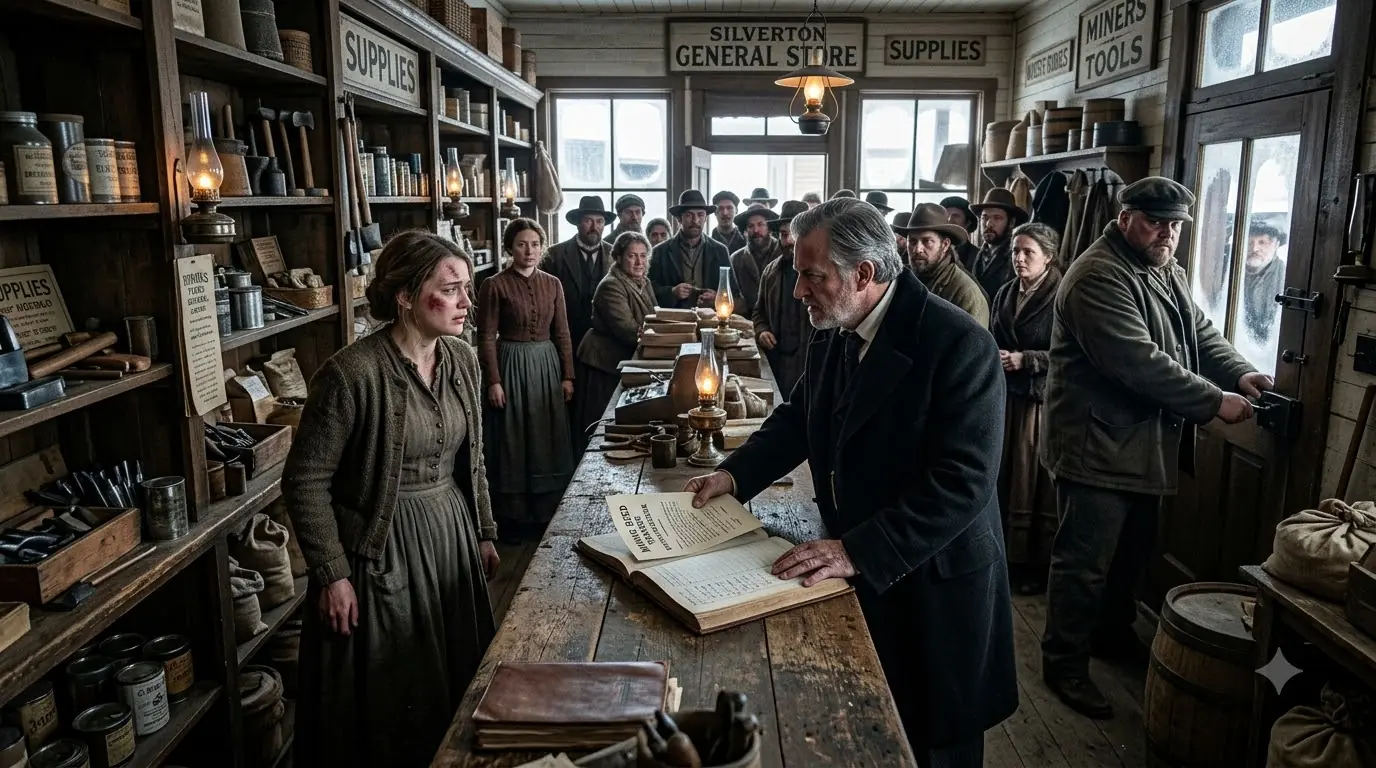
The debt was his legacy, and Evelyn at 17 had become the payment plan. "You left grease on the counter last night." Martha Carter's voice came from the back room like a draft under a door. Cold, precise, unavoidable. Evelyn didn't look up. "I wiped it down twice, Mama." "Don't tell me what you did.
Tell me why it's still dirty." She wiped the counter again. She had stopped explaining things to her mother around the same time she had stopped crying, somewhere in the first year when she realized that explanations only gave Martha more ammunition. Mrs. Hollis came in at eight for her weekly sugar and cornmeal. She was a round woman with kind eyes and the particular talent of looking directly at Evelyn's bruised face and seeing nothing at all. "Morning, Evelyn.
Cold enough for you?" "Morning, Mrs. Hollis. Yes, ma'am." "Your mama in back?" "Yes, ma'am." Mrs. Hollis paid for her goods and left without another word. She always did. Most people in Silverton did. They came, they purchased, they departed, and they carried with them whatever they had witnessed inside that store the way people carry an unpleasant smell, consciously ignored until they stepped back into the open air.
The Morrison brothers came in at nine for tobacco. They glanced at Evelyn's eye the way men glanced at a broken fence post, briefly, with mild acknowledgement that something had gone wrong somewhere, but without any particular intention to fix it. "Your mother around?" the older one, Dale, asked. "Yes, sir. I can get her." "Nah, just tell her Dale says the order came in down at the freight office." "Yes, sir." They left.
Evelyn wrote it down in the ledger. Writing things in the ledger was one of the few things she was still allowed to do without supervision. Her father had taught her figures, and figures were the one territory Martha had never tried to colonize because Martha had never understood them. It was the one small country that still belonged to Evelyn alone. She was running a column of supply costs against the month's sales when she heard the wagon outside.
Not the rattle of a local rig she would have recognized by sound alone after 3 years of listening from behind a counter, but something heavier, something that moved differently. She didn't look up. Then Martha came out of the back room, and she was wearing the expression she only wore on two occasions: when she was about to punish Evelyn or when Harold Vance was coming. Evelyn looked up. "Fix your hair," Martha said.
"My hair is fine, Mama." "I said, fix it." Martha crossed to the counter and yanked Evelyn's braid with the practiced efficiency of someone who had done it a thousand times. "He's early. You make him wait, and I'll give you something to remember tonight." Evelyn fixed her hair. Harold Vance was 47 years old and owned the largest silver operation in the county. He had a wife once, people said, though she had died or left.
The story changed depending on who was telling it and how much they wanted to stay on Harold's good side. He wore expensive coats and walked like a man who had never once in his life been told no by anyone who mattered. He had been coming to the store for 6 months. He had been looking at Evelyn for five of them. The bell above the door rang.
"Martha." Harold didn't remove his hat. "I see you've been keeping her busy." "She works hard," Martha said in the voice she only used for Harold, soft and cooperative and entirely unlike herself. "Evelyn, say hello." "Hello, Mr. Vance," Evelyn said. Harold walked along the counter slowly, the way a man walks when he's inspecting something he's considering purchasing. He stopped in front of her and looked at her eye.
"That's a bad bruise," he said. "I fell," Evelyn said. He smiled. It didn't reach anything above his mouth. "Clumsy girl." "Yes, sir." He turned back to Martha.
They spoke in low voices near the door, figures mostly, though Evelyn caught phrases she had been catching for weeks. Arrangement. By spring. The property on Ridgeline. She kept her eyes on the ledger.
She kept her fingers on the pen. The numbers didn't change based on who was standing in the room. And right now, numbers were the only thing she trusted to stay where she put them. When Harold left, the bell rang again and the cold rushed in briefly before the door closed. Martha turned around with the look of a woman who had just closed a very satisfying transaction.
"He'll have an answer for us by Friday," Martha said. "An answer about what?" Evelyn asked, though she already knew. She had known for weeks. "About your situation." "My situation is that I work in this store." "Your situation," Martha said, moving behind the counter with slow, deliberate steps, "is that you are 20 years old and you have a debt hanging over this family that your father left us. Your situation is that Harold Vance is a wealthy man who has expressed a serious interest, and your situation is that you will be grateful for that interest whether you feel grateful or not." Evelyn set down the pen.
"He's twice my age." "He's successful." "He looks at me like I'm something in a catalog." Martha's hand moved fast. The slap landed across Evelyn's right cheek, the side without the bruise. She always knew how to keep the damage varied, and Evelyn's head turned with it. She held very still until the ringing in her ears settled. "You will not speak about Harold Vance that way," Martha said quietly.
"You will not speak about him at all unless you are spoken to. Do you understand me?" "Yes, Mama." "Get back to the ledger." Evelyn got back to the ledger. The bell rang at 11. She heard it the way she heard everything, with the surface part of her attention, while the deeper part stayed coiled and watchful inside her chest, ready for whatever the sound meant. The bell rang a hundred times a day.
Merchants, farmers, ranch hands, wives, children. She had cataloged them all until the bell had become nothing but background, the way a river sound becomes background to someone who lives beside it. But this time something was different. Not the bell. The bell was the same.
It was the silence after it that was different. She looked up. He was already inside, which meant she had missed the moment of his entrance, and that bothered her because she never missed entrances. He was standing just past the threshold, and he was the largest man she had ever seen in the store. Not tall the way Harold Vance was tall, with that particular height that expensive boots and good posture can manufacture, but large.
The way a thing is large that was simply made that way without any intention of impressing anyone. He wore a heavy coat that had seen many winters and a hat that he did not remove when he came inside. He had a jaw that looked like it had been carved from the same granite as the mountains he had probably just come down from. His eyes, when they found her, were the particular gray of sky before a storm that hasn't decided what it wants to do yet. He didn't say anything.
He looked at her face, not at her eye the way Mrs. Hollis had looked, dismissively careful in that trained civilian way that absorbs information and releases it immediately for self-protection. He looked at her face the way you look at something that has been damaged by something specific in a specific way that you recognize because you know what that specific damage looks like. Evelyn felt the back of her neck go tight. "Can I help you?" she said. He was quiet for a moment longer.
Then he said, "Flour, 20 pounds, and whatever salt pork you've got in the back." His voice was low and unhurried. It was the voice of a man who had spent a great deal of time in places where there was no one to talk to and had made his peace with that. "Yes, sir," she said. She went to the flour sacks. She was aware of him watching her move, not the way Harold watched her move, that slow, appraising, proprietary watching that made her feel like she was standing in the middle of an auctioneer's floor.
This was different. This was the watching of someone who was paying attention to something other than what was visible on the surface. It made her more uncomfortable, not less. She brought the flour to the counter and began measuring and bagging it. He stayed on the other side of the counter, and she felt very distinctly that he was not looking at her eye anymore.
He was looking at her hands, the way they moved, the small involuntary flinch when Martha's voice came sharp and sudden from the back room. "Evelyn, who is it?" "Customer, Mama. Just a customer." The hands. He had seen the flinch. She knew it because his jaw tightened very slightly, the way something tightens when it absorbs a piece of information it already suspected but did not want confirmed.
"Twenty pounds of flour," she said. "Salt pork in the back. I'll get it. What else?" "That'll do," he said. "That'll be..." She calculated quickly, the way her father had taught her.
"Forty cents for the flour. Salt pork depends on the cut." "Whatever you've got." She went to the back. Martha was there reshuffling inventory. She had already shuffled twice that morning, which was what Martha did when she was agitated and didn't want to admit it. "Who is he?" Martha asked.
"Don't know him," Evelyn said, pulling down the salt pork. "He's a mountain man, I think. I don't recognize him." Martha moved to the curtain and looked through. "Jack Coleman," she said after a moment, in a tone Evelyn couldn't immediately read. "He traps up on the North Face.
Comes in twice a year, maybe. Pays cash and doesn't make trouble." "All right," Evelyn said. "Stay behind the counter," Martha said. "And don't make conversation." Evelyn went back out front with the salt pork. She set it on the counter and named her price.
Jack Coleman looked at it, then looked at her hands again. There was a split in the skin of her left knuckle she hadn't managed to hide, old and reopened, the kind that came from work and cold and occasional impact with things that were not soft. Then he set coins on the counter without argument. "You've been here long," he said. She looked up.
"What?" "In the store." "My father owned it," she said. "He died 3 years back." He nodded once, as if that explained something, though she couldn't tell what. He picked up his supplies and turned toward the door. Evelyn went back to the ledger, and that was the end of it, she thought. He came back on Thursday.
She knew it was Thursday because she always knew what day it was. Days were the currency she was spending one at a time toward something she couldn't name yet. He came in at the same hour, late morning, when the store was quiet between the rush of farm wives and the arrival of the afternoon freight workers. He bought a small amount of coffee, a box of rifle cartridges, and a tin of medicinal salve. Small purchases, the purchases of a man who is buying time, not supplies.
She didn't say anything about that. She calculated the total and held out her hand for the coins. "You do the books here," he said. "Yes, sir." "Your mother doesn't." She looked up at him. "No, sir.
Evelyn looked at the tin. She looked at him. She looked at the tin again. "I'll note that," she said. He picked up his purchases and left.
Evelyn stood very still behind the counter for a long moment after the bell stopped ringing, the ledger open in front of her and her pen completely motionless. Something was happening in her chest that she did not have clean language for yet, something small and dangerous that felt like the first smoke from a fire that hadn't quite decided to become a fire yet. She did not pick up the salve. She looked at it for a very long time. Then she put it on the shelf behind the counter, behind the iodine and the bandage cloth, in the place where she kept things that were hers.
Friday came. Harold Vance came with it. He arrived at midmorning with a different energy than usual, something settled in him, something satisfied, like a man who has written a contract and is arriving to have it signed. He was wearing his good coat. He did not come alone.
His man, Deacon, large, quiet, permanent as a wall, stood at the door while Harold came to the counter. Evelyn's hands went still on the ledger. "Is your mother about?" Harold said. "I'll get her." "No need." He stayed where he was. "I'll speak to you directly.
I've made my decision. I've spoken with your mother, and the financial arrangements are settled. By the end of March, you'll be moving out to the Ridgeline property." Evelyn kept her face completely neutral. She had been practicing this for months. "I see." "You'll have everything you need out there.
Housekeeper comes Mondays and Thursdays. Your duties will be what any wife's duties are." He watched her with that flat, assessing gaze. "I understand you have reservations." "Yes, sir." "Your mother explained the debt situation." "She did." "Then you understand this is the practical solution." Evelyn looked at the ledger. She thought about her father's handwriting in the old pages at the back, the cramped and careful columns he had kept before his hands had gotten cold on the ridge road and his books had become hers. She thought about all the things the numbers told her that Martha didn't know.
They told her the actual size of the debt, which was not what Martha claimed, the actual value of the store's monthly revenue, which was substantially more than Martha had ever acknowledged, and the actual timetable on which the debt could be retired if someone with simple arithmetic skill ran the numbers honestly. "What if the debt was cleared another way?" she said. Harold looked at her. "What way?" "The store turns a reasonable profit. If the revenue was managed correctly, the debt could be retired in—" "Evelyn." His voice dropped.
"This isn't a negotiation." "I'm stating a financial fact, Mr. Vance." "You're a 20-year-old girl in a general store," he said, and his tone was the tone of a man who is very accustomed to explaining to things what their category is. "You are not in a position to be stating financial facts to me." She held his gaze for exactly one more second than was comfortable. Then she looked back at the ledger. "Yes, sir," she said. After he left, she took the ledger to the back room and sat with it for a long time.
She was not crying. She had stopped crying long ago. She was calculating. The debt, managed correctly, could be retired in 14 months. The store, run honestly, produced more than Martha had ever admitted.
The arrangement Harold Vance was proposing was not a financial necessity. It was a financial choice. Martha's choice. She put the ledger back. She washed her face at the basin.
She went back behind the counter, picked up the salve tin from behind the iodine, and turned it over in her hands. She thought, Someone knows this is happening. Someone looked at this and did not look away. She didn't know what to do with that yet. It was Saturday when things broke.
It started the way most breaks started in the store, in increments too small to feel catastrophic until they accumulated into something that couldn't be ignored. A ranch hand knocked over a display near the door and paid without trouble. Two of the Morrison brothers' wives came in together and spoke loudly about something Evelyn didn't follow. A child pressed its face against the window and then ran. Harold Vance came in at noon.
He had not been expected. That was the first thing. He came in with Deacon, which was the second thing. Deacon closed the door behind them and stood in front of it. The four or five other customers in the store, Mrs. Hollis again, two farm hands, and a young wife from the far end of the valley, all processed this arrangement quietly and began finding reasons to finish their business.
"Where's your mother?" Harold said. "She stepped out to the freight office," Evelyn said. "Good." He came to the counter. He was carrying a folded paper. He set it on the counter in front of her.
"I need your signature on this today." She looked at the paper. It was a transfer document, property and personhood wrapped in legal language the way those things always were. "My mother signs for the store," she said carefully. "This isn't about the store," Harold said. "This is about you.
Sign it." Evelyn looked at the document. She thought about the 14 months. She thought about the ledger. She thought about her father's handwriting and the real numbers and the gap between what was true and what she had been told was true. "I need time to read it," she said.
Harold's hand came down on the paper flat. "You need to sign it." "Mr. Vance," she kept her voice very level, "I am not signing a legal document I haven't read. That's not unreasonable." "It is when I say it is." He reached across the counter and took her wrist. Not rough, not yet, but firm in the way that communicates that rough is available as an option. "I've been patient with your mother about the timing.
I am not going to be patient with you about this. Sign the document." The farm hands near the back of the store became very interested in the hardware shelf. Mrs. Hollis turned toward the window. The young wife from the far valley put her head down. Evelyn looked at Harold Vance's hand on her wrist.
She was very aware of how quiet the room had gotten. She was very aware of Deacon at the door. She was aware of the exact weight and dimension of the silence that the town of Silverton could generate around a situation like this, that particular quality of collective deafness that 20 people in a room could achieve when they did not want to be responsible for what they had seen. "I said sign." The bell above the door rang. Not from the front.
From the side entrance, the one that came in from the alley, the one that the delivery men used, the one that nobody used without a reason. Deacon turned. Jack Coleman stepped through it. He was carrying nothing. His coat was open despite the cold.
He looked at Deacon the way a man looks at a door he intends to open, which is to say without any particular emotion and with complete intention. Deacon, who was not a small man, stepped sideways without speaking. The human body sometimes makes calculations before the mind is finished with them. Jack walked to the counter. He looked at Harold's hand on Evelyn's wrist.
He looked at Harold's face. The room was so quiet that the wood in the stove was audible, popping in the heat, the only thing in the building that didn't care what was happening. "Let her go," Jack said. Harold turned very slowly. He had the bearing of a man who was not accustomed to being addressed in stores he did not own.
"Who are you?" "Let her go," Jack said again. No escalation in the voice, no threat in it either, just the same words in the same low, unhurried tone, like a man who has time and intends to use it. Harold looked at him for a long moment. He looked at the size of him. He looked at Deacon, who had moved sideways and was now looking at the floor in the specific manner of a man recalculating his loyalties.
Harold let go of Evelyn's wrist. "This is a private business matter," Harold said. "It was," Jack said. "Now it's not." "You have no standing here." "She didn't sign that paper," Jack said, nodding at the document on the counter. "So it's not a paper yet.
It's just a threat." Harold's face did something complicated. "You don't know what you're involving yourself in." "I reckon I know enough." Jack looked at Evelyn, just looked at her the same direct way he had looked at her the first morning, the way that didn't slide past things. "You all right, miss?" She was aware of every person in the room listening. She was aware of Harold 3 feet away. She was aware of the paper on the counter and the document in her chest she had been calculating for 14 months and the salve tin she had put behind the iodine.
"I'm all right," she said. "You want this man to leave your store?" The word your landed somewhere specific. Not Martha's store. Not the store. Your store.
As if it were already a thing that had been acknowledged between them, the truth of the ledger, the truth of who actually ran the numbers. Evelyn straightened. "Yes," she said. "I do." Harold made a sound that was not quite a laugh. "You have no idea—" "Mr. Vance." Jack's voice did not rise.
"The lady has answered the question. I think you should go." "You think?" Harold's composure had a crack in it now, thin but visible. "I own half this county, son. I own the freight contracts that keep this store stocked. I own the note on this building.
You think one mountain man with a cold coat walks in here and—" "The note on this building," Jack said, "is the bank's business, not yours. I've seen the public record." He glanced at Evelyn briefly. "Somebody's been keeping clean books." The crack in Harold's composure widened. He looked at Evelyn. He looked at Jack.
He picked up the unsigned document from the counter and folded it. The sound of that paper folding in the silence was the loudest thing in the room. "This isn't finished," he said. "No," Jack agreed. "It isn't." Harold left.
Deacon left two steps behind him, neither of them looking back, both of them carrying the specific quality of men who have been outmaneuvered in a way they do not yet fully understand. The door closed. The room breathed. Mrs. Hollis was the first to move, gathering her things with the brisk efficiency of someone who intends to have forgotten all of this by supper. The farm hands followed.
The young wife from the far valley was already at the door. Evelyn stood behind the counter. Jack Coleman stood in front of it. Neither of them said anything for a moment. "You saw the public record," she said finally.
"I did, a week ago." He was quiet. "The debt your mother's been using. It's not what she told you it is." Evelyn felt something in her chest, not the small, dangerous smoke from before, but the thing it became when it made its decision. A clean, bright, specific feeling that she recognized after a moment as fury, the kind that doesn't burn hot, but instead burns long. "I know," she said.
He looked at her. "I've known for 8 months," she said. "I figured it in the ledger. I just..." She stopped. She picked up her pen.
She put it down. "I didn't know what to do with knowing." Jack was quiet for a moment. Then he said, "You do now." She looked at him. "What's your name?" he said. "Evelyn Carter." "Jack Coleman." He picked up his hat from the counter where he had set it.
She hadn't seen him set it down, but it had been there, she realized, this whole time. "I'll be back Monday, Miss Carter, if that's all right." She thought about Harold Vance and the paper and the end of March and the Ridgeline property and the 14 months in the ledger and her father's handwriting and the salve tin behind the iodine. "Yes," she said. "That's all right." He nodded once. He put his hat on.
He went out the side door, the delivery men's door, the one nobody used without a reason. The bell rang once behind him. Evelyn stood alone in the quiet store, and outside she could hear the wind coming down off the mountains. She pressed her hand flat on the ledger, on her father's numbers, on her own 8 months of calculations. For the first time in 3 years, she thought about the difference between surviving something and deciding something.
She pulled the ledger close. She picked up the pen. She began to write. The ledger told a story that Martha Carter had never wanted told. Evelyn had known this for 8 months.
She had carried it the way you carry something heavy in a coat pocket, aware of the weight every moment, shifting to compensate, never setting it down, because setting it down meant deciding what to do with it. Deciding what to do with it meant acknowledging that she had been lied to deliberately, systematically, and with the particular cold efficiency of someone who had calculated exactly how much truth a person could be denied before they stopped looking for it. She stayed up past midnight on Saturday. Martha had gone to bed at nine the way she always did after Harold visited, not from exhaustion, but from satisfaction, the satisfaction of a woman who believed a problem was resolving itself on schedule. Evelyn listened to the creak of the floorboards overhead, counted the minutes, and when the house went fully silent, she lit the small lamp.
She spread the ledger open on the kitchen table and went back through everything, not to confirm what she already knew. She knew it. She went back through everything to measure the exact shape of it, to understand not just that she had been lied to, but precisely where the lie had been constructed, how many layers it had, and what was underneath each one. The original debt from her father's estate was $240, legitimate, documented, carried by the First Territorial Bank of Silverton at 4% annual interest. She had found the original note in the third month after her father died, folded inside the back cover of the oldest ledger, in the place her father kept documents he considered important enough to preserve but private enough to conceal.
Martha's version of the debt was $600 at variable interest, owed to Harold Vance personally. Martha had been paying Harold Vance from the store's monthly revenue for 2 years, not against a real debt, but against a fiction Harold Vance had written. Martha had accepted either because she believed it or because she had made a different calculation, that Harold Vance's protection was worth the price of her daughter's future. Evelyn sat with this knowledge in the lamplight and felt the fury move through her like something geological, not explosive, tectonic, the kind of shift that happens slowly and permanently and cannot be undone. She closed the ledger.
She went to bed. She did not sleep. Monday came gray and bitter, the kind of cold that had opinions about you. Evelyn was behind the counter before Martha woke, the store open and the lamp lit, the flour sacks restacked, the week's delivery orders written in her clean, careful hand and set by the door for the freight runner. She had added a new column to the ledger over the weekend, a column Martha had never asked for and would not recognize.
It tracked the actual revenue against the actual debt. It showed in figures as plain as daylight exactly when the bank note could be retired if the store's income was applied honestly. Fourteen months. She had not been wrong. She was running the column for the third time when the side door opened.
She did not look up. She knew the sound of it now, the particular weight of it, the way it moved differently from the front door, the slight drag at the bottom where the hinge needed attention. "Miss Carter," Jack said. "Mr. Coleman." She set down the pen. "You said Monday." "I did." He came to the counter and set down a folded piece of paper.
"I went to the county records office on Saturday. These are copies, the bank note, the original terms, and the filing dates." He paused. "I thought you might want them in your own hand." Evelyn looked at the paper. She looked at him. "You went to the records office," she said.
"Yes, ma'am." "On a Saturday." "It's open till noon." She unfolded the paper. The figures matched everything she had found in the back of the old ledger, down to the decimal. She stood very still for a moment, looking at confirmation of something she had known but had been carrying alone for 8 months. She felt something shift in the architecture of her chest, not relief exactly, but the specific sensation of a weight being distributed differently, shared, no longer entirely hers to hold upright. She folded the paper and put it inside the ledger.
"My mother can't know you brought this," she said. "Understood." "Harold Vance..." She stopped, reorganized. "He owns freight contracts with three of the four suppliers this store uses. If he withdraws them, we can't restock. Martha knows this.
It's part of why she..." She stopped again. "It's part of why she made the arrangement," Jack said. She looked at him directly. "Yes." He was quiet for a moment. He had a way of being quiet that was not uncomfortable, not the silence of someone waiting for the conversation to end, but the silence of someone who understood that some things needed the space to be said completely before a response was warranted.
"There's a supplier in Durango," he said. "Runs independent of the Vance contracts. Better prices on flour and dry goods. I've used him for 5 years." He set a second folded paper on the counter. "Name and address." Evelyn looked at it.
"You've been planning this," she said. "I've been thinking," he said. "There's a difference." "What's the difference?" "Planning assumes I know what you want," he said. "Thinking just means I've been considering what might be useful if you decided you wanted it." She picked up the second paper. "And if I don't?" "Then it's just a name on a piece of paper," he said.
She put it inside the ledger with the first one. The bell rang from the front door. A farmer's wife came in, stamping cold from her boots, needing salt and baking powder. Evelyn handled it in the efficient, automatic way she handled everything, correctly, courteously, without a single unnecessary motion. When the woman left, Evelyn turned back to find Jack exactly where she had left him, patient as stone.
"My mother will be down in an hour," Evelyn said. "If she sees you here regularly, she'll tell Harold." "I know." "He'll consider it interference." "He already does," Jack said. "I was in the Rusty Nail last night. Deacon was talking." Evelyn's hands went still. "What did he say?" "That his employer had been disrespected in a public place by a drifter who didn't understand how things worked in Silverton." Jack's voice carried no particular alarm.
"That things would be set right before the end of the month." The end of the month. March. The Ridgeline property. "And what did you say?" she asked. "I wasn't there to say anything," Jack said.
"I was there to listen." She looked at him for a long moment. She was very aware in this moment of every calculation she had been making since her father's wagon came back empty, every small survival decision, every deliberate invisibility, every number she had run in the back of a ledger while pretending not to understand what the numbers meant. She had been surviving by being small, by being the shape that fit through spaces that didn't invite trouble. Jack Coleman was not a small shape. He was not the kind of shape that fit through spaces quietly.
Something about that, she realized, was exactly what terrified her and exactly what she could not stop thinking about. "You should be careful," she said. "Vance has reach in this town." "I'm not a town man," he said simply. "His reach doesn't extend much past where roads go." He bought two tins of coffee, paid without counting the coins twice the way some men did, and left through the side door. Evelyn stood at the counter for a long moment after he was gone.
Then she took out the ledger, opened it to her new column, and wrote the name of the Durango supplier in the margin where she would see it, but Martha would not think to look. Martha came down at eight. She moved through the store the way she always moved, assessing, cataloging, looking for things out of place or things Evelyn had done inadequately, because finding inadequacy was the lever Martha used to maintain control, and Martha was very skilled with levers. She checked the flour sacks. She checked the restacked shelves.
She opened the ledger and ran her finger down the weekly column, then said nothing because the numbers were correct and Martha could not criticize what was correct. "Harold's man came by yesterday," Martha said, closing the ledger. Evelyn kept her hands on the counter. "I didn't see him." "He came to the house, not the store." Martha poured coffee into the tin cup she kept on the shelf behind the register. "Harold wants the signing moved up.
He said there was an incident Saturday that he wants resolved before it becomes a pattern." An incident. Jack Coleman standing between her and Harold Vance while 20 people looked at the hardware shelf. "What kind of resolution?" Evelyn said. "The kind where you sign the document and stop making problems for people who are trying to help you." Martha set the cup down. "I have arranged something that protects this family.
You are 20 years old, Evelyn. You have no money, no prospects, no—" "I have the store," Evelyn said. The silence was immediate and dangerous. Martha turned very slowly. "What did you say?" "I said I have the store." Evelyn's voice was level.
She had practiced this level. She had been practicing it for 8 months, waiting for the moment she would need it to hold weight. "Papa left it to the family. That means it belongs to both of us. And the bank note on it belongs to the First Territorial Bank, not to Harold Vance." Martha's face went through several things quickly.
"Where did you hear that?" "I read the original filing in the back of the old ledger. Papa kept it there." "That document is old. Things have changed." "The terms of a bank note don't change because someone tells you they changed," Evelyn said. "They change when the bank files an amendment, and no amendment has been filed. I checked." She had not told Jack she had checked this independently.
She had gone to the bank herself on a Wednesday 3 months ago when Martha had sent her to collect a supply invoice, and she had asked the clerk very quietly about the current status of the Carter note. The clerk, who was young and had not understood the significance of the question, had confirmed it readily. Martha stared at her daughter. For the first time in 3 years, something that was not contempt moved in Martha Carter's face. It was not love.
It was not regret. It was something closer to recalibration. It was the look of a person who has been playing chess and has just noticed that a piece they thought was a pawn has been moving differently this whole time. "You have been going through my business," Martha said finally. "I have been reading the ledger I keep," Evelyn said, "which is my business as much as yours." "You do not—" Martha stopped, reset, and came at it differently, the way she always did when direct confrontation wasn't working.
"Harold Vance is not a patient man. Evelyn, if you continue to make difficulties, the consequences will not only fall on you." There it was. The real threat. Not what Harold would do to Evelyn, but what he would do to the store, to Martha, the freight contracts withdrawn, the supply lines cut, the small, steady income that kept Martha in her house and her habits and her particular brand of comfortable authority. All of it was dependent on Harold Vance's continued goodwill.
Evelyn understood this. She had understood it for months. She also understood something Martha did not. "The Durango line runs independent of Vance contracts," Evelyn said quietly. "If we switched our primary supplier, the freight dependency would break.
The profit margin would actually improve. Durango runs 8% lower on dry goods." Martha looked at her as if she had spoken in a foreign language. "I've done the figures," Evelyn said. "You are not running this store," Martha said, each word careful and sharp. "You are not making supplier decisions.
You are not—" "Mama," Evelyn kept her voice quiet, "I have been running this store for 3 years. You know the figures because I give them to you. You know the orders because I write them. You know what we owe and what we earn because I put it in a column every week." She paused. "I am not asking your permission to think about the business.
I'm telling you there's another way through this that doesn't require me to sign something I have not read." The silence stretched. Martha picked up her coffee cup. She looked at Evelyn over the rim of it with an expression that had compressed itself into something unreadable. "You have been spending time with that mountain man," she said. "He's a customer." "Don't lie to me." "He's bought coffee and salt pork and rifle cartridges," Evelyn said.
"That makes him a customer." Martha set the cup down. She left the room without another word, which was worse than if she had shouted, because Martha leaving a room without shouting meant she was going to do something instead of say something. Doing something was always harder to anticipate. Evelyn opened the ledger. She turned to the new column.
She added a new line at the bottom, and she wrote in her careful figures: Durango, request terms, Tuesday. Tuesday brought three things Evelyn had not anticipated. The first was Norah Beecham, who taught at the schoolhouse 2 miles east and came into the store twice a month for chalk and copybooks, and occasionally the kind of quiet company that women in small towns seek from other women when the walls of their particular lives are pressing too close. Norah was 32 and unmarried and had the particular self-possession of a woman who had decided somewhere along the way that her own opinion of herself was the one that mattered most. Evelyn had always liked her in the distant way she liked things she couldn't quite reach.
Norah came in at 10, bought her chalk, set it on the counter, and looked at Evelyn for a long moment. "I heard about Saturday," Norah said. Evelyn kept her face neutral. "Did you?" "Mrs. Hollis told Mrs. Patterson, who told Mrs. Gruber, who told me at church." Norah's voice was dry. "So, by my count, everyone in a 4-mile radius has heard about it, except the people who might have done something useful at the time." Evelyn looked at the chalk.
"People have their own concerns." "People in this town," Norah said, "have a talent for making their concerns very small when Harold Vance is in the room." She paused. "The man who stepped in, Coleman, do you know him?" "He's a customer." Norah looked at her with the specific expression of a schoolteacher who has been told something technically accurate and entirely incomplete. "He came to the school last spring," she said. "Asked if I had any books he could bring up the mountain for the winter. I gave him three, Twain, a history of the territorial period, and a mathematics primer, because that's what I had." She paused.
"He returned them in May with a letter saying which parts he'd found most useful. The letter had better grammar than half the correspondence I receive from the school board." Evelyn said nothing. "I'm just saying," Norah said, "that he is not exactly what he looks like." "Most people aren't," Evelyn said. Norah paid for her chalk. At the door, she turned back.
"If you ever need somewhere to go," she said, "my schoolhouse has a back room. I'm there until 6 most evenings." She said it the way you say something when you're not sure if it will be needed, but you've decided to say it anyway because the cost of not saying it if it turns out to be needed is too high. "Thank you," Evelyn said. The door closed. The second thing Tuesday brought was Dale Morrison, who came in at noon with an invoice dispute that took 40 minutes to resolve and, during the resolution, revealed entirely by accident and without any awareness that he was doing so that Harold Vance had called a meeting at the Rusty Nail on Monday evening and that most of the men in town with freight or supply contracts had attended.
"What kind of meeting?" Evelyn asked while she checked the invoice against the ledger. "Oh, just business talk," Dale said with the careful vagueness of a man who has been asked not to repeat something but lacks the imagination to deny having heard it. "Contracts, terms. You know how Harold likes to keep things organized." "I do," Evelyn said. "Here's the error.
Your count on the nails is off by a dozen. I'll adjust the total." "Good girl," Dale said without meaning anything by it in particular, which was somehow worse than if he had. After he left, she stood at the counter and thought about 20 men in a saloon and Harold Vance talking about terms and organization and what exactly you could make a town do when you held enough of its commercial lifelines in one hand. The third thing Tuesday brought was the letter. It came with the afternoon freight, a sealed envelope addressed to Miss Evelyn Carter, Carter General Store, Silverton, in handwriting she didn't recognize.
She opened it behind the counter while Martha was in the back arguing with the freight runner about a damaged bolt of cloth. It was from the Durango supplier. She had not written to the Durango supplier. She had only written the name in the margin. The letter was a standard term sheet, prices, minimum orders, delivery schedule, payment terms.
At the bottom, in a different hand than the rest of the letter, were two lines: Referred by J. Coleman, North Face trap line. He speaks well of your operation. We'd be glad to work with you. Evelyn read it twice. She folded it into the ledger.
She looked at the back wall of the store. She thought about a man who had brought her county records and a supplier name on a Monday morning and said there was a difference between planning and thinking. She thought she was beginning to understand what he meant. She was still thinking about it when the front door opened and Harold Vance walked in. He was alone this time.
No Deacon. That was the detail that registered first, because Harold Vance without Deacon was Harold Vance making a different kind of statement. Not a statement about force, but about intimacy, about the particular authority that doesn't need witnesses. "Evelyn," he said. "Mr. Vance," she said.
"My mother is in the back." "I'm not here to see your mother." He came to the counter at an angle that put himself between her and the side door without appearing to do it on purpose. "I want to talk to you woman to man." She waited. "Saturday was an embarrassment," he said. "For both of us. I don't hold you responsible for Coleman's behavior.
You didn't invite the man in. But I do need to understand something." He lowered his voice to the register that suggested confidence. "Are you having second thoughts about our arrangement?" She was aware of every inch of the counter between them. "I have questions about the document," she said carefully. "I'd like to read it before I sign anything." "Questions?" He said the word the way you say a word when you're testing whether someone understands they don't have the right to it.
"What kind of questions?" "Legal ones," she said. "About the terms." "The terms are standard." "I'd like to read them nonetheless." Harold looked at her for a long moment. Something was moving behind his face that he was keeping controlled, the way men keep things controlled in public when they intend to release them elsewhere. "You've been talking to someone," he said. "I've been reading," she said.
"Reading what?" "The ledger," she said. "The one I keep every week." The silence that followed was a specific kind of silence, the kind that exists between the moment a thing is said and the moment the person who needed to hear it fully processes what it means. Harold Vance was an intelligent man. That was part of what made him dangerous. He understood in the 4 seconds of that silence exactly what Evelyn was telling him, that she knew, that she had known, that the careful lie he had constructed with Martha Carter's cooperation had been sitting under examination for months by the one person in the building with the arithmetic to see through it.
"That ledger," he said softly, "belongs to the store, not to you personally." "My name is in every column," she said. "Your name is in every column because your mother allows you to do her bookkeeping," he said. "That's a privilege, not a right." "Then perhaps," Evelyn said, "my mother should speak to that." Martha appeared in the doorway. She had heard enough. Evelyn could see it in the set of her shoulders, that particular posture that said she had been listening from the back and had arrived at a decision about what to do with what she had heard.
"Harold," Martha said. "I'm sorry about this. She's been—" "Don't apologize for me, Mama," Evelyn said. Both of them looked at her. Three years she had never said that.
Three years of watching Martha apologize on her behalf for her questions, her expressions, her existence in spaces where her existence created inconvenience. Three years of being apologized for as if she were a broken piece of furniture that embarrassed the household. "I beg your pardon," Martha said. "I said, don't apologize for me." Her voice was steady. The fury was still there, geological, deep and quiet and enormous.
"If Mr. Vance has something to say about my questions, he can say it to me, not through you." Harold's face had gone very still. Martha's face had gone red. "You will go to the back room," Martha said. "Right now." "No," Evelyn said. The word landed in the room like a stone in water.
Small, irreversible. "No," she said again, in case the first one hadn't been clear enough. "I'm not going to the back room so you can make arrangements about me without me present. I'm the one whose name would be on the document. I'm the one whose life is being arranged.
I'll stand here." Martha moved fast. She had always moved fast when words stopped working. It was the transition she made with the fluency of long practice, from language to physical consequence. Her hand came up. Jack Coleman walked through the front door, not the side door this time.
The front door, the main door, in the full sight of the street and the two men standing on the boardwalk outside, who both turned to look. He stepped inside and held the door open for a moment. Not wide, not theatrical, just open enough that the cold came in and the light came in and the fact of witnesses came in with both of them. Martha's hand stopped where it was. Harold looked at Jack.
Jack looked at Harold. It was not the look from Saturday. That had been a warning, a single shot across a bow. This was different. This was a man who had been paying attention, who had added everything up, and who had arrived at a conclusion he intended to be clear about.
"Mrs. Carter," Jack said, addressing Martha without looking away from Harold. "I've come to make a purchase." Martha lowered her hand. Harold straightened his coat. "Coleman," he said, "you are making a habit of appearing where you're not wanted." "I'm a customer of this store," Jack said. "Miss Carter," and he looked at Evelyn now, the same direct gray look, "what are your hours?" She understood what he was doing.
He was making it ordinary. He was making his presence a matter of business record, not confrontation, a customer asking a shopkeeper a question in her own store while two other men watched from the doorway. "We open at seven," she said. "We close at six." "Then I'll be back before six," he said. He stepped to the counter and looked at the shelf behind her.
"I need lamp oil, 2 gallons." She got the lamp oil. She measured it. She named the price. She recorded it in the ledger. She did all of this with her hands perfectly steady, which cost her something, but she had a great deal of practice by now at making things cost her invisibly.
Harold Vance left without another word, without the document signed, without the conversation finished, without the particular satisfaction that he had come there to collect. He left, and Deacon was waiting with the wagon on the street. Evelyn watched through the window as Harold climbed in and the wagon moved and the space it had occupied became just air and winter light again. Martha stood in the doorway to the back room for a long moment. Then she went through it and closed it behind her.
Jack set the coins for the lamp oil on the counter. "You all right?" he said quietly. Evelyn looked at him. She thought about the letter from the Durango supplier in the ledger. She thought about the county record copies folded next to it.
She thought about the word no and the way it had sounded in the room, small, irreversible, and completely new. "I said no to my mother," she said. "I heard." "I've never done that before." He was quiet for a moment. "How did it feel?" She thought about it honestly. "Terrifying," she said.
Then she stopped. "And like something that was closed for a long time just opened." He nodded once. He picked up his lamp oil. He looked at her for a moment with that steady gray gaze that didn't slide past things. "Miss Carter," he said, "whatever you're planning with that ledger, don't let anyone take it from the store." She looked at him sharply.
"Why?" "Because it's evidence," he said. "Of everything." He went to the side door. He paused with his hand on it. "There's a man at the county seat," he said. "A territorial attorney.
He handles land fraud cases. He came through Durango last fall." He paused. "I wrote him a letter in January." Evelyn stared at him. "January?" she said. "That was 2 weeks after I first came in.
You've been—" She couldn't finish the sentence. "Thinking," he said. "Not planning. Like I said." He opened the door. The bell rang.
The side door closed. Evelyn stood behind the counter with her hand flat on the ledger, on the county records and the Durango letter and the new column and her father's handwriting and every number she had run in the dark for 8 months. For the first time since any of it had started, she felt the very specific and unfamiliar sensation of not being alone inside the weight of it. She opened the ledger to the new column. She picked up the pen.
She wrote at the bottom beneath the Durango supplier's name: Attorney, territorial land fraud. Beneath that, because the numbers had always been where she was most honest, she wrote: 14 months becomes less if we move now. She closed the ledger. Outside, the wind was coming off the North Face again, cold and direct and indifferent to everything human beings did to each other in the valley below it. Evelyn turned the store's lamp up another notch.
She had work to do. The letter from the territorial attorney arrived on a Thursday. Evelyn knew it was from him before she opened it. The handwriting on the envelope was precise and institutional, the kind of handwriting that belonged to a man who understood that written words carried legal weight and treated them accordingly. It had come with the morning freight, tucked between a supply invoice and a circular about a land auction in Ouray County that nobody in Silverton had asked for.
She slipped it under the ledger before Martha came down the stairs. She read it in the back room at noon while Martha was across the street arguing with the blacksmith about a fence repair she believed was his responsibility and he believed was hers. The argument had been ongoing for 6 weeks and showed no signs of resolution, which meant Evelyn had approximately 40 minutes. The attorney's name was Thomas Aldrich. He wrote from Denver in the careful, measured language of a man who had spent his career translating injustice into terminology that courts would accept.
He had received Jack Coleman's letter in February, he wrote, and had made preliminary inquiries into the financial arrangements between Harold Vance and certain Silverton residents. What he had found, he wrote carefully, was consistent with a pattern he had encountered in three other mining counties over the past four years. He would need documentation. He would need the original bank note. He would need the ledger or a certified copy of its relevant columns.
He would need a signed statement from someone with direct knowledge of the arrangement. He would need, in short, everything Evelyn had been building toward for 8 months without knowing she was building toward anything. She read the letter twice. Then she folded it precisely along its original creases and placed it inside the back cover of the old ledger, in the exact place where her father had kept the original bank note, because some places, she thought, were made for keeping things that mattered. She picked up the pen.
She began to write her statement. She finished a first draft in 3 days, working in the hours between midnight and three in the morning, when the house was silent and the store was dark and the only sounds were the lamp and the pen and occasionally the wind finding some gap in the building's aging boards to move through. She wrote in the plain declarative style her father had used for business correspondence. No embellishment, no apology, no softening, just dates and figures and facts. The original note.
The amount. The terms. Martha's payments to Harold Vance. The discrepancy between the stated debt and the documented one. The freight contract leverage.
The document Harold had attempted to have her sign. She wrote about Saturday in the store and Tuesday and the pattern of escalation. She wrote it all. On the fourth night, she read it back to herself and felt the particular vertigo of a person who has constructed a complete and honest account of something they have been surviving piece by piece without ever seeing the whole shape of it. On paper, assembled, it was larger than she had understood while living inside it, more systematic, more deliberate, more like something that had a name in a court of law.
She hid the draft in the same place as the letter and the bank note. Then she went to bed and slept for the first time in weeks without dreaming about the end of March. Jack came in on Friday morning earlier than usual, with the look of a man who had something specific on his mind and had decided to say it directly. "Aldrich wrote you," he said. It wasn't a question.
"Last Thursday," she said. She looked at him steadily. "I've started the statement." Something shifted in his expression. Not surprise, not relief, but the specific adjustment of a man who had been holding a very careful stillness and was now allowed to release it slightly. "Good," he said.
"How much longer do you need?" "I'm close," she said. "But I need the original bank note certified, the one my father kept. There's a notary in Durango. I can't leave the store for a day." "No," he agreed. "But I can take it and bring it back." She looked at him.
"That document is the most important piece of paper you've got," he said. "I know." "If anything happened to it—" "Nothing will happen to it." His voice was quiet and entirely certain in the way of a man who has made a promise to himself about something before he arrived and is now simply making it audible. She went to the back of the store. She retrieved the original note from the ledger. She stood for a moment with it in her hands, the paper her father had folded and hidden in the last year of his life.
It was the document that told a truth Martha had spent 2 years burying. Then she walked back to the counter and placed it in Jack Coleman's hands. His fingers were careful with it. That was what she noticed, the careful way he took it, the way he folded it exactly as it had been folded, the way he put it in the interior pocket of his coat against his chest, like a man who understood what he was carrying. "I'll be back Monday," he said.
"Jack." It was the first time she had used his name. They both noted it without making anything of it. "Be careful." He looked at her for a moment. "Always am," he said. He left through the front door this time.
She watched him through the window moving down the main street of Silverton with that particular unhurried deliberateness, the bank note against his chest, the mountains at his back. Martha appeared beside her at the window. Evelyn hadn't heard her come in from upstairs. She controlled the flinch. "He was here again," Martha said.
"He bought lamp oil last week," Evelyn said. "He's a regular customer now." "He is not a customer," Martha said. "He is a complication, and Harold has noticed. Harold notices everything." "That's his business," Evelyn said. Martha turned to look at her, the full measuring look that Evelyn had grown up under, the look that cataloged and assessed and calculated how much correction was required.
"You are playing a game you don't understand the rules of," Martha said. "I understand the rules fine," Evelyn said. "I just don't agree that they're fair." Martha slapped her. It was the old motion, the practiced one, fast and precise. Evelyn's head turned with it.
She held still and waited for the ringing to settle. When it settled, she turned back and looked at her mother and said nothing. Her face did not arrange itself into apology. Her eyes did not drop. Martha looked at her own hand.
Then she looked at Evelyn's face. Something passed between them, not reconciliation, not even acknowledgement, but a kind of reckoning, the recognition that the motion had landed differently than it used to, that the person it had landed on was not the same person it had been landing on for 3 years. Martha went back upstairs without speaking. Evelyn stood at the window until Jack's shape had cleared the far end of the main street and passed out of sight. Then she opened the ledger and worked on the statement.
Harold Vance made his move on Saturday. He did not come himself. He sent Deacon and two men Evelyn didn't recognize, large, quiet men with the particular economy of movement that said they had been hired for their size and their willingness to apply it. They came in at midmorning when the store was at its busiest, which was deliberate because Harold Vance was a man who understood the particular cowardice of witnesses. Deacon came to the counter while the other two stood near the door.
"Mr. Vance requests the ledger," Deacon said. "For review of the financial arrangements." Evelyn looked at him. The store had seven or eight customers in it at that moment, the Morrison brothers' wives, a rancher from the South Valley, two children with a coin for penny candy, Mrs. Hollis, and Norah Beecham, who had come in for chalk and had stayed, Evelyn suspected, because she had seen the wagon outside and made a calculation. "The ledger is a business record of this store," Evelyn said. "It doesn't leave the premises." "Mr. Vance is a financial stakeholder in this operation," Deacon said.
"He has the right to review business records." "He has no documented stake in this store," Evelyn said. "The only documented creditor is the First Territorial Bank. If Mr. Vance would like to produce documentation of his stake, I'll be happy to review it." Deacon stared at her. He had clearly not anticipated this particular response. He had anticipated compliance, or he had anticipated tears, and he had prepared for neither.
"Give me the ledger," he said, dropping the formal language. "No," she said. The word again, smaller than everything else in the room and heavier than all of it. One of the men by the door moved forward. "That's far enough." Norah Beecham's voice came from the left side of the store, clear, unhurried, with the particular authority of a woman who had spent a decade commanding rooms full of people who did not initially want to listen to her.
She had moved without Evelyn noticing, positioning herself between the two men and the counter. "This is a place of business, and these women have not invited a physical confrontation." "Ma'am, this doesn't concern you," the man said. "I'm a customer in a store," Norah said, "and I'm watching two men move toward a woman behind a counter who has not done anything except refuse to hand over her property. That concerns me considerably." Mrs. Hollis, to Evelyn's profound and lasting shock, stepped to stand beside Norah. She said nothing.
She simply stood there, a round woman with kind eyes and a lifetime habit of looking away, and she did not look away. The rancher from the South Valley put himself near the door. The Morrison brothers' wives both turned from the shelves and faced the room. Deacon looked at the arrangement of people in the store. He looked at Evelyn.
He looked at the ledger on the counter. He did the calculation that men like Deacon are paid to do, the calculation of force against consequence, of what can be taken against what it will cost to take it. The calculation did not come out in Harold Vance's favor. "Mr. Vance will hear about this," he said. "Mr. Vance hears about everything," Evelyn said.
"That seems to be a habit of his." Deacon left. The two men followed. The wagon pulled away from the front of the store with enough force to scatter gravel. The room held its breath for a moment. Then the rancher looked at Evelyn and said, "You all right, miss?" "Yes, sir," she said.
"Thank you." He nodded, tipped his hat, and went back to examining harness hardware. The Morrison wives went back to the shelves. The children, who had watched the entire episode with the wide, calm attention of the very young, held out their coin for the penny candy, and Evelyn gave it to them. The store exhaled back into its ordinary rhythms. Norah came to the counter.
"The back room offer still stands," she said quietly. "I know," Evelyn said. "I may need it sooner than I thought." Norah looked at her steadily. "How soon?" Evelyn thought about the end of March. She thought about the bank note against Jack's chest.
She thought about the statement in the back cover of the old ledger. "A week," she said. "Maybe less." Norah nodded once. "Six o'clock," she said. "The back room.
The lamp will be on." She paid for her chalk and left. Evelyn looked at the ledger. Then she looked at the store, at the shelves her father had built and the counter he had sanded smooth and the lamp he had hung from the center beam, and at the people moving through it in the ordinary way of people who needed salt and nails and thread and the small, dignified commerce of daily life. She thought, This is mine. I have run it for 3 years.
I know every inch of its books and every name in its accounts and every supplier and every debt. This is mine, and no document Harold Vance produces is going to change what is simply and factually true. She opened the ledger. She turned to the statement she had been drafting. She picked up the pen and wrote the next section.
Jack came back Monday morning with the bank note certified and notarized, and with something else, a second letter from Thomas Aldrich that had been waiting at the Durango post office. Evelyn read it behind the counter while a farm hand purchased rope and Martha moved inventory in the back. Aldrich had accelerated his timeline. He had received information from a source in the county records office. Evelyn suspected the young clerk who had answered her questions 3 months ago, who had apparently answered similar questions for someone else more recently.
Aldrich was coming to Silverton. He would arrive, the letter said, on the Wednesday stage. He would need to meet with Evelyn privately. He would need the ledger, the statement, and the original bank note. She looked up at Jack.
"Wednesday," she said. "I know," he said. "I traveled with him part of the way. He's thorough. He's done this before." "Harold will find out he's here," she said.
"The stage isn't private." "No," Jack said. "It isn't." "What happens when Harold finds out?" Jack was quiet for a moment. "He'll move fast," he said. "He'll try to get the document signed before Aldrich can establish grounds for an injunction." The word landed clearly. An injunction, a legal stop, the kind of thing that existed in law books and territorial courts and the gap between what Harold Vance believed he could do and what, in fact, he was permitted to.
"How long does an injunction take?" she asked. "If Aldrich files on Wednesday evening," Jack said, "and the county judge is where I think he'll be... Thursday morning." "Harold won't wait until Thursday morning." "No," Jack said. "He won't." They looked at each other across the counter. Outside the window, the main street of Silverton moved in its ordinary way, horses, wagons, men with their collars up against the cold, women with their baskets, the town doing what it did regardless of what was happening inside individual lives at any given moment.
"Wednesday night," Evelyn said. "That's when he'll come." "Yes," Jack said. "Then I need to not be here Wednesday night," she said. "The schoolhouse," he said immediately. It was not a suggestion.
He had already thought it. "Norah Beecham," she said. "She's steady," he said. "I've seen it," she offered. Evelyn looked at the window.
"The ledger has to come with me. The statement, the bank note, all of it." "I'll carry it," he said. "Jack." She looked at him directly. "If Harold finds out, if he comes to the schoolhouse—" "He won't come to the schoolhouse," Jack said. "A territorial attorney in town, a building full of witnesses, a woman who hasn't signed anything.
Even Harold Vance knows where the lines are." "He's been crossing lines for 2 years," she said. "He's been crossing lines where no one was drawing them," Jack said. "That's about to change." She thought about Martha, not about her mother as an enemy. She had stopped thinking of her that way sometime in the first year because enemy required a kind of parity that didn't exist. But she thought about her as a person who had made choices and who was going to have to live inside the consequences of those choices when the truth finished arranging itself into something a court could see.
"My mother," she said. "She made her own decisions," Jack said quietly. "She was afraid," Evelyn said. "Of the debt. Of being without." She stopped.
"It doesn't excuse it." "No," he said. "It doesn't." "But she's still my mother." He was quiet for a moment. "What do you want to happen to her?" The question was simple and entirely serious. He was not steering her toward any particular answer. He was asking because it was her answer to give.
Evelyn thought about it. She thought about the slaps and the arrangements and the voice that came like a draft under a door and the way Martha had looked at her own hand on Saturday, the specific look of someone encountering their own reflection unexpectedly. "I want her to stop," she said. "I want the arrangement with Harold to end. I want the store to be run honestly." She paused.
"I don't want her in prison." "That may not be in your hands," Jack said carefully. "I know," she said. "But it's what I want." He nodded once. "Wednesday," she said. "Wednesday," he agreed.
He left through the front door. Evelyn watched him go and then turned back to the counter and thought very deliberately about the next 48 hours. Tuesday to get through. Tuesday night to move the documents. Wednesday to wait.
Wednesday night to not be where Harold expected her to be. Thursday morning for Thomas Aldrich to file whatever he was going to file. Whatever came after Thursday, she would face it with the ledger in her hands and the truth already on paper, and with the particular advantage of a person who has been keeping honest books in a dishonest house for 3 years and knows exactly where everything is. Tuesday went wrong before noon. It started with Martha finding the Durango supplier's letter, not in the ledger, Evelyn had moved it, but the copy of the term sheet she had kept in a separate fold inside the inventory records because she had been planning to approach Martha about the supply switch and had wanted the figures ready.
Martha found it while Evelyn was serving customers at the front counter, and Martha was not the kind of person who needed to ask questions before drawing conclusions. "What is this?" Martha appeared in the doorway to the back room with the term sheet in her hand. Evelyn looked at it. She had one customer at the counter, a young wife buying thread, who immediately found something fascinating to look at in her purse. "It's a term sheet from a supplier in Durango," Evelyn said.
"I'll explain it when I'm done." "You'll explain it now," Martha said. "Did you contact this supplier?" "No," Evelyn said. "He contacted us. I'll explain when—" "Did that man give you this?" The young wife paid for her thread and left with the focused efficiency of someone escaping a flood. "Jack Coleman referred our store to the supplier," Evelyn said.
"It's a better rate on dry goods by 8%. I was going to propose—" "You were going to propose?" Martha came to the counter. "You were going to propose a business change to me in my store?" "In our store," Evelyn said. "I told you. The store is half mine.
Papa left it to the family." "I'm the family." Martha's voice dropped to the register that was worse than shouting. "You have been going behind my back. You have been working with that man against me, against Harold, against everything I have built to keep us from losing everything." "You haven't built anything," Evelyn said. It came out quiet and precise and entirely without cruelty, which was somehow more devastating than cruelty would have been. "You have been giving Harold Vance money that belongs to this store against a debt that doesn't exist in the amounts you told me.
I know what the original note says. I know what the real figures are. I have known for 8 months." She paused. "I didn't say anything because I didn't know what to do with it. I know now." Martha stared at her.
"What have you done?" she said, not a question. "I've been keeping honest books," Evelyn said. "The same thing Papa did. The same thing I've done every week for 3 years." "What have you done?" Martha said again. This time, the words were different.
Not accusation, but something closer to fear, the specific fear of a person who has been running a lie and can feel it beginning to come apart at a seam she can't locate. "There's an attorney coming on Wednesday," Evelyn said. "A territorial attorney. He handles land fraud cases." The color went out of Martha's face. "He's been looking at the Vance arrangements in three other counties," Evelyn said.
"The pattern is the same in all of them. False debt leverage, freight contract threats, forced property or personhood transfers." She looked at her mother steadily. "He'll need a statement. I've been writing mine." "Evelyn." Martha's voice was entirely different now. The command had gone out of it.
What was left was something raw and smaller and more difficult to look at. "Evelyn, if you do this, if Harold finds out, he will destroy this store. He will destroy everything I have." "He's already been destroying it," Evelyn said. "You just couldn't see it because you were looking from inside." "I was protecting us." "You were protecting yourself," Evelyn said, not unkindly, just accurately. "And I understand why.
I understand you were afraid. I understand the debt felt real and the threat felt real and you didn't have any other shape for it." She paused. "But it cost me 3 years, Mama. It almost cost me the rest." Martha sat down on the stool behind the counter. She put her hands in her lap.
She looked at them. Evelyn had never seen her mother sit like that, small, still, the particular stillness of a person who has run out of angles. "What happens now?" Martha said. "Wednesday night I'm going to Norah Beecham's schoolhouse," Evelyn said, "with the ledger and the original bank note. I'm going to meet with the attorney and give him my statement." She paused.
"After that, it's his business." "Harold will come here," Martha said. "Probably," Evelyn said. "But I won't be here." "He'll come for you." "He can try," Evelyn said. Something in her voice, in the steady, matter-of-fact way she said it, made Martha look up, really look at her daughter's face, not the bruises, not the split knuckle, not the swollen eye, but Evelyn herself, at whatever was standing behind Evelyn's eyes that had been growing there for 8 months and had finished growing into something Martha apparently had not expected. "You've changed," Martha said.
"Yes," Evelyn said. When Evelyn thought about it, she thought about the ledger and the figure in the doorway and the salve tin behind the iodine and the word no and the county records and the letter from Durango and the statement written in the dark. "Probably," she said, "I started changing the day you decided to use me to pay a debt that wasn't real, but I didn't notice until someone else did." Martha said nothing. Evelyn straightened. "You should stay upstairs Wednesday night," she said.
"Whatever happens, stay inside." She went back to the ledger. Martha stayed on the stool for a long time. Wednesday arrived the way Wednesdays do when you have been waiting for them, too fast and too slow simultaneously, with a quality of realness that ordinary days don't have. Thomas Aldrich came in on the afternoon stage. Evelyn saw him from the store window, a compact man in his 50s with a gray beard and a leather satchel he kept close to his body.
He went directly to the hotel without looking around, which was the behavior of a man who had done this before and understood that attention was a currency you didn't spend unnecessarily. Two hours later, she saw Harold Vance's wagon in front of the hotel. Her hands went still on the counter. Harold had moved faster than Thursday. He was moving Wednesday afternoon.
She turned to the back room. "Mama," she called. Her voice was steady. "Take the cash box upstairs right now." Martha appeared in the doorway with something new in her face. Not cooperation exactly, but the absence of opposition, which was as close as Martha Carter came to it.
"What's happening?" Martha asked. "Harold's at the hotel," Evelyn said. "He saw the stage. He knows." She was already moving to the back of the ledger, the statement, the bank note, the county records, all of it in her hands, assembled in the order Aldrich had specified in his letter. "I need to go now." "Now?" Martha looked at the window.
"It's not dark yet." "It doesn't matter," Evelyn said. "I need to move before he comes here." She was wrapping the documents in oilcloth. She had prepared the oilcloth 2 days ago, cut and folded and waiting, when the bell above the front door rang. Not Harold. Jack.
He came in with the particular energy of someone who had been watching the street and had seen the same wagon she had seen. His eyes found her immediately. He saw the oilcloth package in her hands. "We need to go," he said. "I know," she said.
"The hotel." "He's not at the hotel anymore," Jack said. "He's coming this way." The statement wasn't finished. She had three sections written and a fourth half done. The fourth was the most important, the specific figures, the specific dates, the specific amounts that tied Harold Vance's name to the false debt with the precision of arithmetic. "The statement isn't complete," she said.
"Aldrich can work with what you have," Jack said. "The fourth section—" "Evelyn." He said her name the way you say a name when time is the variable that matters most. "Bring what you have." She looked at the ledger. The statement was in the back cover. The fourth section was in her head.
She knew every number. She had been carrying them for 8 months. She could write them from memory. She picked up the package. She looked at the store, at the lamp, the counter, the shelves her father built.
She looked at the ledger one more time. She left the ledger on the counter. "Mama," she called. Martha appeared. "The ledger stays on that counter," Evelyn said.
"No one takes it. Not Deacon, not Harold, not anyone. Do you understand me?" Martha looked at her, at the oilcloth package, at Jack Coleman standing at the door with that particular quality of readiness. "I understand," Martha said. Something passed between them.
Not forgiveness, not yet, possibly not ever, but something that acknowledged the long, complicated history of two people sharing a space and a grief and a loss and making entirely different choices about what to do with all three of it. "Stay upstairs," Evelyn said. "Be safe," Martha said. It was the first time she had said that in 3 years. Evelyn went out the side door with Jack Coleman, the oilcloth package pressed against her chest, the cold air hitting her face like a hand, and the sound of Harold Vance's boots on the boardwalk somewhere behind them, close, purposeful, 30 seconds away from the store she had just left.
They moved fast through the alley behind the freight office. "How far?" she said. "Four blocks," Jack said. He was keeping pace beside her, not ahead, not pulling, beside her. That registered somewhere specific.
"The statement," she said. "I can finish it tonight." "Aldrich will want to start tonight," Jack said. "He knows Harold's moving." "Everyone in this town knows Harold's moving," she said. "They've known for months. They just didn't do anything." "Some of them did," Jack said.
She thought about Norah standing between the two men and the counter, Mrs. Hollis standing beside her, the rancher at the door, the Morrison wives turning from their shelves. "Some of them did," she agreed. They turned a corner. Behind them, faint but clear in the cold air, she heard the bell above the front door of the store ring once. Harold had arrived.
She kept walking. The schoolhouse lamp was on exactly as promised, a steady yellow rectangle in the early dark. Norah opened the door before they reached it, held it wide, and said nothing. She just stepped aside and let them in and closed it firmly behind them. Thomas Aldrich was already at the table with his satchel open and his pen out and the look of a man who had been waiting for exactly this moment and was prepared to use every second of it.
He looked at Evelyn, at the oilcloth package. "Miss Carter," he said. "Mr. Aldrich," she said. She sat down at the table. She unwrapped the package.
She set the bank note in front of him, the statement in three sections, the county records, the Durango supplier letter. Then she picked up Norah's pen, pulled a fresh sheet of paper toward her, and began to write the fourth section from memory, from 8 months of numbers that lived in her head as clearly as her own name. Outside, somewhere in the town, Harold Vance was in the store she had left, looking at the ledger on the counter, looking at Martha Carter, asking a question he had not expected to need to ask. Where is she? Evelyn didn't stop writing.
The lamp held steady. The numbers came. Evelyn wrote the fourth section in 47 minutes. She knew it was 47 minutes because Aldrich had a pocket watch on the table, and she had looked at it when she sat down and again when she set the pen down, and the difference between those two numbers was 47. She wrote without stopping, without crossing out, without second-guessing a single figure.
Eight months of carrying these numbers in her head had made them as permanent as bone. The original $240 note, the 4% annual rate, the 26 payments Martha had made to Harold Vance's account rather than the bank, the aggregate transferred from the store's revenue, the difference between the real debt and the invented one, calculated to the dollar. Aldrich read it while she was still writing the final paragraph. She could see him reading, see his pen moving alongside her words, annotating in the margins. She could see from the quality of his attention that he was finding what he had come for.
"This is clean work," he said when she finished. "My father taught me figures," she said. "He taught you more than figures." Aldrich set down his pen and looked at her across the table. "Miss Carter, I've handled four cases with this same structure. False debt instruments, freight contract leverage, forced transfer arrangements.
Harold Vance is not the first man to run this kind of operation in a mining county." "The reason men like him run it is because the records are usually gone before anyone qualified to read them arrives." He paused. "You kept the records." "It was my job," she said. "It was more than your job," he said. "It was your evidence." Jack was standing near the door. He had not sat down.
He had that quality he sometimes had of being completely present without taking up the center of the room, steady, unhurried, watching without appearing to watch. Norah had made coffee. She set it on the table without interrupting and went to the window and looked out at the dark street. "What happens tomorrow?" Evelyn asked. "I file for an injunction first thing in the morning," Aldrich said.
"I know the county judge. We've worked together on the Ouray County case." He was already organizing the documents, the bank note, the statement, the county records, with the practiced efficiency of a man who had assembled these pieces before and knew exactly what order they needed to be in. "The injunction will freeze Harold Vance's ability to enforce any transfer arrangement pending investigation. It will also freeze his ability to retaliate against the store through the freight contracts." "He'll fight it," Evelyn said. "He'll try," Aldrich said.
"But this," he touched the statement, her 47 minutes of numbers, "makes it very difficult. Judges understand figures. Figures don't have the ambiguity that testimony does." "What about my mother?" Evelyn said. Aldrich was quiet for a moment. "Your mother made payments from the store's revenue to Vance's account over 2 years," he said carefully.
"Whether that constitutes knowing participation in fraud or whether she was herself a victim of coercion depends on what she tells us and what she's willing to say." Evelyn thought about Martha sitting on the stool with her hands in her lap, the color going out of her face, and the words, Be safe. "She didn't know the debt was false," Evelyn said. "She believed him." "That's a significant distinction," Aldrich said. "Can I talk to her before you do?" Aldrich looked at her, then at Jack. Jack said nothing.
It was not his to say. "Tomorrow morning," Aldrich said. "Before I file, if she'll speak with me voluntarily, that changes her position considerably." "She'll speak with you," Evelyn said. She didn't know if that was true. She said it because it needed to be true, and because she had decided sometime in the last hour of writing that she was not going to let the truth she had built protect everyone except the woman who had put her in the position of needing to build it.
Martha had made choices. She also lived inside a trap that Harold Vance had constructed, and traps did not discriminate between the people who built them and the people who wandered into them. Martha Carter had done both. That was the complicated truth, and Evelyn intended to give it the complicated treatment it deserved. "All right," Aldrich said.
He gathered the documents into his satchel. "You'll stay here tonight." "Yes," Norah said from the window. "She will." Aldrich snapped the satchel closed. "I'll be at the judge's office when it opens. Seven o'clock." He stood and looked at Evelyn one more time with the particular look of a man who has seen people do brave things under pressure and recognizes the category.
"Get some sleep, Miss Carter." "Yes, sir," she said. He left with Jack walking him out. Then the schoolhouse door closed, and it was just Evelyn and Norah and the lamp and the coffee going cold on the table. "How do you feel?" Norah said. Evelyn considered the question honestly.
"Like I've been carrying something very heavy for a very long time," she said, "and I've just set it down, and my arms don't know what to do with themselves yet." Norah sat down across from her. "That's exactly what it feels like," she said. "I know because I've done it." "What did you carry?" Evelyn asked. Norah was quiet for a moment. "A different kind of arrangement," she said.
"A different kind of man. A different town." She paused. "But the same feeling of not knowing you were allowed to set it down until someone showed you the door." They sat with that for a moment without needing to say anything else about it. "Sleep," Norah said finally. "The back room has a cot.
It's not comfortable, but it's warm." Evelyn slept. She hadn't expected to, but she did, deeply, without dreaming, the sleep of a body that has spent a long time on alert and has finally provisionally decided that the immediate danger has passed. She was wrong about the immediate danger, but she slept anyway, which was the right thing to do while she could. Harold Vance came to the schoolhouse at six in the morning, not with Deacon, not with the two hired men. He came alone, which was more frightening than if he had brought an army, because Harold Vance alone meant Harold Vance had decided this was a conversation rather than a demonstration of force.
Harold Vance's conversations had a way of costing the other person more than his demonstrations did. Jack was already there. He had not gone to the hotel. He had slept across the schoolhouse doorway, which Evelyn only found out when she heard the voices and came out of the back room and saw him standing in the front of the room with Harold Vance. The cot where he had apparently slept was still visible through the open back room door.
Harold looked at her. He looked at Jack. He took in the arrangement of the room with the assessment of a man who has arrived expecting to find something and has found something different. "Evelyn," he said, not Miss Carter. Her name said the way you say a name when you're claiming ownership of its owner.
"Mr. Vance," she said. "I'd like to speak with you privately." "No," she said. Third time. It still felt clean, cleaner each time, actually, as if the word was a muscle she had only recently started using and it was getting stronger with practice. Harold looked at Jack.
"Coleman, this is a private matter." "I reckon it stopped being private when you sent three men into her store," Jack said. "I sent no one." "Deacon and two others," Evelyn said. "Saturday morning. Twelve witnesses." Harold's composure shifted, not broke, he was too practiced for that, but shifted the way ice shifts before it cracks, a realignment of interior pressure. "Evelyn," his voice changed register, lower, more intimate, the voice of a man attempting a different tool.
"I understand you're frightened. I understand this has been confusing, but you have to understand that I have tried from the beginning to do right by your family. Your mother came to me. The arrangement was her proposal." Evelyn looked at him. She had not known this.
She had assumed Harold had approached Martha. The idea that Martha had approached Harold, had walked into his office with her ledger of fears and her inventory of liabilities and offered Evelyn as a solution, settled in her chest like something cold and very heavy. But she did not let it land on her face. "The debt doesn't exist in the amounts you told my mother," she said. Her voice was even.
"The original note is $240 at 4%, held by the First Territorial Bank. You've received over $400 from our store's revenue in 2 years. The overage has no legal basis." Harold stared at her. "That's fraud, Mr. Vance," she said. "That's what Mr. Aldrich will be filing this morning." The silence was complete.
Harold's face did something she had never seen it do. It went uncertain. Not for long. A second, maybe two. The specific uncertainty of a man who has calculated the cost of a situation and found that the number is higher than he expected.
Then the certainty came back, different in character, harder. "Whatever that attorney told you," Harold said, "he's working from incomplete information." "He's working from my ledger," Evelyn said, "which is complete." "Your ledger is a child's notebook." "My ledger," Evelyn said, "has been accepted as documentary evidence by a territorial court in Ouray County in a case with the same structure as this one. Mr. Aldrich told me last night. The method worked there. It will work here." Harold turned to Jack.
The look between them was the look of two men measuring each other, not physically, not anymore, past that point, but in terms of will and permanence. Who was going to be here when this was finished, and in what condition? "You have no stake in this," Harold said. "No financial interest, no legal standing. You are a mountain trapper who wandered into a business dispute that has nothing to do with him." "She gave me her ledger to carry to Durango," Jack said.
"I reckon that's standing enough." "I can make your supply lines very difficult," Harold said. "The freight contracts I hold don't cover independent trappers," Jack said. "I've bought through Durango for 5 years. You don't touch that line." He paused. "And come Thursday, you won't be holding those freight contracts either.
Aldrich's injunction covers them." Harold went very still. "You've been thorough," he said. Not to Evelyn, to Jack, with something that was not quite respect, but was the thing that precedes respect, recognition. "She's been thorough," Jack said. "I just carried things." Harold looked at Evelyn one more time.
She held his gaze. She had been practicing holding gazes in the mirror of still water behind the store, in the dark glass of the lamp at midnight, in the window of the back room when she thought no one was watching. She could hold a gaze now for as long as she needed to. "This isn't finished," Harold said. "You keep saying that," Jack said.
"It gets less true every time." Harold left. The schoolhouse door closed. Evelyn let out a breath she had been holding since six. It came out slow and complete and took something with it that she was glad to release. "He'll go to the judge before Aldrich gets there," she said.
"He'll try," Jack said. "But Aldrich left at 5:30." He looked at her steadily. "He's already there." She stared at him. "5:30?" "He doesn't sleep much," Jack said. "Neither do I." She looked at the cot through the open door, at the blanket folded on it, at the door that had been between her and the street all night with Jack Coleman on the outside of it.
She did not know how to express what that meant to her yet. The language for it existed somewhere, she suspected, but she hadn't needed it before and hadn't built the vocabulary. She made a note to build it later. "I need to go to my mother," she said. Martha was behind the counter when Evelyn came through the store's front door.
She was doing the books. Not the real books. She had never done the real books, had always left that to Evelyn. But she was at the counter with the ledger open and a pen in her hand. She was looking at the columns the way a person looks at something they've always known existed but have never actually examined directly.
When Evelyn came in, Martha looked up. For a moment, neither of them spoke. "He came to the store last night," Martha said. "Harold?" "Yes." Martha looked down at the ledger. "He wanted the ledger.
I told him no." Evelyn stopped. "I told him no," Martha said again, as if she was testing the weight of the words, finding out what they were made of. "He said things. He threatened the freight contracts. He said everything I'd worked for would be gone." She paused.
"I told him no." Evelyn walked to the counter. She stood across from her mother. She looked at the ledger, at the real numbers in her own handwriting, at the columns she had kept faithfully for 3 years while everything around them had been dishonest. "There's an attorney," Evelyn said. "Thomas Aldrich.
He'll want to speak with you today." Martha nodded. "I know." "If you speak with him voluntarily, it changes your position," Evelyn said. "He told me last night. Cooperating witnesses are treated differently." "Then I know," Martha said again. "I figured that out for myself." She looked at Evelyn.
Not the cataloging look, not the assessing look, but something older and smaller and buried under 3 years of everything else. "I believed him," she said. "When Harold showed me the figures, I believed him because I was afraid and because the numbers he showed me looked real, and because..." She stopped. "Because I'd never learned to read a ledger properly. Your father tried to teach me.
I didn't want to learn." She paused. "I should have learned." Evelyn was quiet. "I am sorry," Martha said. Two words, plain and insufficient, and the most she had to offer. Evelyn understood in this moment that they were genuine, not strategic, not performative, not the sorry of someone apologizing for getting caught, but the sorry of someone who had looked at their own hands and seen clearly what those hands had done.
"You'll need to tell Aldrich everything," Evelyn said. "All of it, including that you approached Harold first." Martha flinched. "He'll find it out anyway," Evelyn said. "It's better from you." "Yes," Martha said. "I know." Then Evelyn said, "We need to talk about how this store is run going forward." Martha looked at her.
"Together," Evelyn said. "Or not at all." The bell above the door rang. Jack came in brushing cold from his coat, and behind him was a man Evelyn didn't recognize, short, compact, with a badge on his coat that caught the lamplight. "Sheriff Royce," Jack said by way of introduction. Evelyn looked at the sheriff.
Sheriff Caleb Royce was a man she had seen a hundred times in 3 years and spoken to perhaps twice, a man who had the particular talent of being present at every public event in Silverton without ever being relevant to any of them. He was 50 and tired and had the look of someone who had been avoiding a specific reckoning for a very long time and had just run out of road to avoid it on. "Miss Carter," he said. He held his hat in both hands. "I, uh, got a message this morning from Mr. Aldrich at the judge's office." He cleared his throat.
"The injunction was filed at 7:15. Judge Marsh signed it at eight." He paused. "I'm here to, uh, serve notice." He produced a folded document from his coat and set it on the counter. Evelyn looked at it. She didn't need to open it.
She knew what an injunction looked like. She had read Aldrich's description of them twice, had understood the legal structure, had known what Thursday morning was going to look like. She had not expected it to feel like this, like something settling, like the last column of a ledger balancing after you've been carrying an error for months and finally found it, that specific satisfaction that had nothing to do with triumph and everything to do with correctness, the restoration of a true number to its proper place. "Where is Harold Vance now?" she said. The sheriff looked at his hat.
"He's, uh, he's been asked to present himself to the judge this afternoon for the preliminary hearing." He paused. "He's aware of the injunction." "Is he complying?" Jack said. "At this point," the sheriff said with the careful phrasing of a man who has recently been reminded that his job has legal obligations he has been selectively applying, "yes, he's complying." Jack looked at Evelyn. She looked at him. "Thank you, Sheriff," she said.
Royce put his hat back on. He looked at the store, at the shelves, the counter, the lamp, the ledger. He looked at Martha, who was sitting straight-backed on the stool with her hands in her lap. He looked at Evelyn, who was standing behind the counter with the injunction notice in front of her and 3 years of arithmetic behind her. "I should have come sooner," he said.
"Yes," Evelyn said. "You should have." He left. The bell rang. Martha let out a long, slow breath. "What happens now?" she said.
"Aldrich presents the evidence," Evelyn said. "The judge reviews the case. If it goes the way Aldrich expects, Harold Vance's freight contracts get reviewed for coercive practices. The false debt gets invalidated. The payments Martha made," she looked at her mother, "get treated as overpayment, which may or may not be recoverable depending on how Harold's assets look." "And Harold himself?" Martha asked.
"Depends on the judge," Jack said, "and the territorial court in Denver, and what the Ouray County case establishes as precedent." He paused. "But he's not coming back to this store. Not with authority." Martha was quiet for a long time. Then she said to no one in particular and both of them simultaneously, "Henry would have known what to do from the beginning." Her voice was not quite steady. He always knew what the numbers were.
Henry Carter, their father, the man who had folded the original bank note into the back of the ledger in the year before the ridge road took him, as if he had known that someone would need to find it later and wanted to make sure they could. "He knew," Evelyn said. "He just didn't get to finish." "You finished it," Jack said quietly. She looked at him. He was standing by the door the way he had stood the first morning, large and unhurried and paying attention to what was actually in front of him rather than what he expected to find.
She thought about the first morning, the way he had looked at her face and the whole room had changed temperature. She had not understood then what he was doing. She thought she understood it now, not as an act of rescue, not as a white-knight arrival in a story that needed one, but as something simpler and more serious. He had looked at something wrong and decided he was not going to be one of the people who looked away. Everything after that had been consequential, but that had been the first thing, the essential thing, and it had cost him nothing but attention and the willingness to keep showing up.
"Jack," she said. He looked at her. "The Durango supplier," she said. "You set that up in January." "I wrote a letter," he said. "You wrote Aldrich in January." "I wrote a letter," he said again.
"You went to the county records office on a Saturday." "It was open till noon." She looked at him. He looked back. Neither of them said anything for a moment. "Why?" she said. "You didn't know me.
You'd been in the store twice." He was quiet for a long moment, the kind of quiet that meant he was choosing language carefully, not because he was uncertain of the answer, but because he wanted the words to be the right weight for what they were carrying. "My mother," he said finally, "ran a dry goods store in Missouri after my father was gone." He paused. "Different man, same kind of arrangement. Different outcome." Another pause. "I was 18, and I didn't know what to do.
By the time I did know, it was too late to matter." The store was very quiet. "I know what to do now," he said. "And I was paying attention. And you..." He stopped. "You were keeping honest books in a dishonest house, and you hadn't stopped.
Most people stop. You didn't stop." "I didn't know what else to do," she said. "Yes, you did," he said. "You just needed someone to show you the door." She thought about Norah saying those same words, until someone showed you the door, and wondered how many people in how many rooms in how many towns had been waiting for exactly that, and how many of them had never gotten it. She thought she might cry then for the first time in 3 years, not from pain or fear or frustration, but from the specific, overwhelming sensation of something that had been held very tight for a very long time finally being allowed to release.
She did not cry. She pressed her hand flat on the ledger and breathed. Martha reached across the counter and put her hand on top of Evelyn's. It was not an apology. They had already done that.
It was something smaller and more specific, the gesture of two people who have been on opposite sides of something and have arrived by different and painful roads at the same side. Evelyn did not pull her hand away. The bell rang. A customer, a farmer's wife from the South Road, needing baking powder, entirely ordinary, entirely unaware that the store she had just walked into was different in every way that mattered from the one she had visited 2 weeks ago. Evelyn straightened.
She moved to serve her. Jack settled onto the stool near the door, not behind the counter, not in her space, but present, available, unhurried. Martha opened the ledger. She looked at the columns for a long moment. Then she looked up at Evelyn and said with the particular humility of a person learning to ask for something they should have asked for long ago, "Can you show me how you read the figures?" Evelyn looked at her mother.
Then she came back to the counter and stood beside Martha and put her finger on the first column and began. Outside, the injunction notice sat on the counter, folded and signed and entirely legal. The First Territorial Bank held a note for $240 at 4%. In Denver, a territorial attorney named Thomas Aldrich was building a case from 47 minutes of honest arithmetic. Harold Vance was sitting in a judge's anteroom with a lawyer he was paying very well and a set of accounts that were no longer, in any legal sense, what he had told everyone they were.
In Carter General Store in Silverton, Colorado, in the year 1882, a woman stood beside her mother and showed her how to read the numbers that had always been hers to read. The lamp burned steady. The store was open. The books were honest. The preliminary hearing lasted 2 days.
Evelyn knew this because Aldrich sent word each evening through Jack, a brief note, factual and precise, the way all of Aldrich's communications were, giving her the shape of what had happened in the judge's chambers without the kind of dramatic elaboration that would have made it harder to sleep. Day one, Harold's attorney objected to the ledger's admissibility. Judge Marsh overruled. Day two, Harold's attorney argued the payments from the store constituted a voluntary commercial arrangement. Aldrich presented the original bank note, certified, notarized, and entirely inconsistent with that argument.
Evelyn ran the store both days. She opened at seven and closed at six. She did the books and served customers and restocked shelves and wrote the week's orders in her clean, careful hand. The only difference between these 2 days and every other day of the past 3 years was that she did all of it without the specific weight of inevitability she had been carrying since the night her father's wagon came back empty. That weight was gone.
She could feel its absence the way you feel the absence of a sound that has been present so long you had stopped hearing it, in the sudden quality of the quiet, in the way her shoulders sat differently, in the way she breathed at the end of the day. Martha worked beside her, not behind her, not over her, not as the authority Evelyn reported to, but beside her, as someone learning the actual shape of the business she had believed she understood. Evelyn showed her the real columns, showed her how the revenue tracked against the original note, showed her what 14 months of honest management looked like in figures and what it would produce by the end of it. Martha listened with the focused attention of a woman who has discovered she has been navigating with a broken compass and is now, for the first time, looking at the actual terrain. She asked questions, real ones, not the kind designed to assert authority, but the kind that came from genuine ignorance, which was harder to admit and more useful to address.
On the second evening, after the store closed and the lamp was turned low, Martha said, "I want to understand the freight contracts, all of them, not just Vance's, the whole supply chain." Evelyn looked at her. "That'll take a few evenings." "I have evenings," Martha said. They started that night. Then Aldrich came to the store on Friday morning. He came alone, satchel in hand, with the measured energy of a man who has completed a specific task and is arriving to report on it.
He sat down at the counter. Evelyn gestured him to the stool, the good one, the one with the straight back, and he opened his satchel. He laid three documents on the counter in the order they needed to be read. "Judge Marsh issued the full injunction this morning," Aldrich said. "It freezes Harold Vance's ability to enforce any arrangement related to this property or its occupants pending a full territorial court review.
It also triggers an audit of his freight contract holdings in this county. Any contract that can be shown to have been leveraged coercively gets reviewed for validity." Evelyn looked at the documents. She did not pick them up yet. "The false debt is invalidated as of this morning," Aldrich said. "The overpayment, the amount Martha paid to Vance's account in excess of the original note, is a separate civil claim that goes to the territorial court.
Recovery is possible, not guaranteed, but possible." "How much?" Martha said. She had come out of the back room and was standing in the doorway. "$412," Aldrich said. "Over 2 years." Martha was quiet for a moment. Then she said, "That's what he took." "Yes," Aldrich said. "That's what he took." Martha came to the counter and sat down beside Evelyn and looked at the documents.
Her face was doing something complicated that she was not trying to hide, which was new, and Evelyn noted it without comment. "What happens to Harold?" Evelyn asked. "The territorial court will determine that," Aldrich said. "The Ouray County case has already established legal precedent for this pattern. The judge there is expecting my filing by the end of the month." "Together, the two cases..." He paused.
"Men who run this kind of operation depend on each case being isolated. Separate counties, separate victims, no one connecting them. When cases connect, the pattern becomes visible." He looked at Evelyn. "Your ledger made it visible. Your arithmetic made it impossible to dismiss." "Will he go to prison?" Martha said.
"I don't speculate on sentencing," Aldrich said. "But I will tell you that the territorial prosecutor in Denver has been looking for exactly this kind of documented case for 2 years." He closed his satchel. "Miss Carter, what you built here in this ledger over 8 months, not knowing anyone would ever use it, that's the kind of evidence that changes how these cases go." Evelyn looked at her hands on the counter. The split knuckle had healed. She had put the salve on it, the tin from behind the iodine, and it had healed the way things heal when they're finally given what they needed and allowed to close.
"I was just keeping honest books," she said. "Yes," Aldrich said. "That's exactly what you were doing." He stood, picked up his satchel, and looked between the two women at the counter. "I'll send word from Denver when the hearing is scheduled. You may be called to testify, both of you." "We'll be there," Martha said.
Aldrich nodded once. He put on his hat. He left. The bell rang once. The store was quiet.
Then Martha said, "$412." "Yes," Evelyn said. "If we get it back." "When we get it back," Evelyn said. Martha looked at her. Something moved in her face that was not quite a smile, but was the thing that comes before one, the thing that hasn't decided yet whether it's allowed. "When we get it back," she said, "what do we do with it?" Evelyn had been thinking about this.
She had been thinking about it for 3 days, in the gaps between the ledger work and the customer service and the freight order writing and the evening sessions with Martha over the supply chain. She had been thinking about it with the same methodical patience she brought to every arithmetic problem, not what she wanted the answer to be, but what the numbers actually supported. "New freight arrangement with Durango," she said. "That saves us 8% per quarter on dry goods. We apply that saving to the note.
We're paid off in 11 months instead of 14." She paused. "With the recovery, we have operating capital for the first time. We expand the inventory. There are three ranch families east of here who drive 12 miles each way to the Morrisons because we don't carry hardware." "If we carry hardware, we capture their business," Martha said. She was doing the arithmetic herself.
Evelyn could see it, the new skill, imperfect and effortful, but genuine. "How much does hardware inventory cost to establish?" "I've been pricing it," Evelyn said. She pulled a sheet from under the ledger. "Here." Martha took the sheet. She read it.
She looked up. "You've been pricing it for 2 weeks." "Yes," Evelyn said. Martha looked at the sheet. She looked at Evelyn. Then she did something she had not done, not once in 3 years.
She laughed. Not loudly, not long, but real. The laugh of a woman who has discovered something about the person she was looking at that she did not know before and finds it, against all expectation, genuinely good. "Your father," Martha said when it passed, "would be so angry that it took this long." "He would," Evelyn agreed. "And then he'd want to see the figures." "Show me the figures," Martha said.
Evelyn showed her the figures. Jack came in at noon. He came through the front door, which had become his usual entry point. The side door was for emergencies, they had established without ever explicitly establishing it. He bought nothing, which was also becoming a pattern.
He came to the counter and stood on the customer side of it with his hat in his hands. "Aldrich told you," he said. "He came this morning," Evelyn said. "Full injunction, freight audit, territorial court referral." Jack nodded. "Good." "How did you find Aldrich?" she said.
"Originally, when you wrote him in January." He was quiet for a moment. "I knew a man in the Ouray County case," he said. "A rancher. He'd lost his land in a similar arrangement 5 years back. He wrote me when the case opened.
We'd trapped together for a season. We kept in touch." He paused. "He told me about Aldrich. Said he was the kind of man who read figures the way they were meant to be read, without giving anyone the benefit of a doubt they hadn't earned." "And you wrote him about this store," Evelyn said, "without knowing if I'd cooperate, without knowing if there was a case." "I knew there was a case," Jack said. "I'd seen the figures in the county record.
I'd seen your face." He paused. "I didn't know if you'd let anyone help. That was the variable." She looked at him. "What made you think I might?" He thought about it. "You kept the salve," he said.
She blinked. "Behind the iodine," he said. "I came back Thursday, and it was still there. You hadn't thrown it out. Hadn't hidden it somewhere I couldn't see it.
You'd just put it where you could reach it." He paused. "That told me something." Evelyn remembered the tin, remembered the deliberate act of putting it in the place where she kept things that were hers. She had not known anyone was paying attention to that. She had not known it was readable. "What did it tell you?" she said.
"That you hadn't stopped believing something better was possible," he said. "You'd just run out of ways to reach it on your own." The store was quiet around them. Outside, Silverton moved in its ordinary rhythm, indifferent and continuous, the way towns move regardless of what has shifted in the lives inside them. "I want to ask you something," Evelyn said. "All right," he said.
"The North Face," she said. "The trap line, is that..." She stopped, reorganized. "Is that where you want to be permanently?" He looked at her steadily. "Why?" "Because you've spent 3 months in this town," she said. "Coming in twice a week, going to county record offices on Saturdays, writing letters to attorneys, walking women to schoolhouses in the dark." She paused.
"That's not the behavior of a man who's passing through." He was quiet for a moment, the particular quiet that meant he was choosing words carefully. "The North Face is where I live," he said. "It's not where I have to be." "There's a difference," she said. "Yes," he said. "There is." "This store," she said, "is going to look different in 12 months.
New freight arrangement, hardware inventory, paid-off note. It's going to need more than two people to run." "Is it going to need a third person?" he said. "It's going to need someone who understands supply lines and knows the independent carriers and can negotiate freight terms without getting cheated," she said. "Someone who knows the county roads and the ranchers east of here and can tell the difference between a fair contract and a coercive one." "That's a specific list," he said. "I'm a specific person," she said.
He looked at her for a long moment. Something in his face, that particular quality of careful stillness he had always carried, shifted into something warmer and less guarded, like a door that has been closed against weather and is now cautiously being opened from the inside. "I reckon," he said, "that I could come down off the North Face more permanently." "I'm not asking you to give up the trap line," she said quickly. "I know you're not," he said. "I'm offering." The word landed quietly.
Offering, not claiming, not taking, not arranging without asking. Offering, the act of presenting something with open hands and leaving the response to the other person. She looked at his hands, open on the counter between them, big, scarred, careful with things that mattered. "All right," she said. "All right," he said.
Martha came out of the back room at exactly that moment carrying a supply invoice and pretending she had not been listening, which she absolutely had been. She looked at Jack. She looked at Evelyn. She put the invoice on the counter and picked up the pen. She said with the deliberate composure of a woman who has decided that this, at least, she can do correctly, "Mr. Coleman, would you like coffee?" Jack looked at Martha Carter.
Martha Carter looked at Jack Coleman. Three years of her daughter's life stood between them in the space of that look, and they both knew it, and neither of them pretended otherwise. "Yes, ma'am," Jack said. "I would." Martha made coffee. But the twist came 4 weeks later, and it came from a direction none of them had anticipated.
The letter arrived on a Tuesday, not from Aldrich, not from Denver, not from anyone they were expecting. It was from a woman named Clara Hutchins in Ouray County, who had written to Thomas Aldrich about the Carter case after reading an account in the territorial newspaper. Clara Hutchins was 44 years old, widowed, and had lost her dry goods store in Ouray to a man named Pendleton 3 years ago in an arrangement that bore, she wrote, a remarkable similarity to what she had read about the Vance case in Silverton. She had kept her books, she wrote. She had never thrown them out.
They were in a trunk in her sister's house in Durango. Aldrich forwarded the letter to Evelyn with a note: This is the third woman in 2 months who has written after reading about your case. The pattern is larger than Silverton. Your ledger opened a door that more people than you know were waiting on the other side of. Evelyn read the letter twice.
She read Aldrich's note. She sat for a long time at the counter with both pieces of paper in front of her and something happening in her chest that was not quite any single emotion, but was all of them simultaneously, the specific compound feeling of a person who has done something she thought was only for herself and discovered unexpectedly that it reached further than she knew. She showed the letter to Martha. Martha read it. She looked up.
"There are others." "There are others," Evelyn said. "What do we do?" Evelyn looked at the ledger, at the new columns, the honest figures, the hardware inventory she had been building for 2 weeks, the Eastern Ranchers' business, and the Durango freight terms stapled neatly to the inside cover. She looked at the space where the original bank note had lived before it went to Aldrich's satchel, now occupied by a certified copy she had made herself on the notary's press in Durango. "We write back," she said. "To all of them?" "To all of them," Evelyn said.
"We tell them what we did, how we did it, which attorney to contact, what documents to keep." She paused. "We tell them about the ledger." Martha was quiet for a moment. "That's a lot of letters." "Yes," Evelyn said. "You'll need help writing them." "Yes," Evelyn said. Martha picked up the pen.
"Tell me what to say," she said. "I'll write." Evelyn looked at her mother, at the pen in Martha's hand, at the particular posture of a woman who has made a decision about what the rest of her life is going to look like and has sat down inside it. "Start with the date," Evelyn said. "Then, Dear Mrs. Hutchins, my name is Evelyn Carter. I am writing to tell you that you are not alone and that the books you kept are the most important thing you have." Martha wrote.
Jack built the hardware shelves on a Saturday in April. He came in early, before the store opened, with lumber he had cut and planed himself up on the North Face over the previous 2 weeks. He worked through the morning with the focused, unhurried competence of a man doing something he knows how to do and sees no reason to perform. The shelves went up along the east wall, measured and level, anchored at the studs, the way things are anchored when they are meant to last. Evelyn sorted hardware beside him while he worked, nails by gauge, hinges by size, the small, deliberate taxonomy of useful things finding their proper places.
Martha handled the front counter. The sound of the hammer and the sound of Martha's voice with customers and the sound of Evelyn writing labels in her precise hand made a particular kind of music that Carter General Store had never made before. At noon, the Morrison brothers' wives came in together and stopped in the doorway and looked at the east wall. "Hardware," one of them said. "Hardware," Evelyn confirmed.
They bought $12 worth between them, hinges for a barn door, nails for a fence repair, a length of chain the husband had been driving to Ouray County for twice a year. On the way out, the older one turned at the door and said, "You're expanding." "We are," Evelyn said. "Good," the woman said. "This town needed someone who would." The door closed. Jack came down from the ladder and looked at the finished shelves.
He looked at Evelyn. She looked at the shelves, at the hardware sorted precisely into its places, at the east wall that had been empty for 3 years and was now finally doing what a wall in a working store is supposed to do. "$12 in the first hour," she said. "Told you the Eastern Ranchers needed closer supply." "You did," he said. He stepped down from the last rung and stood beside her. They both looked at the shelves, and the moment had the quality of something being completed, not finished, because nothing useful is ever finished, but completed in the sense of a thing that has found its proper shape and is now ready to be used.
"I got a letter from the Durango man," Jack said. "He wants to discuss a formal distribution arrangement, exclusive terms for this county." "What are his numbers?" "Better than the current sheet," Jack said. "I negotiated." She looked at him. "When?" "When I took the bank note to Durango," he said. "I thought it might come to this eventually." She stared at him.
"You negotiated freight terms in January?" "I had time while the notary was working," he said. "Jack Coleman." Her voice had a quality in it that was new, warm and exasperated and entirely without the edge that 3 years of vigilance had put into everything she said. "You cannot keep doing things 2 months before I know I need them done." "I reckon I can," he said. "If you'll keep letting me." She looked at him for a long moment. The store was warm around them.
Martha's voice came from the front counter, steady and capable and increasingly fluent in the language of honest commerce. Outside, Silverton moved in its April rhythms, the cold loosening its grip on the valley as the mountains let the season turn. "Jack," she said. "Evelyn," he said. It was the first time he had used her name without the miss.
They both noted it. Neither of them made anything of it except that she did not ask him to add it back. "Stay," she said. Not a question, not an arrangement. A word that meant exactly what it said, no more and no less.
He looked at her the way he had looked at her that first morning, direct, unhurried, paying attention to what was actually there rather than what he expected to find. Then he said, "I already am." The territorial court ruling came down in June. Aldrich wrote personally, this time not through Jack. The letter was longer than his usual communications, seven paragraphs, which was for Thomas Aldrich practically a speech. Harold Vance had been found liable for fraudulent debt instruments in three counties.
The freight contracts held through coercive practices had been invalidated. His mining operation was under separate investigation by the territorial revenue office, triggered by the audit that the Silverton injunction had initiated. The overpayment recovery, $412, would be transferred to the Carter account at the First Territorial Bank within 30 days. In the final paragraph, Aldrich wrote: I have now received documentation from 11 women in six counties who kept their business records during arrangements similar to yours. Nine of those records are usable as evidence.
The territorial prosecutor has opened a consolidated case. I believe we are looking at something historically significant. Your ledger was the first one. It is worth noting that. Evelyn read the letter behind the counter on a Wednesday morning, the store around her humming with the particular productive energy of a business that had found its stride.
The hardware shelves were half restocked. The Eastern Ranchers had come twice in the first month, and she had already expanded the initial inventory order. The Durango freight arrangement was formalized and signed. The note balance, with the new savings applied, was on track to retire by February. Martha was in the back room writing the 14th letter to the 14th woman in the 14th county who had read about the Carter case in the territorial paper and written to Aldrich asking how Evelyn had done what she did.
The answer was always the same. Aldrich sent them to Evelyn. Evelyn sent them to Martha. Martha wrote: She kept honest books even when it was the only honest thing in the house. Especially then.
Jack came in through the front door at noon and stood at the counter. She handed him the letter without speaking. He read it. He set it down. "Eleven women," he said.
"Nine usable," she said. "That's a case," he said. "That's a case," she agreed. He looked at her. "How do you feel?" She had been thinking about this since she read the letter, turning it over in the way she turned numbers over, looking for the honest figure underneath the impressive one, the real answer under the satisfying one.
"I feel," she said slowly, "like I kept the books because it was the only thing I could do, because my father taught me, and it was the only piece of the world that was entirely mine. I held on to it because there was nothing else to hold on to." She paused. "And it turns out that holding on to the one true thing you have, even when everything around it is dishonest, that's not nothing. That's how it starts." Jack was quiet for a long moment. Then he reached across the counter and put his hand over hers, the way she had seen him handle things that mattered, carefully, with full attention, with the particular gentleness of someone who knows the difference between holding something and gripping it.
She turned her hand and held his back. Outside, the June sun was coming off the mountains with the clean authority of a season that has made up its mind, and Silverton was going about its business in the ordinary way of a town that had mostly forgotten to be ashamed of what it had watched in silence for 3 years, the way towns do. But inside Carter General Store, the lamp was lit, the books were honest, the hardware shelves were stocked, and $412 was coming back where it belonged. At the counter, in the space between a ledger that had told the truth when nothing else would and two hands that had found each other on the right side of it, Evelyn Carter understood something. She would spend the rest of her life knowing that the most powerful thing she had ever done was not the statement she wrote or the attorney she contacted or the word no she had learned to say in a room full of people who expected yes.
The most powerful thing she had ever done was keep writing the numbers down, column by column, in the dark, when no one was watching, long before she knew anyone ever would. That was where it had started. That was where she had refused to stop. And that, more than any court ruling, more than any injunction, more than any man who had looked at her face and decided to stay, was what had set her free.
END