She didn't wear it to look tough. She wore it because the heating in her 2004 Taurus had been dead for three years and the Nevada morning was freezing.
She thought it was just her late uncle's ugly oversized leather coat. She didn't know what the faded blood brown stitch work on the back actually meant. But the fifteen Hells Angels who just kicked open the diner doors knew.
The cold in northern Nevada doesn't just chill you. It physically assaults you. It gets into the marrow of your bones and settles there heavy and aching.
At five-thirty in the morning, the air outside the Bluebird Diner was a brittle twenty-two degrees. Joan sat in the driver's seat of her 2004 Ford Taurus, her breath pluming in white clouds against the windshield.
The engine ticked, struggling to hold an idle, blowing nothing but tepid metallic smelling air through the cracked plastic vents. She rubbed her hands together, the friction doing nothing to warm the stiff cracked skin over her knuckles. Her shift started in ten minutes.
A ten-hour stretch of pouring scorched coffee, carrying scalding plates of cheap eggs, and scraping dried ketchup off laminated menus. She needed a coat. Her thin polyester fleece pullover was practically useless.
Popping the trunk release, Joan stepped out into the biting wind. The asphalt of the diner parking lot was silver with frost. She wrenched the trunk open, the hinges screaming in protest.
It was a graveyard of jumper cables, empty windshield washer fluid jugs, and trash bags full of things she hadn't unpacked since her last move. In the corner, shoved beneath a rusted tire iron, was a black plastic garbage bag. She ripped the plastic open.
The smell hit her instantly, a sharp unmistakable blend of stale cedar, ancient motor oil, and cheap stale tobacco. It was Uncle Hutch's jacket. Hutch had been dead for five years.
Liver failure in a single-wide trailer outside of Reno. Joan had been the only family member willing to clean out his place. She didn't remember much about him other than his perpetual silence, a beard that smelled of grease, and his total absence from every Thanksgiving and Christmas.
The jacket was the only thing of his she had kept, mostly because she hadn't bothered to throw it in the dumpster with the rest of his ruined life. Joan pulled it out into the pale morning light. It was heavy, absurdly heavy, like lifting a dead dog.
The black cowhide was thick, stiff as cardboard, and heavily distressed. The brass Talon zipper at the front was warped, missing three teeth near the bottom. She slipped it on.
It swallowed her whole. The hem fell past her hips, and the shoulders hung halfway down her biceps. But beneath the freezing nylon lining, it blocked the wind completely.
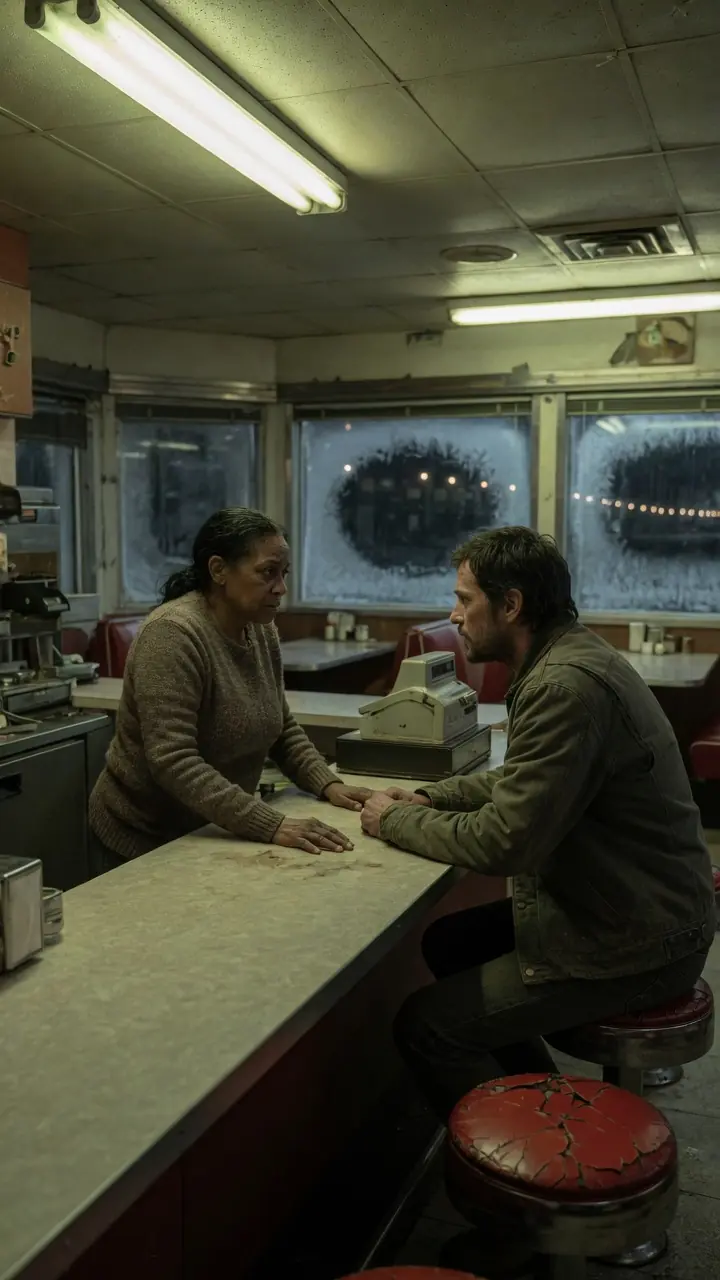
She slammed the trunk shut and walked to the diner. The Bluebird was a concrete block box sitting stubbornly on the shoulder of Highway 93. Inside, it smelled of stale fryer grease and industrial lemon bleach.
The floor was covered in faded checkered linoleum, sticky in the corners where the mop never quite reached. Gary, the sixty-year-old line cook with a perpetual scowl and a paper hat, was already behind the grill, slamming a spatula against the cast iron to knock the morning rust off.
Heater's busted. Gary grunted without looking up. Propane line froze overnight. Perfect. Joan muttered.
She walked behind the counter, grabbed a stack of pink aprons, and looped one over her neck. She didn't take the leather jacket off. She just tied the thin pink strings of the apron tight around the bulky waist of the coat, cinching it so she wouldn't knock over salt shakers with the massive sleeves.
She looked ridiculous, a tired twenty-eight-year-old woman swallowed by scarred black leather wrapped in a bright pink diner apron. She rolled the heavy leather sleeves up past her wrists, exposing her pale forearms, and started brewing the first pot of coffee.
By seven-fifteen, the diner was empty except for two long-haul truckers chewing quietly in a corner booth. The sun was fully up, casting harsh flat light across the desert scrub. Then the floor began to vibrate.
It didn't start as a sound. It started as a tremor in the soles of Joan's cheap canvas sneakers. The stack of ceramic coffee mugs on the espresso machine began to rattle against the metal grating, producing a thin chaotic clinking.
Gary stopped scraping the grill. He looked out the grease-stained front window. A low guttural roar washed over the building, thick and violent.
It was the sound of heavy pistons chewing through the morning air, aggressive and entirely unapologetic. Through the glass, a line of headlights cut through the morning glare. They pulled into the lot, not as individuals, but as a swarm.
Fifteen motorcycles. Large, stripped-down Harley-Davidsons. The exhaust fumes hit the diner's air intake, and suddenly the smell of unburned gasoline and hot metal flooded the small restaurant.
Joan watched as the riders cut their engines in near unison. The sudden mechanical silence outside was somehow louder than the roar. The two truckers in the corner booth immediately stood up, threw a wrinkled twenty-dollar bill on their table, and walked out the side emergency exit without waiting for their change.
Great. Gary muttered, wiping his greasy hands on a towel. Keep your head down, Joan. Don't look at them too long. Don't talk back. Just get them fed and out.
Joan exhaled a breath she didn't realize she was holding. She didn't care about the intimidation factor. She cared about her sore feet and the fact that fifteen guys meant fifteen separate checks, spilled coffee, and a tip jar that would likely remain entirely empty.
The front door swung open, the cheerful little brass bell above it chiming frantically, completely at odds with the men walking through the frame. They didn't just walk into the room. They occupied it.
The air pressure in the diner seemed to physically change. They were loud, their voices rough like boots scraping across gravel. They smelled strongly of road dirt, heavy denim, stale sweat, and marijuana.
There was no movie magic gloss to these men. They were weathered, scarred, and filthy. One man, built like a cinder block wall, had a massive sunburn peeling across the bridge of his nose.
Another had hands deeply stained with black axle grease that no amount of scrubbing would ever get out. Every single one of them wore the three-piece patch on their backs. The curved top rocker, the grinning death's head in the center, the bottom rocker.
Hells Angels. They bypassed the stools and took over the three largest booths in the center of the room, dragging chairs from other tables to cram themselves together. Heavy boots kicked the table legs.
Thick leather vests scraped against the cracked red vinyl. Joan stood behind the counter, the coffee pot feeling suddenly heavy in her hand. Her massive leather jacket squeaked as she shifted her weight.
She kept her front facing them, the pink apron obscuring the bulk of the coat, her mind strictly shifting into retail survival mode. All right. She whispered to herself. Just an order.
She grabbed a plastic pitcher of ice water and a stack of menus, walking out from behind the safety of the counter. The sheer physical size of the men made the aisles feel incredibly narrow. As she approached the main booth, the conversation didn't stop or lower in volume.
They talked over her, around her, cursing casually, laughing at something a guy with a braided gray beard had just said. Morning. Joan said, her voice flat, devoid of customer service cheer. Coffee?
A younger biker sitting on the outside edge of the booth looked up. He couldn't have been much older than Joan, but his face was prematurely lined, his eyes wide and aggressive. He had a spiderweb tattooed entirely over his throat.
Nice coat, sweetheart. Miller said, his tone dripping with condescension. You steal that off a dead guy?
Joan felt a hot spike of annoyance, but she clamped her jaw shut. Something like that. You want coffee or just the water?
Miller chuckled, leaning back and spreading his arms over the top of the booth. I want black coffee, a steak bloody, and four eggs. And don't burn the eggs, or I'm throwing them back at the cook.
Noted. Joan said dryly. She moved around the table, pouring water, taking the rapid-fire orders. Four plates of pancakes, six orders of biscuits and gravy, side of bacon, side of sausage.
She scribbled frantically on her green notepad, her massive rolled-up leather sleeves brushing against their shoulders as she reached across the table to set down the water glasses. The physical proximity to them was suffocating.
The sheer heat radiating off their bodies, mixed with the smell of leather and stale beer from the night before, made the diner's frozen air feel suddenly clammy. She retreated to the counter, ripping the ticket from her pad, and clipping it to the metal wheel for Gary.
Fifteen covers. Joan said. Steak, eggs, pancakes, the works. Gary looked at the ticket, his jaw tight. It's going to take twenty minutes. I only got half the flat top working.
Joan nodded, grabbing three glass carafes of coffee to make the rounds. For the next fifteen minutes, she played a tense game of avoidance. She kept their mugs full.
She ignored the crude joke a heavily tattooed man in the second booth made about her legs. She ignored the way Miller tapped his heavy silver rings against the Formica table, an impatient rhythmic clack clack clack that grated against her nerves.
She was sweating now. The physical labor of carrying heavy plates and pots combined with the ten-pound leather jacket was trapping her body heat. But the zipper was hopelessly jammed and pulling the stiff thing off over her head in the middle of the crowded diner was out of the question.
Hey, waitress. Miller's voice cut through the low rumble of the room. Joan turned.
He was holding up his empty water glass, shaking it so the remaining ice cubes rattled aggressively. We got food coming today, or is the old man in the back slaughtering the cow himself? Miller asked loudly.
A few of the other guys chuckled. It's coming. Joan said, keeping her face blank. Well, tell him to work faster. I'm hungry.
Miller dropped the glass onto the table. It tipped over, spilling a small puddle of ice and water across the laminate, soaking into a pile of paper napkins. He didn't move to clean it.
He just looked at Joan, waiting for her to do it. Joan stared at the puddle. The exhaustion in her bones flared into a brief blinding flash of anger.
She grabbed a rag from her apron pocket, walked over, and wiped the table in three harsh efficient strokes. We're out of hash browns. Gary suddenly called out from the kitchen window.
I need the frozen bag from the walk-in. Joan threw the wet rag under the counter. I'll get it.
To get to the walk-in freezer, she had to go through the narrow corridor past the restrooms. She realized her apron strings were soaked from the spilled water sticking uncomfortably to her side.
Frustrated, she reached behind her waist, yanked the knot loose, and pulled the pink apron over her head. She tossed it onto the counter. She was now just wearing the jacket, open at the front, hanging loose and heavy.
She pushed through the swinging door into the back hallway, hit the heavy metal latch of the walk-in, and stepped into the freezing dark box. The walk-in freezer was a sensory deprivation chamber compared to the dining room.
The heavy insulated door shut with a solid thud, cutting off the noise of the bikers completely. The only sound was the loud rattling hum of the freon condenser fan. Joan stood in the biting cold for exactly ten seconds, eyes closed, just breathing.
Her heart was beating a little too fast. The stress of the room out there was infectious. She rubbed her eyes, located the massive twenty-pound cardboard box of frozen shredded potatoes on the bottom shelf, and heaved it into her arms.
The box was awkward, covered in a thin layer of slippery frost. She kicked the freezer door open and walked back down the short hallway, leaning backward to balance the weight of the cardboard against her chest.
She pushed through the swinging double doors back into the main diner. The noise hit her again like a physical wave. Laughter, the clatter of silverware, Gary cursing at the grill.
She walked behind the counter, maneuvering toward the kitchen pass-through. Over by the booths, Miller was out of his seat. He was standing in the aisle, digging in his pockets for a lighter.
He bumped into the edge of the counter, knocking over a tower of small plastic creamers. They scattered across the floor like marbles. Damn it! Miller hissed.
He looked up instantly finding someone to blame. Hey, you got a mess here. Joan didn't even look at him.
She was focused on hoisting the heavy box of potatoes onto the high metal prep table behind the front counter. I see it. She said, her voice tight. Then clean it up.
Miller snapped, stepping closer, his aggression flaring at her dismissive tone. He wanted deference and she wasn't giving it. He picked up a heavy thick-walled ceramic coffee mug from the counter.
Hey, look at me when I'm talking to you. He didn't throw it at her, but he threw it hard onto the floor behind the counter. Crack.
The mug exploded against the brick tiles. Shards of white ceramic and a splash of leftover hot coffee sprayed against the back of Joan's denim jeans.
Joan froze. The box of potatoes hit the metal table with a loud hollow boom. Her breath hitched.
For a fraction of a second raw panic spiked in her chest. She was alone with an old man against fifteen outlaws. But the panic was immediately swallowed by a deep dark exhaustion.
She was tired of being cold. She was tired of being broke. And she was deeply profoundly tired of angry men throwing things.
She didn't run. She didn't cower. Slowly, Joan turned her back to the dining room.
She reached for the industrial broom leaning against the wall near the coffee machine. As she turned the heavy black leather of her jacket swung with her. Her back was now completely exposed to the entire diner.
To the booths, to Miller. The back of the jacket was a scarred wasteland of old leather. But it was what was stitched into the center that commanded the room.
There was no club logo, no death's head. Instead, there was a massive rectangular white block patch so old it was stained the color of weak tea. The heavy black threading of the letters was frayed but legible.
Filthy Few. Below it, stitched with crude thick fishing line directly into the leather, was a smaller diamond patch. A 1% logo bisected by an actual bullet hole surrounded by dried rusted stains that could only be one thing.
But it was the top rocker that held the true gravity. It wasn't a location. It was a name and a year burned and branded into a strip of raw leather.
Hutch. Nomad. 73.
Miller opened his mouth to yell at her again, his hand gripping the edge of the counter. He stopped. The words died in his throat.
His eyes locked onto the patches. The color literally drained from his sunburnt face, leaving him looking sickly and pale. He took a physical step backward, his heavy boots stumbling over the fallen creamers.
At the main table, a massive man with a gray nicotine-stained beard and a leather cut completely covered in grease sat at the head. His name was Burl. He was the road captain, a man who had survived thirty-five years of highway wars.
He had been mid-sentence laughing at a joke. Burl looked past Miller's shoulder. He saw the jacket.
He stopped laughing. The silence didn't happen gradually. It fell over the diner like a suffocating blanket.
It was instantaneous and violent. The conversation at the second booth snapped shut. The clinking of forks stopped.
Even the sound of a booted foot tapping the floor ceased entirely. The only sound left in the room was the sizzle of grease on Gary's flat-top grill. It was a dead heavy terrifying silence.
Joan gripped the wooden handle of the broom. The sudden quiet made the hair on the back of her neck stand up. It felt like the air pressure had dropped to zero.
She squeezed her eyes shut bracing for the physical impact she was sure was coming. She gripped the broom tight ready to swing. She slowly turned around to face them.
No one was looking at her face. Every single man in the room was staring at her shoulders. Staring at the leather.
Miller was standing perfectly still. His hands held slightly out from his sides. His aggressive posture completely dissolved into rigid shock.
At the main table, Burl slowly placed his massive scarred hands on the table. He didn't stand up immediately. He just stared.
His breathing was heavy rattling in his chest. Where? Burl's voice was a low gravelly rasp that barely broke the silence.
He cleared his throat. His eyes wide completely abandoning his tough guy facade. Where did you get that leather, girl?
Joan swallowed hard. Her throat was bone dry. She looked from Miller's pale face to Burl's wide unblinking stare.
It's my uncle's. Joan's voice shook and she hated herself for it. She cleared her throat and tried again louder. It's my uncle Hutch. I just... My heater is broken.
Burl stood up. The sound of his boots scraping against the linoleum was deafening in the quiet room. He stood to his full height, a towering six-foot-four of muscle and bad miles.
He didn't look angry. He looked like he had just seen a ghost walk out of the kitchen. He slowly raised a hand pointing a thick calloused finger at Miller.
Miller. Burl said, his voice dropping into a deadly quiet register. Get a broom. Pick up that mess. Now.
Miller didn't hesitate. He didn't argue. He moved with a frantic desperate speed diving for the broom in Joan's hand.
His eyes cast firmly down at the floor. Miller didn't just take the broom from Joan's hand. He practically ripped it away desperate to have something to do with his hands.
Something to break the paralyzing gravity of the moment. He kept his chin tucked practically to his collarbone. He didn't look at Joan.
He didn't look at Burl. He stared rigidly at the spilled creamers and the shattered white ceramic of the mug he had just thrown.
The bristles of the industrial broom dragged across the brick red quarry tile. Scratch. Sweep. Clink.
The sound was tiny, pathetic even. But in the suffocating silence of the Bluebird Diner, it sounded like a shovel striking rock. The fourteen other men in the room watched him.
Nobody laughed. Nobody made a snide comment about the youngest guy in the pack playing maid. The tension in the air was so thick Joan felt like she had to chew it just to draw a breath.
Joan stood with her back against the stainless steel prep counter. Her hands were buried deep in the cavernous fleece lined pockets of Hutch's jacket. She kept them there because they were shaking.
A fine violent tremor had started in her fingers and was working its way up her forearms. The adrenaline crash was beginning flooding her veins with a cold metallic ache.
The spilled coffee from the shattered mug was soaking through the denim at the back of her calves clammy and uncomfortable, but she didn't dare move. Burl stepped closer.
He stopped exactly three feet away from her. It was a very specific deliberate distance. Not close enough to be an aggressor.
Not far away to be dismissive. Up close, the road captain smelled intensely of stale tobacco dried sweat and the sharp chemical tang of highway ozone.
His gray beard was a wiry mess, yellowed around the mouth from decades of unfiltered cigarettes. His eyes nested in deep folds of sun-baked skin were a pale, washed-out blue.
They weren't looking at her face. They were locked onto the thick raw leather draped over her collarbones. He breathed in heavily through his nose.
His chest rattled. You're Hutch's blood. Burl said.
It wasn't a question. It was a quiet, heavy statement of fact. His voice was raw, like he had gargled with sand.
He was my uncle. Joan said. Her voice cracked on the last syllable.
She swallowed hard, forcing her throat to open. She wanted to shrink back to press herself into the metal counter until she disappeared, but the sheer weight of the oversized jacket kept her anchored in place.
My dad's older brother. Burl nodded slowly. He didn't smile.
His expression was impossible to read, a mixture of deep reverence, lingering shock, and a strange cold sorrow. He passed. Joan added, not entirely sure why she felt the need to fill the quiet.
Five years ago. Reno. Liver gave out.
We know when he died. Burl said softly. He finally looked up from the jacket, meeting her eyes.
We paid for the cremation, kept the cops out of the trailer so the family could clear it out without the state taking half his junk to pay off back taxes. Joan blinked.
The memory of cleaning out Hutch's single-wide trailer flared in her mind. It was a sweltering July afternoon. The place had smelled of rotting particle board, feral cat urine, and stale beer.
She remembered finding an envelope of crisp one-hundred-dollar bills taped to the back of the toilet tank. It had been exactly enough to cover the crematorium fees and the lot rent. She had assumed Hutch had saved it.
I found this in a garbage bag. Joan said, her defensive instinct flaring again. In the back of a closet. I didn't steal it.
Nobody here thinks you stole it, girl. Burl said. His pale eyes flicked back down to the massive black stitching on the front lapel, then to the heavy zippers.
You can't steal a Filthy Few cut. You try and the leather rejects you. Usually violently.
Joan didn't know what that meant. She didn't want to know. The exhaustion was starting to outweigh the fear.
Her feet throbbed in her cheap canvas sneakers. She just wanted to go home, turn on a hot shower, and stand under it until the water ran ice cold.
Clatter. Miller was down on one knee using a piece of cardboard he'd torn from a napkin dispenser box to scrape the last shards of ceramic into a pile.
He scooped them up, his hands shaking slightly, and dumped them into a plastic trash can behind the counter. He stood up, avoiding Joan's gaze entirely.
He practically tipped his head to her, a jerky awkward motion of complete submission before retreating backward toward the booths. He didn't sit back down in his original spot.
He found a chair at the very edge of the group, pulling it tight to the table, making himself as small as physically possible. Burl turned his head slightly, addressing the room without raising his voice.
We eat quiet today, boys. We're in a ghost's house. The men nodded.
A few of them reached up and physically touched the grinning death's head patches on their own chests. A silent synchronized gesture of respect that sent a fresh chill down Joan's spine.
Burl looked back at Joan. He didn't offer an apology for the mess or for Miller's behavior. An apology would imply a debt and men like Burl didn't accrue debts with civilians.
But his tone had shifted from demanding to entirely transactional. How long on the food, ma'am? He asked.
Ma'am. Ten minutes ago she was sweetheart and waitress. Now wrapped in a dead man's scarred cowhide, she was royalty.
Ding. The harsh metallic strike of the service bell over the kitchen window shattered the quiet. Joan flinched.
Burl didn't even blink. Orders up. Gary's voice croaked from the kitchen.
It sounded thin and terrified. Joan pulled her trembling hands out of the heavy leather pockets. It's ready now.
The kitchen was a greasy smoke-filled sanctuary. Joan pushed through the swinging double doors and leaned her back against the aluminum prep sink, squeezing her eyes shut for three seconds.
The heavy thump of her own heartbeat was deafening in her ears. Gary was standing by the flat top grill, an oversized metal spatula gripped so tightly in his right hand that his knuckles were stark white.
A row of heavy ceramic plates lined the heating shelf piled high with steaming eggs, thick cuts of bruised steak, and pale greasy hash browns. What happened out there? Gary hissed, his eyes wide and frantic beneath his paper hat.
I heard a smash, then nothing. Did they pull a gun? Joan swear to God if they pulled a piece I'm hitting the panic button under the register. No gun, Gary. Joan said.
She opened her eyes and pushed off the sink. The heavy leather jacket shifted, the thick collar scraping roughly against her jawline. Just a dropped mug.
Then why the hell is it so quiet? Gary demanded gesturing with the spatula toward the swinging doors. They were louder than a jet engine a minute ago. Now it sounds like a damn funeral parlor.
I don't know. Joan lied. It was easier than explaining. She grabbed a heavy scarred plastic serving tray and started loading the plates.
The sheer weight of the food combined with the ten-pound leather jacket pulling at her shoulders made her muscles burn. She pushed backward through the doors reentering the dining room.
The silence held. It wasn't the total paralyzing silence of the immediate aftermath. But it was a heavy disciplined quiet.
The fifteen bikers were sitting up straight. The casual lounging, the boots kicked up on empty chairs, the aggressive sprawl, all of it was gone. They spoke to each other in low muted murmurs.
Joan walked to the main booth. She didn't use her tray stand. She just balanced the heavy plastic oval on her left forearm, the thick leather sleeve providing a strange padded barrier against the scorching hot bottoms of the plates.
Steak rare four eggs. Joan said keeping her voice flat and professional. She set the plate down in front of a man with a scarred scalp and a missing left earlobe.
Thank you, ma'am. The man murmured. He didn't look at her face.
He looked at the heavy brass zipper of her jacket. She moved down the line. Pancakes, side of bacon.
Appreciate it. Another biker mumbled pulling his plate closer. It was deeply fundamentally unnatural.
These were men who wore their capacity for violence like a badge of honor. They carried heavy steel buck knives clipped to their belts. They smelled of hard miles, cheap amphetamines, and unwashed denim.
Yet as Joan moved among them setting down plates of cheap diner food, they physically pulled their shoulders in to avoid brushing against her. She reached Miller's table.
He was staring intensely at a ketchup bottle. Steak bloody. Four eggs.
Joan said. She set the plate in front of him. Miller didn't say a word.
He just gave a sharp jerky nod, his hands resting flat on his thighs under the table. He looked thoroughly sick. Joan retreated behind the counter to grab the coffee carafes.
As she poured the smell of roasted beans masked the heavy scent of the bikers' leather and exhaust fumes. She stood by the register watching them eat, her mind racing trying to reconcile the reality of the room with the memory of her uncle Hutch.
A man who sat in a stained recliner for twelve hours a day watching reruns of Gunsmoke. A man who only spoke in grunts and complaints about his knees. A man who died with yellow skin and a distended belly completely alone in a rusted metal box on the outskirts of Reno.
What did you do, Uncle Hutch? Joan looked down at her own forearm encased in the black leather sleeve. She ran her thumb over a deep jagged scar carved into the cowhide near the elbow.
It wasn't a tear from a fall. The edges were clean. It was a knife cut.
A deep one. Her eyes drifted to the front of the jacket to the faded patches she hadn't bothered to understand. Beside the zipper over the right breast, there was a small rectangular patch.
The red stitching was practically black with age and grease. The DeMau. She didn't know what it meant.
She didn't know it was a bastardization of a Vietnamese phrase brought back by combat veterans. She didn't know it meant go fast, get out of here, kill and leave. She only knew that whatever this jacket represented, it was steeped in a history of profound terrifying violence.
The Filthy Few patch on her back, the one Burl had stared at with such bleak reverence, felt like it was radiating heat against her shoulder blades. The bikers ate quickly.
There was no lingering, no laughing with mouths full of food, no crude jokes shouted across the aisles. They ate with the mechanical efficiency of men fueling up for a long ride.
Silverware scraped against cheap ceramic. Heavy jaws chewed through tough diner steak. Joan stayed behind the counter, leaning against the cold glass of the pie display case.
The physical exhaustion was settling deep into her bones. The early morning adrenaline spike had left her feeling hollow and incredibly brittle. She rubbed her eyes, the grit of too little sleep scratching against her corneas.
Waitress. The voice was low, polite, but firm. Joan opened her eyes.
Burl was standing at the counter. He had left his plate practically clean, just a smear of egg yolk and grease remaining. He reached into the front pocket of his grease-stained denim jeans and pulled out a thick roll of bills secured with a dirty rubber band.
Check, please. Burl said. Joan walked over to the register, her fingers stiff as she hit the heavy plastic keys.
She pulled the green paper ticket from her apron, which was still crumpled in a wet heap beneath the counter. One hundred eighty-four dollars and fifty cents. Joan said.
Burl didn't even look at the total. He peeled off three crisp new one-hundred-dollar bills and laid them flat on the scratched Formica counter. He placed a massive calloused hand flat over the money, preventing Joan from taking it immediately.
Keep the change. Burl set his pale blue eyes finally meeting hers, holding her gaze with a sudden piercing intensity. For the mess.
That's one hundred fifteen dollars. Joan said, her voice dropping. I don't need a tip for a dropped mug.
Take it. Burl insisted, his voice dropping an octave, losing the polite diner customer cadence and slipping back into the gravelly authority of a road boss. Consider it a tax for my guy being a disrespectful piece of shit to Hutch's blood.
Joan didn't argue. She carefully slid the bills from beneath his thick fingers and placed them in her pocket. It was more than she made in two twelve-hour shifts.
Burl didn't leave immediately. He rested his forearms on the counter, leaning in slightly. The smell of him, tobacco, highway grit, and old leather was overpowering.
You don't ride, do you, girl? Burl asked quietly. I drive a 2004 Taurus. Joan replied, crossing her arms over the bulky chest of the jacket.
The heater's broken. A ghost of a smile twitched at the corner of Burl's mouth, hidden mostly by his wiry gray mustache. Yeah.
Hutch drove a beat-up Ford at the end, too. Said his knees couldn't handle the vibration of a rigid frame anymore. The smile vanished as quickly as it appeared.
Burl looked left, then right, ensuring none of his guys were within earshot before leaning closer. That jacket. Burl whispered, his tone dropping into something dangerously close to a warning.
You think it's just a heavy coat to keep the frost off. It ain't. I figured that out. Joan said dryly.
No, you didn't. Burl corrected, his voice hard. You saw fifteen guys get quiet. You think that's respect? It's not. It's fear.
Joan felt a cold knot form in her stomach. She looked at Burl's eyes. They were completely serious.
That patch on your back. The Filthy Few club. Burl continued, his eyes locked on hers.
You don't earn that patch for riding hard or partying late. You earn it for doing the things that keep the club alive when the law and the rivals want us dead. You earn it in the dark.
Joan's breath caught in her throat. She gripped her own elbows tighter, the stiff leather creaking slightly under the pressure. Hutch got his in seventy-three.
Burl said, his voice barely a breath now. Nomad chapter. No fixed address. No rules.
Just the road and the club. There was a war with the Outlaws in Oakland. A bad one.
Guys dying in their driveways. Hutch ended it. Just him.
Nobody knows exactly what he did or how he did it, but three rival presidents disappeared in a week and the war stopped. Joan stared at the old man.
Her mind struggling to overlay this brutal violent mythology onto the sad drunk old man she remembered. We thought he burned the cut when he retired.
Burl said, his eyes drifting down to the heavy brass zipper. Most guys do if they survive that long. The fact that it exists, it's a target, girl.
A target. Joan repeated, her mouth suddenly dry. The wrong cop sees that diamond patch with the bullet hole on your back, they'll pull you over, tear your car apart, and leave you handcuffed on the asphalt just for the thrill of disrespecting it.
Burl said. The wrong rival club sees it, a Mongol or a Vaquero, they won't care that you're a twenty-eight-year-old waitress in a broken Ford. They'll see the top rocker.
They'll see the history. And they'll take it off you. With the knife if they have to.
He stood up straight, the leather of his own vest groaning. He adjusted his heavy belt. Keep it in the trunk, girl.
Burl said, his voice returning to its normal gravelly volume. Wear it in your house if you're cold, but don't wear it on the highway. Hutch paid for that leather with a lot of blood.
Don't let it cost yours. Burl turned around. He didn't issue an order.
He just gave a short, sharp whistle. Every biker in the diner stood up simultaneously. The synchronized scraping of chair legs against linoleum was loud and abrupt.
They didn't linger. They walked out of the diner in a single file line, disciplined and silent. Miller was the last one out.
He paused at the door, gave Joan one last terrified look, and pushed through the glass. The door shut. The bell chimed happily.
Five seconds later, the low guttural roar of heavy pistons shattered the morning air. It vibrated through the concrete walls, rattling the coffee mugs on the machine, shaking the glass in the pie display.
The roar peaked loud and aggressive, and then slowly began to fade as the pack pulled out onto Highway 93, heading south. Joan stood alone behind the counter.
The silence returned, but it didn't feel heavy anymore. It just felt empty. She exhaled a long shuddering breath.
Her shoulders slumped. The adrenaline was completely gone, leaving nothing but an aching fatigue. She reached up with stiff cold fingers and gripped the heavy brass zipper of Hutch's jacket.
She tugged hard, fighting the missing teeth until it finally gave way. She slid the massive leather coat off her shoulders. The sudden absence of its weight was jarring.
She felt incredibly light, but the frozen air of the diner immediately bit through her thin polyester fleece. She dropped the jacket onto a vinyl stool behind the counter. It landed heavily, slumping over the metal backrest.
The back of the jacket faced her. The faded tea-stained block letters of the Filthy Few patch stared back at her, surrounded by scarred distressed cowhide. Joan reached out her finger, trembling slightly, and traced the outline of the rusted dark brown stain surrounding the bullet hole in the 1% diamond.
The leather there was stiff, completely unyielding. Gary. Joan called out, her voice echoing slightly in the empty restaurant.
The kitchen door swung open. Gary poked his head out, his eyes darting around the empty booths. They're gone.
They're gone. Joan said. She reached into her pocket, pulled out a crisp one-hundred-dollar bill, and tossed it onto the counter.
Put that in the register to cover the check. Put the rest in the tip jar. Gary walked out, picking up the bill.
He looked at the money, then at the massive black jacket draped over the stool. You want me to hang that in the back for you? Gary asked, pointing a greasy spatula at the leather.
Joan stared at the jacket. She could still smell the stale cedar and ancient motor oil, but now she could smell the iron and the asphalt, too. She thought of Burl's warning.
She thought of three dead men in Oakland. No. Joan said softly.
She scooped the heavy leather up, folding it inward so the patches were hidden. I'm going to put it in the trunk. The rest of the shift was a blur of mechanized routine.
Joan poured coffee. She scraped dried egg yolk off ceramic plates with her thumbnail. She wiped down the laminate tables with a rag soaked in industrial bleach, the sharp chemical smell burning her nostrils and masking the lingering scent of stale leather and unburned gasoline.
But her body hadn't forgotten. The fine tremor in her hands didn't stop until well past noon. Every time the heavy brass bell above the diner door jingled, her breath hitched, catching sharply in the back of her throat.
She expected to see another wall of scarred leather and sunburned faces. She expected Miller to walk back in with a score to settle. Instead, it was just the usual midday drifters.
An elderly couple complaining about the price of the meatloaf. A tired phone company lineman who left a single crumpled dollar bill beside his coffee cup. At four o'clock, Joan untied her apron.
It was stiff with spilled coffee and dried grease. She threw it into the canvas laundry bin behind the kitchen door. She walked out the back emergency exit into the alley, the bitter Nevada wind immediately slicing through her thin fleece pullover.
Her 2004 Ford Taurus was parked by the dumpsters. It was the color of faded champagne, marred by a constellation of rust spots blooming around the wheel wells. She walked to the back, shoved her key into the stiff lock, and popped the trunk.
The heavy black garbage bag sat exactly where she had left it. Joan stared at it. The plastic was slightly opaque, but she could see the dark crumpled mass of the jacket inside.
She reached out and pressed her hand against the plastic. It was freezing. It felt like a dead thing.
You think it's just a heavy coat to keep the frost off. It ain't. Burl's gravelly voice echoed in the empty alleyway.
Joan slammed the trunk shut. The noise cracked like a gunshot off the cinder block walls of the diner. She flinched at the sound, her own nerves betraying her.
She got into the driver's seat. The vinyl was hard as stone in the cold. She turned the key.
The engine cranked, wheezed, and finally caught the idle rough and shuddering. She turned the heater dial all the way to red, knowing it would only spit out metallic tepid air. She pulled out onto Highway 93.
The drive back to her apartment was an exercise in pure paranoia. Every vehicle in her rearview mirror was a threat. A lifted pickup truck tailgating her made her grip the steering wheel until her knuckles turned stark white.
When a lone motorcycle passed her going the opposite direction, just a civilian on a sleek plastic-clad sport bike, she physically ducked down in her seat, her heart slamming against her ribs. She was carrying a bomb in her trunk.
She lived in a two-story stucco complex on the edge of town, the kind of place where the parking lot was more gravel than asphalt, and the exterior lights were caged in rusted wire mesh to prevent kids from smashing the bulbs.
She parked the Taurus, grabbed her canvas purse, and hurried up the concrete stairs to her second-floor unit. She locked the deadbolt. She engaged the cheap chain lock.
She leaned her back against the cheap veneer of the front door and slid down until she was sitting on the thin, scratchy carpet of her entryway. The apartment was freezing. The baseboard heaters barely functioned, emitting a faint clicking sound, but no actual warmth.
She sat there in the quiet, pulling her knees to her chest. She reached into the front pocket of her jeans. Her fingers brushed against the thick, tightly folded wad of paper.
She pulled it out. Three crisp, brand-new one-hundred-dollar bills. Burl's money.
It felt entirely wrong in her hand. It felt like blood money. She had one hundred fifteen dollars in her checking account.
This cash was practically a month's rent. She threw the money onto the small laminate table in her kitchen. It sat there glaringly green and pristine amidst the clutter of unopened electric bills and empty soup cans.
That night, Joan couldn't sleep. She lay under two thin polyester blankets, staring at the water stains on the ceiling. Every time the wind rattled the single-pane window of her bedroom, she saw Burl's pale, washed-out eyes.
She saw the rusted blood stain around the bullet hole on the back of the leather. What did you do, Uncle Hutch? She tried to picture the old man, but the memory was fading, being overwritten by the sheer, terrifying gravity of the men in the diner.
Hutch wasn't just a sad drunk in a trailer. He was a nomad, a ghost who ended a war, and now she was his keeper. At three o'clock in the morning the cold in the apartment became unbearable.
Joan threw off the blankets. She put on her canvas sneakers without socks, grabbed her car keys, and walked out into the freezing night. The parking lot was dead quiet save for the hum of the nearby highway.
She walked to the Taurus. She opened the trunk. The black garbage bag was still there.
She reached in and ripped the plastic open. The smell of stale cedar, ancient oil, and cold leather washed over her. She gripped the heavy collar and pulled the jacket out.
It was incredibly stiff from the cold hanging from her fists like a suit of armor. She didn't put it on. She just held it.
The sheer physical weight of it was grounding. It was real. It wasn't a ghost story.
It was ten pounds of scarred cowhide and heavy brass. She traced her thumb over the frayed black stitching of the top rocker. Hutch. Nomad. 73.
I don't want this. Joan whispered to the empty parking lot. Her breath plumed in the freezing air.
I just wanted a coat. She shoved the jacket back into the trunk, slammed the lid, and walked back upstairs. She didn't sleep the rest of the night.
Three days passed. The temperature in northern Nevada dropped another five degrees settling into a bitter dry freeze that cracked the skin around Joan's fingernails. It was a Tuesday evening.
The night shift. The Bluebird Diner was bathed in the harsh flickering glare of fluorescent tube lights. Gary was in the back meticulously breaking down the flat top grill with a pumice stone.
The dining room was entirely empty. The smell of old fryer grease hung heavy in the air, unmasked by the usual scent of coffee, which had been turned off hours ago. Joan stood behind the register doing the night's receipts.
Her hands were freezing. She was wearing two thin sweaters layered over each other, but it wasn't enough. The chill was radiating off the large front window, settling deep into her joints.
Clack. The sound of a heavy kickstand snapping down on the asphalt outside cut through the hum of the refrigerators. Joan stopped adding the column of receipts.
She looked up. A single motorcycle sat beneath the flickering neon sign of the diner. It wasn't a stripped-down Harley.
It was a chopped-up metric cruiser painted a jarring metallic lime green. The engine sputtered and died with a high-pitched whine. The front door opened.
The brass bell chimed. The man who walked in was nothing like the Angels. He was lean, almost wiry, moving with a twitchy, restless energy.
He wore a heavy green canvas jacket over a black hoodie. He didn't smell of old leather and road dirt. He smelled sharply of cheap, sweet cologne, chemical smoke, and unwashed hair.
He didn't take a booth. He walked straight to the counter and sat on the stool closest to the register. Joan didn't move.
She kept her hands flat on the Formica counter. Coffee's off. Joan said, her voice flat, betraying none of the sudden spike of adrenaline pooling in her stomach.
Grill's closed. We're locking up in ten. The man smiled.
His teeth were remarkably white against a patchy, sparse beard. His eyes were dark, darting around the empty diner before settling squarely on Joan. I don't want food, sweetheart.
He said. His voice was higher than Burl's, lacking the heavy gravel, but it carried a different kind of threat. It was slippery, calculating.
He unzipped the heavy green canvas jacket just enough to reveal the black leather cut he wore underneath. On his left breast was a patch, a green wheel with wings. Vagos.
Burl's warning screamed in Joan's mind. The wrong rival club sees it. A Mongol or a Vago.
Then what do you want? Joan asked. She slowly slid her right hand off the counter, dropping it to her side, inching closer to the heavy ceramic coffee pot sitting empty on the warmer.
The man leaned his elbows on the counter. He reached into his pocket and pulled out a cheap plastic lighter, flipping the metal lid open and shut with a rhythmic click-clack-click-clack.
My name's Garrett. He said softly. I was passing through a truck stop down in Ely a couple days ago.
Overheard a fat trucker running his mouth, said he saw something funny up here at the Blue Bird. Said he saw a waitress serving coffee while wearing a Filthy Few cut. An old one.
Nomad. Garrett stopped flicking the lighter. He leaned in closer.
The smell of his sweet cologne was nauseating. Now. Garrett whispered, his dark eyes locking onto hers.
I thought to myself that can't be right. An Angel's bloody leather just sitting on a waitress in a roadside greasy spoon. That's the kind of trophy men die over.
So I came up to see for myself. Joan stared at him. The exhaustion of the past three days, the paranoia, the constant bone-deep cold, it suddenly calcified into a hard, brittle anger.
The trucker was drunk. Joan said evenly. There's no jacket here.
Garrett's smile vanished. The twitchy energy settled into a predatory stillness. He reached into his back pocket.
For a terrifying second, Joan thought he was pulling a gun. Instead, he pulled out a thick folded wad of cash. He dropped it on the counter between them.
That's five hundred dollars. Garrett said. More than you make in a month slinging hash in this dump.
You go in the back, you bring me that jacket, and I walk out of here. Nobody gets hurt. You get to buy a new heater for whatever piece of shit car you drive, and I get a piece of history to hang on my clubhouse wall.
Joan looked at the money. Five hundred dollars added to Burl's three hundred, it was enough to fix her car. Enough to buy a real coat.
Enough to catch up on rent. All she had to do was hand over a dead man's leather. She looked back up at Garrett.
She saw the greed in his eyes. He didn't revere the jacket like Burl did. He didn't respect the ghost of Hutch.
He just wanted a prize. He wanted to parade it around and brag about how he took a Nomad's colors off a civilian. And Joan knew with sudden terrifying clarity that if she gave it to him, Burl would find out.
The Hells Angels would find out that Hutch's legacy was hanging in a Vagos clubhouse. And they would come back to the Bluebird Diner. They wouldn't come back for breakfast.
I told you. Joan said, her voice dropping into a harsh cold register she didn't know she possessed. There is no jacket.
Garrett's jaw tightened. He picked up the plastic lighter and shoved it in his pocket. He left the money on the counter.
He slowly stood up from the stool. Listen to me, you stupid bitch. Garrett hissed, leaning completely over the counter, his face inches from hers.
You think because Burl and his pack of geriatrics ate here, you're protected? You're not. You're holding a lit stick of dynamite.
Give me the cut or I come back tomorrow with three guys and we tear this diner down to the studs to find it. Hey! The voice roared out from the kitchen pass-through thick with uncharacteristic rage.
Garrett flinched pulling back from the counter. Joan spun around. Gary was standing in the kitchen window.
He wasn't holding his pumice stone. He was holding a rusted heavy barreled Remington 870 pump action shotgun. The barrel was resting flat on the stainless steel shelf pointed directly at Garrett's chest.
Gary racked the slide. Clack clack. The sound was deafening in the empty diner.
It was the universal language of finality. The lady said we're closed. Gary barked his voice shaking but loud.
Take your money and get the hell out of my diner. Garrett froze. He looked at the massive black bore of the shotgun.
He looked at Gary's white-knuckled grip on the stock. He slowly raised his hands a mocking half surrender. All right old man.
Garrett sneered though the color had drained slightly from his cheeks. Keep your hair on. He reached down, snatched the five hundred off the counter and shoved it in his pocket.
He looked back at Joan. His eyes narrowed to cruel slits. I'll see you around sweetheart.
Garrett whispered. Keep an eye on your rearview. He turned and walked out.
The door chimed. He didn't run but he walked fast. He threw his leg over the green cruiser, kicked it into gear and peeled out of the parking lot.
The high-pitched whine of the engine fading quickly into the dark. Joan stood behind the counter her chest heaving gasping for air as if she had been underwater. Gary slowly lowered the shotgun.
His hands were shaking violently. He laid the weapon on the prep table and leaned against the sink, burying his face in his hands. I've never pointed a gun at a man in my life.
Gary wheezed, his voice cracking. Joan walked over to the pass-through. She reached through and placed her hand over Gary's trembling shoulder.
Thank you, Gary. She whispered. He's coming back, Joan.
Gary said, looking up, his eyes wide with fear. Guys like that, they don't just let it go. They can't.
I know. Joan said. She pulled her hand back. Her decision was made.
The internal contradiction was gone. The jacket wasn't protection. It wasn't money.
It wasn't a family heirloom. It was a death sentence. Lock the doors, Gary.
Joan said, untying her apron and throwing it on the counter. I have to take care of something. Highway 50 cuts east across Nevada, stretching out into the deep, empty alkali flats.
They call it the loneliest road in America. At midnight, the title is absolute. There are no streetlights.
There are no gas stations. There is nothing but a ribbon of cracked black asphalt cutting through a seemingly endless expanse of sagebrush and gray dirt. Joan drove the Taurus for an hour.
The heater was still dead. The temperature outside had dropped to twelve degrees. She shivered violently, her teeth clattering together in a steady, uncontrolled rhythm.
But she didn't turn back. She needed distance. She needed the silence of the deep desert.
She found an unmarked dirt turnout fifty miles past the city limits. She wrenched the steering wheel, the Taurus's suspension groaning as the tires crunched off the asphalt and onto the hard-packed frozen dirt.
She drove one hundred yards off the highway, the headlights illuminating nothing but pale dust and twisted scrub brush. She put the car in park and killed the engine. The silence that rushed in was absolute.
It was heavy like water pressure. Joan stepped out of the car. The cold was a physical shock, instantly numbing her exposed cheeks and biting through her thin sweaters.
The sky above was a staggering canvas of stars unpolluted by city lights. It was beautiful, but she didn't look up. She walked to the trunk.
She opened it. She grabbed the black garbage bag and pulled it out. She walked twenty yards away from the car, her cheap sneakers crunching loudly on the frozen salt flats.
She dropped the bag onto the dirt. She walked back to the trunk. She rummaged past the jumper cables and the trash until she found a half-empty red plastic jug of gasoline Gary kept for the diner's backup generator and an old book of matches from a casino in Reno.
She walked back to the black bag. Joan didn't rip the plastic off this time. She grabbed the collar of the jacket through the bag and pulled it free.
The heavy scarred black cowhide slumped onto the pale dirt. The moonlight caught the brass zippers. It lay there thick and unyielding smelling of cedar and old violence.
Joan knelt in the dirt beside it. She reached out with freezing stiff fingers and turned the jacket over. The white block letters stared up at her.
Filthy Few. Below it, the 1% diamond with the rusted bullet hole. Above it, the top rocker.
Hutch. Nomad. 73.
She stared at the name. You survived all of them. Joan whispered to the leather, her voice swallowed instantly by the vastness of the desert.
You survived Oakland. You survived the miles and you died alone in a trailer. She traced her finger over the rusted stain around the bullet hole one last time.
It wasn't reverence. It was acknowledgement. An understanding that violence only buys you time, not peace.
Burl revered the jacket because Burl was still in the life. Garrett wanted it because Garrett wanted the glory, but Joan just wanted to be warm. She just wanted to live without looking over her shoulder.
The jacket couldn't give her that. It was anchored to the past, dragging everyone who touched it down into the dirt with it. Joan stood up.
She unscrewed the cap of the red plastic jug. She poured the gasoline directly over the patches. The clear liquid splashed against the raw leather, soaking instantly into the frayed stitching of the top rocker.
She emptied the entire half gallon over the coat. The sharp, toxic smell of fuel overpowering the scent of old cedar. She tossed the empty jug aside.
She opened the matchbook. Her hands were shaking so badly from the cold that she broke the first match. She took a deep breath, steadied her right hand against her thigh, and struck the second one.
The match flared a tiny fragile point of orange light in the massive frozen dark. Joan dropped the match onto the center of the filthy fuel patch. Whoosh.
The gasoline caught instantly. A sudden violent pillar of orange flame erupted upward, washing a sudden wave of intense heat over Joan's freezing face. She stumbled backward, shielding her eyes from the glare.
The fire was aggressive. It chewed through the chemical fumes, burning bright and loud. But the leather itself fought back.
Cowhide doesn't burn easily. It curled. It blackened.
It hissed and spit, releasing a thick acrid black smoke that smelled deeply of sulfur, burning hair, and old grease. Joan stood ten feet away, her arms wrapped tightly across her chest. The heat from the fire finally penetrated her sweaters, warming her skin.
But it was a harsh, ugly heat. She watched the top rocker. The heavy thread reading Hutch curled inward, the leather warping and shrinking under the extreme temperature.
The brass zippers glowed a dull, angry red. The 1% diamond patch blackened the white fabric turning to ash and floating upward into the cold night sky. It took thirty minutes for the fire to break the jacket down.
Thirty minutes of standing alone in the dark watching a ghost story turn to charcoal. When the flames finally died down, leaving nothing but a smoldering, unrecognizable mass of blackened crust and glowing red embers on the desert floor, Joan let out a long, shuddering breath.
The weight was gone. She turned around and walked back to the Taurus. She got into the freezing car, shut the door, and locked it.
She started the engine. The heater blew cold air, but as she put the car in drive and pulled back onto the empty highway heading back toward the city, she felt lighter. The rearview mirror was completely dark.
No headlights. No motorcycles. Just the empty, quiet road.
She was cold, but she was free. Joan's choice out in the desert wasn't about disrespecting history. It was about surviving it.
Hutch's jacket carried the weight of a violent past, and sometimes the bravest thing you can do is refuse to wear a ghost's armor.