Sixty-three black walnut trees lay in the mud at Brier Creek Timber. Each one was slashed with red spray paint that meant the same thing it always meant: not worth the blade.
Every buyer that morning drove past without slowing. Every sawyer shook his head at the twisted grain spiraling through the trunks, because no commercial mill would touch them.
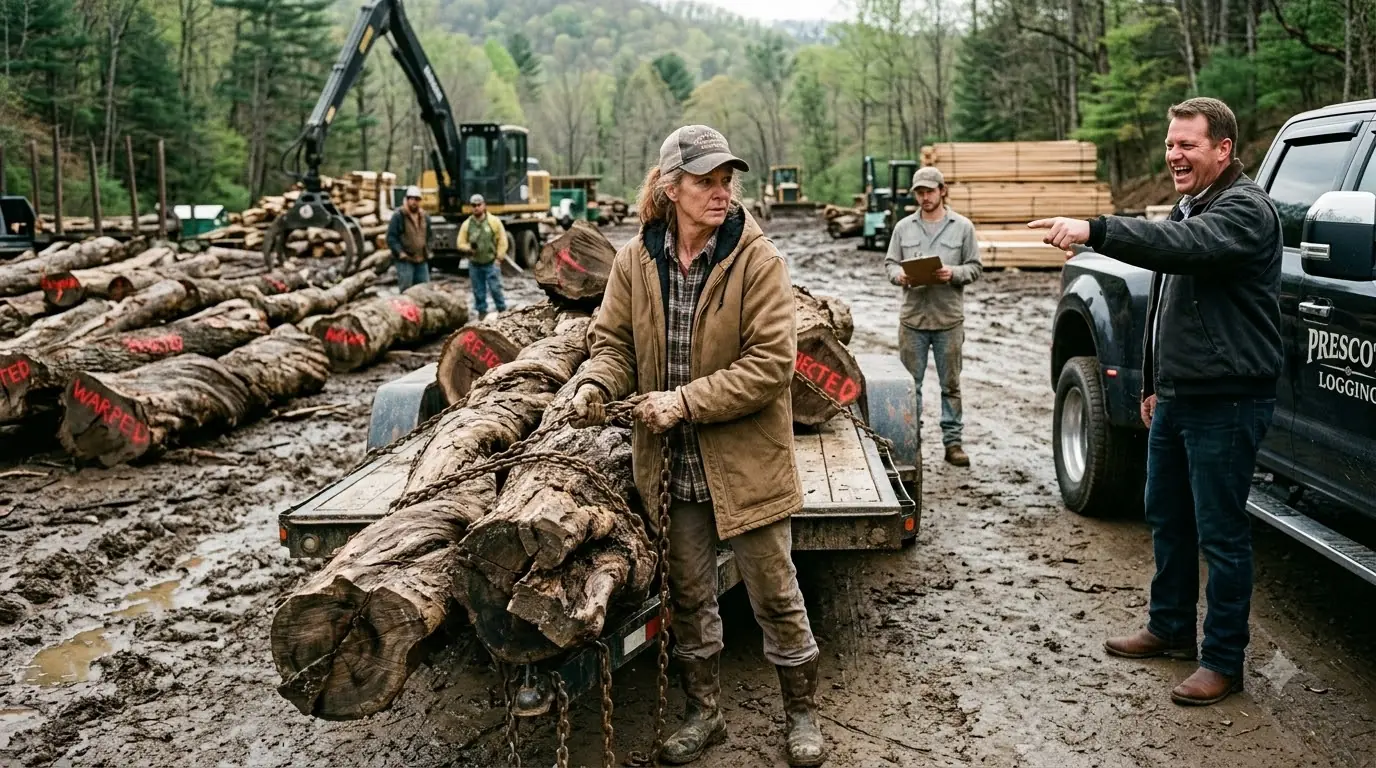
Then a woman in a canvas coat stepped over the mud, crouched beside the worst log in the row, and pressed her palm flat against the bark like she was listening to something nobody else could hear.
Colleen Ser wasn't interested in the straight timber stacked near the road where the real money was. She wanted the eleven trees the yard had already given up on, including one so badly torqued that the foreman couldn't finish his laugh before catching it in his throat.
She wrote a check that represented nearly everything left in a savings account her sister had been watching shrink for three years. Behind her, a black dually truck pulled through the gate, and the man who stepped out owned the biggest lumber operation in the county.
He looked at the twisted logs on her flatbed, looked at the woman chaining them down, and his voice carried across the entire yard before she ever turned around.
The morning after the storm, the yard at Brier Creek Timber looked like a graveyard nobody wanted to bury. Sixty-three black walnut trees, some older than the county courthouse, lay stacked in rows across the loading zone.
Each one was marked with a red slash of spray paint that meant the same thing it always meant. Not worth the blade.
Not worth the diesel.
Mud churned to soup under the loaders, thick enough to pull a boot clean off a man's foot if he stood still too long. The smell of fresh-cut walnut hung sharp over the exhaust fumes, mixing with wet bark in a way that would have turned the head of anybody who still remembered what good timber smelled like before machines took all the romance out of cutting it.
Nobody's head turned that morning. The log trucks idled past the rows without slowing.
A buyer from a flooring outfit in Greensboro drove through, rolled down his window, took one look at the twist running through the nearest trunk, and rolled it back up again. Two men from a pallet company walked halfway down the line before one of them kicked a log with his boot heel, shook his head, and turned around.
By 10:00, the only creature paying those trees any real attention was a crow sitting on top of the farthest stack, pulling at a strip of loose bark like it was unwrapping a gift nobody else wanted.
Then a quiet woman in a canvas coat stepped over that mud, laid her hand flat against one twisted trunk, and stood there long enough for the loader operator to shut off his engine just to see what she was doing.
Colleen Ser didn't look like someone who belonged in a timber yard. She was sixty-one years old, neither tall nor short, with hands that had more scars on them than most surgeons collect in a career.
Gray-streaked auburn hair was pulled back under a cap that had faded past whatever color it started as. She didn't carry a clipboard or a tape measure.
She carried a question, the kind that sounds simple enough until you try to answer it.
What happened to these?
She wasn't asking the foreman. She wasn't asking anybody standing in that yard.
She was asking the wood itself, running her palm across the bark the way a person touches the face of someone they haven't seen in a long while, checking for what changed beneath the surface.
Nobody there could have told you why a sixty-one-year-old cabinet builder would care one way or another about logs already headed for the burn pile. Nobody could have told you why she seemed more interested in the trees the mill considered the worst of the lot than in any of the straight, clean trunks stacked closest to the road where the real buyers always looked first.
Ryland Teague, the young foreman, stood six feet behind her with a clipboard balanced against his hip. He was twenty-eight years old, lean as a fence rail, with the kind of confidence that comes from knowing exactly how a sawmill works but not much else about wood beyond what a blade can do to it.
He watched her crouch beside a log thick enough to take two men to roll, pressing her thumb into a groove in the bark where the grain had spiraled so tight it looked like the tree had tried to wring itself out like a wet rag before it fell.
He caught half a laugh in his throat before it got all the way out. Not a cruel laugh, not quite.