Eliza Callaway pressed her palm flat against the cold wooden floor of the auction platform and told herself she would not cry. She had promised herself that much. They could take her dignity. They could shout her name like a curse. They could hold up the paper that listed every dead husband, every whispered accusation, every year she had spent being called something she never was.
But they would not get her tears. The auctioneer's voice carried across the whole of Redemption Creek like a church bell nobody wanted to hear. Next lot, he called out, shuffling his papers without looking up. Eliza Callaway, age 24, domestic services cook seamstress general household labor. He paused, looked at his paper, looked at the crowd.
Then he said it, "The way men say things, they want to make sure everyone remembers. Previously married twice." The murmur started in the back and rolled forward like a wave rolling in off a dry lake bed, fast, ugly, and carrying things that had no business being in the air. Black Widow, you hear that? Two husbands, both dead.
Shouldn't be surprised. Look at her. Eliza stood on that platform and stared at a point just above the heads of the crowd. She had learned to do that.
If she looked at their faces, she would see the way their mouths curved when they said those words, and she couldn't afford to feel it. Not today, not here, not with nowhere left to go after this. Her hands were clasped in front of her. Her dress was clean because she had washed it the night before in a creek 2 mi outside of town, ringing it out in the dark and draping it over a low branch to dry while she sat with her back against the bark and counted her remaining coins.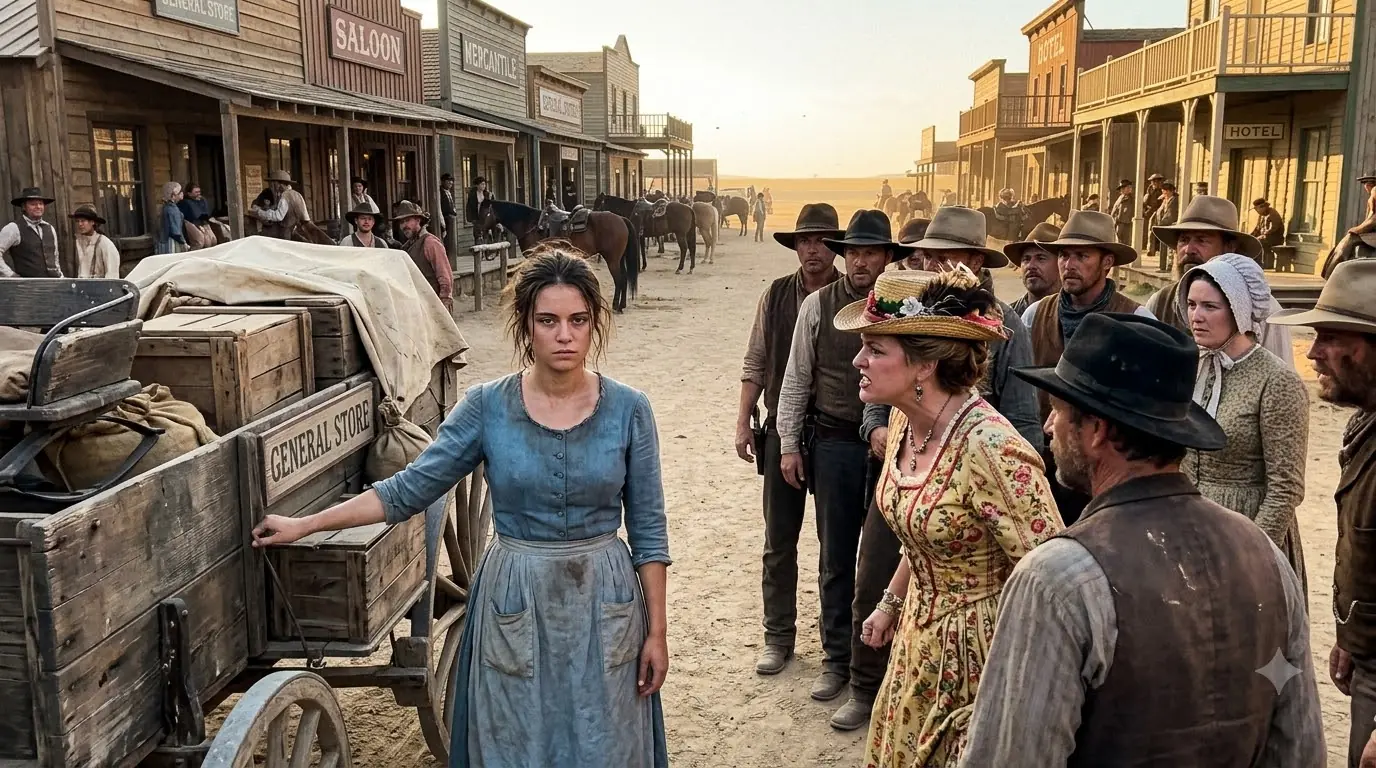
Seven cents. She had seven cents to her name, one small traveling bag, and a reputation that had followed her across three territories like a dog that wouldn't stop barking. The first husband had died of fever. She had nursed him for 6 weeks, barely sleeping, barely eating, changing his cloths every few hours through the worst of it.
The doctor had said there was nothing anyone could have done. The fever had come through the whole valley that summer. Three other men died the same week as Thomas, but Thomas was her husband, so it was different. When the second husband, a man named Gerald Whitmore, 20 years her senior, who had married her partly out of practical need, and partly she suspected, out of pity, died of a heart seizure in his sleep.
14 months into their marriage, the verdict had already been decided. The town didn't need evidence. They had a pattern. Two husbands, two dead men, one woman left standing.
The math, as far as Redemption Creek was concerned, was simple. Eliza Callaway is a curse. She had tried to argue it at first, had sat across from the Reverend's wife and explained carefully that fevers were not caused by wives, and that heart seizures struck men in their sleep, regardless of who lay beside them. The Reverend's wife had nodded in a way that meant she had already made up her mind and was merely being polite about it.
After that, Eliza stopped arguing. There was no point in fighting a verdict the jury had delivered before the trial even began. So here she was standing on a platform in the center of Redemption Creek while the summer sun pressed down on the back of her neck and the auctioneer read out her life like a list of faults. Opening bid, he said.
Domestic services 6 months guaranteed labor. Who will start at $2? Silence. Not the respectful kind, the amused kind. the kind of silence a crowd holds when they want to see what happens next because it costs them nothing and entertains them plenty.
A woman near the front leaned toward her neighbor. "Who in their right mind would take that on?" "Nobody with sense," the neighbor replied. "Not quietly." Eliza felt the heat rise up the back of her throat. She pressed her clasped hands tighter against each other and kept her eyes fixed on that point above the crowd.
Don't Don't you dare. $1, a voice called out from the far left side of the crowd. Someone laughed. Brave man, somebody muttered. Or a fool, said another.
The auctioneer wrote it down with the disinterest of a man who processed misery for a living.$1. Do I hear $1.50? More silence. Then from somewhere near the back, a different voice, quieter, lower.
The kind of voice that didn't raise itself for crowds because it had never needed to. $2. The murmur changed. Eliza didn't look. She had learned not to look at the men who bid on women at these things because looking gave them the impression that she was grateful before she'd had any reason to be.
She had seen other women make that mistake. Had watched them smile too quickly and thank too readily, only to find that the man who bought their labor considered the gratitude to be a promise. She was not making that mistake. $2. the auctioneer repeated. Do I hear $2.50?
Nobody moved. Sold. The auctioneer said with the same flat tone he'd have used to close a deal on a sack of grain. $2. Step forward and settle accounts.
Eliza finally allowed herself to breathe. She descended the platform steps carefully, her traveling bag clutched in both hands and waited at the bottom while the auctioneer handled the paperwork. She still hadn't looked at the man who bought her contract. She was looking at her shoes, practical, worn, resoled twice, and reminding herself of the agreement she had made with herself on the night she'd walked away from Redemption Creek's boarding house with no money, no references, and no options.
You will work hard. You will be useful. You will save what you can. And when the contract is up, you will leave and start somewhere new where nobody knows your name.
Ma'am, she looked up. He was tall. Not the theatrical kind of tall that demanded attention, just the kind that came from years of hard physical work in open country, the kind that built itself quietly and didn't feel the need to announce itself. Dark brown hair, sunworn at the edges.
Eyes that were a shade of blue, she might have described in another life as the color of a winter sky when the storm has just cleared. A jaw that looked like it had been set against trouble for so long, it had simply stayed that way. He was holding his hat in his hands. She noticed that immediately.
He had taken it off. Not in a grand gesture, just taken it off. The way a person does when they're speaking to someone they intend to treat with basic courtesy. Eliza hadn't experienced basic courtesy in so long that it landed on her like something she didn't quite know how to receive.
"I'm Callum Ross," he said. "I have a ranch about 12 mi north of here up in the foothills. I know who you are, she said. Then because that sounded sharper than she'd intended by reputation, you keep to yourself mostly.
That's accurate, he said. He didn't seem bothered by it. The work is hard. I've got cattle, some horses, a garden that's gone to trouble since my housekeeper left last fall.
I need someone who can cook and manage the household. I'm not, he paused, set his jaw slightly. I'm not looking for anything beyond that. The arrangement is exactly what the contract says it is.
Eliza studied him. She had learned in the last two years to read men quickly. Survival had made it necessary. She looked at the set of his shoulders straight but not rigid.
Looked at the way he held his hat, both hands turning it slightly at the brim, which meant he was aware of a social tension he wasn't entirely comfortable with. looked at his eyes, which met hers directly, and then moved aside, not with shame or evasion, but with the particular restraint of someone who has decided that staring at people is its own kind of presumption. She had met men who smiled too easily and spoke too smoothly and made grand promises in front of witnesses. "This man was doing none of that." "All right," she said. "Mr. Ross.
Callum, he said, then as if he'd surprised himself, if you prefer. She didn't answer that. She fell into step beside him as he moved toward the edge of town, and she didn't look back at the platform or the crowd or the auctioneer already calling out the next name. She was done looking back.
The wagon ride took nearly 2 hours, most of it uphill. the road, if it could be called that, wound through dry grass that had gone gold in the summer heat, threading between stands of pine and aspen that thickened as the elevation climbed. Callum Ross did not fill the silence with conversation. Eliza appreciated that more than she could say. She watched the landscape change and thought about nothing in particular, just the sound of the horses, the smell of pine sap warming in the afternoon sun.
The way the light fell differently up here, sharper, cleaner, like the air itself was better behaved than it was down in the valley where people lived too close together and convinced themselves they knew things they didn't. There's a room off the back of the main house, Callum said, breaking the quiet about an hour in. Separate entrance. It's small, but it's sound.
Yours for the duration of the contract. Thank you. There's a woman who comes from town on Thursdays. Margaret Daws.
She brings supplies. She'll bring word if anything comes up that needs attending. All right. Another long silence then.
And she didn't know what made him say it. Whether it was guilt or fairness or simply the habit of a man who didn't know how to say a thing sideways, he said, "I know what they call you." Eliza's hands tightened in her lap. She kept her eyes on the road ahead. I suspect most people in three territories know what they call me.
"I don't put much stock in what people call things," he said. "I've had enough things called wrong in my life." She looked at him then. He was watching the road. His profile was steady, unhurried, like a man saying a thing he'd thought out before he said it.
"Is that why you bid?" she asked. He was quiet for a moment. I bid because I need the help, he said, and because nobody else was going to. It wasn't the answer she'd expected.
Most men in his position would have made something heroic out of it, would have offered her a story about fairness and courage that was really a story about themselves. He had simply told her the truth. She turned back to the road. "Fair enough," she said.
The ranch sat in a wide clearing backed against a ridge of pine-covered hills, the kind of place that had been chosen deliberately by someone who understood both the beauty and the practicality of high ground. The main house was solid logs fitted close a covered porch running the full length of the front windows with real glass that had survived seasons of mountain weather. It wasn't a grand house, but it was built to last. There were two hands living in the bunkhouse. a young man named Josiah, 16, and all elbows who looked at Eliza with wide eyes when Callum introduced her, and an older hand named Rowan, who had a gray beard, and the permanent squint of a man who had spent decades reading weather.
Rowan looked at her for a long moment, then at Callum, then nodded once like something had been decided. "There's Stew on," Rowan said. "Left from yesterday. Won't be much good past tonight.
I'll make something fresh, Eliza said. Rowan raised an eyebrow. Kitchens in a state. I've seen states before.
He almost smiled. Almost. The kitchen was in fact in a considerable state. Someone, she suspected a series of reluctant someone had been managing it without any clear intention or system, which meant the stores were disorganized.
The iron pots were crusted in ways that spoke of long neglect, and the herbs that had once been hung to dry above the window had turned to dust on their strings. Eliza set her bag down, pushed up her sleeves, and went to work. She had the stove going, and the old stew cleared away inside of 20 minutes. She had sorted the stores, assessed what was usable, and started a proper broth from a bone.
She found wrapped in cloth at the back of the cold box, old but still good within the hour. She found dried beans and soaked them. Found cornmeal and mixed a quick bread that she set near the heat to rise. Found a tin of salt pork and added it to the broth along with wild onions she spotted growing just outside the kitchen door.
When Callum came back from settling the horses and pushed open the kitchen door, he stopped. She didn't look up from the pot she was stirring. "Smells different in here," he said. "The old stew had turned," she said.
"I started fresh. I was quiet for a moment. You didn't have to do all this tonight. The kitchen needed doing.
Tonight is as good as any other time." She felt him watching her. It was not the uncomfortable kind of watching. It was the kind a person does when they're trying to reconcile something they'd expected with something they're seeing instead. I'll let you finish, he said.
Supper will be ready in an hour. All right, he left. She went back to stirring. Supper was eaten mostly in silence, which suited Eliza fine.
Josiah ate three helpings and looked guilty about it each time, glancing at her like he was waiting to be told he'd taken too much. Rowan ate steadily and said nothing, which she was coming to understand was his primary means of communication. Callum ate everything on his plate and set down his fork and said, that's the best meal that's come out of this kitchen and going on 2 years. I wouldn't know about that, Eliza said.
I would. He looked at her directly. Thank you, Miss Callaway. Eliza, she said, then without knowing quite why, if you prefer.
Something shifted in his expression. Not a smile, not quite, but something adjacent to it. The ghost of something that had been alive in his face once and was considering whether it was safe to come back. Eliza, he said.
3 days into her time at the ranch, she learned about the wife. Not from Callum, from Josiah, who had the particular incontinence of tongue that belongs to 16-year-olds who don't yet understand that some silences are held for good reason. They were in the yard, Eliza mending a split in a leather work glove, and Josiah supposedly cleaning tack, but mostly talking when he said, "You know, he had a wife before." Eliza kept her eyes on the glove. "No, her name was Clara.
He paused. He couldn't. There wasn't anything to be done. Eliza said nothing.
He ain't been the same since, Josiah said in the tone of someone reporting a fact that everyone already knew. That was 7 years ago. He don't talk about it. He don't.
Another pause. He don't let people in much anymore. Rowan says it's because once you lose something like that, you start building walls so high you forget there was ever a door. Rowan said that.
She raised an eyebrow. Well, Josiah had the grace to look slightly abashed. He said something like it. I might have added a piece.
Eliza tied off the final stitch on the glove and set it aside. She thought about a man who had stopped letting people in, who had come to an auction in a hot summer town and placed a quiet bid on a woman everyone else had turned their backs on. Not out of charity, not out of heroism, but simply because nobody else was going to. She thought about walls built high enough to forget the door.
She understood that particular kind of architecture more than she could say. The trouble came on the ninth day. She had ridden into town with Rowan to collect supplies, which she did not particularly want to do, but which was necessary. The list was long, and the wagon was needed.
She had made it through the general store, without incident, had kept her eyes on her list, and her list on the shelves, and her voice low and professional when she spoke to the storekeeper, who had the decency to treat her transaction like a transaction. And she was outside loading the wagon when she heard the voice. "Well, look at that." She recognized it immediately. Virginia Hargrove, the wife of the county assessor, a woman who had made Eliza's life in Redemption Creek a particular kind of misery for the two years she'd lived there, mostly by being the type of person who believed that speaking loud enough made cruelty into truth.
Eliza kept loading the wagon, bold as brass. Virginia said to the woman beside her, Lucy Apprentice, who had the spineless quality of a person who agrees with whoever is speaking loudest. She's up at Ross' ranch now. You hear that?
God knows what she's doing up there. God knows what'll happen to him. What are you implying, Mrs. Hargrove? Eliza said she had not turned around.
I'm not implying anything, Virginia said. I'm stating plain fact. Two husbands dead. Now she's in a house with a man who's alone.
"I am employed there," Eliza said. "As a cook and housekeeper, the contract was filed with the county clerk." She placed the last supply crate in the wagon. "If you'd like to review it, you're welcome to request a copy. Don't be clever with me.
I'm not being clever." She turned then finally and looked at Virginia Hargrove directly. I'm being accurate. There's a difference. Virginia's eyes narrowed.
Women like you. Women like me, Eliza said, are finished being described by women like you. Good day, Mrs. Hargrove. She climbed up onto the wagon seat.
Her hands were shaking, but she held the rain steady. Rowan, who had been loading supplies onto the back of the wagon, with the focused indifference of a man who had seen this kind of thing before, and had decided long ago that silence was its own form of witness, climbed up beside her, and clicked his tongue at the horses. They moved. She didn't look back, but she heard Virginia Hargrove's voice carrying after them loud enough to reach the street.
Mark my words, something will happen to that man. Rowan said nothing until they were clear of town and moving back up the hill road. Then, without preamble. You did all right back there.
I didn't do anything, Eliza said. I said a few words and got in the wagon. Sometimes that's everything, he said. She thought about that for the rest of the ride.
That evening, she found Callum at the fence line east of the main house fixing a post that had been kicked loose by one of the younger horses. He was working with the focused efficiency of a man who found physical labor easier than most other things, and she stood a few feet away and waited until he looked up. There was some talk in town, she said, about me being here. He drove the post back into the ground with a single clean strike.
I expected there would be. Virginia Hargrove suggested something would happen to you. She said it plainly because she had decided long ago that the only way to carry the weight of other people's accusations was to refuse to carry them alone. On account of me being here, he set down the mallet, turned to face her.
Do you believe that? He asked. Of course not. Then I don't know that they're believing it requires anything from either of us.
She looked at him. You're not worried. I'm worried about plenty of things. He said the fence line on the north pasture weather will have enough winter feed.
The fact that the barn roof has a spot that's going to give before September if I don't get to it. He picked the mallet back up. What Virginia Hargrove thinks is not on the list. Eliza was quiet for a moment.
Mr. Ross. Callum Callum. The name felt unfamiliar in her mouth. She pressed forward.
Anyway, I want you to understand that I will not be the reason that your life becomes harder than it already is. If this arrangement becomes a problem for you, for the ranch, for your work, for your standing, Eliza, she stopped. He was looking at her with that steady, unhurried directness that she was beginning to understand was simply the way he looked at things he considered worth looking at. "I don't make decisions based on what Virginia Hargrove might say about them," he said.
"I made this decision because the ranch needed help and you needed work, and both those things are still true. That's the whole of it." She held his gaze for a moment, then nodded once. "All right," she said. All right, he agreed.
She went back toward the house. Behind her, she heard the mallet strike true clean solid, settling the post deep into the earth. Something about the sound stayed with her all the way to the kitchen door. That night, she sat at the small table in her room after the household was quiet, and she allowed herself for the first time in a long time to think about what it meant to be somewhere that nobody had yet decided what she was.
Back in Redemption Creek, she had been a verdict, walking around in a dress. Here she was, a woman who made good broth and kept a clean kitchen and fixed work gloves, and talked back to Virginia Hargrove in the street. She was not, she realized, waiting to be told what she was worth. She was simply quietly, stubbornly against every odd that had been stacked in front of her, deciding it herself.
She folded her hands on the table. Outside, the mountain wind moved through the pines. The sound of it was different up here. Not the restless hot wind of the valley.
Something older. Something that had been moving through these hills long before any of them arrived and would be moving through them long after. She listened to it for a long time. Then she blew out the lamp, and for the first time in longer than she could remember, she slept without dreaming of the things she'd lost.
The morning after the supply run, Eliza woke before first light. Not because she had to, not because anyone had told her to, but because the habit of rising early was one of the few things that had survived intact from the life she'd had before all of it. Before Thomas, before Gerald, before the platform, and the crowd, and the auctioneer reading her out like a list of failures, she built the fire, set the coffee on, and started on breakfast while the ranch was still dark and quiet around her. There was something about those early hours that she had always found useful.
The world hadn't started making demands yet. The opinions of other people hadn't yet filled up the air. It was just her and the work, and the work never once asked her what her previous husbands had died of. Josiah appeared first, as he always did.
Sleep rumpled and squinting drawn by the smell of coffee with the helpless sincerity of a boy who had not yet learned to pretend he didn't want things. He dropped into his chair at the kitchen table and wrapped both hands around the mug she slid toward him without comment. You're up early, he said. I'm always up early.
Earlier than early, I mean. He took a long drink. Sighed the sigh of someone whose entire outlook on the morning had just improved. Rowan says you were up past midnight.
Rowan says a great deal for a man who barely speaks. He notices things. Josiah said he just doesn't say them out loud most of the time. Last night was an exception.
Eliza cracked eggs into the iron pan and said nothing. He also said Josiah continued in the careful tone of someone delivering a thing they know might land badly that you handled Virginia Hargrove like a professional. Rowan doesn't use words like that. He said you handled her clean.
Josiah took another drink. I added the professional part. Eliza almost smiled. Almost.
Rowan himself appeared 10 minutes later. Sat, drank, and did not speak, which was its own form of approval. Callum came in last, having already been out to the horses. She could tell by the particular way the morning cold settled into a person's shoulders when they'd been outside for an hour before sunup.
He poured his own coffee and sat at the far end of the table and looked at the breakfast she'd set out with the expression of someone recalculating something in their head without saying what the numbers were. You don't have to do this every morning, he said. I know the contract specifies three meals a day. It doesn't specify. he gestured at the table at the eggs and the salt pork and the biscuits she'd made from the remaining morning dough and the small jar of preserves she'd found tucked at the very back of the top shelf.
Probably forgotten, probably from two summers ago, but still good. The contract specifies meals, she said. I'm making meals. I don't see the conflict.
Rowan made a sound that might have been a laugh. Callum looked at her for a moment, then looked at his coffee, then drank it. "All right," he said, and that was the whole of it. After breakfast, Josiah took the horses out to the pasture, and Rowan went to work on the north fence line, and Callum disappeared into the work of the ranch with the focused quiet of a man who was more comfortable with labor than with being in a room where someone might say something unexpected.
Eliza cleaned the kitchen, and then stood in the middle of it, and thought about what needed doing most. The answer was most things. The house had been maintained in the way that men maintain houses when they are doing it alone and under sufference, which is to say, the things that would cause immediate disaster were addressed, and everything else was allowed to accumulate until it became its own kind of disaster. The windows hadn't been properly cleaned since God knew when.
The main room had a rug that needed beating within an inch of its life. There were two chairs with loose joints that would eventually give under someone's weight, and she'd rather fix them now than have Rowan or Josiah go through one in the middle of supper. She started with the chairs. She found the glue and clamps in the small workroom off the back of the house, the same room where she'd found the mending supplies, and she worked steadily and quietly fitting the joints back together with the particular satisfaction of fixing a thing that had been broken and making it sound again.
She had always found that satisfying. Fixing things. It was one of the skills she'd acquired by necessity over the years because there had never been enough money to hire someone to fix things for her. So, she'd learned to do it herself.
She could mend leather and set a loose chair joint and pack a wound with clean cloth and bring down a fever with the right combination of herbs steeped in hot water. She could do a great many things. The people of Redemption Creek had never been particularly interested in that list. She was fitting the second clamp into place when she heard footsteps outside the workroom door.
Not the quick energy of Josiah or the steady, deliberate tread of Rowan, but something in between. She turned. Callum was standing in the doorway. He looked at the chairs, looked at the glue and clamps arranged on the workbench beside them, looked at her.
Those have been loose since last winter, he said. I noticed. I kept meaning to get to them. Most things get gotten to eventually, she said.
Or they get gotten to by someone else. He stepped into the room and looked at the work she'd done. He picked up the first chair, turned it over, examined the joint, set it back down. "Clean," he said.
"Thank you." He didn't leave immediately. He stood there with his hands in his jacket pockets and the look of a man who had come in with something on his mind and was taking the long way to it. "Virginia Hargrove's husband paid me a visit this morning," he said. Eliza set down the clamp she was holding.
"Dale Hargrove," Callum continued. Rode up the hill road just after sunrise. "Said he wanted to have a friendly conversation. His jaw moved in the way it did when the word he'd chosen was being diplomatic about what the word really was." said there was talk in town about the arrangement up here.
Said he was concerned as county assessor about whether the contract had been properly filed. Said he'd hate for there to be any irregularities. Eliza was quiet for a moment. And is the contract properly filed?
It is. I filed it myself the day before the auction. Spoke to the clerk directly. Then there are no irregularities.
No, Callum agreed. There aren't. He looked at her steadily. I told him that.
I also told him that the business of my ranch was my business and that if he rode up this road again to discuss it, he could bring something more substantive than concern. Eliza looked at him. Something had shifted in his expression. Something subtle but real.
The particular set of a man who has drawn a line and means it. He didn't like that. She said, "No, he did not. He'll make it worse probably.
Callum said, "People like that usually do when they realize they can't make you feel small." He paused. I wanted you to know because it's your name they're using, and you deserve to know when your name's being used. Eliza looked at the chair in front of her. At the joint she'd pressed back together, solid, now held in place until the glue cured.
"Thank you," she said, "for telling me." "All right," he said. He left. She stood in the workroom for a long moment after he'd gone, her hands resting on the workbench, and she thought about a man who had told her that she deserved to know things. She couldn't remember the last time someone had said that to her.
She couldn't remember the last time someone had considered it relevant. She picked up the clamp and finished the work. The week that followed was a kind of settling, not peace exactly, but something adjacent to it. a routine forming itself around the edges of the days the way a path forms when enough people walk the same stretch of ground. She cooked and cleaned and organized and fixed things and the ranch responded to it the way a neglected thing responds to steady attention slowly at first then with increasing gratitude.
Josiah began leaving his work gloves on the kitchen table in the evenings, which she understood to be his way of asking if she'd check them for wear without having to ask directly. She checked them. She repaired the ones that needed it. She left them back on the table and said nothing, and he took them in the mornings without comment, and they both understood perfectly what had happened.
Rowan, who had initially regarded her with the careful watchfulness of a man who had seen too many things go wrong, to trust anything going right, began leaving the kitchen door open when he came in for his midday meal, which meant he was no longer checking the room before he entered it. She recognized the significance of that and filed it away without remark. Callum was harder to read. He was courteous.
He was reliable. He did what he said he would do and said what he meant when he said anything at all, which was less often than other men, but more meaningfully. He thanked her for meals with the sincerity of someone who actually meant it, rather than the reflexive politeness of someone going through motions. When she mentioned that the herb patch outside the kitchen door could be salvaged if the dead growth was cleared, he came out that evening with a pair of work gloves and cleared it without being asked again.
But there was something behind all of it. Something held at a careful distance. The way a person holds something they're not sure they can afford to set down. She understood it.
She recognized the shape of it. She lived in the same shape herself. 11 days into her time at the ranch, the first real trouble arrived. She heard the horses before she heard anything else.
Too many of them moving too fast up the road with the particular urgency that meant the riders wanted to arrive before their arrival could be prepared for. She was in the kitchen when she heard it, and she moved to the window and counted four horses and four riders and recognized none of them, which meant they weren't from Redemption Creek proper. They were from somewhere else. She dried her hands on the cloth hanging from the stove handle and went to the front porch.
Callum was already there. He had come from the direction of the barn and he was standing at the foot of the porch steps with his arms at his sides and the look of a man who had recognized something and was deciding how to handle it. The riders pulled up in the yard. The one in front was dressed better than the others.
Not richly, but deliberately. the kind of dress that announces a person considers themselves to be of importance. He had a wide-brimmed hat and a smile that didn't reach his eyes, and the easy manner of a man who was accustomed to being the most powerful person in any given room. "Mr. Ross," he said. His voice was the smooth kind, the practiced kind.
"Weston," Callum said. He did not say it like a greeting. The man Weston let his eyes move to Eliza, standing just behind Callum's left shoulder on the porch step. The eyes moved over her in a way she recognized and disliked.
"Don't believe we've met," Weston said to her. "We haven't," she said. "This is Eliza Callaway," Callum said. "She manages my household." "A Callaway." Something shifted in Weston's face, just barely.
"I know that name." Most people do, Eliza said evenly. Weston's smile widened, which made it worse. I'm sure. He looked back at Callum.
I've come about the east pasture land, Ross. We've had this conversation before. We have, Callum agreed. And I've given you the same answer each time.
It's been 2 years. I thought perhaps you'd reconsidered. I haven't. Weston tilted his head.
He had the quality of a man who was used to conversations going the direction he wanted them to go and who found the alternative more puzzling than offensive. "My offer is fair." "Your offer is for land I intend to keep. Land you can barely work on your own. I'm not on my own," Callum said.
He said it with a slight tilt of his head toward the barn where Rowan had appeared in the doorway and the bunkhouse where Josiah stood in the shadow of the overhang with the look of a boy who had decided to stay very still and very present. Weston looked around the yard. Something calculated moved behind his eyes. "I heard you'd taken on some help," he said.
His gaze drifted back to Eliza from the auction in town. "That's right," Callum said. Interesting choice. Weston said it the way men like him say things that are not compliments but wear the shape of neutrality.
Given her history. Eliza stepped forward to the edge of the porch. Mr. Weston, she said. He looked at her.
If you have something to say about my history, she said, "Say it plainly. I found that people who circle around a thing are usually more afraid of it than I am." A beat of silence. Then Weston laughed short. genuine surprised out of him. "I like her," he said to Callum as if she weren't standing 6 feet away.
"She's not performing for you," Callum said. The laugh stopped. "Think about the offer, Ross," Weston said, pulling his horse around before circumstances make the thinking less comfortable. He tipped his hat at Callum, not at her, and rode back down the hill with his three riders behind him.
The yard went quiet. Josiah came out from the bunkhouse shadow. Rowan walked over from the barn. Weston.
Rowan said to nobody in particular. Weston Callum confirmed. He's been after that east pasture since you expanded the herd two years back. Rowan said he'll keep being after it.
He won't stop at asking. Rowan said it wasn't a question. No. Callum agreed.
He won't. Eliza looked at Callum. What is he? Callum was quiet for a moment.
He's a man who buys things, he said, and has a hard time with anything that won't be bought. That night, after the household was quiet and the lamps were low, Eliza found herself unable to sleep. She lay in the small room with its separate entrance and listened to the wind in the pines and thought about Weston's eyes when he'd heard her name. She had seen that look before.
It was the look of someone who had filed a piece of information away, who had looked at a tool and begun thinking about how it might be used. She got up, made herself a cup of tea, and sat at the small table, and tried to organize what she knew into something with edges she could hold on to. Weston wanted the east pasture. Callum wouldn't sell.
Weston was not the kind of man who accepted refusal. She knew that type as well as she knew the sound of her own heartbeat. And now Weston knew that Callum's household included a woman with a ruined reputation and no allies and no resources beyond a six-month contract that could, if the right kind of pressure was applied to the right kind of people, be made to look like something it wasn't. She was not afraid.
She was something else, something colder and clearer than fear. Something she recognized from the two years she'd spent in Redemption Creek. Staying one step ahead of the conclusions people had already decided to draw, she set down her cup. She would need to be careful.
Not careful in the way that meant shrinking. Careful in the way that meant paying attention. Watching which way the current was moving before she committed to which bank she was swimming for. She had survived this before.
She would survive it again. The next morning, she asked Callum about the east pasture. Not because she was entitled to the information, but because Weston's visit had made clear that her presence at the ranch was now a variable in a situation that had been in play long before she arrived, and she believed that people who shared a danger had an obligation to share what they knew of it. She told him that was why she was asking.
He looked at her for a moment with that steady attention he gave to things he was deciding about. Then he told her the east pasture was about 400 acres of high country grazing land that he'd acquired 7 years ago around the time Clara died. Though he didn't say that and she didn't ask. It was the best grazing on the mountain.
Weston had tried to buy it from him three times. The first time Callum had refused and thought that was the end of it. The second time Weston had arrived with a surveyor who claimed there was a boundary dispute, a claim that was eventually dismissed when Callum produced his deed and a witness who'd been present at the original sale. The third time Weston had arrived with a lawyer.
What did the lawyer say? Eliza asked. That my deed was irregular. Is it?
The county clerk filed it himself. I was there. Who is the county clerk? Callum looked at her.
Harold apprentice. She absorbed that. Lucy apprentice, she said. Virginia Hargrove's neighbor.
Yes. His jaw set slightly. I know. Eliza sat with that for a moment.
So Hargrove and Weston. I don't know that they're working together, Callum said carefully. I know that Hargrove is Weston's man in town in the same way I know the sky is up. I just don't have anything I could take to a court.
What would you need? He looked at her again. This time, the look had something different in it. A careful reassessment.
The kind a person makes when they realize the person they're talking to is thinking several moves ahead rather than just listening. Something in writing, he said. Something that shows the connection between the deed challenge and Weston's offer. People like Weston put things in writing.
Eliza said they can't help it. They're too used to everything going their way to worry about what happens when it doesn't. Callum was quiet for a moment. That's an interesting thing to know.
He said, "I was married to Gerald Whitmore for 14 months." She said, "Gerald Whitmore was a land speculator. I know how men like Weston think because I watched one of them do it up close. She met his eyes directly. I also know where they make mistakes.
Something shifted in the air between them. It was the particular shift that happens when two people who have been moving through the same space suddenly find themselves facing the same direction. "All right," Callum said. "All right," she agreed.
She was clearing the supper dishes that evening when Josiah came into the kitchen with the look of someone carrying something they weren't sure they should be carrying. "There's a man outside," he said. "At the edge of the tree line. Been there since afternoon." Eliza sat down the dish.
Did you tell Callum? He's out at the north fence. Rowan's with him. All right.
She moved toward the door. Stay in the house. You're not going out there. I'm going to the porch, she said.
I'm not going to the tree line. She stepped out onto the front porch and stood in the last of the evening light and looked toward the tree line. It took her eyes a moment to find him a figure at the edge of the pines, not hiding exactly, but not announcing himself either. just present watching. She stood and looked at him without moving for a long count.
Then she turned and went back inside and told Josiah to go get Callum. By the time Callum came back to the house, the figure was gone. But she had seen his horse tethered at the far end of the tree line, and she had seen the particular cut of the man's jacket. Not a working man's jacket, not the kind that accumulated dust and wear, but a town jacket worn by someone who didn't usually spend their evenings in tree lines.
She described it to Callum. His expression didn't change much. But his jaw did that thing it did. That's Weston's man, he said.
Crane, he runs errands for him. He was watching the house, she said. Yes. That's not a conversation.
That's something else. Yes, Callum said again. The word sat between them, and neither of them tried to fill the space around it because they both understood what it meant, and both of them had already known in different ways that this was the shape the next few weeks were going to take. I won't leave, she said.
He looked at her. I want you to know that, she said. In case you were going to suggest it, in case you were going to tell me that for my own safety or for the sake of the ranch's peace or for any other reason that sounds reasonable, but is really just about making the problem go away. I won't leave.
I made a contract and I will honor it. He was quiet for a long moment. I wasn't going to suggest it, he said. She held his gaze.
Good. But I want you to know, he said, that if it becomes genuinely dangerous, then we'll handle that when we get to it. She said it with the particular finality of a woman who has made her decision and sealed it. Together, he looked at her for a moment with an expression she couldn't entirely read.
Not because it was unclear, but because it was too many things at once. Something that might have been relief. Something that might have been something else quieter and more careful that he wasn't ready to name yet. All right, he said.
All right. That night, she lay awake again, but for different reasons. She was thinking about the word he'd used. The one he hadn't corrected when she'd said it together.
It was a word she hadn't applied to herself in years. Not really. Not in the way it meant something. She had been with Thomas, but she had always felt in some essential way that the two of them were moving through adjacent lives rather than a shared one.
Thomas had been kind but remote, and she had understood even then that she was performing a version of herself that fit into the shape he needed rather than simply being who she was. Gerald had needed her practically concretely. But that wasn't the same thing. Together, the way Callum had received it without flinching, without qualification, as if it were simply a fact they had both arrived at and were now acknowledging was something she didn't quite have a category for.
She was 30 days into a six-month contract. She reminded herself of that. She pressed the reminder down firmly into the part of herself that was already against every one of her better instincts, beginning to feel the edges of something she hadn't felt in a very long time. The trouble was that the reminder felt less solid than it had 10 days ago.
The trouble was that solid things had a way of getting less solid when you were around someone who treated you like you were worth holding ground for. She closed her eyes. Outside, the wind moved through the pines the way it always did up here, old and steady, and indifferent to the small lives moving below it. She would be careful.
She would be practical. She would honor the contract, do the work, keep her eyes open, and not make the mistake of building something in her heart. On ground she hadn't yet tested the weight of. She made herself believe that.
She almost convinced herself it was true. Three days later, a letter arrived with the Thursday supplies. Margaret Daws, the woman from town who brought the weekly order, handed it to Eliza with the careful blankness of someone who had read the return address and decided not to have feelings about it publicly. The return address was the county assessor's office addressed to Callum Ross.
Eliza set it on the table and told herself it was not her business. She told herself that twice more before Callum came in and picked it up and opened it and read it. She knew from the quality of the silence that followed that the contents were not good. "What is it?" she asked.
He set the letter down on the table. She moved closer and read it. The county assessor, Dale Hargrove, was notifying Callum Ross that a formal inquiry had been opened into the boundary delineation of the east pasture as defined in his filed deed on grounds of a potential clerical irregularity in the original filing. The inquiry would require Ross to present the original deed documents along with any supporting witness testimony to the county offices within 30 days.
If no response was received within 30 days, the county would proceed with its own assessment of the boundary in question. Eliza read it twice. Then she looked up at Callum. This is Weston, she said.
Yes, Hargrove is doing it for him. Yes. She thought about Gerald Whitmore and the way he had talked about county assessors and their particular utility to men who understood how paperwork could be made to become something other than what it originally was. The original deed, she said.
Do you have it? Filed with the county. Not a copy. The original.
He was quiet. Callum. I had it. He said, "I had it here.
Filed it and kept the original." He looked at the shelf where he kept the ranch papers. It was there last fall. She looked at the shelf. She looked at him.
When did Hargrove's man last come to the ranch? She asked. He thought about it. His jaw set.
October, he said. On what pretext? A routine property assessment. The words came out with the particular flatness of a man who had just understood something he wished he hadn't needed to understand.
I let him into the office. The kitchen was very quiet. Outside, Josiah was calling to one of the horses, his voice bright and unconcerned in the summer afternoon. "We need to find the original," Eliza said.
"Or we need to find something that substitutes for it." "In 30 days. In 30 days," she confirmed. She looked at him. "Tell me everything you remember about the original sale.
Who was present? Who witnessed it? Where it was filed? Every name." He looked at her for a long moment.
Why? He said, not suspiciously. More like the question of a man who has been managing things alone for so long. He genuinely needs to understand what it means when someone offers to stand beside him.
Because Weston used my reputation to make his move, she said. Because he thought bringing me into this picture would give him leverage. Because he looked at me and saw a liability. She held his gaze.
I intend to make him understand what a mistake that was. The silence between them held for a moment. Then Callum Ross did something she had not seen him do in the 32 days she had been at the ranch. He sat down at the table.
He folded his hands and he started talking. Callum talked for 2 hours. That was the thing she hadn't expected. Not the information, though the information was considerable, but the talking itself, the fact of it, the way it came out of him slowly at first, like water from a source that had been damned so long, it had nearly forgotten what it was for, and then steadily, with increasing assurance, as if the act of someone listening, had reminded him that speech was something he was capable of.
He told her about the original land purchase. The seller had been a man named Arthur Beal, who had ranched the east pasture land for 15 years before his age, caught up with his ambition, and he decided to sell up and move south to be near his daughter. The sale had been conducted in the county offices with Harold Apprentice as the filing clerk. The same Harold Apprentice, whose wife, Lucy, had stood beside Virginia Hargrove in the street and said nothing while Virginia said everything.
The witnesses at the signing had been Rowan, who had been with Callum since before Clara, and a lawyer named Henry Marsh, who had since moved his practice to Helena. Eliza wrote every name down on a piece of paper she found in the kitchen drawer. She wrote them carefully in the order Callum gave them, because order mattered with things like this. The sequence of who knew what and when was the difference between a story that held together and one that could be picked apart.
Arthur Beal, she said. Is he still alive? I don't know. Rowan was a witness.
Yes. Then Rowan's testimony is part of your documentation. She looked at the list. Henry Marsh and Helena.
That's two days ride. I know. Someone needs to go. Callum looked at her.
Someone does. Not you. She said you need to be here. Weston's man has been watching the property.
If you leave, they'll interpret it as weakness or opportunity, and I don't think we can afford either right now. He studied her for a moment. You've thought this through. I've been thinking it through since the letter arrived.
She set the pencil down. Gerald Whitmore used to say that in a land dispute, the first side to panic always loses. He said it because he was usually the one manufacturing the reasons for the other side to panic. smart man. In certain ways, she looked at the paper in front of her.
In other ways, deeply foolish. She didn't elaborate. He didn't ask. Rowan, he said finally.
I can send Rowan to Helena. Can you trust him to talk to Marsh directly to explain what's needed? I'd trust Rowan with my life, Callum said without hesitation. the way people say things that are true in the most uncomplicated sense. Then send him in the morning, she said.
And write to Arthur Beal. You must know the last town where he settled. Tucson or near it. I had a letter from him two years back.
Write to him tonight. I'll draft it if you want. Explain the situation plainly and ask if he still has any record of the original transaction, a copy of the deed, a receipt, anything with both signatures. If Hargrove's man took your original, they didn't necessarily reach Beal.
Callum was quiet. This is your ranch, she said because she suddenly felt the need to say it to be clear that she understood where she stood in this. I know that I'm not I'm not overstepping my place here. I'm just You're not, he said, overstepping.
He said it quietly without the shape of a man making a concession. Just a statement of fact. I asked you to help me run this household. A household with a deed problem is a household that needs help with the deed problem.
She looked at him. All right, she said. She drafted the letter to Arthur Beal that night, sitting at the kitchen table with the lamp turned up full. She wrote it in plain language.
No legal flourishes, no excessive explanation, just the facts of the situation laid out clearly with a specific and reasonable ask at the end. She read it back to herself twice, adjusted two sentences, and left it on the table for Callum to review and sign in the morning. Then she sat back and looked at the list of names, and thought about Harold Apprentice. Apprentice was the weak point.
She could feel it the way you feel a loose board under your foot before you hear the creek. Some instinct compounded from experience, telling you that this particular piece won't hold. He was Virginia Hargrove's neighbor's husband, which meant he was adjacent to the social architecture that had made Eliza's life in Redemption Creek miserable. But adjacency wasn't the same as loyalty.
Men like Apprentice were loyal to whoever was standing closest to them when the pressure came and the pressure was about to come. She folded the letter, blew out the lamp, and went to bed. Rowan left before sunup. Callum found her in the kitchen and told her so with the brevity of a man confirming a plan already agreed to.
She handed him the letter. He read it once, then looked up. Good, he said. I may have been direct.
Direct is good. He signed it, folded it, and put it in his jacket. I'll post it from town when I go for the fence supplies. I'll come with you, he looked at her.
I know what you're thinking, she said. And I'm going to say what I said before. I'm not staying home because the town makes me uncomfortable. That only teaches the town that making me uncomfortable works.
A beat of silence. All right, he said. She had expected at least mild resistance. The absence of it landed somewhere in her chest in a way she elected not to examine too closely.
The ride into town was quieter than the previous one. A different kind of quiet than their usual silences, which had the texture of two people who were comfortable enough not to fill air for the sake of it. This was the quiet of two people moving toward something and both knowing it. They posted the letter first.
Then Callum went to the hardware for fence supplies and Eliza went to the general store with the week's list. the storekeeper, a man named Aldis Burke, who had the permanently startled expression of someone who had witnessed too many scenes in his own establishment to find any of them remarkable anymore, served her with the flat efficiency of commerce. She was on the last item of her order when the door opened, and Harold Apprentice walked in. Eliza had only seen Apprentice from a distance before at the auction platform, and once in the street when she'd been with Rowan. Up close, he was a smaller man than she'd expected.
Not physically, he was of average height and build, but in the particular way of men who have spent their lives in proximity to larger forces, and have compensated by becoming very careful about where they stood. He saw her immediately. His eyes did the thing eyes do when people recognize someone they'd prefer not to have to deal with in public. She looked at him directly.
"Mr. Apprentice," she said. He hesitated then because there was no escape route that wouldn't require obvious effort. Miss Callaway, "I'm glad to see you," she said. She said it as if she meant it, which she did, though not for the reason he might have hoped.
"I've been wanting to ask you something." Aldis Burke had gone very still behind the counter. This was Eliza suspected because he was the kind of man who found other people's difficult moments very interesting, as long as he wasn't in them. I'm rather in a hurry, Apprentice said. Of course, she didn't move.
7 years ago, you filed a deed for Callum Ross' East Pasture. Do you recall that? Apprentice's expression went through three small changes in rapid succession. First, calculation.
Second decision. Third, the particular blankness of a man who has decided to know nothing. I file a great many deeds, he said. I don't recall the specifics of each one.
That particular one had two witnesses, Rowan Algate and a lawyer named Henry Marsh. She watched his face. I imagine those names might refresh your memory. I've told you I don't.
A copy of that deed has gone missing from Mr. Ross's records. She said the county assessor has opened an inquiry which I imagine you know since the letter came from his office. She kept her voice pleasant and her posture easy. Mr. Ross will be presenting his documentation within the 30-day window.
Given that you were the filing clerk of record, your testimony may be relevant to that process. Apprentice's jaw worked. I don't know what you're implying, he said. I'm not implying anything, she said.
I'm informing you the way one professional informs another. She picked up her supply basket. Good day, Mr. Apprentice. She walked out of the store.
She made it halfway down the board sidewalk before her hands started shaking. She pressed them flat against the sides of her skirt and kept walking. She had learned to do to keep moving through the shaking to not let anyone see that the steadiness she projected on the outside was something she had to actively maintain rather than simply possess. Callum was loading the fence supplies onto the wagon when she reached him.
He took one look at her face. What happened? Nothing bad, she said. I spoke to Apprentice.
He went very still. I didn't threaten him, she said quickly. I just made sure he understood that his name was part of the record. That if the inquiry proceeds, he'll be asked to account for what he filed and what he knows about what happened to the original.
Callum was quiet for a moment. You rattled him. I intended to. He'll go to Hargrove.
I know. and Hargrove will go to Weston. I know that too. She looked at him. They'll move faster now, but they'll also move less carefully, and people who move fast and careless make mistakes.
He studied her for a long moment. Gerald Whitmore again, he said. Partly, she said, partly just experience. He climbed up onto the wagon seat and offered her his hand.
She took it and climbed up, and neither of them mentioned the fact that it was the first time they'd touched, and that neither of them had hesitated. The wagon moved. Eliza watched the town recede behind them, and thought about Apprentice's face, and the three small changes that had moved across it, and thought that she had read the second one correctly, the decision, and that what he'd decided was not what Weston would want him to decide. She thought she was right about that.
She was almost sure. The certainty cracked 4 days later when Virginia Hargrove arrived at the ranch. She didn't come with riders. She came alone in a small trap driven by a young man who stayed with the horse while Virginia walked up the porch steps with the purposeful stride of someone who has been building toward a thing for long enough that doing it feels like relief.
Eliza was on the porch when she arrived. She had come outside to beat the kitchen rug which she had thrown over the porch railing. And she was mid swing when she heard the trap coming up the road. and she lowered the beater and watched Virginia climb down and walked toward the house. She didn't go inside.
She didn't call for Callum. She set the rug beater against the railing and stood and waited. Virginia stopped at the foot of the porch steps. For a moment, neither of them spoke.
It was the first time Eliza had seen Virginia Hargrove up close enough to read her face without the buffer of a crowd or a moving wagon. And what she saw there was not quite what she'd expected. She'd expected cold satisfaction, the kind Virginia had worn in the street that day. What she saw instead was something more complicated, something that might in a different arrangement of the same features have been called afraid.
Mrs. Hargrove, Eliza said, Miss Callaway, Virginia's voice was controlled, practiced. I'd like to speak with you privately. Mr. Ross's ranch is Mr. Ross's property," Eliza said. "Any conversation you have here, you have with his knowledge.
I'll let him know you're here." "I'd rather," but Eliza had already turned and opened the front door and said into the house. "Callum, Mrs. Hargrove is here. She'd like a word." She heard the pause before his footsteps. Heard the particular quality of a silence that was brief but full of meaning.
Then the footsteps measured and unhurried, and Callum appeared in the doorway behind her. He looked at Virginia with the expression of a man who has been patient with something for a long time and has not run out of patience yet, but is aware that the supply is finite. Virginia, he said, Callum. She looked between them, adjusted something in herself.
I'll say this plainly. My husband's involvement in the inquiry. It wasn't my idea. Silence.
I know, she continued. That you have no reason to believe me, but Dale has been. Weston has a hold on him that I don't fully understand and have not been able to change. She pressed her mouth together.
The deed that was taken. Harold Apprentice took it, but he didn't act on his own. Dale told him to. Eliza felt something shift inside her.
She kept her face still. Why are you telling us this? Callum asked. Because Harold Apprentice came to my house last night in a considerable state, Virginia said.
Because he told my husband that the woman at your ranch had cornered him in Burke's store and made it clear that his name was in the record and that he'd be accountable for what he knew. She looked at Eliza directly. He was frightened, Miss Callaway. You frightened him.
I informed him, Eliza said, of facts. It amounts to the same thing for a man who's been doing things he shouldn't. Virginia held her gaze. There was something in it that wasn't hostility anymore, wasn't warmth either, wasn't anywhere near warmth, but was something less simple than either.
Apprentice wants out. He's told my husband he won't go any further with this. Dale is, she stopped. Dale is not handling that well.
What does that mean for the deed? Callum asked. Apprentice knows where it is, Virginia said. He took it from your office during the October assessment.
Weston told Dale to have it retrieved and Dale told Apprentice. It's been in Apprentice's safe since October. She paused. He'll give it back.
He told my husband last night that he wants it out of his house before this goes any further. The porch was very quiet. Josiah had appeared from the direction of the barn and was standing at a respectful distance, clearly uncertain whether to approach or retreat. Eliza looked at Callum.
His face had the quality of a man receiving information that confirmed what he'd already understood, but that still required a moment to settle into the full shape of what it meant. I'll need that in writing, he said. Apprentice's account of how it came to be in his possession. Not just the deed returned, the full account.
Virginia nodded. I thought you'd say that. She reached into the small bag she carried and produced a folded paper. He wrote it last night.
My husband doesn't know. She held it out. Callum came down the porch steps and took it, read it, handed it to Eliza without comment, which meant she understood that he trusted her reading of it as much as his own. She read it.
It was a full account. Names, dates, instructions given. Dale Hargrove's name appeared three times. Weston's name appeared twice.
"This is enough," she said quietly. to Callum, not to Virginia. I know, he said. Virginia was watching her. Miss Callaway.
She said it with a different quality than she'd used before. Not different enough to undo 2 years of damage, but different in the particular way of someone who is acknowledging for the first time that they might have made a significant error. I said things about you in town. I said them loudly and I said them often.
Eliza looked at her. Yes, she said. You did. I Virginia stopped.
Her face moved through something difficult. I don't know that I can explain it in a way that makes it anything other than what it was. No, Eliza agreed. I don't think you can.
The silence between them was not comfortable, but it was honest, which was more than most silences they might have managed. Thank you, Callum said to Virginia, for bringing this. Virginia nodded once, turned, walked back to the trap, climbed in, and the young driver turned the horse back down the road. They stood on the porch and watched her go.
Then Josiah, who could apparently no longer contain himself, said from across the yard, "Was that Virginia Hargrove?" "It was," Eliza said. "What did she want?" Eliza looked at the paper in her hand. apprentice's careful, frightened handwriting covering half the page. She wanted to make something right, she said. Partly.
What's the other part? She wanted to make sure she was on the correct side of it before it finished. Josiah absorbed that. Is that enough?
Eliza thought about it. Today it is, she said. The paper went into the ranch's document box along with the letter from Helena, which had arrived the previous day. Henry Marsh, now a senior partner in a Helena law firm, which meant he was precisely the kind of witness whose testimony carried weight, had written a careful, detailed letter confirming every aspect of the original transaction.
He had offered in the final paragraph to provide sworn testimony if matter required it. The matter was going to require it, but that was the next step. The current step arrived 3 days later in the form of Weston himself. He didn't come alone this time.
He came with four riders and a man in a town suit who was introduced as his legal representative. A man named Collier who had the professional pleasantness of a shark that has learned to smile with its mouth closed. Eliza was in the kitchen when they arrived. She knew because she heard the horses and because Josiah came through the back door at a near run and said very quietly and with the commendable composure of a boy who was learning fast, "Weston, four riders and a lawyer." She wiped her hands.
Where's Callum? Came out of the barn when he heard them. "Go stand with him," she said. "Don't speak unless spoken to.
If Weston's man speaks to you, you don't know anything about anything." "Clear, clear," Josiah said and went. She gave it 2 minutes. Then she took off her kitchen apron, smoothed her dress, picked up the document box, and walked out the front door. Weston was on his horse in the yard.
Callum was standing at the foot of the porch steps. Collier had dismounted and was presenting a paper which Callum was reading with the stillness of a man who does not want whoever he's reading in front of to know how the reading is going. Eliza came down the steps and stood beside him. Weston's eyes went to her immediately, then to the box in her hands.
A calculation moved across his face. Quick practiced almost invisible almost. She had spent 14 months watching a land speculator's face. She could read that calculation as easily as block print.
Miss Callaway, Weston said pleasantly. I'd hoped you might have moved on by now. I have a contract, she said. I honor my contracts.
Commendable. He looked at the box again. What's in the box? Documents, she said.
What sort of documents? The sort that pertain to Mr. Ross' legal interests. Collier looked at the box too now with the particular attentiveness of a lawyer who has just encountered an unexpected variable. Callum finished reading the paper.
He looked up at Collier. This is a formal challenge to the east pasture boundary, he said. Filed through the county assessor's office. Filed 2 days ago, Collier confirmed.
I understand you've been notified of the inquiry. I have. Callum folded the paper. I've also been notified that the document your client's associates removed from my property last October has been recovered along with a written account of the circumstances of its removal.
He said it with the same flat tone he used for everything, which made it sound worse somehow than if he'd said it with anger. Harold Apprentice's signed account, naming the individuals who instructed him. Collier went very still. Weston did not go still.
He was too good for that. But something shifted in his posture. A micro adjustment. A rebalancing.
The kind of thing that happens when a man who is accustomed to controlling the shape of a situation realizes that someone else has been reshaping it while he wasn't watching. That's a serious allegation, Collier said carefully. It's not an allegation, Eliza said. It's a documented account.
There's a distinction. Collier looked at her. and a letter from Henry Marsh. She continued, confirming the original transaction in detail. You may know Mr. Marsh.
He's quite senior in the Helena Bar. She looked at Weston. He's offered to provide sworn testimony. Weston looked at her for a long moment.
She held his gaze without moving. He had looked at her in the street that first day at the auction and decided she was a liability. a weight around a man's neck. A story that could be pointed at and used. She could see the moment he revised that assessment.
It landed without drama. Just a shift in the quality of his attention. Like a man quietly putting down a tool, he's realized won't cut what he wanted it to cut. This ranch isn't worth this level of trouble, Callum said.
He said it quietly, which somehow made it louder than a raised voice would have. You know that the east pasture is good land, but it's not extraordinary land. You came after it because you thought it would be easy. He looked at Weston directly.
It's not. Weston was quiet for a moment. I misjudged the situation, he said. He said at the way men like him say things they've been forced to admit with a kind of precise neutrality that isn't quite grace, but isn't quite defiance either.
You misjudged several things, Callum said. I'd like to withdraw the formal challenge, Weston said to Collier. Collier blinked. Mr. Weston, withdraw it.
His voice didn't change. Today, Collier's jaw moved. He nodded once. Weston looked at Eliza.
Your formidable Miss Callaway, he said. It wasn't a compliment exactly, but it was accurate, and he knew she knew it, and they understood each other on that point. with the cleareyed mutual recognition of two people who have just tested each other and gotten a useful answer. I'm thorough, she said. There's a difference.
Weston pulled his horse around. He rode down the hill without looking back. Collier gathered his papers with the stiff dignity of a man who has been wrong about a case from the beginning, and nose it mounted and followed. The yard went quiet.
Josiah let out a breath that sounded like it had been held since the riders arrived. Rowan, who had come back from Helena the previous day and had been standing at the barn door throughout the entire exchange with his arms crossed and his usual expression of watchful silence, walked over. "Done," he said. "The formal challenge will be withdrawn today," Callum said.
Hargrove still has to answer for the deed removal. That's a separate matter, Eliza said, and a longer one, but Apprentice's statement is enough to open it. Rowan looked at her, looked at Callum, looked at the document box. "Good work," he said.
It was from Rowan the equivalent of a standing ovation. She almost smiled. That evening after supper, Callum sat at the kitchen table long after Josiah and Rowan had turned in and Eliza sat across from him because she was not tired and because the day had left a particular kind of energy in her that needed somewhere to go before she could sleep. She had expected him to be relieved.
He was she could see that there was something looser in his posture than there had been in weeks. The relief of a man who has been braced against something and can now cautiously unbrace. But there was something else in his face, too. Something she recognized and hadn't expected to see there tonight.
You're thinking about Clara, she said. He looked at her. It was too direct. She knew it the moment it came out of her.
She had meant to be careful, and she had been careful all day. And then, in the quiet of the evening, with the lamp low and the ranch settling into its night sounds around them, she had not been careful. "I'm sorry," she said. That's I shouldn't have.
No, he said you're right. She waited. He looked at the table at his hands which he had flattened on the surface in front of him in the way he did when he was deciding something. She would have liked you, he said.
That's the thing. She would have Clara liked people who were straight with her, who didn't trim the truth to fit a shape she wanted. He was quiet for a moment. She was like that herself, straight as a fence post.
She sounds like she was remarkable. Eliza said she was. He didn't say it with the hollow performance of grief. He said it the way people say things that are simply true.
She was also, "It took me a long time to understand this. She would have hated me spending 7 years not letting anyone in." He paused. She had a temper. I would have heard about it.
Eliza's mouth moved. She couldn't quite stop it. It wasn't a full smile, but it was the shape of one. "She sounds like she would have been worth arguing with," she said.
"She was," he said. Something in his voice had changed. Something had eased like a door opened in a room that has been closed a long time and needed air. "She really was." They sat in that quiet for a moment.
Outside, the mountain wind moved through the pines. the way it always did, old and steady and particular to this elevation, to this piece of the world that Callum Ross had built his life on and nearly lost and now had back. Eliza, he said. Yes. He looked at her directly.
When the contract ends, he stopped, recalibrated, started again. I want you to know that the ranch that what you've done here. He stopped again. She waited.
He was not a man who said things easily. She had understood that from the beginning. But she had also understood over these weeks that when he said things, he had already meant them for a long time before the words arrived. I don't want you to leave, he said.
The kitchen was very quiet. She looked at him at the particular quality of his face in the lamplight. Not young, not trying to be carrying every year of the life he'd lived in the set of it. a face she had been reading for weeks and was beginning to understand in the way you understand a language when you've lived inside it long enough. I'm not planning on it, she said.
He looked at her. Not because of the contract, she said. I mean beyond the contract. I'm not I don't want to leave either.
The silence that followed was not empty. It was the kind of silence that holds more than words could carry the kind that two people sit inside together when they have both said the most honest thing they know how to say and there is nothing left to add that wouldn't diminish it. Then Josiah appeared in the kitchen doorway in his socks squinting holding an empty cup and said is there any coffee left or oh sorry he retreated immediately. Eliza pressed her hand over her mouth.
Callum put his head down. His shoulders moved. She had not heard him laugh before. Not really.
Not like this the way it came out of him now. Helpless and genuine. The kind of laugh that surprises even the person it comes from. It changed his face completely.
Made him look like someone 10 years younger and 10 miles closer to the surface of himself. She was laughing too quietly into her hand, but laughing. When they stopped, the kitchen felt different, like something had shifted in it permanently. Some arrangement of the air that would not go back to what it had been before.
She stood and started clearing the cups. "Good night," she said. "Good night, Eliza." She walked to the back room. She lay down in the dark and listened to the wind and to the sound of her own heartbeat, which was steadier than she'd expected, but carrying something new in its rhythm. some additional weight that was not heavy.
That was in fact the opposite of heavy. The way a thing feels when you've been holding your arms out for a long time to balance against emptiness and someone steps up beside you and the emptiness becomes something else entirely. She pressed her palm flat against the wall beside her bed. Solid logs built to last.
She thought about what Josiah had said weeks ago, repeating Rowan's words. Once you lose something like that, you start building walls so high you forget there was ever a door. She thought about a man at a kitchen table talking about his wife with the voice of someone who had finally found the door again. She thought about the laugh that had changed his face.
She thought, "I have 41 days left on this contract." Then she thought, "I am not going anywhere." She meant it in every direction she could mean it in. And for the first time since the platform in Redemption Creek, that felt like something she had chosen rather than something that had simply happened to her. She closed her eyes. She slept.
The 41 days became 30, then 20, then 10. Eliza stopped counting somewhere around the two week mark, which told her something she chose not to examine directly, but which she felt in the way she moved through the ranch. less like a woman marking time and more like a woman who had stopped marking it because the place had become something she measured herself against rather than something she measured her remaining days within. The formal withdrawal of Weston's land challenge came through the county office on a Tuesday. Harold Apprentice resigned his clerk position 3 days later, which was not a surprise.
Dale Hargrove was facing a separate inquiry into the deed removal. A slower, more complicated process, but one that Henry Marsh had agreed to support from Helena with the particular enthusiasm of a lawyer who recognizes a clean case when he sees one. The ranch breathed differently after that. Even Rowan, who breathed the same way in all circumstances, seemed somehow less braced.
The contract had 12 days left when Callum found her in the herb garden. She had been out there most of the morning, working the late summer growth into a shape that would survive the first cold snap, which she could feel building at the edges of the air. Not here yet, but coming the way things that are going to matter, always announced themselves slightly before they arrive. She had replanted two of the beds, entirely cleared the dead growth from the third, and was on her knees in the fourth when she heard him come up behind her.
She knew his footsteps by now. She knew the particular cadence of them, the way they were deliberate without being heavy. The step of a man who was always aware of where he was putting his weight. "I need to talk to you about some," he said.
She sat back on her heels, brushed the dirt from her hands. "All right," she said. He was quiet for a moment with the quality of someone who has been preparing what they're going to say and has now discovered that the preparation hasn't made the saying of it any easier. I spoke to the lawyer, he said.
Marsh, he's coming down from Helena next week. I know. He wrote to confirm. He's coming to handle the Hargrove matter, Callum said.
And I asked him to handle something else while he's here. She waited. I asked him to draw up a new contract, Callum said. Not an employment contract.
He paused. His jaw did the thing it did. A different kind. The herb garden was very quiet. a different kind of contract.
She understood what he meant. She understood it completely and immediately. And the understanding landed in her with a clarity that was both simpler and more complicated than she'd expected because she had told herself had told herself carefully and regularly and with considerable discipline over the last 6 weeks that she was not going to want this. that she was going to be practical and cleareyed and was not going to mistake the warmth of being treated with basic human dignity for something larger. She had failed that discipline comprehensively.
Callum, she said, I know, he said. He said it the way he said most things straight without decoration. I know what people will say. I know what the town will say.
I know. He stopped. I know your history with what people say. It's not the town," she said.
"Then what is it?" She looked at her hands at the dirt under her fingernails, which she'd grown accustomed to without noticing when that happened. She thought about how to say the things she needed to say honestly, and without either cruelty or softening that would make it dishonest. "I've been a wife twice," she said. "Both times I came into it with very little and was told implicitly by the shape of the arrangement that I should be grateful for the stability of it.
Both times the arrangement was was built on what I could do for someone, not on. She stopped, tried again. I need to know this isn't that. He was quiet.
I need to know, she said, that you're not asking me because the ranch runs better with me in it because it does and we both know it. And that's not that can't be the reason. That's not the reason, he said. Then tell me what is.
He crouched down beside her in the herb garden. So they were at the same level because he was she had come to understand a man who did not like to speak down to people in any sense of the phrase. The day after Weston rode away. He said, "I went out to fix the section of north fence that Rowan and I had left half done.
And I was out there for 2 hours and the whole time I was out there, I was he paused, searched. I kept thinking about things I wanted to tell you. Not important things, just observations, things I'd noticed. And I realized that for seven years I had thoughts like that and nowhere to put them and now I had somewhere and that the somewhere was you.
He looked at her directly. That's the reason. The herb garden held that for a moment. She looked at him at his face which was not performing anything, not patience, not hope, not the particular controlled anxiety of a man waiting for an answer he wants.
He was just there, present and steady and honest in the way he was honest about everything else which was completely. I'm going to say yes, she said. I want you to know it's a real yes, not a grateful yes, not a practical yes. She held his gaze, a real one.
He let out a breath. It was a small thing, but she felt the weight of it. Seven years of held breath releasing itself one careful measure at a time. All right, he said.
All right, she agreed. He offered her his hand to help her up from the ground. She took it, and when she was standing, they were very close together, and neither of them moved away. Eliza, he said.
"Yes." He reached up and removed a small piece of dried herb from her hair. "Set it aside." His hand came to rest briefly at the side of her face, the lightest possible contact, just the edge of his palm against her cheek. the touch of a man who is making an enormous decision very quietly. "Thank you," he said. "For staying." "I told you I would," she said.
"I know. I'm thanking you anyway." She pressed her hand briefly over his where it rested against her cheek. Then they both stepped back into the shape of the ordinary afternoon, and she went back to the herb bed, and he went back toward the barn, and the ranch continued its work around them as if nothing had shifted. Everything had shifted.
Henry Marsh arrived from Helena on a Wednesday, which was also the day that Margaret Daws came with the Thursday supplies a day early because she'd had a wagon going out toward the foothills, and it was more practical. Margaret Daws set her supply baskets on the kitchen table and looked at Eliza with the careful attention of a woman who had been observing things for a very long time and had just observed something new. "You look different," Margaret said. I'm the same as I've always been, Eliza said.
H Margaret looked at the kitchen, which was organized and well stocked, and smelled of the rosemary bread that was cooling on the rack. Then she looked at the mended curtains and the cleaned windows and the arrangement of dried herbs above the stove. The place looks different, too. It needed some attention.
Most things do. Margaret folded her hands on the table. She was a practical woman, not given to inference when directness was available. I hear Weston dropped the land challenge.
He did. I hear Harold Apprentice stepped down. He did. I hear Dale Hargrove is facing an inquiry.
He is. Margaret was quiet for a moment. I also hear things about how those things came to pass. She said, "I hear that Callum Ross' household manager had some involvement." Eliza set the bread rack on the counter and said nothing.
In town, Margaret said carefully, "There are two opinions about that. There are people who think it confirms every terrible thing they always said about you, that you cause trouble and destroy things." And the other opinion, Eliza asked, that Dale Hargrove has been Weston's man for 15 years, and it took a woman with nothing to lose and everything to prove to finally bring that out into the light where people could see it. Margaret paused. That opinion is held by more people than you might think.
Eliza turned around. Margaret was looking at her with the particular expression of a woman who has been carrying a thing she wanted to say and is now finally saying it. Virginia Hargrove told people Margaret said about going to the ranch about what she brought you. She didn't have to do that.
No, but she did. Margaret picked up her empty baskets. She's not a good woman necessarily, but she's not entirely irredeemable either. Sometimes people surprise you in the last direction you'd expect.
She left. Eliza stood in the kitchen and thought about Virginia Hargrove telling people about the particular imperfect belated self, interested in its own way that it took to say a thing that contradicted every other thing you'd ever said about someone. She thought people are complicated. She thought, "Sometimes that works in your favor." Henry Marsh was a tall man with gray at his temples and the careful manner of someone who had spent decades in rooms where words had legal weight and had developed an enormous respect for precision as a result.
He sat at Callum's desk and reviewed the documents Eliza had compiled. Apprentice's statement, the recovered deed, Marsh's own letter, the record of Rowan's witness testimony with the attention of a man reading a case that had been prepared well. When he was done, he set the papers down. "This is thorough," he said.
"Thank you," Eliza said. He looked at her. "You assembled this." Callum and I assembled it. Most of it was you.
She didn't argue with him. It would have been false modesty, which she had never seen the use of. "The Hargrove matter will take some months to resolve," Marsh said. "But the evidence is solid.
Apprentice will cooperate. He's already cooperating." and Weston's connection to it, while harder to pin legally, will be part of the public record," he paused. "I understand you're to be congratulated for other reasons as well." She looked at him. Callum mentioned the other contract, Marsh said.
He said it with a small genuine smile, the first unguarded expression she'd seen from him. When he asked me to draw it up, she found that she didn't mind. He mentioned it, did he? He did, he said. and I'm quoting him directly here because it was the most words I've heard him say consecutively in the 12 years I've known him that he wanted to make sure everything was done properly, that she'd had enough of things being done improperly and she deserved the real version of every single thing.
The kitchen was very quiet. She looked at the table. The real version of every single thing, she repeated his words, Marsh confirmed. She pressed her hands flat on the table surface and took a careful breath and told herself very firmly that she was not going to cry in front of Callum's lawyer.
She didn't, but it was close. The real trouble, the kind she hadn't seen coming because it arrived from a direction she hadn't been watching, came 5 days before the end of the original contract. It came in the form of a letter not from Weston, not from Hargrove's lawyers, from a woman named Constance Whitmore, who was Gerald Whitmore's eldest daughter from his first marriage, and who had apparently spent the 14 months of Eliza's marriage to her father, compiling a collection of grievances she was now prepared to make public. The letter was addressed to Callum.
It had been delivered through the county office through Hargrove's replacement, an interim clerk who had nothing to do with Weston and no particular interest in the matter, which meant it was technically a legal document rather than a private correspondence, which meant it had a weight to it that a personal letter wouldn't have had. Constance Whitmore claimed that Eliza Callaway had manipulated Gerald Whitmore during his final months had encouraged him to alter his will, had in the 14 months of their marriage systematically positioned herself to inherit his property while excluding his children. She was calling for a formal inquiry into Gerald Whitmore's estate. Eliza read the letter at the kitchen table with Callum standing beside her, and she read it twice, and she set it down.
"This is not true," she said. I know, he said. Gerald Whitmore's will was unchanged from the year before we married. He had his lawyer, a man named Coffey in Abilene, document it specifically.
He told me himself that he didn't want me to receive anything beyond what the law required as his widow because he didn't want anyone to accuse me of. She stopped. Her voice had gone flat in the way it went flat when she was controlling something that wanted very much not to be controlled. He was trying to protect me.
He thought if there was nothing to contest, there would be nothing to say. I was wrong about that, Callum said. He was wrong about a lot of things. She pressed her hands flat on the table.
But not this one. The will is in Coffey's office in Abilene. It's clearly dated. There was nothing for me to inherit, and I inherited nothing.
Then we need coffee. He may not even remember it was two years ago, and I was not his client. Gerald was, "Write to him tonight," Callum said. Marsh is still in town.
He can send a formal legal request through his office, which carries more weight than a personal letter. She looked at him. He was not panicking. He was doing the thing she had first noticed him doing weeks ago, assessing prioritizing moving.
The calm of a man who has been through real difficulty and knows that the difference between managing it and being consumed by it is whether you stop moving. Why is she doing this now? Eliza said it's been 2 years since Gerald died. Because you're here, Callum said, because you won against Weston.
Because people like Constance Whitmore hear that someone they've already written off has reappeared in circumstances they consider above what she deserves, and they feel compelled. The word landed with a particular bitterness. She doesn't know me, Eliza said. No.
Callum agreed. She knows the version of you that's been circulating in other people's mouths for two years. He looked at her steadily. We're going to correct that.
She wrote to coffee that night. Marsh added a formal letter the next morning. They sent both by the fastest available post. Then they waited.
The waiting was its own kind of trial. She knew rationally that the case against her was thin, would prove to be non-existent once Coffey's records were reviewed. She knew that the truth of the Witmore will was documented and clear. She had been present when it was documented.
She had in fact asked Gerald to document it specifically because she had understood even then that her position as a woman twice widowed marrying an older man was going to look a particular way regardless of what she did. And the only protection against a story people wanted to tell was the existence of evidence they couldn't talk around. But knowing something rationally and not feeling it in the place where anxiety lives are different things entirely. She moved through the days with her usual efficiency.
Cooked, cleaned, managed the household, worked the herb garden, mended what needed mending. But Josiah noticed something was off because Josiah noticed everything, and he came to her on the third day of the waiting with a plate of biscuits he had made himself, which were somewhat misshapen, but clearly made with genuine effort. I found the recipe on the shelf, he said. I think I did it right mostly.
She looked at the biscuits. She looked at him. They're perfect, she said. He grinned the grin of a 16-year-old who has been told he did something right.
Rowan said they looked like river rocks. Rowan eats river rocks for breakfast, so I'd take that as a compliment. Josiah sat down at the table. He was trying to look casual about it, which meant he was not feeling casual, which meant he had something to say and was building up to it in the way young men build up to things with baked goods, hoping the approach would be noticed and appreciated before the actual content was delivered.
"Are you all right?" he asked. "I'm fine," she said. "Because you've been," he searched for the word quieter. "I'm often quiet. different quiet.
He looked at her with the uncanny directness that young people have before they learn to be careful with it. Is it the letter, the one that came from the Whitmore woman? She looked at him. Callum told me, he said, "Not everything, but he said there was something from Gerald Whitmore's family and that it wasn't true and that we were handling it." He paused.
He said, "We looked at the table." He did, she said. He doesn't say that word much, Josiah said, not accusingly, just observationally the way he observed most things. It's a new word for him kind of. She picked up one of the misshapen biscuits, took a bite.
It was in fact quite good, better than the shape suggested. It's a new word for me, too, she said. The response from Coffey's office arrived on a Saturday, which was later than she'd hoped, but still within a time frame that felt like mercy. The letter was detailed, precise, and signed by Coffee himself, along with a junior partner who had been present at the will's documentation.
It confirmed every fact she had described. It enclosed a certified copy of the will and a sworn statement from Coffee attesting that Gerald Whitmore's estate had been settled entirely in accordance with a will that predated Eliza Callaway's appearance in Gerald Whitmore's life by 3 years. There was nothing for her to have taken. There was nothing she had taken.
Marsh forwarded the documentation to the county office and sent a formal response to Constance Whitmore's representatives that effectively closed the inquiry before it formally opened. Eliza read Coffey's letter sitting at the kitchen table and then put it down carefully and pressed her hands over her face for a moment, not crying, just allowing herself the 10 seconds of not having to hold everything up that she'd been denying herself for a week. Callum came into the kitchen. He saw her.
He didn't say anything. He pulled out the chair beside her and sat in it and waited. After the 10 seconds, she lowered her hands. Coffey confirmed everything, she said.
I read it, he said. Then you know it's over. I know that part is over. He looked at her.
Are you all right? She thought about the question honestly the way she tried to think about most things. I'm tired, she said. Not not tired the way I was in Redemption Creek.
That was a different kind of tired. That was the tired of someone who has been fighting for so long she's forgotten what she was fighting for. She paused. This is just tired.
The ordinary kind. The kind that means something was hard and now it's less hard. That's a better kind, he said. Yes, she agreed.
It is. He reached across the table and set his hand over hers. She looked at it at his hand which was large and work roughened and had spent the last few months fixing fences and managing horses and when it was needed holding documents that proved the people who thought they could take things from him were wrong. She turned her hand over and held his.
They sat like that for a while. The kitchen was warm and smelled of the morning's coffee and the herbs drying above the stove. And outside, Josiah was calling to Rowan about something to do with the east pasture fence and the ordinary business of the ranch was moving through its day around them. "There's something I should tell you," Callum said.
She looked at him. "When I went to that auction," he said, "when I bid, I want to tell you what was actually going through my mind because I said I bid because the ranch needed help and nobody else was going to bid." And that was true, but it wasn't the whole truth. She waited. I had seen you in town, he said before the auction about a week before.
You were at the post office. I was on the other side of the street. He looked at the table then at her. Virginia Hargrove said something to you loud enough to carry about your dead husbands, about your history.
He paused and you looked at her and I was watching from across the street and you couldn't have known and you didn't flinch. You just looked at her with this. He searched for the word. This absolute refusal to be what she was trying to make you.
The kitchen was very quiet. I thought, he said, that was the most courageous thing I had ever seen a person do. Just standing there, not running, not crying, just refusing. He paused.
I thought about it for a week. And then the auction came around and your name was on the list. And I thought I thought I wanted to know the person who looked like that. She was looking at him.
She had not expected this. She had not expected that there was a before a week of before that she hadn't known about. That her instinct to hold herself upright in front of Virginia Hargrove in a post office street had been seen by a pair of blue eyes across the road and filed away and carried for 7 days and then acted on. You never told me, she said.
No. Why? Because at the beginning it wasn't relevant to the arrangement, he said. And then later he stopped.
Later I was afraid that if I told you you'd think the whole thing had been something other than what it was. What was it? Honest. He said all of it.
The ranch needed help. That was true. And I wanted to know you. That was also true.
Both things were real. She looked at him for a long time. Callum. Yes.
You could have just said hello. she said across the street a week before the auction. He absorbed that. Something moved across his face. I could have, he said.
In retrospect, that would have been simpler considerably. I'm not always. He looked slightly pained. I'm not quick with approaches.
I know, she said. I've noticed. Is that a problem? No, she said.
It means that when you do say the thing, it's been through enough consideration that it's actually true. He looked at her. Eliza, he said, "Yes, I'd like to marry you." She looked at him at the steadiness of him, at the man who had bid $2 for her labor at an auction in a hot summer town because the ranch needed help. And he wanted to know the woman who refused to flinch and who had spent three months building something without announcing what he was building and who had just said the most important thing he'd probably ever said with the same quiet directness he used for everything else.
I know, she said. He raised an eyebrow. You know, Marsh told me you said you wanted everything done properly, the real version of every single thing. She let him absorb that.
I may have had some idea of where things were heading. and you weren't going to say anything. I was waiting to hear it from you. He looked at her for a moment. Then he laughed.
Not the helpless, surprised laugh that Josiah had startled out of him that night in the kitchen, but a different one, quieter, warmer. The laugh of a man who has just understood something about the woman he's chosen and finds it rather than exasperating deeply correct. "Well," he said. "Now you've heard it." Yes, she said.
I have and and I'd like to marry you, too, she said since we're being direct. He brought her hand up and pressed his mouth against her knuckles. A simple gesture the kind men make in this country when they want to say something that words would shrink. His eyes were on hers the whole time.
Rowan's going to say something insufferable, she said. Rowan won't say anything at all. Callum said he'll just look at us like he's already known for a month. That's worse somehow.
Considerably, he agreed. She was right about Rowan. When they told him that evening, he looked at them both for a long steady moment with the expression of a man who is electing not to say, "I've been waiting for you two to arrive at this obvious conclusion for approximately 60 days." Then he nodded once, set his coffee cup down, said without inflection, "Good," and went to bed. Josiah did not go to bed.
Josiah grabbed Eliza's hands and spun her in a half circle in the kitchen with the unguarded joy of a boy who has been watching two people he cares about move toward each other and is enormously relieved that they finally got there and said, "I knew it. I knew it. I knew it. When you fix those chairs, I knew it." "The chairs," Callum said.
The chairs, Josiah confirmed. Eliza was laughing properly this time, not trying to contain it, letting it be what it was, bright and startled and real. The chairs, she agreed. That night, she wrote a letter to no one in particular, just sat at the small table in her room and wrote out the sequence of the last three months in her own handwriting, beginning at the auction platform and ending at the kitchen table this evening.
And then she read it back and folded it and put it in the bottom of her traveling bag because she wanted the record to exist somewhere. She wanted it written down by her own hand that she had stood on a platform with seven cents and a bad reputation and a promise to herself that she would not cry and that what had come after was real and earned and hers. The lamp was low. Outside the mountain wind moved through the pines.
She picked up her pen one more time. At the bottom of the folded letter below, everything she'd written, she added four words. She did not leave. She set the pen down.
She blew out the lamp. And in the dark, for the first time in the adult life, she could remember the whole long complicated life of it. with its grief and its humiliation and its seven cents and its two dead husbands and its auction platform and its herb garden and its misshapen biscuits and its mountain wind. She felt completely and without qualification that she was exactly where she was supposed to be. The wedding was not a large affair.
That had been Eliza's preference, stated plainly when Marsh asked whether they'd want the ceremony filed in town, meaning in Redemption Creek, meaning in front of the people who had stood in the street and watched the auctioneer read her name like a list of crimes. She had said no, not out of shame, out of the simple understanding that she did not require an audience for the most important thing she had ever done. She required only the people who had earned the right to stand in the same room with it. So it was Marsh who served as witness and officiant, both having the legal authority for the former and the quiet dignity for the latter.
It was Rowan who stood with his arms folded and his expression as unreadable as ever, except for his eyes, which were not unreadable at all to anyone who had spent enough time learning to read them. It was Josiah who had pressed his good shirt so many times the evening before that Eliza had finally taken it from him and done it herself and who stood throughout the brief ceremony with the expression of someone who is trying very hard not to cry and is succeeding only intermittently. It was the kitchen of the ranch house, which she had cleaned the day before, with the particular thoroughness she reserved for things that mattered, and which smelled of the rosemary bread she'd made that morning, and the coffee that was still warm on the stove, and the dried herbs above the window that she had hung herself in the first weeks of her time here, when she was still figuring out what kind of woman she was going to be in this place. She knew now.
Marsh, read the words. Callum said his part in the steady, unhurried way. He said everything looking at her directly the entire time. She said hers clearly and without hesitation because she had made this decision with her whole self and she wanted the saying of it to reflect that.
When it was done, Rowan said, "Good." Josiah cried. He denied it immediately and thoroughly, attributing the event to dust. To which Rowan said with the closest thing to humor she had ever heard from him, "There's no dust in here. She cleaned it yesterday.
Josiah cried harder. Eliza put her arm around him, which surprised him enough to make him stop. And she said quietly, "You're allowed to be happy about good things, Josiah. That's what good things are for." He straightened.
Wiped his face, nodded with the dignity of someone who has decided to own the moment rather than be embarrassed by it. "Yes, ma'am," he said. It was the first time he'd called her that. It hit her somewhere she hadn't expected.
She kept her face steady and let the moment pass and went to cut the bread. The days that followed had a different quality to them, not dramatically different. The ranch work continued. The rhythm of the place persisted.
The horses needed tending, and the fences needed checking, and the kitchen needed running. But something had settled. Something that had been slightly provisional before the way her presence in each room, each conversation, each decision had carried the faint background note of temporary contingent. Conditional that note was gone.
She moved through the ranch like someone who knew where she lived. Because she did. Callum was different, too, in small ways that she noticed because she paid attention to small things. He talked more, not excessively.
He was still himself, still a man who chose his words rather than scattering them, but more freely. He told her things, observations about the cattle, about the pasture, about the particular behavior of one of the younger horses that was going to be a problem by fall if they didn't work with her now. He told her things he'd noticed about Josiah, that the boy had a gift for working with animals that went beyond what most men twice his age had, and that he was thinking about how to encourage it properly. He told her one evening, when they were both sitting on the porch in the last of the summer light, that he had always wanted to expand the east pasture herd, but had never done it because the logistics of managing it alone were beyond one man and two hands, and that now he thought it might be possible.
Tell me what you'd need," she said. He looked at her with that particular look, the one that still caught her slightly offguard. The look of a man who has not yet entirely accustomed himself to being listened to, and finds it each time something between a relief and a wonder. So he told her and she listened and asked questions and by the end of the evening they had the outline of a plan that was practical and achievable and that would if it worked double the ranch's herd capacity within 3 years.
You could have done this 2 years ago. She said I didn't have the right. He paused. I didn't have someone to think it through with.
You had Rowan. Rowan thinks in four-word sentences. Rowan's four words are usually worth 40 of anyone else's, she said. True, he admitted, but you can't build a three-year herd plan in 40 words.
She looked at the sky, which had gone the particular deep blue of mountain evenings, the kind that looked different up here than anywhere else. It was bigger, somehow more deliberate, like the sky was aware of how much space it had to work with. No, she agreed. You cannot.
The first real test of what they'd built came six weeks after the wedding, and it came, as real tests often do, from a direction she hadn't been watching. It was Constance Whitmore, not a letter this time, the woman herself. She arrived on a Thursday, which Eliza would always associate afterward with supply days, and the particular way that Thursdays had a habit of delivering things you hadn't ordered. Margaret Daws was just leaving when a second trap came up the road, a hired one town livery by the look of it, and a woman climbed out who Eliza had never met, but recognized immediately.
In the way you recognize someone you've been dreading, by the particular quality of their intention, which preceded them like a weather front, Constance Whitmore was somewhere in her early 40s, dressed well with the rigid posture of a woman who had been raised to believe that bearing communicated authority. She looked at the ranch with the expression of someone taking inventory. Then she looked at Eliza who had come to the porch and the inventory continued. "Mrs. Ross," she said.
The name came out with a slight hesitation as if she was still deciding whether to grant it. "Miss Witmore," Eliza said. She didn't move from the porch step. "I wasn't expecting you." "No," Constance said.
"I imagine not." She looked around the yard again. I'd like to speak with you privately. My husband is on the property. Eliza said, "Whatever you have to say, you can say with him present." Something shifted in Constance's expression.
It wasn't quite surprise, more the particular recalibration of someone who has arrived expecting a certain kind of opponent and encountered a different kind. "As you like," she said. Callum came from the barn when Josiah went to get him, which took less than 3 minutes. He came with the focused ease of a man who has been interrupted in the middle of work and has not let the interruption change the quality of his attention.
He looked at Constance Whitmore once briefly and then at Eliza and Eliza gave him the smallest possible nod that meant I know who this is. I'm all right. Let's hear what she came to say. He tipped his hat.
Miss Whitmore, Mr. Ross. She looked between them. Then she made a decision. Eliza could see at the precise moment it happened.
The way you can see a person arrive at a thing they've been resisting. And she said, "I want to speak to your wife about my father." Eliza said, "Then speak." Constance looked at her for a long moment. "I made a mistake," she said. The words came out with the effort of something that has been rehearsed many times and is still not easy.
The inquiry, the letter I made, I acted on assumptions that I should have verified before I acted on them and I did not. And the inquiry was dismissed as I understand. You know, I know, Eliza said, I convinced myself, Constance continued, that you had taken something from my father, taken him from his children in the time he had left, taken his, his rational mind, his judgment. I looked at the fact of the marriage and decided what it meant before I knew anything about what it was.
She paused. After the inquiry was dismissed, I requested a copy of the will documentation from Coffey's office. I read it. Another pause.
My father wrote a letter to Coffee at the time he signed the will. A personal letter, not a legal document. Coffee included a copy of it with the files he sent. Eliza was very still.
He wrote, Constance said that he had asked you before the marriage to review the will and confirm you understood that you would inherit nothing beyond the legal minimum. He wrote that you had not only agreed but had asked him to add a further specification, waving even that. He wrote her voice changed quality slightly. He wrote that he had never met a woman less interested in his money and more concerned with whether he ate enough and slept properly.
The yard was quiet. Eliza felt Callum's hand come to rest at the small of her back. Not a public gesture, not a display, just the quiet pressure of someone standing beside you so you know they're there. He was a lonely man, Eliza said after his children were grown and gone.
He needed someone to look after the practical details. I did that. I don't have any other claim on the time we spent. I know that now, Constance said.
I knew it when I read his letter. She looked directly at Eliza. I came to say that I was wrong. Not about everything I ever believed about you, about this specific thing, the inquiry, the letter I sent.
I was wrong and it caused you harm. And I, she stopped. I'm not skilled at this, she said. And for a moment, the rigidity of her posture eased slightly, and underneath it was something that might have been in another life, a person Eliza could have understood.
I don't apologize easily. My father used to say it was my worst quality. He told me you were stubborn, Eliza said. He said it with considerable admiration.
Constance looked at her. Something moved across her face. Grief recognition, the particular ache of hearing a dead man described by someone who had known him in his last chapter with details that were small and true and that only come from actually being present. He did, she said.
He talked about you often, Eliza said about all three of you. He was proud of you. He just he wasn't very good at saying it directly. No, Constance said quietly.
He wasn't. A beat of silence. I accept your apology, Eliza said. And I don't expect anything further from it.
You can go back to your life and I'll go on with mine. And neither of us needs to pretend this made us something we're not. Constance nodded. That's fair.
It's practical, Eliza said, which is more durable than fair in my experience. The ghost of something crossed Constance Whitmore's face. It might have been in a different arrangement, a smile. She nodded at Callum.
Got back into the livery trap, rode back down the hill road. Josiah, who had materialized from behind the barn at some point during the exchange with the determined unobtrusiveness of a boy who knows he shouldn't be listening but can't help himself said from somewhere to Eliza's left. Was that was that did she just apologize? She did.
Eliza said to you to me he absorbed that. Huh? Then how do you feel? She thought about it like something finished. she said.
Not dramatically, just closed. The way a door closes when it's been open too long and finally someone pushes it shut. He nodded slowly in the way he nodded when he was filing a thing away for later. Callum's hand was still at her back lightly present.
"Come on," he said. "There's still work to do before dark." "There always is," she said. And they went back to it. The twist that came in October arrived without warning and rearranged everything.
Rowan collapsed. He was in the barn moving hay bales. When it happened, Josiah found him on the ground and came running for the house at a dead sprint with a fear in his face that Eliza had never seen there before. A young man who has suddenly encountered the reality that the people he depends on are not indestructible.
She was in the barn within 2 minutes. Rowan was conscious but pale. the particular gray white of a man whose body has just done something very alarming. He was sitting against the barn wall because she'd told Josiah not to move him, and he looked at her when she crouched beside him with the expression of a man who finds his own incapacity both confusing and deeply offensive. "I'm fine," he said.
"You're not," she said. She pressed two fingers to the inside of his wrist and counted. His pulse was erratic. Not dangerously so, but enough.
How long have you been feeling this way? What way? Don't do that, she said. I'm not asking to embarrass you.
I'm asking because I need information. How long have you been dizzy or short of breath doing ordinary work? A pause. Couple of weeks, he said.
Couple of weeks, she repeated. She kept her voice level. All right. Callum was in the doorway.
She looked up at him. We need the doctor from town today. She saw him read her face. He didn't ask questions.
He turned to Josiah. Ride fast. Josiah was already moving. She stayed with Rowan while they waited.
She found him a position that was comfortable and elevated slightly, and she sat beside him in the barn straw and talked to him, not about his health, not about what might be wrong, but about the east pasture expansion plan, about the behavior of the young horse that was improving slowly under Josiah's patient attention about the herb garden, and whether it would need more protection against the first hard frost than she'd originally thought. He listened. He answered in his four-word sentences and she understood because she was paying attention to the right things that what he needed in this moment was not medical reassurance which she couldn't honestly give him but the normalcy of being talked to as if he were still himself still the person he'd always been rather than a problem waiting to be diagnosed. She gave him that.
The doctor, a man named Aldis from town, who had the brisk competence of someone who had been called to ranches in emergencies enough times to have stopped being surprised by them, arrived in under two hours and examined Rowan with thorough quietness. He spoke to Callum afterward with Eliza present because Callum turned to her as naturally as he turned to anything he wanted her to be part of. Rowan's heart, Aldis said, was not critically damaged, but was working harder than it should. The work of the ranch, the heavy physical labor, the hay bales, the fence posts needed to be reduced significantly.
Not eliminated, but reduced. He'll fight that, Callum said. He will, Aldis agreed. Most stubborn men his age do.
You'll have to be firm. After Aldis left, Callum stood in the yard with the look of a man calculating a new set of figures against a fixed amount of resources. We need another hand, he said. We need two.
Eliza said if Rowan's workload is being reduced and the herd expansion moves forward, we're short by two. I know. I can write to Helena. Marsh may know of reliable men looking for ranch work.
He looked at her. You do that? I'd draft the letter tonight. She said you'd sign it.
We'd send it Monday. He looked at her for a moment with the expression she had come to love most. the one that was still, after months of her being exactly who she was every single day, slightly surprised by it. Not in a way that suggested he'd expected less. In a way that suggested he found the constancy of it extraordinary, the way certain beautiful things remain extraordinary, precisely because they don't diminish with familiarity.
"All right," he said. "There's one more thing," she said. He waited. Rowan needs to understand that reducing his load isn't a dismissal.
She said he needs to understand that his role here doesn't depend on what he can lift. It depends on what he knows and what he's built here and that none of that goes away because a doctor told him to stop moving hay bales. Callum was quiet for a moment. You should be the one to tell him that, he said.
She looked at him. It should come from you. It should come from both of us, he said. Together, she held his gaze.
All right, she said. Together, they told Rowan that evening. They sat with him in the bunkhouse, all four of them, because Josiah was part of this place and had earned the right to be in the room. And Callum spoke first plainly about the ranch, and what Rowan meant to it, about the fact that Rowan had been here before Clara had stayed through the grief of it, had maintained the place through 7 years of a man who had stopped knowing how to let people in, and had done it without complaint or credit or any particular acknowledgement.
I should have said that before now, Callum said, "I'm saying it now." Rowan looked at the floor. Then Eliza said, "This ranch became what it is because of the work you've done in it for longer than I've been here. That doesn't change because of what your heart is doing. What changes is how the work gets distributed.
And that's a problem we'll solve because that's what we do here." Rowan looked at her. He looked at Callum. He looked at Josiah who was sitting very straight with the determined composure of a young man who has decided that Rowan not being dead is an enormous relief and is trying to express that with his posture. Sentimental lot, Rowan said.
His voice was gruff. His eyes were not. Yes, Eliza agreed. Absolutely insufferable.
The winter came in fast and hard that year. the way mountain winters do not gradually. Not with the polite warning of the seasons easing into each other, but all at once, the temperature dropping 20° overnight and the first real snow hitting the ground before November was halfway through. The ranch adapted the new hands. Two men from Helena Brothers named Dermit and Cal who came with solid references and turned out to be reliable in the particular way of men who have learned the value of reliability through its absence arrived in late October and integrated into the work with minimal friction.
Josiah took on more of the skilled animal work which he did with a calm confidence that was becoming by small increments the confidence of someone who had stopped being surprised by his own ability. Rowan managed. He was not gracious about managing. He muttered about the restrictions, looked with thinly veiled contempt at any task that could be done, sitting down, and twice attempted to move hay bales when he thought no one was watching.
Both times someone was watching. The first time it was Dermit, who was diplomatically blind to it. The second time it was Eliza, who was not. She walked into the barn and looked at him.
He put the bale down. I need to be useful, he said. Not defensively, just plainly the way Rowan said most things. You are useful, she said.
You have 40 years of knowledge about this land and these animals that neither of those new men has. You know this ranch better than anyone alive. Use that. He looked at her.
Sit with Josiah when he's working with the young mare, she said. Tell him what you see. That's not doing nothing. That's building something that outlasts you.
Rowan was quiet for a long moment. "That's a hell of a way to frame it," he said. "I learned from the best," she said. "You told Josiah that losing something makes people build walls so high they forget the door." "Remember?" He frowned.
"I didn't say it that poetically." "Josiah rendered it poetically," she said. "But the substance was yours." He almost smiled. He almost always almost smiled. He sat with Josiah and the young mare that afternoon.
By December, the mayor was the quietest animal in the stable, which said something about both of them. The letter came in December. It was addressed to Eliza, her name only, not her married name. And the return address was a town in Wyoming that she didn't immediately recognize.
Inside was a single page in handwriting she didn't recognize either from a woman named Adah Reeves who introduced herself as the wife of the man who currently ran the boarding house in Redemption Creek and who explained that she was writing on behalf of a group of women in town who had followed the events of the past several months and wanted to communicate something directly. The letter said with the plainspoken courage of women who have had to practice courage in small rooms before they could manage it in larger ones. We believed what we were told about you. We repeated what we were told about you.
We have since learned that what we were told was not accurate and that the sources of it were not trustworthy. We do not expect forgiveness. We are writing because we believe you deserve to know that the story has changed. That the woman they called the Black Widow is now understood by most of the people who ever said that word. to be the woman who exposed Dale Hargrove's corruption, kept Callum Ross' land in Callum Ross' hands, and sent Weston back down the mountain with nothing to show for three years of scheming.
Whether or not that matters to you now, we thought you should know." She read it at the kitchen table on a gray December morning with snow coming down outside and the smell of coffee and bread in the warm air around her. Then she read it again. Callum came in from outside stamping snow from his boots and saw her at the table with the letter in her hands. "What is it?" he said.
She looked up at him. She thought about seven cents, about an auction platform in summer heat. About the promise she'd made to herself not to cry, and how she'd kept it, and how the keeping of it had cost her something she hadn't had the accounting for until now, till now. in this kitchen, in this life, with this man standing in the doorway, pulling off his snowdusted gloves and looking at her with the complete and steady attention he gave to everything he thought was worth attending to. She handed him the letter.
He read it. He set it down on the table. He sat down across from her and looked at her and said, "How do you feel?" She thought about it. She thought about the word they'd used, the woman they called the Black Widow.
She thought about what it had meant to carry that name, the weight of it, the particular kind of exhaustion that comes from spending years fighting a story you didn't write about yourself. She thought about the platform, the crowd, the auctioneer. She thought about Virginia Hargrove in the street. She thought about Apprentice's frightened face in Burke's store.
She thought about Weston's recalculation on the day he realized he'd misjudged the tool he'd thought he could use. She thought about Josiah crying at a wedding in a kitchen. She thought about Rowan sitting with a young mare in a barn. She thought about a man who had watched her from across a street and spent a week deciding what it meant and then bid $2 on a contract and changed everything without announcing that was what he was doing.
I feel, she said slowly, like it's over. Not just the legal part of it, the whole thing. the part that started with Thomas dying and me not being able to grieve him without being accused of causing it. She paused. I've been fighting for so long.
Not always fighting in ways people could see. Sometimes just fighting to take up the space I was already in. Fighting to justify being in a room. Fighting to be worth the ground under my feet.
She looked at her hands on the table. I don't feel like I'm fighting anymore. Callum reached across the table and covered her hands with his. You're not, he said.
She looked at him. You haven't been, he said. Not for a while now. I think you just didn't notice because you were so used to it.
She held his gaze. He was right. She hadn't noticed when it stopped. Couldn't point to the specific morning or the specific moment when the weight of it had shifted from something she carried to something she'd set down.
It had happened in increments in chair joints pressed back together and letters written at kitchen tables and herb beds cleared and documents assembled and $2 bid quietly in a summer crowd. In a laugh that had surprised both of them in a boy's misshapen biscuits in a one-word verdict from a man who never wasted language in four words written at the bottom of a folded letter in a lamplit room. She did not leave. She turned her hands over and held his.
I want to write back to them, she said. The women in Redemption Creek. What will you say? She thought about it.
That I understand why people believe what they're told. She said that I'm not sure I would have been braver in their place. That what I want them to know is. She paused.
That the story about who I was was never true. And that the story about who I am now, that one is true. and it's the one I intend to keep living," he was quiet. "Is that too much?" she asked. "No," he said.
"That's exactly right. She wrote the letter that afternoon. She wrote it carefully, the way she wrote everything that mattered, not with anger, which she had mostly released somewhere in the long mountain autumn, and not with false grace, which she'd never had much patience for. She wrote it with the particular tone of a woman who has been through something real and has come out of it knowing something that wasn't available to her before.
She thanked them for writing. She told them what she told Callum. She ended the letter with a sentence that she read back three times before she decided it was right. The woman you called the Black Widow is grateful you wrote, but she hasn't thought about that name in months.
She's been too busy building something worth keeping. She folded it, sealed it, set it in the outgoing correspondence box next to a letter from Dermit to his mother in Helena and a ranch account notice to the county land office. Ordinary things, good things, hers. Winter deepened.
The ranch pulled close around itself the way ranches do in the cold months, tighter rhythms, longer evenings, the particular intimacy of shared warmth against shared weather. They ate together every night, the six of them. And the meals were long, and the conversations were not always deep, not always important, often ridiculous, but alive in the way that meals are alive when the people around the table have earned their places there. Josiah had opinions about the mayor's training that he was no longer shy about stating.
Dermit had a talent for making everyone at the table laugh that he deployed with surgical timing. Cal was quiet, like Rowan was quiet, economically, meaningfully, and occasionally said things that stopped everyone, and made Rowan look at him with the particular respect of a man recognizing his own language in a new speaker. Rowan, who had spent the fall learning to be useful in ways that didn't involve hay bales, had become something he hadn't been before a teacher. Not formally, he would have rejected that designation with considerable horror, but functionally in the barn and the pasture and the quiet hours between supper and sleep.
He taught Josiah. He taught Cal. He occasionally taught Dermit things Dermit had to be told twice before they sank in, and told him so plainly both times, which Dermit took with good humor, and Rowan respected for it. Eliza watched all of it.
She was aware in the watching of something that would have been unrecognizable to the woman who had stood on the auction platform in July with seven cents and a traveling bag and a promise to herself not to cry. She was aware of it not as an event but as a state, a condition. She now inhabited the way you inhabit a house. You've lived in long enough that you've stopped noticing its particular qualities because they've become simply the qualities of where you are.
She was home. Not in the abstract sense. Not in the aspirational sense. She'd carried through two marriages and a ruined reputation and three territories of running from a name she hadn't earned.
In the specific concrete daily sense of the word, the place where the herbs knew her hand and the kitchen knew her patterns and the people knew her name. all of her name, the real one, not the one that had been given to her by the fear and smallalness of people who needed someone to blame for things that were simply the grief of living. On a February morning with snow on the ground and a thin pale sun coming through the kitchen window, Callum came in for breakfast and stopped in the doorway in the way he sometimes did not because anything was wrong, but because he was she had come to understand a man who sometimes needed to stop in a doorway and take stock of the fact that what he was looking at was real. She was at the stove. Josiah was at the table arguing with Cal about something to do with the fence line in the north pasture.
Rowan had not yet come in from the barn. The kitchen smelled of coffee and eggs and the fresh bread she'd started before sunup. Callum looked at all of it. He looked at her.
She raised an eyebrow. You're doing the doorway thing again, she said. What doorway thing? The standing in the doorway and taking inventory thing.
He came in, sat down, poured his coffee. "Is it annoying?" he said. "No," she said. "I like it.
It means you know what you have." He looked at her over the rim of his cup. "I do," he said. "I know exactly what I have." She turned back to the stove. She was smiling and she didn't try to stop it because there was no one here who would use it against her.
There was no one here who would use anything against her. That was the thing in the end. That was the whole of it. The woman they had called the Black Widow.
The woman they had called cursed, useless, a liability, a warning, a story to tell in the street to make themselves feel safer than she was. That woman had come up a mountain road in a wagon on a summer afternoon with seven cents and no allies and a traveling bag and a decision she'd made so quietly that no one around her had understood what they were watching. She had decided to stop being what other people called her. She had decided to find out what she actually was and what she actually was under the names under the auction platform under the two dead husbands and the seven cents and the ruined reputation and the hundred miles of running.
Was this a woman who fixed broken things? Who kept her word? who cooked good bread and grew good herbs and wrote careful letters and read people with the precision of someone who had learned through the hardest kind of education that most people are worth understanding if you look past what fear has made them. A woman who had stood in a doorway she hadn't expected to find open and walked through it anyway. A woman who had stayed.
The Black Widow was a story someone else had written about a woman they had never bothered to know. And it had died quietly somewhere in the foothills of a Montana mountain, unmorned, unannounced, unremarkable in its ending. Because the life that replaced it was so thoroughly, completely, undeniably real. Eliza Ross stood at the stove in her kitchen on a February morning with snow on the ground and people at her table and her husband's hand resting briefly on her shoulder as he moved past her to refill his cup.
And she was not the woman they had called poison or curse or widow or unwanted. She was the woman who had walked into a broken place and made it whole. She was the woman this mountain had been waiting for. And she was exactly permanently and without any remaining question.
END