Two patrol cars rolled slowly onto Maple Ridge Court with their emergency lights flashing against the polished stone fronts of Crestwood Manor.
The moment the first cruiser stopped at the curb, Judith Pennington sprang to her feet.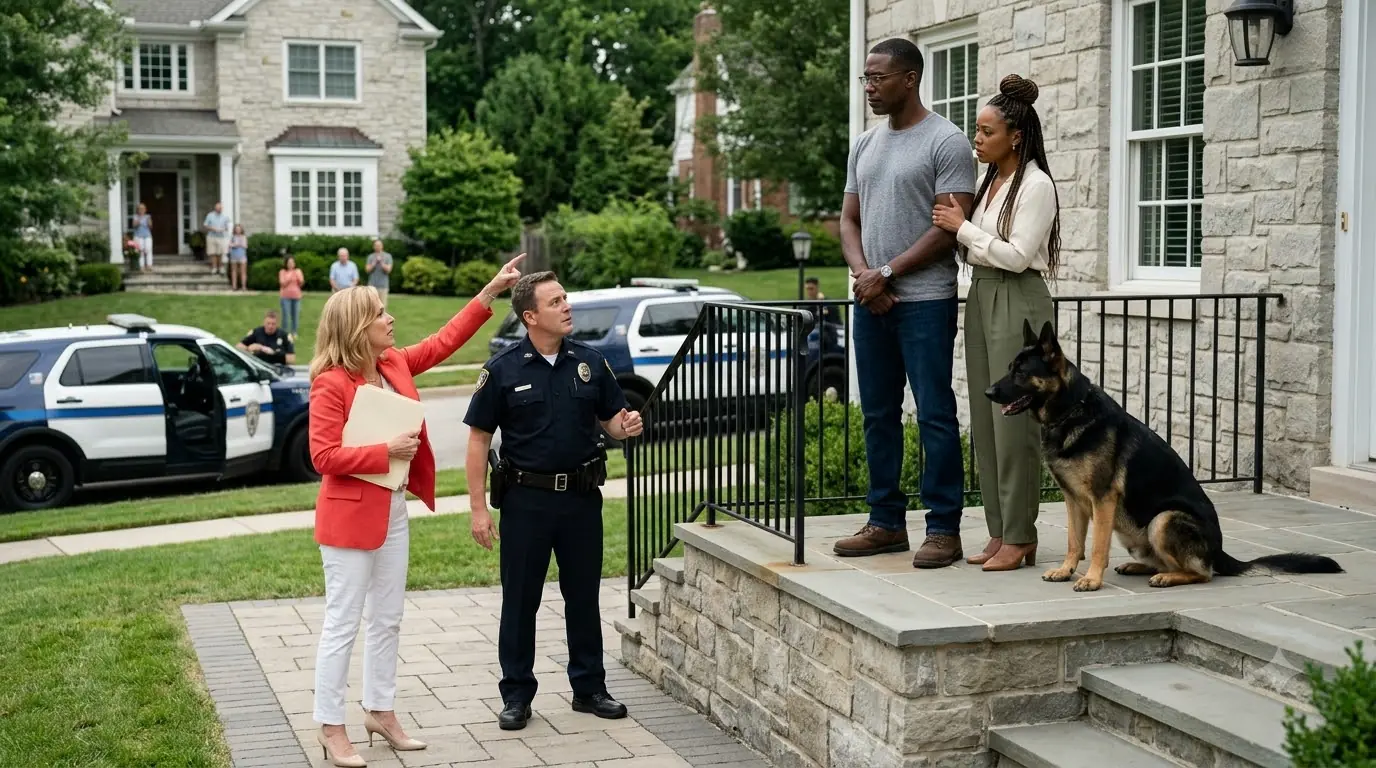
Until then, she had been sitting dramatically beside the neighborhood mailbox, one hand pressed against a scrape on her knee and the other clutching her phone. The tears came back instantly. They rolled down her cheeks as though she had been saving them specifically for an audience in uniform.
She hurried toward the officers before either man had fully closed his car door.
“They’re trespassing,” Judith cried, pointing toward the porch of 14 Maple Ridge Court. “I caught them breaking into that house. I’m the HOA president. I reported it.”
Denise Ferris stood beside her husband near the front door.
Her hands were trembling.
“Ma’am,” she called, trying to keep her voice steady, “we bought this home.”
Judith spun toward her.
“Lies.”
She looked at the officers.
“They’re vagrants. Look at them. Do they look like they belong in Crestwood Manor?”
Franklin Ferris did not move.
He stood with his hands visible, shoulders relaxed, expression controlled.
At his feet, Bruno, their three-year-old German Shepherd, gave a nervous whimper.
Judith grabbed the sleeve of the nearest officer.
“He assaulted me,” she sobbed. “And that horrible dog attacked me when I tried to protect the property.”
The officer gently removed her hand from his arm.
“Ma’am, step back for me.”
“But you don’t understand.”
“We’ll talk to everybody.”
Judith backed away reluctantly.
For nearly three hours, she had controlled the story on Maple Ridge Court.
She had decided Franklin and Denise did not belong.
She had announced it to the neighborhood.
She had questioned how they could afford the house.
She had accused their dog of being dangerous.
She had fallen from the porch after provoking him, then claimed Franklin had pushed her.
She had coached at least one neighbor into supporting that lie.
And finally, she had called 911.
By the time the officers arrived, Judith believed the outcome was inevitable.
A white HOA president.
A scraped knee.
A large black man.
A large dog.
A frightened-looking black woman.
A neighborhood full of silent witnesses.
She thought she understood how the scene would be interpreted.
What she did not understand was the identity of the man she had spent the morning trying to have removed from his own home.
Three hours earlier, Crestwood Manor had looked peaceful enough to appear artificial.
The gated neighborhood stretched across six broad blocks of mature trees, deep lawns, stone walkways, and large colonial and craftsman-style homes. Every hedge appeared trimmed to the same height. Every mailbox matched. Every utility box was hidden behind decorative shrubs approved by the architectural committee.
At the entrance stood two iron gates framed by brick pillars.
A brass plaque beside them read:
CRESTWOOD MANOR
ESTABLISHED 1988
A COMMUNITY OF EXCELLENCE
For decades, residents repeated that phrase with pride.
A community of excellence.
It appeared on neighborhood newsletters.
On summer picnic banners.
On the HOA website.
On welcome packets handed to new buyers.
But excellence had developed a very specific meaning in Crestwood Manor.
Order.
Predictability.
Appearance.
Sameness.
And for the last nine years, no one had defined those things more aggressively than Judith Pennington.
Judith was fifty-six years old and had lived at 12 Maple Ridge Court for twenty-two years.
Her late husband, Richard, had been a regional insurance executive. After his death, Judith devoted nearly all of her time to neighborhood governance.
At first, residents considered that useful.
She remembered trash collection schedules.
She negotiated landscaping contracts.
She coordinated holiday decorations.
She organized summer barbecues and winter charity drives.
Then, slowly, helping became controlling.
Controlling became deciding.
Deciding became ruling.
Judith became HOA board secretary, then vice president, then president.
By her third year in charge, residents had stopped saying the Crestwood Manor Homeowners Association.
They simply said Judith.
Judith says the fence stain is too dark.
Judith says the basketball hoop has to come down.
Judith says the patio furniture cannot remain visible from the road.
Judith says your landscaping plan is still under review.
Judith says the board wants additional documents.
The board usually meant Judith.
Most residents knew it.
Few challenged her.
Judith understood procedure well enough to make resistance exhausting.
She did not scream often.
She did not threaten openly.
She sent letters.
She quoted subsections.
She delayed approvals.
She requested additional documentation.
She scheduled hearings.
She copied attorneys.
She understood that bureaucracy could accomplish what open hostility could not.
That talent had become especially useful whenever someone tried to move into Crestwood Manor whom Judith did not consider the “right fit.”
She never used openly racist language in official correspondence.
She did not need to.
She preferred phrases like:
Community compatibility.
Unusual financial structure.
Potential occupancy concerns.
Additional background verification.