They Came to Empty the Old Woman’s House — Then She Saw Her Own Signature
Reader Theme:
Font Size:
24px
30 private guards surrounded Diane Mercer's home before sunrise carrying boxes, dollies, and an order claiming the homeowners association had the right to empty everything she owned. Vanessa Whitmore stood in the driveway smiling as furniture was dragged toward waiting trucks. Diane was given 15 minutes to leave the house she had owned for 35 years. What Vanessa didn't know was that Diane's son wasn't an ordinary government employee, and he was already driving home. Minutes later, a line of black federal marshall vehicles appeared at both ends of the street.
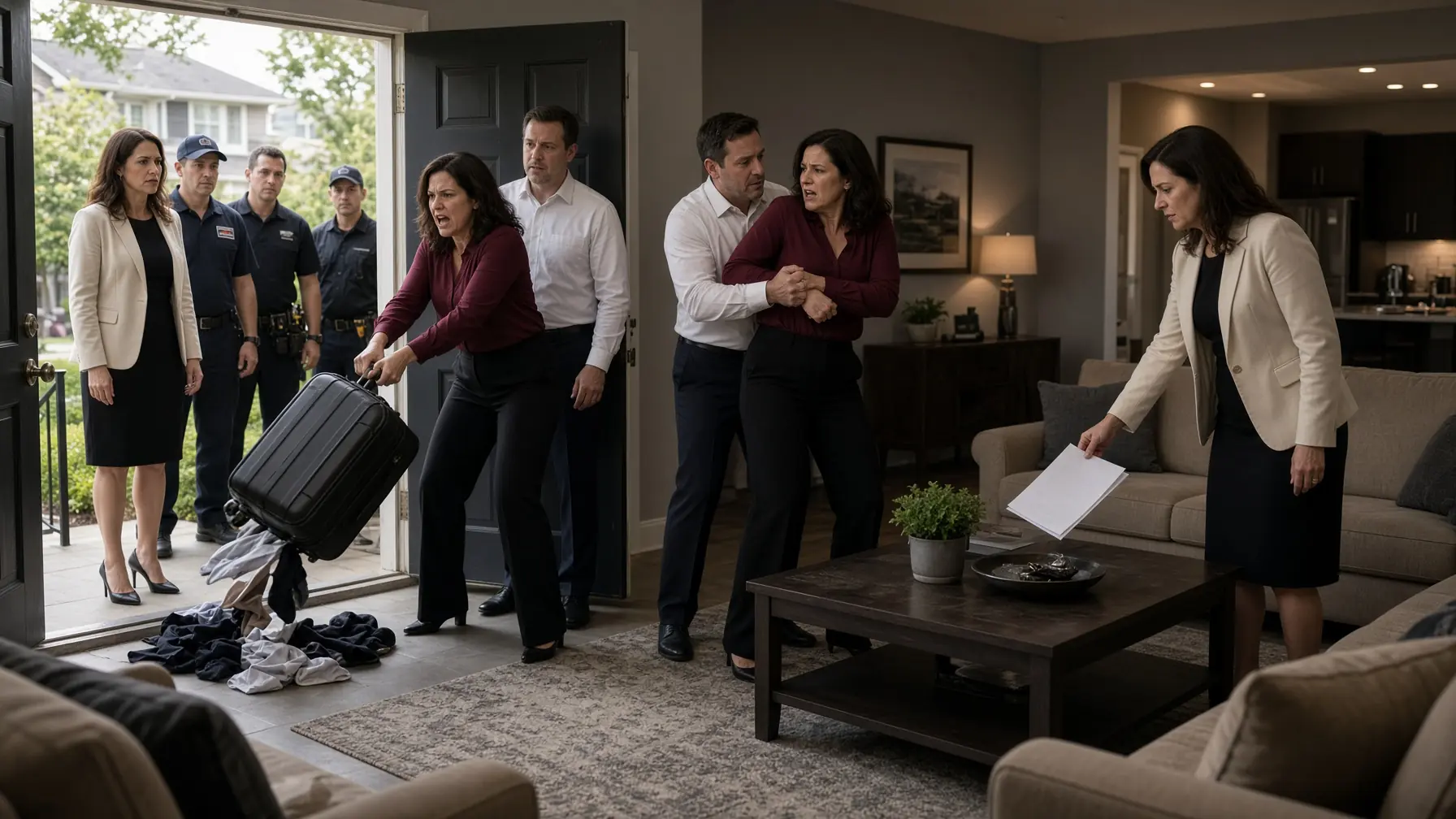
Every association truck stopped, every exit disappeared, and Caleb Mercer stepped out, holding a federal warrant. The morning began at exactly 40 minutes past 5 when Diane Mercer woke to the low growl of diesel engines and white headlights sweeping across her living room curtains. She had lived in Silver Ridge Estates long enough to recognize every ordinary sound of the neighborhood, the sprinklers, the early joggers, the mail truck at 7. This was none of those things. When she stepped onto her porch in her robe, she counted six pickup trucks belonging to the association's private security division, three moving trucks with their ramps already lowered, and nearly 30 men in matching black uniforms fanning out across her lawn like a small occupying army.
A pair of camera operators trailed behind them, filming everything for what she would later learn was meant to be evidence of a lawful eviction. Vanessa Whitmore stepped out of a black sport utility vehicle, holding a leather folder against her chest, her heels clicking against the driveway with a calm that felt almost rehearsed. She told Diane that the association had obtained temporary possession of the property due to unpaid landscaping fines, legal fees, security search charges, administrative penalties, and a special assessment that Diane insisted she had never received a single notice about. The total written across the top of the document exceeded $84,000. Diane's hands trembled as she read it, not from fear, but from disbelief, because the house had been paid off years earlier, and she had never signed anything, granting the association the right to seize her personal belongings.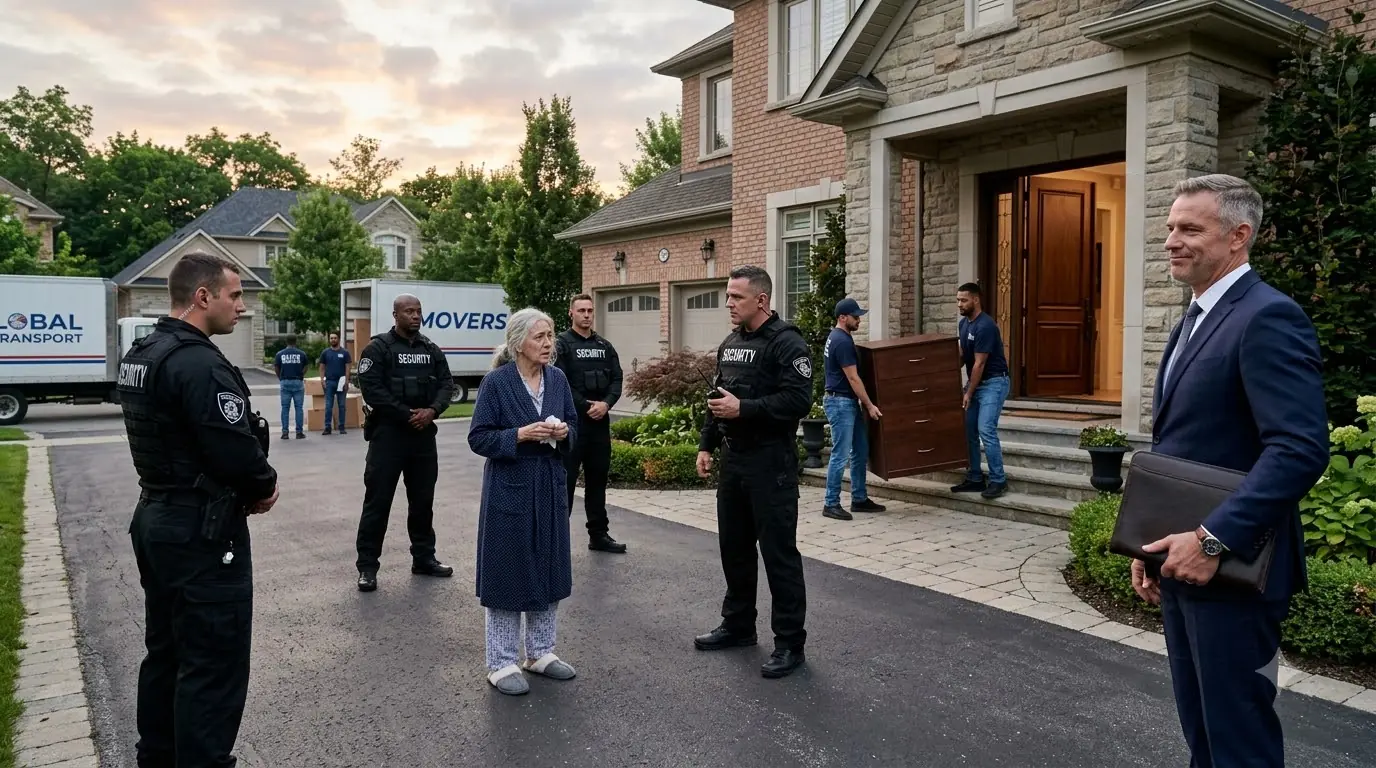
Diane objected immediately, telling Vanessa that this had to be a mistake, that she paid her dues on time every single month. Vanessa's expression did not change. She said in a voice flattened by years of practice, that today Diane's opinion simply did not matter. One of the security men moved toward the garage and began working the manual release on the door. while two others pressed a red notice against the front entrance that read property under association possession. Diane called the local police from the porch, her voice cracking for the first time, but Vanessa remained unbothered, explaining almost cheerfully that the paperwork had already been filed with the county clerk and that this was simply a civil enforcement action.
Nothing the police would involve themselves in. Graham Pike, the head of the association security contractor, raised his hand and gave the first order of the morning. Start with the living room, he said. and two men in black moved past Diane and into her home as though she were no longer standing there. They carried out her armchair, then the coffee table, then a wooden cabinet that had belonged to her late husband, loading each piece onto the trucks with mechanical efficiency. Diane tried to step between them and the doorway, but a line of guards closed in front of her, not touching her, simply forming a wall of shoulders and silence that made resistance feel impossible.
No one raised a hand against her, but the tactic was its own kind of violence. 30 strangers surrounding one elderly woman in the yard she had tended for over three decades. The neighbors began stepping onto their own porches one by one drawn outside by the noise, and none of them moved to help. Not because they lacked sympathy, but because the sheer number of guards made the entire scene feel like something out of their control, an official operation rather than a crime, unfolding in plain daylight. A woman two houses down stood frozen with a coffee mug in her hand, watching the trucks fill with someone else's furniture, and clearly wondering whether the same crew might arrive at her own door before the year was over.
Diane noticed the silence of her neighbors more than anything else. In that moment, the way people she had known for years suddenly looked away rather than meet her eyes as though acknowledging what was happening might somehow invited onto their own property. Next, Vanessa seemed to feed off that silence, moving through the yard with the practiced ease of someone who had done this before, and understood precisely how discomfort could be weaponized into compliance. Vanessa handed Diane a single sheet of paper and told her she had 15 minutes to gather anything she considered personally necessary before the house would be locked for the remainder of the process. Diane looked down at her phone, her thumb hovering over the screen for several long seconds as the noise of dragging furniture continued behind her.
Then she made a decision that would unravel everything Vanessa believed she had built. She called her son. What Vanessa did not know, what none of the 30 men on that lawn understood was that Caleb Mercer was not the mid-level office worker Diane sometimes described to curious neighbors. He was a supervisory deputy United States Marshall. And at that exact moment, he was less than an hour away driving home from an assignment that had kept him away for nearly a week.
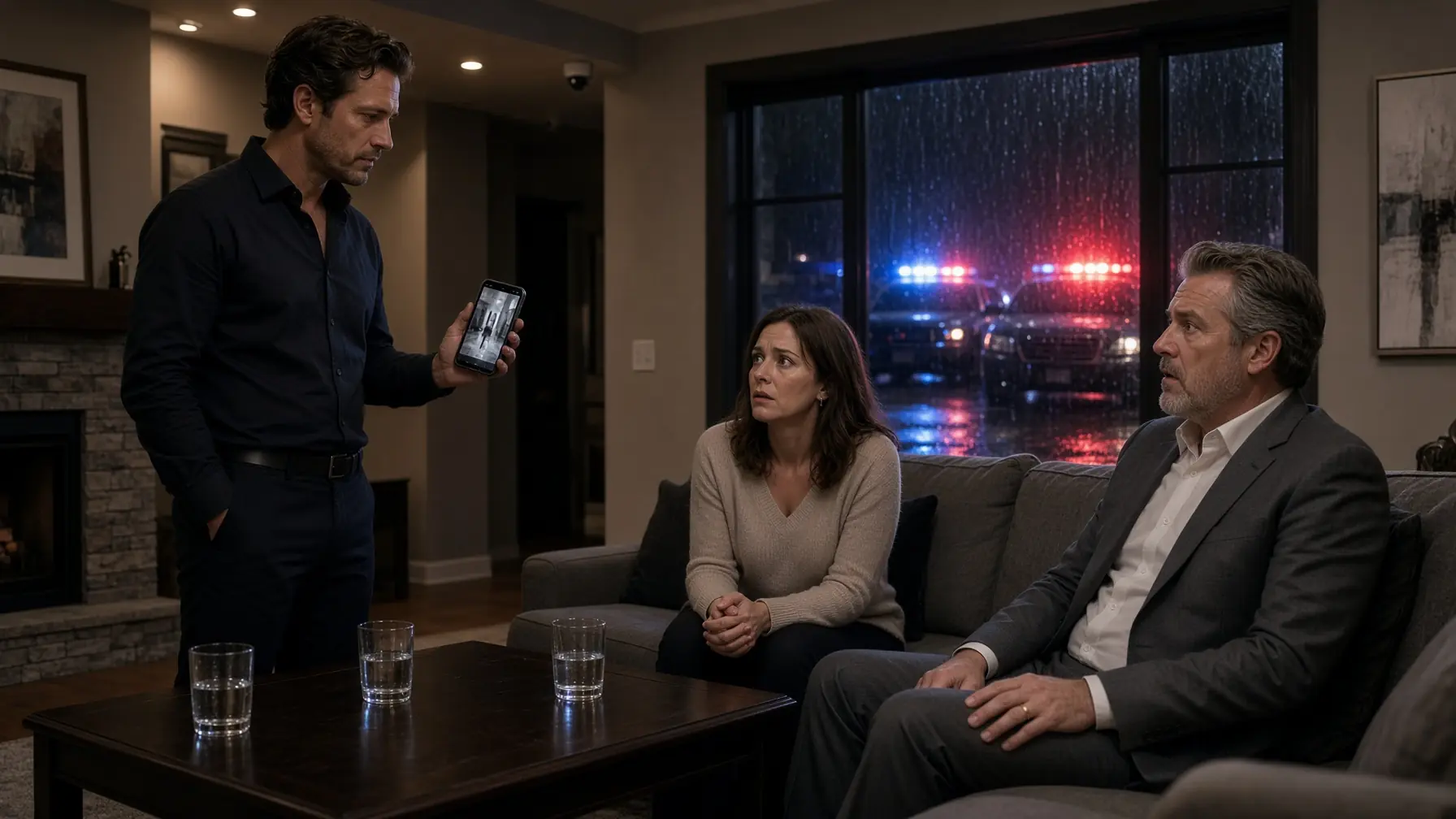
Caleb was navigating the last stretch of highway before his exit when his phone lit up with his mother's name. Her voice when he answered was unnervingly steady, almost too composed for what she was describing. She told him simply that the homeowners association was inside the house. Caleb asked how his tone sharpening instantly the training of two decades pulling his focus away from the road ahead and onto the details. Diane explained it in fragments.
30 guards moving trucks, a locksmith standing by furniture already loaded onto trailers. Caleb told her not to argue with anyone, not to touch a single guard, and to record everything on her phone the moment she was able, because in his experience, footage mattered more than outrage. He asked her one specific question before hanging up. Did they show you a court order? Diane said Vanessa had handed her something called an authorization for possession, and Caleb asked her to photograph it and send it immediately.
When the image loaded on his screen at a red light 2 m from the exit, it took him only seconds to recognize what was missing. There was no presiding judge's name anywhere on the page, no valid court case number, no clerk certification stamp, and no signature from any enforcement authority recognized by the county. This was not a court order at all. It was a document dressed up to look like one, and Caleb had spent enough years serving legitimate federal paperwork to know the difference at a glance. He called his colleague, Deputy United States Marshal Owen Barrett, not to ask for a favor involving a family dispute, but to request something far more procedural.
He asked Owen to run the names Vanessa Whitmore and Silver Ridge Estates through the federal investigative database, expecting perhaps a parking violation or a minor civil complaint. Owen went quiet for several minutes long enough that Caleb assumed the call had dropped. When Owen finally spoke again, his tone had shifted entirely and what he said changed the shape of the entire morning. The name Silver Ridge Estates had already surfaced in an active investigation involving forged leans, suspicious wire transfers across state lines, fraudulent property filings, and repeated intimidation of homeowners across several ple neighborhoods. At least six other properties in the surrounding area had been forcibly transferred or sold under similarly questionable circumstances over the previous two years.
Caleb realized in that instant that what was happening at his mother's house might not be an isolated dispute between one difficult association president and one stubborn homeowner. It might be a single visible thread in a much larger pattern of organized property theft disguised as routine enforcement. He thought briefly about calling local police backup instead the simpler and faster option available to almost anyone in his position. But something about the forged authorization document nagged at him. a small detail that felt too deliberate to be an isolated act of overreach by one overzealous association president. Years of federal work had taught him that genuine mistakes tended to look sloppy, while genuine fraud tended to look almost too polished, and the document his mother had photographed fell firmly into the second category.
He forwarded every photograph and video his mother had sent to special agent Marissa Cole, a federal investigator he had worked alongside on prior cases involving financial crimes. Marissa reviewed the material within minutes and responded with a single urgent instruction, telling him not to let anyone remove the paper files from the house under any circumstances. Caleb asked which file she meant, and Marissa explained that Diane's property records could potentially contain original documentation, proving the association had falsified its chain of ownership and its leans across the p neighborhood. In an instant, his mother's home stopped being merely the site of an unlawful eviction and became something else, entirely a location that might hold physical evidence central to a federal fraud investigation already months in the making. Caleb changed lanes, took the next exit, and called the regional coordination center to request immediate backup, describing not a family emergency, but a possible obstruction of a federal case unfolding in real time.
The dispatcher on the line asked him twice to confirm the address, and both times Caleb read it back without hesitation. Fully aware of how strange it must have sounded to be requesting a marshall's convoy for his own mother's street. Yet entirely certain that hesitation now would cost them evidence they could never recover later. Within minutes, units already stationed nearby began rerouting toward Silver Ridge Estates, moving with the quiet coordination of people who had executed similar operations many times before, even if none of them yet understood the personal stakes waiting for their supervisor at the end of the drive. While Caleb closed the remaining distance, Vanessa accelerated the operation at the house.
And Diane noticed something strange in the pattern of what her possessions were being taken. Vanessa showed little genuine interest in the sofa, the dining table, or the artwork on the walls. But the moment a guard uncovered the small filing cabinet in the rear office that had belonged to Diane's late husband, Vanessa crossed the yard almost too quickly, her composure slipping for the first time that morning, she pointed directly at the cabinet and told the nearest guard to take that first before anything else in the house. Diane stepped forward and objected because inside that cabinet sat the original deed to the property, old subdivision maps, decades of correspondence dating back to before the association even existed, and property tax receipts stretching across most of her marriage. Vanessa waved the objection away, calling the contents association records subject to collection, though nothing about a private family archive suggested it belonged to anyone but Diane.
In that moment, Diane understood that Vanessa was not simply seizing a house at random. She was searching for something specific, something she needed to control before anyone else had the chance to read it. Diane thought back to a conversation months earlier when Vanessa had unexpectedly stopped by under the pretense of welcoming her to a new landscaping committee, asking a surprising number of questions about her late husband's paperwork and whether she still kept his old business files anywhere in the house. At the time, Diane had dismissed it as idol neighborly curiosity, the kind of small talk people made at community gatherings. But standing on her own lawn, watching guards zero in on that exact cabinet, the visit no longer felt idle at all.
Across the street, Elliot Vaughn, a longtime neighbor who had lived beside Diane for nearly as long as she had owned the house, stepped out onto his own lawn and began recording the entire scene on his phone. Graham Pike sent two guards across the street to tell him to stop filming. But Elliot refused calmly, reminding them that he was standing on his own property and had every right to document whatever happened in public view. Vanessa threatened to find him for interference. and Elliot answered without even lowering his phone, telling her to simply add it to the pile of things she already owed explanations for. In the chaos of loading, one of the movers stumbled and dropped a box of paperwork scattering loose pages across the driveway in the early light.
Diane knelt and picked one up and her breath caught when she saw a signature at the bottom of the page bearing her own name, a signature she had absolutely never written. The document was titled Acknowledgement of Homeowners Association debt listing a balance of more than $80,000, and Diane clutched it to her chest. the instant Vanessa reached to take it back. "That's not my signature," Diane said, her voice suddenly sharp and clear, cutting through the noise of the yard for the first time all morning. Something in Vanessa's posture changed at that moment, the practiced confidence draining from her face as quickly as it had arrived hours earlier. She turned to Graham Pike and issued a new order in a lower, harder voice, telling him to clear the office immediately and not to worry about the rest of the house.
It was no longer possible to interpret her behavior as simple, aggressive debt collection. Vanessa was not merely trying to take possession of a home. She was racing to remove documents before anyone had the chance to examine them closely. And at the far end of the street, Elliot noticed a line of unfamiliar vehicles approaching, moving with a slow, deliberate discipline that had nothing in common with the chaos behind him. Vanessa had just ordered the first loaded truck to pull away from the curb when Graham slapped the side panel and shouted for the driver to move.
The truck rolled forward perhaps a hundred yards before its brakes locked hard because directly ahead of it, three Matte Black Sport utility vehicles belonging to the United States Marshall Service had already sealed off the streets only northern exit. The driver considered reversing, but behind the house at the opposite end of the block. More federal vehicles were arriving in a steady, unhurried line, closing the second exit before anyone inside the moving trucks fully understood what was happening around them. There was no shouting, no drawn weapons, no dramatic announcement over a loudspeaker. And it was precisely that stillness that made the scene so unsettling to everyone standing on the lawn.
Deputy marshals stepped out of their vehicles and took up quiet, deliberate positions at both ends of the street, effectively sealing Silver Ridge Estates's single access road without a single raised voice. Owen Barrett walked directly to the stalled moving truck and told the driver to turn off the engine, his tone flat and entirely without room for negotiation. Graham Pike came running, insisting loudly that this was association property being transported under a civil dispute and that federal marshals had absolutely no authority to interfere. Owen answered him with four words that ended the argument before it began telling him simply that he was not leaving. Vanessa turned from the frozen truck toward the growing line of federal vehicles, and that was when Caleb stepped out of the final sport utility vehicle in the convoy, dressed in a tactical jacket bearing his AY's insignia, his federal credentials already visible at his belt.
For a moment, the entire yard seemed to hold its breath. Guards glancing at one another, uncertain whether to keep loading boxes or to simply stop and wait for instructions that were clearly no longer coming from Vanessa alone. Diane saw her son and exhaled for what felt like the first time in over an hour. Vanessa studied Caleb from a distance, taking in the jacket, the badge the radio clipped to his shoulder, and something behind her eyes shifted as she began to understand that she had badly misjudged the family she had chosen to target. Still, she tried to hold her ground, walking toward him with her folder raised like a shield and announcing that his mother owed the association a considerable sum of money.
Caleb did not argue the debt at all. He asked her a single precise question, wanting to know exactly who had authorized the physical removal of records from inside the house. Vanessa answered that the association's attorney had authorized it, and Caleb followed immediately with a second question, asking which judge had signed off on the possession of the property itself. Vanessa said nothing, and her silence answered the question more clearly than any words could have. Caleb turned toward the row of trucks, then spoke to Owen in a voice meant to carry across the entire yard, ordering everyone to freeze exactly where they stood.
No vehicle would leave the block. No box would move another inch. No footage would be deleted, and no paper would be destroyed under any circumstance from that moment forward. Vanessa's composure finally cracked entirely, and she accused Caleb of abusing his federal position to protect his own mother from a legitimate debt. Caleb's response was calm and unhurried, and it landed with far more weight than any raised voice could have managed.
He told her that this had stopped being about his mother roughly 10 minutes earlier. behind him. Special Agent Marissa Cole stepped out of the rearmost vehicle carrying a thick case file under one arm. And the instant Vanessa's eyes fell on the federal seal printed across its cover, the last traces of her earlier confidence disappeared completely from her face. Marissa began examining the documents on the spot while Marshalls cordined off a section of the driveway to preserve whatever physical evidence remained scattered across the lawn. Roughly 20 minutes later, Lydia Harrow, the association's attorney, arrived and immediately attempted to reframe the entire morning as an ordinary civil dispute rather than anything approaching criminal conduct.
She insisted the association held a valid lean, a legitimate right of recovery, and full legal authority to sell the property in order to satisfy the outstanding debt Diane supposedly owed. Marissa asked for the corresponding court case number and when Lydia provided it a quick search revealed the number actually belonged to an unrelated lawsuit that had already been closed for nearly 2 years. That was the first significant blow to the association story. Caleb then handed Marissa the authorization for possession document his mother had photographed earlier that morning. And within minutes, it became clear that the signature attributed to a court administrator belonged to a woman who had left that position 8 months prior and had no remaining authority to sign anything on behalf of any court.
That was the second blow. Diane produced the forged acknowledgement of homeowners association debt she had recovered from the scattered paperwork. And when Marissa asked directly whether the signature belonged to her, Diane answered with a single firm word, "No." Elliot crossed the street once more. This time, carrying a cardboard box filled with his own carefully preserved records. He explained to Marissa that Vanessa had attempted a nearly identical strategy against him years earlier, though he had quietly saved every threatening email, every lean notice, and every piece of correspondence rather than discarding them.
Most significantly, Elliot produced an old subdivision map, proving that Dian's house had been built years before Silver Ridge Estates' homeowners association had even been legally established, which meant her property likely qualified for a grandfather exemption from association authority altogether. It was entirely possible the association had never possessed any legitimate power over Dian's home in the first place. Vanessa's smile, which had defined her entire presence that morning, was completely gone by the time Elliot finished speaking. Lydia attempted one final argument, suggesting that even if the grandfather exemption applied, the association could still pursue the outstanding fees through normal civil channels rather than through what she now carefully described as unfortunately premature enforcement action. Marissa reminded her that premature enforcement actions did not typically involve 30 armed guards, a locksmith, and 15 minutes to vacate a home of 35 years, and Lydia had no immediate response to that observation.
Graham Pike understood almost immediately how serious the situation had become, and he moved quickly to separate himself from Vanessa's growing legal exposure. He explained to Caleb that his men were simply contractors following the terms of a signed agreement, nothing more. Caleb asked him plainly who had given his crew authorization to enter the house that morning, and Graham pointed directly at both Vanessa and Lydia without hesitation. With Graham's consent, a marshall reviewed the messages on his work phone and the internal instructions displayed. There were damning in their clarity, a directive reading, "Remove all paper records before 8 in the morning," followed by another warning not to let her paper records.
Diane contact any neighbors while the crew worked. A third message was worse still, instructing the team that if Mercer arrived, the evidence needs to be gone before he does. Caleb stared at his own last name typed out in someone else's phone, and asked simply how Vanessa had known it at all. Marissa turned to Vanessa directly and asked how she could have possibly anticipated Caleb's arrival or timed the operation around his absence, but Vanessa refused to answer, her jaw tightening as she looked away from both of them. The investigation widened almost immediately, and a review of internal association records revealed that Vanessa had been researching details about Dian's family for several weeks prior to that morning, which ruled out any possibility that the timing had been coincidental.
Inside the filing cabinet, Vanessa had been so desperate to seize sat the original deed and a planning appendix capable of dismantling numerous claims the association had asserted across the entire northern section of Silver Ridge. If those documents disappeared, the association could continue exerting authority, real or fabricated over land potentially worth millions of dollars. Vanessa had not simply been trying to remove one elderly widow from her home that morning. She had been attempting to erase the physical proof of a property seizure scheme that appeared to have been operating quietly for years. Several of the guards, once they understood the true nature of what they had participated in, began cooperating almost immediately, explaining that they had been hired strictly for what their contract called property recovery and had never been told the underlying order might be unlawful.
Graham voluntarily surrendered every contract email exchanged between his company and the association. And with each new document brought forward, Vanessa found herself increasingly isolated on the very lawn she had arrived to conquer ours. Earlier, a few of the younger guards quietly asked whether they were still expected to be paid for the day, and Owen told them their immediate concern should be giving accurate statements rather than worrying about wages. A response that settled the yard into an even heavier silence than before. Somewhere near the trucks, one of the moving crew members admitted under quiet questioning that this was not the first time he had been asked to remove filing cabinets specifically and that similar requests had come through at two other addresses earlier that same year.
Marissa laid out the broader shape of the investigation for Caleb. As marshals continued documenting the scene around them, for roughly 18 months, a federal task force had been quietly tracking suspicious financial activity connected to several homeowners associations and property management firms operating across the region. The pattern repeated itself with unsettling consistency from one case to the next. Unusual fines were levied against targeted homeowners. Legal fees were added on top of those fines.
Leans were quietly filed against the properties and residents were pressured into signing agreements. They barely understood under mounting financial threat. When a homeowner resisted, the association escalated toward foreclosure or a forced sale, and a shell company with quiet ties back to the association's leadership would ultimately acquire the property at a fraction of its true value. Silver Ridge estates had already surfaced repeatedly within that broader pattern of transactions, but investigators had lacked the one thing that could truly prove the original filings were fabricated rather than simply aggressive. The deed and subdivision map recovered from Dian's own filing cabinet supplied exactly that missing piece.
Elliot contributed further, producing a list of 11 other properties he personally knew Vanessa had pressured over the years. Three sold under duress at drastically reduced prices, two families who had simply given up and moved away rather than fight. and one homeowner who had permanently lost legal access to part of his own land through a disputed easement. Vanessa had built her entire system of control by ensuring that every targeted homeowner believed they were facing her completely alone. But that morning, she had made a critical miscalculation, arriving with 30 guards and three trucks concentrated at a single address, generating dozens of witnesses, hours of continuous footage, a paper trail of written orders, and an unmistakable chain of command connecting every action directly back to her. Caleb turned to Marissa and observed quietly that Vanessa had essentially delivered the entire case to them herself.
Marissa's reply carried a note of grim satisfaction, noting that she had also boxed up most of the physical evidence for them in the process, loading it neatly onto trucks that were now sealed off on both ends of the street under federal watch. She added that in 18 months of tracing shell companies and quietly worded contracts, this was the first time an entire operation had walked itself directly into a sealed perimeter without a single subpoena being necessary to get there. Caleb allowed himself a brief tired laugh at that. The first genuine moment of relief he had felt since the phone rang on the highway that morning. As the full scope of what was unraveling became clear, Vanessa's composure finally shattered completely, and she made a hurried phone call to a member of the association's governing board before turning and walking briskly toward her own vehicle.
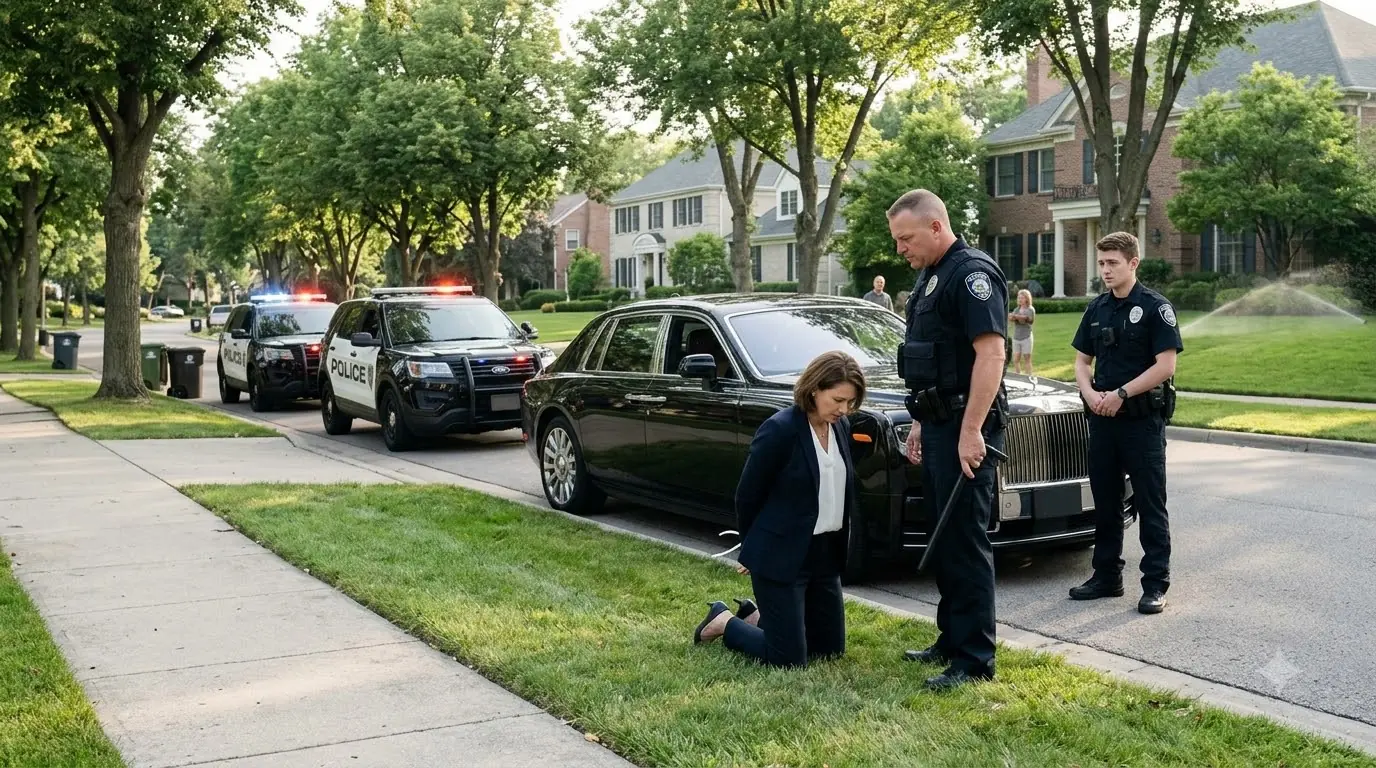
Owen stepped into her path, and Vanessa insisted loudly that she had not been placed under arrest and retained every right to leave the scene. Owen acknowledged that much was technically true, but pointed out that her vehicle currently sat within a zone secured for evidentiary review connected directly to the morning's unlawful seizure attempt. When Vanessa announced she would simply walk away instead, Marissa's phone rang with a call from the federal prosecutor's office confirming that the legal team had just finalized a request built entirely around the documents recovered that very morning. Judge Raymond Talbet had already signed a search warrant authorizing entry into the association's main office in order to seize all electronic records stored there, a directive to freeze the relevant financial accounts and arrest warrants connected to fraud and obstruction of a federal investigation. Marissa walked directly up to Vanessa and told her with quiet finality that she would not be leaving after all.
Vanessa spun toward Caleb and accused him of orchestrating the entire morning purely because Diane happened to be his mother. Caleb answered without raising his voice even slightly, telling her that she had done this to herself the moment she assumed his mother was standing entirely alone. Two marshals stepped forward and asked Vanessa to surrender her phone, and she initially refused before reluctantly handing it over after several tenth seconds of silence stretched across the driveway. Lydia Harrow was also detained for questioning once a review of her email correspondents revealed she had known at minimum that several of the association's filings had never actually been reviewed or approved by any court. Graham and his crew were separated for individual statements.
And remarkably, the entire collapse of Vanessa's operation unfolded without a single raised fist or chaotic struggle. Instead, it came apart through the very instruments she had always relied upon to dominate others. Official documents, formal orders, careful recordkeeping, and genuine legal authority, finally arriving to counter her own. As marshals began escorting her toward a waiting vehicle, Vanessa looked back once at the house, she had come to empty its front door, still standing open. boxes still stacked halfway between the porch and the trucks that would never carry them away. Diane did not look at her.
She stood beside Elliot near the mailbox, her arms folded, watching the woman who had tried to erase 35 years of her life in under two hours finally run out of paperwork to hide behind. Later that same afternoon, a separate federal convoy arrived, not at Dian's house, but at the administrative offices of Silver Ridge Estates itself. This time, unlike the morning's forged paperwork, every document authorizing entry was entirely legitimate. Computers throughout the office were sealed for examination. Hard drives were carefully cataloged and removed, and box after box of property records was carried out under the close supervision of federal agents.
Investigators soon discovered a digital folder simply labeled distressed owners, and its contents made the true nature of the operation unmistakably clear to everyone involved. The list inside identified elderly residents living alone absentee property owners and homeowners with limited family support nearby each name accompanied by chillingly clinical notes describing them as unlikely to fight back lacking nearby family and suitable for pressure through repeated fees or to eventual acquisition. Dian's name appeared on that list as well. and beside it sat a note that made Caleb's stomach turn the moment he read it, instructing whoever handled the file to verify his work schedule before taking any action against the household. This single detail confirmed beyond any doubt that Vanessa had deliberately chosen that particular morning because she believed Caleb would be away from home and unable to interfere. It had never been an ordinary coincidence or a routine debt collection effort.
It had been a carefully scheduled operation, timed and targeted with the same cold precision Vanessa applied to every business decision she made. Financial records recovered from the office revealed that proceeds from several previous property sales had been quietly funneled through a network of connected shell companies. With Silver Ridge estates functioning as merely the visible surface layer of a much larger scheme, the federal investigation expanded rapidly from there, drawing in additional individuals and associations across the region as agents traced the money further and further from its original source. Vanessa had believed she was simply clearing out one troublesome house before anyone finished their morning coffee. By the end of that same day, it was her own office, her own records, and her own carefully built network that had been completely dismantled instead.
Agents also uncovered a spreadsheet tracking projected profits from each targeted property broken down by estimated market value, expected legal costs, and anticipated resale price once the association's affiliated buyer completed a purchase at a steep discount. Diane's address appeared on that spreadsheet as well with a projected resale figure nearly triple what the fraudulent debt claim had listed that morning, revealing that the $84,000 scrolled across her eviction paperwork had never been about recovering unpaid fees at all. It had always been about the difference between what Vanessa could force a frightened homeowner to accept and what the property was actually worth once emptied and resold through a friendly buyer three steps removed from her own name. News of the raid spread quickly through Silver Ridge Estates once residents noticed the same federal vehicles that had blocked Diane's street, now parked outside the association's main office. Several homeowners who had quietly paid disputed fees over the years rather than risk a confrontation, began reaching out to the independent investigators handling the case, describing patterns eerily similar to what Diane had experienced.
A retired school teacher two streets over described receiving a nearly identical possession notice 18 months earlier only she had been alone without a son who carried federal credentials and had ultimately signed away access to a portion of her backyard rather than risk losing the entire house. Her account along with several others that surfaced in the days that followed would eventually become part of the broader case prosecutors built against Vanessa and the network surrounding her. Several weeks later, Diane returned to a specially convened meeting held at the Silver Ridge Estates Community Building, though the chair at the head of the table where Vanessa had once presided now sat empty. An independent administrator appointed by the court to oversee the association during the ongoing investigation ran the meeting in her place with a level of transparency the neighborhood had not experienced in years. Every questionable lean filed under Vanessa's leadership had been frozen. pending review.
A substantial number of disputed fees, had already been formally cancelled, and several older enforcement cases, including some involving families who had left the neighborhood entirely under pressure, were quietly being reopened for reconsideration. Dian's home was formally confirmed to fall outside the majority of authority. Vanessa had once claimed to hold over it, thanks in large part to the grandfather exemption Elliot had helped bring to light that very first morning. The independent administrator read the ruling aloud to the room, and several longtime residents who had quietly watched Vanessa operate for years exchanged glances that carried more relief than surprise. As though a suspicion they had never dared voice out loud, had finally been confirmed by someone with the authority to say it plainly.
One elderly man near the back of the room, a widowerower who had lived in the neighborhood even longer than Diane, raised his hand simply to ask whether the exemption might apply to his own property as well, and the administrator promised a full review within the month. Every piece of furniture loaded onto those trucks weeks earlier was eventually returned to the house, undamaged and fully accounted for following careful cataloging by federal investigators. Caleb spent an afternoon helping his mother carry the old filing cabinet back into its rightful place in the small office at the rear of the house, setting it down exactly where it had always stood before that chaotic morning interrupted everything. Diane watched him work for a long moment before speaking, telling him quietly that she hated the idea of her son having to use his federal position to solve a family problem. Caleb straightened, glancing toward the stack of documents still sitting on the desk between them, and told her gently that he had not brought federal marshals to her home simply because she was his mother.
He explained that he had brought them because Vanessa and her associates had clearly crossed a well-defined federal line, one that had nothing to do with family loyalty and everything to do with the law itself. Diana allowed herself a small tired laugh at that, then carefully placed the original deed into a brand new fireproof safe recently installed in the corner of the room. Elliot stopped by not long afterward to share an update, explaining that several former residents, who had quietly sold their properties under pressure years earlier, had come forward to offer statements once they learned Vanessa's operation had finally collapsed. Vanessa herself now faced a lengthy list of federal charges including wire fraud, the creation and use of forged property records, obstruction of an active investigation, conspiracy, and participation in what prosecutors were now formally describing as an unlawful property acquisition scheme spanning multiple neighborhoods. Lydia Harrow remained under separate investigation regarding her own role in preparing and filing the fraudulent documents used throughout the scheme.
Graham Pike, in exchange for his continued cooperation, became a key witness for the prosecution, handing over the full archive of internal contracts and communications that had guided his security team's actions that morning. His statement, combined with the messages recovered from his phone that first morning, helped investigators trace the exact chain of instructions from Vanessa's office down to the individual guards standing on Dian's lawn. closing gaps that might otherwise have allowed her legal team to argue the entire operation had simply been a rogue decision made without her direct knowledge. Prosecutors made clear in later filings that no such argument would hold given the sheer volume of written orders bearing her name and her direct instructions regarding the timing of Caleb's absence. The independent administrator overseeing Silver Ridge Estates during the transition period also announced a formal review of every special assessment issued over the previous 5 years. A process expected to take several months, but one that early estimates suggested could return tens of thousands of dollars to homeowners who had paid fees, never properly authorized by any legitimate vote of the community.
Several residents who had left the neighborhood entirely under financial pressure were contacted individually and informed of their right to reopen their cases. A small measure of justice that could never fully undo years of lost equity. Displaced lives, but one that at least acknowledged what had blank actually happened to them, rather than leaving the record exactly as Vanessa had written it. The story closed on the same quiet residential street where 30 guards had once stood shoulder-to-shoulder before dawn, certain that sheer numbers alone would be enough to frighten one widow into silent surrender. Vanessa's greatest miscalculation that morning had never really been about how many guards she brought with her at all.
It had been her deep and unquestioned belief that no one more powerful than her own carefully constructed authority would ever arrive to challenge her. Caleb stood beside his mother in the early evening light, watching the final federal vehicle pull away from the curb and disappear around the corner of the street they had lived on for so many years. Diane asked him quietly whether she thought anyone would ever try something like that again. Caleb looked past her toward the house, still standing solid and unchanged behind them, its windows catching the last warm light of the afternoon sun. He told her simply that no one would try it again, not with this particular house.
In the distance, workers were already removing the large sign that once read Silver Ridge Estates's homeowners association, taking it down as part of the community's broader reorganization under new independent leadership. Closer to home, the small wooden sign planted at the edge of Dian's front yard remained exactly where it had always been weathered, but unmoved through everything that had happened quietly reading Mercer private property a simple truth that no forged document had ever been able to erase. Diane sat down on the porch steps as the evening cooled, watching her son check his phone one last time before finally slipping it back into his pocket. A rare gesture from a man who almost never allowed himself to fully switch off. For the first time in weeks, the street was simply quiet again.
No trucks, no guards, no folder of forged authority, waiting to be waved in someone's face. Only the ordinary sound of sprinklers ticking on somewhere down the block, and the porch light flickering to life above the door that had never actually stopped being hers.
END