The smell reached County Road 7 before the trucks did.
By nine o'clock on the second Tuesday of April, people in western Knox County were already calling the sheriff's office to complain about a sour, fermented odor moving over the fields.
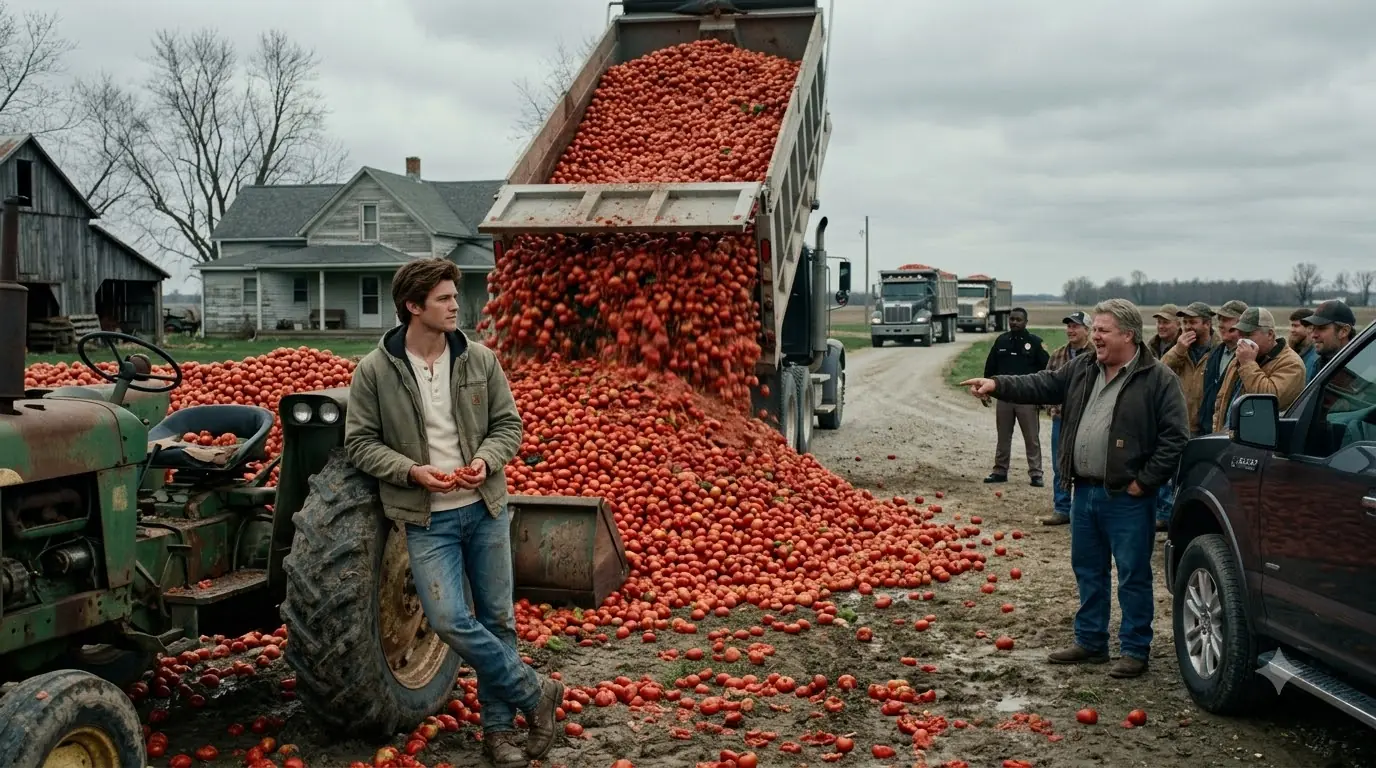
By ten, the first commercial dump truck had backed through the gate of a five-acre parcel that most local growers had stopped referring to as farmland years earlier. By noon, the gravel shoulder was crowded with pickup trucks, curious neighbors, two county vehicles, and a reporter from the Knox County Herald who had arrived because somebody had told him there was an illegal landfill being built beside a farm road.
The parcel belonged to twenty-two-year-old Cole Evans. It sat low against a windbreak of cottonwood and scrub maple on the western edge of the county, a flat rectangle of gray alkaline clay that cracked like old pottery in August and turned slick as soap after heavy rain. Fifteen years earlier, Cole's grandfather had tried corn on it. Before that, a tenant had tried soybeans. Both attempts had produced the same result: pale plants, shallow roots, poor yields, and bills larger than the harvest checks.
A farm appraiser had eventually written a sentence that Cole knew by memory because Arthur Vance liked repeating it whenever he saw him in town. "Marginal to nonproductive agricultural ground under current management assumptions." The appraiser had not literally assigned the land a legal value of zero, but for crop-income purposes the meaning had been close enough. No banker wanted to lend against it. No established farmer wanted to rent it. The parcel had become the place where broken equipment was temporarily parked and where people pointed when they needed an example of bad ground.
That morning, however, it was suddenly the most interesting five acres in Knox County.
Forty-eight trucks came through the gate in a controlled sequence. They did not all carry the same load, and despite what the Herald later printed, nobody dumped fifty tons from each truck. The total material delivered over two days was a little more than fifty tons of tomato pomace and wash solids from Midwest Canning Corporation: crushed skins, seed-rich pulp, fiber, stems, diluted juice, and the organic residue left from a specialty cold-processing run. It had begun fermenting in covered holding bins at the plant, which explained the smell that made people cover their noses half a mile away.
The first truck raised its steel bed and released a red-brown mass onto a prepared pad near the center of the property. Steam lifted faintly in the cool air. Liquid spread in a shallow ribbon before disappearing into the straw Cole had laid beneath the unloading area. The second truck followed. Then the third.
Arthur Vance arrived in a new white dual-cab pickup with polished chrome steps and a dealership sticker still on the rear window. He parked half on the shoulder, climbed down in spotless work boots, and stood with one hand on his hip while watching another load slide out.
Arthur farmed close to six thousand acres in three counties. Tomatoes were his specialty, although his business also included contract corn, soybeans, and leased packing equipment. He was not merely successful. In Knox County he was the kind of successful man whose opinions became weather. If Arthur said a seed company was unreliable, growers stopped ordering from it. If he said a piece of machinery was junk, the dealer felt it by the end of the month.
He looked at Cole's field, smelled the air, and laughed.
"Look at him," Arthur said loudly enough for everyone near the ditch to hear. "Praying over a pile of rot."
Several men laughed with him.
Cole stood beside an old 1972 John Deere that belonged to his uncle Benjamin. His canvas jacket was faded at the shoulders. One cuff had been repaired with brown thread that did not match. He held a clipboard, not because he was trying to look official, but because every truck had a manifest and every load had to be checked against it.
Arthur walked toward the fence line without entering the property. "That stench is going to run off every neighbor you've got."
Cole glanced down at the manifest in his hand.
"You hear me, boy?" Arthur called.
Cole looked up. "I hear you."
"Midwest Canning was staring at disposal bills, and they found the one person in Indiana willing to turn his land into their toilet."
More laughter came from the shoulder.
Deputy Sheriff Harold Miller stood nearby with his thumbs hooked over his belt. He was not laughing. The sheriff's department had already received calls from residents who believed hazardous waste was being dumped, and Miller had been sent to keep the road clear until the county environmental health officer arrived.
"Arthur," Miller said, "stay on the shoulder. Cole, make sure your drivers aren't blocking traffic."
"They're not," Cole replied.
Arthur pointed toward the red mound. "You know what that is, Miller? That's what happens when a kid reads three books and decides every farmer before him was stupid."
Cole wrote the truck's weight on his sheet.
"Hey, Cole," another grower shouted. "You farming maggots this year?"
Cole did not answer.
Silence irritated Arthur more than an argument would have. He took two steps closer to the fence. "You spent your grandmother's land on this nonsense and you can't even defend it?"
That got Cole's attention.
He raised his eyes.
For one second Arthur seemed pleased to have finally found the right nerve. Then Cole said, "It wasn't my grandmother's land. She bought it with me."
Arthur's smile faded a fraction.
"And I'm not defending anything today," Cole continued. "I'm unloading."
He turned back toward the truck.
The county environmental health officer arrived twenty minutes later. Her name was Teresa Nolan, and she came carrying a folder, a digital camera, and the expression of a person who had already been yelled at by three different taxpayers before lunch. She asked Cole for the transfer paperwork. He handed her the manifests, the laboratory sheet from Midwest Canning, the land-application notification, and the temporary odor-control plan he had filed ten days earlier.
Teresa read every page.
"This is food-processing residual," she said.
"Yes, ma'am."
"No municipal sewage sludge?"
"No."