You don't belong here. Filthy black rat. Tyler Anderson laughed as he poured a bottle of water over Whitney Williams' head. You're just a weak black woman, too frail to fight.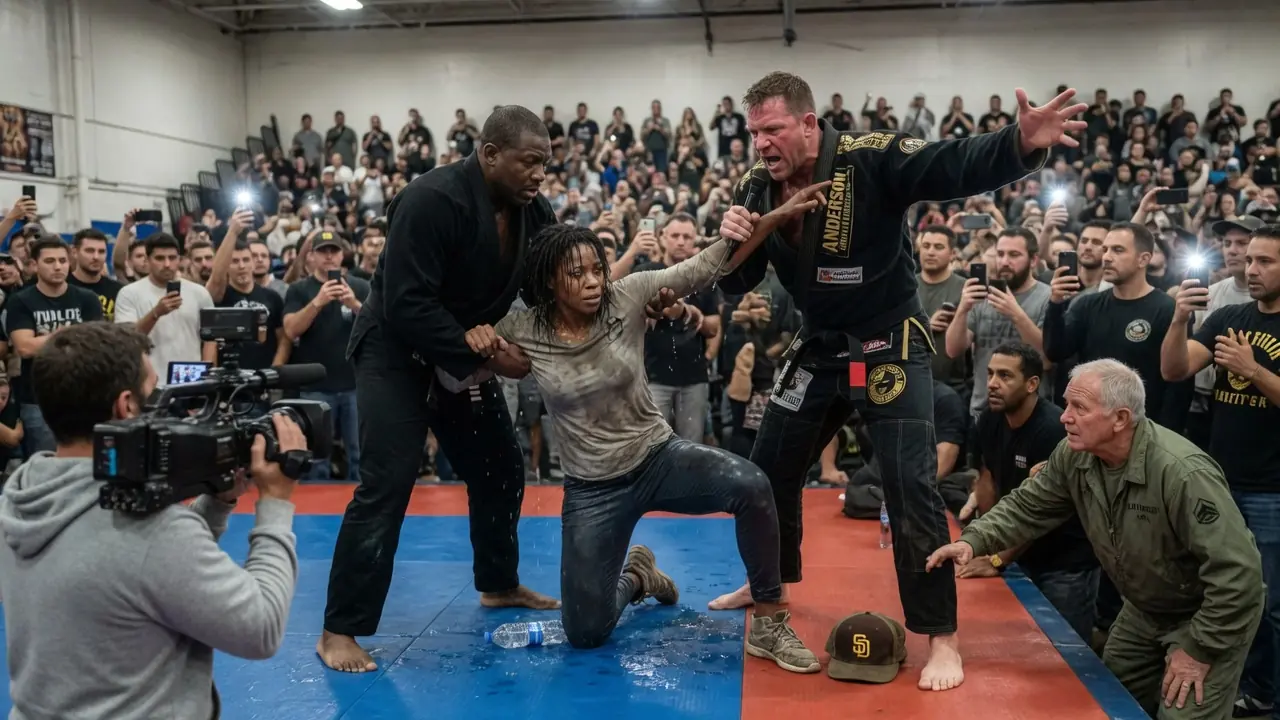
Then he turned to the 600 spectators, spreading his arms wide. Look everyone, the little rat is in the ring. Whitney was speechless. Two fighters held her arms behind her back.
Let me teach you gutters how to punch. You crossed the line. His face flushed red. He snatched the hat from her head and threw it onto the carpet.
Are you scared, little rat? He stomped on it three times, laughing loudly with delight. But Tyler didn't know one thing. What was revealed from beneath the sleeves of the black woman would be etched into his memory for the rest of his life.
Coral Bay, California, a small coastal town two hours north of San Diego. The kind of place where everybody knows everybody and nobody asks too many questions. Whitney Williams lived in a one-bedroom rental above the laundromat on Magnolia Street.
38 years old, quiet, polite to her neighbors, but never stayed for small talk. She paid her rent in cash on the first of every month. Always on time, always exact. She worked at the Coral Bay Veterans Outreach Center five days a week, eight hours a day.
She helped former service members file disability claims and find housing. Her co-workers knew she was a vet. They didn't know much else. She wore long sleeves year round, even in August.
Even when the kitchen at the center hit 90°, she'd just dab the sweat off her forehead and keep typing at her desk. The receptionist once asked her about it. Whitney smiled and said, "I get cold easy." That was the end of the conversation.
What nobody knew was this. Eight years earlier, Whitney Williams had been Staff Sergeant Williams of the United States Marine Corps, a level four instructor in the Marine Corps Martial Arts Program. She was the youngest woman to ever reach that rank in Corps history.
She had won the All-Marine Combatives Championship three times, in 2012, 2014, and 2016, gold medals each time. In the close combat community, she had a nickname. They called her the Sickle because of the way she moved on the mat and because of what happened in the 2016 final.
That final had been written up in Marine Corps Times, a two-page spread with photographs. The headline read, "The scar that won gold." Her opponent had broken the rules, pulled a tactical knife mid-match, slashed Whitney's right arm from shoulder to elbow before the referees could pull him off.
Whitney had finished the match anyway with one arm bleeding through her white gi. And she had won. The scar was crescent-shaped, long, pale against her dark skin. Anyone who had served in MCMAP knew exactly what that scar meant.
Anyone who had followed the championship circuit knew exactly whose arm it belonged to. Which is why Whitney kept it covered. She had retired in 2018 on medical discharge. The shrapnel from a vehicle blast in Helmand had left her left hip permanently damaged.
She walked with the faintest limp. Most people never noticed it. She didn't talk about the Marines. She didn't display her medals. The Bronze Star she had earned in 2014 sat in a shoe box under her bed.
She had not opened that box in five years. Whitney did not want to be known. She wanted to be left alone. Now meet Tyler Anderson, 42 years old, owner of Anderson Elite Martial Arts on Coral Bay Boulevard.
Third-degree black belt in Brazilian Jiu-Jitsu, self-proclaimed combat coach to the stars. His Instagram had 80,000 followers. His TikTok had more than that. Tyler was the son of Walter Anderson, a two-time state karate champion in the 1980s.
Walter had built Anderson Elite from nothing. When Walter died of cancer in 2019, Tyler inherited the dojo and the pressure that came with it. Enrollment was down 40% year-over-year. The lease was up for renewal next spring.
Tyler needed a viral moment, something big, something that would put his name back in the local news cycle. So he created the Civilian Combat Challenge. $10,000 prize open to anyone brave enough to step in the ring with a real fighter.
The launch event was scheduled for Saturday, October 12th. 600 tickets sold out in four days flat. Tyler stood in front of his bathroom mirror the morning of the event. He practiced his opening speech.
He practiced his predator smile in the glass. He had no idea that the woman who would walk through his front doors at noon was about to end his entire career. Three hours later, Whitney Williams handed her ticket to the usher at the door.
At 12:15 p.m., Whitney walked into Anderson Elite Martial Arts. She showed her ticket. The usher waved her toward the back row. She took seat number 587, last row, corner, her favorite kind of seat, close to the exit, far from the stage.
She wore a long-sleeve gray cotton shirt, dark jeans, a faded Padres cap pulled low. She held a paper cup of black coffee in her left hand. She had come because her neighbor Donna had given her two free tickets. Donna's husband fought in the amateur bracket.
Whitney had agreed to come out of politeness. That was the plan: watch the first match, clap, leave by two. The lights dimmed at 12:30. Smoke machines kicked on. Heavy bass rattled the bleachers.
Tyler Anderson burst out from behind the curtain in a custom black gi with gold trim. The crowd roared. He grabbed the microphone. He worked the room.
He cracked jokes about his ex-wife. He called himself the last real fighter in California. Then he announced the warm-up demo. He needed a volunteer from the audience, someone to feel what real combat feels like.
His eyes scanned the bleachers. They moved past the front row, past the men with their phones out, past the cheering seasoned ticket holders. They locked onto Whitney. She was the only Black woman in the section, sitting alone, holding a coffee cup, wearing a cap.
Tyler smiled. He pointed the microphone at her like a weapon. You, ma'am, in the gray, come on up here. Whitney shook her head once, calm.
The crowd turned to look at her. Phones came up. A few people laughed. Tyler smiled wider. He snapped his fingers.
Two of his senior students, both over six feet, both former college wrestlers, stood up from the front row. They walked down the aisle, straight toward row 20. Whitney set her coffee cup down on the empty seat next to her slowly, carefully.
She knew what was about to happen. She also knew with absolute certainty that there was no version of the next ten minutes where she walked out of this building the same woman who had walked in. The two students reached row 20 in fifteen seconds.
The taller one, blonde crew cut, grabbed Whitney's left arm. The other, thick neck, tattoos down his knuckles, grabbed her right. Come on, sweetheart. Coach wants to meet you. Don't make this hard.
Whitney didn't resist. She didn't fight back. She let them pull her up from her seat. She let them walk her down the center aisle toward the ring. 600 faces turned to watch every step.
Phones came up everywhere across the bleachers. She made eye contact with no one. She kept her arms loose. She kept her breathing steady. Four counts in, four counts out. The way she had been trained in the Marines.
They walked her up the four steps onto the elevated ring. The stage lights hit her face. The bass dropped into a low growl. The crowd cheered louder than before.
Tyler met her at center mat. He looked her up and down slowly like he was inspecting used furniture. What's your name, sweetheart? Speak up.
Whitney said nothing. Ah, she's shy. Folks, give her a round of applause. She's nervous. The crowd clapped on cue.
Tyler turned back to her. The smile dropped off his face like a mask. I asked your name, woman. I don't want to be here.
Her voice was flat, steady, almost bored. Tyler blinked. Then he laughed into the microphone. She doesn't want to be here. Hey, folks. She doesn't want to be here. Too bad.
You bought a ticket. You're part of the show now. He started to circle her like a shark circles a wounded seal. Where are you from, ma'am? Not Coral Bay. I'd remember you.
You look like you wandered in off Magnolia Street. You one of those Section 8 tenants? Welfare line? Whitney said nothing. That's what I thought.
Folks, this is what's wrong with this country. They let anyone walk in here. No skills, no discipline, no respect. He stepped closer, two feet away. One foot.
He leaned in until his mouth was inches from her ear. The microphone caught every word. You smell like a dirty laundromat, sweetheart. When was the last time you took a bath?
The crowd laughed loud, real laughter. Some people clapped along. A man in row four shifted uncomfortably. A woman in row eight covered her mouth, but nobody stood up. Nobody said stop.
Tyler kept going. He was warming up now, finding his rhythm. Look at this outfit. Long sleeves in October. Sweetheart, this is California. Are you cold?
You hiding track marks under there? He grabbed her right wrist. He yanked her sleeve up two inches. Whitney pulled back calmly, firmly. Her sleeve dropped back down.
Tyler's eyes flashed dark. Nobody pulled away from him on his own mat. Oh, she's got fight in her. Look at that. The little black rat's got fight.
He turned to his two students. He snapped his fingers twice. They moved in fast. Each one took an arm. They pulled them back hard behind her shoulders.
Not hard enough to dislocate, hard enough that she couldn't move. Whitney counted to three in her head. The way MCMAP doctrine had taught her. Three seconds, the mandatory pause before any escalation decision in close quarters.
Three seconds to choose a path she could live with. She chose. She stayed still. Tyler smiled wide.
He took a half step back. He looked her up and down again. You know what I think, folks? I think you're one of those women who watches MMA on TV and thinks she could do it.
You ever hit a heavy bag, sweetheart? You ever thrown a punch? Whitney said nothing. Answer me when I'm talking, woman. You ever thrown a punch?
Whitney looked him in the eye for the first time. Her voice was so quiet the microphone almost missed it. Please let me go. The crowd went quieter.
Not silent, but quieter. Something in her voice had shifted the room. A man in row two stopped recording. A young woman in row six lowered her phone.
Tyler felt it instantly. He didn't like it one bit. He grabbed the cap off her head roughly. He looked at it. Faded San Diego Padres.
The brim was sweat stained. The thread was unraveling at the corner. He threw it onto the mat at her feet. Sheep hat stolen.
He stomped on it. Once, twice, three times. He ground his heel into the brim. That's what your kind does, isn't it? Steal, beg, cry, then steal some more.
He pulled a plastic water bottle from his gi pocket. He uncapped it. You look thirsty, sweetheart. Here, drink.
He poured it over her head. Slow, deliberate. The water ran down her face, down her neck. It soaked into her gray cotton shirt.
The crowd laughed harder. Someone in the back wolf whistled. There we go. Now you're refreshed. Now we can have a real conversation.
He stepped behind her. He spoke into her ear loud enough for the microphone. Why don't you do us all a favor and get on your knees? Apologize for wasting our time.
Apologize for taking up space in my building. His two students pressed down on her shoulders. Whitney's knees bent just an inch. She locked them tight.
Tyler's hand moved to the back of her neck. He pressed down, not hard, but firm. The two students pressed harder on her shoulders. Her right knee touched the mat.
Tyler walked around to face her. He bent down low. He pointed his finger one inch from her nose. This is where you belong, on your knees apologizing.
He straightened up. He turned to the crowd. He spread his arms out wide. Folks, I want you to remember this image.
This is what too weak for combat looks like. This is why some people don't belong in my world. 600 people watched a Black woman on her knees in a wet shirt with a stranger's finger pointed in her face.
Nobody stood up. Nobody said stop. And somewhere in row four, a 68-year-old man in a faded Marines windbreaker started to cry quietly because he had just recognized the woman kneeling on that mat.
And he knew exactly what was about to happen next. Then she lifted her head slowly, calmly. She looked past Tyler, past his two students, past the bright stage lights. She looked into the dark crowd.
She closed her eyes for one second. Behind those eyelids, she was somewhere else. November 2014. Helmand Province. A burning Humvee.
The voice of her squad leader in her ear. Sergeant Williams. Three seconds to decide, then move. Whitney opened her eyes.
Tyler was still grinning at the crowd. His finger was still in her face. His two students were still pressing on her shoulders. She did the math in her head, the way she had been trained.
The taller student on her left, 6'4", 230, grip on her bicep, weak point, planted knee. The shorter one on her right, 6'1", 250, grip on her forearm, weak point, left elbow hyperextended. Tyler, six feet exactly, 190, standing one arm's length in front of her.
A fighter stance, but sloppy. He thought the fight was already over. 1.4 seconds. That was her estimate.
She glanced once toward the exit signs at the back of the room. Two of them. She glanced once at the news crew tripod at the side of the stage recording. Good.
She took one deep, slow breath in, out, and then Whitney Williams made her decision. It happened in 1.4 seconds. The taller student on her left felt her shift her weight first.
He felt her bicep tense under his hand. He thought she was trying to pull away. He tightened his grip. That was his mistake.
Whitney dropped her left shoulder six inches. The student's locked arm went with it. His balance broke forward. Whitney's left elbow drove backward into his planted knee.
The joint folded sideways. He screamed and collapsed onto the mat. The shorter student on her right was still processing what had happened to his partner when Whitney's right hand reached up.
She caught his wrist. She rotated. She stepped under his arm. His elbow hyperextended with a wet pop.
He went down to one knee, gasping. Both students released, both incapacitated. 0.8 seconds. Tyler was still grinning at the crowd when he heard the screams.
He turned his head. He saw both his men on the mat. His mouth opened. He never got to close it.
Whitney was already moving. She launched forward off her back leg, not at his face, not at his throat. She drove her shoulder into his sternum. Tyler went airborne.
Three feet back. He landed hard on his shoulder blades. The wind exploded out of his lungs. Whitney was on him before he could blink.
She rolled him onto his stomach. She caught his right wrist. She locked it into a textbook MCMAP armbar. Knee on his shoulder blade, wrist bent past the natural range.
One ounce of additional pressure and the bone would break. She did not add that ounce. She held him there, calm, steady, breathing even. 1.4 seconds, exactly her estimate.
The room went silent. 600 people, not one sound. Even the bass from the speakers seemed to have stopped breathing. A water bottle rolled across the floor near row 12.
You could hear it clearly across the entire room. Somebody in the back gasped. Then nothing. Tyler was face down on the mat, his cheek pressed into the rubber, his arm bent at an angle that should not exist.
He could feel her knee on his shoulder. He could feel her breath on the back of his neck. He whispered into the mat. Get off me!
Whitney did not move. Get off me. Whitney spoke for the first time on that stage. Her voice was level, almost gentle.
Tap the mat three times slow. He did not tap. She added one ounce of pressure. Just one.
He tapped three times slow. She released him immediately. She stood up. She stepped back two paces.
Her hands went down to her sides. That was when the crowd noticed her right sleeve. It had torn during the takedown. From shoulder to elbow.
The gray cotton hung in shreds and underneath, in the harsh white stage light, was the scar. Long, crescent-shaped, pale against her dark skin from shoulder all the way down to her elbow. A scar that anyone in the combat sports world would recognize on sight.
A man in row four stood up. He was 68 years old. He wore a faded Marines windbreaker over a white polo shirt. His name was Colonel Frank Whitaker, retired.
He had been the head instructor of the Marine Corps Martial Arts Program from 2010 to 2017. He had personally presented the gold medal at the 2016 All-Marine Combatives Championship final. He had been the one who taped Whitney Williams' arm back together after the knife incident.
He had written the recommendation letter that got her promoted to level four instructor. Tears were streaming down his face. His voice cracked, but it carried. My God, that's Williams. That's the Sickle.
I gave her the gold medal in 2016. 600 heads turned to look at him. A woman in row 11 stood up next, mid-40s, short brown hair. She wore a Navy and Marine Corps Commendation Medal pin on her jacket lapel.
Her name was Lisa Brennan, former gunnery sergeant. She had served alongside Whitney in Helmand in 2014. Her voice was barely a whisper, but the room was so quiet. Everyone heard it.
Whitney. Whitney Williams. Oh my God. Then a man in row 8 stood up, younger, mid-30s.
He wore a Marine Corps veteran's hat. He spoke louder than the other two. I watched that 2016 final on YouTube a hundred times. That's her. That's the scar.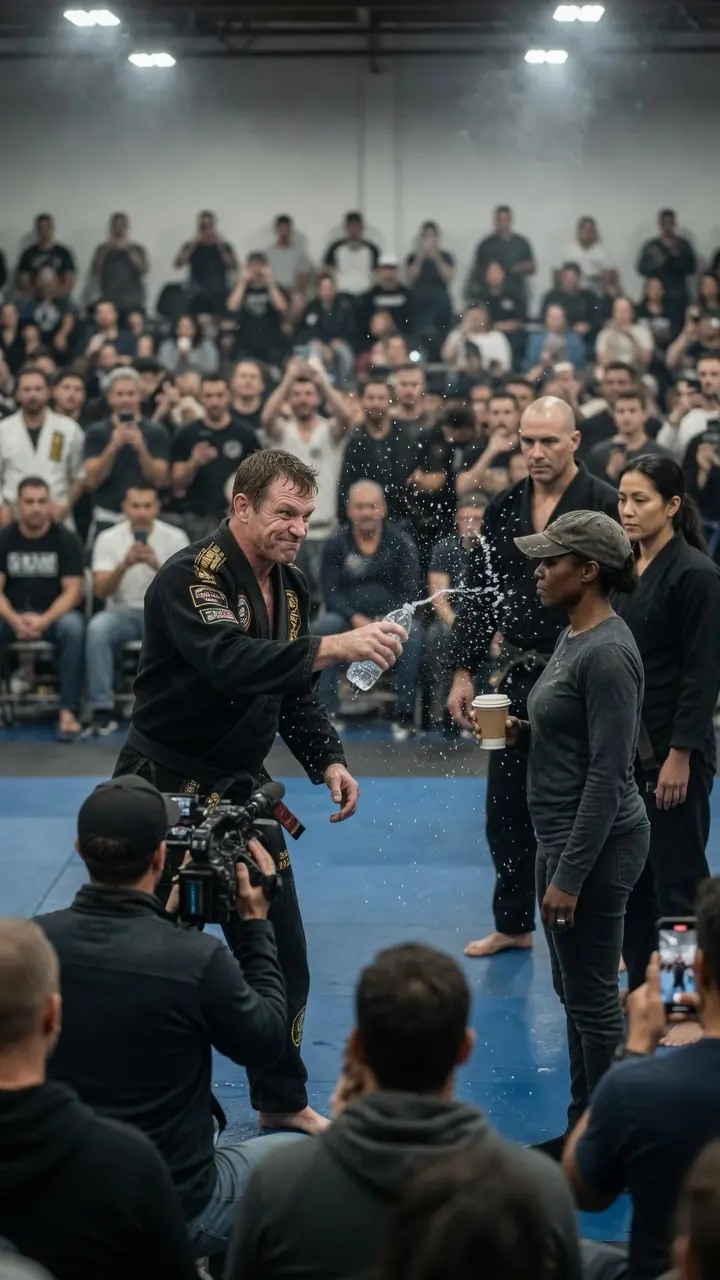
Three people standing, then five, then twelve. A retired Navy chief in row two, a former Army medic in row 17, a widow of a Marine in row 9, holding her husband's old dog tags. They all stood up.
None of them said anything. They didn't have to. Whitney looked at Colonel Whitaker for a long moment. She did not move.
She did not speak. Then she did something nobody expected. She raised her right hand to her brow. Slowly, calmly, a textbook military salute.
Held it for three full seconds. Colonel Whitaker returned the salute. So did Lisa Brennan. So did every single veteran in that room.
Twelve hands at attention in a martial arts gym in Coral Bay in front of 600 witnesses and three local news cameras. Tyler was still on the mat. He pushed himself up onto his elbows.
He saw the salute. He saw the standing veterans. He saw the scar on Whitney's arm. His face went pale.
He had seen that scar before in a magazine, in a video, in a training tape at his black belt certification course five years ago. The Sickle. The 2016 final. The woman who finished the fight with a knife wound from shoulder to elbow.
His mouth moved. No sound came out at first. Then he screamed. He scrambled to his feet.
Rage in his eyes. Wounded pride. He charged her again. Whitney did not move until he was two feet away.
Then she stepped to the side. She caught his arm. She used his own momentum. He hit the mat face first.
She locked the armbar again, released on the tap, stepped back. He got up again. He charged again. Same result.
He got up a third time. Same result. He got up a fourth time. This time when he hit the mat, he did not get up.
His nose was bleeding from his own impact. His shoulder was dislocated from his own bad fall. He lay there gasping, looking up at her. Whitney looked down at him for one second, no expression on her face.
Then she turned. She walked across the mat. She bent down. She picked up her cap, the one he had stomped on three times.
She brushed it off. She put it back on her head. She walked across the ring, down the four steps, up the center aisle. 600 people parted to let her through.
Nobody laughed now. Nobody filmed. She walked out the front door of Anderson Elite Martial Arts. She did not look back.
Behind her, in the silence, Colonel Frank Whitaker was still standing, still saluting. And on three local news cameras, the entire thing had been captured live.
By Monday morning, Whitney Williams was the most talked about woman in Coral Bay. By Tuesday morning, she was the most hated. The three local news stations had aired the footage Saturday night at 11:00, then again at 6:00 a.m. Sunday, then every hour after.
But somebody had gotten to the footage first. Tyler Anderson had been busy all weekend. He had hired a crisis PR firm out of Los Angeles. He had hired two lawyers.
He had hired a video editor who specialized in narrative reconstruction. Everyone else called it doctoring. By Monday morning, a new clip was making the rounds online, 16 seconds long.
It started with Whitney already on the mat. It started with her launching shoulder first into Tyler's chest. It cut to her locking the armbar. It cut to Tyler face down screaming.
The clip did not show Tyler pouring water on her head. It did not show her saying, "Please let me go." It did not show the two students holding her arms. It did not show her on her knees with his finger in her face.
The clip just showed a Black woman attacking a white martial arts instructor in his own gym. The caption read, "Unprovoked assault. Coral Bay business owner hospitalized. Lawsuit pending." It got 200,000 views on Monday alone.
By Tuesday morning, Tyler had filed a civil lawsuit. $2 million. He cited assault. He cited emotional distress.
He cited lost business income due to defamation. He held a press conference outside his dojo. His arm was in a sling. His shoulder was wrapped in white medical tape.
His face was scrubbed clean of any blood. He stood in front of nine cameras. He looked into them with sad wounded eyes. I tried to help her.
I tried to give her a chance. And she attacked me right in front of my students, in front of children. I am lucky to be alive.
A reporter asked about the cap, about the water, about the two students. Edited footage. Fake news. The internet does what the internet does.
The full video shows the truth. He did not say what the full video was. He did not release any other footage. By Tuesday afternoon, three things had happened to Whitney.
The first was the tires. Both front tires had been slashed in the parking lot of the Veterans Outreach Center. Clean cuts, professional, done with a tactical knife.
The second was the brick. A red brick came through her living room window Tuesday at 2:00 a.m. Wrapped around it with a rubber band was a piece of paper.
On the paper was the Anderson Elite Martial Arts logo. Nothing else. The logo was enough.
The third was the call from her boss at the Veterans Outreach Center. He sounded apologetic. He sounded scared. Whitney, listen.
The board called an emergency meeting last night. They want you to take administrative leave unpaid, just until this blows over. I am so sorry.
Whitney did not argue. She said, "Thank you." She hung up. She sat in her apartment for one hour.
The brick was still on her living room floor. Glass was still scattered across the carpet. The cold October air was coming through the broken window. Then she did three things.
The first was she opened the shoe box under her bed. She took out the Bronze Star with Valor. She looked at it for 30 seconds. Then she put it in her pocket.
The second was she called Gunnery Sergeant Dwayne Brooks, her former squad leader from Helmand, the man who had been with her the night of the Humvee fire. Brooks, it's Williams. I need a lawyer.
Brooks did not ask why. Brooks said he would be there in two hours. The third was she took the Padres cap off her head. She washed it in the sink, slowly, carefully.
She hung it on the towel rack to dry. Then she went to bed. Brooks arrived at 8:00 p.m. He brought a woman with him, 45 years old, Black, short natural hair, sharp gray suit.
She carried a leather briefcase. Her name was Diana Moore. She had been a civil rights attorney for 19 years. She had argued two cases before the Ninth Circuit Court of Appeals.
She specialized in cases where the system tried to bury people who looked like Whitney. She did not shake Whitney's hand. She nodded once. Professional.
She sat down at Whitney's kitchen table. She opened her briefcase. She pulled out a laptop. Show me everything you have.
Whitney showed her the brick, the note, the tire photos, the text from her boss, the doctored video circulating online. Diana watched the doctored video twice without speaking. Then she opened a separate file on her laptop.
She turned the screen toward Whitney. It was the full unedited footage from one of the three local news stations. The footage Tyler did not want anyone to see.
Whitney watched herself walk into the dojo. She watched Tyler point at her. She watched the two students drag her up the aisle. She watched him pour water on her head.
She watched herself say, "Please let me go." She watched her own knee touch the mat. Then she watched the 1.4 seconds.
Diana paused the video. She looked at Whitney across the kitchen table. Three things, Whitney. First, we have all three news station feeds.
All of them unedited, timestamped. Second, we have 12 witnesses who stood up and saluted you Saturday, including a retired Marine Corps colonel. Third, I already spoke with Colonel Whitaker on the phone tonight.
He is willing to testify as an expert witness on MCMAP doctrine and minimum force application free of charge. Whitney did not say anything for a long moment. Then she asked one question. How bad will it get before it gets better?
Diana did not lie to her. Diana never lied to her clients. It will get worse. They will dig up everything.
They will leak it. They will pay people to say things about you. They will call your old commanding officers. They will say you are mentally unstable.
They will say you are dangerous. They will say you have PTSD and lost control. Whitney nodded once.
And then we will go to court and we will win and Tyler Anderson will spend a very long time wishing he had picked a different woman to drag onto his stage. Diana closed her laptop. She stood up.
She buttoned her jacket. I need three things from you, Whitney. Number one, do not give any interviews. Number two, do not respond to any messages from Tyler's people.
Number three, wear short sleeves to court. Whitney looked at her for a long moment. Why short sleeves? Diana smiled for the first time that night.
Because juries believe what they can see. She walked to the door. She turned back. She gave Whitney one more piece of advice, the most important one.
And Whitney, when you take the stand, do not say anything you have not already said in this kitchen tonight. Not one word. Six weeks later, Coral Bay Superior Court, Courtroom 3, downtown.
The hearing was scheduled for 9:00 a.m. Thursday. By 8:30, the public gallery was full. Standing room only. The bailiff turned people away at the door.
Tyler Anderson sat at the plaintiff's table. He wore a charcoal gray suit. His arm was still in the sling six weeks after the dislocation. His two lawyers sat on either side of him.
Expensive haircuts, expensive watches. At the defendant's table, Diana Moore sat alone next to Whitney. Whitney wore a simple navy blue blouse, short sleeves. The crescent scar on her right arm was visible to every juror, every reporter, every face in the gallery.
The Bronze Star was pinned over her heart. She had not put it on. Diana had put it on her that morning. Behind her, in the second row of the gallery, sat Colonel Frank Whitaker.
He wore his full dress uniform, service ribbons across his chest. Beside him sat Gunnery Sergeant Dwayne Brooks, also in dress blues. Beside Brooks sat Lisa Brennan and beside her 11 other veterans Whitney had never met.
All in uniform, all sitting at attention. The judge entered. Honorable Patricia Mendes, 22 years on the bench. The plaintiff went first.
Tyler's lead lawyer was sharp, polished. He played the doctored 16-second clip. He talked about an unprovoked assault. He asked for $2 million in damages.
He sat down at 10:15. Diana Moore stood up at 10:16. She did not raise her voice. She did not pace.
She walked to the projection screen. She opened her laptop. She loaded a file. Your honor, the plaintiff has shown you 16 seconds of edited video.
I would like to show the court the full 34 minutes. She pressed play. All three news station angles, timestamped, synchronized.
The courtroom watched Tyler point at Whitney from the stage. They watched his two students drag her up the steps. They watched Tyler call her a black rat. They watched him pour water on her head.
They watched him stomp on her cap. They watched him press her down onto her knees. They watched her say, "Please let me go." Then they watched the 1.4 seconds, followed by Colonel Whitaker standing, followed by the salute.
Diana stopped the video. The courtroom was silent. She turned to Judge Mendes. Your honor, the defense calls Colonel Frank Whitaker, retired.
Whitaker walked to the witness stand. He was sworn in. He sat down. Diana asked three questions.
Colonel Whitaker, what is the Marine Corps Martial Arts Program? He answered for 12 minutes. He explained MCMAP doctrine. He explained levels of force.
He explained that a level four instructor was trained to neutralize a threat with the least possible injury. Colonel Whitaker, did you observe the defendant's actions on the video the court just watched? I did, ma'am.
In your professional opinion, did her actions comply with MCMAP minimum force doctrine? Whitaker looked directly at Tyler. They were textbook.
She could have killed three men in that ring. She chose to break no bones. She chose to draw no blood except what they did to themselves. In 32 years of Marine Corps service, I have never seen better restraint under provocation. Ever.
Diana nodded. One more question, Colonel. Do you recognize the scar on the defendant's right arm? Whitaker's voice cracked.
I do, ma'am. I bandaged that wound myself. November 5th, 2016. The All-Marine Combatives Championship final.
Her opponent broke the rules, drew a tactical blade, cut her open from shoulder to elbow. She finished the match anyway, won the gold. He paused.
That is the scar of a woman who does not quit. That is the scar of a champion. Diana sat down. Tyler's lawyer stood up for cross-examination.
He had no questions. Diana called her second witness, Lisa Brennan, former gunnery sergeant. Ma'am, do you recognize the defendant? Yes, she saved my life.
November 24th, 2014. Helmand Province. A Humvee in our convoy hit an IED. I was the driver.
The vehicle was burning. I was unconscious. Sergeant Williams pulled me out through a broken window. She was under fire the whole time.
Was she awarded a medal for that action? Yes, ma'am. The Bronze Star with Valor, the one she is wearing today. The courtroom shifted.
Somebody in the back exhaled hard. A juror in the second row wiped her eyes. Diana sat down. No cross-examination.
Then Diana stood one final time. She walked to the projector. She pulled up one image, a magazine cover. Marine Corps Times, November 2016.
The headline read, "The scar that won gold." The cover showed a younger Whitney Williams bleeding through her gi, holding up a gold medal. Diana turned to face Tyler.
Mr. Anderson, you told 600 people that this woman was too weak for combat. You told them she did not belong in your world. Could you define combat for the court, please? Tyler did not answer.
Could you tell us, Mr. Anderson, your own combat record, your deployments, your service? Tyler's lead lawyer stood up. Objection. Relevance.
Judge Mendes looked at him over her glasses. Overruled. Mr. Anderson called the defendant too weak for combat in a public forum recorded by three news stations. He opened the door.
He will answer the question. Tyler's mouth opened. Closed. Opened again.
I never served. You never served. Diana repeated. And the woman you called too weak.
The woman you dragged onto your stage. The woman you poured water on and forced onto her knees. She is a three-time All-Marine Combatives champion. A level four MCMAP instructor.
A Bronze Star recipient for valor under enemy fire. She has earned the word combat. Have you, sir?
Tyler said nothing. Diana let the silence sit for ten full seconds. Then she said the words that would end Tyler Anderson's career. No further questions.
Judge Mendes looked at Tyler. Mr. Anderson, the court is going to give you one opportunity to address the bench before I rule. Would you like to say anything?
Tyler's pride broke. Six weeks of rage cracked open in his eyes. She had no business being a soldier. Women like her, they get in because of quotas.
She did not earn that scar. She did not earn that medal. She is a fraud. A welfare case in a uniform.
The courtroom gasped. Judge Mendes slammed her gavel. Whitney was offered one final chance to speak. Diana looked at her.
Whitney nodded once. She stood up. She walked to the witness stand. She did not sit down.
She looked directly at Tyler. Her voice was steady. I learned to fight so I would never have to. You made me have to.
Twenty-one words. She sat back down. Behind her, Colonel Whitaker stood up, then Brooks, then Lisa Brennan, then every veteran in the room.
Judge Mendes took 30 seconds. Then she ruled. The plaintiff's case is dismissed with prejudice. All claims denied.
I am referring Mr. Anderson's perjury and his fabricated video evidence to the district attorney's office for criminal prosecution. The fall came fast. Within 48 hours of Judge Mendes's ruling, Tyler Anderson's world began to collapse from every direction at once.
His insurance carrier dropped Anderson Elite Martial Arts. His landlord terminated the lease for cause. Three sponsors pulled their logos off his dojo walls. The crisis PR firm that had cost him $40,000 stopped returning his calls.
Two weeks later, the district attorney filed criminal charges: perjury, fabrication of evidence, assault, and false imprisonment from the original incident, civil rights violations under California Penal Code section 422.6. The case made the front page of every newspaper in the region.
The trial lasted four days. Twelve witnesses testified against him. The jury deliberated for less than two hours. Tyler Anderson was sentenced to 24 months in state prison.
He was ordered to pay $100,000 in restitution to Whitney Williams. He was permanently barred from owning or operating any martial arts business in the state of California. His two students, the ones who had dragged Whitney up the aisle, they were charged with assault and unlawful restraint.
Each was sentenced to six months in county jail. Both lost their black belts in formal proceedings before the regional Brazilian Jiu-Jitsu Federation. Anderson Elite Martial Arts closed its doors on a Tuesday in early December.
The sign came down on Wednesday. By Friday, the building was empty. Whitney did not attend the sentencing. She had something more important to do.
She had opened a class. She called it Sleeves Up. The first session was held in the back room of the Coral Bay Community Center. A converted basketball court, folding chairs, donated mats, hand sanitizer, and plastic pumps.
50 people signed up in the first week. By the second month, the list had grown to 212. Most of them were women. Many of them carried scars under their own long sleeves.
Scars from husbands, scars from strangers, scars from things they had never told anyone about before. Lisa Brennan came down from Sacramento every Saturday to assist. Gunnery Sergeant Brooks drove in from Bakersfield twice a month.
Colonel Whitaker showed up to the very first class in his Marines windbreaker. He carried a folding chair under one arm. He sat in the back. He never said a word.
He just watched. Whitney did not teach punches first. She did not teach kicks first. She taught breath.
She taught how to stand. She taught the word no. She taught her students how to say it out loud. Calm, steady, without apology.
The way she had said it in the ring six months earlier. On opening day when her first student, a 70-year-old grandmother named Ruth, who had survived three decades of abuse from a man now dead, finally said the word no without trembling. Whitney smiled at Ruth.
It was the first time anyone had seen her smile in the entire story, two full seconds long. Then it was gone again. But Ruth saw it and Ruth told everyone.
By spring, the Coral Bay City Council passed an ordinance. They called it the Williams Law. It required written consent from any audience member before commercial martial arts demonstrations could involve them physically. The law passed unanimously.
Within a year, five other California cities had adopted similar versions. The hashtag was the last thing to spread. It started inside the veterans community. Then it moved into the women's self-defense community.
Then it crossed over into everything. #JusticeForWilliams #TooWeakForCombat. By the six-month mark, the original news footage had been viewed 40 million times across every major platform.
The phrase that Tyler Anderson had used as a weapon, "too weak for combat," now belonged to every woman, every veteran, every survivor who had ever been underestimated, dismissed, dragged onto somebody else's stage against her will. Whitney never gave a single interview about any of it.
She declined every offer: talk shows, documentaries, book deals. The only public statement she made was a single line on a small handwritten sign she put up on the wall of the Sleeves Up classroom. The sign read, "I learned to fight so I would never have to. Now I teach so you never have to either."
She wore short sleeves to class that day. Standing at the front facing 50 students, the crescent scar caught the morning light. And not a single woman in that room looked away from it.
One year after the events at Anderson Elite Martial Arts, Whitney Williams was back at the Veterans Outreach Center. The board that had suspended her had been replaced. The new director personally drove to her apartment to deliver the apology letter.
Whitney accepted the job back on one condition. She would work four days a week. Friday was for Sleeves Up. By that summer, Sleeves Up had three locations across Coral Bay County.
All of them ran on donated mats and volunteer instructors. None of them charged a single dollar in tuition. Whitney refused to accept any payment for teaching.
She told the press exactly once in a written statement. You cannot put a price on the word no, so I do not. Colonel Frank Whitaker passed away peacefully in his sleep in March of the following year.
He was 70. At his funeral, Whitney Williams gave the only eulogy. It was four sentences long. She did not cry.
She said he had saved more lives in his retirement than most generals saved in their entire careers. She said he had saved hers twice. Once in 2016 with a roll of medical tape and again in a courtroom in Coral Bay with a phone call she did not know he had made.
Gunnery Sergeant Brooks opened his own Sleeves Up location in Bakersfield. Lisa Brennan started a sister program for female veterans in Sacramento. Together, the three programs have trained over 4,000 women in basic self-defense over the last two years.
Tyler Anderson served 18 months. He was released on good behavior. He moved to Arizona. He works at a hardware store now.
He does not teach anymore. He will never teach again. His two students, the ones who held Whitney's arms behind her back, both completed their six-month sentences.
One of them, the younger one with the tattoos, eventually wrote Whitney a letter from his cell. He apologized. He asked if there was any way to make it right. Whitney wrote back three sentences.
She told him there was. She told him to go find a Sleeves Up program in his city. She told him to sign up as a student. He did.
He has been training for 14 months now. He has not missed a single class. The crescent scar on Whitney's right arm is now visible in every Sleeves Up class photo.
Every student knows what it means. Every student is told the story on day one. The story of the woman who finished a championship match bleeding through her gi. The story of the woman who walked into a martial arts demonstration as a spectator and walked out as a movement.
The story of the woman they tried to drag down and could not.