The Saturday morning Frank Dalton took his granddaughter shopping for her first car began without ceremony.
There was no ribbon around a key, no photographer, no family gathering waiting to surprise her, and no private showroom appointment arranged under his name.
There was only the smell of coffee in Frank's kitchen, the scrape of a spoon against a ceramic bowl, and eighteen-year-old Emily Dalton sitting across from him with a folded notebook open beside her breakfast.
She had spent most of the week filling that notebook with numbers. Insurance estimates. Fuel costs. Registration fees.
Average maintenance for compact sedans. The prices of used cars she had found online and the mileage each one carried. Frank had watched her add and subtract and cross things out until the page looked like a map drawn by someone who was determined not to get lost.
“This is it, Grandpa,” Emily said, closing the notebook with both palms as though sealing a contract. “My first car search.”
Frank smiled into his coffee. “Then let’s go find you something reliable, sweetheart.”
Emily’s excitement was impossible to miss. She had been talking about driving since she was fourteen, though Frank had made her wait until she had a license, a steady part-time job, and enough money saved to understand what owning a car actually cost. He had never wanted her to mistake access for entitlement. A car was freedom, but it was also fuel, insurance, tires, repairs, registration, and the thousand small responsibilities hidden behind a shiny hood.
Emily knew all of that. She had worked weekends at a neighborhood bakery for almost two years, waking before sunrise to frost cinnamon rolls and box pastries before most of her friends were awake. She had saved nearly every dollar she could after putting aside money for college books. Frank knew exactly how much was in her account because she had shown him the balance proudly the week before, but he had not told her what he planned to contribute.
He had promised only one thing: when she was ready to buy, he would go with her.
Frank dressed the same way he dressed most Saturdays, in worn khaki pants, a pale blue button-down shirt with the sleeves rolled once at the wrist, and a brown canvas jacket that had faded unevenly at the elbows. His boots were clean but old, the leather creased from years of use. He wore no expensive watch, no ring besides his wedding band, and nothing that suggested the actual scale of the life he had built.
Emily wore jeans, white sneakers, and a navy sweater under a light jacket. She had tied her hair back loosely and carried a canvas tote with her notebook, a bottle of water, a packet of crackers, and every document Frank had told her to bring even though she was only planning to look that day.
“You packed like we’re crossing state lines,” Frank said when he saw the folder sticking out of her bag.
“You told me to be prepared.”
“I did.”
“So I’m prepared.”
Frank chuckled. “Your grandmother would have liked that answer.”
The mention of Helen softened the room for a moment. Emily had been twelve when her grandmother died, old enough to remember the shape of her hands and the way she folded dish towels into perfect thirds, young enough that some memories were already becoming fragments. Frank still spoke about Helen often, but never in a way that made grief the center of every conversation. He believed remembering someone should include laughter, irritation, ordinary habits, and all the small pieces that made a person real.
Helen had been the one who insisted money should never become the loudest thing in their family. Frank had already been successful by the time Emily’s mother, Laura, was a teenager. The businesses had grown, the investments had multiplied, and people who once ignored him had begun returning his calls with suspicious speed. Helen had noticed the change before he did.
“Watch how people behave before they know what you can do for them,” she had told him one night after a charity dinner. “That is usually when they are telling you the truth.”
Frank had never forgotten it.
He was not ashamed of wealth. He had worked for it, taken risks for it, and used much of it to build things he believed mattered. But he refused to make wealth the introduction to his name. He had spent twenty-two years in the Army, starting as a young mechanic and leaving as a colonel in logistics, after which he had built a commercial fleet-maintenance company with two partners and a bank loan no one sensible would have approved. The company had grown across four states before he sold most of his interest. He invested part of the proceeds in businesses he understood, including regional transportation companies, repair networks, and, eventually, Ashford Automotive Group.
He had been one of the company’s early outside investors when it was still six dealerships and a struggling distribution operation. Twenty years later, Ashford operated dozens of dealerships across the region. Frank was not involved in daily management, and he preferred it that way. His name appeared in board materials, investment reports, and foundation partnerships, but almost never in advertising.
The work he cared about most now was the Dalton Veterans Foundation, which he and Helen had created after his retirement. It funded emergency housing, trade-school scholarships, family counseling, adaptive vehicle programs, and transition support for veterans leaving military service. Frank had sat with too many men and women who had worn uniforms proudly and then found themselves invisible the moment those uniforms came off. He had built the foundation around a simple rule: help should arrive before humiliation becomes the price of asking.
Emily knew her grandfather had money. It would have been impossible not to know. She had been to foundation events and had heard adults introduce him with titles that made him uncomfortable. But she had grown up with a version of Frank who still changed his own oil, reused grocery bags, drove a twelve-year-old pickup, and returned tools to the same drawer every time.
That was the grandfather getting into the passenger seat beside her that morning.
“You’re driving?” Emily asked.
“You need practice.”
“I thought today was supposed to be relaxing.”
“For me, it will be.”
Emily groaned, but she was smiling as she started the truck.
The dealership they chose was Ashford Motors West, a large glass-fronted showroom on the edge of town with polished concrete floors, bright banners, and nearly three hundred vehicles spread across several acres. Frank had suggested it because its used inventory was broad and its service department had one of the better regional records. He had not told anyone they were coming. He had not called the general manager. He had not used the investor concierge line available to him. He wanted Emily to experience a normal purchase from beginning to end.
More importantly, he wanted her to learn how to judge people in situations where she did not yet know what she wanted.
They arrived just after ten in the morning. The dealership was already busy. A young couple stood beside a crossover with a salesperson pointing at the cargo area. A man in golf clothes was being shown a large luxury SUV. Two salesmen waited near the main entrance, but both glanced at Frank’s old pickup, then looked away as he and Emily climbed out.
Emily noticed.
She did not say anything at first. They walked through one row of compact sedans, then another. Bright price stickers filled the windshields. Frank let her stop wherever she wanted, and he answered questions only when she asked them.
“Look,” Emily said after a few minutes, pointing down the row. “There’s so many cars to choose from.”
“Take your time,” Frank said. “No rush today.”
She stopped at a dark gray sedan, read the mileage, then shook her head. Too high. She moved to a red hatchback, looked at the interior through the glass, and decided she did not like the blind spot around the rear window. Frank said nothing. This was her decision, and he intended to let her make it.
Then she saw the blue car.
It sat three rows over beneath a white shade canopy, a late-model compact sedan with modest mileage, simple trim, good safety ratings, and the exact deep-blue color Emily had once pointed out while they were driving together months earlier.
“Grandpa,” she said. “Look at that blue one over there.”
“We’ll take a look.”
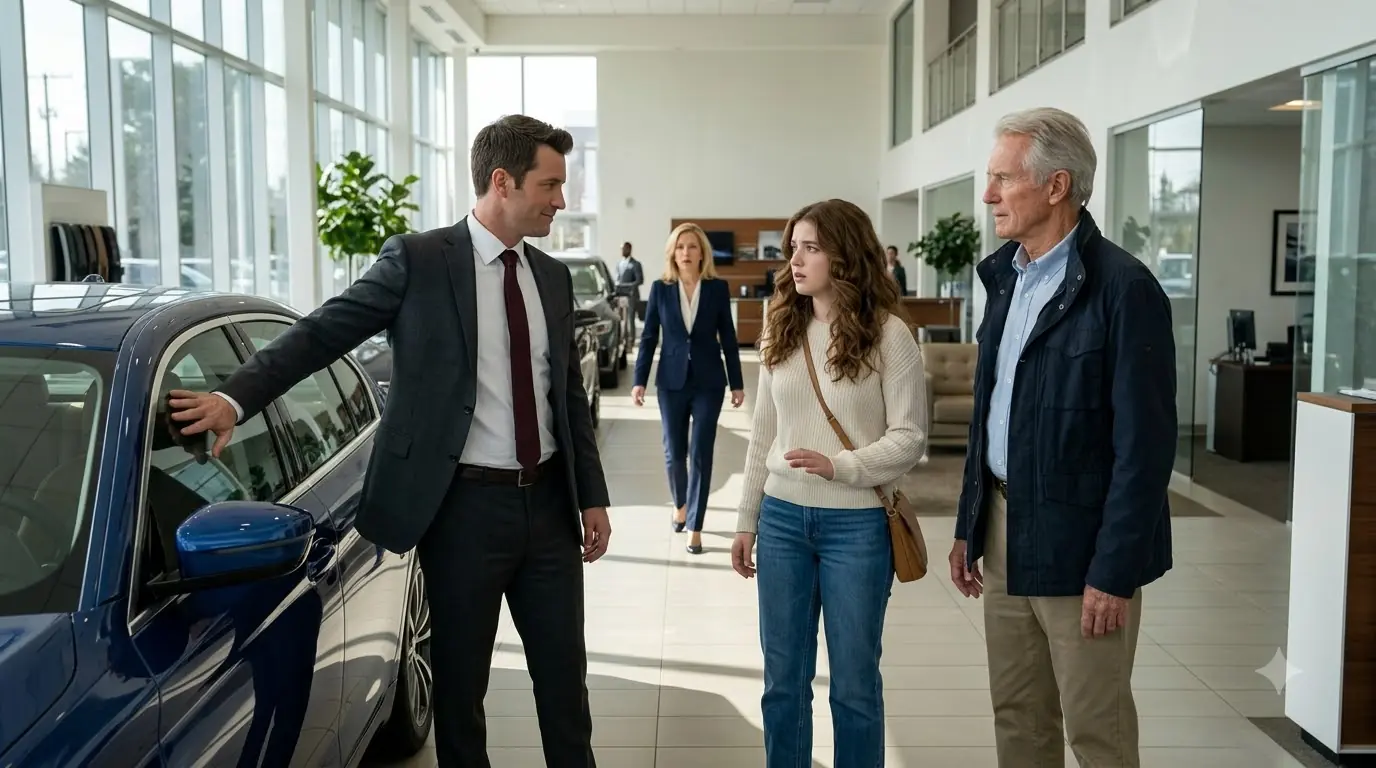
They crossed the lot and stopped beside it. Emily walked slowly around the car, trying not to look too eager. Frank watched her inspect the tires the way he had taught her. She crouched to look beneath the rocker panels for rust. She checked the panel gaps. When she reached the driver’s side, she smiled despite herself.
“Can we look inside?” she asked.
“We can,” Frank said. “Let’s just wait for someone to help us first.”
They waited.
One salesman passed within twenty feet of them and gave a quick polite smile before continuing toward a middle-aged couple stepping out of a new SUV. Another walked from the showroom carrying a tablet, glanced at Emily, then at Frank’s jacket, and turned toward a man in a suit standing beside a performance coupe.
Five minutes passed.
Emily’s excitement dimmed only slightly at first. She read the window sticker again. Then she checked the tires a second time, though she already knew there was nothing else to see without a key.
“Is anyone going to help us?” she asked quietly.