They Laughed at the Dirty Black Janitor — Then the CEO Walked In and Dropped to His Knees
Chad Prescott snatched the mop handle directly out of the old black man's hands and held it up in the air like evidence at a trial. Let me ask you something.
His voice was loud, deliberate. The three board members behind him stopped walking.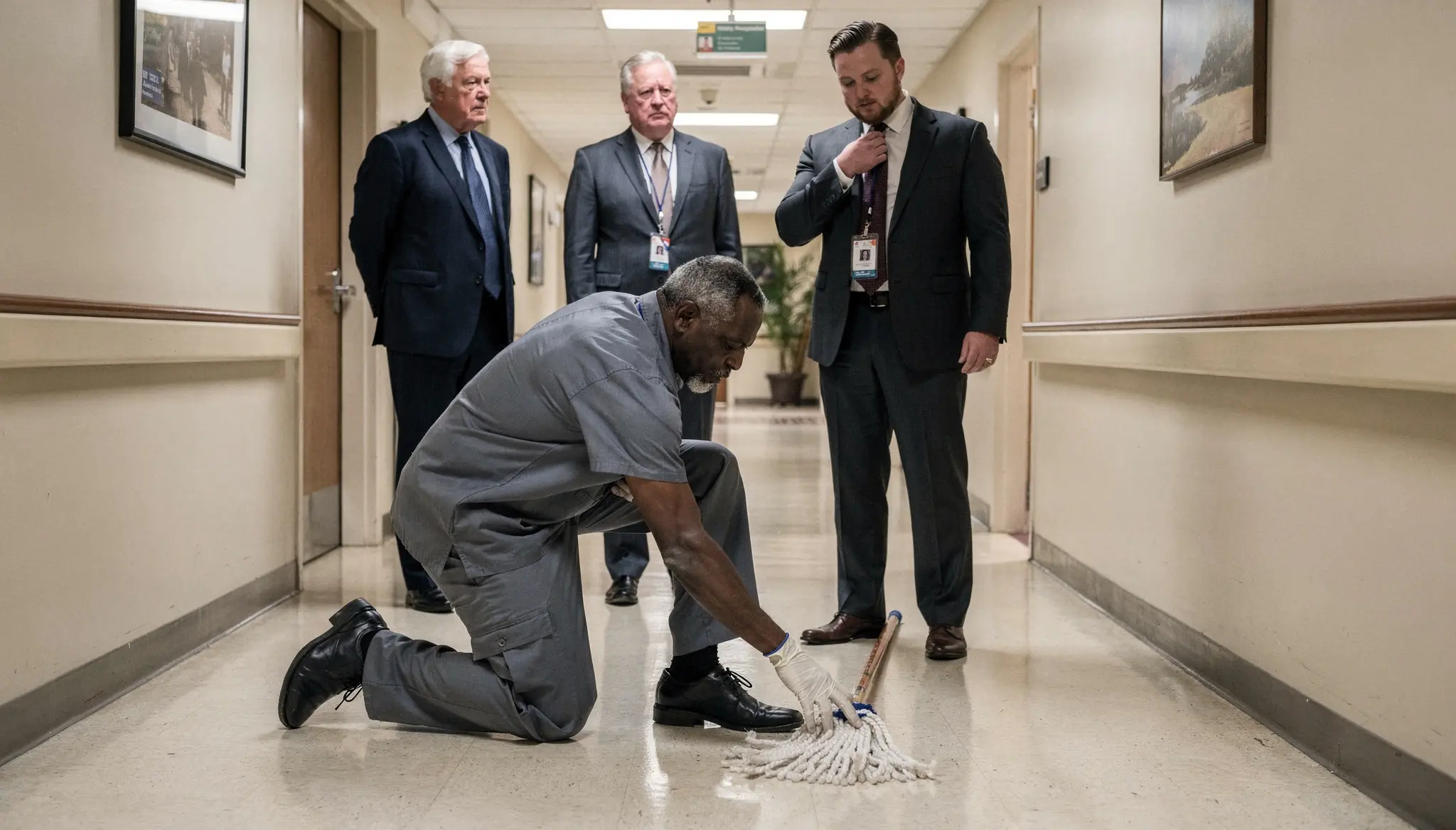
How long does it take a grown black man to mop one hallway?
Because I have been standing here for 4 minutes and this floor looks exactly the same as when I got here. He dropped the mop. It clattered against the linoleum and slid into the wall. Pick it up.
The old man reached for the handle, slowly. His knees were not young. Prescott stepped on the mop head before the man's fingers reached it.
You know what your problem is?
He leaned down close enough that his voice dropped to something almost private, almost except that every nurse in that corridor could hear every word.
You people think showing up is the same as working.
It isn't. Showing up is the bare minimum and right now you're not even clearing that bar. He straightened, adjusted his tie, looked back at the board members with a small, satisfied smile, the smile of a man performing for an audience he believed was on his side. Then he looked back down at the black man still on his knees on the wet floor.
I've seen more hustle from the vending machine at the end of the hall.
At least that thing delivers when you push its buttons. Two board members looked away. One of them studied his shoes very carefully. The old man on the floor said nothing.
He looked up once, steady, quiet. Those eyes holding something Prescott would never have the vocabulary to name, and then he reached for the mop handle again. What nobody in that hallway understood yet was who this man had been before he ever touched a mop. They were about to find out.
And not a single person in that building would walk away unchanged.
His name was James Earl Whitfield. Not Earl. Not the janitor. Not the quiet old black man on the neurology floor who showed up before sunrise and left after sunset and never once complained about anything.
James Earl Whitfield. 64 years old. 6 feet. Even though he carried himself smaller these days, the way men do when they have decided consciously or not to take up less space in the world.
His hair was silver at the temples and cropped close. His hands were the thing about James that you noticed if you were paying attention, which almost nobody was. They were extraordinary. Long-fingered, precise, steady in a way that had nothing to do with youth.
The kind of steady that gets trained into a person over decades of work that does not forgive mistakes. Nobody at Mercy General Hospital in Richmond, Virginia had thought much about his hands. He had applied for the janitorial position 8 months ago under his middle name. Earl Whitfield.
The HR coordinator, a 26-year-old named Brittany, who was juggling 14 open requisitions that week, had processed his application in 11 minutes. Background check clean. References, two. Both former colleagues who understood what he needed without being told.
Prior employment was listed simply as medical research and consulting, retired. She had not Googled him. There was no reason to Google a janitor. He started on a Monday in early February assigned to the neurology ward third floor.
He arrived at 5:45 every morning 15 minutes before his shift began. He folded his personal jacket in his locker the same way every time: collar down, sleeves in, edges squared. A habit from another life. He made himself coffee in the break room, black, no sugar, and he stood at the window for exactly 5 minutes looking out at the parking lot while the building woke up around him.
Then he worked. He was methodical. Unhurried but never slow. He moved through the corridor in long even passes the mop tracing the same pattern each time the same way a scalpel traces the same path not because you are on autopilot but because precision is its own form of respect.
For the floor. For the patients behind the closed doors. For the work itself.
Grace Tillman had noticed him on his third day.
Grace was 61, white, with 35 years at Mercy General, the kind of nurse who had outlasted six Chiefs of Medicine and three full administrative overhauls and still knew where every supply closet key was kept. She had a way of reading people that had nothing to do with credentials and everything to do with decades of watching human beings under pressure. She had watched a lot of people mop floors.
Something about the way Earl did it made her slow down one morning and just watch.
You've done detail work before, she said, not as a question. He looked up.
Beg your pardon? The way you work.
Around the chair legs, under the baseboard. Most people just push the water around. You're actually cleaning. He smiled. Small, real.
My mother was particular about floors.
Grace had laughed. She brought him coffee the next morning. After that, it was simply what she did. She was one of two people on the entire floor who called him by name.
The other was Dorothy Haines in room 412. Dorothy was 78, a retired Henrico County schoolteacher with 41 years in the classroom. She had stage-four ovarian cancer, diagnosed 14 months earlier. Her son lived in Phoenix and called on Sundays if he remembered.
Her daughter had died young, an accident 20 years ago, and Dorothy had carried that loss the way some people carry a stone in their chest, always there, always heavy. So familiar by now that it had become part of her posture. James had knocked on her door on his second week. The crossword puzzle from her breakfast tray was sitting untouched on the side table.
And she was staring at the ceiling with the particular expression of someone counting the tiles and finding no comfort in the number.
Mind if I take a look at that? he asked, nodding at the puzzle.
She had looked at him for a long moment. Then she handed it to him. He sat in the chair by the window and looked it over. 14 across is Hippocrates. 11 letters, starts with H. Dorothy had raised an eyebrow.
You sure about that? Nearly certain. She had almost smiled. Nearly certain isn't certain.
In my experience, nearly certain is the best any of us can honestly offer.
She had looked at him differently after that. Not with pity, and not with the careful professional warmth he received from the nurses, but with curiosity. The real kind. She never asked what he did before.
She just asked him back the next morning. That was 6 months ago. He had not missed a morning since. This was his life now.
The mop, the corridor, the coffee with Grace, the crossword with Dorothy. He did not advertise what he had been. He did not think about it much, or he tried not to. Which is a different thing entirely.
What he thought about, what came to him sometimes in the silence of the early morning corridor, the building still half asleep around him, was Loretta, his wife. 59 years old when she died. A grade-five brain aneurysm rupture had presented as the worst headache of her life on a Tuesday afternoon in October 2021. She had called him from the grocery store parking lot because she did not want to alarm him, but she wanted to hear his voice.
He had told her to call 911 immediately. He had driven to the hospital himself, running two red lights. She was in surgical crisis by the time he arrived. The attending on call was a second-year fellow.
The chief was 20 minutes out in traffic. James had scrubbed in. Of course he had. She was his wife, and she was dying.
And he was the best neurosurgeon in the building, in most buildings, if he was being honest, which he tried to be. He had done everything right. Every single thing. It was not enough.
Loretta died on his table at 7:42 p.m. with his hands still inside her skull, and his voice still saying her name. The medical board had cleared him 8 months later. Unanimous. No finding of error.
The rupture was unsurvivable at presentation. Any competent reviewer said the same thing. James had not gone back. His daughter, Renee, called every Sunday from Chicago.
He always said he was keeping busy. She always said she was proud of him. Neither of them said the things they actually meant because some grief is too careful for phone calls. He had been mopping the floors of Mercy General's neurology ward for 8 months when Chad Prescott was appointed acting administrator.
And everything that had been quiet was about to become very loud.
Chad Prescott had been appointed acting administrator of Mercy General on a Thursday. By Friday morning, he had rearranged the furniture in the administrator's office, replaced the generic landscape print on the wall with a framed copy of his MBA diploma, and scheduled a full board inspection tour for the following Tuesday. He was 34 years old and had never worked a clinical day in his life, and moved through the hospital with the energy of a man who had confused authority with competence so many times and for so long that the confusion had become permanent. He had come from a private equity firm in Charlotte that had consulted on three hospital acquisitions in the past 2 years.
He knew spreadsheets. He knew efficiency metrics. He knew how to look at a balance sheet and identify what he called friction, his word for anything that cost money without producing a number he could point to in a quarterly report. People in Chad Prescott's experience were frequently friction.
The board tour was scheduled for 9:00 a.m. on Tuesday. Richard Foss, the board chairman, had flown in from New York the night before. He was 58, silver-haired, the kind of man who had run large institutions long enough to develop the particular skill of knowing when a room is performing for him versus telling him the truth. He had not yet formed an opinion about Prescott.
He was here to form one. James arrived at 5:45 that Tuesday morning, the same as every morning. He made his coffee. He stood at the window.
Then he took his cart to the neurology corridor and began. He was working the stretch of hallway outside the OR suites, the most visible section of the floor. Polished linoleum under fluorescent light, every scuff showing when he heard the elevator bank at the end of the corridor open at 9:03 a.m. He did not look up immediately. He knew the sound of the board tour.
He had worked through three of them in eight months, same as always, move to the side, give them room, become invisible. It was not a difficult skill. He had been practicing it for two years. But this time the footsteps stopped.
You. James looked up. Prescott was standing 10 feet away, board members fanned behind him, Foss at the back with the expression of a man cataloging everything. Prescott's eyes were on James with the specific focus of someone who had decided before the interaction began what it was going to mean.
Earl, how long have you been on this section? Since 6:15, sir.
6:15?
Prescott looked at his watch with theatrical deliberateness. It is 9:03.
That is two hours and 48 minutes on one hallway.
I did the patient rooms first, sir.
This is my second pass on the corridor.
Your second pass?
Prescott turned to the board members with a short, sharp laugh, the kind designed to invite people to laugh with him. One board member offered a polite smile. The others did not. Two passes and it still looks like this.
The floor was clean. Any reasonable person looking at the floor could see that the floor was clean. Foss said nothing. He was watching.
Sir, James said, I can move to another section if you need this corridor clear for the tour.
What I need, Prescott said, walking toward James, now closing the distance in the slow way of someone who understands that proximity is a form of pressure, is for the people on my payroll to actually earn what they're being paid.
Is that a complicated concept? No, sir.
Because I've been told you're here early every morning. That's good. I like early. What I don't like is early with nothing to show for it. He stopped 3 feet away.
What exactly do you do from 6:15 to 9:00 a.m., Earl?
Take me through it. The question was not a question. It was a performance. James understood the difference.
Patient rooms first, James said, his voice level.
Bathrooms, floor surfaces, then the supply corridor, then the nurse station area, then the OR hallway, which I do last because it gets the most foot traffic.
That sounds very organized, Prescott said.
The tone made the word organized sound like a synonym for slow. He looked at the board members again.
You know what the problem with over-organized people is?
They spend so much time having a system that they forget to actually produce results. Marcus Webb was in the supply room doorway, 12 feet back, half hidden behind a linen cart. 29 years old, black, 8 months as an orderly on this floor. He had his phone out.
He did not make a decision about filming. His hand simply moved the way hands move when something is happening that the body knows should be witnessed. The red dot blinked on. Prescott stepped forward and took the mop handle out of James's hands.
He held it up, examined it. Then he looked at James with the particular expression of a man who is about to say something he has been wanting to say since he walked into the building.
You know what I think the problem is?
His voice dropped just enough to seem almost private, the way a knife seems almost friendly when it's still in its sheath.
I think you've been here long enough that you think comfortable is the same as secure.
It isn't. Nothing about your position here is secure.
Am I being clear? Yes, sir.
Prescott dropped the mop. The handle struck the linoleum and the crack of it traveled the full length of the corridor. Every head on the floor turned. Pick it up, Prescott said.
And when the tour is over, I want a written explanation of your daily schedule on my desk by 3:00 p.m. If it doesn't satisfy me, we'll be having a very different conversation tomorrow. James bent to pick up the mop. His right knee, the one that had been giving him trouble since the winter, sent a bolt of pain up through his thigh as he crouched. He did not make a sound.
He picked up the handle, straightened, and nodded once. Prescott had already turned back to the board. This, he said, gesturing vaguely at the corridor, at James, at all of it, is exactly the kind of operational inefficiency I was brought here to address. Foss, at the back of the group, had not moved.
He was still watching. His expression had shifted slightly subtly into something harder to read than before. And at that exact moment, at the far end of the corridor, the elevator doors opened. Dr. Sandra Okafor stepped out.
The crash came without warning. Prescott had turned back toward James, not because the tour required it, not because there was any administrative reason to continue the interaction, but because he wasn't finished. That was the thing about men like Prescott. They were never finished until someone made them stop, and no one in that corridor had done that yet.
He grabbed the supply cart beside James and shoved it. The cart rolled hard into the wall. Three bottles of cleaning solution rattled off the lower rack. One hit the linoleum and the cap split on impact.
A sharp chemical smell opened up immediately across the corridor, pale blue liquid spreading in a slow fan across the floor James had just cleaned. The sound of it, the crash, the rolling bottles, the liquid spreading cut through the ambient noise of the floor like a blade. Two nurses at the station, 20 feet away, looked up simultaneously. A patient family member sitting in a chair near the elevator got to his feet.
Marcus Webb in the supply room doorway went absolutely still, phone's steady red dot still blinking. Prescott looked at the spill, then at James. Well, he said, now you have something to do. He said it the way you'd say it about a dog you'd just given a bone to.
Patient, mildly amused, the total absence of apology. James looked at the spreading liquid on the floor. He looked at the bottles. He looked at his cart, now resting against the baseboard with one wheel slightly bent from the impact.
Then he crouched down slowly, that right knee again, the pain moving through him in a long wave, and began picking up the bottles one by one. Methodical. Unhurried. The way he did everything. The way a surgeon closes.
Grace Tillman had heard the crash from the medication room around the corner.
She came out with a fistful of paper towels already in her hand. Not because she had been called, but because 35 years of nursing had given her the particular reflex of moving toward noise before you know what the noise means. She turned the corner, assessed the scene in approximately 2 seconds, and walked to James without hesitation, dropping to one knee beside him, and pressing the paper towels into the spreading liquid. Grace.
Prescott's voice was a warning. She did not look up. You dropped something, Mr. Prescott. We're cleaning it. You have patients.
I have 12 minutes before my next medication round.
I'm spending them here. Her voice was perfectly pleasant. It was the pleasantness of a woman who had survived three decades of difficult people and learned that the most devastating thing you can offer them is calm. Prescott's jaw tightened.
He looked at the board members at Foss specifically, and something in Foss's expression made him recalibrate. Not stop. Just lower the volume by half. He crouched down beside James.
When he spoke again, his voice was quiet enough that only James and Grace could hear it clearly. The board members would catch fragments. The nurses at the station would catch nothing.
I'm going to pull your personnel file this afternoon, he said.
And I'm going to look at every single thing in it. And if I find one reason why I'm going to recommend your termination to HR before the end of the week. You understand me? James was still picking up glass fragments from the broken bottle cap.
His hands moved carefully, deliberately, turning each piece and placing it in his palm. I understand you, sir, he said quietly. Good. Prescott started to stand. Sir.
James's voice stopped him. Still quiet. Still level. But something in it, a single degree of change in temperature, made Prescott pause.
That solution is a mild corrosive.
You'll want to wash your hands before you continue the tour. The residue is on the cart handle. Prescott looked at his right hand. A faint chemical sheen on his palm where he had gripped the cart.
He stood up and walked to the nearest hand washing station without another word. Grace watched him go. Then she looked at James. He was still on the floor finishing the cleanup with the same unhurried precision he brought to everything.
She handed him the last of the paper towels. Earl, she said softly.
Are you all right? I'm fine, Grace. Thank you.
You don't have to take that. I know.
She looked at him for a moment, at his hands, at the careful way he folded the soiled paper towels and placed them in the waste bag on the cart, at the steadiness of him that she had never once been able to fully account for. Then she stood, smoothed her scrubs, and walked back to the medication room. In room 412, Dorothy Haines had her door open 4 inches. She could not see the hallway from her angle, but she had heard the crash and then she had heard nothing, which was sometimes worse than hearing something.
She pressed her call button once, not for the nurse. She knew the nurse was busy, but because pressing it made her feel slightly less far away from whatever was happening out there. 30 seconds later, James appeared in the doorway, cart beside him, expression easy. Just a spill, he said. All cleaned up.
She looked at his face the way she had learned to look at it over 6 months of mornings, the way you read a text that is written between the lines.
James, she said, just his name.
It was the name she had figured out three months ago and kept to herself because it was his to give, not hers to take. He looked at her. Sit down for a minute.
I've got the corridor to finish.
The corridor will wait 2 minutes. She held up the crossword. Seven letters.
The act of remaining in a place despite difficulty. He was quiet for a moment. Then he came in and sat down. Staying, he said. Dorothy wrote it in.
That's what I thought, she said softly.
Out in the corridor, Marcus Webb had 2 minutes and 17 seconds of uninterrupted footage. His phone screen told him he had 4% battery left. He plugged it into the supply room outlet and stood there in the dark, heart hammering, thinking about what he was going to do with what he had just recorded. Down the hall, Dr. Sandra Okafor had not moved from the spot where she'd stepped off the elevator.
She was watching the janitor who had just walked into room 412. She was thinking about a photograph, a journal cover, a name she had memorized at 26 years old in a cold library at Harvard Medical School because the paper attached to it had changed the way she understood the human brain. Her resident Dr. Kim Park touched her arm.
Dr. Okafor. The morning rounds.
Give me 1 moment, Okafor said.
She did not take her eyes off room 412.
Dr. Sandra Okafor had a particular memory from her second year at Harvard Medical School. It was February. The library closed at midnight and she had been there since 7:00 sitting under a cone of yellow lamp light with three journals spread open in front of her and a cup of cold coffee she kept forgetting to drink. She was preparing for a seminar on surgical innovation, specifically the evolving technique of awake craniotomy, a procedure in which a patient is kept conscious during brain surgery so the surgical team can monitor her neurological function in real time as they work.
It was complicated. It was delicate. It required a level of precision and interpersonal skill that most surgeons spent entire careers approaching without reaching. She had been reading a paper published in the New England Journal of Medicine.
The author had not simply advanced the technique, he had rewritten the foundational protocol entirely introducing a mapping approach that reduced post-operative cognitive deficit by 31% in a study of 212 patients. The paper was 63 pages long. She had read it twice in one sitting which she had never done with any paper before or since. The photograph on the author page was small, black and white.
A man in surgical attire, mask down, looking directly at the camera with the particular expression of someone who is thinking about three things simultaneously and finding none of them especially difficult. The name beneath the photograph was Dr. James Earl Whitfield. She had been 26 years old. She had said the name out loud in the empty library the way you say the name of something you want to remember.
She had remembered. 16 years later, she was standing in the corridor of Mercy General Hospital's neurology ward watching a man in gray janitor's clothing walk into a patient's room and something in the back of her mind was pulling at her with both hands. The hands. It was the hands.
She had watched him pick up those broken bottle fragments from the floor. The careful angle of his wrist, the way each finger moved independently, the total absence of wasted motion. It was not the way a person picks up broken glass. It was the way a person handles objects that matter.
Objects where a mistake has consequences. She had seen hands move like that in exactly one context in her professional life. An operating room. Dr. Okafor.
Kim Park again, gentle but insistent. Rounds start in 4 minutes. I know. Okafor did not move.
Who is that man?
The one who just went into 412. Park glanced down the corridor. Earl. He's the janitor on this floor.
Has been for I don't know since before I rotated up here. Why? His last name. Whitfield, I think.
Earl Whitfield. Why? Okafor closed her eyes. 1 second. 2. She opened them.
Cover rounds for 10 minutes, she said. I'll be there.
Park opened her mouth, closed it, nodded, and walked away. Okafor moved down the corridor to room 412. The door was open 4 inches. She stopped outside it and looked through the gap.
The old black man was sitting in the chair by the window. The patient, a small woman in her late 70s, white-haired, with eyes sharp and tired in equal measure, had a crossword puzzle on her tray table and was watching him with the expression of someone who finds a person genuinely interesting, which is rarer in hospital rooms than it should be. He was talking. Okafor couldn't hear the words, but she could see his hands resting on his knees, and she could see the way the patient looked at him.
And something about the composition of the scene, the stillness of it, the quality of the attention moving between the two of them, felt less like a janitor checking on a patient and more like something older and less nameable. She knocked softly on the open door. Both of them looked up. I'm sorry to interrupt.
She kept her voice even professionally warm. My name is Dr. Okafor.
I'm the new chief of surgery. She looked at James.
I wonder if I could borrow you for just a moment.
James looked at Dorothy. Dorothy made a small motion with her hand, Go on. He stood, nodded to Okafor, and followed her into the corridor. She led him to the consultation room three doors down.
Small, quiet, a round table, and four chairs, and a white board with last week's case notes not fully erased. She closed the door. She put her phone on the table. She pulled up the article.
NEJM, 2019. She turned the screen to face him. He looked at it for a long moment. Long enough that the silence in the room became its own presence.
Where did you get that? he said finally.
I've had it memorized since 2010. She paused.
There was an earlier version, a 2010 paper in the Journal of Neurosurgery.
Same author. I read that one first. James looked at the table.
I wrote my fellowship thesis on your mapping technique, Dr. Whitfield, Okafor said.
Her voice was steady, but something underneath it was not entirely steady.
I presented it at the Northwestern Symposium in 2014.
Dr. Benning was in the audience. He told me afterward that he had trained with you. James looked up at the name.
He's a good man, James said quietly. He is. She leaned forward slightly.
Sir, what are you doing here? A pause. I'm mopping floors, Dr. Okafor. I understand that.
I'm asking why. He was quiet for a moment. Outside the consultation room, the floor had come fully to life. The sounds of morning rounds, a cart rolling, someone's pager going off twice in quick succession, the ordinary percussion of a hospital at work. Because it's honest, he said.
And because the woman in room 412 has 6 weeks left, and nobody sits with her at night. Okafor looked at him. She did not speak for four full seconds.
Does anyone here know who you are? She asked.
Grace Tillman has a sense of something, he said.
Dorothy in 412 figured out my first name 3 months ago. She hasn't mentioned it to anyone.
And the administration, he almost smiled.
HR processed my application in 11 minutes.
Okafor sat back in her chair. She pressed her fingers together in front of her mouth, and looked at the table, and then looked at him.
I need to tell you something, she said. All right.
Marcus Webb, the orderly on this floor, filmed this morning's incident with Mr. Prescott. I don't know what he's done with the footage, but I saw him in the supply room doorway with his phone out. James was very still. Okay, he said.
If that video goes anywhere, then it goes, he said simply. She studied him.
You're not concerned?
He thought about it genuinely, the way he thought about everything without rushing toward an answer.
I've been more afraid than this, he said. In smaller rooms.
Okafor looked at him for a long moment. Then she picked up her phone, stood, and moved toward the door. She stopped with her hand on the frame.
Dr. Whitfield, she said quietly without turning around.
I want you to know something.
The technique in that paper, the mapping approach you developed, last Thursday I used a variation of it on a 41-year-old woman with a glioblastoma in her left temporal lobe.
She woke up from surgery able to speak her daughter's name. She pushed the door open.
I just thought you should know that.
She walked out. James sat alone in the consultation room for 3 minutes. Then he got up, went back to his cart, and finished the corridor.
Marcus Webb had 17% battery left when he finally sat down in the break room at 11:40 and watched the footage back. 2 minutes and 40 seconds of clean, unshaking video. He watched it three times. The first time he watched it for the facts, what happened in sequence without interpretation.
Prescott approaching. The words. The dropped mop. The shoved cart.
The bottles on the floor. James on his knees. Grace arriving. Prescott crouching down, voice low.
The words inaudible on the recording, but the posture unmistakable. The specific body language of a person delivering a threat at close range to someone they believe cannot respond to it. The second time he watched it for James. The stillness of him.
The way he never once raised his voice, never once lost the particular quality of self-possession that Marcus had always noticed about Earl, and never been able to name until this moment watching it on a 4-inch screen in a hospital break room. That quality was not passivity. It was not defeat. It was something much harder to sustain: the absolute refusal to let another person's ugliness become your own.
The third time he watched it, he stopped it at the moment Prescott crouched down and spoke directly into James's ear. He looked at James's face in the frozen frame. The angle of his jaw, the set of his eyes. Marcus had grown up in Richmond.
He had a father who had worked 40 years in a warehouse and retired without a party or a plaque or a single acknowledgement beyond a card signed by 12 people he barely knew. He had watched his father absorb 30 years of Chad Prescott's different names, same performance, with that same quality of stillness, that same absolute refusal. He had never understood until now whether that stillness was strength or resignation. Watching James's face in that frozen frame, he understood.
It was both. And it was neither. It was something that had no clean name in English, something that gets made in a person only by living through things that should have broken them, and choosing every single morning to pick up the mop and start again. He posted the video at 11:52 a.m. He captioned it simply, This is what happened this morning at a Richmond, Virginia hospital.
The man on the floor doesn't complain. He never complains. That's the problem.
He tagged the hospital. He tagged the city. He tagged three local news accounts. Then he put his phone in his pocket, went back to the floor, and did his job.
By 12:30 p.m., the video had 400 views. By 1:15 p.m., it had 11,000. By 2:00 p.m., a journalist named Carla Dennis from the Richmond Times-Dispatch had called the hospital's main line asking for a comment from the administration regarding a video of a staff member being publicly humiliated by the newly appointed acting administrator. The receptionist had no idea what she was talking about.
She transferred the call to PR. PR had no idea what she was talking about. They called Prescott's office. Prescott's assistant had seen the video.
She did not tell Prescott about the call for 40 minutes, during which she sat at her desk and watched the view count climb and thought very carefully about her own employment history and what she would need to document to protect herself.
Meanwhile, in a medical professionals forum on social media, a thread had begun. It started with a physician in Seattle who had shared the video with the comment, Something about the way this man moves is bothering me. Those hands.
Within 20 minutes, a surgical resident in Philadelphia replied, I know. I can't explain it, either.
The way he picked up that glass.
Then a neurosurgeon in Boston, 47 years old, who had done her residency at Johns Hopkins, posted three words and a question mark. James Whitfield. The thread exploded.
At 2:17 p.m., Dr. Sandra Okafor was finishing a consult on the second floor when her phone buzzed with a text from Dr. Kim Park.
Dr. O, you need to see what's happening online. It's about Earl.
She read the thread in the elevator. By the time the doors opened on the third floor, she had made a decision. She found Richard Foss in the administrator's conference room reviewing the morning's tour notes with two board members. She knocked on the open door.
Foss looked up. Dr. Okafor, come in.
I need two minutes, Mr. Foss, privately if possible.
He studied her face. He had been reading faces across conference tables for 30 years. What he saw in hers made him close his notebook.
Give us a moment, he said to the board members.
They filed out. Okafor sat down across from Foss and placed her phone on the table between them. The medical forum thread was open on the screen. The man in the hallway this morning, she said.
The janitor Mr. Prescott addressed during the tour. Foss nodded slowly. I remember.
His name is not Earl Whitfield. She paused.
His name is Dr. James Earl Whitfield.
He is the former chief of neurosurgery at Johns Hopkins Hospital.
He held that position for 19 years. He has published 43 peer-reviewed papers. He developed the Whitfield protocol for awake craniotomy currently used as a foundational technique in 34 countries.
He has trained over 200 practicing neurosurgeons in the United States.
She turned the phone to face him.
He is also the subject of a video that currently has 60,000 views and is growing.
Foss looked at the phone. Then he looked at Okafor. He did not speak for a long time. Outside the conference room window, the afternoon had turned gray, a low Richmond sky pressing down over the parking lot.
Somewhere below in the hospital, a man in gray janitor's clothing was finishing his afternoon rounds, moving through the neurology corridor in long even passes, unhurried, precise, cleaning a floor that would need cleaning again tomorrow and the day after that, and the day after that. Foss picked up the phone, read the thread, put it down.
Where is he now? he asked quietly. Third floor, neurology ward.
Foss stood up. He straightened his jacket with both hands, a slow, deliberate gesture, the kind a person makes when they are trying to compose themselves before doing something that cannot be undone.
Take me to him, he said.
James was in the supply corridor when he heard the footsteps. Not Prescott's footsteps, he had learned those in 8 months, the particular confident heel strike of a man who had decided that the sound of his own walking was a form of communication. These were different. Measured.
The footsteps of someone moving with intention, but without performance. He turned. Richard Foss rounded the corner, Dr. Okafor two steps behind him. Foss was not a small man, 6 feet broad-shouldered, the build of someone who had been athletic once, and maintained enough of it to still carry authority without effort.
But the authority in his bearing right now was different from what James had observed during the morning tour. The performative quality was gone. What remained was something quieter and considerably more serious. Foss stopped 4 feet away.
He looked at James the way you look at someone when you are trying to reconcile two images of the same person, and the distance between the images is too large to cross quickly. Mr. Whitfield, he said.
James was still for a moment. Then he nodded.
Sir? I'm Richard Foss. I'm the board chairman.
I know who you are, Mr. Foss. Foss absorbed that.
I've been told, Dr. Okafor has told me who you are, what you've done.
I want to ask you directly if that information is accurate.
That depends on what she told you.
Johns Hopkins, 19 years, chief of neurosurgery. A pause. The Whitfield protocol.
James leaned the mop handle against the supply room door frame and looked at Foss without expression. That's accurate, he said.
Foss looked at the mop, at the gray janitor's uniform, at the man inside it.
Will you walk with me? he said.
They walked to the neurology corridor, Foss, James, Okafor, and by the time they reached the main hallway, the floor had begun to understand that something was happening. Nurses at the station were watching, an attending physician stopped mid-chart. Marcus Webb, coming out of a patient room with a linen cart, saw James walking beside the board chairman and went completely still. They stopped in the center of the corridor.
Foss turned to face James fully.
I was on this floor this morning, he said. I watched what happened. He paused. I did not intervene.
I want to acknowledge that directly. James said nothing. I should have, Foss said.
I didn't know who you were.
That is not I want to be clear that is not the reason I should have intervened.
I should have intervened because what I saw was wrong, regardless of who you were.
The corridor was very quiet now. Five nurses, two attendings, three orderlies. All of them had found reasons to be within earshot. James looked at Foss. I appreciate that, Mr. Foss.
I need to tell you something, Foss said.
His voice had shifted slightly, not breaking, but moving toward a register that was personal, rather than institutional.
In 2018, my daughter was in a car accident in Baltimore.
Severe head trauma. She was unconscious for 11 days. James was still. Her neurosurgeon, Foss continued, was a man I never met face-to-face.
I was in New York when it happened. My wife was with her. The surgeon operated through the night twice. My daughter woke up on day 12.
She walked out of that hospital 3 weeks later. He paused. Her surgeon's name was on the report. I had my assistant look him up afterward.
I read everything I could find about him. The papers, the protocol. His voice steadied.
Dr. Whitfield, you saved my daughter's life.
The corridor did not breathe. James looked at Foss. Something moved across his face, not surprise, exactly. Surgeons who have operated on hundreds of patients learn early that they will never know most of the stories that follow.
Every outcome walks out of the hospital and disappears into its own life. The not knowing becomes part of the work.
What's her name? James asked. Foss blinked. Caroline.
How is she?
She's— Foss stopped and collected himself. She's 31.
She's a teacher. She has two kids. James nodded slowly.
I'm glad, he said, simply, without ceremony.
Foss pressed his lips together. He reached into his jacket pocket, and for a moment the corridor watched and waited, not knowing what would come next. What came next was not what anyone expected. Foss did not produce a document, or a badge, or a phone.
He simply stood in the middle of the neurology corridor of Mercy General Hospital, Richard Foss, board chairman, 58 years old, and he bowed his head. Not a nod, not a professional acknowledgement, a full deliberate bow, brief but unmistakable.
Grace Tillman, watching from the nurse station, pressed one hand flat against her sternum.
Then the elevator at the end of the corridor opened and Dr. Arthur Benning walked out, 72 years old, silver-haired, upright, wearing his age the way distinguished men do not, fighting it, not apologizing for it. He had a visitor's badge on his lapel and a slight smile on his face that suggested he had come expecting something pleasant and had not yet understood what he was walking into. He turned the corner. He saw James.
The smile disappeared. He stood very still. His hand went slowly to the wall beside him, not for support, but the way hands reach for solid things when the world suddenly feels less certain than it did 10 seconds ago.
Jimmy, he said, just that, just the one word, the whole weight of a decades-long friendship and a 2-year absence compressed into five letters.
James looked at him. For the first time since the morning, since the mop handle hitting the floor, since the chemical spill, since Prescott's voice in his ear, something in James's face shifted. The composure held, but something underneath it moved. The way deep water moves when something breaks the surface far above. Arthur, he said.
Benning crossed the corridor in eight steps and took both of James's hands in both of his, the way you hold someone's hands at the end of a very long road when you are not entirely sure you believed you would arrive, and now you have, and the relief is almost indistinguishable from grief. He held them and did not speak. James let him. At the far end of the corridor, Chad Prescott came around the corner from the administrative wing phone in hand, the expression of a man who had just been told by his assistant that there was a situation on the third floor that required his attention.
He stopped when he saw the group. He saw Foss. He saw Okafor. He saw the nurses watching from the station.
He saw Benning holding the janitor's hands with tears running freely down the old man's face. And for the first time since he had walked into Mercy General with his MBA framed and his metrics memorized, Chad Prescott had no idea what was happening. He was about to find out. Foss saw Prescott the moment Prescott rounded the corner.
He did not call out to him. He did not gesture. He simply looked at him with the particular stillness of a man who has made a decision and is waiting for the other person to arrive at the place where the decision will be delivered. Prescott walked forward.
His steps slowed as he read the room, the nurses watching Benning's tears, Okafor's expression, Foss standing in the center of the corridor with his hands clasped in front of him like a man presiding over something.
Mr. Foss?
Prescott stopped 6 feet away. I was told there was a situation. There is, Foss said. Come here, please.
Prescott crossed the remaining distance. His eyes moved to James—the janitor, Earl, whoever he was—standing beside the old man who was still holding his hands and still crying quietly. Something in Prescott's chest registered a warning he did not yet have language for. Chad. Foss said.
Do you know who this man is? Prescott looked at James. Sir, that's Earl Whitfield.
He's on the janitorial staff third floor. He's been His name, Foss said, is Dr. James Earl Whitfield. A pause.
He is the former chief of neurosurgery at Johns Hopkins Hospital.
He held that position for 19 years. He has published 43 peer-reviewed papers in the field of neurosurgery. He developed the Whitfield protocol for awake craniotomy, a technique currently used in 34 countries as a foundational standard of care. Foss's voice did not rise. It did not need to.
He has trained over 200 neurosurgeons currently practicing in the United States.
He has received the National Medal of Medicine and the Presidential Medal of Distinguished Civilian Service.
He is one of the most significant figures in American neurosurgical history.
Foss let that sit in the air of the corridor for three full seconds.
And this morning. he continued you stood in this hallway and called him a problem.
You shoved his cart into the wall. You crouched down beside him while he was on his knees and you threatened his employment. You called him help.
The word landed flat and final. In front of this board, in front of this staff of in front of patients. Prescott's face had gone through several colors in the space of 15 seconds. It had settled on something between white and gray. Mr. Foss, I didn't know.
I'm aware you didn't know his credentials, Foss said.
I want to be very precise about this, Chad, because I need you to understand exactly what I am saying.
The credentials are not the point. Prescott blinked.
You did not need to know that this man had saved my daughter's life in 2018.
Foss's voice remained level, but something in it had acquired an edge so clean, it was almost surgical.
You did not need to know that he trained half the neurosurgeons in this building.
You did not need to know his publications or his protocol or his medals.
None of that is why what you did this morning was wrong.
Then he took one step forward.
It was wrong because he is a person.
That is the only credential that was ever required. And you looked at him this morning and decided it wasn't enough. The corridor was a held breath.
Grace Tillman at the nurse station had stopped pretending to work.
Every nurse on the floor had stopped pretending to work. Marcus Webb was standing in the open doorway of a patient room, and his phone was in his pocket. This time, this moment did not need documentation. It needed witnesses. Prescott opened his mouth.
Sir, I was performing my administrative function.
There are standards of— Prescott began.
Your badge, please. The sentence was so quiet it took Prescott a full second to parse it. Mr. Foss? Your badge. Now.
Prescott's hands moved to the lanyard around his neck. They were not steady. He lifted the badge over his head and held it out. Foss took it without looking at it.
You are suspended effective immediately pending a full review of this morning's incident and a comprehensive audit of your conduct since your appointment.
Foss placed the badge in his jacket pocket.
HR will contact you within the hour regarding the process.
You will not return to this floor or any clinical area of this building until that process is complete. A pause.
Do you understand? Yes, sir.
Prescott said, his voice having lost its shape. Foss nodded once.
Officer Chen will escort you out.
Security had arrived at the corridor entrance 30 seconds earlier, called by Okafor's resident, who had seen the gathering and made a quiet, sensible decision.
Officer Chen, a compact woman in her 40s, stepped forward without expression and waited.
Prescott looked at the corridor, at the nurses, at Marcus, at James. James was looking at him, not with anger. That was the thing that would stay with Prescott longer than anything else from that morning, longer than Foss's voice, longer than the badge coming off his neck. James was looking at him without anger, with something that was not quite pity and not quite forgiveness, and not quite anything that Prescott had a name for.
The eyes of a man who had seen worse than this, in smaller rooms with higher stakes, and had arrived at some understanding of human failure that existed beyond resentment. Prescott looked away first. He walked past Officer Chen and toward the elevator without another word. The doors closed on him.
For 3 seconds, the corridor was absolutely silent. Then Grace Tillman walked out from behind the nurse station. She walked the length of the corridor to where James was standing and she stopped in front of him and she looked at him. Really looked at him.
The way she had been doing for eight months without knowing why. She said, Eight months, Earl. Eight months and I never asked. You asked on day three, James said. I remember.
I asked what you did before. You said you worked with your hands. That was true. That was half the truth.
He was quiet for a moment.
The half I needed to keep for a while.
Grace reached out and took one of his hands in both of hers. They were the extraordinary hands that had moved through the architecture of living human brains and brought people back from the edge of the longest darkness, and she held one of them. I'm so sorry, she said. Not for not knowing.
For every morning you walked in here and nobody asked your name and went home not knowing they'd been in the presence of something remarkable. James looked at her. Grace, he said gently.
You brought me coffee on day four.
You asked if I was warm enough. You put a folded dollar on my cart the morning of the first cold snap and didn't say a word about it. He paused. You knew everything that mattered.
She pressed her lips together. Behind her, one by one, the nurses of the third floor neurology ward came out from behind their stations and their doorways and their careful professional distances. They lined the corridor and they waited for whatever came next.
The video hit 1 million views at 4:17 p.m. Marcus Webb was sitting in the break room on his lunch when the number crossed over and he looked at his phone screen for a long time without moving. He had posted it five hours ago with a caption that was barely 30 words. He had not expected this. He did not know what he had expected.
Maybe a few thousand views, maybe a news segment, maybe nothing. He had posted it because not posting it had felt like a form of participation in what he had witnessed, and he could not participate in that. His phone was ringing every 4 minutes now. He had stopped answering numbers he didn't recognize after the seventh call.
The Richmond Times-Dispatch had run a digital piece at 3:00 p.m. under the headline Video shows hospital administrator berating janitorial staff during board tour. The piece included three screenshots from the footage and a brief statement from the hospital's PR department that said, in the careful non-language of institutional crisis management, that Mercy General took all concerns regarding staff conduct seriously and was reviewing the matter. By 4:30 p.m., two national news networks had picked up the story. By 4:45 p.m., the medical community thread that had begun with James Whitfield had been shared 14,000 times and was being discussed in surgical departments from Boston to Los Angeles.
By 5:00 p.m., a producer from a morning news program in New York had reached Okafor's office line. Okafor did not take the call. She was in a meeting with Richard Foss and the hospital's legal counsel and the director of HR, and the meeting had been going for an hour, and the table in the boardroom was covered in printed documents, and nobody's coffee had been touched. The audit of Chad Prescott's personnel decisions since his appointment 3 weeks earlier had begun at 3:30 p.m. By 5:00 p.m., it had already surfaced four prior incidents.
A dressing down of a Filipina nurse in the emergency department, a written warning issued to a black orderly on the second floor for a uniform infraction that had never been applied to white staff, a recommendation to terminate a 63-year-old Haitian-American custodian for performance deficiencies that her 20-year employment record did not support, and an email to HR suggesting that the hospital considered demographic rebalancing in its non-clinical hiring. The legal counsel read the email aloud in full. Nobody at the table moved. Foss said very quietly, How was this man appointed?
Nobody had a good answer. The honest answer, the one that sat in the room without being said, was that he had been appointed quickly by a subcommittee that had prioritized efficiency metrics and financial projections over character assessment, and that the speed of the appointment had served everyone's convenience until the moment it stopped. Foss looked at the table. I want a full institutional review, not just Prescott.
The appointment process, the complaint review system, every prior flag that was buried. He paused. And I want to know who in this building knew something was wrong and said nothing. The HR director shifted in her seat.
Okafor looked at her. The HR director said, There were two informal complaints filed within Prescott's first week. Both were logged as low priority. Foss closed his eyes for 2 seconds.
Going forward, he said, there is no such thing as a low priority complaint involving conduct towards staff.
Meanwhile, on the third floor, something quieter was happening. James had finished his shift at 3:30 p.m., the same time he always finished. He had cleaned his cart, returned his supplies, folded his gray jacket in his locker, collar down, sleeves in, edges squared, and then gone to room 412. Dorothy was awake.
She had the television on with the sound off, which was what she did when she wanted company without noise. She looked up when he appeared in the doorway.
I heard some things today, she said. I imagine you did.
The nurse, the young one, Kim Park, she came in and told me.
Dorothy folded her hands on the blanket. She was very emotional about it. She kept apologizing to me for some reason, like I was involved. People process things differently. Mhm. Dorothy looked at him.
Is it all true what they're saying about you?
He sat in the chair by the window. Outside, Richmond was moving through its late afternoon cars, leaving the parking lot, a November sky pressing low and gray, a single tree at the edge of the lot, still holding half its leaves. Most of it, he said.
The part about Loretta, Dorothy said gently, is that true, too? He looked at the window. Yes, he said.
Dorothy was quiet for a moment.
I lost my daughter, she said.
22 years ago. Car accident. She was 29. James looked at her.
I know, she said before he could respond. Different kind of loss. Different weight, but She paused.
I know what it is to keep waking up after something that should have stopped you. I know what it costs. He didn't speak.
You kept waking up, she said.
You came in here every morning and you brought me a crossword puzzle, and you sat in that chair, and you talked to me like I was worth talking to.
She looked at him with those sharp, tired eyes. That cost you something. Every day. I know it did.
It gave me more than it cost, he said.
She reached across the tray table and put her hand over his. They sat like that for a while.
At 6:00 p.m. Renee Whitfield landed at Richmond International Airport. She had received a call at noon from Dr. Arthur Benning. Calm, brief, precise, in the way of a man who has delivered difficult information many times and learned that clarity is a form of kindness. He had told her where her father was.
He had told her that her father was all right. He had told her what had happened. She had booked the next available flight. She had sat in seat 14C with her hands in her lap and looked out the window at 30,000 feet and thought about Sunday phone calls, about the way her father said keeping busy with a lightness that she had always known was constructed and had never had the courage to dismantle.
She had cried for 20 minutes somewhere over West Virginia and then stopped the way her father had taught her. You get the 20 minutes, baby, and then you get back to work, and she spent the rest of the flight looking out the window and thinking about what she was going to say when she saw him. By the time she walked through the arrivals door into the November cold, she had decided she was not going to say anything. Some things don't need words.
Some homecomings are better received in silence with both hands. She got into the cab. She said, Mercy General Hospital, please. Third floor.
Renee found him in room 412. She stood in the doorway for a long moment before he saw her. He was in the chair by the window, the crossword puzzle open on the tray table, Dorothy asleep in the bed beside him. The room was dim, one small lamp in the corner, the gray November light failing outside the window.
Her father was reading. Just reading in the quiet, the way he had always read, utterly still, completely present. The rest of the world held at a comfortable distance. He looked older than the last time she had seen him.
Not fragile, James Whitfield was not a fragile man. And she did not think he would ever become one. But worn in the way that good things get worn. A book read many times, a tool used honestly.
He looked up. He saw her. He closed the book. He did not say her name out loud.
Dorothy was sleeping. But his mouth shaped it, and Renee crossed the room in six steps, and put her arms around her father in the chair, and held him the way she had wanted to hold him for two years, and three months, and 11 days. He held her back. Both arms full, without reservation.
The way fathers hold daughters when they have stopped worrying about appearing strong. They stayed like that for a long time. When Renee finally pulled back, her face was wet. His was too.
Although he would not have said so. You should have called me, she whispered. I know. You should have told me. I know, baby.
Why didn't you?
He looked at her. Those eyes calm and deep, and carrying everything he had ever lived through. And he said, Because I needed to find something out, and I needed to find it out alone.
What did you need to find out?
He was quiet for a moment. Outside the window, the last of the November light was folding itself away behind the rooftops.
Whether I was still a person, he said, without the white coat. Renee looked at him.
Whether someone would look at me, just me, no title, no protocol, no 30 years of credentials, and see something worth looking at. She pressed her lips together. And? she said.
He thought about Grace on her knees on the wet floor, paper towels in her hand, not moving when Prescott told her to. He thought about Dorothy handing him the crossword on a Tuesday morning 8 months ago, the particular quality of attention she had offered him, the way she had let him be exactly what he was in that room, and asked for nothing more and nothing less. He thought about Okafor's voice through the consultation room door. She woke up from surgery able to speak her daughter's name. One or two, he said. That's all you ever need.
The institutional consequences arrived in waves, each one larger than the last. Chad Prescott's suspension became termination within 72 hours after the audit surfaced all four prior incidents, and the demographic rebalancing email. The hospital's legal counsel filed a formal report with the Virginia Department of Health. A civil rights organization in Richmond contacted three of Prescott's prior targets directly.
Two of them retained attorneys. The HR director who had logged the two early complaints as low priority submitted her resignation on day four. It was accepted. Marcus Webb's video reached 22 million views in 3 days.
He was offered a journalism scholarship by a foundation in New York. He declined it. He enrolled in the nursing program at Virginia Commonwealth University the following semester. He sent James a text message the day of his acceptance.
James texted back, Good. The floor needs people like you. So do the patients. Richard Foss commissioned an independent review of Mercy General's administrative appointment process, its complaint management system, and its non-clinical staff treatment protocols.
The review took 11 weeks and produced a 40-page report with 31 specific recommendations. Foss accepted all 31. The Whitfield initiative, named by the board over James's mild objection that it didn't need to be named after anyone, became a hospital-wide dignity protocol effective the following spring. Every staff member, clinical or non-clinical, wore a single first name badge.
No titles in the hallways. Mandatory annual training on unconscious bias and institutional power for all administrative personnel. A confidential reporting line for non-clinical staff managed by an external ombudsman entirely independent of internal HR.
Grace Tillman was asked to chair the committee that implemented it.
She said yes immediately and without conditions.
In February, 7 months after his daughter had found him in room 412, James Earl Whitfield walked through the doors of Mercy General Hospital's neurology department. Not in gray janitor's clothing, in surgical blue. The offer had come from Foss personally, followed by a formal recommendation from the department heads and co-signed by Okafor. It was a part-time appointment as chief of neurosurgery, with full clinical privileges and no administrative obligations beyond what he chose to take on.
The other part of his time was his own. He had accepted. Part of his time every week was room 412. Dorothy's condition had progressed through the winter as her doctors had known it would.
The timeline had not been wrong, but she was still there in February, which her oncologist described as medically improbable, and Dorothy described as none of the medicine's business. She was there because she had things to finish. The crossword puzzles, the conversations, the quiet company of the man who sat in the chair by the window and talked to her like she was worth talking to. She died on a Tuesday morning in March with the crossword half finished on the tray table and James in the chair beside her and the particular pale light of a Virginia winter morning coming through the window.
He stayed with her for a while after. Then he folded the crossword, put it in his jacket pocket, and walked back to the corridor. He stopped at the nurse station. A new orderly, 22 years old, first week on the floor, the slightly overwhelmed expression of someone learning that the reality of the work is larger than the description in the job posting, was struggling with a linen cart whose wheel had jammed against the baseboard.
James walked over. He crouched down, both knees, unhurried, and looked at the wheel, found the problem, freed it in 45 seconds with two careful adjustments. He stood. The orderly stared at him.
Thank you. I've been fighting that thing for 20 minutes.
It catches on the lip of the baseboard, James said.
Angle the cart slightly before you turn.
You'll learn the feel of it. He walked back toward the OR suites. The orderly watched him go.
Who is that? he asked the nurse at the station.
Grace Tillman looked up from her chart.
She looked at James's retreating figure, the surgical blue, the unhurried walk, the hands. She smiled.
That, she said, is Dr. James Whitfield.
And if you are very lucky, you will spend enough time on this floor to understand what that means. The orderly looked after James until he disappeared through the OR doors.
What does it mean? he asked.
Grace thought about 8 months of coffee, about a wet floor and paper towels, about the way a man can carry an entire life inside a gray janitor's uniform and never once ask you to see it.
It means, she said, that the most important person in any room is not always the one who looks like it.
She went back to her chart. Down the corridor, the OR doors swung closed and the floor went back to work. The world will hand you titles and take them away. It will give you white coats and gray uniforms and decide, based on which one you're wearing, whether you deserve to be treated like a human being.
But dignity was never in the coat. It was always in the person inside it. The next time you walk past someone invisible, the janitor, the orderly, the quiet person on the floor, remember, you are not seeing the whole story. You are never seeing the whole story.
Look anyway. Ask anyway. Say their name.
Tags:
News in the same category
Three Men Trashed the Store and Cornered Her — But She Refused to Back Down

The Officer Slammed Him Into the Truck — Then One Phone Call Changed Everything
CHAPTER 2: THE NIGHT THE FEDERAL TEAM ARRIVED
An Undercover CEO Visited His Own Café for Coffee — Then Two Cashiers Started Talking

A Black Boy Defended an Elderly Biker From 6 Bullies — The Bikers' Response Left Everyone Speechless

CHAPTER 2: A Black Boy Defended an Elderly Biker From 6 Bullies — The Bikers' Response Left Everyone Speechless
CHAPTER 3: THE PRICE OF A BADGE ABUSED
CHAPTER 3: A Black Boy Defended an Elderly Biker From 6 Bullies — The Bikers' Response Left Everyone Speechless
The Court Laughed When a Black Child Entered as His Father's Lawyer — Then He Asked One Question
The CEO Walked Into His Own Café Disguised as a Customer — What He Overheard Changed Everything
Six Bullies Cornered an Old Biker — Then a Black Boy Stepped In, and Everything Changed
CHAPTER 2: Six Bullies Cornered an Old Biker — Then a Black Boy Stepped In, and Everything Changed
CHAPTER 3: Six Bullies Cornered an Old Biker — Then a Black Boy Stepped In, and Everything Changed
A Black Child Walked Into Court as His Dad's Lawyer — Then One Question Changed Everything
CHAPTER 2: A Black Child Walked Into Court as His Dad's Lawyer — Then One Question Changed Everything
CHAPTER 3: A Black Child Walked Into Court as His Dad's Lawyer — Then One Question Changed Everything
An Undercover CEO Ordered Coffee at His Own Café — Then He Heard Something He Was Never Meant to Hear
The HOA Karen Tried to Throw His Family Out — Then He Came Home
News Post
She Saved a Desperate Father’s Motorcycle — Then Her Manager Fired Her
Three Men Trashed the Store and Cornered Her — But She Refused to Back Down
The Officer Slammed Him Into the Truck — Then One Phone Call Changed Everything
CHAPTER 2: THE NIGHT THE FEDERAL TEAM ARRIVED
An Undercover CEO Visited His Own Café for Coffee — Then Two Cashiers Started Talking
A Black Boy Defended an Elderly Biker From 6 Bullies — The Bikers' Response Left Everyone Speechless
CHAPTER 2: A Black Boy Defended an Elderly Biker From 6 Bullies — The Bikers' Response Left Everyone Speechless
CHAPTER 3: THE PRICE OF A BADGE ABUSED
CHAPTER 3: A Black Boy Defended an Elderly Biker From 6 Bullies — The Bikers' Response Left Everyone Speechless
The Court Laughed When a Black Child Entered as His Father's Lawyer — Then He Asked One Question
The CEO Walked Into His Own Café Disguised as a Customer — What He Overheard Changed Everything
Six Bullies Cornered an Old Biker — Then a Black Boy Stepped In, and Everything Changed
CHAPTER 2: Six Bullies Cornered an Old Biker — Then a Black Boy Stepped In, and Everything Changed
CHAPTER 3: Six Bullies Cornered an Old Biker — Then a Black Boy Stepped In, and Everything Changed
A Black Child Walked Into Court as His Dad's Lawyer — Then One Question Changed Everything
CHAPTER 2: A Black Child Walked Into Court as His Dad's Lawyer — Then One Question Changed Everything
CHAPTER 3: A Black Child Walked Into Court as His Dad's Lawyer — Then One Question Changed Everything
An Undercover CEO Ordered Coffee at His Own Café — Then He Heard Something He Was Never Meant to Hear