The auctioneer’s voice carried across the gravel lot outside Whitford Farm Equipment on a cold Saturday morning in October 1990.
“Four hundred, four hundred, now four and a quarter, four and a quarter, who’ll give me four and a quarter?”
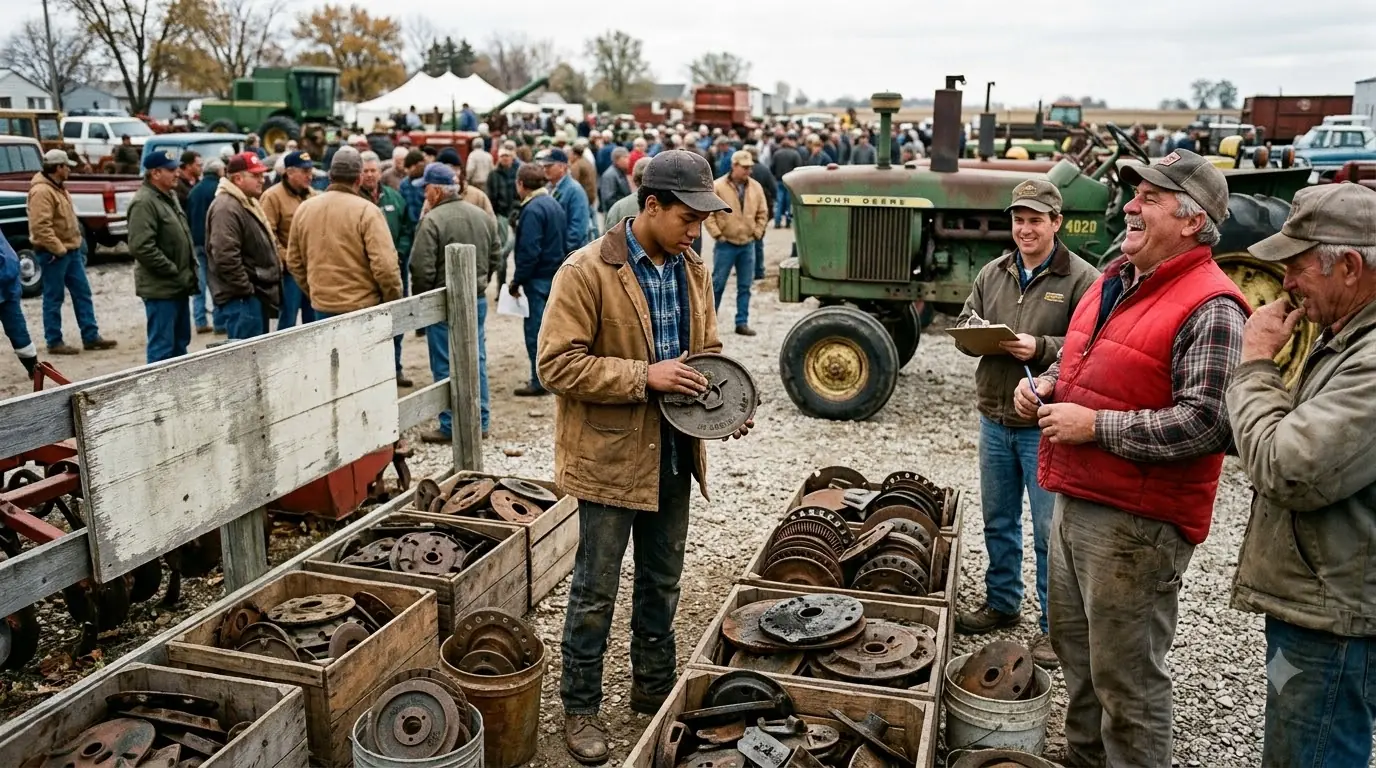
A man in a green canvas jacket raised two fingers.
“Four twenty-five, thank you. Now four fifty.”
The item being sold was a used disc harrow with more rust than paint, but that did not stop six farmers from studying it as though the future of their operations depended on every bearing and weld.
For some of them, it probably did.
Whitford Farm Equipment had operated on that same patch of ground for fifty-three years.
Three generations of the Whitford family had sold planters, combines, cultivators, corn pickers, tractor parts, seed meters, chains, sprockets, belts, bearings, and almost anything else a farmer could break during planting or harvest.
Now the business was closing.
The last Whitford brother had decided not to continue.
His children had careers elsewhere.
The building had been sold to a trucking company.
Everything inside had to go.
Tractors stood in rows near the road.
Planters lined the fence.
Inside the parts building, bins were being auctioned shelf by shelf.
Old dealership signs leaned against a wall.
Boxes of manuals sat beneath folding tables.
Anything that looked useful had attracted attention.
Anything that did not had been pushed toward the back.
Sixteen-year-old Malik Carter stood near the edge of the crowd with both hands buried in the pockets of his work coat.
He was not there because his family needed a tractor.
They could not afford one anyway.
The Carter family farm covered seventy acres outside Millbrook County.
It was enough land to keep them busy and not enough land to make them comfortable.
Malik lived there with his mother, Denise, and his grandmother, Ruth Carter.
His father had left years earlier and was not part of the farm’s daily life.
Denise worked three mornings each week at a medical office in town and spent the rest of her time managing the farm.
They grew corn, soybeans, and a small amount of hay.
They kept six beef cattle.
Every piece of equipment on the farm was paid for, which was good.
Every piece of equipment was old, which was less good.
They owned a 1963 tractor, a planter almost as old, a worn hay rake, two wagons, and a combine they shared with Denise’s brother.
On a larger farm, a broken machine meant calling a dealer.
On the Carter place, it usually meant Malik and his mother standing beside the machine with a flashlight after sunset, deciding whether the repair could wait until payday.
Malik had learned early that parts mattered.
Not machinery in general.
Parts.
A tractor worth thousands could become useless because of a six-dollar bearing nobody stocked locally.
A planter with good bearings, chains, frame, and wheels could sit idle because one plate was cracked.
An old combine might still cut grain perfectly if someone knew where to find a belt manufacturer stopped making fifteen years earlier.
That lesson became stronger after Malik started working at Bell Farm Equipment Repair.
Otis Bell owned the shop.
Sixty-eight years old.
Gray hair.
Heavy glasses.
Hands permanently stained in the lines no matter how much soap he used.
Otis had repaired farm machinery in Millbrook County since before Malik’s mother was born.
His shop sat in a low cinder-block building behind his house.
There were two service bays, one hydraulic press, one welder old enough to frighten insurance agents, and a parts room that looked disorganized until Otis told you exactly which dusty shelf held the part you needed.
Malik had started sweeping floors there at fourteen.
By sixteen, he changed bearings, rebuilt simple carburetors, cleaned seed meters, replaced chains, diagnosed wiring faults, and performed every dirty job Otis no longer wanted to crawl underneath equipment to do himself.
He earned modest wages.
Most of what he earned went into an envelope in the top drawer of his bedroom dresser.
By October 1990, he had saved $236.
He had no specific plan for it.
Maybe a better socket set.
Maybe a used motorcycle if his mother ever lost her mind and allowed one.
Probably nothing.
Then he went to Whitford’s auction.
Otis had driven there because closing auctions attracted two kinds of people.
People looking for bargains.
And mechanics looking for things no one else knew were bargains.
“You buy anything,” Otis told Malik before they separated, “make sure you know how you’re getting it home.”
Malik nodded.
Otis pointed toward his trailer.
“I said make sure.”
“I heard you.”
“Teenagers hear sound. Whether language reaches the brain is another question.”
Malik walked away before Otis could add anything else.
For almost two hours, Malik watched the main auction.
He could not afford anything important.
A used planter sold for $2,900.
A drill brought $1,600.
A pallet of new-old-stock bearings brought $475.
A farmer bought a nearly thirty-year-old corn picker for $850 and looked delighted.
Then the bidding paused while the auction crew moved equipment.
Malik wandered behind the parts building.
That was where he found the crates.
There were six large wooden boxes stacked near a chain-link fence.
Rain had stained the wood.
One lid sat crooked.
A faded stencil on the side read:
PLATES / OBSOLETE.
Malik stopped.
He lifted the loose lid.
Cast iron discs filled the crate.
Some nearly black from grease.
Some red-brown with surface rust.
Different sizes.
Different openings.
Some had round cells near their edges.
Others had long narrow slots.
A few had shapes Malik did not recognize.
He picked one up.
Heavy.
Much heavier than a modern plastic seed plate.
He turned it over.
Nothing obvious at first.
Then he wiped the back with the sleeve of his coat.
Letters appeared beneath the grime.
C-16.