By the time Nell Mercer lifted bidder number 19, every man in the sale barn had already decided what kind of mistake she was about to make. She had come for two wagon horses. She left owning 27 mine mules. The auctioneer stared at her as though he had misheard. "84 dollars," he said, "for the whole lot." Nell raised the card 1 inch higher.
From the third row, Ezra Rusk laughed so hard he had to remove his hat. "Miss Mercer," he called, "those animals have spent half their lives underground. You put them on that farm, you won't own a team, you'll own a cemetery with harness marks." The room laughed with him. Nell did not. Because one mule at the back of the pen had not taken its eyes off the open doors, not the people, not the whip hanging from the rail, the daylight.
That animal was watching daylight as if it had heard about such a thing, but had never trusted the description. And Nell remembered something her father had told her when she was 10 years old. A balking animal is not always refusing the road. Sometimes it is refusing the last road. So, she spent 84 dollars, and 3 years later when the flood took the lower bridge, the county came looking for the very animals Ezra Rusk had called a graveyard.
But that was later. First, she had to get them home. Nell Mercer was 23 in the autumn of 1891. Old enough to understand a debt notice, and young enough to still believe a problem could be outworked if you rose before it did. The Mercer place sat above Laurel Fork in western North Carolina on 31 acres of steep pasture, scrub oak, tired corn ground, and one narrow bench of flat land her father had called the Shelf.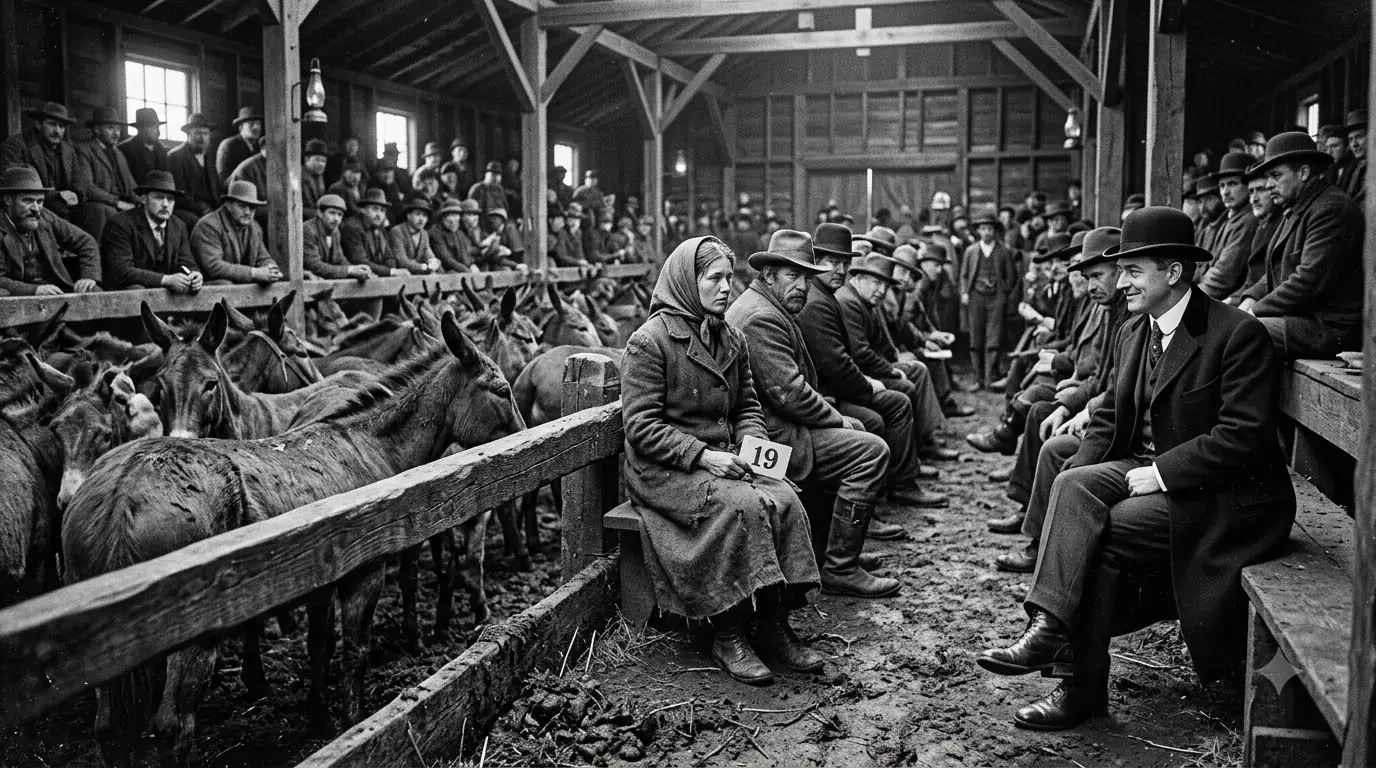
The farm had never been rich. It had only been stubborn. Her father, Samuel Mercer, had kept it alive with hauling work, orchard pruning, and the kind of repair jobs that paid partly in cash and partly in favors no bank would recognize. When fever took him in July, it left Nell with the land, a wagon with a cracked tongue, six hens, one milk cow, and a note at the county bank for $340. The first payment was due in January.
Without a working team, there would be no timber hauling in November. Without hauling, there would be no winter cash. Without winter cash, the bank would have the deed by spring. That was why she drove 5 hours through cold rain to the Caldwell Transfer Yard with $160 sewn into the lining of Samuel's old coat. She had calculated the trip exactly.
Two serviceable horses at $70 each, $10 for feed on the road, $10 left for repairs. She had written the numbers twice in her father's ledger, once in pencil and once in ink, as though darker writing could make the arithmetic more merciful. It did not. The first horse she inspected sold for $98. The second went for 112.
By noon, her plan had become impossible without changing its shape. That was when the handwritten notice appeared on the post beside the office window. Rail Company Disposal. 27 mine mules, one lot only. No guarantee.
Buyer responsible for removal. The animals had belonged to the Black Ridge Iron Company, which had closed two shafts after a roof collapse and a 6-month wage dispute. The mules had been moved to a holding field, then left there through summer while lawyers argued over machinery, payroll, timber rights, and everything else that could be assigned a value on paper. The mules did not appear on anyone's urgent list. They were too old for the dealers who wanted speed, too wary for farmers who wanted obedience, too thin for anyone interested in resale by weight.
And because they had worked underground, most men in the yard treated them as if darkness had entered the bone. Nell walked the pen twice. She saw scars across shoulders where collars had rubbed raw and healed badly. She saw hooves overgrown for months without trimming. She saw one sorrow mule whose left ear had been split.
She saw a small black molly standing in the open rain while every other animal crowded under the shed roof, as though shelter had become a place she no longer trusted. And at the back stood the gray mule watching the daylight beyond the doors. Nell did not ask what was wrong with them. She asked what had happened often enough for 27 animals to stand that still in a loud place. The answer was everywhere.
In the way they held their breath when a chain moved. In the way six bodies pressed toward one corner when a man stepped into the aisle. In the way the gray mule watched the exit but never moved toward it. Memory had tied them in place more effectively than rope. The bidding opened at $60.
A livestock buyer offered 65 without looking up. Nell raised to 70. The buyer glanced at her, then at the pen, and shrugged. Ezra Rusk entered at 75, not because he wanted the animals, because he wanted the room. Ezra owned the largest sawmill in Caldwell County and leased more mountain acreage than most families would ever see.
He had the heavy calm of a man accustomed to being believed before he spoke. He looked back at Nell. "You understand this is the entire lot?" "I do." "You understand half of them may never take a collar." "I heard the terms." He smiled and the smile made the room lean toward him. "Then I suppose education has its price." The auctioneer asked for 80. Nell lifted her card.
Ezra offered 82. She said 84. Silence held for 1 second. Then Ezra laughed and lowered his hand. The hammer fell.
27 mine mules. $84. Nell signed the transfer papers with fingers that remained steady until the clerk turned away. She had $76 left. She needed three wagons, temporary halters, two hired men, road feed, and enough daylight to cross the ridge before the rain became ice. None of those things were available.
By 9:00 that night, she had borrowed two freight wagons from a produce dealer who remembered Samuel repairing his barn roof after a storm. She had hired a father and son to drive one team. She had bought rope, oats, and a lantern with $12 she had not planned to spend. Loading the mules took 6 hours. The first animal went up the ramp only after Nell removed every man from the narrow lane, laid her coat over the rattling boards, and waited in the rain without pulling the lead.
The mule stood with every muscle prepared to reverse. Nell looked at the open space ahead of him and said, "This road is different." He could not understand the words, but he understood that no one struck him. After a while, he walked forward. The others followed badly, slowly, and one at a time. The last wagon left Caldwell after 2:00 in the morning.
Nell drove the lead wagon. Rain ran off the brim of Samuel's hat and down the back of her neck. The mountain road was black except for the lantern glow in the pale movement of mule ears above the wagon rail. For the first mile, she felt triumphant. For the second, terrified.
By the third, she understood the difference between courage and momentum. Courage was what people called a decision after the consequences had become survivable. Momentum was what carried you into the dark before that proof existed. At 4:00 in the morning, one wheel sank to the hub in roadside mud. The hired men cursed.
The mules inside the wagons began to shift. A chain struck wood. The gray mule threw himself against the sideboards so hard the wagon rocked. Nell climbed into the bed before anyone could stop her. She crouched 3 ft away.
No touching, no rope, no demand. The mule's eyes showed white in the lantern light. "Listen," she said, though what she needed him to hear was not her voice, the rain, the men going quiet, the fact that the chain had stopped moving, the fact that no pain followed the noise, one fact, then another. A new road had to be built from moments too small to look like construction. The mule's breathing changed.
Not calm, less trapped. It was enough. They freed the wheel at dawn. The Mercer farm appeared below the ridge just after sunrise. Gray roof, smoke-dark chimney, bare orchard, and the long pasture fence running uphill like a sentence nobody had finished.
Nell opened the lower field. 27 mules entered in fragments. Some rushed, some froze. The small black Molly refused the gate until Nell turned sideways and stopped looking at her. The gray mule crossed last.
He took three steps into the pasture, lifted his head, and stood in full morning light. Then he closed his eyes. Only for a second. But Nell saw it. She leaned against the gate because her knees had started shaking.
Behind her, one of the hired men said, "What are you going to do with all these?" Nell looked at the debt notice folded in her pocket. At the broken wagon. At 27 animals she could not feed through winter. She gave the only honest answer available. "I'm going to find out what they can still do." That afternoon, she opened Samuel's ledger to a clean page.
At the top she wrote, "What ends you first?" Under it, "Feed, bank, weather, pride." Then she added one more line, "Do not solve the whole winter. Solve tomorrow morning." Tomorrow morning arrived at 3:40. So did the next one, and the one after that. Exhaustion did not come as a dramatic collapse. It came as small theft, a missed nail, a forgotten bucket, a sentence spoken twice, a cup of coffee discovered cold in a place she did not remember setting it.
The mules consumed more feed than Nell had calculated because desperate people always calculate toward the number they can survive. Three animals developed coughs within the first week. The sorrel with the torn ear had an abscess under the jaw. The small black molly would not enter a stall, and the gray mule would not permit a rope within 6 ft of his head. Dr. Amos Venn came on the fourth day.
He was 60, narrow as a fence slat, and uninterested in comforting anyone with lies. He walked the herd for 2 hours. Then he stood beside Nell at the rail and removed his spectacles. You have five with lungs I don't trust, four with shoulders that should not see heavy collar work again, two with vision trouble, and one gray mule who has learned enough about men to make him dangerous if you become impatient. Is he dangerous now?
No. Venn looked at her. He is careful now. People call careful animals dangerous when they get tired of earning permission. The sentence landed with the weight of something Samuel might have said.
Venn continued, "The black molly has old burn marks along the flank. Lamp oil perhaps, or steam pipe contact. She is not refusing shelter. She is refusing enclosure. What can be done?
Time, distance, predictability. All the expensive medicines." Nell almost smiled. "How expensive?" "More than time, less than losing the farm. If you make the right animals useful." He left powders for the coughing mules and a bill for $9. Before he climbed into his buggy, he looked back at the pasture.
"Your father understood teams. He understood animals. That is not the same thing. No. Do you?" Nell considered the question.
"I understand that fear can look like stubbornness." Venn nodded once. "That is enough to begin. It is not enough to finish. The first month became a study in invisible progress. Nell stopped trying to work the whole herd.
She divided the animals by what they could tolerate. Open gate animals, near fence animals, hand distance animals, halter animals, collar candidates. No one in the county used those terms. They existed only in her ledger, but they gave shape to work that otherwise felt endless. She named the gray mule Lantern because of the way he had stared at daylight.
The black molly became coal. The torn ear sorrel became Pike. Not after Ezra Rusk, though she enjoyed the confusion when people assumed so, but because the split in his ear made a sharp point against the sky. Nell worked with Lantern at dawn. She never approached directly.
She carried rope where he could see it, but did not use it. On the ninth day, he allowed her inside the same pen. On the 15th, he accepted grain from a bucket she held at arms length. On the 23rd, she touched the side of his neck once. He recoiled so violently that her shoulder struck the fence.
Nell wanted to try again immediately. That was the dangerous impulse, not cruelty. Urgency. Urgency wore respectable clothes. It called itself necessity.
It produced the same result as force if you let it choose the pace. She stepped out of the pen. In the ledger, she wrote, "Day 23, touch accepted, then regretted. Do not make him pay twice for one brave decision." Coal slept outdoors through the first freeze. Nell built a three-sided shelter in the pasture, open at both ends, so enclosure would never become a trap.
Coal ignored it for six days. On the seventh, snow began before dawn. Nell watched from the kitchen window as the Molly stood 50 ft away, head lowered, snow gathering along her back. At noon, Cole moved 10 ft closer. At dusk, she stood beneath the outer edge of the roof.
By midnight, she was inside. Nell did not go out to confirm it. Trust could be frightened by celebration. Money, however, did not care about trust. By December, the bank note sat on the table every evening, $340.
Nell had $28 in cash. The timber contract she had expected to take was gone because she had no train team ready by November. Ezra Rusk's mill had taken the work. He sent a man named Hollis Dane to the Mercer farm in the second week of December. Officially to ask whether Nell wished to sell the upper cedar stand.
Unofficially, Hollis came to count how close she was to failing. He leaned on the fence while Nell worked Pike between two ground poles. "Mr. Rusk can make a fair offer now," he said, "before the bank gets involved." "The bank is already involved." "You know what I mean." "I do." Hollis watched Pike step over the first pole without panic. "I heard none of them would harness." "You heard early." "Heard Venn's been here three times." "Twice." "I saw his buggy." "Then you saw the same buggy twice." Hollis smiled. "You always answer like that." "Only when the question arrives wearing someone else's coat." He left without discussing cedar prices.
That evening, Nell found a note under the kitchen door from Alma Reed, who ran the mountain mail route. "Elder school needs a safe cart animal before January. Payment possible. See Mrs. Vail." Nell rode the milk cow's old saddle horse, borrowed from a neighbor, to Alder School the next morning. Mrs. Iris Veal taught 29 children in a one-room schoolhouse and drove six of them from outlying farms when weather made the walk dangerous.
Her gelding had gone lame. She needed an animal steady enough to pull a light cart over narrow roads with children inside. Nell thought of Pike. Then she said, "No." Pike was progressing, but progressing was not safe. Mrs. Veal studied her.
"Most sellers would have said, 'Yes.' Most sellers need the money. Do you?" "Yes." "Then why no?" "Because need does not make him ready." Mrs. Veal nodded. "Bring me the animal when you can say yes without needing to." That sentence fed Nell more than the conversation should have. It also frightened her. Because honest work took longer than desperate arithmetic allowed.
The darkest week came after Christmas. A wet snow collapsed part of the north shed roof. Two mules broke through the temporary fence. Cole vanished into the timber. One coughing mule worsened overnight, and the bank sent a second notice with red ink along the margin.
Final payment date, January 31. Nell found Cole after 14 hours in a ravine above Laurel Fork. The Molly stood among rhododendrons, shivering, with a length of broken rail still tied to the lead rope trailing behind her. Nell climbed down alone. Cole saw her and backed toward the drop.
Nell stopped. There was no room to circle, no time to build comfort. Snow had covered the trail, and darkness was coming. The practical answer was to take the rope. The practical answer was also the fastest way to send the mule over the edge.
Nell sat on a wet stone. Cole trembled for an hour. Neither moved. Nell's gloves soaked through. Her toes went numb.
From somewhere below came the sound of water under ice. Nell began talking, not commands, accounts. She told Cole about the bank note, about the shed roof, about Samuel's habit of sharpening tools that were already sharp whenever he did not know what else to do, about the two wagon horses she had meant to buy, about the moment the hammer fell and how certain she had looked while fear moved through her like fever. "I bought you because I thought nobody else should get to decide what your worst day meant," she said. Cole's ears moved.
Nell laughed once without humor. "That was a large opinion for someone with $28." The mule lowered her head. Nell kept talking until speech stopped feeling like language and became only sound. At dusk, Cole took one step, then another. She came close enough to smell Nell's sleeve.
Nell did not reach for the rope. Cole stepped on it, pinned it beneath one hoof, stood there. Nell slowly placed her hand on the loose end. The mule lifted her hoof, permission, not surrender. They walked out of the ravine in darkness.
When Nell reached the farm, Dr. Venn was waiting beside the sick mule. His face told her before he spoke. The animal died before midnight. It was the first one she lost, a bay John mule with a white muzzle, number 14 in the rail company list. Nell had not named him because she had kept believing names could wait until survival felt less uncertain.
She buried him above the orchard, where the ground was soft enough to open. The next morning, she found the old brass number plate from his mine harness in a tack box. 14. She cleaned it and nailed it above the barn door. Not as a monument to failure.
As a correction. Nothing under her care would remain only a number again. That afternoon, Ezra Russ came himself. He arrived in a covered buggy with polished wheels that had never carried feed. He stood beneath the damaged shed roof and looked at the grave on the hill.
"I can clear the bank note," he said. Nell said nothing. "In return, I take the upper cedar and 12 acres along the ridge." "That is more land than the note is worth. It is what the risk is worth. The risk is mine until January 31st." He walked to the fence.
Lantern stood far across the pasture in pale winter sun. Ezra pointed. "You are trying to turn cave animals into farm stock while the bank counts days. That is not courage. It is refusal to admit the numbers." Nell looked at the grave, then the broken roof, then the animals.
He was not entirely wrong. That was what made the offer dangerous. Bad advice rarely arrives as pure falsehood. It arrives carrying one true fact and asks you to build the wrong conclusion around it. Nell said, "Put the offer in writing." Ezra's expression changed.
He thought she had yielded. "I'll have Hollis bring papers tomorrow." "Do that." When he left, Nell opened Samuel's ledger. She copied the offer. Then she wrote beneath it, "A door can be real and still lead to the wrong room." She had nine days. Lantern was not ready for work.
Cole was not ready for enclosure. Pike was almost ready for the school cart, which meant not ready. The farm had one asset she could sell quickly. the upper cedar. Samuel had protected that stand for 20 years. Nell walked the ridge at sunset and marked trees by lantern light, choosing six mature trunks rather than the entire stand.
The timber buyer offered $105. It was not enough, so she sold the milk cow for 32. She sold Samuel's spare wagon iron for 11. She accepted three pruning contracts in neighboring orchards and worked them by moonlight after the mules were fed. Mrs. Vale paid $15 in advance against Pike's future cart work, not as charity, she insisted, but as a reservation fee with a written refund condition.
Alma Reed collected small hauling commitments from five families for spring, each paying $2 to hold a date. Dr. Venn postponed his bill without discussing it. On January 31st, Nell walked into the county bank with $340. She paid the note. She left owing almost everyone something, but the deed remained in her name.
Outside, Ezra Rusk stood beside his buggy. He had come to record the transfer he expected. Nell passed him on the steps. He looked at the receipt in her hand. You cut the cedar, six trees, you sold the cow.
Yes. You stripped the place to save animals that still cannot work. Nell stopped. No, she said. I stripped the place to keep the right to decide what happens next.
For the first time, Ezra had no answer ready. The bank payment saved the farm. It did not save the winter. Feed still had to be bought. Roof boards still had to be replaced, and 26 living animals still woke hungry every morning.
But pressure had changed shape. It was no longer a closing door. It was work. Nell understood work. Pike pulled the older school cart for the first time on March 12th.
Nell walked beside him for the first mile. Mrs. Vail held the reins. Four children sat in the cart, quieter than children had ever been in the history of roads. At the first bridge, Pike stopped. The planks beneath him echoed over water.
His torn ear turned backward. His body tightened. Mrs. Vail waited. Nell stood near his shoulder without touching him. A boy in the cart whispered, "Is he going to run?" "No," Nell said.
"He is going to decide." Pike looked at the bridge, then the road behind him, then Mrs. Vail. She loosened the reins by 1 in. Pike stepped forward. The cart crossed. On the far side, every child began talking at once.
Nell walked home with $15 in her pocket and a feeling she did not trust enough to call hope. Within a month, Pike was making the school route 3 days each week. Not because Nell had trained fear out of him. Fear remained. What changed was the order of authority inside him.
The old alarm spoke first, but it no longer spoke alone. Experience had begun answering. That difference became the Mercer method, though Nell never named it that. People did. First Mrs. Vail, then Dr. Vann, then a farmer named Corbin Hale who needed a mule gentle enough for his injured brother to drive.
Corbin came expecting to buy Lantern because Lantern was the largest. Nell refused. She offered a smaller dun Molly named Mavis who had shown an unusual tendency to slow herself when a handler lost balance. Corbin objected. "She hasn't the size." "Your brother does not need size.
He needs an animal that notices him. Mavis went home with the Hale family for $80. Two months later, Corbin returned with a basket of apples and said his brother had driven a loan to church. He placed the basket on Nell's table and left before gratitude required more language. By summer, four mules had been placed.
Three more were in paid work arrangements. Cole had begun entering the open shed even in clear weather. Lantern accepted a halter. The first time Nell led him through the barn aisle, he stopped beneath the brass number 14 above the door. He stared at it, then at the darkness beyond the stalls.
Nell opened both rear doors so daylight made a path through the building. Lantern walked the length of the barn without being pulled. Dr. Venn watched from the yard. "You have a useful animal," he said. "I have an animal deciding whether usefulness is safe." Venn's mouth shifted at one corner.
"Your father would have argued with that sentence for half an hour. He would have lost. He usually did with you." Nell thought the summer would be about finding work for the mules. Instead, it became about finding the shelf. Samuel had called the flat bench below the upper ridge the shelf because it was too narrow for a field and too level to be ordinary mountain ground.
Nell had passed it all her life without interest. In June, while repairing a fence post above the bench, she drove an iron bar into the soil and heard hollow stone. Not a rock, a chamber. She cleared leaves and found a line of fitted slate beneath the earth running across the slope. The structure was too deliberate to be natural.
That night, she searched Samuel's workshop. Behind a broken cabinet, she found a cedar box containing survey sketches, old receipts, and a cloth-bound notebook marked water. Samuel's entries began in 1876. He had discovered a buried stone channel built by German settlers who occupied the ridge before the Civil War. The channel captured a limestone spring above the property and carried cold water beneath the shelf before releasing it near Laurel Fork.
For reasons Samuel never fully understood, the deed to the springhead had been omitted from a boundary correction in 1868. The channel crossed Mercer land, but the spring itself lay inside an unclaimed wedge between two old surveys. Samuel had tested the water flow for 6 years. He had measured temperature, volume, winter reliability, and the effect on the soil above the channel. The shelf stayed cool through summer, dry during heavy rain, unfrozen several weeks longer into winter.
He had grown seed potatoes there in 1881 and stored them in a shallow stone room beside the channel. The crop had resisted rot better than anything from the lower field. Then Samuel's notes stopped. The final page contained one sentence. The water is worth more than the bench.
But only if the right is made clean. Nell read it three times. The spring was not treasure. It was infrastructure. That made it more believable and more difficult.
A hidden vein of gold would have solved a story. A water right created paperwork, surveys, neighbors, cost, proof, and the possibility that someone wealthier would understand its value before she secured it. Nell told only Dr. Vann and Iris Vail. Vann recommended an attorney in Morganton named Clara Wynn. Iris recommended silence.
Not secrecy forever, she said. Secrecy until your facts can stand without your voice. Clara Wynn was 38, sharp-eyed, and the first person Nell had met who treated land records as living things capable of deception. She reviewed Samuel's maps, then she visited the ridge. Then she spent 6 weeks in county archives.
Her conclusion was careful. The spring wedge appears never to have been conveyed after the 1868 resurvey. That means no current owner can show clean title. Can I claim it? You can petition to quiet title based on continuous use of the channel, documented maintenance, tax treatment of the receiving land, and the original survey error.
Will I win? Clara looked at her overfolded hands. Anyone who promises that before filing is selling confidence, not law. What will it cost? $40 to begin, more if contested. Nell almost laughed.
Every useful door on the farm demanded money before revealing what waited behind it. She sold two trained mules. She filed the petition. Then she began documenting the shelf. Temperature at dawn, temperature at noon, water volume, soil moisture, storage loss in marked crates.
She planted two equal plots of seed potatoes, one on the shelf, one below the barn. Same seed, same planting date, same cultivation. Different ground. By August, the plants on the shelf remained dark green, while the lower plot had begun to yellow. By September, the shelf crop yielded nearly half again as much marketable weight.
More important, the stored tubers held firm. Nell wrote every measure in Samuel's notebook beneath his older figures, her handwriting narrower and darker. The mule business grew in the same season. A logging contractor named Beck Crowder came to inspect Lantern. He wanted strength.
Nell showed him patience. She harnessed Lantern beside a drag sled loaded with green oak. The mule waited for the command, pulled steadily, stopped when Nell stumbled. Beck noticed the stop. "Why'd he do that?" He felt the line change.
Most mules pull through. Most men teach them the load matters more than the person. Beck bought Lantern for $140. Nell did not sleep the night before the transfer. Lantern had been the first animal onto the wagon in Caldwell.
The first to stand in daylight. The first to make her believe the lot might contain something other than ruin. At dawn, she walked into the road. Beck took the lead. Lantern followed three steps, then stopped and looked back.
Nell wanted to go to him. Instead, she waited. Beck waited, too. That was why she had chosen him. Lantern turned toward the road.
He left without drama. Nell watched until the trees closed behind them. Then she went to the barn and worked. Love that only knows how to keep becomes another kind of confinement. Samuel had taught her that with dogs, horses, tools, land, and children, a thing in your care was not proof of ownership.
It was proof of responsibility. In October, Ezra Rusk filed an objection to the spring petition. Clara brought the notice to the farm herself. Ezra claimed the unassigned wedge should attach to his northern timber lease because the springhead drained toward his boundary before entering the Mercer channel. The argument was weak.
The money behind it was not. "He knows," Nell said. "He knows enough," Clara replied. "Someone saw the survey filing." "Can he take it?" "He can delay it." Delay can be a form of taking when one party can afford time and the other cannot. That winter became the true darkest point.
Ezra diverted men to cut a temporary ditch above the disputed wedge, reducing flow into the Mercer channel. He called it erosion control. Clara called it interference. The shelf began to dry. Potato storage temperatures rose.
At the same time, influenza moved through Laurel Fork. Two hired teamsters were unable to work. Three mule placements were postponed. Cole developed a severe hoof infection after stepping on a buried nail. Nell had money on paper and no cash in hand.
For 10 days, she slept in the tack room beside Cole's stall because the Molly had finally accepted enclosure but panicked whenever the door closed. Nell left the door open despite the cold. Cole stood on three legs. Dr. Venn cut away damaged tissue and said the next week would decide whether she remained sound. Nell changed dressings by lantern light.
On the sixth night, Ezra came to the barn. He did not enter. He stood outside the open door where Cole could see him. "I will withdraw the objection," he said. Nell kept wrapping the hoof.
"In return for what?" "A permanent half share of the spring right and first purchase on every trained mule suitable for mill work." "At your price." "At market price." "Your market." "The market is the market." Nell tied the bandage. Cole shifted but did not pull away. Ezra looked into the stall. You could lose the spring, the crop, and the animal, yes. You could also accept that a larger operation has uses for things you cannot fully develop.
Nell stood. That is the argument every large operation makes after a smaller one proves value. His expression hardened. You think this is personal. No, that is what worries me.
She moved past him and stepped into the cold. The diverted spring ran as a thin thread through the channel outlet. Ezra followed. Your father left you a farm too small to survive on sentiment. My father left me measurements.
Measurements do not stop a court. No. Nell looked toward the shelf. They stop a lie from becoming convenient. The hearing was set for February.
Clara built the case around Samuel's records, county tax maps, the original survey, the stone channel, and 20 years of documented maintenance. Ezra arrived with two attorneys and a drainage engineer. Nell arrived with Clara, Dr. Van, Iris Vale, and Samuel's water notebook. The engineer argued that the spring's natural flow favored Rusk land. Clara asked whether natural flow explained the fitted stone channel.
He said no. She asked whether Rusk had maintained that channel. No. Paid tax on land receiving the water. No.
Used the spring before the Mercer filing. No. Then Iris produced school records from 1879 documenting children storing lunch milk in Mr. Mercer's spring room during a summer heat wave, doctor. Then produced veterinary invoices showing decades of livestock treatment using water drawn from the channel. And Nell produced the paired potato records. not because potatoes proved title, because they proved use, continuous, measured, intentional.
Ezra's attorney called the notebook family hearsay. Clara asked the clerk to compare Samuel's entries with county agricultural fair submissions carrying his verified signature. The handwriting matched. The dates aligned. The room shifted.
Not emotionally, procedurally. That was Clara's kind of victory, not applause, the removal of places where doubt could hide. The judge did not rule that day. He ordered the diverted ditch closed pending decision. Water returned to the channel three mornings later.
Nell stood at the outlet before sunrise and watched the first clear run spill over stone. Cole stood behind her, weight resting evenly on all four feet. Nell did not interpret either fact as a promise. She had learned better. But she allowed them to be evidence.
The title order arrived in May of 1893. The spring wedge, 1.6 acres shaped like a broken spearhead above the Mercer boundary, was awarded to Nell under quiet title. Ezra Rusk withdrew his appeal. Clara's final bill was $63. Nell paid it in full.
Then she did something Samuel had never managed. She made the spring useful beyond survival. Not by chasing scale, by building a system small enough to remain honest. She repaired the stone storage room beside the channel. She planted seed potatoes, winter onions, and late greens on the shelf.
She sold breeding stock to mountain farmers who had been losing stored potatoes to rot. She marked every sack by plot and harvest date. No claims larger than the records. No miracle language. No volume she could not maintain.
A hotel buyer from Asheville offered to take the entire late green crop. Nell refused half the order. He asked why. Because I can grow quality or I can grow your quantity. This year I cannot do both.
He stared at her. Then he accepted the smaller contract at a higher price. The mule operation followed the same rule. No animal placed because a buyer was impatient. No buyer accepted because money was urgent.
No promise made before behavior had repeated under different conditions. By the end of the second year, 19 of the original 27 mules were working in homes, schools, orchards, logging crews, and road teams across three counties. Three had died. Five remained at Mercer. Cole stayed because enclosed hauling would always carry too much of the mine inside.
Pike stayed part-time, returning from the school route during summer and becoming the farm animal every child trusted first. A red John mule named Bishop stayed because arthritis made heavy work unfair. Two others remained because the honest answer was that no placement improved their lives. Those animals were not failures in the business. They were the cost of refusing to turn rehabilitation into another market that rewarded only what could be sold.
The county began sending difficult cases to Nell. Not all mine animals. A plow mule beaten for stopping on a damaged shoulder. A mare made dangerous by a poorly fitted bit. A cart pony that froze at bells after surviving a runaway wagon.
Nell took only the animals she could support. No became part of the method. So did paperwork. So did rest. So did hiring help before exhaustion became a moral identity.
Jesse Ward arrived at Mercer Farm in July. He was 16, tall, silent, and known in Laurel Fork mainly as the boy who had stopped speaking in full sentences after his older brother died in a logging accident. Dr. Venn brought him. "He needs work." Venn said. "So do many people." "He needs work." that answers honestly.
Nell looked at Jesse. He looked at Cole. Cole looked back. Nell gave him a water bucket and pointed to the lower trough. He returned the next Saturday and the next.
For 6 weeks, she allowed him to clean, carry, repair, and observe. On the seventh, she placed him in a round pen with a chestnut mule named Amos. Jesse approached too directly. Amos moved away. Jesse stopped.
"What did he say?" Nell asked. Jesse shrugged. "He moved." That is how he said it. Jesse watched the mule. "He wants space.
Give it before he has to ask louder." Jesse stepped back. Amos turned one ear toward him. The boy noticed. Not because Nell explained it, because he was finally quiet enough inside to see it. Through autumn, Jesse learned the work.
He learned that patience was not softness. It was accuracy over time. He learned that a frightened animal might obey and still be unreachable. He learned that calm could be performed badly by both animals and people. He learned to leave a pen before the good moment became one demand too many.
One morning, Nell heard him talking to Cole while he changed bedding. His voice was low and even. Not coaxing. Not instructing. Present.
Cole stood loose in the stall with the door half closed. Nell stopped outside. Three years earlier, that mule had stood in rain rather than enter shelter. Now, she stood beside a grieving boy and allowed a door to remain partly shut. Neither one was cured.
That was not the word. Both had acquired another experience strong enough to answer the old one. The flood came in March of 1894. Rain fell for 4 days on ground already saturated by snowmelt. Laurel Fork rose past the mill posts before dawn.
The lower bridge twisted loose at one end. Two families became trapped on the south bank. A school cart overturned in the water road near Alder. The county road captain had horses, but the current noise made them rear. Someone rode to Mercer Farm.
They asked for mine mules, the animals Ezra Rusk had called a cemetery. Nell brought Pike, Bishop, and two later arrivals trained for unstable footing. Mine mules had spent years walking where echoes lied about distance, where floors shifted, where darkness hid edges. Once fear no longer controlled them, that history became competence. They placed each foot, tested weight, waited for instruction.
Pike carried rope across the flooded road. Bishop hauled the school cart free. The smallest mule, Fern, stood in chest-deep water while two children were transferred to a rescue wagon. Rain struck her face. Debris hit her flank.
She did not run. She looked at Nell, waited, received the next instruction. By evening, every trapped person had crossed. No speeches followed. People were wet, cold, and occupied with survival.
But the next week, the county commissioners approved a working agreement with Mercer Farm for emergency pack and road animals. A 1-year contract, modest pay, regular assessments, written welfare conditions. Clara drafted the language. Nell insisted on the last clause. No animal would be deployed beyond demonstrated capacity, regardless of emergency demand.
The road captain objected. Nell said, "An emergency does not improve an animal's limits. It only makes humans more willing to ignore them." The clause stayed. Ezra Russ came to the farm in June. He did not arrive in the polished buggy.
He came on foot from the north boundary where flood damage had washed out part of his mill road. He stood beside the spring outlet. "I owe you an apology," he said. Nell continued sorting seed potatoes. "For the auction?" "For several things.
That is a broad category." He accepted the line. "I thought you were refusing reality." "I was." He looked surprised. Nell held up a potato, turned it, placed it in the storage crate. "I refused the reality you offered. That is different from refusing all reality." Ezra looked toward the pasture where Cole stood under the open shed.
"My north slope is unstable since the flood. I need a lower access road. It would cross eight acres I am not using." "And I want to lease the ground to you for pasture in exchange for a right-of-way maintained by both operations." "Written proposal?" "I brought one." He handed her folded papers. Clara reviewed them. Nell changed six clauses.
Ezra accepted five. They negotiated the sixth for two weeks. That was not forgiveness. It was business conducted after contempt had lost its authority. The distinction mattered.
By the third autumn, Mercer Farm no longer depended on a single source of income. The mule placements paid irregularly but well. The emergency contract paid modestly but reliably. The shelf crops produced late, stored cleanly, and sold at a premium because the quality repeated. The spring room became a seed seller.
The farm hired Jesse 2 days each week. Mrs. Vail brought school children twice each season to learn handling and observation. Dr. Venn stopped asking whether Nell understood animals. He began sending younger veterinarians to watch her work. The strongest proof was not one large payment.
It was accumulation. 24 mules placed or partnered over 3 years. Three winter crops stored with losses less than half the valley average. Two restaurant and hotel contracts maintained without expanding beyond capacity. One county service agreement renewed.
A bank account that no longer emptied before planting. A roof repaired before rain entered. Feed purchased before the bin showed wood. Ordinary evidence. That was what stability looked like after spectacle had faded.
Not wealth. Room. Room to refuse a bad buyer. Room to keep an unsellable animal. Room to pay Clara before receiving a reminder.
Room to let Jesse learn slowly. Room to make the next decision without terror choosing first. Samuel's brass number 14 remained above the barn door. Visitors sometimes asked what it meant. Nell told them.
Not because grief required display. Because systems become dishonest when they remember only the animals that succeeded publicly. The number belonged to the mule who died before he was named. It kept the operation accurate. In November, Nell received a package from Beck Crowder.
Inside was Lantern's old halter, cleaned and oiled, with a note, "Retired him from logging. He taught two green teams and never once left a man in trouble. He will remain here on pasture. Thought you should have the first rope." Nell sat at the kitchen table holding the halter. The leather carried scratches from 3 years of work.
She placed it beside Samuel's water notebook. One object from the animal that had stared at daylight. One object from the man who had measured water nobody else valued. At first, they seemed like separate inheritances. They were not.
Both contained the same instruction, "Pay attention before judgment. Measure before claim. Do not confuse damaged use with damaged worth, and never let urgency become permission to lie about what something is ready for." In February of 1895, Jesse arrived at the farm at exactly 7:00. For 2 years, he had arrived early, sometimes by half an hour. Early had been proof.
Exactly on time was belonging. He went directly to the barn. Nell remained at the kitchen table with the spring accounts, the seed orders, and a request from a farm in Tennessee asking whether she could take six abandoned quarry mules before April. She could take three. The old version of Nell would have taken all six and called the damage commitment.
She wrote three. Then she heard Jesse's voice through the wall. He was working with a new mule named Ada, a compact bay molly that struck at anyone who approached the left side of her head. Jesse said nothing for a long time. Then softly, "I know.
I saw it." Nell stood and walked to the barn. She stopped before entering. Through the gap in the boards, she could see Jesse in the pen. He was not touching Ada. He had noticed the warning before it became a strike.
He had stepped back. Ada's head lowered by 1 in. Jesse waited. No triumph, no reward offered too quickly, no need to turn a good second into proof of mastery. Nell recognized the moment.
Not because it repeated her work, because it no longer needed her. The method had moved. Samuel had given it to a girl on a fence rail. Nell had carried it through an auction barn, a winter debt, a flooded road, and 27 animals whose worst experiences had been mistaken for their permanent nature. Now Jesse held it.
One day he would give it to someone else. That was the inheritance that mattered. Land could be sold, water rights could be challenged, buildings could burn, records could be lost. But a way of seeing could travel farther than property. Nell stepped back from the door and let Jesse finish.
She walked to the shelf. Winter sunlight lay thin across the stone channel. Water moved beneath the ground where no one could see it. Cold and steady, doing work that did not require witness. Cole stood at the edge of the pasture.
Her black coat had gone gray around the muzzle. The shed behind her was open at both ends. It had remained that way for 3 years. Though Cole no longer needed the far opening to feel safe. Nell had considered closing it to keep out weather.
She never did. Some structures should remember why they were built. Cole walked toward her, stopped, then came the rest of the way. Nell rested one hand against the mule's neck. No flinch, no held breath, just wait, warmth, presence.
Across the valley, Ezra Rusk's mill whistle sounded. Once, that whistle had represented everything larger than Nell. Money, land, authority, the power to define a mistake before it had time to become anything else. Now it was only a whistle, a sound crossing air. The farm beneath Nell's boots was the answer.
Not because it had defeated Ezra, not because every animal had been saved, not because hardship had secretly been a gift. Hardship was hardship. The dead mule remained dead. Samuel remained gone. Three winters had taken things no ending could return.
The answer was simpler. Nothing that happened in the dark had been allowed to make the final decision. Not for lantern, not for Cole, not for Jesse, not for the spring buried under the shelf, not for Nell. The valley still asked for more than it gave quickly. It asked before dawn.
It asked in feed bills, broken boards, legal fees, infected hooves, and work nobody praised because nobody saw it. Nell no longer waited for the asking to stop. She had built a life capable of answering without becoming cruel. From the barn came Jesse's low voice. From beneath the shelf came the steady run of water.
Cole turned toward the open shed, then changed her mind and remained beside Nell. The morning brightened by degrees. Not suddenly, not dramatically, the way trust does, the way land recovers, the way a frightened thing returns to itself when no one demands that it hurry. A balking animal is not always refusing the road. Sometimes it is refusing the last road.
Nell had spent 3 years building another one, and this time they walked it in daylight.
END