The men began laughing before Jonah Kessler had finished backing his father's pickup toward the scrap pile.
There were three of them standing beside the office of Voss Salvage, their breath rising in white clouds against a January morning so cold that the gravel made a brittle sound under tires.
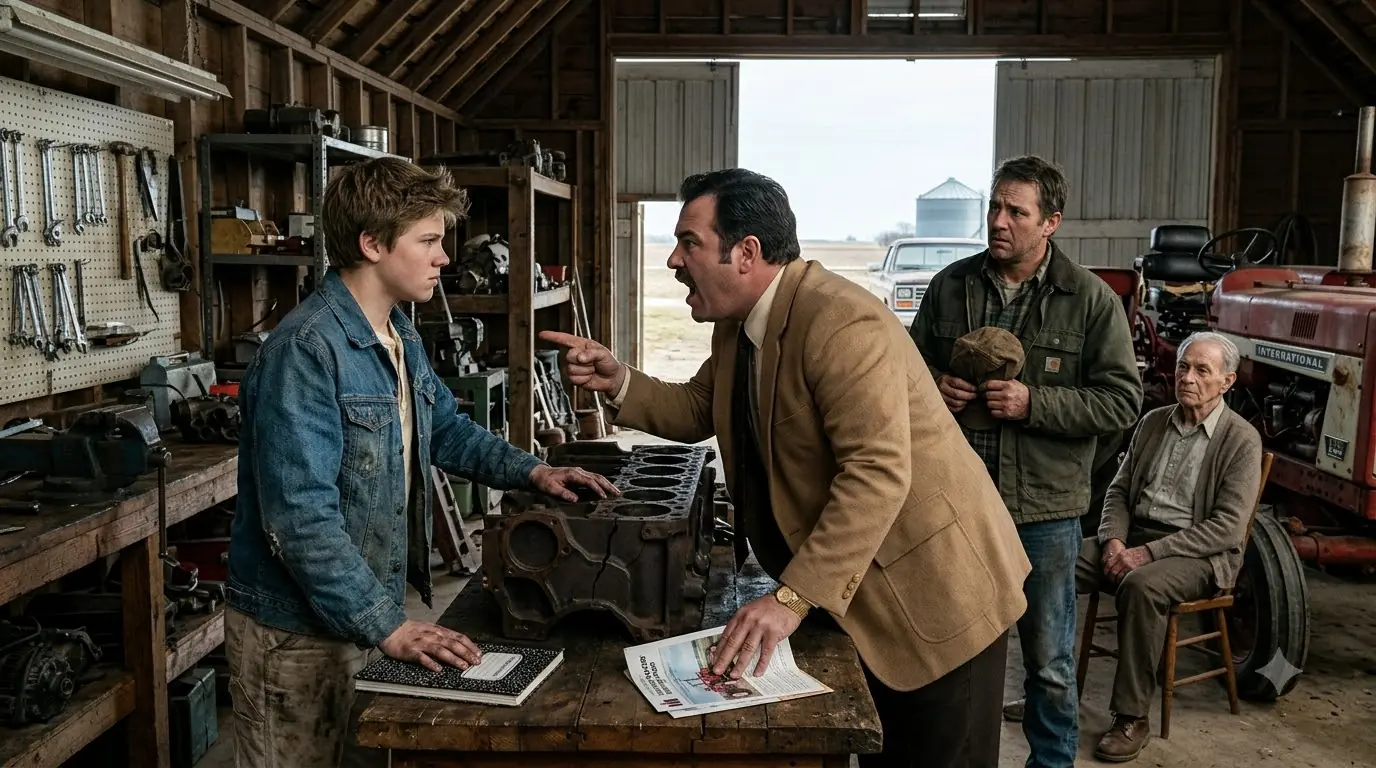
One wore a faded seed-company cap, another had a canvas coat with its cuffs polished by years of work, and the third was Big Earl Voss himself, whose reputation for knowing the value of every pound of metal in Hardin County was exceeded only by his delight in telling other people what their possessions were worth.
All three watched a fifteen-year-old boy climb down from an aging blue Ford and study a pile of broken tractor engines as though he had discovered something rare.
"Back for more garbage, Jonah?" Earl called from the doorway. The farmer in the seed cap laughed into his coffee, and the other man nudged him with an elbow. Jonah pulled on his gloves, looked over the pile, and asked whether the cracked International block near the fence had already been sold for melting. Earl shook his head, grinning, and told him it would probably be there until somebody invented a use for a tractor that could no longer hold its own coolant.
Jonah nodded as though the answer were perfectly ordinary. He walked across the frozen yard, brushed snow from the casting, and found the long dark fracture running beneath a mounting flange. The block was too heavy for him to lift alone, so he rolled out the battered shop hoist Earl allowed customers to use and began maneuvering it into position. The men watched in silence for a moment, then one asked if Jonah intended to build himself an entire tractor out of the broken ones.
"Not exactly," Jonah said. He could have explained that there were forty-three pages of measurements waiting at home, or that each failed casting was teaching him something no textbook in the school library could show him. He could have mentioned his grandfather, whose mind could still hear trouble inside an engine long before an instrument found it, even though his hands could no longer hold a precision tool steadily. Instead, Jonah checked that the load was secure and moved the iron toward the truck.
"People usually bring their mistakes here," Earl said. "You might be the first fellow who insists on taking them back." Jonah smiled slightly, but he didn't answer. By the time the second casting was settled safely in the bed, the January wind had turned his ears red and made the seams of his gloves feel stiff. He pulled the straps tight, thanked Earl, and drove out beneath the rusting sign while the men were still discussing what a strange hobby the Kessler boy had developed.
That was a Tuesday in January 1989, several miles outside Eldora, Iowa, where the land spread flat and brown beneath a hard winter sky. The Kessler farm lay beyond a shallow bend in a county road lined with empty fields, old drainage ditches, and telephone poles that leaned at different angles depending on how many winters they had survived. Jonah could tell when he was almost home by the sight of the red machine shed rising beyond a stand of leafless cottonwoods. He had lived there for every year of his life and had never believed the land needed to be beautiful to deserve his loyalty.
His father, Dale Kessler, thought differently about beauty, though he rarely used the word. To Dale, the farm was beautiful when a field had drained properly, when an engine started in cold weather, or when a grain truck reached the elevator before the line grew too long. He had inherited more obligations than acreage, and the numbers on his kitchen table had been unpleasant for several seasons. He loved the farm in a practical, exhausted way that sometimes looked too much like worry.
The Kesslers owned a modest spread and rented additional acres when they could justify it. They planted corn and soybeans, kept a few pieces of equipment alive well beyond their expected useful years, and depended on weather that never consulted their finances. The older International tractor was the backbone of their spring work because it was powerful enough for the equipment Dale needed and familiar enough that he could maintain most of it himself. Every season, however, that familiarity became a little less reassuring.
The previous autumn had been wet, and their harvest had dragged past the point when the neighboring fields were already empty. A hydraulic housing on the International had failed just when Dale needed the tractor most, leaving him waiting on a replacement that had to be located through two dealerships. The delay forced him to hire help on terms he disliked, and he had spent the following weeks calculating how much better the balance sheet might have looked if the old machine had kept running. Jonah remembered the arithmetic because he had watched his father work through it with a pencil sharpened nearly to the eraser.
Jonah's mother, June, kept the farm accounts in a ledger she carried between the kitchen and the small desk beside the pantry. She worked part-time at the town library and could find a misplaced receipt in seconds, but she could not make a bill smaller merely by organizing it well. His younger sister, Emma, was eleven and already understood that certain conversations stopped when children entered a room. One night she asked whether their farm was going away, and Dale answered too quickly that it was not. The silence afterward told Jonah his father had been frightened by the question.
The family owned newer equipment only when necessity and a bank officer happened to agree on timing. Their pickup had dents that belonged to several different decades, their grain wagons carried repairs in mismatched shades of red, and their workshop heater needed to be coaxed through the first minutes of every morning. None of that embarrassed Jonah. He had grown up believing that a machine which could still do honest work deserved attention before it deserved replacement.
The workshop belonged, in every meaningful sense, to his grandfather Silas. It was a long, low building behind the main machine shed, put together in stages from poured concrete, rough lumber, and salvage windows that didn't quite match. An enamel sign above the door carried the words KESSLER REPAIR in letters worn so thin they were easier to read at noon than at dusk. Silas had never removed it, even after he officially stopped taking most outside work.