By the time the sun came up on the day Elias Marsh’s water got shut off, his cattle had already stopped walking to the trough out of habit. They just stood near the fence line instead, heads low, waiting on something that wasn’t coming. Elias stood at the head gate that fed his forty acres, watching a stranger from the county water office snap a padlock shut on a valve his family had used, unbothered, for three generations.
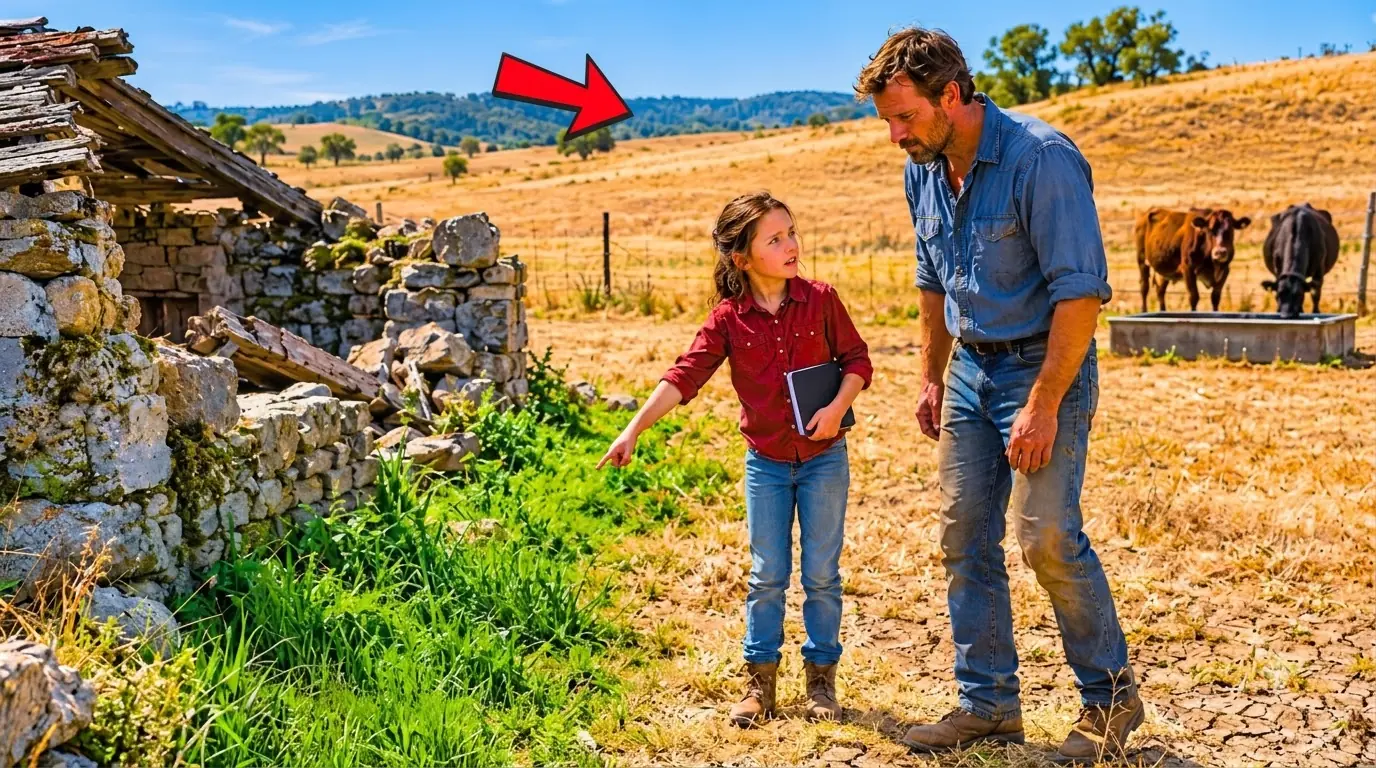
The man didn’t look him in the eye when he did it. He just checked a clipboard, said something about relocation priorities, and drove off in a truck that still had the dealership tag on the back window. Two hundred yards up the hill behind the old collapsed stone springhouse nobody had touched in decades, Elias’s eight-year-old daughter, Ren, was crouched low in the weeds with her notebook open on her knee, staring at a strip of grass that had no business staying green while everything around it had already gone the color of old rope.
She didn’t call out to him. She didn’t say a word to anyone yet. She just kept looking at it, the way she looked at everything, like it was a puzzle nobody else had noticed was even a puzzle.
What had an eight-year-old spotted in a dying pasture that a whole water district full of engineers had somehow walked right past? And why was the ground behind that ruined old springhouse staying cool and green when the rest of the farm was already cracking apart under a summer sun that hadn’t let up in weeks? To understand that, you have to go back to where all of it actually started. Because the answer to Elias Marsh’s problem had been sitting quietly under his own land for longer than anybody in that county had been alive to remember.
Elias was thirty-nine, built like a man who’d spent his whole life around livestock instead of people. The kind of quiet that made strangers assume he had nothing to say, when really he just didn’t waste words on things that didn’t need saying twice. He’d taken over the farm from his father, Denny, who’d taken it over from Otis Marsh, a hard, silent man who’d come out west after the war with almost nothing and turned forty acres of scrub ground into something worth passing down.
The valley Elias farmed didn’t run on rainfall the way outsiders assumed. It ran on an old handshake water-sharing agreement between his grandfather and the grandfather of the man who owned the ranch next door, a sprawling operation now run by Garrett Voss, whose family had quietly bought up most of the water rights in that basin over three decades while everyone else was busy just trying to keep their fields alive.
The agreement had never been written into anything modern. It was just decades of goodwill and a shared ditch with a single head gate sitting right on the property line. That goodwill ran out the same year Garrett signed a supply contract with a bottling company looking to expand into the region. A deal that made his water suddenly worth more sitting in a tank or truck than it ever had been running through Elias’s alfalfa.