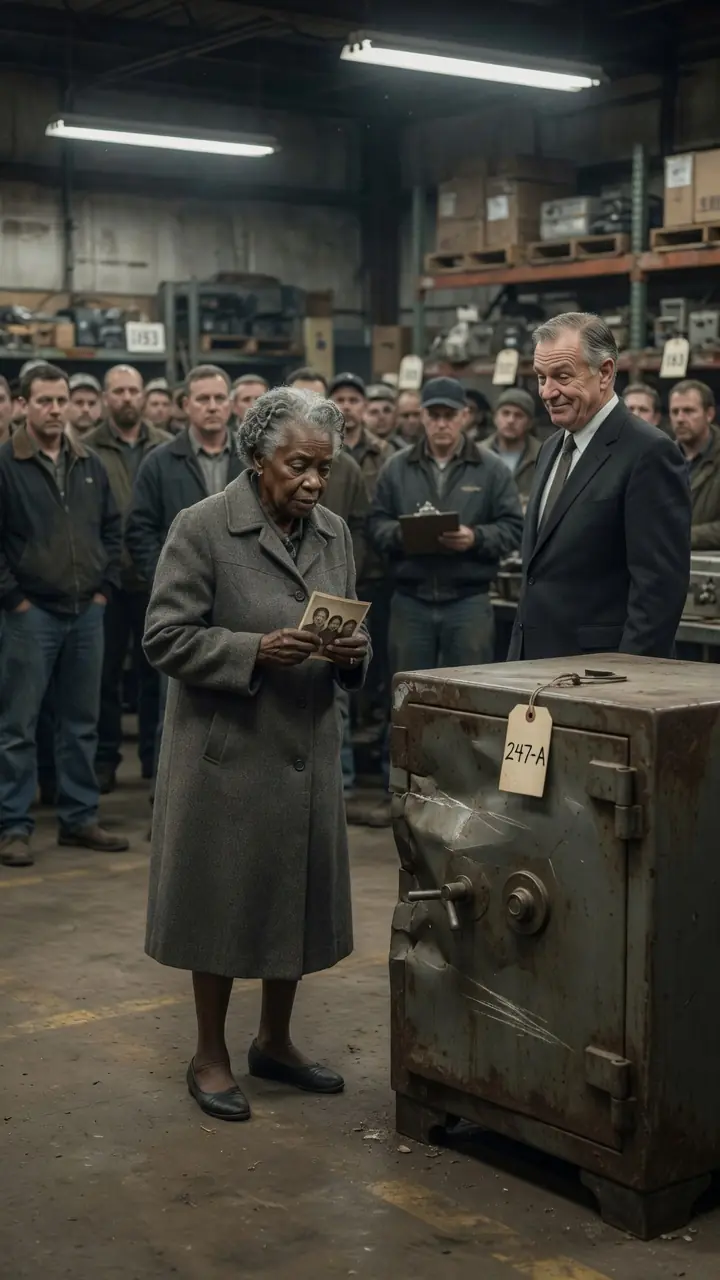
"Put that down. Your kind doesn't touch anything here." "I'd like to buy this safe, please." "Buy? With what? Food stamps?" "I have the money right here." "Where did you crawl out from? In that corner of the garbage dump, penniless wretch." "Take the money and get the auctioneer." "Fine. Give it to her." "That safe hasn't opened in 30 years. Scrap metal suits the filthy poor." The room quieted. Willa folded the receipt to her next to a photograph she had kept for 30 years.
Same safe, same dent, same scratch. None of them knew that rusted box held the one secret Russell Tate spent 30 years burying. This is the story of Willa Brooks and the $50 secret that changed everything. The pickup truck groaned under the weight of the safe.
Willa sat in the passenger seat while Nathan drove. 22 years old, law student, the only grandchild she had left. "Grandma, you just spent $50 on a box that doesn't open." "It'll open." "How do you know?" "Because your grandfather taught me." Nathan glanced at her. She was holding that photograph again.
The one she kept in her coat pocket like other women kept prayer cards. He had seen it a thousand times growing up, but never understood it. They pulled into the driveway on Clanton Avenue. Paint peeling off the porch.
A lawn mower rusting beside the steps. Nathan backed the truck up and killed the engine. It took 40 minutes to get the safe inside. 300 pounds of steel and rust.
Nathan's arms shook by the time they set it down in the living room. The floorboards dipped under the weight. Willa placed the photograph on the floor next to the safe. Nathan crouched and looked back and forth.
"Same dent," she said. "Left side. Same scratch across the dial." "Where is this photo from?" "Crime scene evidence. Case number 94-1873.
The People versus Jerome Brooks." Nathan went quiet. His father's name did that to a room. "This is the safe from Dad's case? The safe they never opened during trial?" "The prosecution said it held $12,000 your father supposedly stole." Willa ran her hand across the dial.
"They convicted him without ever showing the jury what was inside." Nathan sat on the floor. He grew up carrying his father's name like a sentence of his own. Jerome Brooks, convicted armed robber. Every school year some kid's parent recognized the last name.
Nathan learned to eat lunch alone by third grade, learned to fight by fifth, learned to stop explaining by seventh. Jerome died in Donaldson Correctional at 25. Ruptured appendix. The prison infirmary said no surgeon was available.
Nathan was three months old when they arrested his father. Not yet two when they buried him. "Grandma, that was 30 years ago." "Truth doesn't expire, baby." She walked to the closet and pulled out a leather roll. Elmore's tools.
Her husband's locksmith kit. He carried it for 40 years. Every pick, every tension wrench, every decoder. Arranged the same way he left them before the stroke took him.
Willa unrolled the kit on the kitchen table. She picked up the smallest tension wrench and held it to the light. Elmore used this one to teach her. Saturday mornings in the garage, his rough hands guiding hers.
"Patience, Willa. Locks don't fight you. They talk to you. You just have to listen." He had worked for the very same bank that foreclosed on three black families on their street.
40 years of service. They let him go at 62. No pension, no letter. Just a box of his tools left at the security desk.
Elmore never complained. He just kept opening locks for neighbors who couldn't afford a locksmith. Willa knelt beside the safe, pressed her ear against the steel door, eyes closed, turning the dial one click at a time. "Mosler, 1940s model," she said.
"Three-wheel combination. Your grandfather opened hundreds of these." "You know how to crack a safe?" "I know how to listen to one." 30 years earlier, that same safe sat in the back room of a convenience store on Fourth Avenue. Jerome Brooks worked the night shift, 2five years old, saving for a deposit on an apartment so he could bring his wife and baby son home from his mother's house. At 11:14 on a Tuesday, four cruisers surrounded the store.
Russell Tate walked in first. Police chief at 42, big shoulders, bigger voice. "Jerome Brooks, you're under arrest for armed robbery." "I've been here all night. Check the cameras." "Cameras malfunctioned." "That's not possible.
I saw the red light when I clocked in." "Are you calling me a liar, boy?" They dragged Jerome out in handcuffs. His coworker, Derek Coleman, stood behind the counter shaking. Tate pointed at him. "You saw him leave at 9:00.
Say it." Derek said it. Jerome called Willa from the station. One phone call, voice cracking. "Mama, I didn't do it.
I was working. Check the cameras, please, Mama." Elmore drove to every lawyer in Birmingham that week. Brick offices, glass towers, strip mall consultations. Nobody took the case.
He filed four. Each one denied. He called Willa collect every Sunday. She worked double shifts at the laundry to pay the phone bills.
He told her about the food, about the noise at night, about the man in the next cell who screamed in his sleep. He never once told her he was scared. She knew anyway. 18 months in, Jerome collapsed on the floor of his cell.
Ruptured appendix. The guards waited two hours before calling medical. The prison infirmary had no surgeon on duty. They put him on a stretcher and left him in the hallway.
He died before the transport van arrived. The prison doctor wrote natural causes on the report. He was 2five years old. Elmore spent his last 10 years filing appeals, writing letters, knocking on doors that never opened.
Massive stroke at 70. Gone before the ambulance came. Willa buried her husband six years after burying her son. She kept the photograph.
She kept the tools. She kept fighting. Lost her son to a lie. Lost her husband to the grief.
And 30 years later, she's on her living room floor with a dead man's tools and a $50 safe, still fighting. Back in the living room, Willa turned the dial. Click. The first tumbler fell.
Nathan opened his laptop. Court records from his father's case. He had pulled them last semester for a criminal justice paper. Read them once.
Closed the file. Reading your own father's trial transcript was not something you did twice. Tonight, he read it again, page by page. On page 41, the forensic report.
Latent prints recovered from safe exterior, results inconclusive. On page 63, Russell Tate's sworn testimony. Fingerprint analysis confirmed a positive match to the defendant. Nathan looked up from the screen.
"Grandma." "I know, baby." Eyes closed, ear pressed to steel. "I've known for 30 years." The dial clicked, second tumbler. One more to go. Day 12.
Willa had barely slept. Every night after dinner, she knelt beside the safe, ear to the steel, dial turning. Nathan brought her coffee at midnight and a blanket at 2:00. She didn't use either.
On the 12th morning, the third tumbler clicked. Willa sat back on her heels. Her hands were trembling. She hadn't opened anything yet, but her body already knew.
30 years of waiting gathered behind that steel door like water behind a dam. Nathan stood in the doorway in his sweatpants. Grandma? ""Get a towel," she said.
"Lay it on the kitchen table." He did. Willa gripped the handle with both hands and pulled. The hinges screamed. Rust flaked off in sheets.
The door swung open and a smell hit them both. Stale air trapped since before Nathan was born. Inside, a cassette tape in a plastic bag, a brown envelope thick with paper, and a small leather notebook held shut with a rubber band that crumbled when Willa touched it. She opened the notebook first.
Handwriting she did not recognize. Small, precise, slanted left. On the first page, a list of five names. Dates beside each one.
The word closed in red ink after every entry. The third name on the list was Jerome Brooks, dated November 14, 1994. Willa turned the page. Notes in the same handwriting.
Interview schedules, witness names. Derek Coleman circled three times with an arrow pointing to the words "parole leverage". "Whose writing is this?" Nathan asked. Willa turned to the inside cover.
Stamped in faded blue ink, "Property of R. Tate, Birmingham PD". She set the notebook down very carefully, as if it might disappear. Nathan unsealed the brown envelope.
Inside, a forensic analysis report from the Alabama Department of Forensic Sciences, dated October 1994. The conclusion line read, "No identifiable latent prints matching the suspect were recovered from the safe or surrounding surfaces. Not inconclusive. Not partial match.
No match. None." "This is the original report." Nathan said. His voice was barely a whisper. The one submitted to the court was different.
They changed it. Willa didn't speak. She was staring at the cassette tape. A piece of masking tape on the side read, "MC, October 22, 1994" in the same handwriting.
Nathan found an old tape player in the hall closet. The kind Elmore used to record jazz off the radio. He pressed play. Static.
Then, Russell Tate's voice, younger, but unmistakable. """Derek, listen to me. You're going to say Jerome left the store at 9:00." You're going to say he came back at 11:00 with a crowbar."" Derek Coleman's voice, shaking. """But that's not what happened." He was there the whole..." "I don't care what happened.
You're on parole, Derek. One phone call and you're back inside. "Your daughter's what? Three?" You want her growing up visiting Daddy in prison?" Silence on the tape.
"Say it, Derek. He left at 9:00." A long pause. Then Derek, barely audible, "He left at 9:00." "Good. Now, here's what you're going to say about the crowbar." Willa reached over and pressed stop.
The kitchen was silent. Nathan was gripping the edge of the table so hard his fingertips had gone white. "He threatened his children," Nathan said. "He threatened everyone," Willa said.
"That's how he worked. That's how he always worked." She placed her palm flat on the notebook. Five names. Five families.
30 years of silence held together by fear and a badge. "What do we do now?" Nathan asked. "We find a lawyer who isn't afraid of a ghost in a uniform." The next morning, Nathan drove to the office of Gloria Ashford. 4five years old.
Civil rights attorney. She operated out of a converted row house on Sixth Avenue with two paralegals and a copier that jammed every third page. She had spent 1five years taking cases no one else would touch. Police brutality.
Wrongful conviction. Prosecutorial misconduct. She won more than she lost. Nathan set the notebook, the forensic report, and the cassette tape on her desk.
Gloria listened to the tape without expression. When Tate's voice said, ""Your daughter's what? Three?"" she pressed pause, rewound, played it again. Her jaw tightened.
She read the forensic report twice. Then she opened the notebook and ran her finger down each name. She stopped at the second entry, Arthur Simmons. She pulled a file from her cabinet.
She had represented Arthur's sister in 2009. A civil suit against the county that went nowhere because they couldn't prove misconduct. "I've seen this handwriting before." Gloria said quietly. ""In the evidence file I couldn't crack eight years ago."" She studied each remaining name in the notebook.
Then she closed it and looked at Nathan. ""I'll take the case. No fee."" ""Just like that?"" ""Your grandmother bought a safe for $50 and found evidence that a police chief fabricated at least five criminal cases to build his career. This isn't just about your father, Nathan.
There are four other families in this notebook."" Within 7two hours, Gloria filed a motion to reopen the case of Jerome Brooks. She simultaneously filed a formal complaint with the Jefferson County District Attorney requesting an investigation into Russell Tate for evidence tampering, coerced testimony, and obstruction of justice. The filings were public record. By the end of the week, two of the four other families in the notebook had called Gloria's office.
By the following Monday, it was three. Word spread through the neighborhood first, then through the churches, then through the local news. A 74-year-old woman bought a broken safe at a police auction for $50. Inside was proof that a decorated police chief had been framing black men for decades.
Russell Tate found out on a Thursday morning. He was sitting in his sunroom reading the paper when his phone rang. His old deputy told him about the filing, told him about the tape. Tate drove to Clanton Avenue that afternoon, parked his silver Cadillac in front of Willa's house, knocked once, didn't wait for an answer, walked right in.
Willa was sitting at her kitchen table, the notebook open in front of her. "Willa." His voice was the same one from the tape, just older. ""You need to stop this nonsense." "Sit down, Russell." "I'm not sitting." "Your boy was guilty 30 years ago and he's still guilty today. You're embarrassing yourself." "My boy is dead because of you." "Your boy is dead because he robbed a store." "Then why did you hide the forensic report?
Why is there a tape of you threatening Derek Coleman's children?" Tate's jaw tightened. He hadn't expected her to know about the tape already. Nathan stepped into the kitchen, six feet two inches, arms folded. "Mr.
Tate, you're in our house without invitation. I'm going to ask you once to leave." "You must be Jerome's boy." Tate looked him up and down. "Playing lawyer, just like your daddy played innocent." "My father was innocent and you know it." "Case is closed, son. Case is closed." "Truth doesn't." Tate stared at Nathan for a long 3 seconds.
Then he turned and walked out. On the porch, he pulled out his phone. Willa heard him say four words before the screen door closed. "We have a problem." That night, someone went through Willa's mailbox.
Letters scattered on the lawn. Nothing taken, just a message. The war for Jerome's name had officially begun. Gloria Ashford found Derek Coleman living in a rented room above a laundromat in Mobile, Alabama.
5six years old, thin as a wire hanger. Three empty bottles on the kitchen counter. A television playing to no one. He opened the door in a stained undershirt and didn't look surprised.
""I've been waiting for this knock for 30 years," he said. Gloria sat at his kitchen table, which was a card table with a folded napkin under one leg. She placed a small tape recorder between them and pressed play. Derek heard his own voice.
2six years old on that tape, shaking, saying words Russell Tate put in his mouth. He listened without moving. When it ended, he pressed his palms flat on the table and stared at them. "He told me he'd send me back to prison.
I had a daughter. She was three." Derek's voice cracked. "I told myself I'd fix it later. Come forward when things settled.
But things never settled. Jerome died, and I just kept not saying anything. 30 years of not saying anything." His daughter was 33 now. She hadn't spoken to him in five years.
She found out what he did and cut him off with one sentence. ""You let an innocent man die so you could stay free." "Derek, I need you to testify."" "I know. Tate still has influence. It won't be easy." "Easy?" Derek almost laughed.
""I haven't slept through the night since 1994. You think I'm worried about easy?"" He signed the affidavit that afternoon. His hand shook the entire time, but he signed every page. Gloria drove back to Birmingham and played the tape again in her car.
She had handled dozens of wrongful conviction cases. She knew the pattern. A cop who needed a win, a suspect who fit the profile, a witness too vulnerable to resist. But five names in one notebook?
That was not a pattern. That was a production line. Back on Clanton Avenue, Willa sat in the living room holding a shoebox. Inside were 11 letters, all from Jerome.
All written from Donaldson Correctional Facility on lined paper torn from a commissary notebook. Nathan sat across from her. He had never read them. "Your father wrote me every two weeks," Willa said.
"11 letters in 18 months. Then he was gone." She handed Nathan the last one. Dated three weeks before Jerome died. The handwriting was messier than the others, rushed.
Nathan read it aloud. Mama, I heard the guards talking last night. One of them said something about the safe. He said Tate kept things in it.
Things that were never supposed to see a courtroom. I don't know what that means, but I know it means something. The truth is in that room, Mama. They didn't destroy everything.
"Don't stop fighting." Tell my son I love him. Tell him his daddy wasn't what they said he was. I love you. Jerome.
Nathan folded the letter and held it against his chest. He didn't speak for a long time. "He knew," Nathan finally said. "He knew there was evidence." "He knew." And he tried to tell me.
But I didn't understand until I saw that safe at the auction. Willa took the letter back gently. Your grandfather understood. "Elmore spent 10 years trying to find it." He wrote to the police department, filed freedom of information requests, showed up at the precinct asking where evidence was stored.
They laughed at him the same way they laughed at me. What happened? "They told him the evidence had been destroyed per standard procedure. They lied." The safe sat in a warehouse this whole time.
When the department liquidated old evidence last year, it ended up in the auction lot. Nobody checked what was inside because nobody cared. Willa walked to the closet and brought back Elmore's locksmith roll. She unfolded it on the coffee table and picked up a small brass pick with a worn wooden handle.
"This was his favorite," she said. "He called it the listener." Said every lock had a voice. Most people just couldn't hear it. She turned it in her fingers.
Elmore taught me on Saturday mornings. I'd sit in the garage on a milk crate and he'd hand me a padlock and this pick. "Close your eyes, Willa. Feel the pins.
They'll tell you when they're ready." I got so frustrated the first year I almost quit. He smiled and said, ""30 seconds of patience saves 30 years of wondering."" She set the pick down next to the photograph of Jerome. He didn't know how right he was. Nathan looked at the tools, the letters, the photograph, the safe in the corner with its door hanging open.
Three generations of Brooks men. Jerome, who lived it. Elmore, who fought it. Now Nathan, who would finish it.
"I'm going to law school because of you," Nathan said. "You know that, right?" "You're going to law school because of your father." "Same thing." The next Tuesday, the Birmingham Herald ran a front-page story. Local woman's $50 safe purchase may overturn 30-year conviction. A photo of Willa on her porch, arms crossed, not smiling.
By Wednesday, three national outlets picked it up. By Thursday, Russell Tate's name was trending. Tate called a friend at the local television station and gave an interview from his living room. Leather chair, flag pin on his lapel.
""This is a grieving mother who never accepted the truth about her son. I have sympathy for her, but sympathy doesn't change facts. Jerome Brooks was convicted by a jury of his peers. This so-called discovery is a desperate attempt to rewrite history."" The interview aired at 6:00.
Half the town believed him. The other half wasn't sure what to believe. At church on Sunday, Willa's pastor asked the congregation to pray for discernment in difficult times. He didn't mention her name.
He didn't have to. After the service, three women who had known Willa for decades walked past her without speaking. One crossed the street. Nathan watched from the car.
His grandmother walked to the passenger door, sat down, and stared straight ahead. She didn't cry, but her hands were shaking for the first time since the safe opened. The neighborhood split clean down the middle. Tate's supporters left anonymous notes on porches.
Let it go. Stop embarrassing this town. Someone spray-painted liar on the sidewalk outside Willa's house. Nathan scrubbed it off before she woke up.
That night, a brick came through Willa's living room window. It landed three feet from the safe, glass everywhere. Nathan ran in from the kitchen and found Willa standing in the middle of the room, glass in her hair, staring at the brick on the floor. No note.
No explanation needed. ""We should call the police," Nathan said. ""The police," Willa said quietly. She almost smiled.
Nathan wanted to stop. He told Gloria the next morning, ""They're going to hurt her. Maybe we let the Innocence Project handle it. Take a step back."" Gloria looked at him.
""That's your call, but your grandmother has been fighting this alone for 30 years. You might want to ask her before you decide to quit."" Nathan drove home. Willa was sweeping glass off the living room floor. He grabbed the dustpan without a word.
""Grandma, maybe we should slow down."" Willa stopped sweeping, leaned on the broom, looked at her grandson with the same eyes Jerome had in his mug shot. Brown, steady, unbroken. ""Your father died waiting for this. Your grandfather died fighting for this.
I've spent 30 years carrying a photograph in my pocket because I promised my son I would never stop."" She pointed the broom at the plywood window. ""A brick? Baby, I've had worse mornings."" She went back to sweeping. Nathan picked up his phone and called Gloria.
""We're not stopping."" Gloria sent the full case file to the Innocence Project on a Monday. By Wednesday, their lead investigator called back. ""We've reviewed the materials. The coerced testimony tape alone is sufficient for a motion to vacate, but the forensic report and the notebook elevate this to law enforcement misconduct.
We want to partner on this."" Gloria put the phone on speaker. Willa was sitting at the kitchen table, hands folded over Jerome's last letter. ""What does that mean for my son?"" Willa asked. ""It means we're going to clear his name, Mrs.
Brooks."" Willa closed her eyes. She didn't cry. She had used up her crying years ago, but her hands tightened on the letter until the paper wrinkled under her thumbs. The partnership changed everything.
The Innocence Project brought national media contacts, forensic experts, and a legal team that had overturned 41 wrongful convictions. Within a week, the story broke on every major network. CNN ran a three-minute segment. The anchor held up Willa's photograph side-by-side with the safe.
A 74-year-old grandmother from Birmingham purchased a broken safe at a police auction for $50. What she found inside may expose one of the most disturbing wrongful conviction patterns in Alabama history. Then the auction video resurfaced. Someone had recorded Tate on their phone that day.
11 seconds. His voice clear. ""That safe is as worthless as the criminal it belonged to."" The woman he mocked, the mother of the man he framed, standing 6 ft away holding a $50 bill. 11 seconds.
14 million views in 4 days. Comment sections exploded. People tagged prosecutors, governors, civil rights organizations. A hashtag emerged overnight. #50DollarTruth.
Tate's face was everywhere. 3five years of service awards, handshake photographs with mayors and keynote speeches at police banquets, all buried under 11 seconds of cruelty and a notebook with five names written in his own hand. Tate hired Raymond Cross, the most expensive defense attorney in Alabama. Cross filed a motion to suppress.
His argument, the safe was government property sold without chain of custody documentation, making its contents inadmissible. Gloria countered, "In 48 hours, public auction, legal purchase, contents discovered in a private home, no warrant required." The judge denied suppression. Every piece of evidence stayed in. Tate escalated.
He went on Birmingham radio and called Willa a confused old woman chasing ghosts. He called Nathan a kid playing detective. He called Gloria an ambulance chaser. Then he went on the local television station.
Same leather chair, same flag pin, same steady voice. I served this city for 3five years. I put dangerous criminals behind bars. I won't let a rusty box and a 74-year-old woman's grief undo the work of an entire department.
The camera loved him. Half the town still did, too, but the internet didn't. Someone clipped Tate's interview and set it side by side with the auction video. Same man, same voice, same contempt.
The split screen went viral in 1two hours. Podcasters picked it up. Legal commentators broke down the evidence on live streams. A retired federal judge tweeted, ""If these allegations hold, this is the most systematic case of evidence fabrication I've seen in 40 years on the bench."" A law professor at Howard University assigned the case to her students as a real-time study in prosecutorial abuse.
The pressure was building from every direction. Tate could feel the floor shifting. So, he did what he had always done when cornered. He attacked.
He went after Derek. Derek Coleman received a phone call at 2:00 in the morning. No voice, just breathing. A hang up.
Next night, same thing. Third night, a text from an unknown number. ""Your daughter lives on Pine Street. Nice neighborhood."" Derek called Gloria at dawn.
His voice was wrecked. ""I can't do this. He's going to hurt my girl."" "Derek, we can get protection." "Protection?" "From a man who ran the police for 30 years?" "Who's protecting me from his friends?" Gloria reported the threats to the FBI. A federal agent took Derek's statement and documented the texts.
But, Derek was shaking. He told Gloria he couldn't take the stand. Then the other families arrived. Gloria had tracked down all four remaining names.
Two died in prison. One served 22 years and was released. One was still locked up. First came Denise Palmer, 60 years old.
Her father, William Palmer, was the first name in the notebook. Arrested in 1991 for burglary. Died of a heart attack in Limestone Correctional in 1999. He was 46.
Denise drove from Huntsville to meet Willa. They sat on the porch in two plastic chairs. Denise brought a photograph of her father. Willa brought Jerome's.
""I thought I was the only one," Denise said. "So did I," Willa said. "For 30 years, two women, two photographs, two men the system swallowed whole. Then came Thomas Reed, 58, the fourth name.
Arrested in 1996 for assault, served 22 years, released in 2018 with no apology, no compensation, and no record correction. He worked at a car wash in Tuscaloosa. He told no one he was innocent because no one had ever asked. Thomas read his name in Tate's notebook.
Next to it, in red ink, closed. He touched the word with his finger. "He wrote it like it was an accomplishment," Thomas said. The third family was the wife of Samuel Graves, the fifth name.
Samuel was still in prison, 30 years for robbery. Same coerced witness pattern, same fabricated forensics, same red ink. Three families, three stories, same handwriting, same word, closed. Derrick heard about the other families from Gloria.
He called back the next evening. "How many are standing up?" "All of them." Silence. "If a 60-year-old woman whose father died in a cell can walk into court, I can, too." "You sure?" "No. But I'm done being the reason an innocent man stays guilty." The hearing was set for October 14th.
30 years and 11 days after Jerome Brooks was arrested in a convenience store on Fourth Avenue, Russell Tate walked into Jefferson County Courthouse in a navy suit and red tie. Silver hair combed back. He still moved like he owned the building. Two decades of walking those halls as chief of police had wired it into his posture.
Willa walked in behind him. Gray coat, flat shoes, Jerome's photograph in her pocket, Nathan on her left, Gloria on her right. The courtroom was standing room only. Local press filled one side.
National cameras lined the back wall. The four families sat in the first two rows. Derek Coleman in the third, hands in his lap, eyes forward. The bailiff called the room to order.
The judge entered. Everyone stood. 30 years of silence were about to break open in front of the entire country. Gloria Ashford stood and addressed the court.
"Your Honor, we are here today because a 74-year-old woman bought a broken safe for $50. And inside that safe was everything Russell Tate spent 30 years trying to bury." She placed the cassette tape into a player connected to the courtroom speakers. The room went silent. Then, Tate's voice filled every corner.
"Derek, listen to me. You're going to say Jerome left the store at 9:00." Derek Coleman's voice, younger, shaking. "But that's not what happened." I don't care what happened. You're on parole.
One phone call and you're back inside. "Your daughter's what? Three?" You want her growing up visiting Daddy in prison? A long pause.
Then Derek. "He left at 9:00." "Good. Now, here's what you're going to say about the crowbar." Gloria let the tape run to the end. Nobody in the courtroom moved.
A woman in the gallery pressed her hand over her mouth. One of the jurors from Jerome's original trial, now 70 years old, seated in the public gallery, lowered his head into his hands. Gloria picked up the forensic report. This is the original analysis from the Alabama Department of Forensic Sciences, dated October 1994.
It concludes, and I quote, "No identifiable latent prints matching the suspect were recovered from the safe or surrounding surfaces." She paused. No match. Not inconclusive. Not partial.
None. She turned to face Tate's attorney. And yet, at trial, Russell Tate testified under oath that fingerprint analysis confirmed a positive match. He looked at a jury, raised his right hand, and lied.
And a 25-year-old man went to prison for it. And died there. Raymond Cross objected. The judge overruled.
Gloria held up Tate's notebook. The leather was cracked. The pages were yellowed. But the handwriting was clear.
Five names, Your Honor. Five men. Each one arrested by Russell Tate. Each one convicted on evidence that now appears fabricated or coerced.
Jerome Brooks was the third name. He died 18 months into a 35-year sentence because the prison infirmary didn't have a surgeon available for a ruptured appendix. She set the notebook on the evidence table. William Palmer.
First name. Died in Limestone Correctional, 1999. Heart attack at 46. Arthur Simmons.
Second name. Served 19 years. Released 2013. Died of liver failure 6 months later.
Jerome Brooks. Third. Dead at 25. Thomas Reed.
Fourth. Served 22 years. Released 2018 with nothing. No apology.
No compensation. Samuel Graves. Fifth. Still incarcerated.
30 years. For a crime that carries Russell Tate's handwriting in the margins. The courtroom was absolutely still. Then Derek Coleman stood up from the third row.
Gloria nodded. He walked to the witness stand. His hands were shaking. His shirt was buttoned wrong.
He sat down and looked directly at Russell Tate for the first time in 30 years. ""I was 26," Derek began. ""Jerome and I worked the same shift. He never left that store.
I watched him stock shelves and mop the floor and count the register three times because that's who he was. He was careful. He was honest." Derek's voice broke. He gripped the edge of the witness box.
"Tate came to me the next day, told me what to say. Told me if I didn't, he'd revoke my parole and I'd never see my daughter again. She was three years old. I could hear her laughing in the next room when he said it." He looked down at his hands.
"I lied. I looked Jerome's mother in the eye at that trial and I lied. And Jerome went to prison. And he died.
And I have been carrying that every single day for 30 years." Derek looked up, tears running down his face. "Jerome, if you can hear me, I'm sorry. I'm sorry I was too scared to tell the truth. I'm sorry it took this long." The courtroom was silent except for the sound of Denise Palmer crying in the front row.
The judge called a 15-minute recess. When the court reconvened, Willa was invited to give a victim impact statement. She stood slowly. Nathan reached for her arm, but she waved him off.
She walked to the front of the courtroom carrying nothing but the photograph of Jerome. She didn't look at Tate. She looked at the judge. Your honor, my name is Willa Brooks.
I am 74 years old. I have been fighting for my son's name for 30 years. My husband Elmore fought beside me until the stress killed him. He died of a stroke at 70.
My grandson Nathan grew up without a father because of what happened in this courtroom 30 years ago. She held up the photograph. This is Jerome. He was 25.
He worked nights to save money for his family. He called me from the police station and said, ""Mama, I didn't do it. Check the cameras."" "I have heard that sentence every single day since. In my sleep, in the grocery store, in church, every day.
Her voice was steady, not loud, not angry, just clear. "I bought a broken safe for $50. People laughed at me. The man who framed my son laughed at me.
But I knew what that safe was. My husband taught me. And when I opened it, I found the truth that Russell Tate buried with my boy. She lowered the photograph.
"I am not here for revenge. I am here because my son wrote me a letter from prison that said, ""Don't stop fighting."" "So, I didn't. And I am here because there are four other families in this room who lost fathers and sons and years they will never get back. We are not asking for sympathy.
We are asking for the truth to be entered into the record. Jerome Brooks was innocent. Say it out loud. Put it on paper.
Let my grandson carry his father's name without shame." She walked back to her seat. Nathan took her hand. Gloria wiped her eyes with the back of her wrist. The judge removed his glasses and set them on the bench.
"The court finds sufficient evidence to vacate the conviction of Jerome Brooks. The court further orders a full investigation into the conduct of Russell Tate in connection with all five cases documented in the evidence presented today." Tate stood. His attorney whispered something. Tate didn't respond.
He looked around the courtroom. The families in the front rows, the cameras in the back. Derek Coleman still sitting in the witness box, head bowed. Not a single friendly face in the room.
His attorney leaned in again. "Russell, we need to discuss a plea." Tate buttoned his jacket with hands that trembled. He walked toward the exit. The crowd outside the courthouse was already chanting.
Signs reading #50DollarTruth and free Samuel Graves lined the steps. 30 years ago, Russell Tate had walked out of this same courthouse to applause after convicting Jerome Brooks. Today, he walked out to the sound of his own name being shouted by people demanding justice. The door that took 30 years to open had finally swung wide and there was no closing it now. three months later, the Jefferson County Court formally vacated the conviction of Jerome Brooks.
The order was two pages long. The last line read, ""The defendant is hereby declared innocent of all charges."" Willa framed that page. She hung it next to Jerome's photograph in the hallway, right above the small table where she kept Elmore's locksmith tools. Russell Tate was indicted on 14 counts: evidence tampering, coerced testimony, obstruction of justice, perjury, civil rights violations under federal statute.
The FBI investigation expanded beyond the five names in the notebook. Two former deputies cooperated. They described a system, Tate identifying vulnerable suspects, fabricating physical evidence, leveraging parole status to coerce witnesses, and closing cases fast enough to justify budget increases and promotions. Tate's bail was set at $2 million.
He posted it. But the town he once commanded had already convicted him. His neighbors stopped waving. The diner where he ate breakfast every morning asked him not to come back.
The local VFW Hall removed his photograph from the wall of honor. His trial date was set for March. He faced 15 to 2five years. Samuel Graves, the fifth name in the notebook, the man still locked up, was released on a Tuesday afternoon.
He walked out of St. Clair Correctional carrying a paper bag with his belongings. 61 years old, he had entered at 31. His wife was waiting in the parking lot.
She had visited him every month for 30 years, never missed once. Samuel stood in the sunlight for a long time. He didn't move, just stood there with his face tilted up toward the sky, breathing free air. His wife didn't rush him.
She knew. Thomas Reed received a formal letter of exoneration and was entered into the state compensation program. 22 years of wrongful imprisonment at $50,000 per year. He didn't care about the money.
What he cared about was the letter. He laminated it and kept it in his wallet. The first time anyone official had ever said he was innocent. The state of Alabama awarded the Brooks family $4.2 million in compensation.
Willa didn't keep it. She used $1.5 million to establish the Jerome Brooks Foundation for wrongful conviction relief. The foundation provided legal aid, transitional housing, and counseling for exonerees and their families. Gloria Ashford signed on as chief counsel, pro bono.
The remaining funds were split among the four other families. Willa kept nothing for herself. Nathan asked her why. ""I didn't do this for money, baby.
I did this so your father's name could be clean. The money belongs to the people who lost what we lost."" Nathan graduated from the University of Alabama School of Law the following spring. He finished second in his class. His thesis was titled Chain of Custody: How Evidence Mismanagement Enables Systemic Wrongful Conviction.
His faculty advisor called it the best paper she had read in 20 years. On graduation day, Willa sat in the third row of the auditorium. When they called Nathan's name, she didn't cheer. She just pressed Jerome's photograph against her chest and closed her eyes.
Nathan accepted his diploma and walked straight to his grandmother. He knelt in front of her seat, still in his cap and gown, and said, ""We did it, Grandma. All three of us."" He became the Jerome Brooks Foundation's first staff attorney. His first case, a 19-year-old in Montgomery convicted on a single eyewitness testimony that recanted two weeks after trial.
Nathan got the conviction overturned in four months. On the one-year anniversary of the safe's opening, the foundation held a gathering at Willa's house on Clanton Avenue. The porch had been repaired. The window had real glass again.
Denise Palmer brought fried chicken. Thomas Reed brought his daughter, who was meeting Willa for the first time. Derek Coleman came last. He stood at the edge of the yard for 10 minutes before Nathan walked over and brought him in.
They set up folding chairs in the living room. In the corner sat the safe. Willa had it cleaned and polished. The rust was gone.
The dent on the left side and the scratch across the dial remained. She told the restoration company to leave them. Next to the safe, on a small wooden shelf, sat Elmore's locksmith roll, unfolded. Every tool in place.
The brass pick with the worn handle, the listener, resting on top. A small plaque on the wall above them read, ""Bought for $50, worth 30 years of truth."" Denise asked Willa to say a few words. Willa stood in front of the safe and looked around the room. Families who had been strangers a year ago, united by the same notebook, the same red ink, the same man.
""I'm not a lawyer," Willa said. "I'm not a detective. I'm not an activist. I'm a mother who made a promise to her son.
Jerome wrote me from prison and said, ""Don't stop fighting."" "So, I didn't. Elmore picked up the fight when I was too tired. Nathan picked it up when Elmore was gone. That's what family does.
You carry it until someone can carry it further." She looked at the safe. "People ask me why I bought that thing. 74 years old, spending $50 on a rusty box at a police auction. They laughed.
They recorded it. They called me names. She paused. "But my husband taught me something about locks.
He said locks don't open with force. They open when you understand them. I understood that safe. I understood what it meant.
And I understood that the truth was waiting inside for someone patient enough to listen." She placed her hand on the cold steel. "Jerome, baby, your name is clean. Your son is a lawyer. And that safe you wrote about in your last letter, Mama found it." The room was quiet.
Nathan was crying. Derek was crying. Denise was holding her father's photograph against her heart. Outside, the sun was going down over Clanton Avenue.
The porch light came on. A neighbor waved from across the street. A dog barked somewhere down the block. The ordinary sounds of a neighborhood that had watched one woman fight for 30 years and never fully understood why until now.
Willa Brooks sat back down in her chair. She folded her hands in her lap. She looked at the safe one more time. Then she smiled.
END