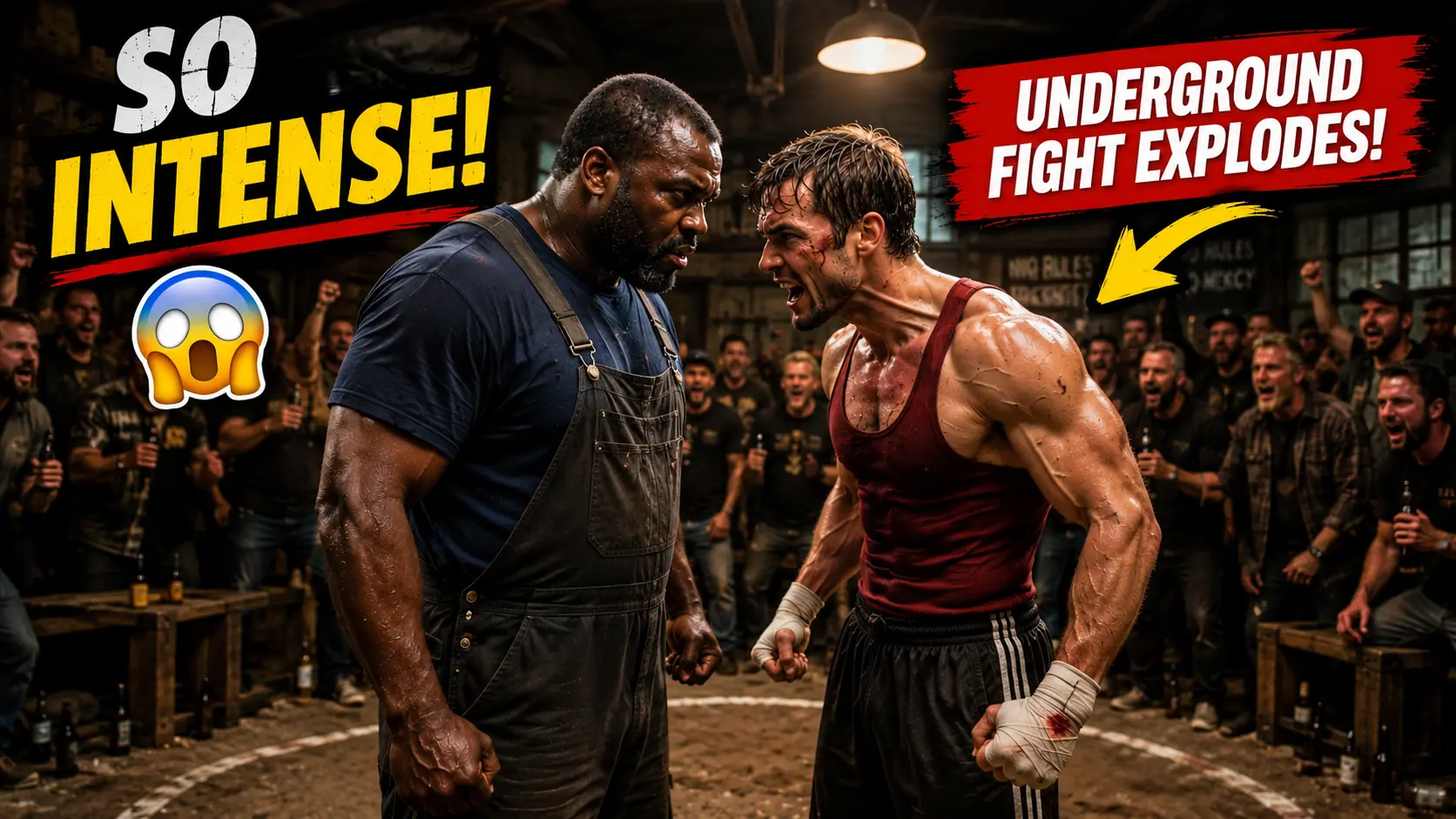
They Slammed the Old Biker to the Floor — Then the Room Heard His Name
Reader Theme:
Font Size:
24px
Hand it over. Keys, wallet, the ring, all of it. You don't want to do this, son. That's enough. And who exactly are you supposed to be?
Someone who's not leaving. You've got a daughter waiting on you. Don't be stupid. She's why I'm staying. You're nobody.
Now get out of my sight. Trent Vaughn had spent years reading people, spotting the ones who would look away, step back, and convinced themselves it wasn't their problem. When the single father in the work jacket stepped into that gas station, Trent read him instantly. A nobody going nowhere. What he couldn't read was the quiet decision already made behind Darius Bennett's eyes.
The years of choosing right over easy, even when no one was watching. The kind of man who taught his daughter that courage wasn't the absence of fear. It was showing up anyway. Trent had dismissed hundreds of men just like that. None of them had ever stayed.
Every morning started the same way. Darius Bennett was up before the sun moving through a kitchen that was too quiet for a man who used to fall asleep to the sound of someone else breathing beside him. He'd crack eggs onto a skillet, set out the small orange pill container Nia needed with breakfast, and lay her school uniform across the back of the chair, the way Talia used to do, pressed flat collar turned down just right. It wasn't a routine he had chosen so much as one he had built piece by piece over four years of learning how to be two parents at once. Nia was 9 years old and had her mother's eyes patient and alert, the kind that noticed everything.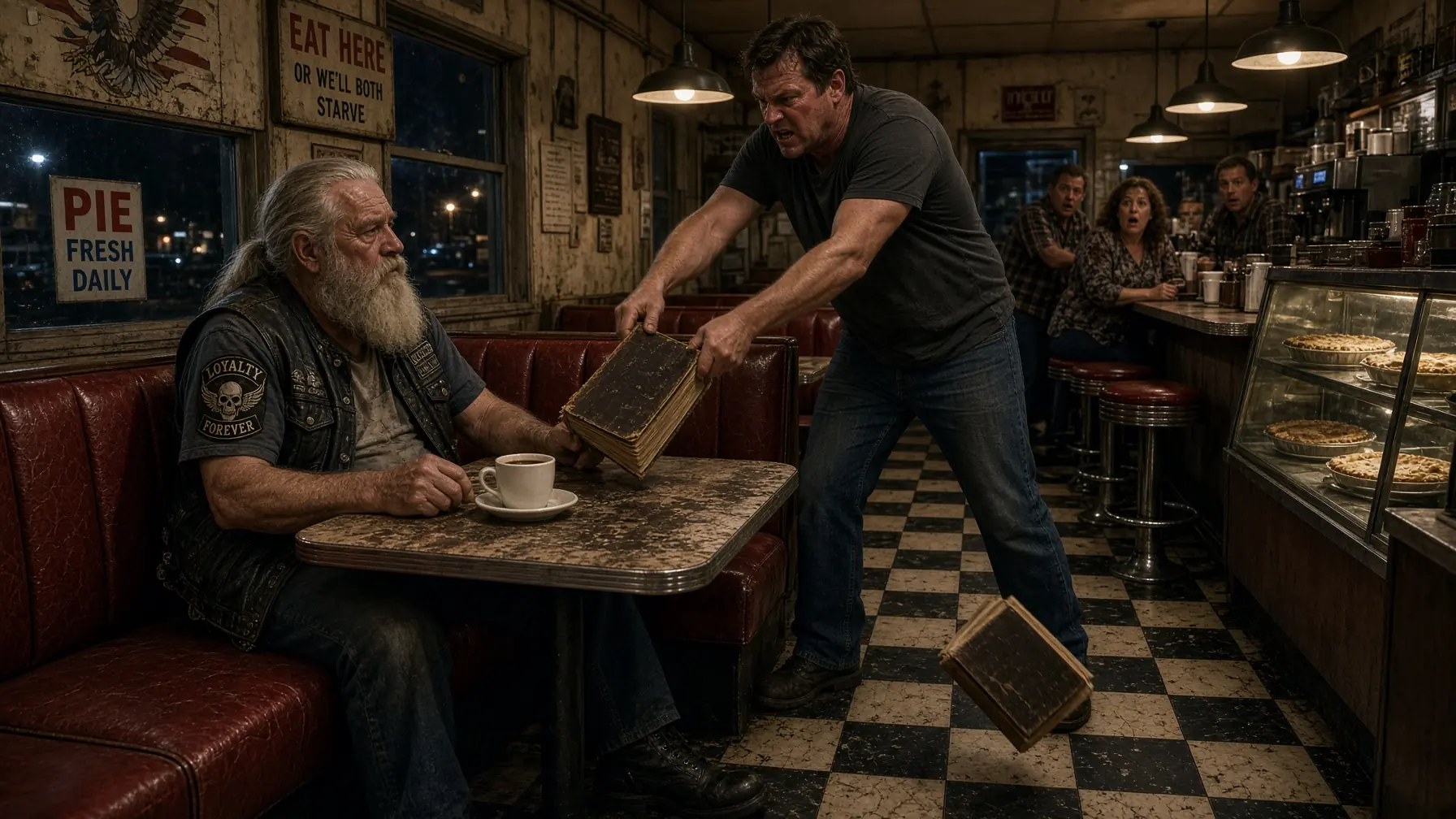
She had a chronic condition that required daily monitoring, the kind that didn't show on the outside, but showed up in bills in specialist appointments scheduled 3 months out in a glucose monitor. She wore on her arm and checked before every meal. The condition was manageable. The cost of managing it was another thing entirely. Darius kept a sealed envelope in the kitchen drawer thick with whatever cash he could set aside each week.
He hadn't opened it in 2 years. He told himself he wouldn't not unless there was no other choice. He wore the same three shirts in rotation. He drove a pickup truck that overheated if he pushed it past 60 mph on the highway and needed a new alternator. He kept putting off because the alternator cost $340 and $340 was a month of Nia's medication.
He ate lunch most days from whatever was left in the garage refrigerator and he didn't think of it as sacrifice. He thought of it as math. Cole Hartman had run his auto shop on Grover Street for 31 years and was not a man who gave compliments without being pushed. He was 64, slowmoving, and had the hands of someone who had spent every decade of his adult life inside an engine. Cole didn't say much to Darius beyond what the job required, but he scheduled Darius's shifts around Nia's school pickup without being asked, and he had never once questioned why Darius sometimes stayed late to help a neighbor push a wheelchairbound woman's electric scooter into the back room for a free repair.
That was Cole's version of approval, and Darius understood it perfectly. What Darius could do with an engine was difficult to explain to anyone who hadn't watched him work. He could listen to a car idle for 30 seconds and tell you which cylinder was misfiring. He could take apart a carburetor in the dark if needed going by feel alone. But where his attention sharpened into something close to obsession, was with old motorcycles, specifically with the handbuilt customs that had come out of small American shops in the 1950s and60s when a single craftsman with the right tools and enough patience could build something that didn't look like anything else on the road.
He had read everything he could find about Henry Callaway. The man everyone in the custom motorcycle world called Iron Hank had started with nothing. A rented space secondhand equipment and a reputation built one frame at a time. His early work from the late 1950s was considered collector's territory now. And the most famous piece was a 1959 pan head in cherry red that Hank had built himself during his first year in business.
Darius had a photograph of it torn from a magazine taped inside his locker at the shop. He knew the bike the way some people knew songs every curve of the tank, the handlettered pinstripe along the fender, the small brass badge riveted just behind the seat. He had never seen it in person. He had never expected to. Nia knew about the dream.
She had heard her father talk about it in the way he talked about things he believed, but couldn't afford quietly, carefully, like something fragile he didn't want to break by holding too tight. She expressed it differently. In her sketchbook, she drew the same image in variations. two figures standing in front of a building with a handlettered sign that read Bennett Community Garage. In the drawings, Darius was always at a workbench. Nia was always at a front desk doing homework.
Every time Darius found a new version of the drawing, he put it on the refrigerator and said nothing for a long moment. Then he'd say, "It looked good." Then he'd go back to doing dishes. He knew what those drawings meant, and he knew what they cost her to make the optimism of a 9-year-old who had already lost one parent and had decided quietly and on her own that she was going to believe in the other one anyway. The call started coming in just after 3:00 in the afternoon. Darius was underneath a customer's sedan at Hartman's Auto finishing a break job that should have been done an hour earlier when his phone began buzzing against the floor of the pit.
He reached for it without looking and then looked because the screen showed three missed calls from Riverside Elementary in a row. He finished the brake line, lowered the car, and told Cole he needed to leave. The customer was waiting, Cole said. Darius said he understood and apologized, and Cole waved him off with one hand and picked up the job himself. Darius was already out the door.
He took the shortcut. It was six blocks out of the way, but cut through a stretch of side streets that avoided the worst of the afternoon traffic, and it brought him past the Sonokco on Fifth Street, a station he'd filled up at a 100 times without incident. He pulled into the lot, intending to cut through to the far exit, and that was when he heard the sound of breaking glass. Six of them had the old man surrounded near the air pump at the far end of the lot. The man on his knees was somewhere around 60, wearing a leather jacket worn soft at the elbows, and behind him close enough to touch, was a cherry red pan head that Darius recognized before he could stop himself from recognizing it.
He pushed the thought aside immediately. There was no room for it yet. Trent Vaughn was doing most of the talking. Darius had seen his type before, not violent by nature, but performing violence for the people watching him, which made him more dangerous than someone who would simply take what he wanted and leave. He was demanding the keys, the wallet, a watch, a compass ring on the old man's right hand, and anything else he could name before he ran out of ideas.
The old man wasn't giving any of it. He wasn't pleading either. He was just kneeling in the broken glass shoulders, squared, waiting. The chair came without warning. One of Trent's crew lifted a plastic lawn chair from beside the station door and swung it hard into the old man's back.
It cracked down the center from the impact. The man dropped forward onto one palm and stayed there, his left shoulder dropping at an angle that said something important had been hit. Darius had stopped his truck at the edge of the lot. His phone buzzed again. Riverside Elementary fourth call.
He watched a car slow on Fifth Street. The driver crane his neck to look and then accelerate. He watched the station attendant close the interior blinds. He watched another customer gather her child by the wrist and walk in the opposite direction quickly without looking back. One of Trent's crew turned and pointed at Darius directly.
The message was simple. This wasn't his business. The old man on the ground turned too, lifted one hand slightly, and moved it toward the exit. The same gesture. Go.
Then Trent picked up the wrench. The old man's voice when it came was low and rough from the impact. He said only two words. Please help. They weren't dramatic.
They weren't a speech. They were just the words of a man who had run out of everything else. Darius thought about Nia for exactly one second. Then he got out of the truck. He had assessed the lot before he was conscious of doing it, the way a person does when they've spent their whole life solving mechanical problems, reading systems, looking for the part that doesn't fit.
A half full water bottle sat on top of his tool bag. A length of bicycle chain was coiled near the base of the trash can. Six men, the nearest of whom was turned away. He didn't announce himself. He threw the water bottle hard into Trent's shoulder the moment the wrench started its arc downward.
The impact threw the swing wide, and in the same motion, Darius crossed the distance between them and drove his shoulder into the nearest man's chest, pushing him clean off his feet and opening a lane directly to the kneeling biker. He got his hands under the man's arms and pulled him back and to the left out of the center of the group, and then the second one came swinging the broken half of the plastic chair at Darius's head. He got his forearm up in time. The plastic split further and both pieces hit the ground and Darius's arm went numb from the wrist to the elbow. He grabbed the bicycle chain with his other hand and swept it low across the ankles of the man holding a broken bottle who went down hard on the asphalt.
Trent came from the right, the wrench raised again, and Darius sidestepped the swing and wrapped the chain once around Trent's wrist. One twist, the wrench hit the concrete. What happened next was not Darius. It was the old man who had pushed himself back to his feet while all of this was happening and stepped forward into the open space between Darius and the remaining crew. He said nothing for a long moment.
He simply stood there looking at them, his left arm hanging lower than the right, blood at the corner of his mouth, and whatever they saw in his face was enough. Trent looked at his own wrist, then at the three men still standing, and something shifted in the air. The running started a few seconds after that first Trent, then the others, all of them disappearing around the far end of the lot until the only sound left was traffic on Fifth Street. Darius's hands were shaking. He hadn't noticed during the fight, but now that it was over, the adrenaline had nowhere to go, and it came out through his palms, his knees, a tightness in his jaw he had to consciously release.
The biker pulled a blue bandana from inside his jacket and folded it into a strip, wrapping it around the cut on Darius's forearm without asking for permission. He asked Darius his name. Darius told him. He asked why Darius had stepped in. Darius looked at his phone.
The missed calls from Riverside Elementary were still on the screen. "My daughter's waiting," Darius said. "I couldn't look her in the eye tonight if I'd walked away from you." The old man reached into his jacket and produced a folded roll of bills thick enough that Darius recognized, even at a glance, that it was more money. He held it out without ceremony. Darius shook his head.
He told the man he didn't want his daughter growing up thinking that helping someone in need was a way to get paid. The man studied him the way Cole sometimes studied an engine he hadn't encountered before. Not with suspicion, but with the focused interest of someone recalibrating an assumption. Darius started walking back toward his truck and that was when he saw the pan head up close. He had told himself it was just a red bike.
He told himself that right up until he was standing 3 ft from it and could see the handlettered pinstripe along the tank, the style of it unmistakable thin pulled single color, the kind of line you couldn't produce with tape and a brush only with years and a very steady hand. He could see the small brass badge behind the seat. He could see the engine configuration, the exact profile of the primary cover, all of it matching what he had memorized from a magazine photograph taped inside a locker at a garage on Grover Street. He turned and looked at the sun behind him. The man did not confirm anything.
He didn't deny anything either. He simply watched Darius with the same expression he'd worn looking at Trent's crew, calm and entirely without surprise, as though this moment had already been accounted for. "We don't forget," the man said. Darius didn't know what that meant. He had a daughter waiting and four missed calls from her school and a forearm wrapped in a stranger's blue bandana.
He got in his truck and drove. He didn't know yet that everything had already started moving. Nia was still sitting in the afterchool room when Darius arrived nearly an hour past pickup time. The supervising teacher was grading papers at the desk by the window and Nia was at the small table in the corner with her sketchbook open her pencil moving. She didn't look up immediately when the door opened.
She had learned not to expect her father exactly when she expected him because something at the shop was always running late, always needing one more hour. But when she did look up and saw the blue bandana wrapped around his forearm, the pencil stopped. She didn't ask about it until they were in the truck. He told her he'd helped someone who was in trouble kept it simple, kept it short. Nia looked at the bandanna for a long time.
The way she looked at things, she was still deciding about. Then she asked if he had been scared. He said yes, he had been scared. She seemed to consider that carefully, and then she said she thought being scared and doing it anyway was the same as being brave, and he agreed that it was. That night, she unwrapped the bandana herself, cleaned the cut on his forearm with antiseptic from the bathroom cabinet and refolded it neatly on the kitchen table.
She didn't ask anything else. She didn't need to. Darius went back to work the next morning before the sun came up the same as always. He told himself the incident at the Sonoko was finished, that it had been a difficult moment, that it was over, and that no further complications were coming from it. He kept that belief for approximately 2 days before he noticed the man on the opposite sidewalk outside Hartman's auto, who appeared to be reading the same newspaper for the better part of an hour.
He noticed the motorcycle that circled the block three times in the space of 20 minutes without stopping. He noticed a pickup truck parked half a block down that hadn't moved in a day and a half with no parking violation notice on the windshield, which meant someone had arranged for there not to be one. He said nothing to Cole. He didn't know yet whether the attention was friendly or something else, and until he knew there was nothing useful to say about it. What was happening on the other side of that attention was this at the chapter house of the local Hell's Angels Iron Hank Callaway had called in the men he trusted most and told them exactly what had taken place at the Sonokco on Fifth Street.
He did not tell them as a story. He told them as a fact they needed to understand before they acted on anything. He told them that Darius Bennett had walked into a situation that gave him every reasonable excuse to walk back out of it. A daughter waiting six men, no backup, no certainty about what he was walking into, and that Darius had not used any of those excuses. He told them that when it was over, Darius had refused the money he was owed, and that the reason he had given was not false modesty, but a considered principle about what he wanted his daughter to understand, about why people help each other.
Several of the men wanted to find Trent. Hank told them no, and the way he said it meant the discussion was finished. Instead, he asked for information. He wanted to know who Darius Bennett was, not rumors, not impression, but fact. What came back over the following days was a portrait that did not surprise Hank, but confirmed something he had already started to believe.
Darius was a single father whose wife had died four years earlier. He had never missed a medical appointment for his daughter, not once, even during the months when missing a shift at work to take her to a specialist. meant he came up short on rent. He was carrying medical debt from the years of Talia's illness that he had been paying down slowly without complaint without asking anyone for help. He repaired a neighbor's electric wheelchair for free on a Saturday afternoon because the repair shop wanted more money than the neighbor had. He had years earlier spoken to a friend about wanting to open a community garage, a place that fixed cars at fair prices and trained people who needed a trade.
He hadn't mentioned it again after Talia got sick. He had folded that idea away and replaced it with what the situation required. Hank read all of it and said very little. What he said to the men in that room was, "The 8 seconds at the gas station didn't make him who he is. It just let us see it.
The news was moving in the meantime." The attendant, who had locked himself inside the station, had unlocked the door soon after the fight ended and spoken to someone who spoke to someone else. And by the second day after the incident, a local reporter named Linda Brennan had enough of the story to start asking questions. She recognized Henry Callaway's name when it came up. It wasn't obscure, not in circles that paid attention to American craft and custom motorcycle history. And she understood immediately that what had happened at the Sonokco was not a simple street altercation.
She started looking for the man who had walked in and she started looking for Hank. Darius didn't know any of this. He was changing oil and replacing brake pads and eating lunch out of the shop refrigerator, checking his phone between jobs for updates from Nia's school, watching the man across the street pretend to read his newspaper and trying to decide whether to be worried. On the third day, he got his answer. He heard them before he saw them.
The sound was low at first, the kind of vibration that arrives before you can identify where it's coming from, felt in the chest before it's registered by the ear. Cole came out of the shop first, wiping his hands on a rag, squinting down the street. Darius followed, and then they both stood in the doorway and watched 43 motorcycles turn onto Grover Street in two parallel lines. They filled the road from curb to curb. Traffic behind them had simply stopped.
There was no other option, no room to pass, and every driver who had been moving in that direction was now sitting still and watching. People came out of storefronts. A woman across the street held her phone up. Darius felt the sound of the engines change as the column slowed and then one by one came to a stop directly in front of Hartman's auto. The shut offs happened in sequence, not all at once, but one after another, each engine dropping out of the sound until the street went almost completely quiet.
For the first time in what felt like years, the cherry red pan head was at the front. Hank dismounted, removed his helmet, and set it on the seat behind him. 42 men stayed beside their bikes and did not move. At the far end of the block, Linda Brennan was already there with a camera operator, having received information that Darius had not received. Cole looked at Darius and said nothing.
There was nothing to say. Hank walked toward the shop at a pace that suggested he had all the time he needed. He stopped 10 ft from Darius and introduced himself. The way a man introduces himself when he knows the other person already knows who he is but wants to say it plainly anyway. His full name, the name of his company, the chapter he had led for 25 years.
And then the simple fact that Darius had saved his life 3 days ago at a gas station on Fifth Street. He did not stop there, standing in the middle of Grover Street with Linda Brennan's camera recording and 42 men silent behind him. Hank described what had happened with the same precision and honesty that he had used in the chapter house. Six men, the wrench, the moment when everyone around them had chosen to look away, and the single person who had not. "We can forget a debt paid in money," Hank said, speaking clearly enough for the camera.
We we cannot forget a man who stood up when everyone else turned away. Nia arrived 6 minutes later, brought home by a neighbor who usually walked with her after school. She came around the corner, saw the wall of motorcycles blocking the street, and ran not toward them, but toward Darius reaching him before he could move toward her and pressing herself against him. He put his arm around her and put his body between her and everything else, which is what he always did when something was large and loud and between him and whatever he needed to protect. Hank saw this.
He removed his leather jacket without a word, folded it carefully, and placed it across his seat. The gesture traveled down the line before anyone spoke. one man, then the next, then all 42 behind him, each one removing his jacket and placing it over his handlebars and standing with his hands open in front of him. It took about 40 seconds. When it was finished, 43 men were standing in the street without their colors on in ordinary shirts and flannel and plain denim in front of a 9-year-old girl who was not entirely sure what was happening. Hank crouched to her level.
He told her in a plain, quiet voice that her father had gotten hurt protecting him and that today they had come only to say thank you. That was all. Nia studied his face for a moment and then asked whether he had been the one who hurt her father. Hank said no that her father had been hurt because he had chosen to help someone who needed it. Nia considered this with the same gravity she had considered everything since she was small.
Then she looked up at Darius and then back at Hank and she nodded once which seemed to settle things for her. Hank invited Darius and Nia to come to Callaway Custom Cycles the following morning. He said it in the way you say something when you are not asking a question. Then he walked back to the pan head, put his helmet back on, and the engines started again. One then another, then all of them together, the sound filling the street and then pulling away as the column moved out.
In under two minutes, Grover Street was ordinary again. The image of 43 men removing their jackets and standing open-handed in front of a single father and his daughter was on three local news broadcasts by that evening. and National Cable by midnight. The Callaway Custom Cycles facility was a converted warehouse on the industrial edge of town, the kind of building that looked unremarkable from the outside, right up until you stepped through the door. Darius had imagined it many times from the books and the magazine photographs. The reality was different in the way that all real things differ from their imagined versions, more worn in some places, more precise in others, with the specific smell of metal and oil that he associated with the best hours of his working life.
Hank met them in a back conference room where a file folder sat in the center of the table. He explained that his family foundation wanted to cover the remaining medical bills, the ongoing cost of Nia's medication, and monitoring equipment, and a portion of her education expenses. He presented it without theater, as though it were a practical matter being handled practically. Darius said no before Hank finished the sentence, not unkindly, but with no uncertainty behind it. He told Hank that what had happened at the Sonokco was not a transaction that he had not stepped in to purchase anything and that his daughter's future was not something he was interested in receiving as payment for a decision that hadn't been made in order to receive anything.
Hank moved to the second item in the folder. a paid apprenticeship at Callaway Custom Cycles starting at the bottom of the shop with a salary health coverage for Darius and Nia as an employment benefit hours arranged around Nia's school schedule and after one year the right to present a business plan for a community garage. If the plan wasn't strong enough, Hank would say so. If Darius left before the year was finished, everything ended. I'm not giving you a future, Hank said. I'm opening a door.
Everything on the other side of it, you'll have to earn. Darius didn't say yes. He sat with the folder open and said he needed to think about the logistics, the distance from Nia's school, the learning curve, the exposure that came with being on television. What he didn't say, because he couldn't quite say it yet, was that the thing he was most afraid of wasn't failing. It was the specific kind of failure that happened when a man chased something he wanted and the person who had trusted him most was left without him when she needed him.
When they left the building, Nia slipped her hand into his on the parking lot asphalt. She asked whether he wanted to work there. He told her what he told her when he didn't want her to worry about something that what he wanted wasn't the most important question and that what mattered was choosing what was right for her. She didn't answer. She put her sketchbook under her other arm and held on to the hand that wasn't sore.
Cole told him that evening in the same flat tone he used to deliver every piece of unwelcome information that the building owner had sold the property to a development firm. Hartman's auto had 30 days. Cole was 64 years old and the equipment alone would cost more to relocate than he had in savings. He was going to retire. Darius checked his bank account when he got home, standing in the kitchen with the refrigerator light on in the dark.
The number he was looking at covered approximately 3 weeks of normal expenses. That same afternoon, a letter had arrived from Nia's specialist. The glucose monitoring device she had been using for 18 months had reached the end of its calibrated lifespan. The replacement was covered partially by insurance and not entirely, and the gap between those two numbers was more than what was in the account. He was standing at the center of three different walls, and none of them had a door in it.
The following day at the shop, while Darius was stacking tool cases near the back bay, he and Cole talked through the options in the honest, uncomfortable way that men who respect each other talk through things when there are no good answers. At some point, not dramatically, not as a statement, just as something that came out of the exhaustion of looking at the problem from every angle, Darius said he sometimes thought it would have been easier if he had kept driving past the Sonokco 3 days ago. That none of the complication would have come to find him. That Nia would have been in exactly the same position she had been in before, which was difficult, but at least familiar. He didn't notice that the side door was open.
He didn't notice Nia standing in the gap, holding her backpack by one strap until she was already there. And from the stillness of her face, he knew she had been there long enough to hear what he had said. She reached into the backpack and took out the sketchbook. She opened it to the page with the Bennett Community Garage drawing and set it on top of the nearest toolbox. She looked at him and said in the same quiet voice Talia used to use when she meant something all the way through.
If he wished he had walked away, did the things he had taught her still mean anything? I had no answer for that. He had nothing at all. That night he sat alone at the kitchen table in the dark. In front of him, the envelope of medical bills, the closing notice for the shop, a job listing for a warehouse position, two towns over the folded blue bandana, and the drawing from the sketchbook.
He picked up the bandanna and held it for a while. Then he set it down and decided to return it to Hank in the morning, along with a clear statement that there was nothing left to discuss. He believed in that moment that he was doing the reasonable thing all the way down to a layer just underneath reason where something else entirely was sitting and waiting for him to run out of arguments. He arrived at Callaway Custom Cycles before the shop opened the blue bandana folded into a small square in his jacket pocket. The receptionist let him in without question.
Hank had apparently left word that Darius Bennett could come through whenever he showed up. Hank was already in the back conference room with a cup of coffee and a trade publication. He set aside when Darius came through the door. Darius put the bandana on the table. He said he had thought carefully about everything that had been discussed and that his answer was no to the apprenticeship, to the medical coverage, to all of it.
He told Hank he needed a job that started immediately and paid reliably, not a program with a 12-month runway and a plan that might not survive contact with reality. He said Nia needed a father who was present and stable, not one who had gambled their situation on a dream that belonged to a version of his life he could no longer afford to inhabit. Hank listened to all of it without interrupting. When Darius finished, Hank asked him one question, whether he was refusing because he didn't want to accept charity or whether he was refusing because somewhere underneath the practical objections, he was afraid he wasn't good enough to earn what the opportunity was offering. Darius said he wasn't afraid of anything.
Hank pulled a second folder from the seat beside him and placed it on the table without comment. This folder did not contain a grant or a gift or a foundation award. What it contained was a contract formatted the way employment contracts are formatted with terms and conditions and performance requirements and a signature line at the bottom. Hank walked through it the way he would walk a new hire through any agreement methodically without softening the language because the language didn't need softening. Darius would be paid a full apprentice wage from day one.
Nia's health coverage would appear on his payub as an employee benefit, the same line item. It appeared on for every full-time worker in the building, because that was what it was, a condition of employment, not a donation with his daughter's name on it. The obligations on Darius's side were explicit. He had to complete every required hour. He had to pass every skills evaluation the senior craftsman put in front of him.
On Saturday mornings, he would help run the youth mechanics program the chapter had been operating for 11 years. At the end of 12 months, he would present a detailed business plan for a community garage. Not a sketch, not a concept, a real plan with a financial model and a projection and a proof that the thing could sustain itself without depending on anyone else's generosity. If the plan wasn't strong enough, Hank would tell him so plainly. If Darius walked away before the year was finished, every benefit ended on the day he left.
There was one additional item Hank had added without being asked. Cole Hartman would be offered a senior instructor position at Callaway Customs Cycles with a salary and benefits of his own supervising the apprentice training program. Cole would not have to retire. Darius would not have to learn without the person who had believed in him first. For Nia's daily situation, the facility had a supervised study room used by employees children during afterchool hours.
A glass partition faced the main floor of the shop. She could be 20 ft from her father's workbench and do her homework at the same time, and either of them could look through the glass at any moment and find the other one right there. This is not a gift, Hank said. You will pay back every dollar of this in work and discipline and in the people you train after you're done being trained. Darius read the contract twice in full without skipping any section.
Then he looked up. He wanted three conditions added before he signed. He would not accept any personal cash payments beyond his earned salary. All medical support for NIA had to be documented as employment benefit. No side arrangements, no informal transfers.
And when the community garage eventually opened, a portion of its operating revenue would be set aside to fund the same kind of opportunity for other single parents who needed a trade and couldn't afford to wait for one. Hank picked up his pen and initialed all three conditions without discussion. Then he slid the contract across the table. Nia, who had been sitting quietly in the chair beside her father, reached into her backpack and placed the sketchbook drawing of Bennett Community Garage on the table next to the unsigned page. She didn't say anything.
She didn't need to. Darius signed his name. On his first morning at Callaway Custom Cycles, no one treated him like a man who had saved the founders's life on a Tuesday afternoon. The senior craftsmen were cordial in the way that experienced trades people are cordial to new arrivals. New neutral, watchful, reserving judgment for what they were about to observe.
His assignment for the first week was exactly what Hank had told him. It would be the floor needed sweeping before the work started, and after it ended, the tool racks needed to be returned to order at the close of every shift, and the parts inventory required a physical count every Friday that had to match the system log. Darius came in earlier than his start time and left after everyone else. He did not mention the gas station or the news coverage or the 43 motorcycles on Grover Street. If anyone brought it up, and a few did in the early weeks, usually while passing him in the corridor, he acknowledged it briefly, and moved the conversation somewhere useful.
What he was there for was the work, and the work had a logic of its own that had nothing to do with anything that had happened outside this building. Nia settled into the study room with the efficiency of a child who had been adapting to new arrangements her entire life. She arranged her books on the shelf beside the table set her pencil case in the same corner every day. And through the glass partition she could see her father at the workbench whenever she looked up. Through that same glass Darius could see her, which in the first weeks was more often than he would have admitted to anyone.
Six months into the apprenticehip, Hank set a dented fuel tank on the workbench in front of Darius and placed a metal shaping kit beside it. He sat on a stool at the far end of the bench and opened a notebook and appeared to be doing something unrelated, but Darius understood immediately that he was being watched and that the watching was the point. He got it wrong the first time. The approach he used on the first pass left a visible ridge along the repair line that would have been unacceptable on a finished piece. He saw it himself before Hank said a word, and he took the shaping tool back to the start.
The second attempt was better and still not right. The third attempt took him 40 minutes of going by feel alone, pressing and releasing and reading the metal the same way he read engines, not by looking at the surface, but by understanding what was underneath it. When he set the tool down after the third pass, the repair was clean. Not perfect, but honest. Hank looked at it for a long time.
Then he said, "That's why you're here." It was the first direct acknowledgement of skill that had come from anyone in the building, and it landed differently than Darius expected, not as a relief, but as a confirmation of something he had been quietly carrying for years, without a place to set it down. Cole had taken to the senior instructor role with the particular authority of a man who had been doing the work for 30 years, and had simply never before been asked to teach it. He ran his training sessions with the same economy of words he had always used, which turned out to be effective. The apprentices under him learned by watching and by being asked to explain what they had just watched. He and Darius ate lunch together twice a week in the facility's breakroom, usually without talking much, which was the same as it had always been at Hartman's Auto, and felt therefore like continuity.
At the 11-month mark, Hank told Darius to begin writing the business plan. Darius spent the next four weeks building it the way he would have approached a complex engine rebuild. Starting with the parts he understood best and working outward toward the things he had to research and revise. He put together a financial model, a lease cost analysis for three possible locations in the neighborhood, a list of required equipment with sourcing options, a staffing plan, a schedule for the youth program, a pricing structure for the repair services, and a projection showing that the garage could cover its own operating costs within 18 months of opening without relying on donations. He presented it to Hank and two of his business partners on a Thursday morning.
Hank read it and in full while Darius stood at the end of the table and when he finished he said the budget projections were optimistic in a way that would become a problem that the lease cost estimates needed to be revisited using current market rates rather than figures from the previous year and that the staffing plan was short on specificity in the middle management tier. He asked Darius to address all three items and come back. Darius went back to the plan and spent two weekends rebuilding the sections Hank had flagged. He brought revised numbers to a second meeting. Hank found two additional items that needed strengthening.
Darius addressed both and returned for a third presentation. This time Hank read through the document, set it down, picked up his pen, and signed on the investor line without a speech or a ceremony. He pushed the page back across the table and said four words, "Now go build it." Bennett and Callaway Community Garage opened on a Saturday morning in October, 18 months after a late afternoon at a gas station on Fifth Street. It occupied a building two blocks from Hartman's old location, close enough that the regulars from the neighborhood knew exactly where to find it. The sign above the door was handlettered, not printed.
Darius had done it himself over three evenings, using the same technique Hank had shown him for the pinstriping on the pan head. Cole ran the repair floor. Hank had contributed the startup capital and had no interest in day-to-day operations, he said clearly. and once that the point was for Darius to build something that worked on its own. The Saturday youth program moved from the chapter facility to the new garage. Nia had a desk near the front window close enough to the repair floor that she could hear the work and far enough that she could concentrate.
She organized the small library of mechanical reference books on the shelf beside her desk and helped update the appointment calendar after school. She described it to her friends as her job, which Darius did not correct. On the back wall behind the service counter, the blue bandanna was mounted in a simple frame. Below it, fixed to the wall on a small piece of oak, were three words cut into the wood, "We don't forget." Nobody who came through the door had to be told what it meant. Those who knew the story recognized it.
Those who didn't usually asked, and whoever was at the counter would tell them. Trent Vaughn came in on a Wednesday afternoon about a year after the garage opened. He was alone, and he looked like a person who had recently stopped carrying something heavy, not lighter, exactly, but reconfigured the way a frame looks after. It's been straightened from a bend. He stood near the door for a moment and then walked to the counter and said he needed work and that he was aware he had no reason to expect any from this specific place and that no one else in the area had been willing to give him any all of this said without self-pity and without asking for sympathy just as the fact it was.
Darius stood behind the counter and looked at him for a long moment. He thought about the wrench. He thought about the man on his knees in the broken glass. He thought about what Hank had placed in front of him when he had shown up with every reason to be turned away, and what Hank had said about it, that it wasn't charity, that it was an opportunity to prove something, and that the proof would be in the work. He went to the back, came out with a push broom, and set it on the counter in front of Trent.
"You start on the floor," Darius said. Nobody here gets a pass on their past, but everybody gets to prove something about their future. Trent took the broom. He came in the next morning and the morning after that. He was still a year later having moved from the floor to the parts room to the first bay where Cole had started working with him on basic diagnostics with the same economical patience he brought to everyone who was serious about learning.
The evening it came full circle. Darius and Nia were locking up the garage together. They had a routine now. She gathered her books. He went through the closing checklist.
They turned off the lights from back to front and walked out together. They had walked half a block when the shouting started from the alley beside the apartment building at the end of the street. Three older teenagers had a younger boy against the wall. His backpack was on the ground and two library books had slid out onto the pavement. He wasn't hurt yet, but he was about to be.
Darius walked toward them at a pace that didn't hurry because it didn't need to. And when the three teenagers looked up and read the name on the chest of his jacket, they made a quick collective calculation and left. It took about 4 seconds. Darius crouched down and picked up the library books. Both had come from the local branch's mechanics section, one on small engine repair, one on motorcycle restoration, published in the 1980s.
The binding held together with a rubber band, he handed them back to the boy, who was maybe 11, and trying to decide whether the worst was actually over. Darius looked at the restoration book in the boy's hands, the faded cover, the worn corners, the kind of wear that came from being read more than once. He asked if the kid liked engines. The boy said yes. Darius took a card from his jacket pocket and held it out.
The card had the garage name, the address, and his name at the bottom. Saturday morning, 8:00. Darius said, "Bring the book. I'll teach you what's in it. The boy took the card with both hands and asked why Darius would do that for someone he didn't know.
Darius looked over at Nia. She was already smiling because she had known this moment was going to happen before it did. In the way that children know the things their parents have always meant, even when those things haven't been said yet, in exactly this form. because we don't forget," he said. The garage was dark behind them when they walked back through the front window. The bandana on the back wall was still visible in the ambient light from the street.
The handlettered sign above the door held steady. Cole's jacket was on its hook by the first bay. Trent's broom was leaning against the wall, exactly where it was supposed to be. The cherry red pan head sat in its usual spot in the side bay where Hank left it whenever he visited. And beside the service counter, the sketchbook drawing of Bennett Community Garage, the one Nia had made years ago in pencil, two small figures in front of a handlettered sign was framed and mounted on the wall next to the real one.
Darius had not become a good father in 8 seconds at a gas station. Those 8 seconds had simply let the rest of the world see the father. He had already been quietly without recognition for years. The courage was never in the moment. It was in every morning before it.
The alarm before sunrise, the pill organizer, the pressed collar, the sealed envelope in the drawer. It was in every choice to show up fully for someone who was counting on him even when no one was watching and there was nothing to gain from it. It was in the dignity he maintained on behalf of a daughter who was learning every single day what kind of man her father chose to be. What Hank and his 42 brothers understood. And what America eventually came to see was that the most powerful thing a person can do is not the dramatic act that everyone witnesses.
It is the thousand quiet acts that make the dramatic one possible. Darius saved a life in 8 seconds because he had spent years building the kind of man who would. And that is the part worth carrying forward. The idea that who you are when nobody is watching is exactly who you will be when it counts. That the way you treat a stranger with nothing to offer you is a measure of something real.
That accepting help when it is offered honestly and then turning around to offer it to someone else is not weakness. It is how communities survive.
END
News in the same category
The Black Belt Mocked the Old Man — Then He Stepped Onto the Mat
The HOA Woman Smashed His Chicken Coop — Then the Old Farmer Came Running
Three Thugs Shoved the Old Mechanic — Then He Stepped Between Them and the Fighter
Six Men Surrounded the Old Biker — Then One Stranger Stepped Out of His Truck
Max and Shadow’s Recovery After Waiting Together for Their Owner
Two Cops Stormed Into Her House — Then Someone Hit the Front Porch
The Officer Dragged the Elderly Woman Toward His Patrol Car — Then Someone Started Recording
Koda’s Journey After Waiting for a Family at the Shelter
They Started Towing His Work Truck — Then the Owner Came Running Out
Black CEO Enters His Daughter’s School Cafeteria — What He Hears Makes Him Freeze Instantly
Martial Artist Mocked a Quiet Black Woman in Front of 600 People — Until Her True Skill Left Him Stunned
The Officer Dragged Him Out of the Gala — Then the Entire Room Went Silent
The Black Belt Shoved the Old Man — Then He Stepped Onto the Mat
The Old HOA Lady Called Her Yard a Disaster — Then a State Vehicle Pulled Up
Boxer Dares a Black Janitor to Evade His Punch — Seconds Later, He Learns He Once Ruled the Ring
NEXT VIDEO: A Cocky MMA Fighter Bet an Old Farmer $500 He Couldn't Last 3 Minutes — Biggest Mistake of His Life