They Started Towing His Work Truck — Then the Owner Came Running Out
Reader Theme:
Font Size:
24px
They started towing my truck before I even understood I had stepped into a place where rules mattered more than reality. And looking back now, it almost feels funny in a dark way. Like I walked into a quiet little neighborhood thinking it was just rows of neat lawns and friendly waves, not realizing I had stepped into something that treated control like a hobby. My name is Caleb Turner, and I moved into a place called Maple Ridge Crossing about 5 years ago. Nothing fancy, just a small house at the edge of a clean suburban grid where every mailbox looked identical and every lawn looked like it had been measured with a ruler.
The kind of place people call peaceful when what they really mean is predictable. I remember thinking that was exactly what I needed at the time because my life before that had been nothing but job sites, long drives, early mornings, and a white work truck that had become almost like a second home to me. Scratched up on the sides, a little worn, but dependable in a way most things in my life weren't. That truck wasn't just transportation. It was my livelihood.
I ran small contract plumbing jobs across the county. Nothing glamorous, just honest work. Showing up when pipes burst and nobody else wanted to come out in the rain or the cold. So, I parked it outside my house like anyone would, right along the curb in front of my place. Not blocking anything, not breaking any posted rules, just existing in the only space available to me.
The first time it happened, I honestly thought it had been stolen. I walked out one morning holding a coffee I never got to drink. And there was just empty asphalt where my truck should have been. No broken glass, no note, no warning, just a kind of silence that felt wrong. I stood there longer than I should have, trying to convince myself maybe I had parked it somewhere else.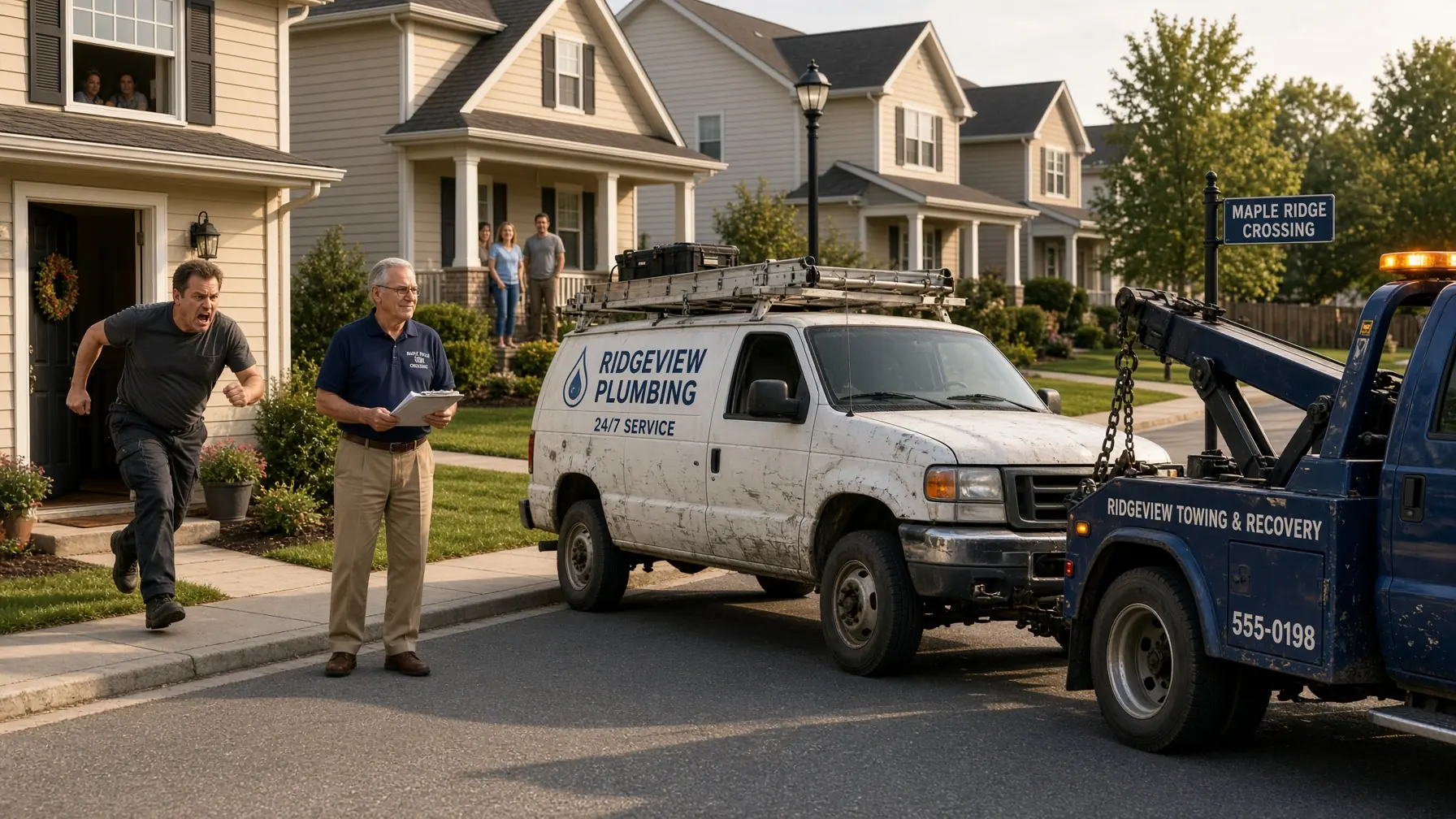
Maybe I had forgotten, but deep down I already knew something didn't add up. When I called the police, the answer came back almost casually, like this was routine. It had been towed at the request of the HOA. I remember repeating that sentence in my head a few times, like I could make it sound more reasonable if I just thought about it differently. I paid $280 to get it back that day, money I didn't plan on spending.
And when I asked why it had been taken, the answer was simple, commercial vehicle parked overnight, as if those three words explained everything. I went home that night annoyed, but still assuming it was some kind of misunderstanding. So, I checked the city ordinances myself, sat at my kitchen table scrolling through pages of local regulations that clearly stated commercial vehicles were allowed on public streets as long as they were properly registered and not obstructing traffic. That should have been the end of it, at least in my mind. But, the problem with places like Maple Ridge Crossing is that logic doesn't always enter the conversation.
I parked the truck again the next evening in the same spot, not out of defiance exactly, more like I wanted to see if reality would stay consistent. And for a few days it did. Then one morning I walked out side again and it was gone again. Same empty space, same quiet street, same feeling that something was happening behind the scenes that nobody bothered to explain to me. This time I didn't waste energy guessing.
I went straight to the tow yard, paid the fee again, and asked for documentation, something official, something that made sense. That was when I first heard the name Victor Harlan, the president of the HOA, a retired man who spoke about the neighborhood like it was his personal project, like every blade of grass answered to him in some indirect way. I started noticing how people reacted when his name came up, a kind of polite silence, like they had learned over time that agreeing was easier than arguing. I decided to attend the next HOA meeting because I still believed, maybe foolishly, that this was the kind of issue adults could sit down and solve with paperwork and reason. The meeting was held in a small community room near the entrance of the neighborhood, folding chairs, fluorescent lighting, a long table at the front where Victor sat like he had been placed there permanently.
I brought everything with me, printed ordinances, highlighted sections, even photos of my truck parked legally on the street. Thinking if I laid it all out clearly enough, nobody could really argue with it. When I spoke, I kept my tone calm, almost careful, explaining that my vehicle was fully legal, that the city allowed it, that I was simply parking in front of my own home like anyone else would. Victor listened without interrupting, which at first I thought was a good sign, until I noticed the slight smile he kept on his face, like I was missing something obvious. When I finished, he leaned back in his chair and said something I didn't forget, "This is a private community.
Our rules override city law." There was a pause after that, not dramatic, just heavy, like the room itself didn't quite agree, but nobody wanted to be the first to say it. I asked him directly who owned the street, not trying to be difficult, just trying to understand the foundation of what he was claiming. That question shifted the energy in the room. I could feel it, like I had accidentally touched something nobody wanted touched. Victor said the HOA owned it, but when I asked for proof, documents, deeds, anything official, he waved it off and changed the subject like it wasn't important.
I left that meeting with a strange feeling in my chest, not anger exactly, more like uncertainty mixed with the realization that I might be dealing with something more complicated than a simple misunderstanding. Two weeks later my truck was towed again, same story, same process, same quiet efficiency, and this time it cost me more than money. It cost me a full day of work and a job site I couldn't reschedule. And sitting there later that night, I remember thinking something had shifted because it no longer felt like they were reacting to me. It felt like they were testing me.
That was the moment I stopped thinking in terms of fairness and started thinking in terms of structure, ownership, authority, the things nobody really explains until you run straight into them. I started asking questions in places I hadn't thought to look before, not just about parking rules, but about the land itself, about who actually controlled the infrastructure underneath the streets I had been driving on every day without ever considering where it came from. The answers didn't come quickly, and when they did, they didn't come in a straight line, more like fragments, hints buried in city offices, old documents, and conversations with people who weren't used to being asked those kinds of questions. And the more I looked, the more I started to realize that what I was dealing with wasn't just an HOA dispute. It was something built on assumptions that nobody had bothered to verify for a very long time.
And if I was right, then everything I thought I knew about that street was about to change in a way none of them were prepared for. The more I dug into it, the more it started to feel like I had accidentally pulled on a thread that nobody in Maple Ridge Crossing ever expected to be touched, and I don't mean that in some dramatic way. I mean it in the very practical sense that every time I asked a simple question like, "Who actually owns the street?" I got answers that didn't really connect to each other. Like different people were repeating parts of a story they had never fully read. After that last tow, I took a day off work, not because I wanted to, but because I literally couldn't afford another surprise disappearance, and I drove down to the city planning office in Ridge County.
Thinking this would be straightforward, just paperwork, maps, maybe a name on a deed somewhere that would settle everything. I still remember sitting in that bland government lobby, the kind with faded posters about community development and recycling programs, waiting for someone who looked like they had answered this question a thousand times before. When the clerk finally pulled up the records, I expected a simple answer, but instead I got this pause, this slight hesitation like even the database didn't want to commit to certainty. She told me something I wasn't prepared for. The street inside Maple Ridge Crossing was not officially dedicated to the city, which meant it wasn't public infrastructure.
But at the same time, it also wasn't clearly controlled by the HOA either. That sentence alone should have been impossible, but she kept going, explaining that the original developer, a company called Halden Urban Projects, had built the roads decades ago with the intention of transferring ownership to the county after completion. But for reasons buried in old paperwork and unfinished approvals, that transfer was never finalized. So technically, legally, the road existed in this strange limbo, not public, not fully private in the way anyone assumed. And that kind of legal gray zone is where things tend to get quietly complicated over time.
I left that office with copies of documents I didn't fully understand yet. And for the first time, I stopped seeing the situation as just an HOA being difficult and started seeing it as a structure built on missing clarity. That night, I spread everything out on my kitchen table, old filings, developer records, property maps, trying to connect dots that didn't want to line up neatly. Halden Urban Projects had gone through multiple dissolutions, asset transfers, mergers that didn't cleanly resolve ownership of certain infrastructure parcels. And somewhere in that chain, the street inside my neighborhood had become what the legal documents referred to as abandoned infrastructure asset, which is exactly as messy as it sounds.
I remember leaning back in my chair thinking, this can't be real, because how does a whole street just exist without someone clearly owning it in a way everyone agrees on. But the more I read, the more it became clear that it wasn't unheard of, just rarely enforced or noticed until something forced it into the open. The next step took me even deeper into something I didn't expect, because buried in one of the filings was a transfer reference to an investment group that specialized in purchasing neglected municipal assets, everything from old utility lines to unresolved land parcels. A company that basically made money cleaning up legal ghosts. Their name was Northbridge Asset Recovery Trust, and at first I thought it was a dead end.
But after a few calls and a lot of waiting on hold, I realized they were still active, still managing properties like the one I was standing on. I won't lie. The idea that a street in my neighborhood was technically an asset being held by some investment trust somewhere felt ridiculous. But it also explained something that the HOA never could. Why nobody ever produced clear ownership documents.
Why every answer from Victor Harlan sounded more like authority than proof. I made the decision to contact them directly, not really knowing what I was walking into. And what surprised me most wasn't how complicated the process was, but how normal it felt on their end. Like I was just another person trying to understand something that had been sitting unresolved for too long. After weeks of back-and-forth, reviewing documents, confirming boundaries, verifying access rights, I did something I didn't expect to ever do in my life.
I made an offer on the street itself. It wasn't cheap, not even close. But compared to the frustration and lost income one had already been dealing with, it felt less like a purchase and more like reclaiming control over something that had been affecting my entire life without permission. When the transfer finally went through, there was no announcement, no celebration, nothing dramatic. Just a set of finalized documents sitting in my inbox one afternoon that said I was now the legal owner of the roadway running through Maple Ridge Crossing.
I sat there staring at that email for a long time. Not because I felt powerful, but because I realized how strange it was that something so important could change hands so quietly. I didn't tell the HOA immediately, partly because I wanted to be sure I understood everything myself, and partly because I knew that once I did, there would be no going back to the way things had been. So, I parked my truck again in the exact same spot, almost like a test I didn't fully explain to myself, and waited. 3 days later, it was towed again.
Same process, same silence, same assumption that the rules they had been enforcing still applied. I went to the tow yard like before, paid the fee like before, but this time I asked for every piece of authorization paperwork they had, and I kept it. Then, I sent a certified letter to Victor Harlen. Nothing emotional, nothing dramatic, just a copy of the deed. I still remember the moment my phone rang that evening.
His name on the screen, and the shift in his voice when I answered. It wasn't the confident tone I had heard at the HOA meeting anymore. It was careful, slightly uncertain, like he was trying to stabilize a conversation that had suddenly stopped behaving the way he expected. He said there must have been a misunderstanding, that the street was community property, that the HOA had always managed it. And I remember looking out my window at the empty curb while he talked, thinking how different management and ownership really are when you strip everything else away.
I told him calmly that community responsibility doesn't replace legal ownership, and that if they wanted clarity, we could absolutely talk about it, but the towing needed to stop immediately. For a short while, it didn't stop, which honestly surprised me more than it should have, because people tend to continue familiar behavior even when the foundation underneath it changes. So, I changed the rules in a way that didn't require an argument. I installed simple signs at both entrances of the street, stating private roadway, towing enforced, authorized vehicles only, and then I issued written authorization for every resident except members of the HOA board who had approved the previous towing actions. The first time one of them ignored it and parked overnight anyway, their car was towed and I didn't feel angry when it happened, just strangely detached, like watching a system respond exactly as it had been configured to.
The next day another board member tried the same thing, same result. And that's when things stopped being a neighborhood disagreement and started becoming something much more official. The HOA brought in a lawyer, letters started circulating, meetings were called and for the first time the city actually stepped back and refused to get involved because once ownership was verified, it was no longer their jurisdiction in the way they assumed it had been. The tow company also shifted its position quickly because they weren't going to risk operating on a property without proper authorization. And suddenly, the same group that had been confidently towing my truck for months was sitting in an emergency meeting trying to figure out how to undo a situation they didn't fully understand anymore.
That was when I realized something I hadn't expected. I wasn't really fighting them anymore. I was just standing in the middle of something they had built their entire system on without ever confirming the foundation beneath it. And now that foundation had changed. By the time everything reached its final stretch, Maple Ridge Crossing didn't feel like the same place I had moved into years earlier.
Not because the houses had changed, they hadn't, but because the quiet certainty everyone had been living under had started to crack in a way nobody could ignore anymore. The HOA called it an emergency resolution meeting, which was ironic in itself because nothing about it felt orderly when I walked into that same community room again. The same fluorescent lights buzzing above folding chairs. Except this time nobody looked comfortable, not even Victor Harlan. He wasn't sitting like he used to, relaxed, in control.
Instead, he kept adjusting his papers, like the table itself had become unfamiliar territory. I remember standing there for a second before speaking, not out of hesitation, but because I could feel how much the atmosphere had shifted, like everyone in that room already knew the direction this conversation was going. They just didn't want to be the first to say it out loud. They asked me what I wanted, and I told them something simple, almost disappointingly simple for how much chaos it had caused. I said I wanted the towing to stop, and I wanted acknowledgement of ownership, so it could all be resolved cleanly.
Victor tried to regain footing, saying things like community standards, long-standing practice, neighborhood governance, but none of it landed the way it used to, because now there were documents on the table that contradicted every confident sentence he had ever used. I remember one moment where he leaned forward and said, almost sharply, "You can't just buy a street." And I looked at him and said, "Apparently, you can, if nobody bothered to finish owning it in the first place." That was the moment the room went completely still. The HOA lawyer, a man named Reed Collins, finally stepped in, not with emotion, but with the tone of someone who had just realized the case they were building had shifted under them. He reviewed the documentation I had provided, the deed transfer, the trust records, the chain of title, and I watched the exact second it became clear to him that continuing the towing had exposed them to liability they could no longer defend in the way they had been doing. The tow company was contacted, and they confirmed what had already become obvious.
They would no longer tow vehicles from a property where ownership was disputed, and now legally documented under a private owner. That sentence alone changed everything, because it removed the one tool the HOA had been using as leverage without ever questioning its foundation. What surprised me most wasn't anger. It was the speed at which confidence turned into negotiation. Suddenly, there were offers on the table, proposals to resolve the matter amicably, suggestions that the street be transferred to the city to restore normal operations, which was their way of trying to return things to the way they used to be without admitting why they broke in the first place.
I didn't reject it out of pride. I just laid out conditions, straightforward and measurable. Reimbursement of towing fees, compensation for lost wages for missed work, legal transfer costs, and a formal written acknowledgement that towing had been carried out without verified authority. There was a long silence after I said it. Not dramatic, just heavy in the way decisions feel when everyone knows they are irreversible.
Eventually, they agreed. Not because they liked it, not because they believed it was fair, but because there was no alternative that didn't make things worse for them. The process of transferring the street to the city again moved faster than I expected after that. Almost like everyone involved wanted distance from the situation as quickly as possible. Within a month, new signage went up, official city signs this time, replacing the private notices I had installed earlier.
And just like that, the same road that had been the center of months of conflict became something ordinary again, at least on the surface. The HOA issued a written apology, carefully worded, the kind that avoids admitting too much while still acknowledging enough, and refunds were issued for every towing incident that had been processed during that period. Victor Harlan resigned two weeks later, quietly, without a public statement. And people in the neighborhood stopped talking about it almost as quickly as they had started, which is how these things usually go when everyone just wants normal back more than they want answers. I remember standing on the curb one evening after everything was settled, looking down the same street where my truck used to disappear, thinking about how strange it was that none of this started as a fight over ownership or power.
It started because someone decided a work truck didn't belong in their idea of a perfect neighborhood, and somehow that small judgment had unraveled into something none of them expected. I didn't feel like I had won anything in a dramatic sense. There was no celebration, no satisfaction like in movies, just a quiet understanding that systems only work until someone actually asks who built them and why. And even now, I still think about how many other places like Maple Ridge Crossing exist where rules are enforced confidently without anyone ever checking whether the ground those rules stand on actually belongs to them. And maybe the real question isn't what happened in my neighborhood, but how many people are still living inside systems nobody has ever fully verified.
END
News in the same category

The Black Belt Mocked the Old Man — Then He Stepped Onto the Mat
The HOA Woman Smashed His Chicken Coop — Then the Old Farmer Came Running
Three Thugs Shoved the Old Mechanic — Then He Stepped Between Them and the Fighter
Six Men Surrounded the Old Biker — Then One Stranger Stepped Out of His Truck
They Slammed the Old Biker to the Floor — Then the Room Heard His Name
Max and Shadow’s Recovery After Waiting Together for Their Owner
Two Cops Stormed Into Her House — Then Someone Hit the Front Porch
The Officer Dragged the Elderly Woman Toward His Patrol Car — Then Someone Started Recording
Koda’s Journey After Waiting for a Family at the Shelter
Black CEO Enters His Daughter’s School Cafeteria — What He Hears Makes Him Freeze Instantly
Martial Artist Mocked a Quiet Black Woman in Front of 600 People — Until Her True Skill Left Him Stunned
The Officer Dragged Him Out of the Gala — Then the Entire Room Went Silent
The Black Belt Shoved the Old Man — Then He Stepped Onto the Mat
She Tried a “Master Key” on His Truck — Then the Owner Walked Outside
The Old HOA Lady Called Her Yard a Disaster — Then a State Vehicle Pulled Up
Boxer Dares a Black Janitor to Evade His Punch — Seconds Later, He Learns He Once Ruled the Ring
NEXT VIDEO: A Cocky MMA Fighter Bet an Old Farmer $500 He Couldn't Last 3 Minutes — Biggest Mistake of His Life